
The Royal Institution of Chartered Surveyors (RICS) has introduced groundbreaking guidance on artificial intelligence integration within building surveys, marking a pivotal shift in how surveyors conduct comprehensive property assessments. With the March 2026 standard now in effect, professionals performing Level 3 building inspections face new requirements for Responsible AI Use in Building Surveys: RICS March 2026 Standard Compliance for Level 3 Inspections that balance technological innovation with ethical practice and professional accountability.
This regulatory update addresses the rapid adoption of AI-powered tools in property surveying, from automated defect detection systems to predictive maintenance algorithms. The new framework ensures that technology enhances—rather than replaces—the expert judgment that defines professional surveying practice.
Key Takeaways
- 🎯 New RICS standards effective March 2026 mandate specific AI governance protocols for Level 3 building surveys
- 🔍 Human oversight remains paramount—AI tools must supplement, not substitute, professional surveyor judgment
- 📊 Data transparency requirements demand clear documentation of AI-assisted findings and algorithmic decision-making processes
- ⚖️ Ethical frameworks establish boundaries for AI use in defect detection, risk assessment, and client reporting
- 🛡️ Professional liability considerations require surveyors to understand and validate AI-generated insights before inclusion in reports
Understanding the RICS March 2026 AI Framework
The second edition of the RICS Home Survey Standard introduces comprehensive considerations for technological advancements, with particular emphasis on artificial intelligence applications in professional practice.[3] This updated guidance, published around March 2026 and scheduled for full implementation by the end of 2027, represents the institution's response to the increasing integration of AI tools across the surveying profession.[3]
Core Principles of Responsible AI Implementation
The framework establishes five foundational principles that govern Responsible AI Use in Building Surveys: RICS March 2026 Standard Compliance for Level 3 Inspections:
- Transparency – Surveyors must disclose when AI tools contribute to inspection findings
- Accountability – Professional responsibility remains with the chartered surveyor, not the technology
- Fairness – AI systems must not introduce bias in property assessments
- Privacy – Client data used in AI systems requires robust protection measures
- Accuracy – AI-generated insights must undergo professional validation before reporting
These principles ensure that technology serves the profession's commitment to delivering reliable, impartial property assessments while maintaining the highest ethical standards.
Scope of AI Applications in Level 3 Surveys
The standard addresses multiple technological applications relevant to comprehensive building surveys, including:
- Automated defect detection using image recognition algorithms
- Predictive analytics for structural deterioration forecasting
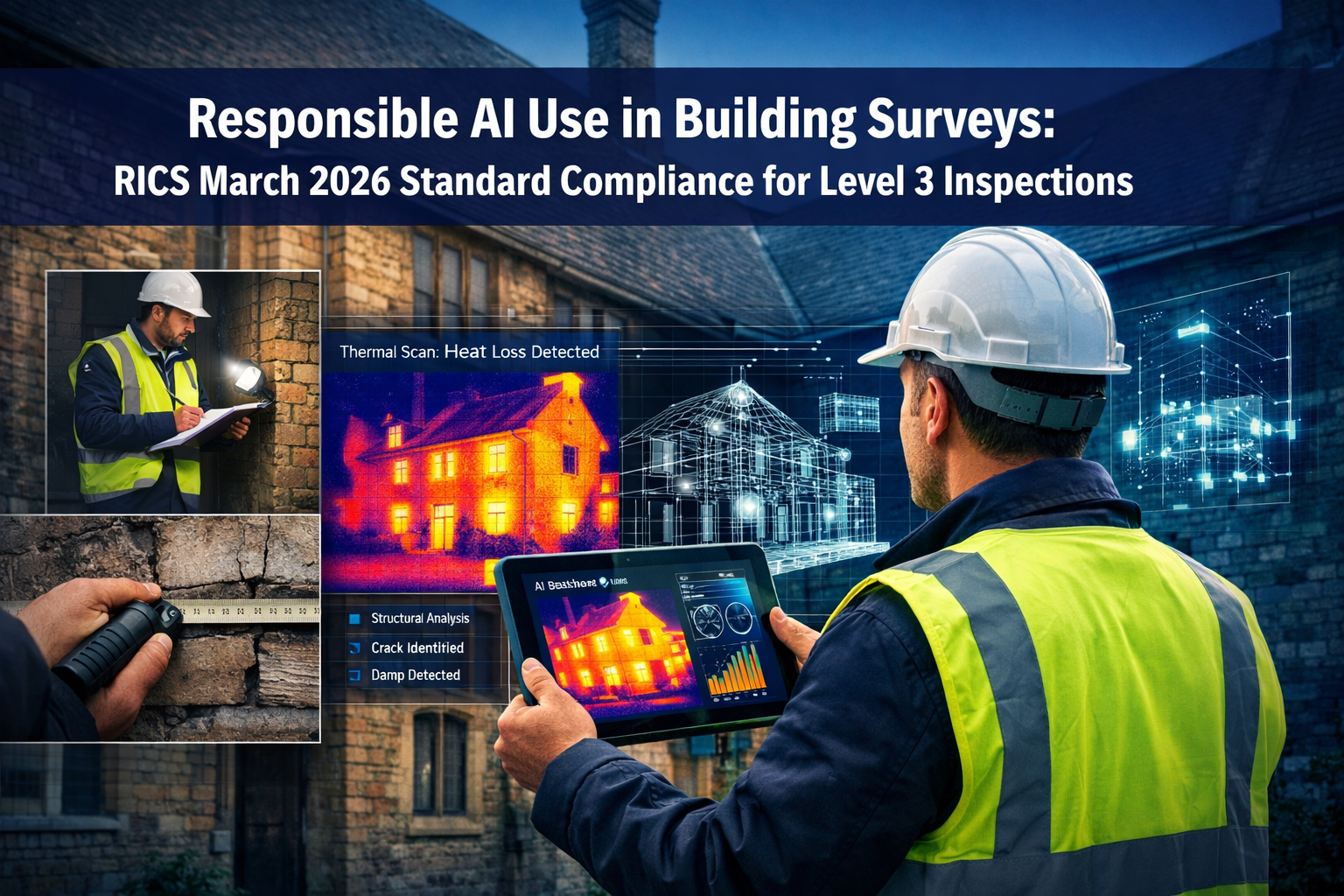
- Thermal imaging analysis enhanced by machine learning pattern recognition
- Cost estimation tools leveraging historical repair data
- Report generation assistance with AI-powered documentation systems
The guidance specifically covers considerations for drone inspections, new build assessments, and insurance reinstatement valuations—all areas where AI integration is accelerating.[3]
AI Integration Requirements for Level 3 Inspections
Level 3 surveys represent the most comprehensive inspection service, requiring detailed investigation of property condition, construction, and defects. The March 2026 standard establishes specific protocols for incorporating AI tools while maintaining the thorough, professional approach that defines this service level.
Pre-Inspection AI Tool Assessment
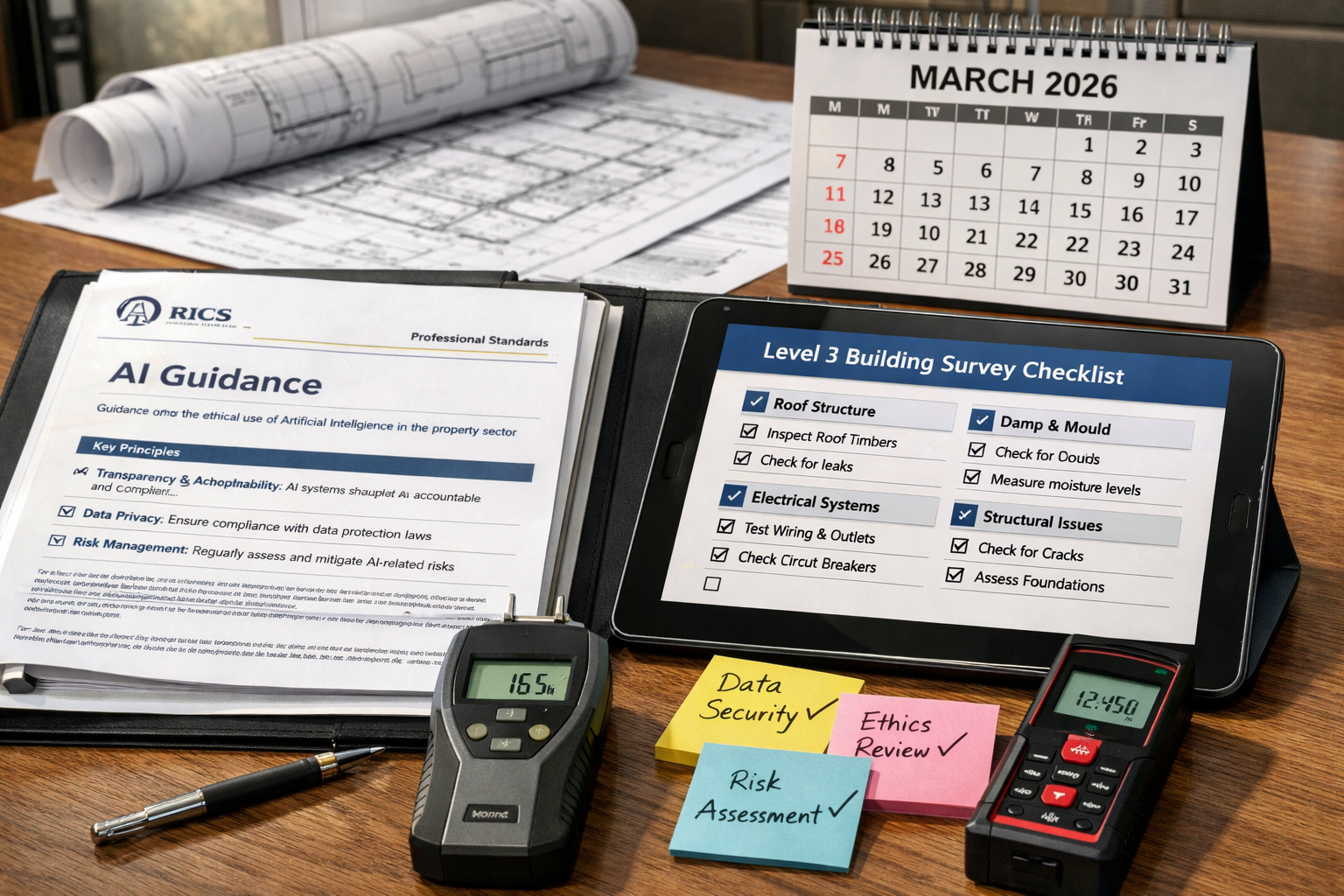
Before deploying AI systems in Level 3 inspections, surveyors must conduct due diligence on the technology:
| Assessment Criteria | Compliance Requirements |
|---|---|
| Algorithm Transparency | Understanding how the AI reaches conclusions |
| Training Data Quality | Verification that datasets reflect UK building stock diversity |
| Error Rates | Documentation of false positive/negative frequencies |
| Update Protocols | Regular algorithm refinement and validation processes |
| Data Security | GDPR-compliant handling of property and client information |
Surveyors must maintain records demonstrating that AI tools meet professional standards before integration into inspection workflows. This documentation becomes part of the professional indemnity framework.
On-Site Inspection Protocols
During property inspections, the standard requires clear delineation between traditional surveying techniques and AI-assisted methods:
Traditional Methods (Mandatory):
- Physical inspection of accessible areas
- Manual measurements and observations
- Professional judgment based on experience
- Direct assessment of materials and construction
AI-Assisted Methods (Supplementary):
- Drone surveys for inaccessible roof areas
- Thermal imaging with AI-enhanced pattern recognition
- Moisture detection with automated data logging
- Structural movement analysis using digital monitoring
The surveyor must personally verify AI-generated findings through traditional inspection methods wherever possible. When verification isn't feasible (such as with inaccessible areas), reports must explicitly state the reliance on technology and associated limitations.
Defect Detection and Classification Standards
AI systems excel at identifying visual patterns that may indicate building defects, but the March 2026 standard establishes clear boundaries:
✅ Appropriate AI Applications:
- Initial screening for potential defects in large-scale surveys
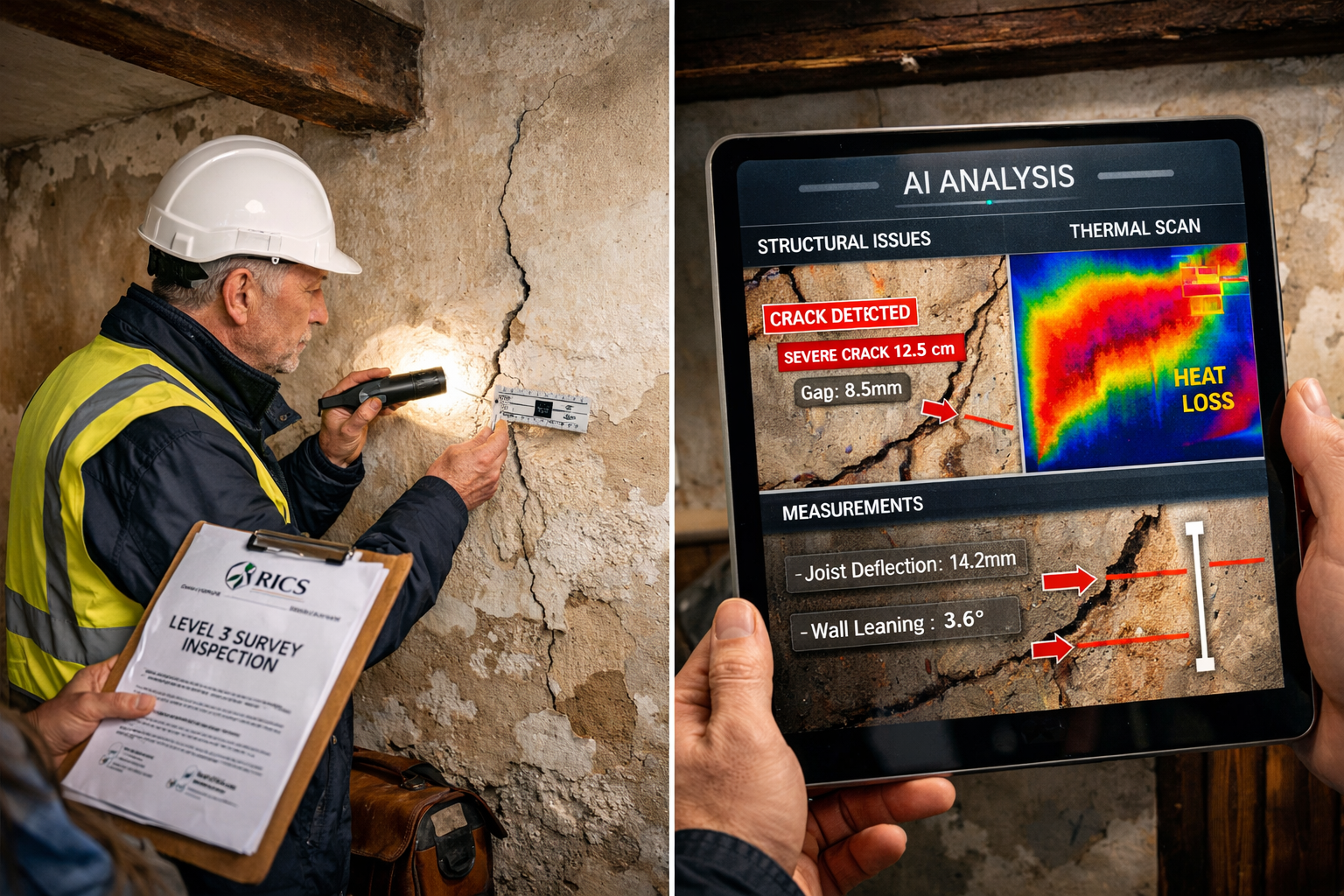
- Pattern recognition in thermal imaging for insulation gaps
- Crack measurement and progression tracking
- Material deterioration assessment in accessible areas
❌ Inappropriate AI Reliance:
- Final defect diagnosis without professional confirmation
- Structural significance determination
- Repair priority recommendations
- Cost implications without surveyor validation
For specialist defect surveys, AI tools may assist in data collection, but the professional surveyor must interpret findings within the broader context of building performance, construction type, and environmental factors.
Ethical Considerations and Data Governance
The ethical dimension of Responsible AI Use in Building Surveys: RICS March 2026 Standard Compliance for Level 3 Inspections extends beyond technical competence to encompass data stewardship, client privacy, and professional integrity.
Client Consent and Data Usage
The standard mandates explicit client consent for AI tool deployment, requiring surveyors to:
- Inform clients about which AI systems will be used during inspection
- Explain data collection methods and what information the AI processes
- Clarify data retention periods and storage security measures
- Provide opt-out options for clients uncomfortable with AI analysis
This transparency requirement ensures clients understand how technology contributes to their property assessment, maintaining trust in the professional relationship.
Algorithmic Bias Prevention
AI systems trained on limited datasets may perpetuate biases that affect property assessments. The RICS framework requires surveyors to:
- Evaluate training data diversity – Ensure AI systems have learned from properties representing various ages, construction types, and regional building practices
- Monitor for systematic errors – Track whether AI tools consistently misidentify defects in specific property types
- Implement correction protocols – Adjust or override AI recommendations when bias is detected
- Document bias incidents – Maintain records of algorithmic failures for continuous improvement
For commercial building surveys, where property diversity is even greater, bias prevention becomes particularly critical to ensuring fair assessments across different building uses and construction methods.
Professional Liability and AI Accountability
The standard clarifies that AI tool use does not transfer professional liability from the surveyor to the technology provider. Key liability considerations include:
Surveyor Responsibilities:
- Validating AI-generated findings before inclusion in reports
- Understanding AI system limitations and failure modes
- Maintaining professional indemnity insurance covering AI-assisted work
- Continuing professional development in AI technology applications
Documentation Requirements:
- Clear attribution of AI-assisted versus human-generated findings
- Explanation of AI tool selection rationale
- Records of AI output verification processes
- Notation of instances where AI recommendations were overridden
When conducting structural surveys or subsidence assessments, where findings carry significant financial and safety implications, the verification burden intensifies. Surveyors must demonstrate that professional judgment, not algorithmic output, drives final conclusions.
Reporting Standards for AI-Assisted Surveys
The March 2026 standard introduces specific reporting requirements that maintain transparency about technology's role in survey findings.
Report Structure and AI Disclosure
Survey reports must include a dedicated section explaining AI tool usage:
Required Disclosures:
- Names and versions of AI systems employed
- Specific applications (e.g., "thermal imaging analysis," "crack measurement")
- Limitations of each AI tool
- Instances where AI findings were verified or contradicted by professional judgment
This transparency allows clients and subsequent professionals to understand the evidence basis for survey conclusions.
Presenting AI-Generated Data
When incorporating AI-assisted findings, reports must distinguish between:
- Direct observations – What the surveyor personally witnessed and measured
- AI-enhanced observations – Technology-assisted measurements or pattern recognition verified by the surveyor
- AI-flagged concerns – Potential issues identified by algorithms requiring further investigation
For example, when reporting on damp surveys, a compliant report might state:
"Moisture meter readings (direct observation) indicate elevated moisture levels in the ground floor rear wall (15-20% wood moisture equivalent). AI-enhanced thermal imaging analysis identified cold spots consistent with moisture ingress, which was verified through physical inspection revealing deteriorated pointing and missing DPC sections."
Limitation Statements and Caveats
The standard requires explicit caveats when AI tools contribute to findings in areas where verification was impossible:
- Inaccessible roof spaces assessed via drone survey
- Concealed structural elements evaluated through predictive modeling
- Historical movement patterns analyzed through photographic comparison algorithms
These limitations protect both surveyor and client by establishing realistic expectations about assessment certainty levels.
Implementation Challenges and Best Practices
Adopting Responsible AI Use in Building Surveys: RICS March 2026 Standard Compliance for Level 3 Inspections presents practical challenges that require strategic solutions.
Technology Selection and Validation
Choosing appropriate AI tools requires careful evaluation:
Selection Criteria:
- ✅ Proven accuracy in UK building contexts
- ✅ Transparent methodology with explainable outputs
- ✅ Regular updates reflecting current building practices
- ✅ GDPR compliance for data handling
- ✅ Professional support for troubleshooting and training
Registered RICS valuers and surveyors should prioritize tools developed specifically for the UK property market, as building construction methods, materials, and defect patterns vary significantly from other regions.
Training and Competency Development
The standard implicitly requires surveyors to develop dual competencies:
- Traditional surveying expertise – Maintaining hands-on inspection skills
- Technology literacy – Understanding AI capabilities and limitations
Continuing Professional Development (CPD) should address:
- AI fundamentals for building professionals
- Critical evaluation of algorithmic outputs
- Data privacy and security protocols
- Ethical decision-making in technology deployment
Quality Assurance Frameworks
Firms implementing AI tools should establish internal quality assurance processes:
Pre-Deployment Testing:
- Pilot AI systems on properties with known conditions
- Compare AI outputs against experienced surveyor assessments
- Document accuracy rates and error patterns
Ongoing Monitoring:
- Regular audits of AI-assisted reports
- Client feedback analysis on technology transparency
- Incident tracking for algorithmic failures or biases
Continuous Improvement:
- Quarterly reviews of AI tool performance
- Updates to internal protocols based on emerging best practices
- Sharing learning across the profession through RICS forums
For firms conducting stock condition surveys across large property portfolios, these quality assurance frameworks become essential for maintaining consistency and reliability at scale.
Future Developments and Industry Evolution
The March 2026 standard represents a starting point rather than a final destination for AI governance in building surveys.
Anticipated Standard Revisions
RICS has indicated that the framework will evolve as technology advances and practical experience accumulates. Expected developments include:
- Expanded guidance on emerging AI applications like predictive maintenance algorithms
- Refined liability frameworks as case law develops around AI-assisted professional services
- International harmonization as other surveying bodies develop similar standards
- Integration with other standards covering commercial building surveys and specialized assessments
Technology Trajectory
AI capabilities in building assessment continue advancing rapidly:
Near-Term Developments (2026-2028):
- Enhanced defect classification with higher accuracy rates
- Integration of multiple data sources (thermal, visual, moisture) into unified analysis
- Improved natural language generation for report drafting assistance
Medium-Term Possibilities (2028-2030):
- Autonomous drone inspections with real-time AI analysis
- Predictive modeling of building performance over lifecycle
- Virtual reality integration for remote survey verification
Long-Term Potential (Beyond 2030):
- AI systems capable of preliminary structural assessment
- Automated compliance checking against building regulations
- Integrated digital twins for ongoing building monitoring
Professional Adaptation Strategies
Surveyors can position themselves for success in this evolving landscape by:
- Embracing technology as an enhancement tool rather than viewing it as a threat
- Maintaining core competencies that AI cannot replicate—professional judgment, client communication, ethical decision-making
- Participating in standard development through RICS consultation processes
- Building technology partnerships with AI developers to influence product development
- Sharing knowledge with colleagues through professional networks and publications
The surveyors who thrive will be those who leverage AI to enhance efficiency and accuracy while maintaining the professional expertise that defines chartered surveying practice.
Conclusion
Responsible AI Use in Building Surveys: RICS March 2026 Standard Compliance for Level 3 Inspections establishes a comprehensive framework that balances technological innovation with professional accountability. The standard recognizes AI's potential to enhance surveying practice while establishing clear boundaries that preserve the human expertise, ethical judgment, and professional responsibility at the profession's core.
For surveyors conducting Level 3 building inspections, compliance requires more than simply adopting new tools—it demands thoughtful integration of technology within established professional practices, transparent communication with clients, and ongoing commitment to validation and quality assurance.
Actionable Next Steps
To achieve compliance and excellence in AI-assisted surveying:
- Audit current practices – Review existing technology use against the March 2026 standard requirements
- Develop implementation plans – Create protocols for AI tool selection, validation, and deployment
- Invest in training – Ensure all surveyors understand both AI capabilities and limitations
- Update report templates – Incorporate required AI disclosure sections and limitation statements
- Establish quality assurance – Implement verification processes for AI-generated findings
- Engage with RICS – Participate in professional forums discussing practical implementation challenges
- Review insurance coverage – Confirm professional indemnity policies cover AI-assisted work
The integration of artificial intelligence into building surveys represents an evolution, not a revolution. By maintaining professional standards while embracing technological advancement, chartered surveyors can deliver enhanced value to clients while upholding the ethical principles that define the profession.
For guidance on implementing these standards in your practice or to schedule a compliant Level 3 building survey, contact local chartered surveyors with expertise in both traditional surveying methods and modern technology integration.
References
[1] Home Surveys – https://www.rics.org/profession-standards/rics-standards-and-guidance/sector-standards/building-surveying-standards/home-surveys
[2] Home Survey Standard Frequently Asked Questions – https://www.rics.org/profession-standards/rics-standards-and-guidance/sector-standards/building-surveying-standards/home-surveys/home-survey-standards/home-survey-standard-frequently-asked-questions
[3] 250922 The Home Survey Standard And Regulatory Scheme A Guide To The Rics Consultations – https://hqnetwork.co.uk/wp-content/uploads/2025/09/250922-The-Home-Survey-Standard-and-regulatory-scheme-A-guide-to-the-RICS-consultations.pdf
[4] Home Survey Standards – https://www.rics.org/profession-standards/rics-standards-and-guidance/sector-standards/building-surveying-standards/home-surveys/home-survey-standards
[5] Navigating Uncertainty In Spring 2026 Valuations How Rics Real Time Surveyor Data Outperforms Automated Valuation Models – https://nottinghillsurveyors.com/blog/navigating-uncertainty-in-spring-2026-valuations-how-rics-real-time-surveyor-data-outperforms-automated-valuation-models