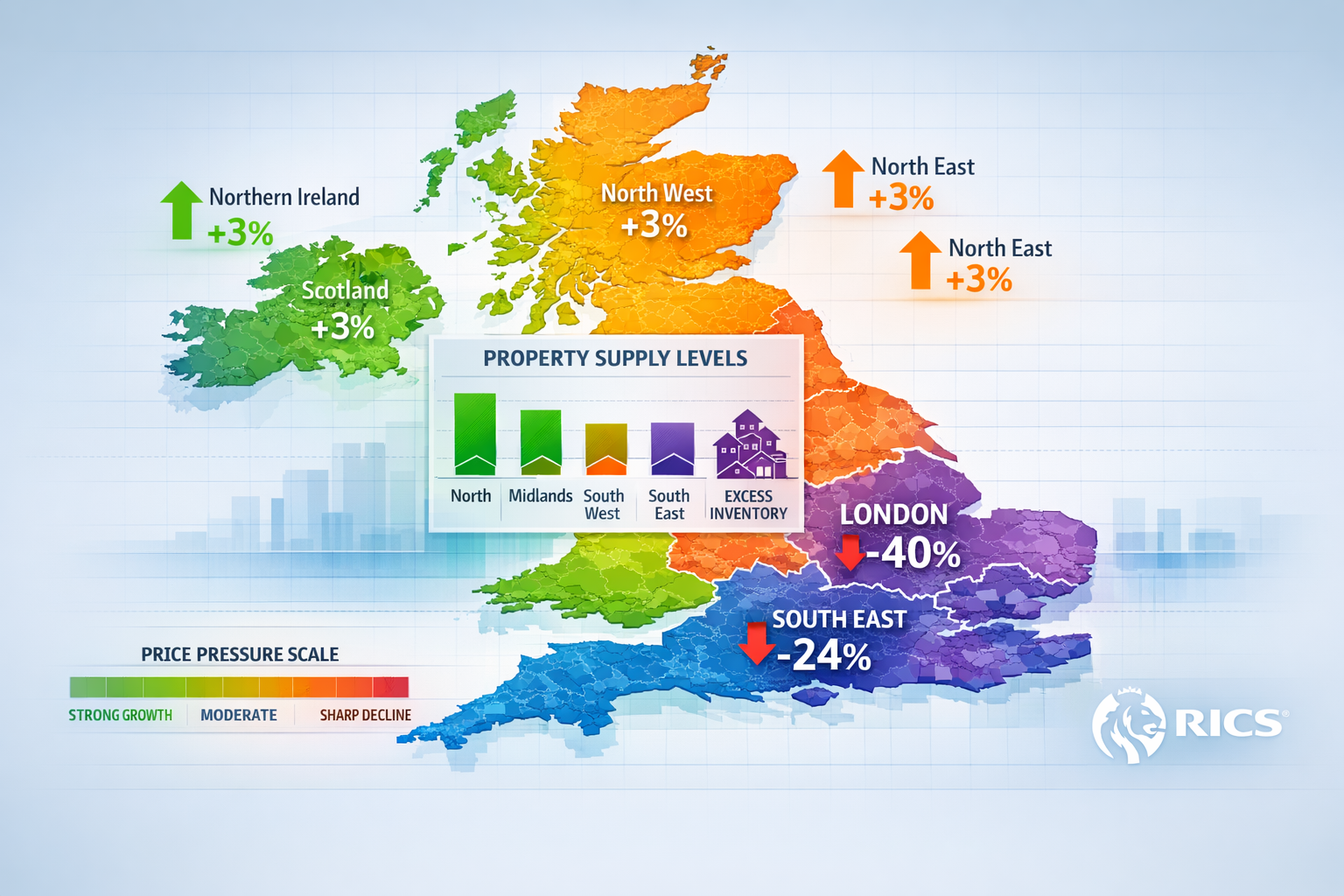
London's property valuation landscape has shifted dramatically: a net balance of -40% of surveyors reported downward price pressure in February 2026, while the North West enjoyed 3% annual appreciation. This striking gap between the capital and regional markets represents the widest valuation divergence recorded in recent RICS survey history, forcing chartered surveyors to fundamentally recalibrate their assessment methodologies across different UK geographies.
The Valuation Divergence in London vs Regions: RICS February 2026 Insights for Surveyor Adjustments reveals a property market split along geographical lines that demands immediate attention from valuation professionals. Understanding these regional variations has become essential for registered RICS valuers working across multiple markets in 2026.
Key Takeaways
- London faces acute downward pressure with a net balance of -40% compared to the national average, representing the most severe regional decline [4]
- Northern regions outperform significantly, with the North West achieving 3% annual price growth while Northern Ireland leads UK-wide performance [2][3]
- Supply imbalances drive divergence, as excess inventory in London and the South East suppresses prices by up to 1% while other regions maintain stable supply [3]
- Surveyor adjustments must reflect regional sentiment, particularly London's collapsed twelve-month expectations from +56% to +7% in a single month [4]
- Valuation methodologies require geographical calibration to account for divergent market fundamentals across UK regions in 2026

Understanding the Regional Price Pressure Gap in February 2026
The RICS UK Residential Market Survey for February 2026 documented unprecedented geographical splits in property valuation sentiment. While London experienced the most acute downward pressure at -40%, the South East followed with -24% and East Anglia with -26% [4]. These figures contrast sharply with the performance of northern territories, where price appreciation remained robust.
London's Valuation Challenges
The capital's property market faces multiple headwinds that chartered surveyors in London must carefully weigh when conducting valuations:
Supply Excess 📊
Zoopla data confirms that excess supply in London has kept price inflation subdued, with some southern markets recording prices lower by up to 1% over the past year [3]. This oversupply situation creates downward valuation pressure that surveyors cannot ignore.
Sentiment Collapse 📉
Perhaps most striking is London's twelve-month price expectations net balance, which collapsed from +56% to +7% in a single month—the most dramatic shift observed nationally [4]. This sentiment deterioration signals fundamental market reassessment rather than temporary fluctuation.
Buyer Enquiry Decline
New buyer enquiries fell to a net balance of -26% in February 2026, down from -15% in January, representing renewed softening in market activity [4]. For valuers, reduced demand translates directly into conservative comparable selection and adjustment factors.
Regional Outperformance: The Northern Advantage
In stark contrast, northern regions demonstrate resilience that requires different valuation approaches:
- North West: House prices rose as much as 3% annually [3]
- Northern Ireland: Identified as the strongest performer across the entire UK [2]
- Scotland: Showing solid gains alongside the North of England [2]
- Wales: Demonstrating stronger price performance compared to southern regions [3]
These regional variations mean that chartered surveyors working in Surrey face entirely different market dynamics than colleagues operating in Hampshire or other regional locations.
Valuation Divergence in London vs Regions: Practical Surveyor Adjustments for 2026
Professional valuers must translate these regional divergences into concrete methodological adjustments. The Valuation Divergence in London vs Regions: RICS February 2026 Insights for Surveyor Adjustments provides a framework for evidence-based recalibration.
Comparable Selection Strategies by Region
London and South East Approach:
When selecting comparables for London properties, surveyors should:
- Prioritize recent transactions (within 3 months) given rapid sentiment shifts
- Apply downward time adjustments to older comparables reflecting the -40% pressure balance
- Weight oversupply factors when analyzing similar properties in high-inventory submarkets
- Consider buyer enquiry trends as leading indicators for near-term value direction
Chartered surveyors in West London, South West London, and North West London must exercise particular caution given the capital's pronounced downturn.
Regional Markets Approach:
For northern and outperforming regions, valuation methodology shifts toward:
- Recognizing appreciation trends in comparable adjustments (particularly the 3% North West growth)
- Accounting for stable supply conditions that support price maintenance [4]
- Reflecting positive sentiment in forward-looking valuations where appropriate
- Applying regional performance differentials when using national indices
Time Adjustment Factors
The divergence necessitates geography-specific time adjustment rates:
| Region | Suggested Monthly Time Adjustment | Basis |
|---|---|---|
| London | -0.5% to -1.0% | Net balance -40%, sentiment collapse [4] |
| South East | -0.3% to -0.5% | Net balance -24% [4] |
| East Anglia | -0.3% to -0.5% | Net balance -26% [4] |
| North West | +0.2% to +0.25% | 3% annual growth [3] |
| Northern Ireland | +0.25% to +0.35% | Strongest UK performer [2] |
| Scotland | +0.15% to +0.25% | Solid gains reported [2] |
Important Note: These adjustments should be applied cautiously and verified against local submarket data, as micro-location factors can override regional trends.
Supply and Demand Weighting
The RICS data reveals that new instructions remained at a net balance of +2%, indicating broadly stable fresh listings nationwide [4]. However, regional distribution varies significantly:
High Supply Markets (London/South East):
- Increase weight given to inventory levels in valuation narrative
- Consider days-on-market trends for comparable properties
- Apply vendor motivation factors more aggressively
- Reference supply-demand imbalance in valuation uncertainty statements
Balanced Supply Markets (Regional):
- Maintain standard supply-demand weighting in methods of valuation
- Focus on transaction velocity rather than inventory levels
- Emphasize local employment and economic fundamentals
Implementing RICS February 2026 Insights: Surveyor Adjustments Across Property Types
The Valuation Divergence in London vs Regions: RICS February 2026 Insights for Surveyor Adjustments extends beyond residential markets to impact commercial and specialized property valuations.

Residential Property Valuation Adjustments
Prime London Properties:
High-value London properties face compounded challenges:
- International buyer sentiment remains cautious
- Stamp duty implications more significant at higher price points
- Supply of luxury properties particularly elevated in central zones
Chartered surveyors in Central London and East London should apply additional conservatism to prime property valuations, potentially adding 5-10% to standard adjustment factors.
Regional Family Homes:
Properties in outperforming regions benefit from:
- Strong local employment markets
- Affordability advantages over southern alternatives
- Remote work trends supporting regional migration
- Limited supply supporting price stability
Commercial Property Considerations
Commercial property surveyors face parallel regional divergences:
London Commercial:
- Office vacancy rates elevated in certain submarkets
- Retail struggling with oversupply
- Industrial/logistics showing relative resilience
- Yield expansion pressures in secondary locations
Regional Commercial:
- Industrial demand robust in northern distribution hubs
- Office markets benefiting from corporate relocations
- Retail stabilizing in strong regional centers
- Yield compression potential in prime regional assets
Specialized Valuation Scenarios
Certain property types require additional consideration:
Leasehold Properties 🏢
The divergence affects lease extension valuations, as freehold valuation assumptions must reflect regional market trajectories. London leaseholders may find more favorable extension terms given subdued growth expectations.
Shared Ownership 🤝
Valuing shared ownership properties requires careful regional calibration, as staircasing decisions depend heavily on local market outlook.
Portfolio Valuations
Multi-property portfolios spanning London and regional assets require weighted approaches that recognize the divergence rather than applying uniform national assumptions.
Market Dynamics Driving the 2026 Regional Divergence
Understanding the underlying causes helps surveyors make informed adjustment decisions:
Supply-Side Factors
London Oversupply:
- Development pipeline completions from 2023-2025 projects
- Build-to-rent schemes adding rental inventory
- Investor liquidation in response to tax changes
- Downsizers adding to available stock
Regional Supply Stability:
- Limited new development in many northern markets
- Planning constraints in desirable regional locations
- Lower speculative building activity
- Balanced inventory turnover
Demand-Side Dynamics
Weakening London Demand:
The -26% net balance for new buyer enquiries [4] reflects:
- Affordability constraints at elevated price levels
- Mortgage rate sensitivity on larger loan amounts
- Return-to-office uncertainty affecting location preferences
- International buyer caution amid geopolitical concerns
Sustained Regional Demand:
Northern markets maintain interest through:
- Relative affordability attracting first-time buyers
- Quality of life considerations for relocators
- Strong regional employment markets
- Generational wealth transfer supporting purchases
Economic and Policy Context
Several macro factors amplify regional divergence:
✅ Interest rate environment affecting high-value London mortgages disproportionately
✅ Stamp duty thresholds creating more significant barriers in expensive markets
✅ Remote work normalization enabling geographic flexibility
✅ Regional economic policy supporting northern growth initiatives
Practical Valuation Report Recommendations for 2026
Surveyors should incorporate these insights into valuation reports:
Enhanced Market Commentary
London Reports Should Include:
- Explicit reference to RICS February 2026 regional divergence data
- Discussion of local supply conditions and inventory levels
- Commentary on sentiment shifts and twelve-month expectations
- Acknowledgment of downward pressure in valuation uncertainty section
- Consideration of comparable time adjustments applied
Regional Reports Should Include:
- Recognition of outperformance relative to national trends
- Local economic fundamentals supporting price stability
- Supply-demand balance in specific submarket
- Differentiation from southern market conditions
- Justification for any positive adjustments applied
Valuation Uncertainty Statements
The divergence warrants explicit uncertainty acknowledgment:
Higher Uncertainty (London):
"Given the acute downward price pressure reported in the RICS February 2026 survey (net balance -40%) and the dramatic shift in twelve-month expectations, this valuation carries higher than normal uncertainty. Market conditions remain fluid, and values may be subject to further downward revision if current trends persist."
Standard Uncertainty (Strong Regional Markets):
"The regional market demonstrates relative stability with positive price performance (+3% annual growth in the North West per RICS February 2026 data). Standard valuation uncertainty applies, though regional economic conditions should be monitored."
Comparable Evidence Documentation
Strengthen comparable evidence sections:
- Expand comparable pool to demonstrate thorough market analysis
- Document adjustment rationale with specific reference to regional data
- Include rejected comparables with explanation of why they were unsuitable
- Apply transparent time adjustments with supporting market evidence
- Reference multiple data sources beyond RICS (Land Registry, Zoopla, local agents)
Risk Management for Valuation Professionals
The pronounced divergence creates professional risk that requires active management:
Professional Indemnity Considerations
High-Risk Scenarios:
- London valuations near previous peak prices without adequate downward adjustment
- Regional valuations that ignore local outperformance and apply negative national trends
- Portfolio valuations using uniform assumptions across diverse geographies
- Refinance valuations that fail to reflect current market sentiment
Risk Mitigation Strategies:
- Document regional data thoroughly in working papers
- Retain evidence of RICS survey consultation
- Maintain detailed comparable adjustment calculations
- Consider desktop revaluations for recent instructions in rapidly changing markets
- Communicate proactively with clients about market uncertainty
Client Communication
Transparent communication helps manage expectations:
For London Clients:
- Explain regional underperformance context
- Provide RICS data supporting conservative approach
- Discuss implications for refinancing, sale timing, or development feasibility
- Offer scenario analysis showing potential value ranges
For Regional Clients:
- Contextualize local outperformance
- Avoid over-optimism while recognizing positive trends
- Explain how regional strength differs from national narrative
- Provide realistic forward outlook based on local fundamentals
Future Outlook: Monitoring Regional Convergence or Continued Divergence
Surveyors should track several indicators to assess whether the divergence persists:
Leading Indicators to Monitor
📊 Monthly RICS Survey Data
Continue tracking regional net balances for price expectations, new enquiries, and agreed sales.
📊 Land Registry Price Indices
Compare actual transaction data against survey sentiment to validate trends.
📊 Supply Metrics
Monitor inventory levels via Rightmove, Zoopla, and local agent data.
📊 Mortgage Approval Volumes
Regional mortgage data provides demand-side validation.
📊 Economic Fundamentals
Employment rates, wage growth, and regional GDP indicators.
Potential Convergence Scenarios
Scenario 1: London Recovery
If interest rates decline or supply absorbs, London sentiment could improve, narrowing the gap. Surveyors should be prepared to adjust methodologies accordingly.
Scenario 2: Regional Cooling
Economic headwinds could spread to currently strong regions, creating more uniform national trends. This would simplify valuation approaches but require different adjustments.
Scenario 3: Persistent Divergence
Structural factors (remote work, affordability, quality of life) may sustain regional differences long-term, requiring permanent methodology bifurcation.
Conclusion
The Valuation Divergence in London vs Regions: RICS February 2026 Insights for Surveyor Adjustments represents a critical inflection point for UK property valuation professionals. With London experiencing a net balance of -40% for downward price pressure while northern regions achieve 3% annual growth, surveyors can no longer apply uniform national assumptions across geographies.
Professional valuers must implement region-specific methodologies that reflect local supply-demand dynamics, sentiment shifts, and economic fundamentals. London valuations require conservative comparable selection, negative time adjustments, and enhanced uncertainty statements. Regional valuations, particularly in the North West, Northern Ireland, and Scotland, should recognize outperformance while avoiding excessive optimism.
Actionable Next Steps for Surveyors:
- Review recent valuations in both London and regional portfolios to assess whether regional divergence was adequately reflected
- Update valuation templates to include region-specific market commentary sections
- Establish regional adjustment matrices based on RICS February 2026 data and local evidence
- Enhance comparable documentation to demonstrate thorough consideration of regional factors
- Monitor monthly RICS surveys and adjust methodologies as market dynamics evolve
- Communicate proactively with clients about regional market differences and valuation implications
- Consider additional CPD training focused on regional market analysis and divergent valuation scenarios
The geographical split in UK property markets demands that chartered surveyors elevate their regional market expertise and apply differentiated methodologies that reflect local realities. Those who successfully navigate this divergence will provide more accurate valuations, better serve their clients, and manage professional risk effectively in 2026's complex market environment.
For surveyors requiring specialized expertise across different London submarkets, chartered surveyors in South East London and other regional specialists can provide valuable local market intelligence to support robust valuation conclusions.
References
[1] Valuation Challenges In Uncertain Markets Using Rics February 2026 Data To Adjust Valuations Amid Geopolitical Volatility And Interest Rate Concerns – https://nottinghillsurveyors.com/blog/valuation-challenges-in-uncertain-markets-using-rics-february-2026-data-to-adjust-valuations-amid-geopolitical-volatility-and-interest-rate-concerns
[2] Uk Economy Property Update February 2026 – https://www.rics.org/content/dam/ricsglobal/documents/market-surveys/uk-economy-property-update-february-2026.pdf
[3] Uk Residential Property Market Update Spring 2026 – https://www.vailwilliams.com/uk-residential-property-market-update-spring-2026/
[4] Uk Residential Market Survey February 2026 – https://www.rics.org/content/dam/ricsglobal/documents/market-surveys/uk-residential-market-survey/UK-Residential-Market-Survey_February-2026.pdf
[5] Uk Residential Market Survey February 2026 – https://www.navah-consulting.co.uk/news/uk-residential-market-survey-february-2026