{"cover":"Professional landscape format (1536×1024) editorial hero image featuring bold text overlay 'Whole Life Carbon Assessments in Party Wall Awards: RICS 2nd Edition Guidance 2026' in extra large 72pt white sans-serif font with dark shadow and semi-transparent navy overlay box, positioned in upper third center. Background shows detailed architectural cross-section of terraced houses with shared party wall, carbon footprint icons, sustainability symbols, and construction materials with CO2 emission labels. Split composition: left side shows traditional brick party wall with excavation work, right side displays modern sustainable construction with green building materials. Color palette: deep navy blue, forest green, white, and carbon grey accents. High contrast, magazine cover quality, professional surveying and sustainability aesthetic with RICS branding elements subtly integrated","content":["Detailed landscape format (1536×1024) editorial image showing professional surveyor in hard hat examining party wall documentation with digital tablet displaying RICS Whole Life Carbon Assessment dashboard. Scene set at active construction site with exposed party wall structure, measuring equipment, and carbon calculation charts visible on clipboard. Background features terraced Victorian houses with excavation work near foundations, construction materials labeled with embodied carbon values, and sustainability certification badges. Foreground shows detailed party wall cross-section diagram with lifecycle stages A1-C4 annotated. Color scheme: construction orange, professional grey, sustainability green. Photorealistic style with infographic overlays showing carbon modules and assessment stages","Comprehensive landscape format (1536×1024) infographic-style image displaying RICS 2nd Edition framework components in organized visual hierarchy. Central focus on circular lifecycle diagram showing building stages from cradle to grave with carbon emission data points at each phase. Left panel features detailed breakdown of modules A1-A5 (embodied carbon), B1-B7 (operational carbon), and C1-C4 (end-of-life carbon) with percentage contributions. Right panel shows party wall specific applications including excavation impacts, material choices, and sustainable alternatives. Bottom section displays comparison table of traditional vs low-carbon construction methods with numerical carbon values. Professional color coding: module A in brown, module B in blue, module C in grey, with green highlights for reduction opportunities. Clean, technical illustration style with data visualization elements","Detailed landscape format (1536×1024) professional scene showing party wall award document being reviewed on modern office desk with sustainability clauses highlighted in green. Document features visible sections on carbon assessment requirements, PAS 2080:2023 compliance checkboxes, and surveyor certification stamps. Surrounding the main document are supporting materials: carbon calculator software on laptop screen showing excavation impact calculations, material specification sheets with environmental product declarations (EPDs), and reference guides to RICS 2nd Edition standards. Background shows dual-screen setup displaying building information modeling (BIM) with carbon data integration and party wall technical drawings. Foreground includes professional surveyor tools, RICS membership certificate, and sustainable construction material samples. Color palette: professional navy, document white, highlight green, and warm wood desk tones. Sharp focus on legal clauses and technical specifications with photorealistic quality"]"}
The construction sector accounts for nearly 40% of global carbon emissions, yet until recently, party wall awards rarely addressed the carbon impact of shared boundary works. With the RICS Whole Life Carbon Assessment 2nd Edition becoming mandatory for members since July 2024, surveyors now face a critical obligation: integrating comprehensive carbon considerations into party wall procedures. This shift transforms how professionals approach Whole Life Carbon Assessments in Party Wall Awards: RICS 2nd Edition Guidance and Surveyor Clause Essentials for 2026, requiring new technical competencies and contractual frameworks.
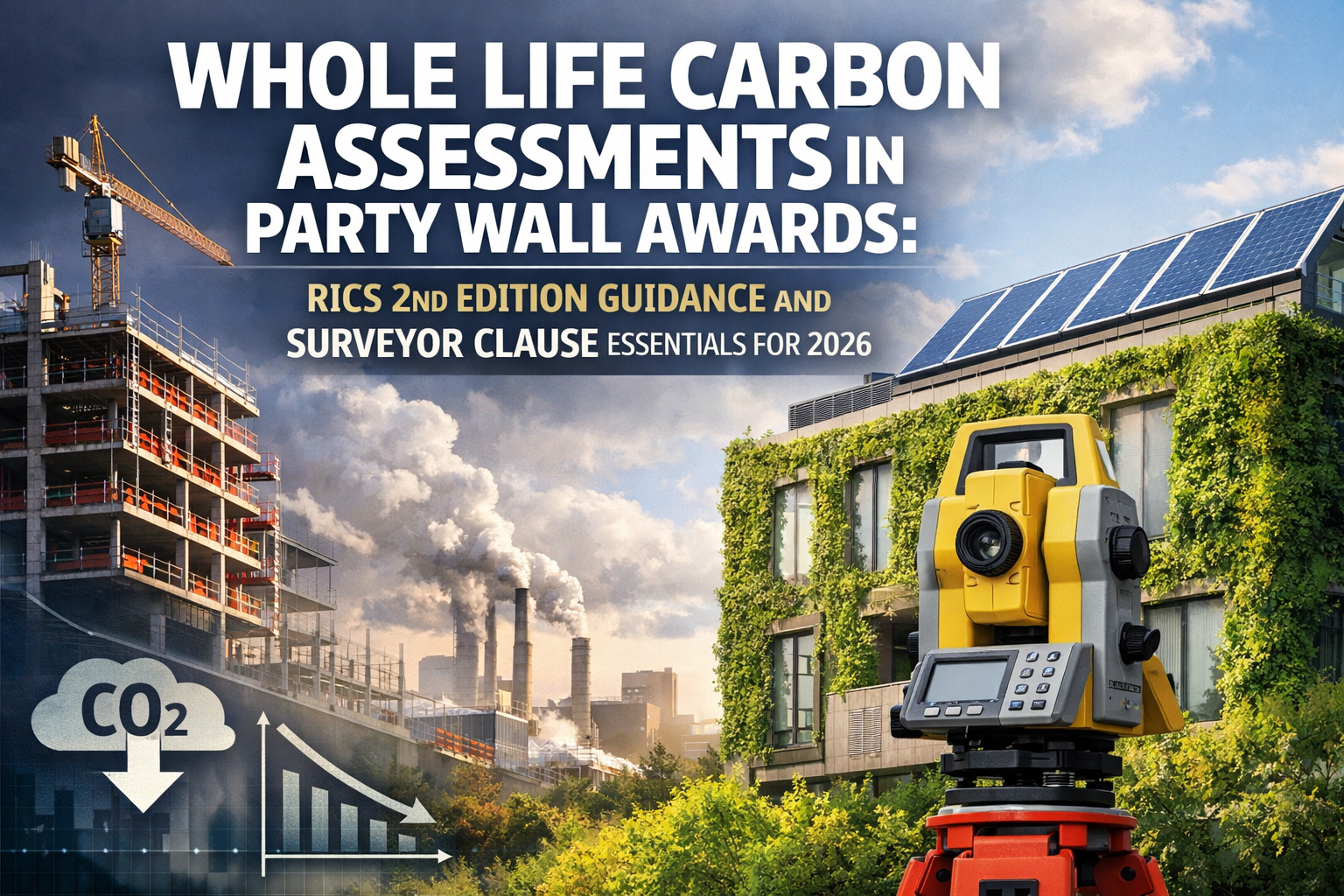
The intersection of sustainability standards and traditional party wall practice represents one of the most significant regulatory developments for surveyors in 2026. Understanding how to properly incorporate carbon assessment clauses into awards protects both building owners and adjoining owners while supporting national decarbonization targets.
Key Takeaways
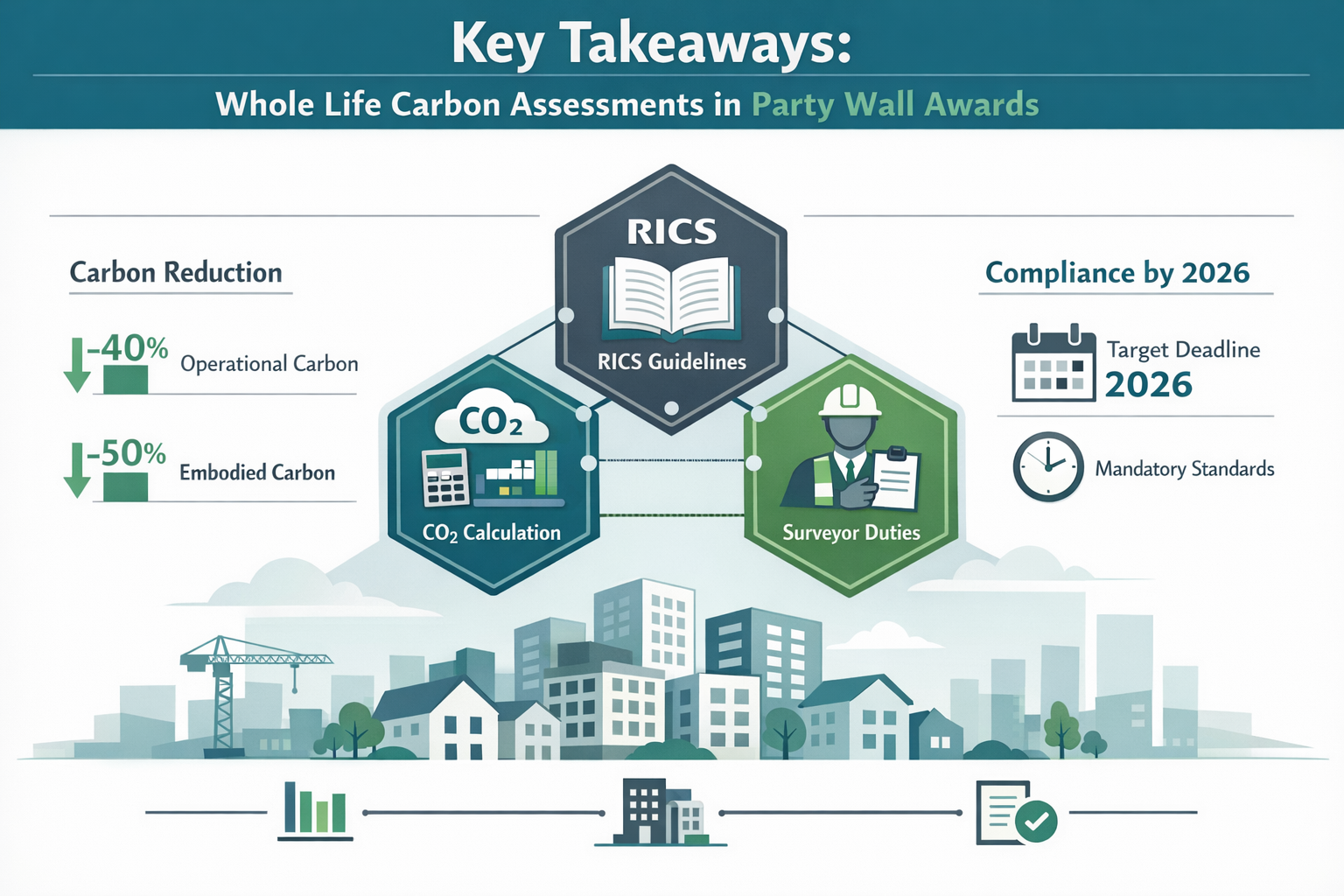
- RICS 2nd Edition became mandatory for all members on July 1, 2024, requiring carbon assessment integration in party wall procedures involving excavations and structural alterations
- Comprehensive lifecycle coverage now extends beyond buildings to include infrastructure, covering embodied, operational, biogenic, and end-of-life carbon across modules A1-C4
- Surveyor clauses must address material selection, excavation methods, transport impacts, and decarbonization strategies with specific reference to PAS 2080:2023 standards
- Deviation recording is mandatory when party wall works cannot fully comply with RICS WLCA standards, requiring documented justification
- Training and certification through RICS Global Certificate programs ensures surveyors maintain competency in applying Whole Life Carbon Assessments in Party Wall Awards: RICS 2nd Edition Guidance and Surveyor Clause Essentials for 2026
Understanding RICS Whole Life Carbon Assessment 2nd Edition: Core Principles for Party Wall Surveyors
The RICS Whole Life Carbon Assessment 2nd Edition, released in November 2023, represents a fundamental shift in how construction professionals evaluate environmental impact.[3] For party wall surveyors, this standard introduces specific obligations when assessing works under the Party Wall etc. Act 1996.
Expanded Scope and Mandatory Compliance
The updated standard dramatically expands coverage to include all buildings and infrastructure across their entire asset lifecycle, moving beyond the previous building-only focus.[3] This expansion directly impacts party wall work, particularly:
- Foundation excavations near adjoining properties
- Structural alterations affecting shared walls
- New construction adjacent to existing party structures
- Underpinning and basement extensions
Since July 1, 2024, RICS members must record any deviations from the standard as part of their assessments.[3] This requirement creates new documentation obligations within party wall awards.
Comprehensive Carbon Coverage Framework
The RICS 2nd Edition addresses four primary carbon categories relevant to party wall work:[4]
- Embodied Carbon – Materials used in party wall construction and repairs
- Operational Carbon – Energy consumption during building use phases
- Biogenic Carbon – Timber and plant-based materials in construction
- End-of-Life Carbon – Demolition, disposal, and recycling impacts
For party wall surveyors, the most immediately relevant categories are embodied and end-of-life carbon, particularly when specifying materials for repairs or evaluating excavation methods that affect existing structures.
Key Technical Changes Affecting Party Wall Practice
The updated standard introduces several technical changes that directly influence how surveyors draft awards:[2]
| Technical Element | Party Wall Application |
|---|---|
| New Reporting Modules | Structured documentation of carbon impacts in award schedules |
| Element Categorization | Specific classification for party walls, foundations, and shared structures |
| Defined Emissions Factors | Standardized calculations for common materials (brick, concrete, steel) |
| Transport Impact Calculations | Assessment of material delivery and waste removal logistics |
| Uncertainty Analysis | Risk evaluation for carbon estimates in complex excavations |
| Decarbonization Guidance | Alternative material and method recommendations |
Understanding these technical elements enables surveyors to draft awards that not only comply with traditional party wall requirements but also address modern sustainability obligations.
Integration with PAS 2080:2023
While RICS provides the assessment framework, PAS 2080:2023 offers the management system for carbon reduction in infrastructure projects. Party wall surveyors should reference both standards when works involve significant excavation or structural intervention, particularly for notice for excavation near a neighbour scenarios.
The combination of RICS WLCA 2nd Edition and PAS 2080:2023 creates a comprehensive approach to sustainable party wall practice, addressing both measurement and management of carbon impacts.
Whole Life Carbon Assessments in Party Wall Awards: Practical Implementation for 2026
Integrating carbon assessments into party wall awards requires practical strategies that balance statutory requirements under the Party Wall etc. Act 1996 with sustainability obligations under RICS standards. Surveyors must develop new clause templates and assessment methodologies specific to shared boundary works.
Essential Carbon Assessment Clauses for Party Wall Awards
When drafting awards in 2026, surveyors should incorporate specific clauses addressing carbon considerations. These clauses protect both parties while ensuring compliance with RICS mandatory requirements.
Material Specification Clauses should require:
- 📋 Submission of Environmental Product Declarations (EPDs) for primary materials
- 🔍 Carbon intensity values for concrete, steel, and masonry products
- ♻️ Minimum recycled content percentages for specified materials
- 🌱 Preference for low-carbon alternatives where structurally appropriate
Excavation Method Clauses must address:
- The carbon impact of different excavation techniques (hand digging vs. mechanical)
- Soil disposal methods and transportation distances
- Temporary works materials and their reuse potential
- Foundation design optimization to minimize material use
Construction Process Clauses should specify:
- Site logistics planning to minimize vehicle movements
- Material storage arrangements to prevent waste
- Waste segregation and recycling requirements
- Progress monitoring for carbon impact tracking
A practical example clause might read: "The Building Owner shall ensure that all primary structural materials used in works to the party wall include Environmental Product Declarations compliant with EN 15804. Where multiple materials meet structural requirements, preference shall be given to options with lower embodied carbon values, subject to party wall cost reasonableness."
Assessing Carbon Impact in Common Party Wall Scenarios
Different types of party wall work present distinct carbon assessment challenges. Understanding these scenarios helps surveyors apply proportionate assessment methods.
Scenario 1: Basement Excavation and Underpinning
Basement extensions represent high-carbon party wall works due to:
- Significant concrete volumes for new foundations and retaining walls
- Extensive excavation and soil removal transportation
- Temporary propping and support systems
- Potential impact on adjoining foundations requiring remedial work
For these projects, surveyors should require full lifecycle carbon calculations covering modules A1-A5 (product and construction stages) and C1-C4 (end-of-life stages). The what is the three-meter rule principle becomes particularly relevant when assessing excavation depth impacts.
Scenario 2: Party Wall Rebuilding or Raising
Raising or rebuilding party walls involves moderate carbon considerations:
- Material selection for new masonry or structural elements
- Demolition and disposal of existing materials
- Scaffolding and temporary works
- Transportation of materials to typically constrained urban sites
These works typically require assessment of modules A1-A5 and C1-C4, with particular attention to material reuse opportunities and recycled content specifications.
Scenario 3: Minor Repairs and Maintenance
Routine party wall repairs present lower carbon impacts but still require consideration:
- Patch repairs using compatible materials
- Repointing and surface treatments
- Minor structural interventions
- Damp-proofing installations
For minor works, simplified carbon assessment may be appropriate, focusing on material selection and waste minimization rather than comprehensive lifecycle analysis.
Documentation Requirements and Deviation Recording
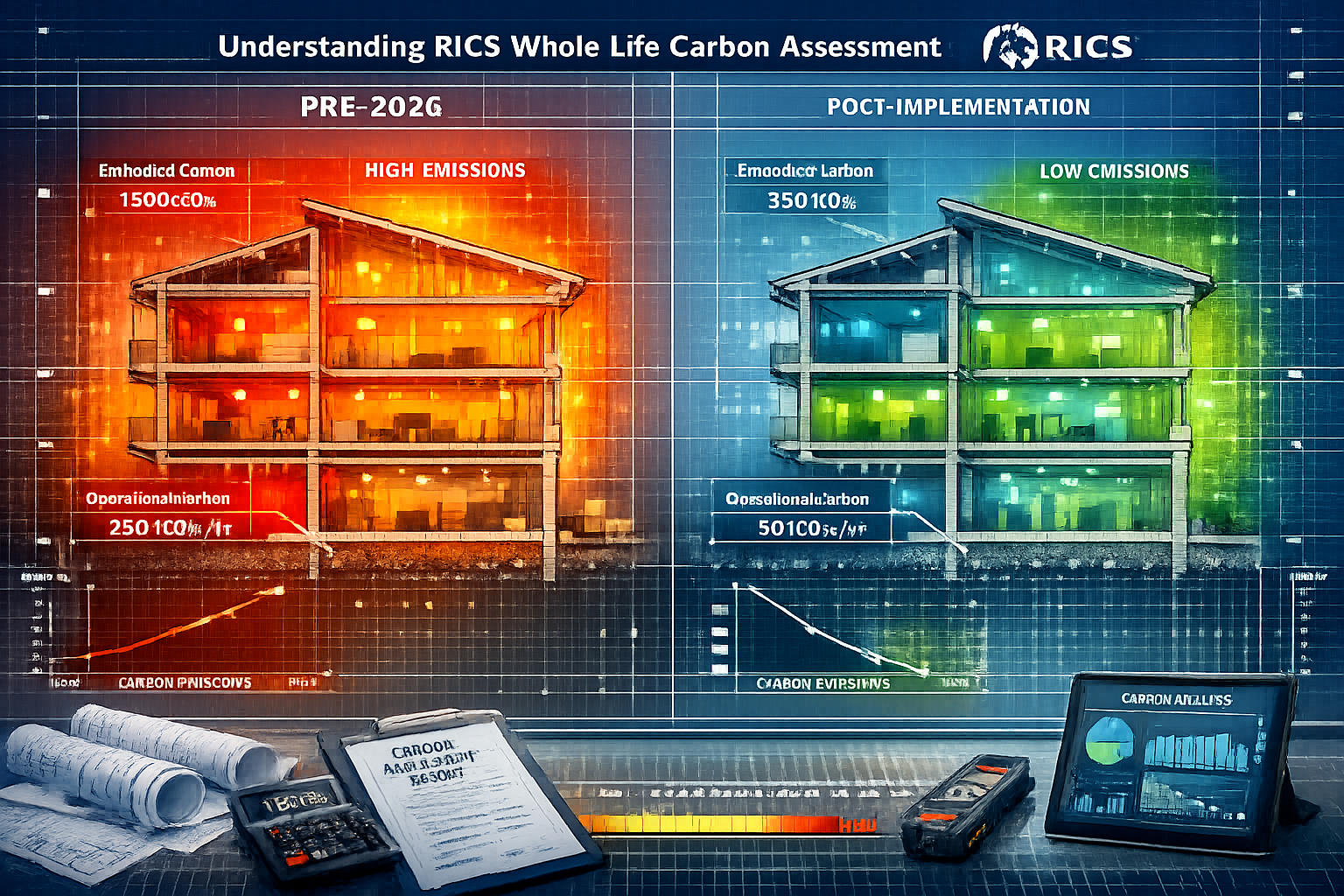
The mandatory deviation recording requirement introduced in the RICS 2nd Edition creates new documentation obligations for party wall surveyors.[3] When works cannot fully comply with carbon assessment standards, surveyors must:
- Identify the specific deviation – Document which RICS WLCA requirement cannot be met
- Explain the reason – Provide technical or practical justification
- Quantify the impact – Estimate the carbon consequence of the deviation
- Propose mitigation – Suggest alternative measures to reduce carbon impact
- Obtain agreement – Secure acknowledgment from both building and adjoining owners
This documentation should be incorporated into the party wall award as a specific schedule or appendix, creating a transparent record of sustainability considerations.
Balancing Carbon Considerations with Party Wall Act Requirements
A critical challenge for surveyors involves balancing carbon reduction objectives with the Party Wall etc. Act 1996's core principle of minimizing inconvenience and cost to the adjoining owner. Several tensions may arise:
Cost vs. Carbon Trade-offs: Low-carbon materials often cost more initially. Surveyors must determine when carbon considerations justify additional expense under the Act's reasonableness standard.
Timing Considerations: Some low-carbon approaches (such as using timber rather than steel) may extend construction timelines, potentially increasing inconvenience to adjoining owners.
Technical Limitations: Existing building constraints may prevent optimal carbon solutions, particularly in historic or structurally sensitive properties.
Effective awards address these tensions explicitly, documenting the decision-making process and demonstrating how carbon considerations were weighed against traditional party wall principles. This approach provides protection if party wall disputes arise regarding sustainability-related specifications.
Surveyor Clause Essentials: Templates and Best Practices for 2026
Developing standardized clause templates helps ensure consistent application of Whole Life Carbon Assessments in Party Wall Awards: RICS 2nd Edition Guidance and Surveyor Clause Essentials for 2026 across different projects. These templates should be adaptable to project scale and complexity while maintaining core sustainability principles.
Template Clause Library for Carbon-Conscious Awards
Clause 1: Carbon Assessment Requirement
"Prior to commencement of notifiable works, the Building Owner shall provide a Whole Life Carbon Assessment prepared in accordance with RICS Whole Life Carbon Assessment 2nd Edition (2023) covering modules A1-A5 and C1-C4 as relevant to the scope of party wall works. This assessment shall be provided to the Adjoining Owner and appointed surveyor(s) for review."
Clause 2: Material Selection and EPD Requirements
"All primary structural materials (concrete, steel, masonry, timber) used in party wall works shall be accompanied by Environmental Product Declarations (EPDs) compliant with EN 15804+A2. Where multiple materials meet structural and aesthetic requirements, the Building Owner shall select options with lower Global Warming Potential (GWP) values unless cost differential exceeds 15% or technical constraints prevent their use."
Clause 3: Excavation and Earthworks Carbon Management
"Excavation methods shall be selected to minimize carbon impact while ensuring structural safety. The Building Owner shall document transportation distances for soil disposal and prioritize on-site reuse where practicable. Mechanical excavation equipment shall meet current emissions standards, with preference for electric or hybrid machinery where available and cost-effective."
Clause 4: Waste Management and Circular Economy
"The Building Owner shall implement waste segregation for all party wall works, targeting minimum 70% diversion from landfill. Demolished materials from existing party structures shall be assessed for reuse potential before disposal. A waste management plan documenting anticipated waste streams and disposal methods shall be provided prior to commencement."
Clause 5: Deviation Recording and Reporting
"Any deviations from RICS Whole Life Carbon Assessment 2nd Edition requirements shall be documented in writing, including justification, estimated carbon impact, and proposed mitigation measures. Such deviations shall be recorded in Schedule [X] of this Award and acknowledged by all parties."
Proportionate Application Based on Project Scale
Not all party wall works require identical carbon assessment rigor. Surveyors should apply proportionate approaches based on project characteristics:
Major Works (basement excavations, significant structural alterations, new party walls):
- Full WLCA covering all relevant modules
- Detailed EPDs for all primary materials
- Transport impact calculations
- Comprehensive deviation documentation
- Third-party verification consideration
Moderate Works (party wall raising, beam insertions, moderate repairs):
- Simplified WLCA focusing on key materials
- EPDs for primary structural elements only
- Basic waste management requirements
- Standard deviation recording
Minor Works (small repairs, maintenance, minor alterations):
- Material specification with carbon preference noted
- Waste minimization requirements
- Simplified documentation
This tiered approach ensures compliance without imposing disproportionate administrative burdens on smaller projects, maintaining the Party Wall Act's principle of reasonableness.
Coordination with Schedule of Condition Requirements
Carbon assessment clauses should integrate with traditional schedule of condition party wall documentation. The pre-works condition survey provides an opportunity to:
- Document existing materials and their potential for reuse
- Identify heritage or conservation constraints affecting material choices
- Assess structural condition to optimize intervention scope
- Establish baseline for measuring actual vs. predicted carbon impacts
Linking carbon considerations to condition surveys creates a more comprehensive assessment framework that serves both protective and sustainability functions.
Addressing Consent and Agreement Challenges
Introducing carbon assessment requirements may create new areas of disagreement between building and adjoining owners. Common challenges include:
Cost Allocation Disputes: When low-carbon materials increase costs, questions arise about who bears the additional expense. Awards should clearly specify that reasonable carbon-related costs fall within the Building Owner's obligations under the Act, while unreasonable premium costs may be challenged.
Technical Disagreements: Parties may dispute carbon calculations or material specifications. Including provisions for independent carbon assessment review can resolve these disputes, similar to how consent for party wall work procedures handle other technical disagreements.
Timeline Impacts: If carbon-optimized approaches extend construction duration, adjoining owners may object. Awards should explicitly address timeline considerations and any compensation arrangements for extended inconvenience periods.
Professional Development and Competency Requirements
Applying Whole Life Carbon Assessments in Party Wall Awards: RICS 2nd Edition Guidance and Surveyor Clause Essentials for 2026 effectively requires specialized knowledge. RICS offers a Global Certificate in Whole Life Carbon Assessment providing comprehensive training on WLCA principles and practical application.[1]
The training program covers:
- 🎓 Core RICS WLCA methodology and calculation frameworks
- 📊 Data sources and emissions factor databases
- 🔧 Software tools for carbon assessment
- 📝 Reporting requirements and documentation standards
- ⚖️ Integration with existing professional responsibilities
Party wall surveyors should consider this certification essential professional development for 2026 practice, ensuring competency in this increasingly critical area. The program equips professionals to confidently incorporate carbon considerations into awards while maintaining traditional party wall principles.
Software and Tools for Carbon Assessment Integration
Several software platforms now support RICS WLCA 2nd Edition compliance, helping surveyors efficiently integrate carbon calculations into party wall work:
- One Click LCA: Provides RICS V2 compliant assessment tools with building element libraries[4]
- eTool: Offers RICS 2nd Edition specific modules for lifecycle carbon calculation[2]
- Circular Ecology: Specializes in embodied carbon databases and calculation methodologies[3]
These tools streamline the technical assessment process, allowing surveyors to focus on professional judgment regarding material selection and method choices rather than manual calculation complexity.
Conclusion
The integration of Whole Life Carbon Assessments in Party Wall Awards: RICS 2nd Edition Guidance and Surveyor Clause Essentials for 2026 represents a fundamental evolution in party wall practice. Surveyors now carry dual responsibilities: protecting the interests of building and adjoining owners under the Party Wall etc. Act 1996 while advancing sustainability objectives through mandatory RICS carbon assessment standards.
Success in this new landscape requires:
✅ Technical competency in whole life carbon assessment methodology and calculation frameworks
✅ Practical clause templates that integrate carbon considerations into traditional party wall award structures
✅ Proportionate application based on project scale, balancing sustainability objectives with reasonableness principles
✅ Clear documentation of carbon assessments, material specifications, and any deviations from RICS standards
✅ Ongoing professional development through RICS training programs and certification
Actionable Next Steps for Party Wall Surveyors
-
Complete RICS WLCA training: Enroll in the Global Certificate in Whole Life Carbon Assessment to build foundational competency[1]
-
Update award templates: Incorporate carbon assessment clauses into standard party wall award documents, adapting them for different project scales
-
Establish assessment workflows: Develop processes for obtaining EPDs, calculating carbon impacts, and documenting deviations
-
Invest in software tools: Evaluate and implement RICS 2nd Edition compliant carbon assessment software to streamline technical calculations
-
Communicate with clients: Educate building owners and adjoining owners about new carbon assessment requirements and their implications for party wall procedures
-
Network with specialists: Build relationships with sustainability consultants, structural engineers, and material suppliers knowledgeable about low-carbon construction
The convergence of party wall practice and whole life carbon assessment creates both challenges and opportunities. Surveyors who proactively develop expertise in this area will be well-positioned to provide comprehensive, future-focused professional services that protect client interests while supporting essential decarbonization objectives. As construction sustainability standards continue to evolve, the principles established in 2026 will form the foundation for decades of professional practice at the intersection of property rights and environmental stewardship.
For surveyors seeking additional guidance on party wall procedures and best practices, exploring resources on party wall fundamentals and related specialist defect surveys provides valuable context for integrating sustainability considerations into comprehensive property assessment frameworks.
References
[1] Certificate In Whole Life Carbon Assessment Training Programme – https://www.rics.org/training-events/training-courses/certificate-in-whole-life-carbon-assessment-training-programme
[2] New Rics Whole Life Carbon 2nd Edition – https://support.etool.app/index.php/knowledgebase/new-rics-whole-life-carbon-2nd-edition/
[3] Rics Whole Life Carbon Assessment 2nd Edition Now In Effect – https://circularecology.com/news/rics-whole-life-carbon-assessment-2nd-edition-now-in-effect
[4] Rics Whole Life Carbon Assessment V2 Whats Working Whats Next – https://oneclicklca.com/en/resources/articles/rics-whole-life-carbon-assessment-v2-whats-working-whats-next