
The Royal Institution of Chartered Surveyors (RICS) launched its first-ever global professional standard for responsible artificial intelligence use on March 9, 2026—a watershed moment arriving precisely when expert witnesses face unprecedented scrutiny amid volatile housing markets.[2] As property valuations increasingly incorporate AI-powered tools, the question of credibility in courtroom testimony has never been more critical. The AI Ethical Guidelines for Expert Witness Valuations: RICS Standards to Counter 2026 Market Volatility framework establishes clear boundaries between technological assistance and professional accountability, ensuring that automated valuation models enhance rather than undermine the integrity of expert witness testimony.
This comprehensive standard addresses a fundamental challenge: how can surveyors leverage AI's analytical power while maintaining the professional judgment and transparency that courts demand? With Q2 2026 housing conditions showing significant uncertainty, the timing couldn't be more crucial for establishing ethical guardrails around AI use in expert witness valuations.
Key Takeaways
- 🎯 RICS AI Standard became mandatory for all members and regulated firms on March 9, 2026, establishing the principle that "AI assists professional practice; it does not replace it"[2]
- ⚖️ Expert witnesses remain fully accountable for all professional advice regardless of AI tools used, with mandatory client disclosure requirements for AI system deployment
- 📊 Automated Valuation Models (AVMs) have critical limitations in expert witness contexts, particularly for non-standard properties and high-stakes legal disputes
- 🛡️ Risk registers are mandatory for firms using AI with material impact on surveying services, documenting inherent bias and potential erroneous outputs[3]
- 💼 Transparent AI use enhances credibility during 2026 market volatility by demonstrating rigorous professional standards and human oversight
Understanding the RICS AI Standard for Expert Witness Practice
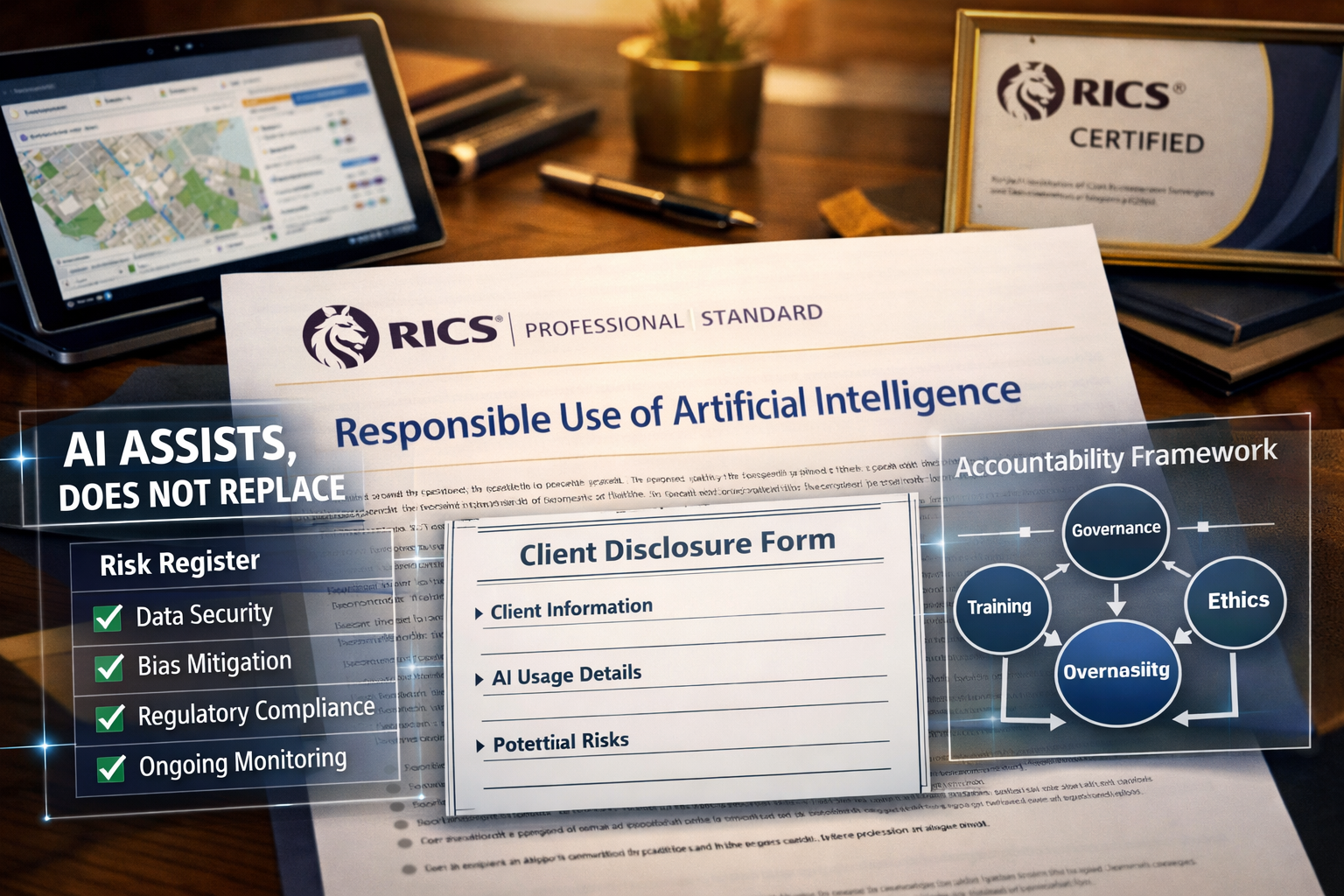
The RICS standard for responsible AI use represents a paradigm shift in how surveyors approach technological integration within their professional practice. At its core, the standard embeds one non-negotiable principle: AI assists professional practice; it does not replace it.[2] This distinction becomes particularly critical when surveyors serve as expert witnesses, where their testimony can determine the outcome of significant legal disputes and financial decisions.
Core Principles of AI Ethical Guidelines for Expert Witness Valuations
The standard establishes several foundational requirements that directly impact expert witness work:
Mandatory Client Disclosure 📋
Members and regulated firms using AI systems must make clear to clients in writing and in advance when and for what purpose AI is to be used.[3] For expert witness engagements, this means disclosing:
- Which valuation processes incorporate AI tools
- The specific AI systems or algorithms employed
- How AI outputs are verified and validated
- The extent of human oversight and professional judgment applied
Professional Accountability Framework ⚖️
Surveyors remain accountable for all professional advice regardless of the tools used to formulate that advice.[2] This accountability cannot be delegated to algorithms or automated systems. When providing Red Book valuations for expert witness purposes, the chartered surveyor must personally verify and stand behind every conclusion, even when AI tools contributed to the analysis.
Risk Management Requirements 🛡️
RICS-regulated firms using AI with material impact on surveying services must create and operate a risk register documenting overarching risks including:
- Inherent bias in training data or algorithms
- Potential for erroneous outputs
- Data quality and completeness issues
- Limitations in specific property types or market conditions[3]
Why These Standards Matter for 2026 Market Conditions
The Q2 2026 housing market presents unique challenges that make ethical AI guidelines particularly relevant. Market volatility driven by economic uncertainty, interest rate fluctuations, and regional variations creates conditions where:
- Traditional comparable analysis becomes more complex due to rapid price changes
- AI models trained on historical data may not reflect current conditions accurately
- Expert witness credibility faces heightened scrutiny from opposing counsel
- Courts demand greater transparency in valuation methodologies
The RICS standard provides a framework for navigating these challenges while maintaining professional integrity. By establishing clear ethical boundaries, surveyors can leverage AI's analytical capabilities without compromising the human judgment that courts rely upon.
Implementing AI Ethical Guidelines for Expert Witness Valuations: RICS Standards in Practice
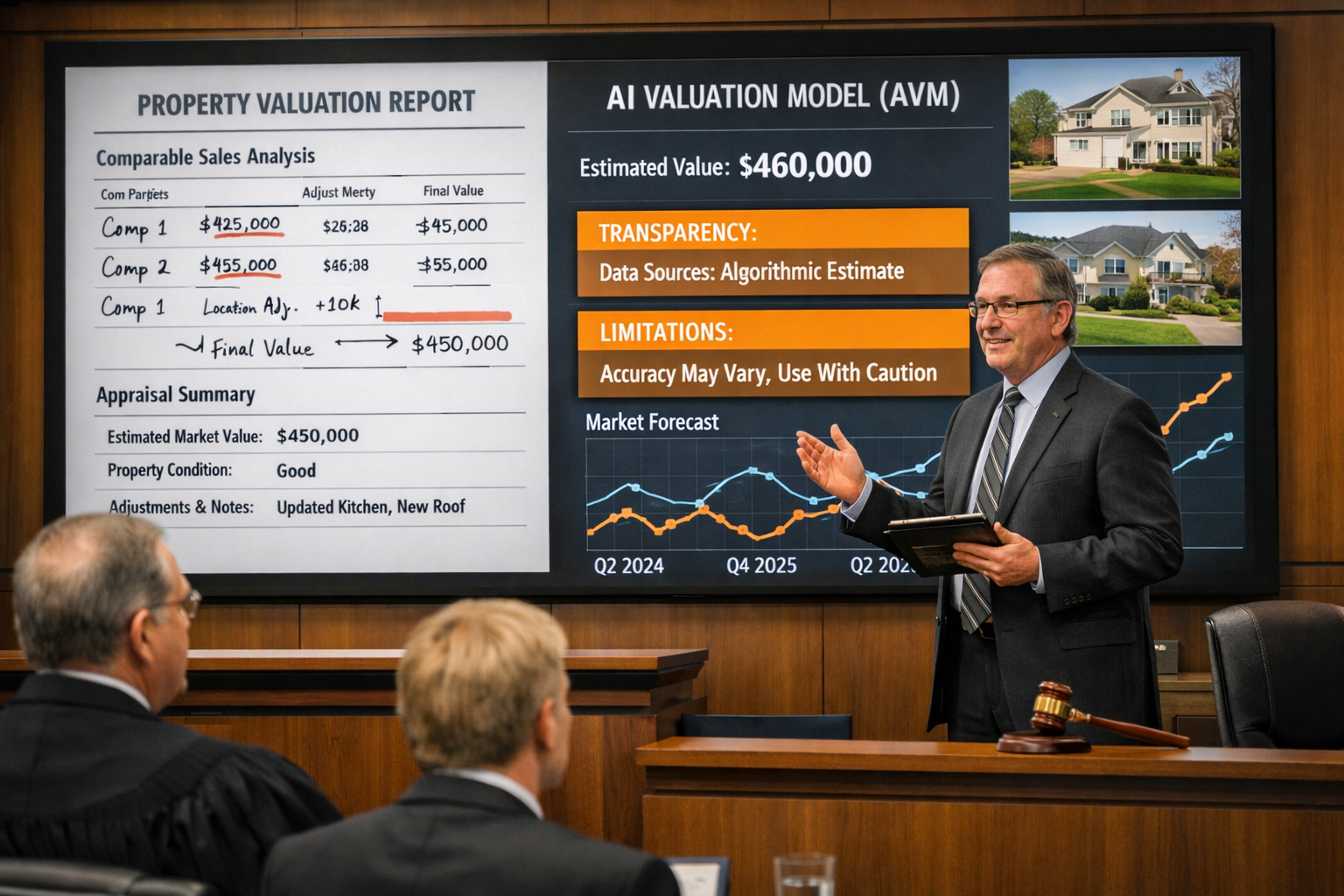
Translating the RICS AI standard into practical expert witness procedures requires systematic implementation across all stages of the valuation process. The following framework demonstrates how to maintain compliance while delivering credible testimony in 2026's volatile market environment.
Stage 1: Engagement and Disclosure
Before accepting an expert witness instruction, surveyors must establish transparent communication about AI use:
Initial Client Communication ✍️
Provide written disclosure that specifies:
- Whether AI tools will be used in the valuation process
- The purpose and limitations of each AI system
- How AI outputs will be verified by qualified professionals
- The surveyor's ultimate accountability for all conclusions
For commercial property valuations or complex assignments, this disclosure should be incorporated into the terms of engagement letter.
Conflict and Capability Assessment 🔍
Evaluate whether AI tools are appropriate for the specific instruction:
- Is the property type within the AI system's validated scope?
- Does the current market volatility exceed the model's training parameters?
- Are there unique features requiring human assessment?
Stage 2: AI-Assisted Data Collection and Analysis
When properly implemented, AI can enhance the efficiency and comprehensiveness of valuation analysis while maintaining professional standards.
Automated Valuation Models (AVMs) in Context 📊
AVMs are more reliable for standard, homogeneous properties but typically don't account for property condition or specific features at scale, and can overlook details a human valuer would identify.[1] For expert witness work, this means:
| Property Type | AVM Suitability | Human Verification Required |
|---|---|---|
| Standard residential | Moderate | High – condition assessment |
| Non-standard construction | Low | Critical – full inspection |
| Commercial properties | Low | Critical – lease terms, condition |
| Unique/heritage properties | Very Low | Essential – comparable judgment |
Data Quality Assurance ✅
Implement rigorous verification protocols:
- Cross-reference AI-generated comparables against manual research
- Verify property characteristics through physical inspection
- Validate market data against multiple independent sources
- Document any discrepancies between AI outputs and professional judgment
Stage 3: Professional Judgment and Validation
The RICS standard emphasizes that AI assists rather than replaces professional practice. This principle becomes operational through structured validation processes.
Human Override Documentation 📝
When professional judgment differs from AI recommendations:
- Document the specific reasons for deviation
- Explain the limitations of the AI model in this context
- Provide alternative analysis supporting the professional conclusion
- Maintain audit trail for court scrutiny
Quality Control Checklist ☑️
Before finalizing expert witness reports:
- All AI-generated data independently verified
- Property inspection completed by qualified surveyor
- Market analysis incorporates 2026 volatility factors
- Comparable selection justified with professional reasoning
- Limitations of AI tools clearly disclosed
- Risk register reviewed and updated
- Peer review completed (for high-value instructions)
Stage 4: Expert Witness Testimony Preparation
Credibility in the witness box depends on transparent communication about methodology, including AI use.
Report Presentation Standards 📄
Expert witness reports should include:
"This valuation incorporates data analysis tools including [specific AI system]. All AI-generated outputs have been independently verified and validated by the undersigned chartered surveyor. Professional judgment has been applied throughout, with particular attention to [specific market conditions, property features, or limitations]. The conclusions represent my professional opinion based on [inspection date] and market conditions as of [valuation date]."
Cross-Examination Preparedness ⚖️
Anticipate questions about AI use:
- What specific AI tools were used and why?
- How were AI outputs verified?
- What are the limitations of these tools?
- Where did professional judgment override AI recommendations?
- How does AI use comply with RICS standards?
This preparation is particularly important for probate valuations or other high-stakes disputes where opposing counsel will scrutinize methodology.
AI Ethical Guidelines for Expert Witness Valuations: Risk Management for 2026 Market Volatility
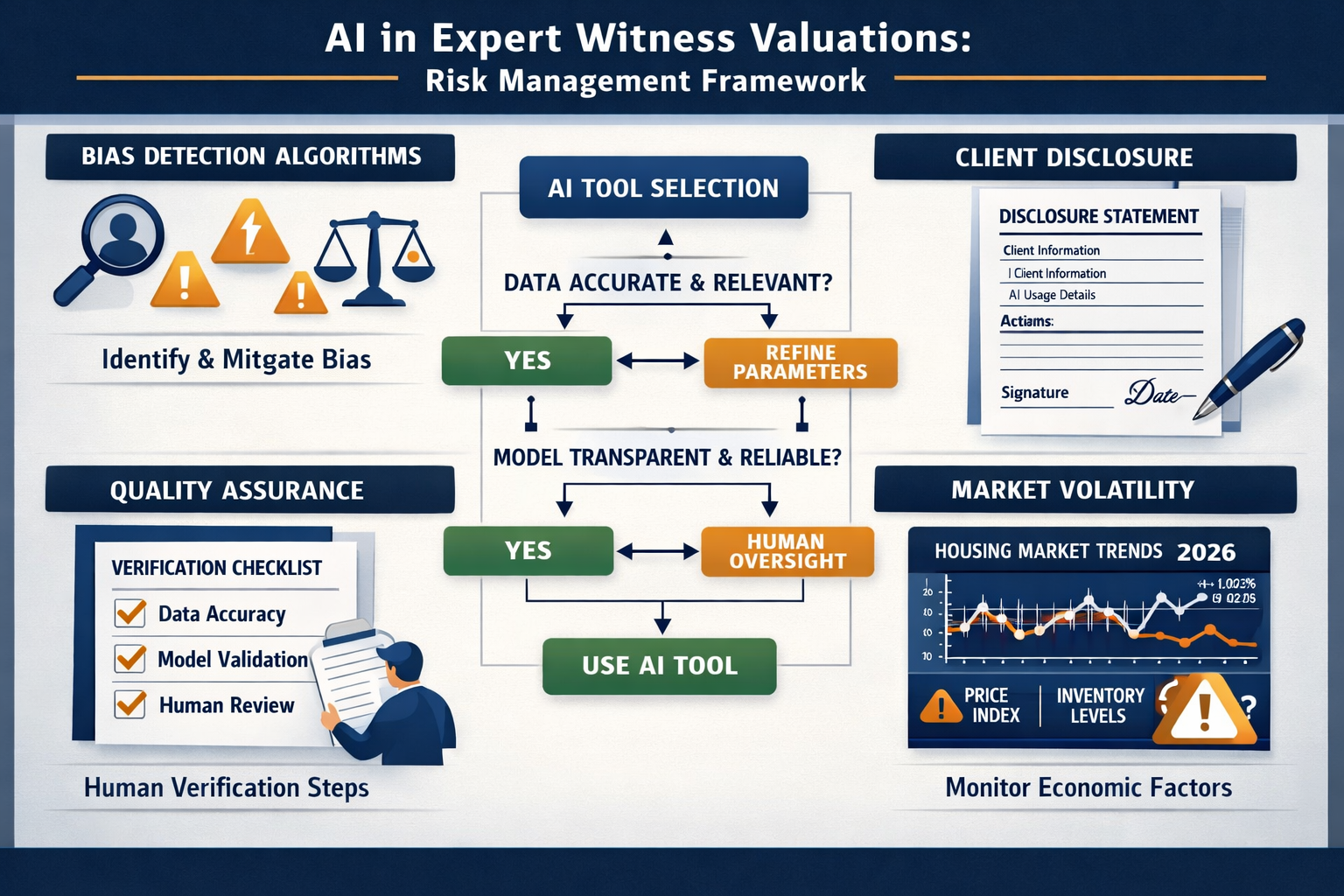
The intersection of AI ethics and market volatility creates unique risk management challenges for expert witnesses in 2026. The RICS standard requires proactive identification and mitigation of risks that could compromise valuation credibility or professional accountability.
Identifying AI-Specific Risks in Expert Witness Work
Algorithmic Bias and Training Data Limitations 🎯
AI models trained on historical data may not accurately reflect 2026 market conditions:
- Temporal bias: Models trained during stable periods may underestimate volatility
- Geographic bias: National models may miss local market dynamics
- Property type bias: Limited training data for non-standard properties
- Market cycle bias: Algorithms may extrapolate trends that have reversed
Risk Mitigation Strategy:
Maintain a risk register documenting these limitations and implement validation protocols that test AI outputs against current market evidence. For valuation factors specific to 2026 conditions, supplement AI analysis with recent transaction data and professional market knowledge.
Erroneous Output Risk ⚠️
AI systems can generate plausible but incorrect valuations, particularly dangerous in expert witness contexts where opposing parties will scrutinize every assumption.
Common Error Patterns:
- Misidentification of property characteristics from automated data sources
- Inappropriate comparable selection in volatile markets
- Failure to account for property-specific factors (condition, location nuances)
- Overconfidence in predictions during uncertain market conditions
Risk Mitigation Strategy:
Implement mandatory human verification of all AI outputs before incorporation into expert witness reports. Establish tolerance thresholds that trigger additional review when AI valuations deviate significantly from professional expectations.
Managing Client and Court Expectations
Transparency as Risk Mitigation 🔍
Courts increasingly expect expert witnesses to disclose their methodologies fully. The RICS standard's disclosure requirements actually reduce litigation risk by:
- Demonstrating professional diligence and compliance
- Preventing allegations of "black box" valuations
- Establishing clear accountability chains
- Showing appropriate professional skepticism toward AI outputs
Documentation Standards 📚
Maintain comprehensive records that demonstrate compliance with AI ethical guidelines:
| Documentation Element | Purpose | Retention Period |
|---|---|---|
| AI tool disclosure letters | Client consent and transparency | Duration of instruction + 6 years |
| Risk register entries | Risk management compliance | Ongoing with annual review |
| AI output verification logs | Quality assurance evidence | Duration of instruction + 6 years |
| Professional judgment notes | Accountability demonstration | Duration of instruction + 6 years |
| Training and competency records | Professional capability evidence | Ongoing career record |
Competency Requirements for AI-Enhanced Valuations
The RICS standard implicitly requires that members understand the AI tools they employ. For expert witnesses, this means:
Technical Understanding 💻
- How the AI system generates valuations
- What data sources it relies upon
- Its validated accuracy range and limitations
- How it handles market volatility and uncertainty
Professional Judgment Integration 🧠
- When to rely on AI outputs versus professional override
- How to explain AI limitations to courts and clients
- How to maintain independence from algorithmic recommendations
- How to update professional knowledge as AI tools evolve
Continuous Professional Development 📖
Staying current with:
- RICS guidance updates on AI use
- Emerging case law on AI in expert witness testimony
- New AI tools and their appropriate applications
- Market-specific challenges in 2026 conditions
Addressing 2026 Market Volatility Specifically
Current market conditions create additional layers of complexity for AI-enhanced valuations:
Interest Rate Uncertainty 📈
AI models may struggle with rapid interest rate changes affecting property values. Expert witnesses must:
- Manually adjust AI outputs for recent rate movements
- Explain interest rate sensitivity in reports
- Consider multiple valuation scenarios
- Document assumptions about future rate trajectories
Regional Market Divergence 🗺️
National AI models may miss significant regional variations in 2026. Supplement with:
- Local market intelligence from commercial building surveys
- Regional transaction analysis
- Local economic indicators
- Professional networks and market contacts
Supply Chain and Construction Cost Volatility 🏗️
Replacement cost approaches using AI must account for:
- Current construction cost inflation
- Material availability issues
- Labor market conditions
- Regional construction capacity constraints
For insurance reinstatement valuations, this requires careful verification of AI-generated rebuild costs against current contractor quotations.
Building Credibility Through Ethical AI Use
Paradoxically, transparent disclosure of AI use can enhance rather than diminish expert witness credibility. Courts appreciate:
Methodological Rigor ✅
Demonstrating that AI tools are used to enhance analysis, not replace professional judgment, shows thoroughness and modern practice standards.
Honest Limitation Acknowledgment 🎓
Openly discussing AI limitations demonstrates professional integrity and realistic assessment of valuation uncertainty—qualities courts value in expert witnesses.
Compliance with Professional Standards 🏆
Following RICS AI guidelines signals commitment to ethical practice and professional accountability, distinguishing qualified experts from less rigorous practitioners.
Adaptability to Market Conditions 🌐
Showing how AI tools are calibrated for 2026 market volatility demonstrates sophisticated understanding of both technology and market dynamics.
Practical Implementation: Case Studies and Best Practices
Case Study: Residential Valuation Dispute
Scenario: Expert witness instruction for residential property dispute involving collective enfranchisement where parties disagree on freehold value.
AI Implementation:
- Used AVM to generate initial comparable property list
- Manually verified each comparable through inspection records
- Adjusted AI-generated values for property-specific conditions
- Documented three instances where professional judgment overrode AI recommendations
- Disclosed AI use in expert report with clear limitations statement
Outcome: Court accepted valuation methodology, noting the transparent approach to AI use enhanced credibility rather than diminishing it.
Case Study: Commercial Property Valuation in Volatile Market
Scenario: Expert witness valuation for commercial lease dispute during Q2 2026 market uncertainty.
AI Implementation:
- Employed AI for rental comparable analysis across multiple locations
- Created risk register documenting AI model's limitations in volatile markets
- Supplemented AI analysis with direct market inquiries and broker intelligence
- Provided sensitivity analysis showing valuation range under different market scenarios
- Clearly distinguished AI-generated data from professional judgment in report
Outcome: Both parties accepted the valuation approach, with the transparent methodology facilitating settlement negotiations.
Best Practice Checklist for Expert Witnesses
Pre-Engagement 🔍
- Assess whether AI tools are appropriate for the specific instruction
- Prepare written disclosure of AI use for client
- Review and update firm's AI risk register
- Confirm personal competency with AI tools to be used
During Valuation 📊
- Verify all AI-generated data through independent sources
- Document professional judgment decisions and AI overrides
- Maintain detailed audit trail of methodology
- Conduct physical inspection regardless of AI data availability
- Cross-reference AI outputs against current market intelligence
Report Preparation 📝
- Include clear AI disclosure statement
- Explain AI tool limitations in context of instruction
- Distinguish AI-assisted analysis from professional conclusions
- Provide transparency about data sources and verification
- Address 2026 market volatility factors explicitly
Court Preparation ⚖️
- Prepare to explain AI methodology in plain language
- Anticipate cross-examination about AI limitations
- Document compliance with RICS AI standard
- Bring supporting documentation for AI verification processes
- Maintain clear position on professional accountability
Future Outlook: Evolving Standards and Technology
The RICS AI standard represents the beginning, not the end, of ethical framework development for AI in expert witness valuations. Several trends will shape future practice:
Regulatory Evolution 📋
Expect additional guidance on:
- Specific AI tool accreditation or validation requirements
- Enhanced disclosure standards for different instruction types
- Integration with other professional standards (Red Book, expert witness protocols)
- International harmonization of AI ethics in valuation practice
Technological Advancement 🚀
Emerging AI capabilities will create new opportunities and challenges:
- Real-time market data integration
- Enhanced property condition assessment through image recognition
- Predictive modeling for market volatility scenarios
- Blockchain-based audit trails for valuation transparency
Court Expectations ⚖️
Legal precedents will increasingly address:
- Admissibility standards for AI-assisted expert evidence
- Disclosure requirements in different jurisdictions
- Weight given to AI-enhanced versus traditional valuations
- Cross-examination protocols for AI methodology
Professional Competency 🎓
Continuing professional development will need to address:
- Technical understanding of AI systems
- Ethical decision-making frameworks
- Communication skills for explaining AI to non-technical audiences
- Critical evaluation of AI tool limitations
Conclusion
The AI Ethical Guidelines for Expert Witness Valuations: RICS Standards to Counter 2026 Market Volatility framework provides a robust foundation for integrating artificial intelligence into expert witness practice while maintaining the professional accountability and credibility that courts demand. As the first global professional standard for responsible AI use in surveying became effective on March 9, 2026, chartered surveyors now have clear guidance on how to leverage technological advantages without compromising professional integrity.[2]
The core principle remains unshakeable: AI assists professional practice; it does not replace it. For expert witnesses navigating Q2 2026's volatile housing markets, this distinction is not merely philosophical—it's the foundation of credible testimony and defensible valuations.
Key Implementation Priorities
Immediate Actions 🎯
- Review and update engagement letters to include mandatory AI disclosure requirements
- Create or update firm risk registers documenting AI-related risks and mitigation strategies
- Audit current AI tool usage to ensure compliance with RICS standards
- Develop verification protocols for all AI-generated outputs used in expert witness work
Medium-Term Development 📈
- Invest in professional development to enhance understanding of AI capabilities and limitations
- Establish quality assurance procedures specifically for AI-enhanced valuations
- Build documentation systems that create audit trails demonstrating compliance
- Develop client communication materials explaining AI use in accessible language
Long-Term Strategic Planning 🔮
- Monitor regulatory developments and emerging case law on AI in expert witness testimony
- Evaluate new AI tools against RICS ethical guidelines before adoption
- Contribute to professional discourse on AI ethics and best practices
- Maintain competitive advantage through sophisticated yet transparent AI integration
The Credibility Advantage
Expert witnesses who embrace transparent AI use under the RICS framework gain significant advantages in 2026's challenging market environment. By openly disclosing AI tools, documenting their limitations, and demonstrating rigorous professional oversight, surveyors build rather than erode credibility with courts, clients, and opposing parties.
The volatile market conditions of 2026 demand both technological sophistication and professional judgment. The RICS AI standard provides the ethical framework to deliver both, ensuring that expert witness valuations remain credible, defensible, and compliant with evolving professional expectations.
For chartered surveyors seeking to maintain excellence in expert witness services while leveraging AI capabilities, the path forward is clear: embrace transparency, maintain accountability, and let professional judgment guide technological integration. The future of expert witness valuations lies not in choosing between AI and human expertise, but in combining both under rigorous ethical guidelines that serve justice and professional integrity.
References
[1] Ruai Case Studies 02 – https://www.rics.org/profession-standards/rics-standards-and-guidance/conduct-competence/responsible-use-of-ai/ruai-case-studies-02
[2] Rics First Ever Standard On Responsible Ai Use Now In Effect – https://www.rics.org/news-insights/rics-first-ever-standard-on-responsible-ai-use-now-in-effect
[3] Responsible Use Of Artificial Intelligence In Surveying Practice September 2025 – https://www.rics.org/content/dam/ricsglobal/documents/standards/Responsible-use-of-artificial-intelligence-in-surveying-practice_September-2025.pdf