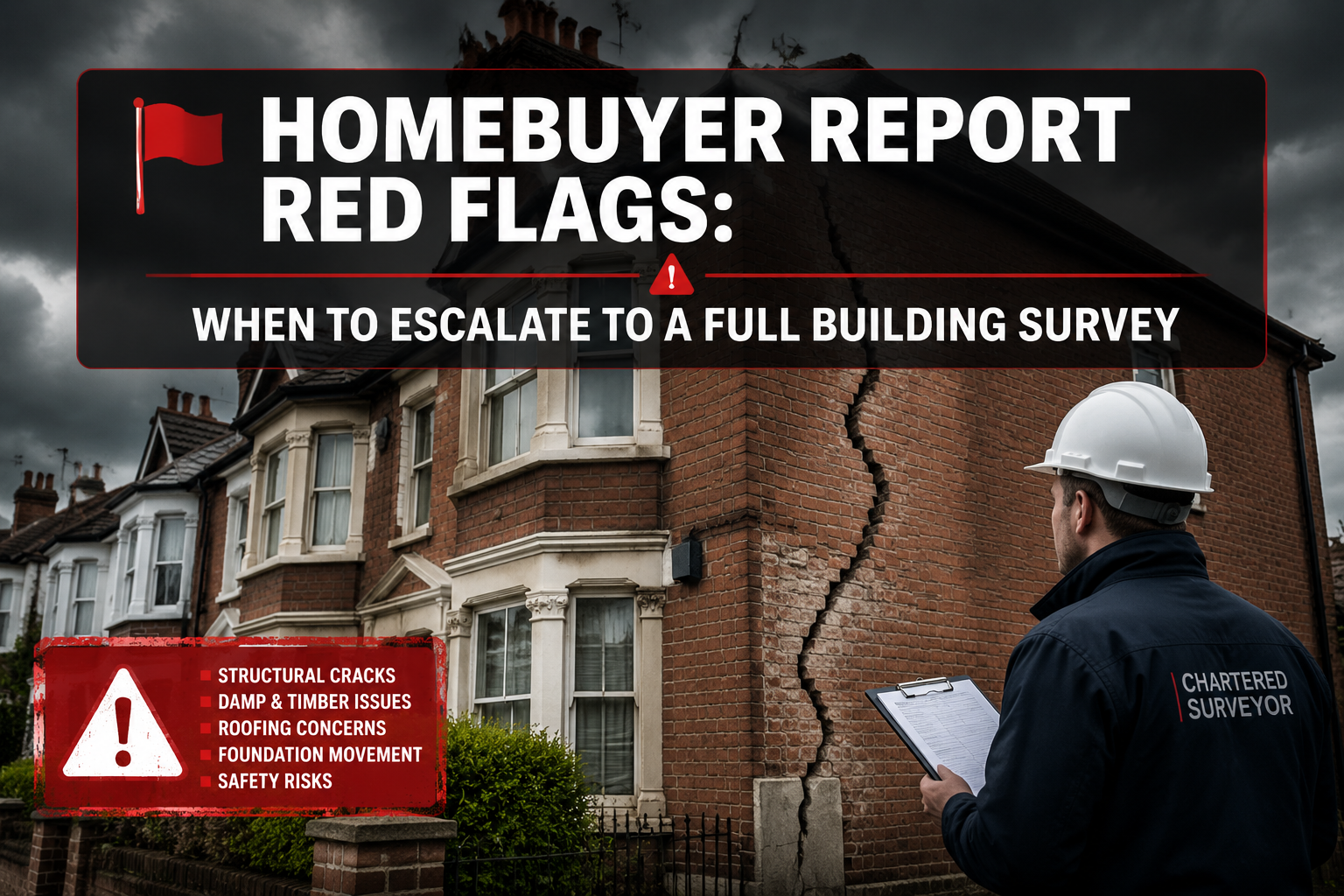

Around one in five UK property purchases involves a defect serious enough to affect the sale price or cause the buyer to withdraw — yet the majority of buyers still opt for a Level 2 Homebuyer Report rather than a full structural inspection. That gap between what buyers choose and what their property actually needs is where costly mistakes happen.
Understanding the Homebuyer Report red flags that should trigger a full building survey is not just useful knowledge — it is a practical decision framework that protects buyers, informs conveyancers, and ensures that the right level of scrutiny is applied before exchange of contracts. This article sets out exactly which warning signs in a Level 2 report should prompt escalation, and why acting on them early can save tens of thousands of pounds.
Key Takeaways 📋
- A Level 2 Homebuyer Report is a visual inspection only — it cannot probe behind surfaces or assess hidden structural issues.
- Certain condition ratings (particularly Condition 3) are explicit signals that a full Level 3 Building Survey is needed before proceeding.
- Red flags include structural movement, active damp, roof defects, unauthorised alterations, and poor maintenance history.
- Buyers and conveyancers should treat escalation as a risk-management step, not an optional extra.
- Acting before exchange — not after — preserves negotiating power and prevents costly surprises post-completion.
What a Level 2 Homebuyer Report Can and Cannot Tell You
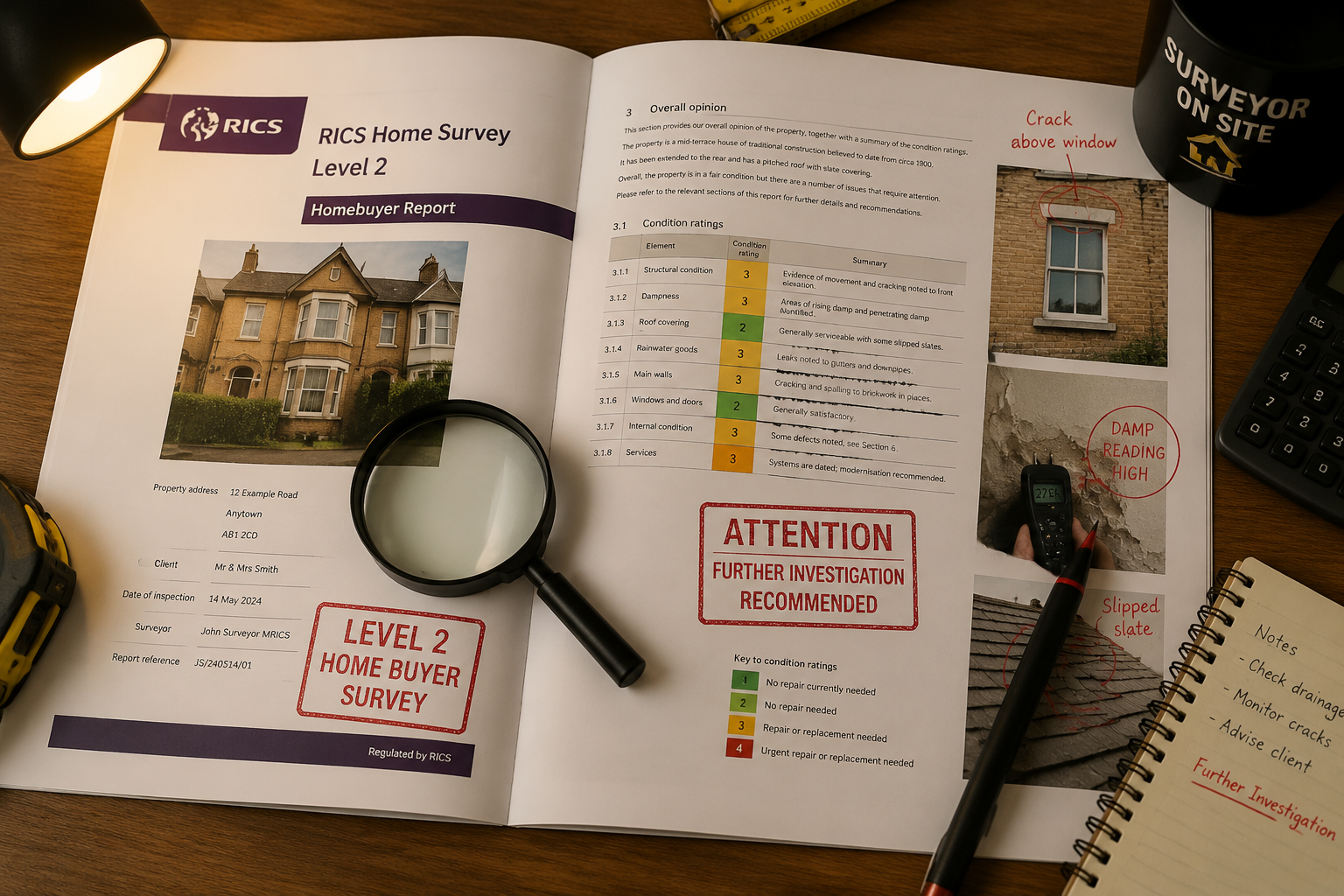
A homebuyer survey (RICS Level 2) is designed for properties in reasonable condition that are of conventional construction. It provides a visual, non-invasive inspection of accessible areas and rates elements using a traffic-light system:
| Condition Rating | Meaning |
|---|---|
| 1 – Green | No repair needed; normal maintenance only |
| 2 – Amber | Defects requiring attention but not urgent |
| 3 – Red | Serious defects requiring immediate action or further investigation |
The critical limitation is that a Level 2 report does not open up the structure. Surveyors cannot lift floorboards, remove ceiling panels, or inspect inside wall cavities. This means a Level 2 report can identify symptoms — but not always their cause or extent.
💡 Pull Quote: "A Homebuyer Report tells you what a surveyor can see. A Building Survey tells you what is actually happening."
When symptoms appear that suggest hidden or complex problems, the responsible course is to escalate to a full structural survey — a Level 3 Building Survey that opens up the fabric of the building and provides a far more detailed assessment.
Homebuyer Report Red Flags That Should Trigger a Full Building Survey: A Surveyor's Decision Framework
🔴 1. Structural Movement and Cracking
Cracking is the most commonly misunderstood defect in residential property. Not all cracks are equal — but certain types are serious enough to demand immediate escalation.
Cracks that warrant a full Building Survey include:
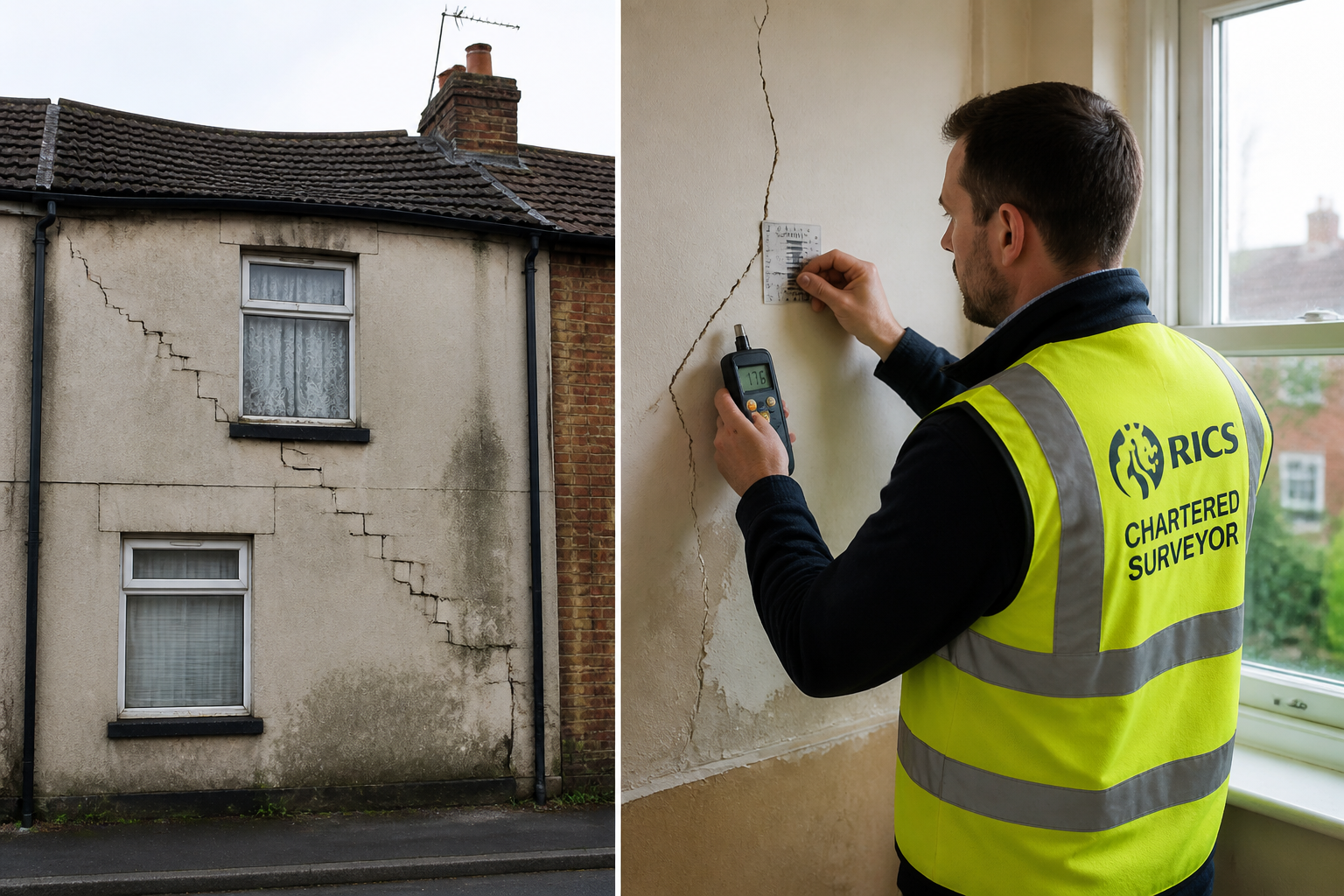
- Diagonal stepped cracks following mortar joints in brickwork (classic sign of differential settlement or subsidence)
- Horizontal cracks in external walls (can indicate wall tie failure or lateral pressure)
- Tapered cracks wider at the top or bottom (suggest ongoing movement rather than historic settlement)
- Cracks wider than 5mm at any point
- Internal cracks that align with external cracks (through-wall cracking)
A Level 2 report will flag these as Condition 3 and recommend further investigation. That recommendation should be taken seriously. A residential structural engineering assessment can determine whether movement is historic and stable or active and progressive — a distinction that changes everything about how a buyer should proceed.
Do not assume a crack is cosmetic without professional confirmation.
🔴 2. Damp — Active, Rising, or Penetrating
Damp is one of the most common findings in UK property surveys, and also one of the most frequently underestimated. A Level 2 report uses a moisture meter to detect elevated readings but cannot determine the source without further investigation.
Escalation is warranted when a Homebuyer Report identifies:
- High moisture readings in multiple locations
- Visible tide marks or salt staining on walls (rising damp indicators)
- Damp patches on ceilings or upper walls (penetrating damp from roof or gutters)
- Evidence of previous damp treatment that may have masked the underlying cause
- Musty odours noted in the inspection comments
A damp survey conducted as part of a full Building Survey can distinguish between condensation, rising damp, and penetrating damp — each of which has a different cause, a different solution, and a very different cost implication.
⚠️ Warning: Damp treatment costs range from a few hundred pounds for localised repairs to £10,000–£30,000+ for full remediation of rising damp or structural waterproofing. The Level 2 report alone cannot tell you which scenario applies.
🔴 3. Roof Defects and Structural Roof Issues
The roof is one of the most expensive elements of any property to repair or replace. A Level 2 survey inspects the roof from ground level or from a hatch — it does not involve a surveyor physically accessing the roof structure.
Red flags in a Homebuyer Report that require a full Building Survey:
- Sagging or uneven roof ridge line (suggests rafter failure or spread)
- Missing, slipped, or cracked tiles or slates
- Evidence of previous patching or repair (may indicate recurring problems)
- Blocked or damaged gutters and downpipes noted alongside internal damp
- No access to loft space (prevents assessment of roof structure entirely)
A roof survey within a full Level 3 inspection allows the surveyor to physically enter the roof space, inspect rafters, purlins, and ceiling joists, check for woodworm or rot in timber, and assess insulation and ventilation. This level of detail is simply not possible within a Level 2 report.
🔴 4. Unauthorised Alterations and Abnormal Construction
Properties that have been extended, converted, or significantly altered present a specific category of risk. A Level 2 report may note that alterations have been made but cannot fully assess their structural integrity or confirm whether appropriate consents were obtained.
Triggers for escalation include:
- Loft conversions with no visible structural support or inadequate headroom
- Rear extensions where the original wall has been removed without evidence of a steel beam
- Garage conversions with potential damp or thermal bridging issues
- Chimney breast removals without proper support at upper floors
- Flat roof additions showing ponding or membrane failure
Each of these scenarios involves structural elements that a Level 2 surveyor cannot fully assess. A full Building Survey, combined with a structural engineering review, can determine whether the work was carried out correctly and whether retrospective building regulations approval or indemnity insurance is required.
Conveyancers should cross-reference the survey findings with the legal pack — if planning permissions or building regulations completion certificates are absent, this is a dual red flag requiring both legal and structural escalation.
🔴 5. Poor Maintenance History and Deferred Repairs
Sometimes the red flag is not a single dramatic defect but a pattern of neglect. A Level 2 report that records multiple Condition 2 ratings across roof coverings, gutters, external decorations, windows, and drainage should prompt serious reflection.
The cumulative maintenance red flag:
- 5+ Condition 2 ratings across different elements
- Evidence of ongoing leaks that have not been addressed
- Overgrown vegetation against walls (moisture retention risk)
- Failed external sealants around windows and doors
- Outdated electrical or heating systems noted as requiring inspection
A property with pervasive deferred maintenance is likely to have concealed defects that a visual inspection simply cannot detect. A full Building Survey is the appropriate tool for understanding the true condition of such a property before committing to purchase.
The Surveyor's Decision Framework: A Practical Escalation Guide
The following framework helps buyers and conveyancers decide when to escalate from a Level 2 Homebuyer Report to a full Level 3 Building Survey.
Step 1: Count the Condition 3 Ratings
Any single Condition 3 rating is a trigger for further investigation. Two or more Condition 3 ratings across different elements should be treated as a strong signal that a full Building Survey is needed.
Step 2: Assess Property Age and Construction Type
Properties built before 1919 are at higher risk of structural movement, timber decay, and non-standard construction. A full Building Survey is almost always recommended for:
- Victorian and Edwardian terraces
- Pre-war semi-detached properties
- Listed buildings or properties in conservation areas
- Properties with non-standard construction (timber frame, concrete panels, prefab)
Step 3: Review the Surveyor's Recommendations
A responsible Level 2 surveyor will explicitly recommend further investigation in specific areas. These recommendations are not boilerplate — they are professional risk signals. If the report says "we recommend a specialist inspection of the roof structure," that recommendation should be acted upon, not ignored.
Step 4: Consider the Financial Exposure
The cost of a full Building Survey (typically £600–£1,500 depending on property size and location) is modest compared to the potential cost of undetected defects. Local chartered surveyors can provide a clear fee estimate before instruction.
Step 5: Consult Before Exchange, Not After
The window between receiving a Homebuyer Report and exchanging contracts is the only period during which a buyer retains full negotiating power. Escalating to a full Building Survey during this window allows buyers to:
- Renegotiate the purchase price based on repair costs
- Request remedial works as a condition of sale
- Withdraw without financial penalty if defects are too severe
Homebuyer Report Red Flags That Should Trigger a Full Building Survey: Specific Scenarios by Property Type
Different property types carry different risk profiles. The table below summarises the most common escalation triggers by property category.
| Property Type | Key Red Flags | Recommended Specialist Survey |
|---|---|---|
| Victorian terrace | Stepped cracks, damp, chimney issues | Full Building Survey + Damp Report |
| 1960s–80s flat | Concrete structure, flat roof, cladding | Full Building Survey + Drainage Survey |
| Extended semi | Structural alterations, loft conversion | Full Building Survey + Structural Engineering |
| Rural property | Subsidence, non-mains drainage, timber decay | Full Building Survey + Solid Floor Slab Survey |
| New build | Snagging defects, incomplete works | Snagging Survey |
What Conveyancers Should Do When Red Flags Appear
Conveyancers play a critical role in the escalation process. When a client shares a Homebuyer Report containing red flags, the conveyancer should:
- Flag the findings in writing and advise the client to seek a full Building Survey before exchange
- Cross-reference the legal pack for missing consents, indemnity policies, or undisclosed alterations
- Pause exchange negotiations until the full survey is received and reviewed
- Advise on retention or price reduction once repair costs are quantified

Conveyancers working in areas with older housing stock — such as those served by chartered surveyors in South West London or chartered surveyors in Hertfordshire — will be familiar with the frequency of structural and damp issues in pre-war properties. Building a standard protocol around Level 2 red flags protects both clients and the conveyancer's professional position.
Conclusion: Act on the Warning Signs Before It's Too Late
The homebuyer report red flags that should trigger a full building survey are not obscure technical details — they are clear, readable signals embedded in every Level 2 report. Structural movement, active damp, roof defects, unauthorised alterations, and cumulative maintenance failure are each, individually, sufficient reason to escalate before exchange.
Actionable next steps for buyers in 2026:
- ✅ Read your Homebuyer Report in full — do not skip the recommendations section
- ✅ Count Condition 3 ratings and treat each one as a trigger for further action
- ✅ Instruct a full Level 3 Building Survey before exchange if any red flags are present
- ✅ Share the report with your conveyancer and ask them to cross-reference the legal pack
- ✅ Use the full survey findings to renegotiate price or request remedial works
- ✅ Never assume a defect is minor without professional confirmation of cause and extent
The cost of a full Building Survey is always less than the cost of discovering a serious defect after completion. The surveyor's decision framework outlined here exists to protect buyers — but only if they act on it.
For expert guidance on property surveys across London and the South East, explore the full range of structural engineering and survey services available from Canterbury Surveyors.