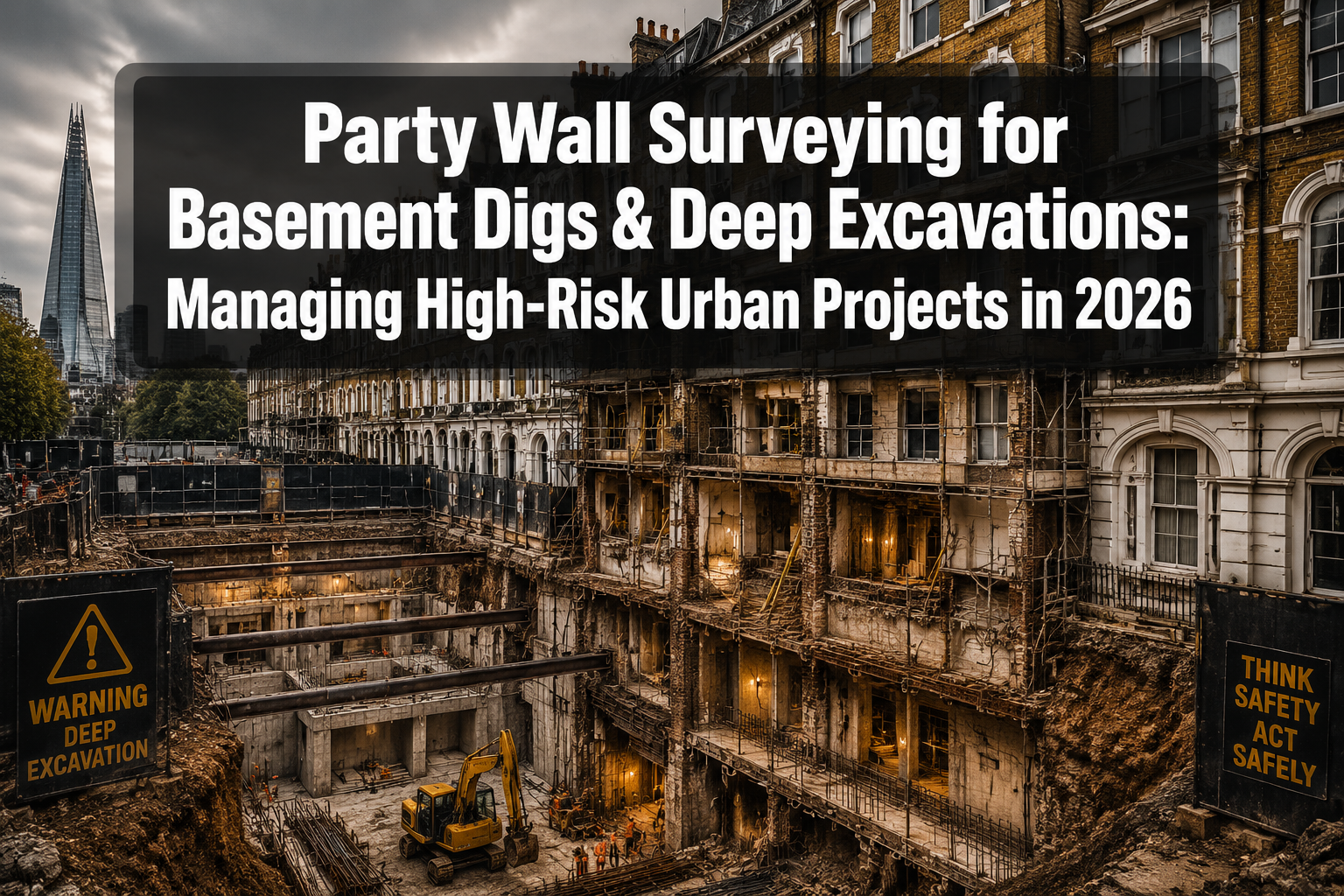

Nearly one in three Party Wall disputes in London now involves basement excavation — a figure that has climbed sharply as homeowners seek to unlock underground space rather than move house [4]. The stakes are high: a single underpinning project can destabilise a neighbouring Victorian terrace, trigger five-figure damage claims, and grind to a halt without a legally compliant Party Wall Award in place. Party Wall Surveying for Basement Digs and Deep Excavations: Managing High-Risk Urban Projects in 2026 has therefore become one of the most technically demanding disciplines in residential construction — and one of the most consequential for property owners on both sides of the boundary.
This guide cuts through the complexity. Whether planning a basement conversion or living next door to one, the information below explains exactly what the law requires, what surveyors actually do on site, and how to protect a property from the ground down.
Key Takeaways 📋
- Almost all London basement projects fall under the Party Wall etc. Act 1996, making professional surveyor involvement legally essential, not optional.
- Two separate notices — a Section 6 (Adjacent Excavation) Notice and potentially a Section 2 (Party Structure) Notice — may both be required for a single basement dig.
- The 3-metre and 6-metre rules are depth-dependent, not just distance-dependent; guessing either measurement carries serious legal and financial risk.
- A Schedule of Condition Survey of the neighbouring property is the single most important document for resolving post-construction damage disputes.
- The Building Owner pays all reasonable surveyor fees — including the neighbour's surveyor — in almost every case.
Understanding the Legal Framework: The 3-Metre and 6-Metre Rules
The Party Wall etc. Act 1996 creates a clear but often misunderstood framework for excavation work near neighbouring properties. Two distance thresholds — 3 metres and 6 metres — determine which notices must be served, but depth is equally critical and frequently overlooked [1].
The 3-Metre Rule
A Section 6 Notice (Adjacent Excavation Notice) must be served when:
- Excavating within 3 metres of a neighbouring building, and
- The proposed excavation will go deeper than the bottom of the neighbour's existing foundations
This second condition is the one that catches homeowners off guard. If a basement dig stays shallower than the neighbour's existing foundations — even within 3 metres — the notice requirement does not automatically apply [1]. However, professional measurement is essential before drawing that conclusion. For a full explanation of this rule, see what the three-metre rule means in practice.
The 6-Metre Rule and the 45-Degree Plane
The 6-metre rule introduces a geometric test. It is triggered when any part of the proposed excavation intersects with a plane drawn at 45 degrees downward from the bottom of the neighbour's foundations [1]. This rule catches many basement conversions and deep piling projects that sit beyond 3 metres horizontally but still threaten the structural load path of adjacent buildings.
💡 Pull Quote: "The 45-degree plane rule means a basement dig 5 metres away can still legally require a Party Wall Notice — geometry, not just distance, determines liability."
When Two Notices Are Required
Many basement projects trigger both types of notice simultaneously [2]:
| Notice Type | Section | Trigger |
|---|---|---|
| Adjacent Excavation Notice | Section 6 | Excavating within 3m or 6m below neighbour's foundations |
| Party Structure Notice | Section 2 | Cutting into, underpinning, or altering a shared wall |
Underpinning — almost universal in basement conversions — typically requires both. Failing to serve either notice correctly exposes the Building Owner to injunctions, forced reinstatement, and unlimited damage liability.
Special Foundations: The Consent Trap Most Homeowners Miss
One provision of the Act that surprises even experienced contractors relates to special foundations — defined as any foundation incorporating reinforced concrete, steel pins, or piles [1].
If the proposed basement design uses special foundations, the adjoining owner's specific written consent is mandatory before work begins. This is a stricter requirement than the standard Party Wall Award process, where a dissenting neighbour triggers surveyor appointment rather than a veto [1].
In practice, this means:
- ✅ Standard mass concrete strip foundations → Party Wall Award sufficient
- ❌ Reinforced concrete raft or piled foundations → Written neighbour consent required
Contractors who proceed without this consent face the risk of having to remove and replace foundation systems at enormous cost. A qualified surveyor identifies this requirement at the design stage, not after concrete has been poured.
What Party Wall Surveying for Basement Digs and Deep Excavations Actually Involves in 2026
The surveyor's role in a basement project extends far beyond serving paperwork. In 2026, Party Wall Surveying for Basement Digs and Deep Excavations: Managing High-Risk Urban Projects in 2026 encompasses a structured programme of risk assessment, documentation, monitoring, and dispute resolution that runs from pre-construction through to post-completion sign-off [2].
Step 1: Pre-Construction Schedule of Condition Survey
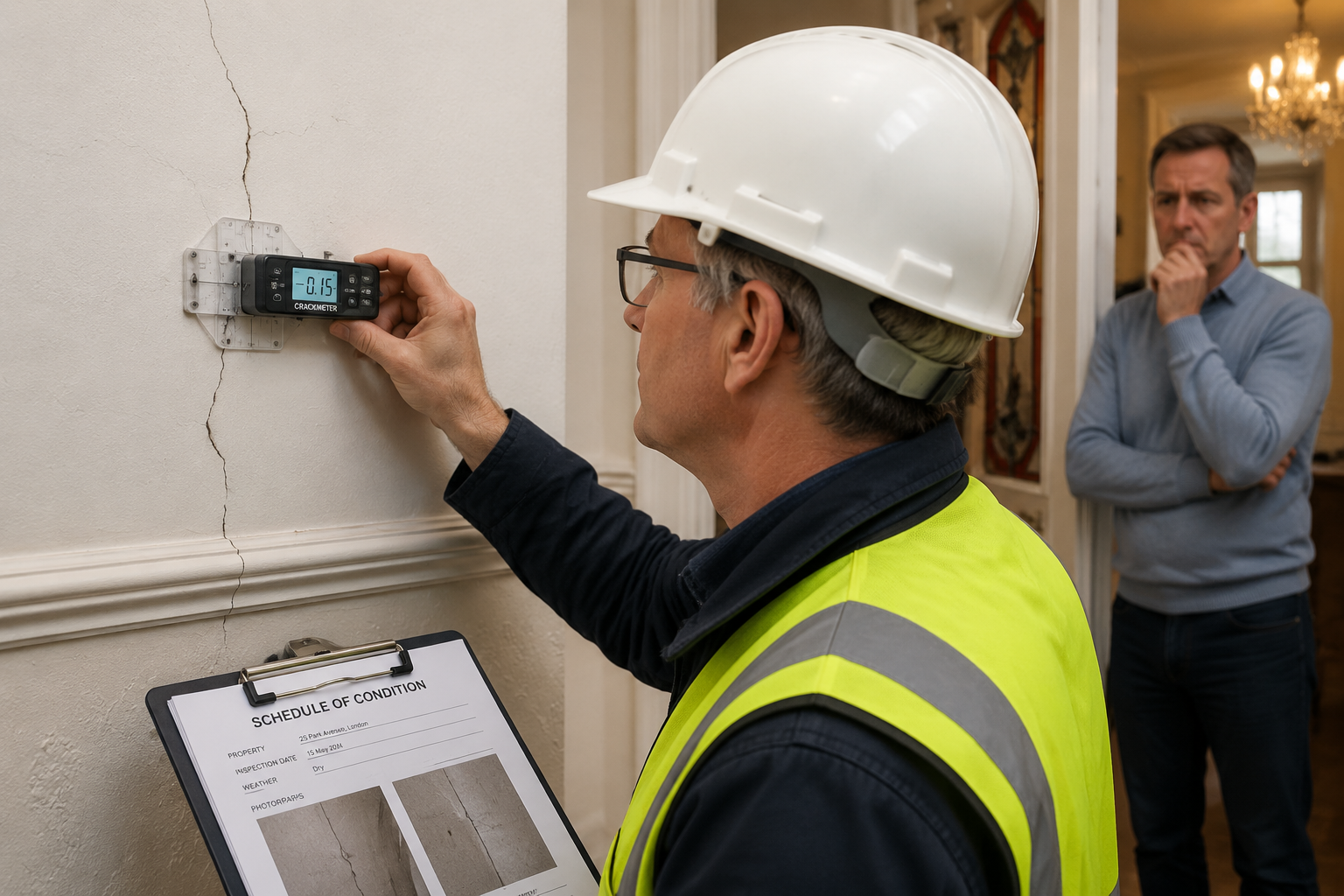
Before a single shovel breaks ground, a detailed Schedule of Condition Survey of the neighbouring property is conducted. This photographic and written record documents every existing crack, settlement mark, and structural defect in the adjoining building.
Why this matters: Without a pre-construction baseline, any crack appearing during or after the basement dig can be claimed as construction damage — even if it existed beforehand. The Schedule of Condition is the single most powerful document for resolving post-construction disputes fairly [2].
Typical Schedule of Condition content includes:
- Room-by-room photographic record (interior and exterior)
- Measured crack widths and locations
- Existing settlement patterns and previous repairs
- Condition of shared walls, ceilings, and floors
- Drainage and damp observations
Step 2: Drafting the Party Wall Award
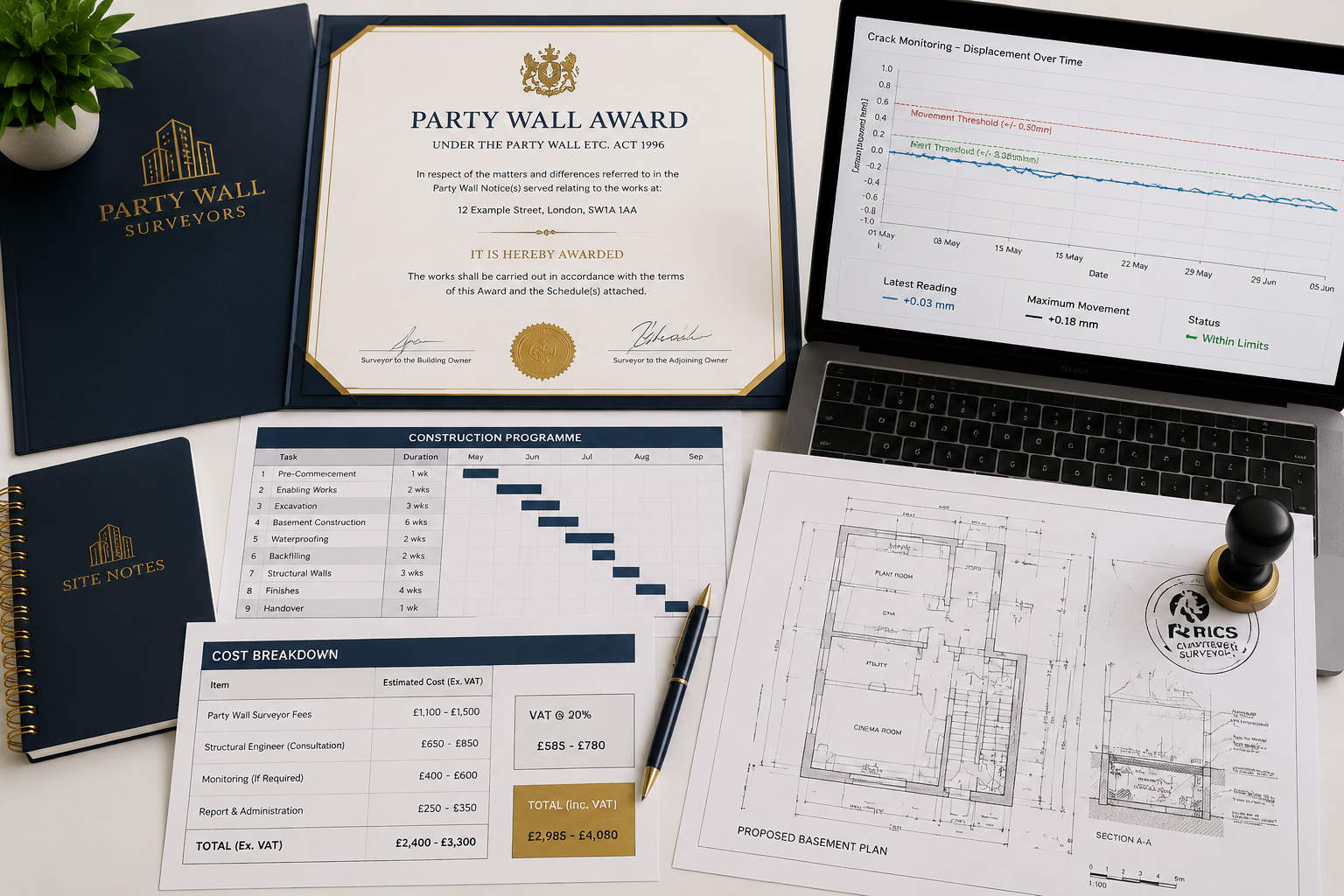
The Party Wall Award is the legally binding document that governs how work must proceed. For basement projects, a well-drafted Award will specify:
- Permitted working hours (typically 8am–6pm weekdays)
- Vibration and noise limits during excavation and piling
- Crack monitoring requirements — including trigger thresholds for stopping work
- Underpinning sequence and structural methodology
- Access rights for the surveyor to inspect during construction
- Reinstatement obligations if damage occurs
Step 3: Crack Monitoring During Construction
This is where basement surveying diverges sharply from standard party wall work. Deep excavations create ground movement — and ground movement creates cracks. The question is always: how much movement is acceptable?
Standard monitoring protocols in 2026 include:
- Tell-tale crack gauges installed across existing cracks before work begins
- Optical level surveys of the neighbouring property at agreed intervals
- Movement thresholds defined in the Award (typically 1–3mm before a mandatory work pause)
- Inclinometer readings for retaining wall deflection on larger projects
If readings exceed the agreed threshold, work must stop until a structural engineer reviews the situation. This provision protects the adjoining owner — but it also protects the Building Owner from claims that minor pre-existing movement was caused by their project.
Step 4: Dealing With Nervous Adjoining Owners 🏠
Basement excavations are uniquely unsettling for neighbours. The sounds of deep digging, the sight of scaffolding on a shared wall, and stories of subsidence in the press create genuine anxiety — even when a project is being managed perfectly. Experienced surveyors understand that communication is as important as technical compliance.
Practical approaches that reduce neighbour anxiety include:
- Providing a plain-English summary of the Party Wall Award before work starts
- Sharing the Schedule of Condition report with the adjoining owner
- Agreeing a named point of contact on the construction team
- Scheduling a mid-project walkthrough inspection
For cases where disputes do arise, understanding what constitutes a party wall dispute and the formal resolution process is essential for both parties.
Costs, Timelines, and Who Pays What
Notice Periods: Build These Into the Programme
Many basement projects run late because notice periods were not factored into the construction programme [6]:
- Section 2 (Party Structure) Notice: 2-month minimum notice period
- Section 6 (Adjacent Excavation) Notice: 1-month minimum notice period
These are minimum periods — if a neighbour dissents and appoints their own surveyor, additional time is needed to agree the Award before work can begin.
Typical Costs for Basement Party Wall Surveys
| Service | Typical Cost (2026) |
|---|---|
| Basement-focused Party Wall Survey | £1,100 – £1,500 + VAT |
| Schedule of Condition Survey | From £585 + VAT |
| Adjoining Owner's Surveyor (paid by Building Owner) | Variable — typically similar range |
Source: [2]
The Building Owner pays the reasonable fees of both their own surveyor and the Adjoining Owner's appointed surveyor in virtually all cases [2]. This is a statutory obligation under the Act, not a negotiable arrangement.
Project Timeline
Most basement Party Wall processes require 3–5 weeks from notice service to Award agreement, assuming no major disputes [2]. Complex projects with multiple adjoining owners, piling, or underpinning of shared walls can take longer.
⚠️ Important: Never begin excavation before the Award is formally agreed and signed. Proceeding without an Award removes all legal protections and exposes the Building Owner to injunctions and uncapped liability.
Serving the Correct Notice: Excavation Notices Explained
Serving the correct notice for excavation near a neighbour is the legal foundation of the entire process. A defective notice — wrong address, wrong section, wrong description of works — can invalidate the entire process and require re-serving, adding weeks to the programme.
Key requirements for a valid Section 6 Notice include:
- Full name and address of the Building Owner
- Description of the proposed works (including excavation depth and method)
- Proposed start date (must respect the notice period)
- Statement of rights under the Act
- Served on all adjoining owners, including any freeholder if the neighbour is a leaseholder
Do not estimate distances or foundation depths. The penalties for non-compliance are severe, and professional surveyors must accurately measure both before notices are finalised [1]. If the damage to a neighbouring property occurs without a valid Award in place, the Building Owner has no statutory framework to limit their liability.
Managing High-Risk Urban Projects: Party Wall Surveying for Basement Digs and Deep Excavations in 2026
London's dense urban fabric creates conditions found nowhere else in the UK. Victorian terrace rows share foundations. Mews houses sit directly above former coach yards with unknown ground conditions. Georgian townhouses have shallow strip foundations that a modern basement dig can undermine within metres [2].
The Highest-Risk Scenarios
🔴 Highest Risk:
- Underpinning of a shared party wall
- Piling within 3 metres of a neighbour's foundations
- Basement dig adjacent to a property with a basement already in place
- Projects near trees (root systems affect soil stability)
🟡 Elevated Risk:
- Basement dig within 3–6 metres of a neighbour without underpinning
- Retaining wall construction adjacent to boundary
🟢 Lower Risk (but still notifiable):
- Excavation for new foundations within 3 metres but shallower than neighbour's foundations
Subsidence and Ground Movement: What Surveyors Watch For
Deep excavations alter the stress distribution in surrounding soil. The primary risks are:
- Lateral soil movement — the excavation face moves toward the neighbour's foundations
- Heave — the base of the excavation rises, pushing up adjacent structures
- Settlement — soil consolidation beneath the neighbour's foundations causes downward movement
- Vibration damage — piling and breaking equipment transmits energy through shared structures
Subsidence surveys may be recommended for adjoining properties where pre-existing settlement is identified during the Schedule of Condition — particularly in areas with shrinkable clay soils common across much of London.
For projects involving significant structural work, monitoring surveys provide ongoing measurement data that protects all parties throughout the construction period.
Conclusion: Actionable Next Steps for Building Owners and Neighbours
Party Wall Surveying for Basement Digs and Deep Excavations: Managing High-Risk Urban Projects in 2026 is not a bureaucratic formality — it is a technical and legal process that directly determines whether a basement project succeeds or collapses into dispute, delay, and damage claims.
For Building Owners — Act on These Steps:
- Appoint a qualified Party Wall Surveyor before finalising basement designs — the surveyor's input can shape the structural approach and avoid consent problems with special foundations.
- Commission a Schedule of Condition Survey of all adjoining properties before work begins — this single document prevents the majority of post-construction disputes.
- Serve notices with the correct lead time — build 2 months into the programme for party structure works and 1 month for excavation notices.
- Never guess distances or depths — professional measurement of the 3-metre and 6-metre zones is mandatory, not optional.
- Budget for both surveyors — the Building Owner pays reasonable fees for the adjoining owner's surveyor as a matter of law.
For Adjoining Owners — Know Your Rights:
- Consent to the notice or formally dissent — either triggers the surveyor appointment process that protects your property.
- Request a copy of the Schedule of Condition report and review it carefully before work starts.
- Understand that the Building Owner pays your surveyor's reasonable fees.
- If cracks appear during construction, report them immediately to the appointed surveyor — do not wait until works are complete.
Basement projects are among the most complex and high-stakes works covered by the Party Wall Act. Engaging the right expertise early — and maintaining clear, documented communication throughout — is what separates a successful project from a costly dispute.
References
[1] Excavation And The Party Wall Act Navigating The 3 And 6 Metre Rules For Foundations – https://www.partywallslimited.com/blog/excavation-and-the-party-wall-act-navigating-the-3–and-6-metre-rules-for-foundations
[2] Party Wall Survey For Basement Works London – https://www.houricanassociates.com/party-wall-surveyor-services/party-wall-survey-for-basement-works-london/
[3] Party Wall Awards By Chartered Building Surveyors Rics Services Fee Structures And Case Studies For 2026 – https://manchestersurveyors.com/party-wall-awards-by-chartered-building-surveyors-rics-services-fee-structures-and-case-studies-for-2026/
[4] 7 Key Scenarios Triggering Party Wall Surveyor Appointments From Shared Walls To Excavations In 2026 – https://partywallsurveyorlondon.uk/blogs/7-key-scenarios-triggering-party-wall-surveyor-appointments-from-shared-walls-to-excavations-in-2026/
[6] Party Wall Surveys For Infrastructure Projects 2026 Protocols In High Demand Regions Like Staffordshire – https://nottinghillsurveyors.com/blog/party-wall-surveys-for-infrastructure-projects-2026-protocols-in-high-demand-regions-like-staffordshire
[10] Party Wall Awards Under New 2026 Rics Matrics Essentials For Basement Conversions In Recovering Markets – https://www.canterburysurveyors.com/blog/party-wall-awards-under-new-2026-rics-matrics-essentials-for-basement-conversions-in-recovering-markets/