Fewer than 20% of flat owners seeking to carry out structural alterations fully understand that they may need two separate forms of consent before a single brick can be moved — one from their freeholder or management company, and one governed by the Party Wall etc. Act 1996. When these two consent chains collide in a multi-owner building, the results can delay projects by months and expose building owners to significant legal risk.
This guide examines the specific challenges of Party Wall Awards for Structural Alterations in Flats: How Surveyors Handle Multi-Owner Buildings and Management Company Complications — a topic that has grown in importance as apartment refurbishment projects have surged across the UK. Whether a leaseholder is removing a load-bearing wall, underpinning foundations, or extending into a shared structural element, the process is rarely straightforward.
Key Takeaways 📋
- Flat owners need dual consent: Party wall procedures under the 1996 Act run parallel to — not instead of — leasehold and management company approvals.
- Every flat in a block is a potential adjoining owner: Horizontal and vertical neighbours all have rights under the Act.
- Management companies are not automatically party wall parties: Their role is separate but critically important to understand.
- A Licence to Alter from the freeholder is often required before or alongside a Party Wall Award.
- Surveyor appointment must be handled carefully in blocks where multiple owners share structural elements.
Why Structural Alterations in Flats Are Uniquely Complex
A terraced house has two neighbours. A flat in a mid-rise block might share structural elements with six, eight, or even twelve other properties — above, below, and to the sides. Each of those relationships carries potential party wall obligations.
The Party Wall etc. Act 1996 defines a party wall as a wall that forms part of a building and stands on the land of two or more owners. In a converted Victorian townhouse or a purpose-built apartment block, this definition can apply to:
- 🏗️ Floor/ceiling slabs between flats (party floors)
- 🧱 Structural dividing walls between adjacent units
- 🏢 External walls where another owner's structure abuts
- 🔩 Shared columns, beams, and load-bearing elements
"In a block of flats, almost every structural element is shared. That makes party wall obligations not the exception — they are the rule."
This reality means surveyors working on flat refurbishments must think in three dimensions, mapping out every ownership boundary before advising their clients on notice requirements.
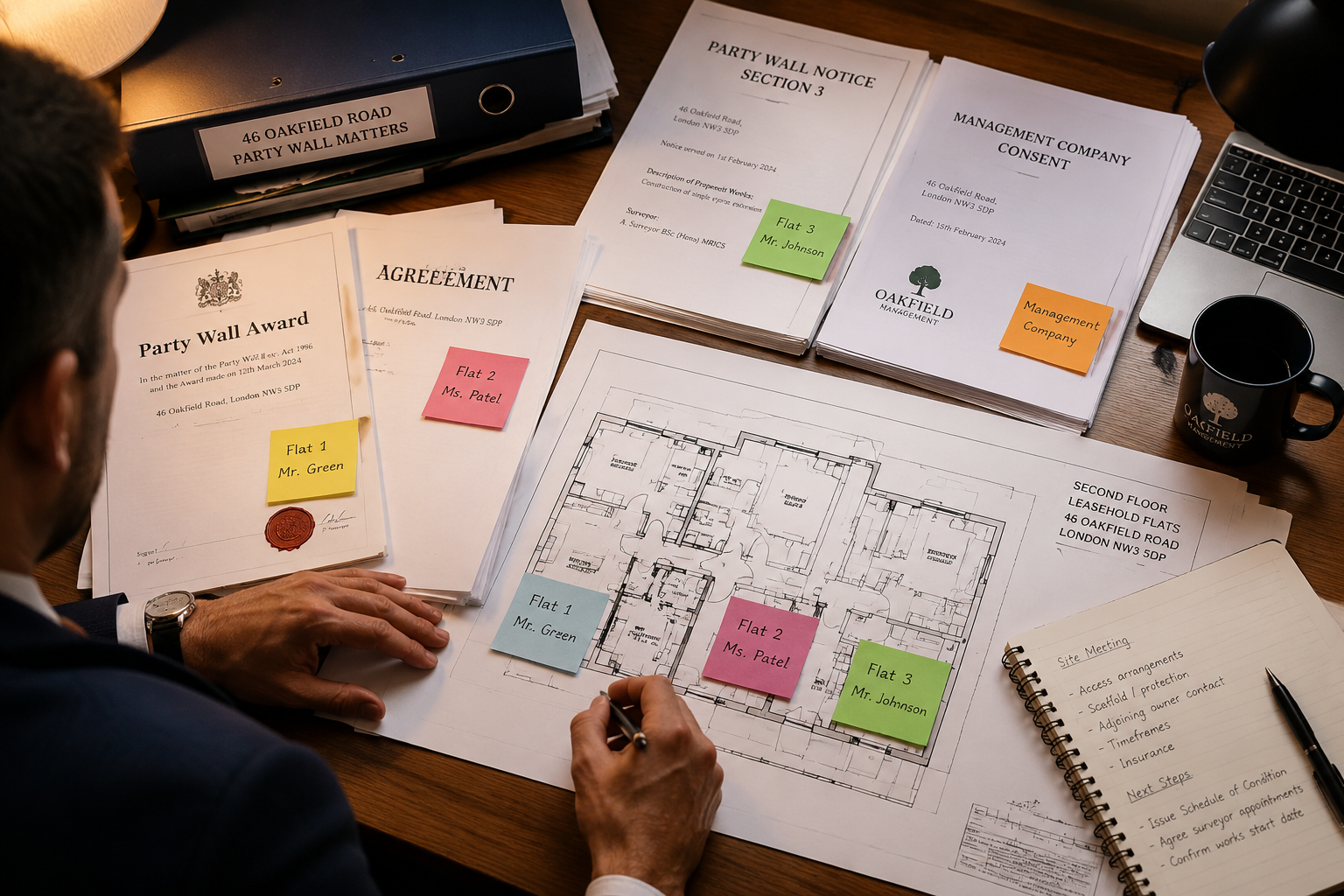
Understanding the Consent Chain: Leasehold, Freehold, and the Party Wall Act
The Leasehold Layer
Most flat owners in England and Wales are leaseholders. They own the right to occupy their flat for a fixed term, but the structure of the building — the walls, floors, ceilings, and foundations — typically belongs to the freeholder. This has a direct impact on party wall procedures.
When a leaseholder wants to carry out structural work, they generally need:
- Consent from the freeholder or management company (via a Licence to Alter)
- Party Wall notices served on all adjoining owners under the 1996 Act
- Building regulations approval for structural changes
These three processes are independent of each other. Completing one does not satisfy the others. A Party Wall Award does not replace a Licence to Alter, and vice versa.
What Is a Licence to Alter?
A Licence to Alter is a formal document granted by the freeholder (or management company acting on their behalf) that permits a leaseholder to carry out alterations to the demised premises. It typically includes:
| Licence to Alter Element | Purpose |
|---|---|
| Scope of approved works | Defines exactly what is permitted |
| Structural engineer sign-off | Confirms works are safe |
| Reinstatement obligations | Protects the freeholder's asset |
| Insurance requirements | Ensures adequate cover during works |
| Surveyor's schedule of condition | Records pre-works condition |
The licence and the Party Wall Award serve different masters. The licence protects the freeholder's proprietary interest; the Award protects the structural and legal rights of adjoining owners.
Where Management Companies Fit In
In many leasehold blocks, a Residents' Management Company (RMC) or a Right to Manage (RTM) company sits between the freeholder and the leaseholders. This adds another layer of complexity.
Management companies are not automatically party wall parties under the 1996 Act. Their role is to manage the building under the terms of the head lease — not to adjudicate party wall disputes. However, they often:
- Control access to common parts needed for survey work
- Hold building insurance that may be affected by structural alterations
- Have the power to grant or withhold a Licence to Alter
- Appoint their own surveyors to review proposed structural works
A surveyor advising a leaseholder client must understand that getting a Party Wall Award in place does not guarantee the management company will grant access or approve the works. Both tracks must be pursued simultaneously.
How Surveyors Handle Multi-Owner Buildings: The Practical Process
Step 1: Identify All Adjoining Owners 🔍
In a flat, "adjoining owner" under the Act means any owner whose property adjoins or is connected to the structure being altered. This includes:
- The flat directly above
- The flat directly below
- Flats sharing a dividing wall
- The freeholder (who owns the structure itself)
In a block of 20 flats, a ground-floor alteration affecting the foundations could theoretically require notices to every owner in the building. Surveyors must carry out a thorough ownership search — often using Land Registry title registers — before issuing any notices.
For guidance on what triggers notice requirements, the three-metre rule explained here is essential reading for anyone planning excavation near a shared structure.
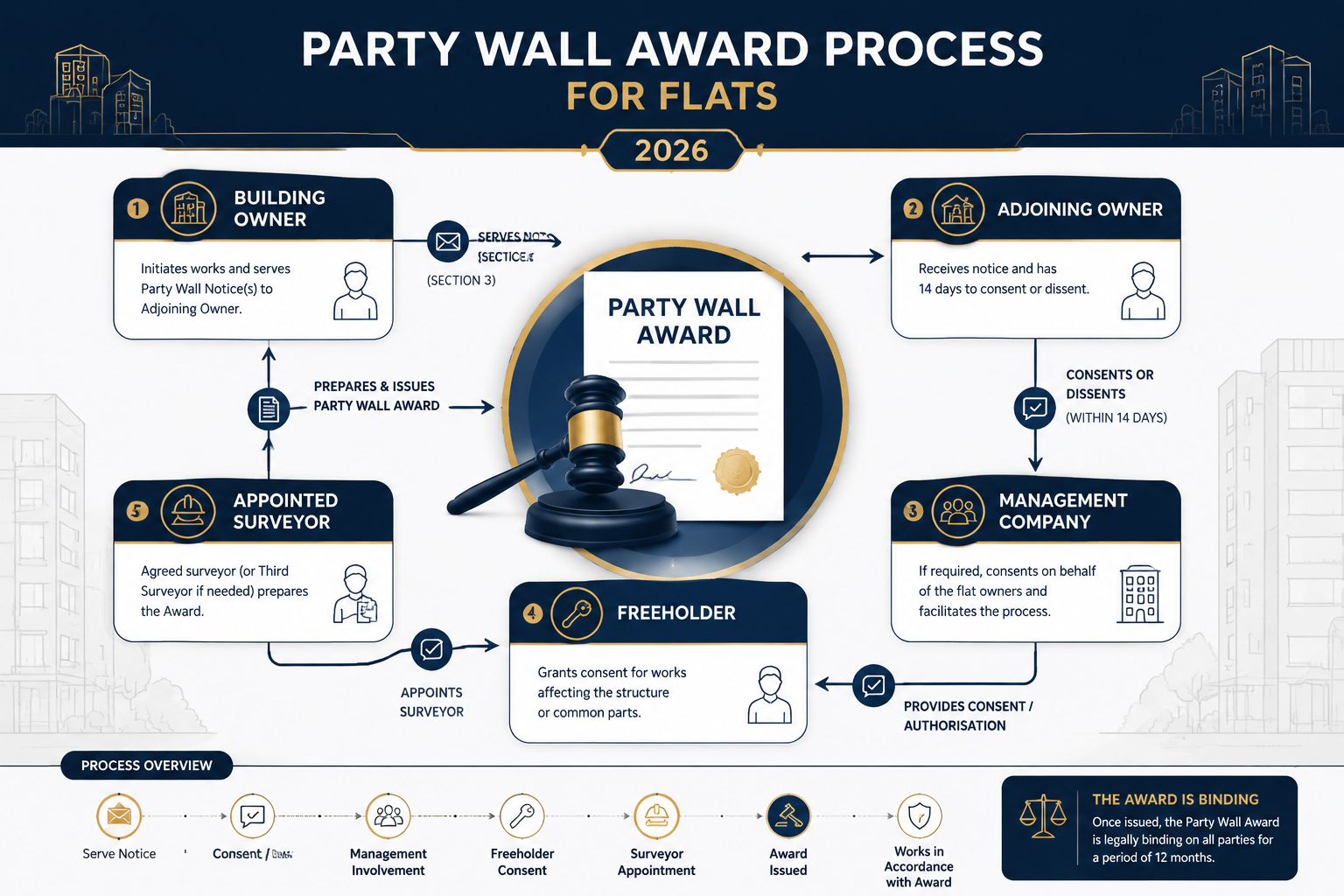
Step 2: Serve the Correct Notices
The 1996 Act provides for three types of notice:
- Party Structure Notice – for works to a party wall or floor/ceiling
- Line of Junction Notice – for building a new wall at the boundary
- Three Metre Notice – for excavations within 3 metres of an adjoining structure
In a flat, the Party Structure Notice is most commonly required. It must be served at least two months before works begin. Failure to serve notice correctly can expose the building owner to injunctions and damages. Understanding the consequences of proceeding without a party wall agreement is critical before starting any structural work.
Step 3: Manage Surveyor Appointments
If an adjoining owner dissents to the notice, they are entitled to appoint their own surveyor. In a block with multiple adjoining owners, this can mean:
- Multiple separately appointed surveyors
- A single Agreed Surveyor acting for all parties (only if all consent)
- A Third Surveyor selected in advance to resolve disputes
The costs of adjoining owners' surveyors are typically borne by the building owner. In a large block, this can become a significant expense. For a clearer picture of what these costs involve, reviewing surveyor pricing guides before committing to a project is strongly advisable.

Step 4: Prepare the Party Wall Award
The Party Wall Award is the legal document that governs how works are to be carried out. In a flat context, a well-drafted Award will typically address:
- Scope of permitted works (precisely defined)
- Working hours (especially important in occupied buildings)
- Access rights to adjoining flats for inspection
- Schedule of Condition of all affected properties before works begin
- Dust and noise mitigation measures
- Structural monitoring requirements during works
- Reinstatement obligations if damage occurs
Pull Quote: "A Party Wall Award in a flat block is not a one-page formality. In complex multi-owner buildings, it can run to 50 pages or more — and every clause matters."
The guidance on what a Party Wall Award contains provides a detailed breakdown of what leaseholders and surveyors should expect from this document.
Step 5: Schedule of Condition Reports
Before any structural work begins, surveyors should prepare a Schedule of Condition for all affected neighbouring properties. This photographic and written record protects both parties: it establishes the pre-works baseline and prevents spurious claims for pre-existing damage.
In a flat block, this may require access to multiple properties — which again intersects with management company control over common parts and individual flat owners' willingness to grant access. Dilapidation surveys and schedule of condition reports are a core part of protecting all parties in this process.
Common Complications in Multi-Owner Buildings
Complication 1: The Freeholder Is Also an Adjoining Owner
In many blocks, the freeholder owns the structure and is therefore an adjoining owner for party wall purposes and the party whose consent is needed for a Licence to Alter. This dual role can create confusion about which hat they are wearing at any given time.
Surveyors must be clear: the freeholder's rights as an adjoining owner under the 1996 Act are separate from their contractual rights as freeholder under the lease. Both must be addressed.
Complication 2: Absentee or Unresponsive Owners
In investment-heavy blocks, some flat owners may be overseas or simply unresponsive. The Act provides a mechanism: if an adjoining owner fails to respond within 14 days of a notice, a dispute is deemed to have arisen, triggering the surveyor appointment process. This is not a disaster — it is the Act working as intended.
Complication 3: Works Affecting Shared Services
Structural alterations in flats frequently affect shared drainage, heating pipes, or electrical conduits running through party walls or floors. These works may require additional consents beyond the Party Wall Award, including from utility providers or the management company. A drainage survey before works begin can identify hidden service routes and prevent costly surprises.
Complication 4: Loft Conversions in Converted Houses
Converted Victorian or Edwardian houses — where a single building has been split into multiple flats — present particular challenges. A top-floor leaseholder seeking a loft conversion may need to serve notices on the flat below, the freeholder, and potentially other parties — while also navigating lease restrictions on altering the roof structure.
Party Wall Awards for Structural Alterations in Flats: Key Mistakes to Avoid
Even experienced professionals make errors in this area. The most common mistakes include:
❌ Assuming the management company's approval replaces party wall notices — it does not.
❌ Serving notice only on immediate neighbours — in a flat, the freeholder and owners above/below must also be considered.
❌ Starting works before the Award is signed — this is a legal breach and can result in injunctions.
❌ Failing to obtain a Schedule of Condition — leaving the building owner exposed to inflated damage claims.
❌ Underestimating the timeline — in a complex block, the full party wall process (including Licence to Alter) can take 4–6 months before a spade goes in the ground.
The Role of Structural Surveys in Supporting Party Wall Awards for Structural Alterations in Flats: How Surveyors Handle Multi-Owner Buildings and Management Company Complications
A Party Wall Award does not exist in isolation. It is supported by — and should be informed by — a thorough structural survey of the building. Before any Award is drafted, surveyors need to understand:
- The existing structural condition of party walls and floors
- Whether there are pre-existing cracks, movement, or defects
- How the proposed works interact with the building's structural system
- Whether specialist input (e.g., from a structural engineer) is required
Commissioning a structural survey before serving party wall notices allows the building owner's surveyor to draft a more precise and defensible Award — and reduces the risk of disputes arising mid-project.
In 2026, as apartment refurbishment projects become more ambitious (open-plan conversions, kitchen relocations, bathroom moves), the structural implications of seemingly minor works are frequently underestimated. A specialist defect survey can identify hidden vulnerabilities in party walls before they become expensive problems.
A Practical Timeline for Flat Owners Planning Structural Works
| Stage | Action | Typical Duration |
|---|---|---|
| 1 | Appoint architect/structural engineer | 2–4 weeks |
| 2 | Apply for Licence to Alter from freeholder/management company | 6–12 weeks |
| 3 | Identify all adjoining owners | 1–2 weeks |
| 4 | Serve Party Wall notices | Day 1 of notice period |
| 5 | Await responses / appoint surveyors | 2–6 weeks |
| 6 | Draft and agree Party Wall Award | 4–8 weeks |
| 7 | Obtain Schedule of Condition | 1–2 weeks |
| 8 | Works commence | After Award signed |
Total lead time: 4–6 months minimum in a straightforward case. Complex blocks with multiple adjoining owners can take considerably longer.
Conclusion: Navigating Party Wall Awards in Flats Requires a Joined-Up Approach
The intersection of leasehold law, building management structures, and the Party Wall etc. Act 1996 creates a genuinely complex environment for anyone carrying out structural alterations in a flat. Party Wall Awards for Structural Alterations in Flats: How Surveyors Handle Multi-Owner Buildings and Management Company Complications is not just a procedural challenge — it is a multi-party negotiation that requires careful coordination, clear communication, and expert professional guidance.
Actionable Next Steps ✅
- Before any design work begins, instruct a party wall surveyor to map out all potential adjoining owners and consent requirements.
- Apply for a Licence to Alter from your freeholder or management company at the earliest opportunity — this process often takes longer than expected.
- Serve party wall notices as soon as the design is sufficiently developed — do not wait until planning permission is granted.
- Commission a structural survey to inform the Award and protect against spurious damage claims.
- Budget for multiple surveyor fees if the block has several adjoining owners who dissent.
- Do not start works until both the Party Wall Award is signed and the Licence to Alter is in place.
Working with experienced local chartered surveyors who understand the specific challenges of multi-owner buildings is the single most effective way to navigate this process successfully — and avoid the costly disputes that arise when it goes wrong.