Every year in the UK, thousands of property owners receive a notice that fundamentally changes their lives — a Compulsory Purchase Order (CPO). In 2026, with major infrastructure programmes including HS2 Phase 2 works, National Highways road improvements, and numerous local authority regeneration schemes still active, the volume of CPO-related compensation claims remains significant. Yet many property owners — and even some surveyors — underestimate how technically demanding Compulsory Purchase Valuations in the UK: How Surveyors Build Defensible Evidence for Compensation Claims truly is. Getting the valuation wrong, or failing to document it properly, can cost claimants tens of thousands of pounds.
This guide explains the legal framework, the valuation principles, and — critically — how experienced surveyors construct evidence that holds up under scrutiny at the Upper Tribunal (Lands Chamber).
Key Takeaways 📌
- The "no scheme" rule is the cornerstone of CPO valuation — compensation must reflect what the property would be worth without the acquiring authority's scheme.
- Compensation is not just about land value; disturbance losses, injurious affection, and severance can collectively exceed the land value itself.
- Betterment can legally reduce compensation where the remaining land benefits from the scheme.
- Surveyors must produce defensible, evidence-based reports that can withstand cross-examination at the Upper Tribunal.
- Early engagement with a registered RICS valuer is essential — delays can weaken the evidence base.
The Legal Framework Behind Compulsory Purchase Valuations in the UK
What Is a Compulsory Purchase Order?
A Compulsory Purchase Order is a legal mechanism that allows public bodies — including local authorities, National Highways, Network Rail, and other statutory undertakers — to acquire private land and property without the owner's consent, provided it is for a public purpose. The power must be authorised by Parliament or a confirming minister.
The key legislation includes:
| Legislation | Key Provision |
|---|---|
| Land Compensation Act 1961 | Rules for assessing market value |
| Compulsory Purchase Act 1965 | Procedure for acquisition |
| Land Compensation Act 1973 | Disturbance, home loss, farm loss payments |
| Planning and Compulsory Purchase Act 2004 | Modernised CPO procedures |
| Neighbourhood Planning Act 2017 | Advanced payments and interest |
The Six Rules of Compensation
Section 5 of the Land Compensation Act 1961 sets out the foundational rules. The most important are:
- Rule 2: The value of land is the amount a willing seller would accept from a willing buyer in the open market.
- Rule 6: The value must ignore any increase or decrease caused by the scheme itself.
💬 "The claimant is entitled to be put in the same financial position as if the acquisition had not taken place — no better, no worse."
This principle of equivalence underpins every element of a CPO compensation claim.
How Surveyors Build Defensible Evidence for Compensation Claims
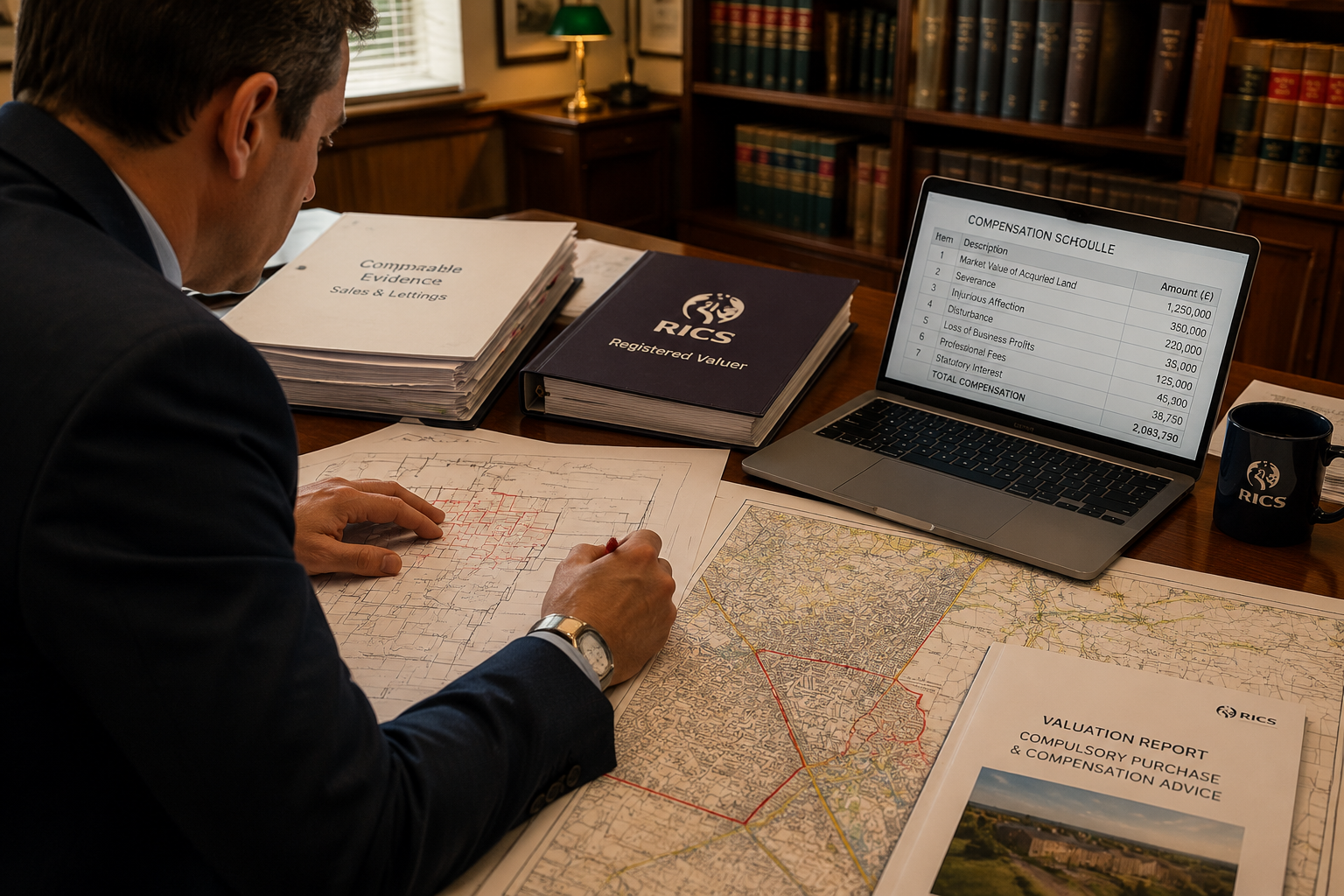
Building a defensible compensation claim requires far more than a standard market appraisal. Surveyors working on Compulsory Purchase Valuations in the UK must construct a layered evidence file that addresses each head of claim separately and anticipates the acquiring authority's counter-arguments.
Step 1: Establishing the "No Scheme" World
The no scheme rule (also called the Pointe Gourde principle, now codified in the 1961 Act as amended) requires surveyors to value the land as if the CPO scheme had never been proposed. This is technically challenging because:
- Comparable transactions may themselves have been influenced by the scheme (blight, hope value changes).
- Planning assumptions must be assessed under the 1961 Act's certificate of appropriate alternative development (CAAD) process.
- The "scheme" must be correctly defined — this is often disputed.
Practical approach: Surveyors typically search for comparable transactions that pre-date scheme announcement or are geographically unaffected by it, then apply adjustments for time, location, and condition.
Step 2: Valuing the Land Taken
For residential and small commercial properties, the primary valuation method is comparable market analysis. The surveyor must:
- Identify genuinely comparable transactions (same use class, similar size, condition, and location).
- Adjust for differences in time, condition, and specification.
- Apply the no scheme filter to exclude blight-affected sales.
- Produce a clear, auditable schedule of comparables with sources and adjustments shown.
For commercial properties, an investment or income approach may be appropriate alongside comparables. A commercial building survey can also inform the condition-adjusted value, particularly where deferred maintenance affects the assessment.
Step 3: Disturbance Losses 🏠
Disturbance is often the most contentious and financially significant head of claim for residential and small business owners. It covers all losses that flow from the displacement — provided they are:
- Caused by the compulsory acquisition.
- Not too remote (the legal test of reasonable foreseeability applies).
- Reasonably mitigated by the claimant.
Common disturbance items include:
- Removal and storage costs
- Professional fees (surveyor, solicitor, accountant)
- Temporary accommodation costs
- Loss of goodwill for businesses
- Redundancy costs
- Adaptation costs at a new property
- Mortgage redemption penalties
⚠️ Important: Disturbance is only payable where the claimant has a compensatable interest (freehold or qualifying leasehold). Licensees and short-term tenants have limited rights.
Surveyors must obtain documentary evidence for every disturbance item — receipts, invoices, business accounts, and professional fee schedules. Unsubstantiated claims will be rejected.
Step 4: Injurious Affection and Severance
Where only part of a property is acquired, the remaining land may suffer a reduction in value. This is compensated under two heads:
- Severance: The diminution in value of the retained land caused by its separation from the acquired part (e.g., a field split by a new road).
- Injurious affection: The diminution in value of the retained land caused by the execution or use of the scheme (e.g., noise, vibration, dust from a nearby bypass).
Injurious affection claims are notoriously difficult to quantify. Surveyors typically use before and after valuations — comparing the value of the whole property immediately before the notice to treat with the value of the retained land immediately after. The difference, less the value of the land taken, represents the combined severance and injurious affection claim.
For properties near major infrastructure, a specialist defect survey may be needed to establish pre-existing condition and separate scheme-related damage from pre-existing issues.
Step 5: Betterment — The Acquiring Authority's Counter-Claim
Betterment is the acquiring authority's right to set off any increase in the value of the retained land that results from the scheme. For example, if a new road improves access to a retained commercial site, the authority can reduce the total compensation by the amount of that increase.
Surveyors acting for claimants must be alert to betterment arguments and be prepared to challenge them with evidence. Key questions include:
- Is the benefit certain or merely speculative?
- Does the benefit arise from the same scheme as the acquisition?
- Has the benefit already been reflected in the market value of the retained land?
The Evidence File: What Makes a Claim Defensible in the UK

A compensation claim that cannot be tested, challenged, and defended at tribunal is not a claim — it is an aspiration. Compulsory Purchase Valuations in the UK: How Surveyors Build Defensible Evidence for Compensation Claims requires surveyors to think like expert witnesses from day one.
The RICS Red Book and Expert Witness Standards
All formal CPO valuations must comply with the RICS Valuation — Global Standards (Red Book) and, where the matter is likely to proceed to tribunal, the RICS Practice Statement on Surveyors Acting as Expert Witnesses. Key obligations include:
- The surveyor's overriding duty is to the tribunal, not the client.
- Opinions must be honestly held and capable of being substantiated.
- All assumptions and limitations must be clearly stated.
- The report must be signed with a statement of truth.
Understanding valuation factors that affect market value is foundational — but in CPO work, those factors must be filtered through the no-scheme lens.
Structuring the Valuation Report
A well-structured CPO valuation report typically contains:
- Instructions and scope — what was asked, by whom, and on what basis.
- Description of the property — tenure, condition, use, planning history.
- The no-scheme analysis — how the scheme has been defined and excluded.
- Market evidence — comparable transactions with full details and adjustments.
- Valuation of land taken — methodology, inputs, conclusion.
- Disturbance schedule — itemised losses with supporting documents.
- Severance and injurious affection — before and after valuations.
- Betterment — analysis of any authority claims.
- Summary of total compensation — presented as a schedule.
- Expert declaration — RICS-compliant statement of truth.
The Role of the Upper Tribunal (Lands Chamber)
If the acquiring authority and the claimant cannot agree compensation, either party may refer the matter to the Upper Tribunal (Lands Chamber). The Tribunal hears expert evidence from surveyors on both sides and makes a binding determination.
Surveyors who have not built their evidence file with tribunal scrutiny in mind will find their claims significantly reduced. Common weaknesses include:
- 🔴 Comparables that are not genuinely comparable (different use, tenure, or condition).
- 🔴 Disturbance items without documentary support.
- 🔴 Failure to apply the no-scheme rule consistently.
- 🔴 Injurious affection claims based on opinion rather than market evidence.
- 🔴 Ignoring or inadequately addressing betterment.
Practical Tips for Surveyors 🛠️
- Inspect early. A thorough RICS Level 3 Building Survey of the subject property establishes a clear baseline for condition — essential for both valuation and disturbance claims.
- Photograph everything. Dated photographic evidence of condition, use, and layout is invaluable at tribunal.
- Track the market. Compile comparable evidence as soon as the CPO is confirmed — market conditions change, and contemporaneous data is more persuasive.
- Engage early with the authority. Many claims are settled by negotiation. Early, well-evidenced engagement often produces better outcomes than waiting for tribunal.
- Consider advance payments. Under the Neighbourhood Planning Act 2017, claimants can request an advance payment of 90% of the authority's estimate — useful for cash flow during a prolonged process.
Special Considerations for Residential and Small Commercial Properties
Residential Owners: Home Loss and Basic Loss Payments
In addition to market value and disturbance, residential owner-occupiers are entitled to a Home Loss Payment — currently set at 10% of the market value of the dwelling, subject to a minimum and maximum prescribed by statutory instrument. This payment is automatic and does not require proof of loss.
Tenants displaced from their homes may be entitled to a Basic Loss Payment (2.5% of market value, subject to caps) and disturbance payments.
Small Business Owners: Loss Payments and Goodwill
Small businesses forced to relocate or close face some of the most complex compensation claims. Key issues include:
- Loss of goodwill: Where a business cannot be relocated (e.g., a location-dependent retail business), the total loss of goodwill is compensatable. Where relocation is feasible, only the loss attributable to the move is recoverable.
- Disturbance of trade: Temporary loss of profit during the move, set-up costs at new premises, and retraining costs are all potentially recoverable.
- Fixtures and fittings: Tenant's improvements and trade fixtures are valued separately.
Business accounts for at least three years prior to the notice to treat are essential evidence. Surveyors should work closely with the claimant's accountant to ensure figures are consistent and defensible.
For properties with lease complications — such as a short lease or a lease approaching renewal — lease extension valuation expertise may be needed to correctly assess the compensatable interest.
Statutory Blight Notices
Property owners whose land is blighted by a proposed scheme — even before a CPO is confirmed — may be able to serve a Statutory Blight Notice on the authority, requiring it to purchase the property at unblighted market value. This is an important but underused remedy for owners who cannot sell at a fair price.
Testing Valuation Evidence: How the Tribunal Evaluates Competing Claims
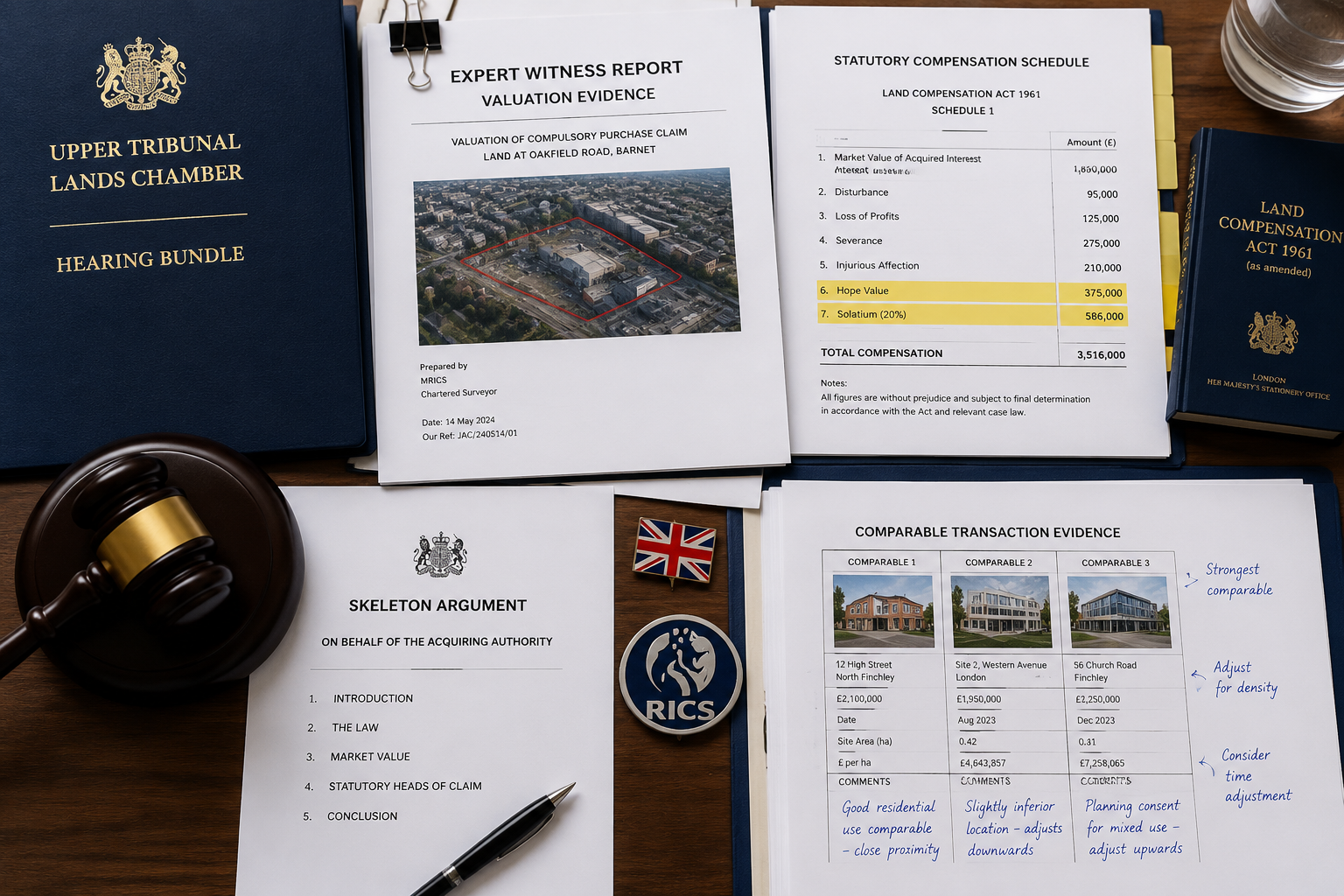
When a CPO compensation dispute reaches the Upper Tribunal, the Members assess the competing expert evidence against several criteria:
| Criterion | What the Tribunal Looks For |
|---|---|
| Relevance of comparables | Same use, tenure, condition, and proximity to subject |
| Consistency of approach | No-scheme rule applied uniformly throughout |
| Transparency of adjustments | All adjustments explained and quantified |
| Documentary support | Disturbance items evidenced by invoices and records |
| Reasonableness of opinion | Conclusions within a defensible range |
The Tribunal has the power to determine compensation at any figure — it is not bound by either party's position. This means a poorly evidenced claim can result in a lower award than the authority's own offer.
💬 "The strength of a CPO compensation claim lies not in its ambition but in the quality of the evidence that supports it."
Surveyors working in London and the South East — where major infrastructure projects frequently intersect with high-value residential and commercial property — should ensure they have access to local market expertise. Whether the property is in Central London, Surrey, or Essex, hyper-local comparable evidence is far more persuasive than regional averages.
Conclusion: Actionable Next Steps for Property Owners and Surveyors
Compulsory Purchase Valuations in the UK: How Surveyors Build Defensible Evidence for Compensation Claims is a discipline that rewards preparation, precision, and professional rigour. The difference between a well-evidenced claim and a weak one can be measured in tens — or hundreds — of thousands of pounds.
If You Are a Property Owner Facing a CPO:
- ✅ Appoint a specialist RICS-registered surveyor immediately — do not rely on the acquiring authority's valuation.
- ✅ Preserve all financial records — business accounts, receipts, and invoices relating to the property.
- ✅ Commission a condition survey before any works begin to establish a clear baseline.
- ✅ Request an advance payment if cash flow is a concern.
- ✅ Do not accept the first offer without independent valuation advice.
If You Are a Surveyor Building a CPO Evidence File:
- ✅ Apply the no-scheme rule rigorously and document your reasoning.
- ✅ Build a comparable evidence schedule with full adjustments shown.
- ✅ Itemise every disturbance loss with supporting documents.
- ✅ Produce before-and-after valuations for severance and injurious affection.
- ✅ Write your report as if it will be read by a Tribunal Member — because it may well be.
The stakes in compulsory purchase are high for everyone involved. With the right evidence, built on sound valuation principles and RICS standards, claimants can secure the full compensation they are legally entitled to — and surveyors can demonstrate the expertise that defines their professional value.