
Canterbury & Kent
Geopolitical Uncertainty in RICS February 2026 Survey: Expert Witness Preparation for Valuation Volatility Disputes
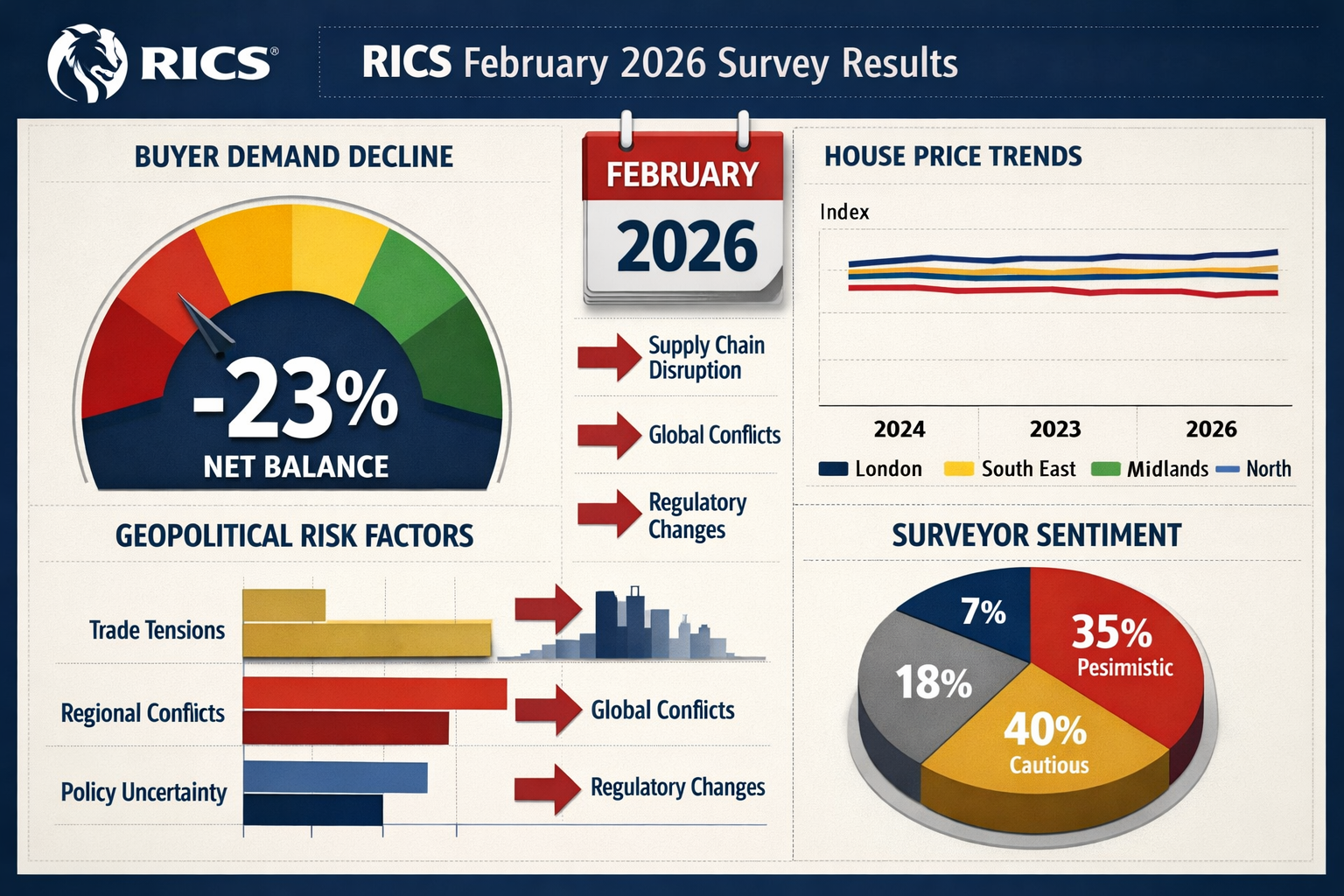
The Royal Institution of Chartered Surveyors (RICS) February 2026 survey reveals a stark reality: buyer demand has dipped significantly while property prices remain stubbornly flat across major UK markets. This combination creates a perfect storm for valuation disputes, particularly as geopolitical factors—from trade tensions to regional conflicts—increasingly influence property market dynamics. Geopolitical Uncertainty in RICS February 2026 Survey: Expert Witness Preparation for Valuation Volatility Disputes has become the critical focus for surveyors who must now defend their professional opinions in an environment where traditional valuation methodologies face unprecedented challenges.
For the first time in Europe’s risk landscape, geopolitics has emerged as the primary concern, surpassing even climate-related risks in expert assessments.[1] This shift fundamentally alters how property valuations must be approached, documented, and defended in legal proceedings. Expert witnesses now face the complex task of explaining how global uncertainty translates into local market volatility while maintaining professional credibility under cross-examination.
Key Takeaways
- 📊 RICS February 2026 data shows buyer demand declining while prices remain flat, creating ideal conditions for valuation disputes driven by market uncertainty
- ⚖️ Geopolitical factors now rank as Europe’s top risk, requiring expert witnesses to incorporate global uncertainty into valuation defense strategies
- 📋 Enhanced documentation standards from RICS MODUS guidance (January 2026) provide critical frameworks for supporting valuation opinions in litigation
- 🎯 50% of global leaders anticipate turbulent market conditions over the next two years, making robust valuation methodologies essential for dispute resolution[2]
- 💼 Expert witness preparation must now address geopolitical volatility as a standard component of property valuation testimony and cross-examination defense
Understanding the RICS February 2026 Survey Context
The February 2026 RICS survey data presents a challenging landscape for property professionals. Buyer demand indicators have softened across residential and commercial sectors, yet price adjustments remain minimal. This disconnect signals market paralysis—potential buyers hesitate amid uncertainty while sellers resist price reductions, hoping for stability to return.
Why does this matter for expert witnesses? When markets freeze, disputes multiply. Parties to transactions, divorce settlements, compulsory purchase proceedings, and lease renewals increasingly challenge valuations that don’t align with their expectations. The gap between what sellers believe properties are worth and what buyers will pay creates fertile ground for litigation.
The Geopolitical Risk Factor
Geopolitical uncertainty has moved from background noise to center stage. According to recent risk assessments, geopolitics ranked as the main risk by experts in Europe for the first time, while ranking second globally behind climate change.[1] This elevation reflects tangible impacts:
- Trade policy disruptions affecting construction material costs and availability
- Regional conflicts creating investor flight to safety or away from perceived risk zones
- Currency fluctuations impacting international investment flows
- Regulatory uncertainty around cross-border transactions and ownership structures
For registered RICS valuers, these factors complicate the traditional “three approaches” to valuation (comparative, income, and cost methods). How do you weight comparable evidence when market conditions shift monthly? How do you project income streams when tenant demand fluctuates with economic sentiment?
Market Volatility and Valuation Challenges
The World Economic Forum’s Global Risks Report 2026 underscores the scale of uncertainty: 50% of surveyed leaders and experts anticipate either turbulent or stormy conditions over the next two years, rising to 57% for longer timeframes.[2] This sustained uncertainty creates several valuation challenges:
| Challenge | Impact on Valuation | Expert Witness Implication |
|---|---|---|
| Reduced transaction volume | Fewer comparables available | Must justify comparable selection more rigorously |
| Price stagnation | Difficulty establishing market trends | Requires deeper analysis of underlying market drivers |
| Buyer hesitation | Extended marketing periods | Need to explain time-on-market adjustments |
| Lender caution | Conservative lending multiples | Must address financing impact on values |
| Investment uncertainty | Volatile yield requirements | Requires detailed income approach justification |
Geopolitical Uncertainty in RICS February 2026 Survey: Documentation Standards for Expert Witnesses
The RICS MODUS guidance published in January 2026 provides critical frameworks for documentation that expert witnesses must now follow.[4] This guidance emphasizes the need to input survey findings into documentation systems and systematically review documents to corroborate inspection findings.
Enhanced Documentation Requirements
Why documentation matters in disputes: Courts increasingly scrutinize the methodology and evidence supporting valuation opinions. Generic statements about “market conditions” no longer suffice. Expert witnesses must demonstrate:
✅ Systematic data collection showing how geopolitical factors were identified and assessed
✅ Contemporaneous notes documenting market conditions at the valuation date
✅ Comparable analysis with clear adjustment rationale for market volatility
✅ Assumption transparency explicitly stating what geopolitical scenarios were considered or excluded
✅ Limitation acknowledgment recognizing uncertainty ranges in volatile markets
The MODUS guidance aligns with broader professional standards that expert witness surveyors must maintain. Documentation created during the original valuation assignment becomes the foundation for testimony months or years later when disputes reach court.
Integrating Geopolitical Analysis into Valuation Reports
Expert witnesses preparing for disputes involving Geopolitical Uncertainty in RICS February 2026 Survey findings should incorporate specific analytical elements:
1. Market Context Section
Include a dedicated section in valuation reports addressing geopolitical factors current at the valuation date. Reference specific events, policy changes, or international developments that influenced market sentiment. This creates a record showing the valuer was aware of and considered these factors.
2. Scenario Sensitivity Analysis
Present valuation conclusions with sensitivity ranges reflecting different geopolitical scenarios. For example:
- Base case: Current conditions persist for 12 months
- Optimistic case: Trade tensions ease, investor confidence returns
- Pessimistic case: Regional conflicts escalate, market liquidity deteriorates
3. Comparable Evidence Commentary
For each comparable transaction used, note the date and any geopolitical context affecting that transaction. This demonstrates awareness that comparables from different periods may reflect different market conditions.
4. Assumption Register
Maintain a clear register of assumptions, particularly those relating to market stability, policy continuity, or economic conditions. When these assumptions prove incorrect, the register provides evidence that the valuation was reasonable based on information available at the time.
RICS Red Book Compliance Under Uncertainty
The RICS Valuation – Global Standards (Red Book) requires valuers to report any material uncertainty affecting valuations. Geopolitical volatility often triggers this requirement. Expert witnesses must be prepared to explain:
- Why material uncertainty was (or wasn’t) declared at the original valuation date
- What information was available to the valuer regarding geopolitical risks
- How professional judgment was exercised in reaching the valuation conclusion
- Whether subsequent events were reasonably foreseeable at the valuation date
This defense becomes critical when opposing counsel argues that a valuation was negligent for failing to anticipate market movements caused by geopolitical events.
Expert Witness Preparation Strategies for Valuation Volatility Disputes
Preparing to defend valuations in an era of geopolitical uncertainty requires strategic thinking beyond traditional expert witness preparation. The RICS Global Valuation Conference has addressed these challenges, focusing on how economic volatility, evolving standards, and technological change reshape the valuation landscape.[5]
Pre-Litigation Preparation
Before disputes escalate to formal proceedings, expert witnesses should:
🔍 Conduct File Reviews
Systematically review valuation files for completeness, checking that all required documentation under MODUS guidance is present. Identify any gaps early and prepare explanatory notes where documentation is limited.
📚 Update Market Knowledge
Maintain current awareness of how geopolitical events have affected property markets since the valuation date. This enables effective testimony about whether market movements were foreseeable or represented genuine “black swan” events.
🤝 Engage with Legal Teams Early
Work with instructing solicitors to understand the dispute’s nature and the likely challenges to the valuation. Early engagement allows time to gather additional supporting evidence.
📊 Prepare Supplementary Analysis
Develop additional analysis that may not have been in the original report but supports the valuation conclusion. This might include expanded comparable analysis, alternative valuation approaches, or retrospective market data analysis.
Cross-Examination Defense Strategies
When testifying about valuations affected by Geopolitical Uncertainty in RICS February 2026 Survey conditions, expert witnesses face predictable challenges:
Challenge 1: “You Failed to Anticipate Market Changes”
Defense Strategy: Emphasize that valuations reflect conditions at the valuation date, not predictions of future events. Reference the RICS Red Book requirement to value based on information available at the valuation date. Explain that professional standards prohibit incorporating hindsight.
Challenge 2: “Your Comparables Are Outdated”
Defense Strategy: Demonstrate that comparable selection followed professional standards and that adjustments were made for time differences. Show that alternative comparables would have yielded similar conclusions. Reference the February 2026 RICS survey data showing market stagnation, which supports using older comparables when recent transactions are scarce.
Challenge 3: “You Ignored Obvious Warning Signs”
Defense Strategy: Present evidence of the geopolitical analysis conducted, showing that uncertainty was acknowledged and considered. Reference risk assessments current at the valuation date. Explain that professional valuers must balance caution with market reality—excessive pessimism is as unprofessional as excessive optimism.
Challenge 4: “Other Valuers Reached Different Conclusions”
Defense Strategy: Explain that valuation involves professional judgment and that a range of reasonable opinions exists in uncertain markets. Reference the WEF data showing 50% of experts anticipate turbulent conditions,[2] demonstrating that uncertainty itself creates legitimate differences in professional opinion. Show that your conclusion falls within an acceptable range.
Leveraging Technology and Data
Modern expert witness preparation increasingly relies on technology to strengthen valuation defense:
- Automated Valuation Models (AVMs) can provide supporting evidence showing your valuation aligns with algorithmic analysis
- Market data platforms offer historical context demonstrating market conditions at the valuation date
- Geospatial analysis tools can visualize comparable locations and adjustment factors
- Transaction databases provide comprehensive evidence of market activity levels
However, expert witnesses must also be prepared to explain technology’s limitations, particularly in volatile markets where historical patterns may not predict future performance.
Building Credibility Through Professional Development
Courts assess expert witness credibility based on qualifications, experience, and professional standing. In the context of geopolitical uncertainty, demonstrating relevant expertise includes:
- Continuing Professional Development (CPD) specifically addressing geopolitical risk and valuation
- Participation in RICS conferences and working groups focused on valuation challenges
- Publication or presentation on valuation methodology in uncertain markets
- Cross-disciplinary knowledge connecting geopolitical events to property market impacts
This professional foundation enables expert witnesses to speak authoritatively about how geopolitical factors affect valuations, moving beyond generic statements to specific, evidence-based analysis.
Practical Applications: Case Study Scenarios
Understanding how Geopolitical Uncertainty in RICS February 2026 Survey: Expert Witness Preparation for Valuation Volatility Disputes applies in practice requires examining realistic scenarios:
Scenario 1: Commercial Property Investment Dispute
Situation: A pension fund purchased a commercial property portfolio in January 2026 based on valuations showing 6.5% yields. By June 2026, following escalating trade tensions, comparable properties trade at 7.5% yields. The fund alleges negligent valuation.
Expert Witness Defense:
- Present February 2026 RICS survey data showing market conditions at valuation date
- Demonstrate that 6.5% yields reflected market evidence available in January 2026
- Show that yield shift resulted from geopolitical events that were not reasonably foreseeable with specificity
- Reference market commentary from January 2026 showing investor sentiment was cautiously optimistic
- Explain that valuations reflect a point in time, not predictions of geopolitical developments
Key Documentation: Original market research reports, yield analysis from comparable transactions in December 2025-January 2026, investment market commentary from the valuation date period.
Scenario 2: Divorce Settlement Valuation Challenge
Situation: A matrimonial property was valued in March 2026 for divorce settlement purposes. Six months later, one party challenges the valuation, claiming regional instability has reduced the property’s value by 15%.
Expert Witness Defense:
- Explain that divorce valuations must be based on conditions at the valuation date
- Show that March 2026 market conditions were stable based on RICS survey data
- Demonstrate that subsequent value changes don’t invalidate the original valuation
- Present evidence that the property type and location had limited exposure to the specific geopolitical factors cited
- Reference professional standards requiring valuation at a specific date
Key Documentation: Local market transaction evidence from February-April 2026, RICS survey data for the region, analysis showing property type resilience to cited geopolitical factors.
Scenario 3: Compulsory Purchase Compensation Dispute
Situation: A local authority acquired property under compulsory purchase powers, with compensation based on a February 2026 valuation. The owner claims the valuation was too low, citing geopolitical uncertainty that should have warranted a premium for uncertainty.
Expert Witness Defense:
- Explain that compensation valuations follow statutory principles and case law
- Demonstrate that geopolitical uncertainty affects both willing buyers and willing sellers equally
- Show that the valuation reflected market evidence, not theoretical adjustments for uncertainty
- Reference comparable compulsory purchase settlements from the same period
- Explain that professional standards don’t support adding subjective “uncertainty premiums” without market evidence
Key Documentation: Comparable compulsory purchase settlements, market evidence showing actual transaction prices (not theoretical adjustments), analysis of statutory compensation principles.
Emerging Trends and Future Considerations
As we progress through 2026, several trends are reshaping how expert witnesses must approach valuation disputes:
Increased Regulatory Scrutiny
Regulatory bodies worldwide are paying closer attention to valuation practices, particularly for properties securing lending or investment. Expert witnesses should expect questions about compliance with:
- Enhanced due diligence requirements for cross-border transactions
- Sustainability and ESG factors increasingly affecting property values
- Cyber risk and data security considerations for commercial properties
- Climate resilience assessments influencing long-term value projections
Integration of Alternative Data Sources
Traditional valuation evidence is being supplemented with alternative data:
- Satellite imagery tracking construction activity and property usage
- Mobile location data measuring foot traffic for retail valuations
- Social media sentiment analysis for location desirability
- Economic modeling incorporating geopolitical scenario planning
Expert witnesses must understand these tools while being prepared to explain their limitations and appropriate applications.
Cross-Border Valuation Complexity
Geopolitical uncertainty particularly affects cross-border property investment. Expert witnesses working on international disputes must navigate:
- Divergent valuation standards between jurisdictions
- Currency risk and its impact on investment returns
- Political risk assessment methodologies
- Sanctions and restrictions affecting property ownership and transferability
For commercial valuation work involving international investors, these factors require specialized expertise and careful documentation.
Building a Robust Defense Framework
Creating a comprehensive defense framework for valuation disputes in the context of Geopolitical Uncertainty in RICS February 2026 Survey findings requires systematic preparation:
The Five-Pillar Defense Framework
Pillar 1: Documentation Excellence
Maintain comprehensive records showing the valuation process, data sources, analysis, and professional judgment exercised. Follow RICS MODUS guidance rigorously.[4]
Pillar 2: Market Context Awareness
Demonstrate detailed understanding of market conditions at the valuation date, including geopolitical factors. Reference authoritative sources like RICS surveys, economic reports, and market commentary.
Pillar 3: Methodological Rigor
Apply valuation methodologies consistently with professional standards. Show that alternative approaches yield similar conclusions, strengthening the valuation’s reliability.
Pillar 4: Professional Credibility
Maintain qualifications, CPD, and professional memberships. Demonstrate expertise specifically relevant to the property type, location, and market conditions.
Pillar 5: Clear Communication
Explain complex valuation concepts in accessible language. Courts appreciate expert witnesses who can make technical matters understandable without oversimplification.
Collaboration with Legal Teams
Effective expert witness work requires strong collaboration with instructing solicitors and barristers. This includes:
- Joint strategy sessions to understand the case theory and how valuation evidence supports it
- Mock cross-examination practice to prepare for challenging questions
- Document review coordination ensuring all relevant evidence is disclosed appropriately
- Timeline development showing the sequence of events and information availability
For complex disputes, consider engaging expert witness surveyors early in the litigation process, allowing adequate time for thorough preparation.
Continuous Market Monitoring
Expert witnesses should maintain ongoing awareness of:
- RICS survey releases tracking market sentiment and activity levels
- Geopolitical developments affecting property markets
- Case law establishing precedents for valuation disputes
- Professional guidance updates from RICS and other bodies
This continuous monitoring ensures expert testimony reflects current professional understanding and market realities.
Conclusion
The intersection of geopolitical uncertainty and property valuation has created unprecedented challenges for expert witnesses in 2026. The RICS February 2026 survey data, showing buyer demand dips and price stagnation, provides concrete evidence of market paralysis driven by global uncertainty. For expert witnesses, this environment demands enhanced preparation, rigorous documentation, and sophisticated defense strategies.
Geopolitical Uncertainty in RICS February 2026 Survey: Expert Witness Preparation for Valuation Volatility Disputes represents more than a technical challenge—it reflects the fundamental shift in how property markets operate in an interconnected, volatile world. Expert witnesses who master the integration of geopolitical analysis with traditional valuation methodology will be best positioned to defend their professional opinions effectively.
Actionable Next Steps
For surveyors and expert witnesses preparing for valuation disputes in this environment:
- Review existing valuation files against RICS MODUS guidance standards, identifying documentation gaps
- Develop geopolitical risk assessment frameworks that can be consistently applied across valuations
- Engage in targeted CPD focusing on geopolitical factors affecting property markets
- Build relationships with legal professionals who specialize in property disputes
- Create template documentation incorporating geopolitical context sections
- Establish market monitoring systems to track relevant developments systematically
- Practice explaining complex concepts in clear, accessible language suitable for court testimony
The property valuation profession faces a period of heightened scrutiny and challenge. However, expert witnesses who embrace rigorous methodology, comprehensive documentation, and clear communication will not only successfully defend their valuations but also strengthen professional standards for the entire industry.
As geopolitical uncertainty continues to shape market dynamics through 2026 and beyond, the ability to bridge global events and local property values becomes an essential professional skill. Expert witnesses who develop this capability will provide invaluable service to clients, courts, and the property profession.
References
[1] 2026 03 02 Geopolitics In The Boardroom Risk Analysis And Anticipation – big-europe.eu
[2] Wef Global Risks Report 2026 – reports.weforum.org
[4] Modus By Rics January 2026 – rics.org
[5] Global Valuation Conference – rics.org
Related services from Canterbury Surveyors
Get a fixed-fee quote or call 0204 579 8270.