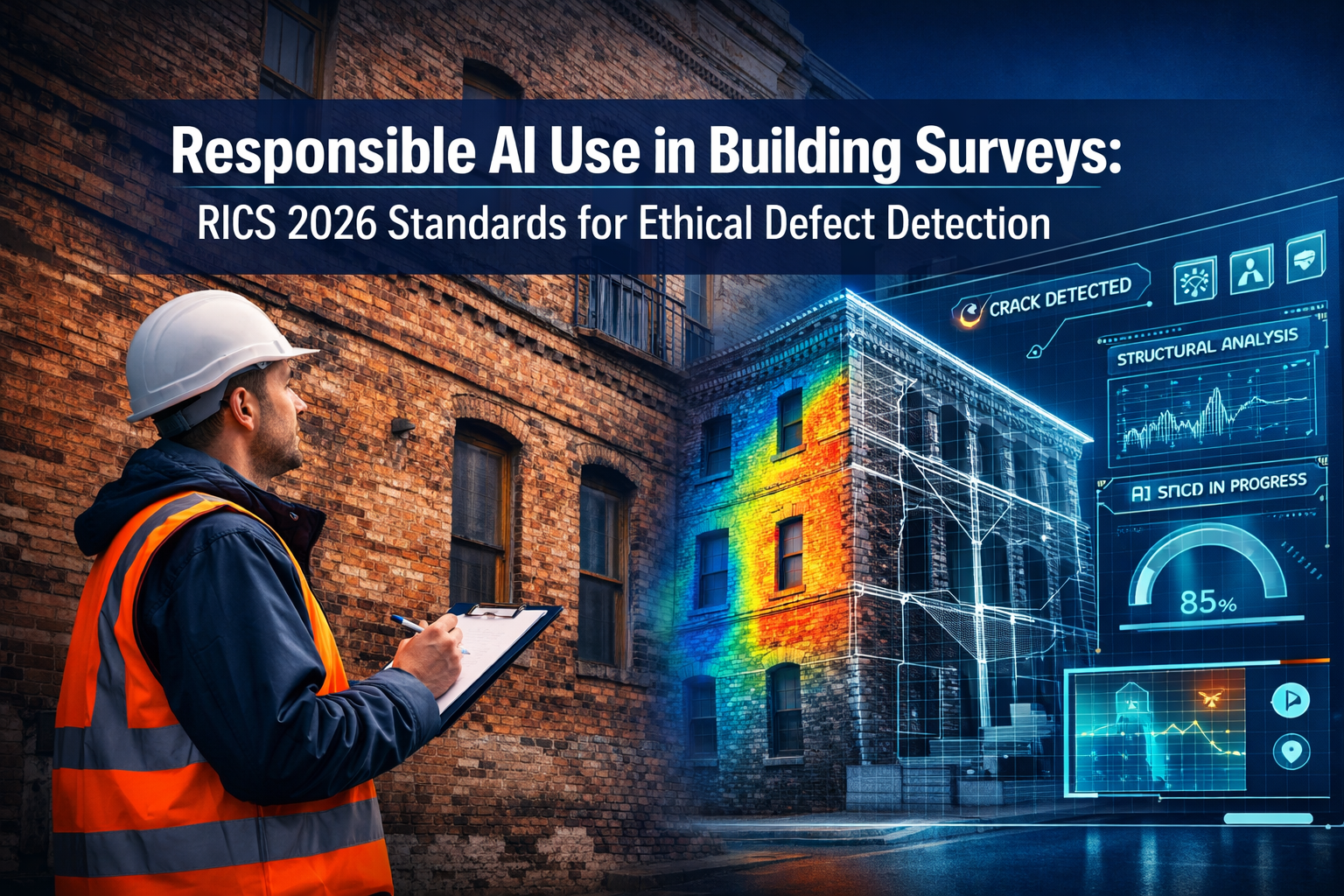
Artificial intelligence now analyzes building defects faster than any human surveyor—but who takes responsibility when the algorithm misses a critical structural crack? As of March 9, 2026, the Royal Institution of Chartered Surveyors (RICS) has answered this question with the world's first mandatory global standard governing Responsible AI Use in Building Surveys: RICS 2026 Standards for Ethical Defect Detection and Reporting. This groundbreaking regulation fundamentally reshapes how surveyors integrate machine learning, computer vision, and automated reporting tools while maintaining the professional accountability that clients depend on.
The new standard affects every RICS member and regulated firm worldwide, establishing clear boundaries for AI deployment in valuation, construction, infrastructure, and land services.[3] For building surveyors specifically, this means navigating the intersection of cutting-edge defect detection technology and time-honored professional ethics—a balance that promises faster inspections without compromising trust or accuracy.
Key Takeaways
- Mandatory compliance for all RICS members worldwide began March 9, 2026, following a six-month preparation period after September 2025 publication.[3]
- Named surveyor accountability requires identification of a qualified professional responsible for all AI outputs with material impact on service delivery.[1]
- Client notification and opt-out rights mandate written disclosure when AI assists in surveys, giving clients choice in service delivery methods.[3]
- Professional oversight remains essential: surveyors must validate all AI-generated content, ensuring accuracy and contextual appropriateness.[4]
- Governance frameworks must address data usage, system reliability, risk management, and procurement due diligence for AI tools.[3]
Understanding the RICS 2026 AI Standard Framework
The RICS Professional Standard on Responsible Use of AI represents a paradigm shift in how technology integrates with traditional surveying practice. Rather than prohibiting AI or allowing unchecked automation, the standard creates a structured framework that enables innovation while protecting client interests and professional integrity.
Core Principles of Responsible AI Use in Building Surveys
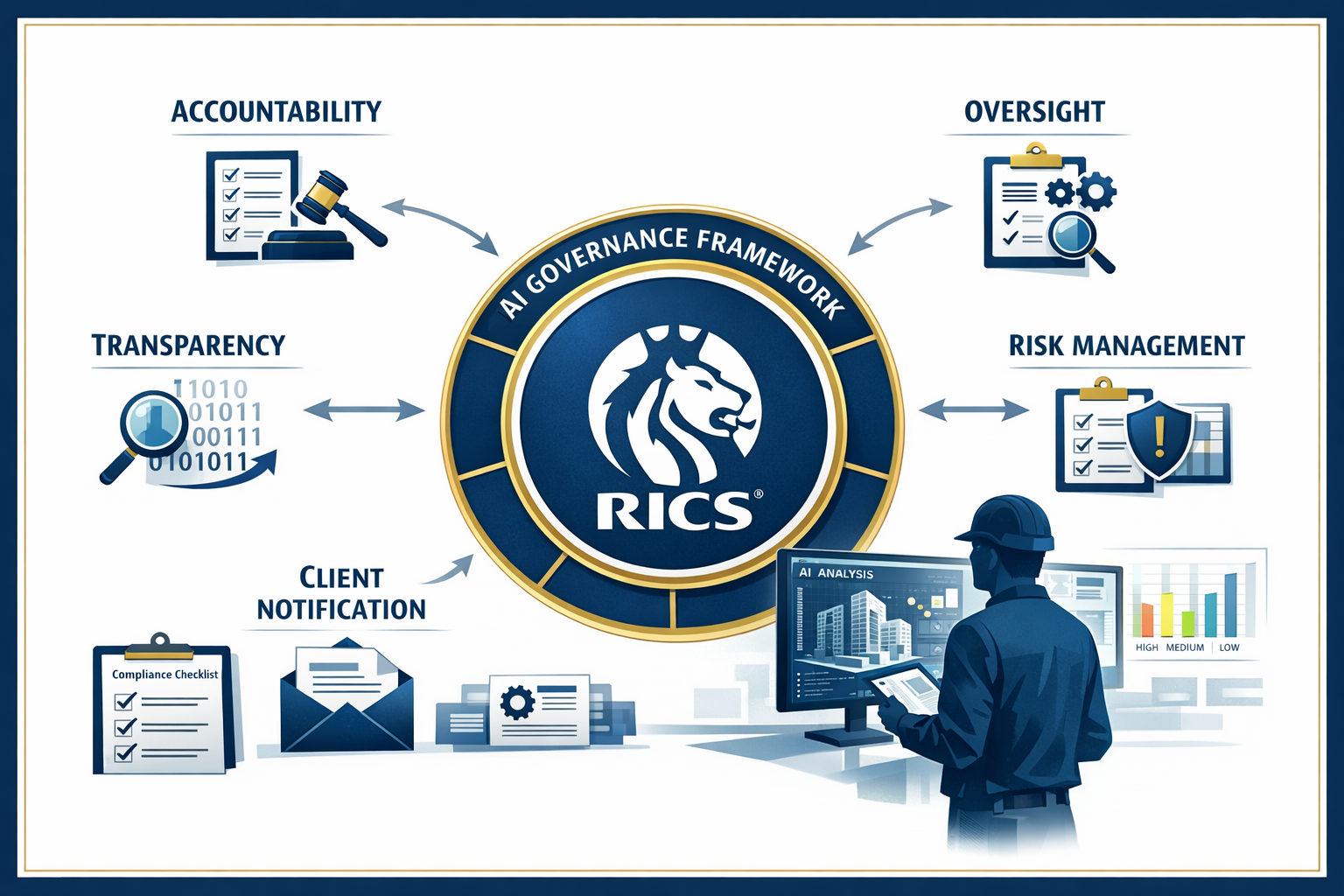
The standard rests on five foundational principles that govern Responsible AI Use in Building Surveys: RICS 2026 Standards for Ethical Defect Detection and Reporting:
🎯 Accountability and Ownership
Every AI-assisted survey must have a named, appropriately qualified surveyor who accepts responsibility for outputs. This principle directly addresses the "accountability gap" that emerges when automated systems generate professional advice. Whether AI identifies damp in a Level 2 Homebuyer Survey or flags structural concerns in a specialist defect survey, a human professional must stand behind the findings.[1]
📋 Transparency and Client Disclosure
RICS members must notify clients in writing when AI contributes to service delivery. This notification isn't buried in terms and conditions—it requires explicit, clear communication that allows clients to make informed decisions. Critically, clients retain the right to opt out of AI-assisted services entirely, preserving traditional survey methods for those who prefer them.[3]
👁️ Human Oversight and Validation
The standard makes professional review non-negotiable. Surveyors cannot simply accept AI outputs at face value. They must critically evaluate automated defect detection results, cross-reference findings with physical evidence, and apply professional judgment to contextual factors the system may overlook. This requirement ensures that RICS building surveys maintain their reputation for thoroughness and accuracy.[4]
⚖️ Risk Management and Governance
Firms must establish documented risk registers that identify potential AI-related issues: data quality problems, algorithmic bias, system failures, or inappropriate application contexts. These registers inform ongoing risk management frameworks that evolve as AI capabilities and limitations become clearer through practical use.[3]
🔍 Procurement and Due Diligence
Before deploying any AI tool, firms must conduct thorough due diligence on vendors, algorithms, training data, and output reliability. This process prevents the adoption of "black box" systems that generate results without explainable reasoning—a critical concern when commercial building surveys inform multi-million-pound property transactions.[1]
Material Impact Assessment: When Does AI Require Formal Oversight?
Not every AI application demands the same level of scrutiny. The standard introduces the concept of "material impact"—recognizing that AI tools exist on a spectrum from trivial assistance to critical decision support.
A spell-checker or scheduling algorithm doesn't materially affect survey quality. However, AI that identifies structural defects, estimates repair costs, or generates condition ratings clearly has material impact. RICS expects members to exercise informed professional judgment in determining which systems require formal governance processes.[1]
This nuanced approach prevents bureaucratic overload while ensuring rigorous oversight where it matters most. For instance, AI that analyzes subsidence patterns or evaluates damp survey findings would definitely qualify as material impact, triggering full compliance requirements.
AI Applications in Building Defect Detection and Analysis
The practical applications of Responsible AI Use in Building Surveys: RICS 2026 Standards for Ethical Defect Detection and Reporting extend across multiple surveying activities, each with unique opportunities and challenges.
Computer Vision for Visual Defect Identification
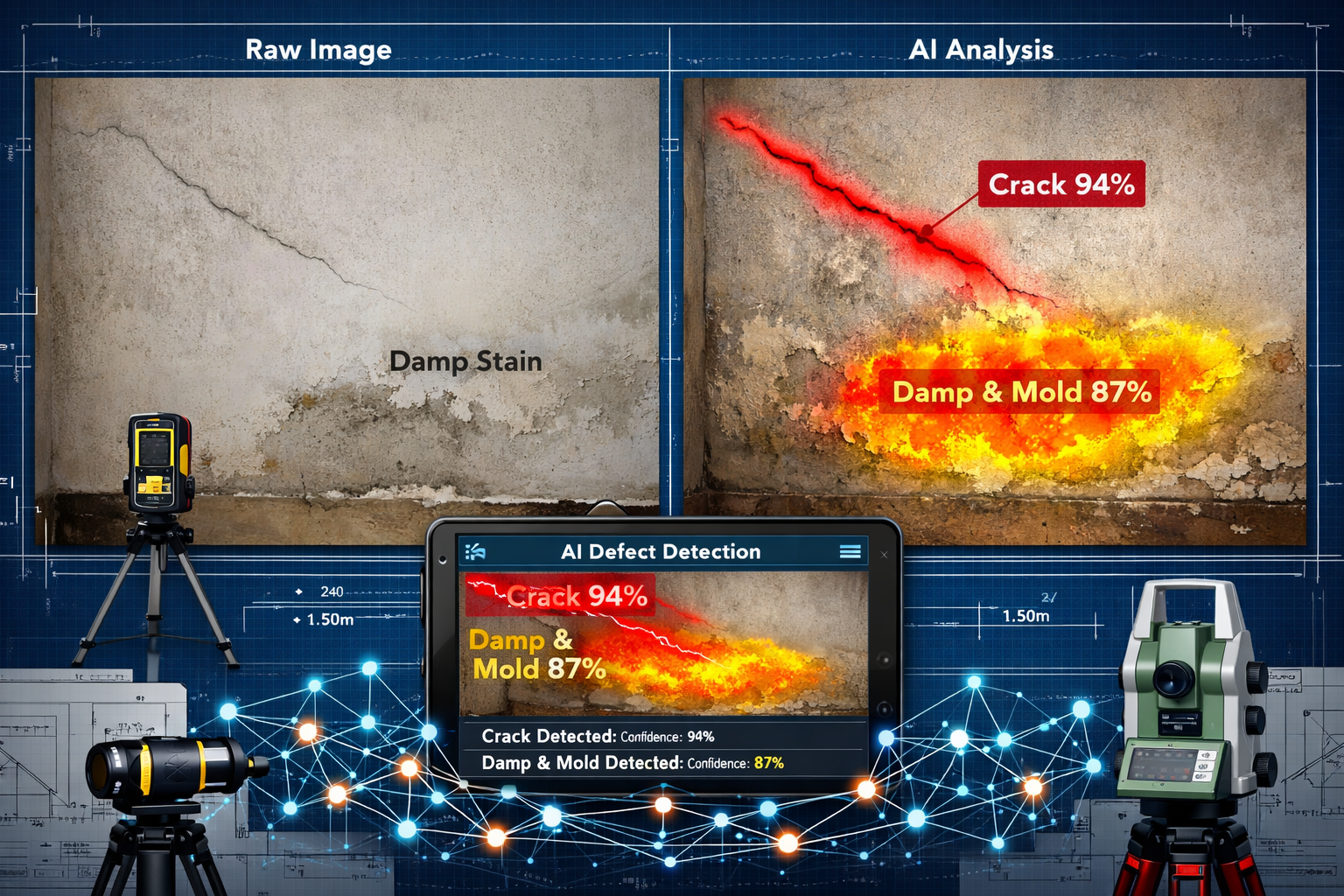
Machine learning algorithms now analyze building photographs and video footage to identify defects that might escape initial human observation. These systems recognize patterns associated with:
- Structural cracks: distinguishing between superficial surface cracks and indicators of serious structural movement
- Moisture damage: detecting discoloration, staining, and surface changes that suggest hidden damp problems
- Corrosion: identifying rust, deterioration, and material degradation in metal components
- Installation defects: spotting incomplete work, improper materials, or construction deviations during building phases[4]
Computer vision excels at processing large volumes of visual data quickly. During roof surveys or structural surveys, drones equipped with AI-enabled cameras can capture thousands of images, with algorithms flagging potential issues for human review.
However, the RICS standard requires surveyors to validate these findings personally. An AI-identified crack might be a shadow, a surface mark, or indeed a serious structural concern—only professional judgment can determine which.
Real-Time BIM Comparison and Design Deviation Detection
Building Information Modeling (BIM) integration represents another frontier for AI in surveying. Advanced systems compare real-time site photography against BIM models and construction schedules, automatically identifying:
- Structural elements installed incorrectly or in wrong locations
- Materials that don't match specifications
- Construction sequence deviations that might affect building performance
- Design changes implemented without proper documentation[4]
This capability proves particularly valuable in commercial building surveys where complex projects involve hundreds of contractors and thousands of individual components. AI can flag discrepancies immediately, enabling project managers to address issues before they become expensive rework problems.
The RICS standard requires that these automated comparisons undergo professional verification. AI might identify a deviation that represents an approved design change, a temporary construction phase, or a genuine defect—context that requires human expertise to interpret correctly.
Thermal Imaging Analysis and Energy Performance Assessment
AI-enhanced thermal imaging takes infrared photography beyond simple temperature mapping. Machine learning algorithms analyze thermal patterns to identify:
- Insulation gaps: areas where heat loss indicates missing or inadequate insulation
- Air leakage: thermal signatures showing uncontrolled ventilation paths
- Moisture intrusion: temperature anomalies suggesting hidden water ingress
- Electrical hotspots: overheating components that pose fire risks
These systems can process thermal imagery from entire building facades in minutes, creating comprehensive heat maps that guide energy efficiency improvements and defect remediation.
Under the RICS framework, surveyors must understand the AI's analytical methodology, recognize its limitations (such as reflective surfaces that confuse thermal readings), and validate findings through complementary inspection methods.
Automated Report Generation and Documentation Standards
Natural language processing (NLP) and large language models (LLMs) have revolutionized survey documentation. These AI systems convert raw data—measurements, photographs, notes, defect classifications—into structured, professional reports that follow RICS formatting standards.
Benefits of AI-Assisted Report Writing
⏱️ Time Efficiency
Report generation traditionally consumes 30-50% of surveyor time. AI reduces this dramatically, converting field data into draft reports within minutes rather than hours. This efficiency allows surveyors to conduct more inspections or dedicate additional time to complex analysis.
📊 Consistency and Standardization
AI ensures uniform terminology, consistent defect categorization, and standardized risk ratings across all reports. This consistency improves client understanding and reduces ambiguity in professional communications.
🔗 Data Integration
Modern AI systems pull information from multiple sources—photographs, measurements, historical records, comparable properties—weaving these elements into cohesive narratives that provide comprehensive property assessments.
Critical Validation Requirements Under RICS Standards
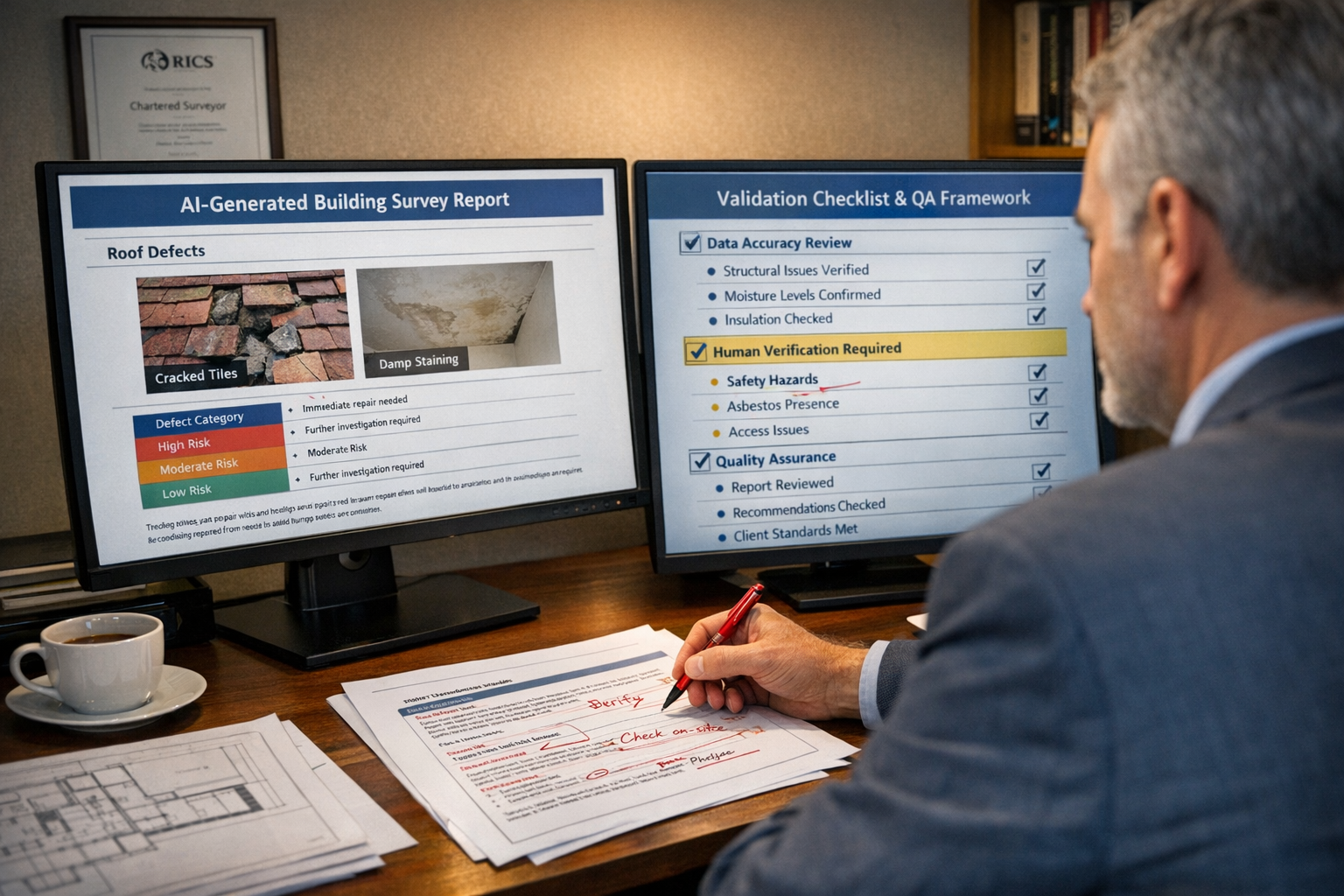
Despite these advantages, Responsible AI Use in Building Surveys: RICS 2026 Standards for Ethical Defect Detection and Reporting mandates rigorous human review of all AI-generated content. Surveyors must verify that:
- Factual accuracy: AI hasn't hallucinated details, misinterpreted data, or included information from wrong properties
- Professional standards compliance: reports meet RICS requirements for content, structure, and disclosure
- Contextual appropriateness: AI recommendations suit the specific property, client needs, and local conditions
- Risk assessment accuracy: defect severity ratings reflect genuine professional judgment, not algorithmic oversimplification[4]
This validation requirement acknowledges a fundamental AI limitation: these systems lack genuine understanding of building pathology, construction methods, and the subtle contextual factors that inform expert judgment. An AI might describe a crack perfectly while completely missing its significance—or lack thereof—in the building's overall condition.
When conducting specific defect reports, surveyors must ensure AI-generated text accurately reflects their professional observations and conclusions, editing or rewriting sections as necessary to maintain accuracy and clarity.
Implementing RICS-Compliant AI Governance in Survey Practices
Translating the RICS standard into operational practice requires systematic implementation across multiple organizational levels.
Establishing AI Knowledge and Competency Requirements
The standard requires RICS members to maintain "sufficient knowledge of AI systems" to support responsible use.[3] This doesn't mean surveyors must become data scientists, but they need functional understanding of:
- How their AI tools work: basic awareness of machine learning principles, training data sources, and algorithmic approaches
- System limitations: recognition of contexts where AI performs poorly or produces unreliable results
- Output interpretation: ability to critically evaluate AI-generated findings and recommendations
- Vendor claims assessment: skills to distinguish genuine capabilities from marketing hyperbole
Firms should implement training programs that educate surveyors on AI fundamentals, specific tools in their technology stack, and practical validation techniques. This knowledge foundation enables informed professional judgment about when to trust, question, or override AI outputs.
Creating Documented Governance Policies
RICS requires formal governance policies covering:
Data Management Protocols
- Data collection methods and quality standards
- Storage security and privacy protections
- Data retention and deletion schedules
- Client data usage permissions and restrictions
System Reliability Standards
- Acceptable accuracy thresholds for different AI applications
- Performance monitoring and quality assurance processes
- Failure response procedures when AI produces obviously incorrect outputs
- Version control and update management for AI systems
Risk Management Frameworks
- Documented risk registers identifying potential AI-related issues
- Mitigation strategies for identified risks
- Incident reporting procedures for AI failures or errors
- Regular risk assessment reviews as AI capabilities evolve[3]
These policies shouldn't gather dust in compliance folders. They must inform daily practice, with surveyors actively consulting governance documents when deploying AI tools or interpreting automated outputs.
Procurement Due Diligence and Vendor Assessment
Before adopting any AI system with material impact, firms must conduct thorough due diligence examining:
- Training data quality: What data trained the algorithm? Does it represent relevant building types, defect categories, and regional construction methods?
- Validation evidence: Has the vendor demonstrated accuracy through independent testing? Are performance claims supported by peer-reviewed research or third-party audits?
- Explainability: Can the system explain its reasoning? Does it provide confidence scores or uncertainty indicators?
- Bias assessment: Has the vendor tested for systematic biases that might affect certain property types, construction eras, or geographic regions?
- Support and maintenance: What ongoing support does the vendor provide? How frequently are models updated?[1]
This procurement rigor prevents adoption of inadequate tools that might compromise survey quality or create liability exposure. When evaluating AI for RICS home surveys, firms should demand evidence that systems perform reliably across diverse property types and conditions.
Client Communication and Consent Management
The RICS standard places significant emphasis on client awareness and choice regarding AI use in their surveys.
Written Notification Requirements
Firms must provide written notification when AI contributes to service delivery. This notification should clearly explain:
- Which specific AI tools will be used (e.g., computer vision defect detection, automated report generation)
- What role AI plays in the survey process
- How human oversight ensures quality and accuracy
- The client's right to opt out of AI-assisted services
This transparency builds trust and demonstrates professional integrity. Clients appreciate knowing how technology enhances their survey while understanding that human expertise remains central to the process.
Opt-Out Rights and Alternative Service Delivery
Clients retain the absolute right to decline AI-assisted services. Firms must offer traditional survey methods without penalty, pressure, or significant price premiums that effectively eliminate choice.[3]
This requirement acknowledges legitimate client concerns about data privacy, algorithmic reliability, or simple preference for entirely human-conducted surveys. Professional firms respect these preferences while explaining the trade-offs—traditional surveys may take longer or cost more due to increased manual effort.
Managing Client Expectations About AI Capabilities
Clear communication prevents misunderstandings about what AI can and cannot do. Surveyors should explain that:
- AI enhances but doesn't replace professional judgment: technology assists analysis but doesn't make final determinations
- Human oversight ensures accuracy: every AI output undergoes professional validation
- AI has limitations: certain defects, contextual factors, or unusual conditions may challenge automated systems
- Professional responsibility remains unchanged: the named surveyor accepts full accountability for all findings regardless of AI involvement
This balanced messaging positions AI as a valuable tool that augments surveyor capabilities rather than a replacement for professional expertise.
Challenges and Practical Considerations for Survey Firms
Implementing Responsible AI Use in Building Surveys: RICS 2026 Standards for Ethical Defect Detection and Reporting presents both opportunities and challenges for practicing surveyors.
Balancing Efficiency Gains With Validation Requirements
AI promises significant time savings, but validation requirements ensure these efficiencies don't compromise quality. Firms must find the right balance:
- Structured validation workflows: systematic review processes that efficiently verify AI outputs without negating time savings
- Risk-based validation intensity: more thorough review for high-value properties, complex defects, or unfamiliar building types
- Continuous learning: using validation findings to improve AI system performance and refine deployment strategies
The goal isn't to eliminate efficiency gains but to capture them responsibly while maintaining professional standards.
Managing Liability and Professional Indemnity Insurance
AI introduces new liability considerations. Professional indemnity insurers increasingly ask about AI use, system governance, and validation procedures. Firms should:
- Notify insurers proactively about AI deployment and governance frameworks
- Document compliance with RICS standards to demonstrate responsible use
- Maintain detailed records of AI outputs, validation processes, and any corrections made
- Review policy terms to ensure coverage extends to AI-assisted services
Transparent communication with insurers prevents coverage disputes and may even reduce premiums as firms demonstrate sophisticated risk management.
Keeping Pace With Rapidly Evolving Technology
AI capabilities advance rapidly, creating ongoing challenges:
- System updates: new AI versions may perform differently, requiring revalidation
- Emerging tools: novel applications (e.g., predictive maintenance AI) demand fresh governance assessments
- Changing best practices: industry understanding of AI limitations and optimal uses continues evolving
Firms need mechanisms for continuous learning, regular governance policy updates, and flexible frameworks that accommodate technological change without compromising professional standards.
Future Directions: AI Evolution in Building Surveying
The RICS 2026 standard establishes a foundation for responsible AI use, but technology will continue advancing beyond current capabilities.
Predictive Analytics and Maintenance Forecasting
Next-generation AI systems will predict future defect development based on current conditions, building characteristics, and environmental factors. These tools could forecast when roofs will require replacement, estimate remaining lifespan of building systems, or identify emerging structural issues before visible symptoms appear.
Such capabilities would transform surveying from reactive defect identification to proactive maintenance planning—but will require robust validation to ensure predictions prove accurate and reliable.
Integrated Multi-Sensor Analysis
Future AI platforms will synthesize data from multiple sources simultaneously: visual imagery, thermal scans, moisture meters, structural sensors, and historical records. This holistic analysis could identify complex defect patterns that single-mode inspection methods miss.
The RICS framework's emphasis on explainability and validation will become even more critical as AI systems grow more sophisticated and their reasoning processes become harder to interrogate.
Augmented Reality Survey Assistance
AR-enabled devices could overlay AI analysis directly onto surveyors' field of view during inspections, highlighting potential defects in real-time and suggesting investigation priorities. This technology could enhance inspection efficiency while keeping human expertise central to the process.
As these innovations emerge, the principles established in Responsible AI Use in Building Surveys: RICS 2026 Standards for Ethical Defect Detection and Reporting will guide their responsible integration into professional practice.
Conclusion
The RICS 2026 standard on responsible AI use represents a watershed moment for building surveying—establishing clear ethical boundaries for technology integration while enabling innovation that benefits clients and professionals alike. By mandating accountability, transparency, human oversight, and robust governance, RICS has created a framework that harnesses AI's analytical power without compromising the professional judgment that defines quality surveying.
For practicing surveyors, compliance requires investment in training, governance systems, and validation workflows. However, these requirements protect both professional reputation and client interests, ensuring that AI enhances rather than undermines the trust that underpins the surveying profession.
Actionable Next Steps
For Survey Firms:
- Conduct a comprehensive audit of current AI tools to assess material impact and compliance requirements
- Develop written governance policies covering data management, system reliability, and risk management
- Implement surveyor training programs on AI capabilities, limitations, and validation techniques
- Establish client communication protocols for AI disclosure and opt-out management
- Review professional indemnity insurance coverage in light of AI deployment
For Individual Surveyors:
- Build functional knowledge of AI systems used in your practice
- Develop systematic validation workflows for AI-generated outputs
- Document all AI-assisted work with clear records of human oversight and verification
- Communicate transparently with clients about technology use and professional responsibility
- Stay informed about evolving AI capabilities and RICS guidance updates
For Clients:
- Ask surveyors about AI use in your survey and request clear explanations of its role
- Exercise your right to opt out if you prefer traditional survey methods
- Understand that AI-assisted surveys still involve full professional oversight and accountability
- Expect transparency about how technology enhances—but doesn't replace—human expertise
The integration of AI into building surveys is inevitable and beneficial when implemented responsibly. The RICS 2026 standard ensures this integration strengthens rather than weakens the professional standards that protect property buyers, owners, and the broader built environment. By embracing these principles, surveyors can confidently deploy cutting-edge technology while maintaining the ethical foundation that defines their profession.
References
[1] Responsible Use Of Ai – https://www.rics.org/profession-standards/rics-standards-and-guidance/conduct-competence/responsible-use-of-ai
[2] Rics First Ever Standard On Responsible Ai Use Now In Effect – https://www.rics.org/news-insights/rics-first-ever-standard-on-responsible-ai-use-now-in-effect
[3] Rics Brings First Global Ai Standard For Surveyors Into Effect – https://www.associationexecutives.org/resource/rics-brings-first-global-ai-standard-for-surveyors-into-effect.html
[4] Ruai Case Studies 06 – https://www.rics.org/profession-standards/rics-standards-and-guidance/conduct-competence/responsible-use-of-ai/ruai-case-studies-06
[5] Rics Introduces Mandatory Ai Standard For Surveyors What Insurers And Their Clients Need To Know – https://cms.law/en/gbr/legal-updates/rics-introduces-mandatory-ai-standard-for-surveyors-what-insurers-and-their-clients-need-to-know