
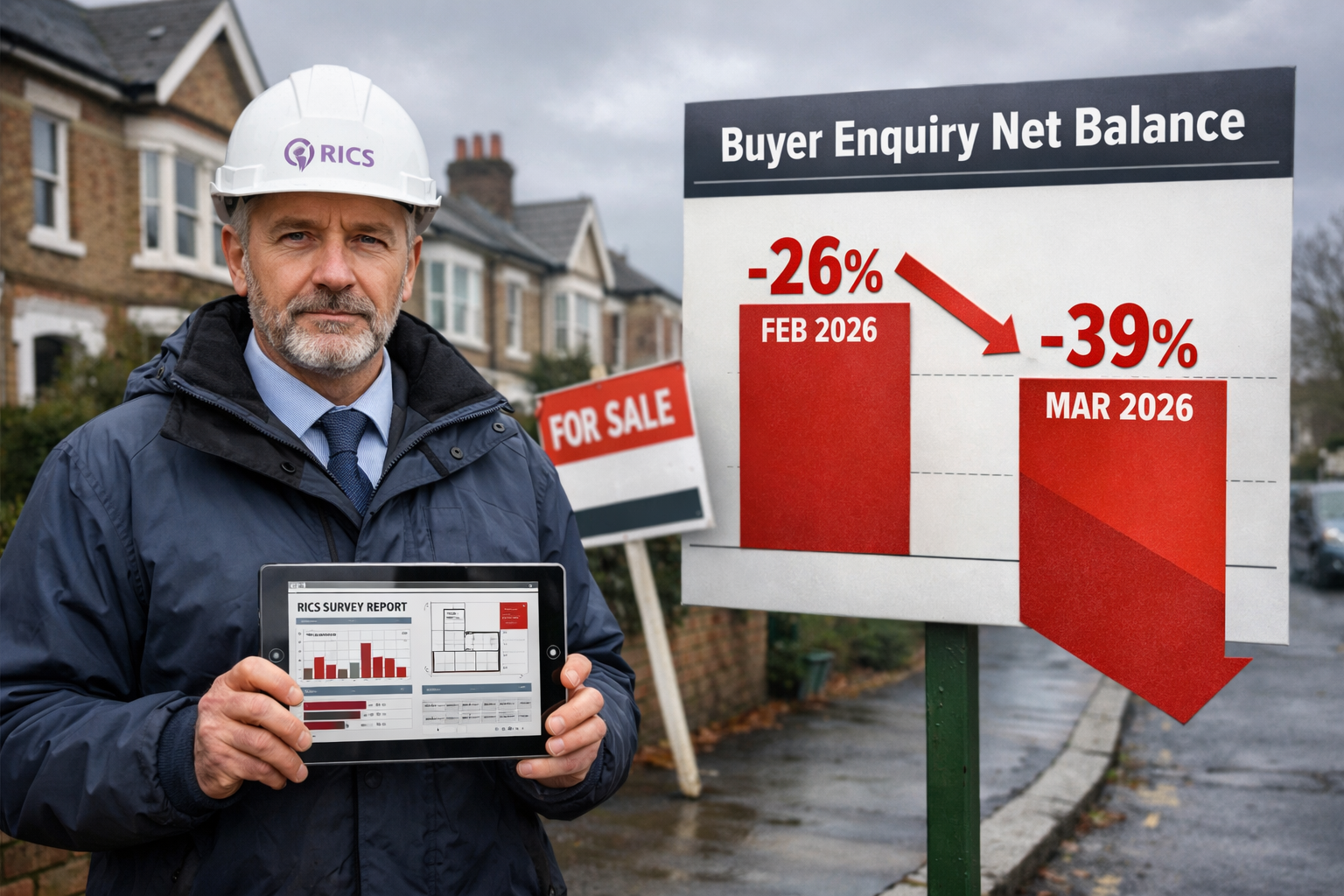
New buyer enquiries across the UK collapsed to a net balance of -39% in March 2026 — a dramatic deterioration from -26% just one month earlier — signalling one of the sharpest demand contractions seen outside a full recession [1]. For anyone relying on an automated valuation model (AVM) to price property in this environment, that figure is a serious warning. Algorithms trained on historical transaction data simply cannot react fast enough when markets move this quickly.
This is precisely why Market Volatility and Valuation Accuracy: Using RICS Real-Time Surveyor Insights Over Automated Models in Q2 2026 has become the defining conversation in UK property finance. Rising borrowing costs, geopolitical uncertainty, and regionally fragmented price trends have combined to create conditions where human expertise and on-the-ground observation are not just preferable — they are essential.
Key Takeaways 📌
- Buyer demand fell sharply in early 2026, with enquiry net balances dropping to -39% in March — conditions AVMs are structurally unable to capture in real time.
- House price net balances deteriorated to -15% by March 2026, with London experiencing the steepest regional decline at -40%.
- RICS-qualified surveyors provide daily, on-site intelligence that reflects current consumer sentiment, pricing sensitivity, and local market dynamics.
- Automated valuation models lag behind turning points because they rely on completed transaction data, which can be weeks or months old.
- Regional divergence is extreme: Northern Ireland and Scotland showed resilience while London and the South East fell sharply — a gap only local surveyor networks can reliably navigate.
Why Q2 2026 Is a Stress Test for Automated Valuation Models
Automated valuation models work well in stable, high-transaction markets. They aggregate sold prices, apply regression algorithms, and produce estimates at scale. In a flat or gently rising market, the lag between a completed sale and its appearance in a dataset is manageable — perhaps a few percentage points of error.
Q2 2026 is not that market.
The combination of elevated mortgage rates, global geopolitical tension, and post-stamp-duty-holiday fatigue has created a market that is moving faster than historical data can track. House price net balances deteriorated to -15% in March 2026, down from -12% in February [4]. Agreed sales posted a net balance of -12% in February, with near-term sales expectations softening further to -2% [1]. These are not gradual shifts — they are abrupt inflection points.
💬 "When the market turns quickly, the most dangerous number is a confident one produced by a model that doesn't know the turn has happened."
AVMs face a fundamental structural problem here: they are backward-looking by design. The data they consume — Land Registry completions, mortgage approvals, portal listings — reflects decisions made weeks or months ago. In a rapidly softening market, this creates a valuation lag that can result in significant overestimation of current market value.
The Structural Limitations of AVMs in Volatile Conditions
| AVM Weakness | Impact in Q2 2026 |
|---|---|
| Relies on historical completed sales | Misses rapid price corrections |
| Cannot capture sentiment shifts | Ignores buyer confidence collapse |
| Regional averages mask local variation | Fails in fragmented markets |
| No physical inspection | Cannot detect condition-related discounts |
| Algorithm trained on stable-market data | Underperforms at turning points |
For lenders, this lag creates mortgage book risk. For buyers, it means potentially overpaying. For sellers, it can mean unrealistic expectations that stall transactions. The solution is not to abandon technology — it is to understand where human expertise must take precedence.
How RICS Real-Time Surveyor Insights Address Market Volatility and Valuation Accuracy in Q2 2026
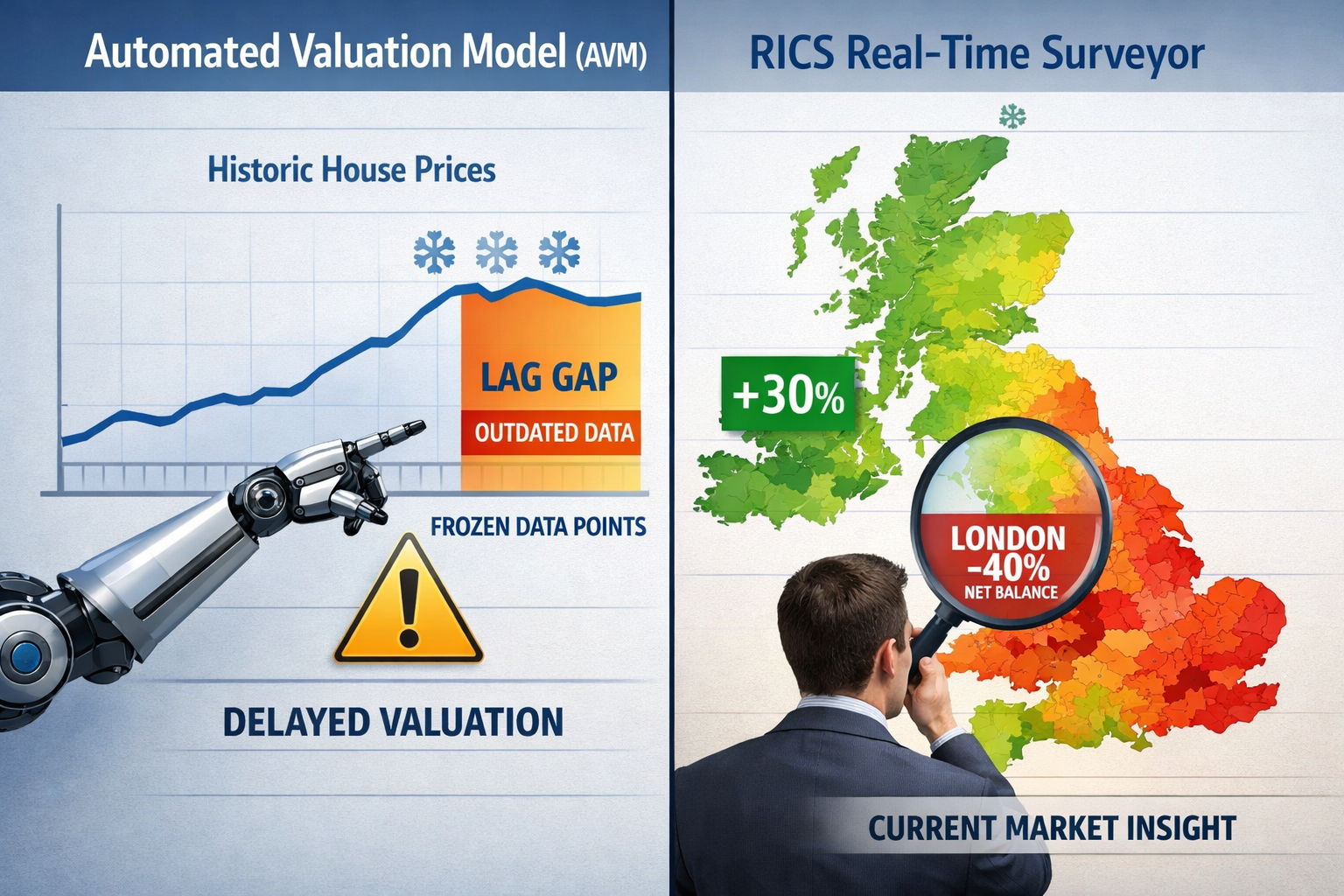
The case for RICS-qualified surveyors in volatile conditions rests on a simple advantage: they are in the market every single day.
Organisations like Countrywide Surveying Services deploy hundreds of RICS-qualified valuers visiting properties across the UK daily. Each visit generates real-time intelligence — which property types are attracting offers, where vendors are reducing asking prices, which neighbourhoods are seeing extended time-on-market [2]. This is granular, current, and human-interpreted data that no algorithm currently replicates.
What Surveyors Observe That AVMs Cannot
🔍 Consumer sentiment in real time — A surveyor speaking with an estate agent before an inspection hears whether viewings have dropped off, whether offers are coming in below asking price, or whether a specific street has become harder to sell. This qualitative intelligence feeds directly into valuation judgement.
🏚️ Physical condition adjustments — An AVM cannot see that a property has a failing roof, unresolved damp, or a structural issue. A thorough RICS building survey captures these factors and applies appropriate valuation discounts. In a falling market, condition-related discounts become more significant because buyers have more negotiating power.
📍 Hyper-local pricing pressure — Even within a single postcode, pricing dynamics can vary by street, property type, and tenure. A surveyor working regularly in an area builds a mental model of these micro-variations that no dataset captures with sufficient granularity.
📉 Emerging trends before they appear in data — When a surveyor notices that three consecutive valuations in a neighbourhood have come in below the agreed purchase price, that is an early signal of market softening that will only appear in Land Registry data months later.
For specialist valuations — such as a lease extension valuation or an ATED valuation — the stakes of getting the number wrong are even higher, because these figures feed directly into legal and tax calculations where errors carry real financial consequences.
The RICS Professional Standard: Why It Matters More Now
RICS-qualified valuers operate under the Red Book Global Standards, which require them to apply professional judgement, consider current market evidence, and justify departures from comparable evidence. This framework is specifically designed to handle market uncertainty — it is not a static formula.
Forward-looking sentiment turned more cautious by February 2026, even as twelve-month expectations remained marginally positive [1]. This divergence — short-term pessimism versus longer-term optimism — is exactly the kind of nuanced market condition where a professional valuer's judgement is irreplaceable. An AVM cannot distinguish between a 3-month dip and a structural decline; a RICS surveyor can.
Regional Divergence: The Strongest Argument for Local Surveyor Networks
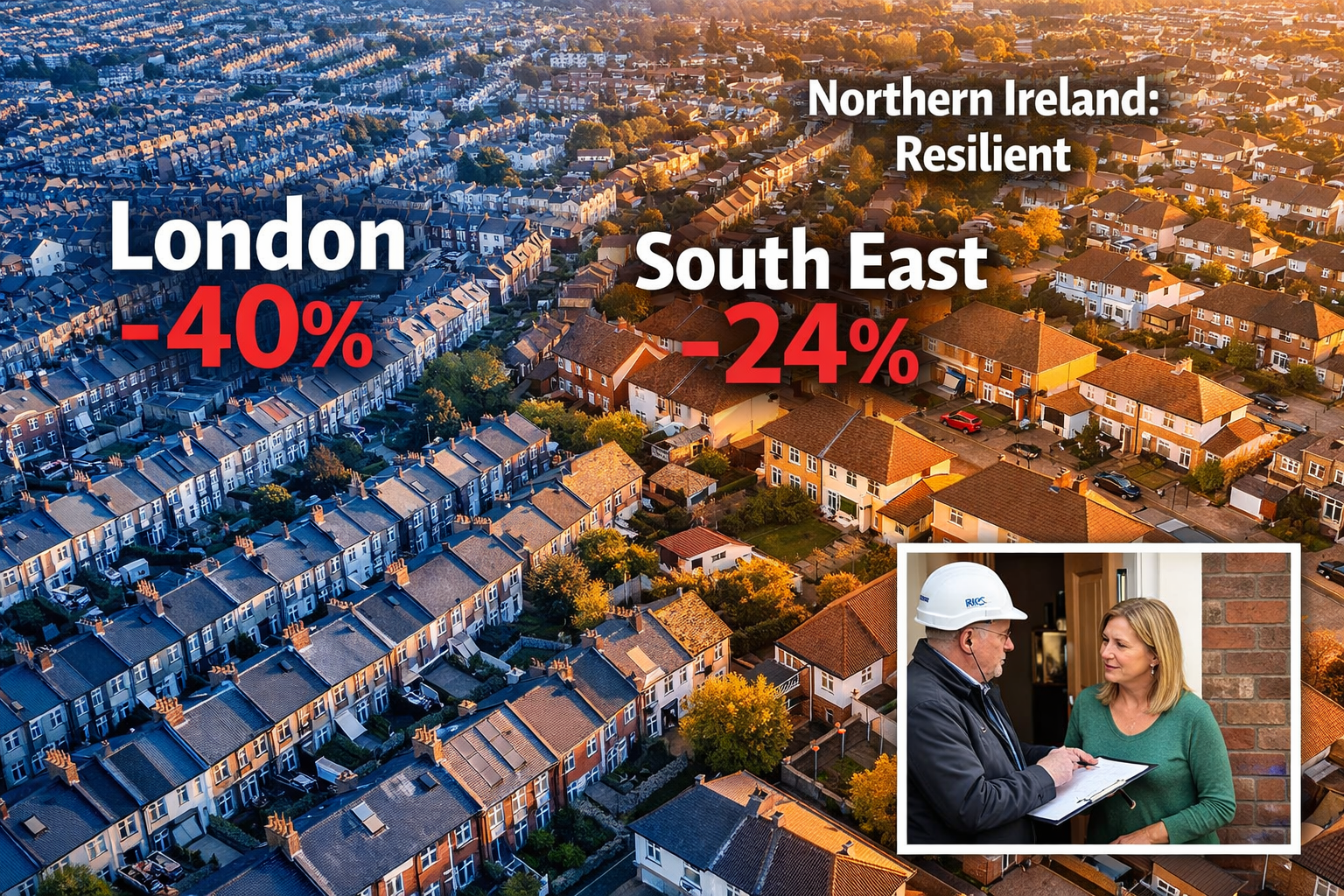
Perhaps the most compelling argument for Market Volatility and Valuation Accuracy: Using RICS Real-Time Surveyor Insights Over Automated Models in Q2 2026 is the sheer scale of regional divergence currently visible across UK markets.
The February 2026 RICS data reveals a market that is not falling uniformly — it is fracturing along regional lines [1]:
| Region | Price Net Balance (Feb 2026) | Trend |
|---|---|---|
| London | -40% | ⬇️ Sharply declining |
| South East | -24% | ⬇️ Declining |
| East Anglia | -26% | ⬇️ Declining |
| Northern Ireland | Positive | ✅ Resilient |
| Scotland | Positive | ✅ Resilient |
| North West England | Firmer | ✅ Relatively stable |
London's net balance of -40% is not a market-wide story — it is a London story [1]. An AVM using national averages or even broad regional averages will systematically misvalue property in this environment. A surveyor based in central London or Richmond understands the specific dynamics of those sub-markets in a way that no algorithm can replicate.
The same logic applies at the other end of the spectrum. Northern Ireland and Scotland are showing relative resilience — but a national AVM applying downward pressure based on aggregate UK data could undervalue properties in those regions, creating different but equally serious problems for buyers, sellers, and lenders.
Specific Valuation Scenarios Where Local Expertise Is Critical
Divorce and separation valuations require a defensible, current market value that can withstand legal scrutiny. In a volatile market, a divorce valuation must reflect the precise conditions at the date of valuation — not a model's lagged estimate.
Probate valuations similarly require an accurate point-in-time assessment. With markets moving rapidly in Q2 2026, a probate valuation based on automated data risks HMRC challenge if it fails to reflect current market conditions.
Capital gains tax valuations carry financial penalties if underestimated. A capital gains tax valuation in a falling market requires careful analysis of the precise valuation date and comparable evidence — work that demands professional judgement.
Commercial rent reviews in a market where occupier demand is shifting require a surveyor who understands current lease terms, comparable evidence, and market sentiment. A commercial rent review conducted without current market intelligence risks either overpaying or leaving money on the table.
Practical Steps: Choosing the Right Valuation Approach in Q2 2026
Given the evidence, the practical question is: when should a RICS surveyor be used instead of, or alongside, an AVM?
Use a RICS Surveyor When:
✅ The property is unusual, non-standard, or has known defects
✅ The valuation has legal, tax, or regulatory implications
✅ The market has moved significantly since the last comparable sale
✅ The property is in a region experiencing sharp price movements
✅ A lender or counterparty requires a Red Book-compliant valuation
✅ The transaction involves leasehold complications or tenure issues
✅ You need a valuation that can withstand professional or legal challenge
AVMs May Be Appropriate When:
⚠️ The property is a standard type in a stable, high-transaction market
⚠️ The purpose is indicative screening rather than a formal valuation
⚠️ Speed and cost are prioritised over precision
⚠️ The result will be cross-checked against professional advice
Understanding surveyor pricing is an important part of the decision. Professional valuations carry a cost — but in a market where prices are moving by several percentage points per month in some regions, the cost of an inaccurate AVM-derived figure is almost always higher.
For buyers unsure which level of survey or valuation service they need, a guide to choosing the right property survey provides a clear framework for matching the survey type to the property and the transaction.
The Forward Outlook: What Q2 2026 Signals for Valuation Practice
The UK housing market continued losing momentum through March 2026 as rising borrowing costs and geopolitical uncertainty weighed on buyer confidence [5]. Even where twelve-month price expectations remain cautiously positive, the short-term 3-to-6-month window presents a genuine valuation accuracy challenge [1].
This is not a temporary blip that AVMs will catch up with next quarter. The conditions driving market volatility — interest rate uncertainty, geopolitical risk, affordability constraints — are structural features of the current environment. They require a structural response in valuation practice.
💬 "The value of a RICS surveyor is not just their qualification — it is their daily presence in a market that is changing faster than any dataset can record." [2]
The RICS monthly survey data itself — which drives much of the market intelligence discussed in this article — is produced by surveyor respondents sharing their on-the-ground observations [3]. The data is only as good as the professionals generating it. That feedback loop between professional observation and market intelligence is precisely what AVMs cannot replicate.
Conclusion: Human Expertise Is the Hedge Against Valuation Risk in 2026
The evidence from Q2 2026 is unambiguous. When buyer enquiries collapse by 13 percentage points in a single month, when London prices fall at a net balance of -40% while Northern Ireland holds firm, and when geopolitical uncertainty makes tomorrow's market conditions genuinely unpredictable, automated valuation models are not fit for purpose as a standalone tool.
Market Volatility and Valuation Accuracy: Using RICS Real-Time Surveyor Insights Over Automated Models in Q2 2026 is not an abstract debate — it is a practical risk management question with real financial consequences for buyers, sellers, lenders, and legal professionals.
Actionable Next Steps 🎯
- Commission a RICS Red Book valuation for any transaction with legal, tax, or mortgage implications — do not rely solely on AVM estimates in the current market.
- Request local market commentary from your surveyor alongside the formal valuation figure — this context is as valuable as the number itself.
- Cross-check regional data before accepting any automated estimate; London and the South East are behaving very differently from Northern regions in 2026.
- For specialist purposes (probate, divorce, ATED, CGT), always use a qualified RICS valuer — the regulatory and financial risks of an inaccurate figure are too significant.
- Stay informed through RICS monthly survey publications and engage with local chartered surveyors who have direct, current knowledge of your target market.
In volatile markets, the most valuable asset is not the algorithm — it is the professional who was in the market yesterday.
References
[1] UK Residential Survey February 2026 – https://www.rics.org/news-insights/uk-residential-survey-february-2026
[2] Navigating A Cautious UK Housing Market In 2026 And Why Surveying Insight Matters More Than Ever – https://www.mortgagesolutions.co.uk/better-business/business-skills/2026/04/15/navigating-a-cautious-uk-housing-market-in-2026-and-why-surveying-insight-matters-more-than-ever-ison/
[3] Market Surveys – https://www.rics.org/news-insights/market-surveys
[4] Valuation Adjustments For March 2026 RICS Survey: Navigating Softer House Prices And Middle East Conflict Impacts – https://nottinghillsurveyors.com/blog/valuation-adjustments-for-march-2026-rics-survey-navigating-softer-house-prices-and-middle-east-conflict-impacts
[5] Research And Insights – https://www.rics.org/news-insights/research-and-insights