The RICS UK Residential Market Survey for April 2026 recorded a net balance of -40% for London house prices — meaning far more surveyors reported falling values than rising ones [1]. That single statistic is not just a headline for property investors. For expert witness surveyors, it signals a fundamental shift in how valuation evidence must be gathered, presented, and defended in court.
Expert Witness Surveyors in a Cooling UK Housing Market: How Falling Prices Change Valuation Evidence is no longer a theoretical concern. It is the daily reality facing RICS-registered valuers who are called upon to justify property values in litigation, professional negligence claims, and disputed transactions — at precisely the moment when the market beneath their feet is moving.
Key Takeaways 📌
- The UK housing market in 2026 is broadly flat or declining, with sharp regional variation — London and the South East face the steepest downward pressure [1][5].
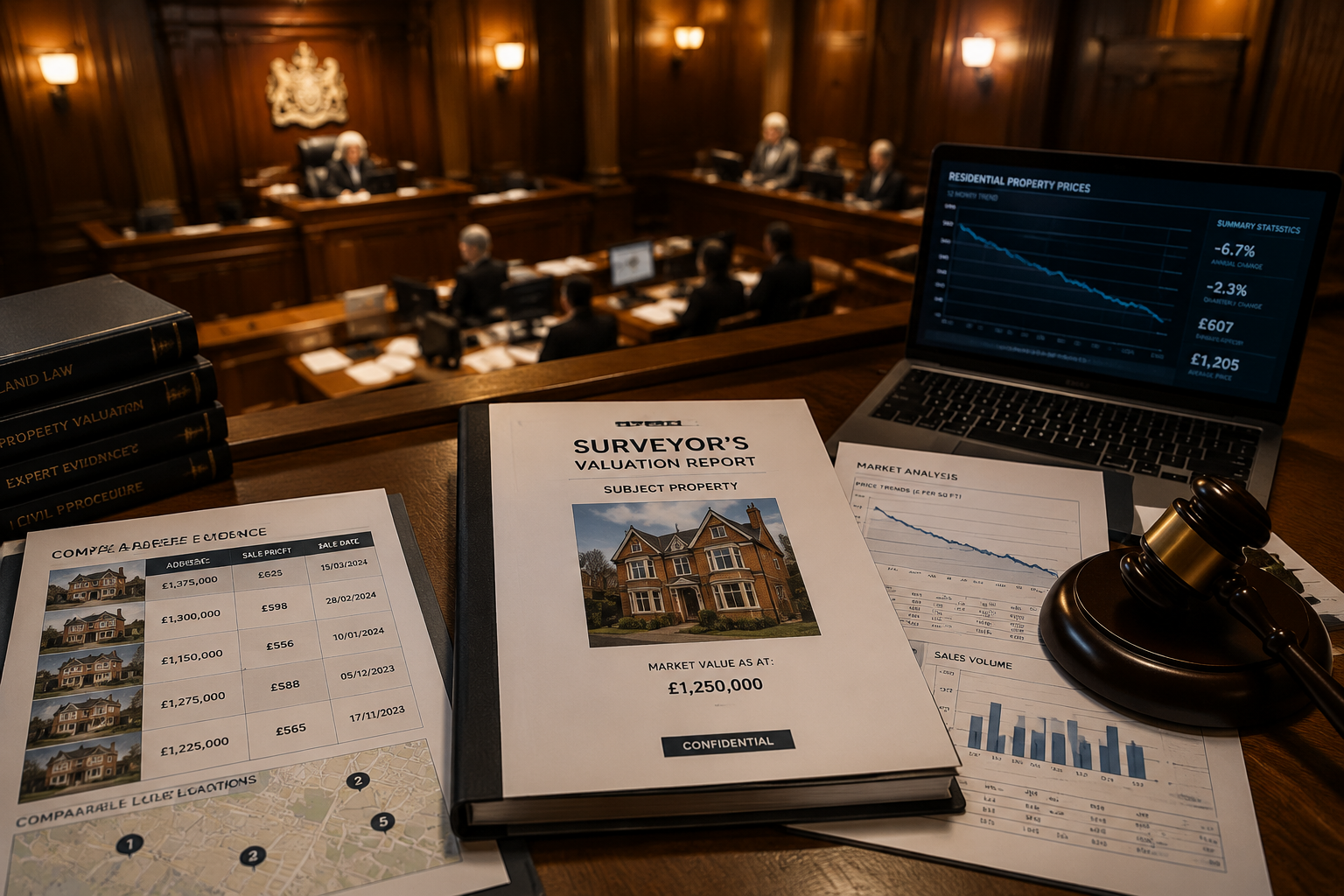
- In a cooling market, comparables even 3–6 months old may be unreliable without explicit time-adjustment and commentary [4].
- Higher stock levels and longer marketing periods provide richer evidence but also more ammunition for opposing experts to challenge selection bias [2].
- Expert witnesses must distinguish clearly between asking prices and achieved sale prices — a distinction courts scrutinise heavily in falling markets.
- Robust, defensible valuations require tightly matched, locality-specific comparables and transparent reasoning — not reliance on broad national indices.
Why a Cooling Market Creates More Valuation Disputes
When prices rise steadily, valuation disputes are relatively rare. A bullish market masks minor errors in comparable selection, and the gap between a claimant's and defendant's valuation is often narrow enough to settle without litigation.
A flat or falling market changes everything.
Reuters described the mood in May 2026 as "gloom in the UK housing market" that shows "no sign of lifting" [5]. When sentiment is fragile, buyers negotiate harder, sales fall through, and the distance between what a seller believed a property was worth and what it ultimately achieved can be substantial. That gap becomes the subject of disputes — and expert witness surveyors are called in to explain it.
💬 "In a rising market, a valuer's margin of error is often absorbed by subsequent price growth. In a falling market, every assumption is exposed."
The types of disputes that increase in a cooling market include:
- Professional negligence claims against surveyors who valued properties at peak prices shortly before a correction
- Matrimonial and divorce valuations where one party disputes a lower current value [see divorce valuation services]
- Probate valuations challenged by HMRC or beneficiaries when estate property values have shifted [see probate valuation guidance]
- Lease extension and enfranchisement disputes where diminishing capital values affect premium calculations [see lease extension valuation]
- Capital gains tax challenges where the base value is contested against a backdrop of price decline [see capital gains tax valuation]
Understanding the 2026 Market Conditions Shaping Valuation Evidence
Regional Divergence: The Core Challenge for Expert Witnesses
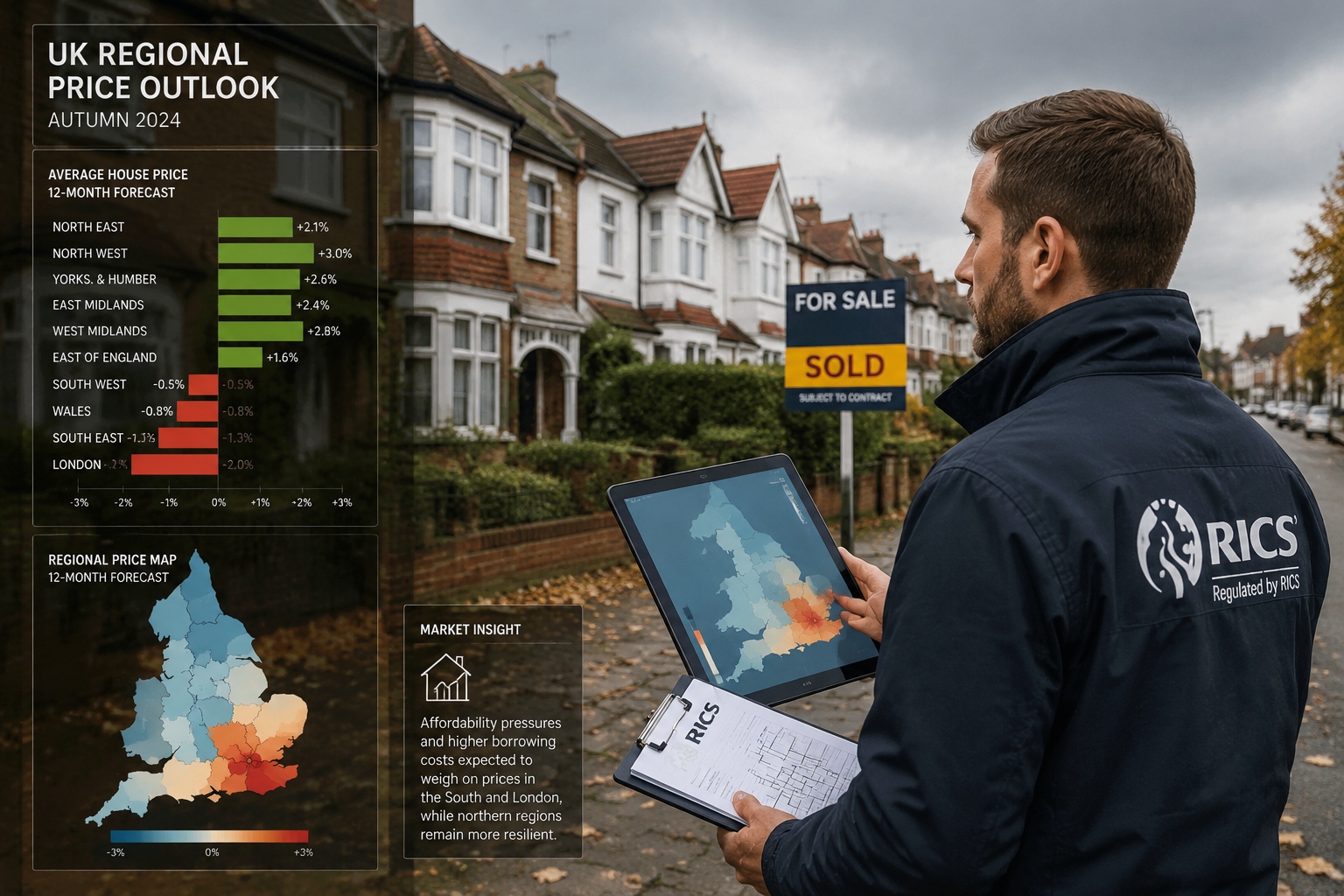
One of the most important — and most misunderstood — features of the current UK housing market is that it is not uniformly weak. The February 2026 RICS survey data reveals a market fractured along regional lines [1][4]:
| Region | Price Net Balance (Approx.) | Trend |
|---|---|---|
| London | -40% | Falling |
| South East | -24% | Falling |
| East Anglia | -26% | Falling |
| North West | Positive | Stable/Rising |
| Scotland | Positive | Stable/Rising |
| Northern Ireland | Positive | Rising |
This divergence creates a critical problem for expert witnesses who rely on national indices. A valuer citing the UK average when the subject property is in Islington or South West London is presenting evidence that a tribunal will immediately question. The RICS data makes clear that broad national figures are not a substitute for hyper-local comparable analysis [4].
Stock Levels and Marketing Times: A Double-Edged Sword 🗡️
Zoopla data cited in the Vail Williams Spring 2026 market update reports an average of 32 homes per agent at the start of 2026 — an eight-year high — with London stock up 16% year-on-year [2]. For expert witnesses, this is both an opportunity and a risk:
Opportunity: More stock means more comparable evidence. Longer marketing periods generate richer data trails — asking prices, price reductions, time on market, and ultimately achieved prices.
Risk: More data means more scope for opposing experts to challenge the comparables selected. If an expert witness has chosen three comparables that achieved strong prices while ignoring five that sold at significant discounts, that selection will be exposed under cross-examination.
The Vail Williams update is explicit: "over-ambitious pricing is likely to be corrected more quickly" in the current environment [2]. Courts expect expert witnesses to reflect that reality — not to cherry-pick evidence that supports an optimistic conclusion.
Near-Term Price Expectations: Why Old Comparables Are Dangerous
The February 2026 RICS survey recorded a near-term price expectation net balance of -18% [1][4]. This means that at the time of the survey, significantly more surveyors expected prices to fall further than expected them to rise.
In practical terms, this creates a time-sensitivity problem for expert witnesses. A comparable sale from six months ago — in a market where conditions have deteriorated — may not represent open market value at the relevant date. Expert reports that fail to acknowledge this, and fail to apply explicit time adjustments, are vulnerable to challenge.
How Expert Witness Surveyors in a Cooling UK Housing Market Must Adapt Their Approach
1. Anchoring Evidence to the Correct Valuation Date
In litigation, the valuation date is everything. An expert witness is not asked what a property is worth today — they are asked what it was worth on a specific date in the past. In a cooling market, the difference between a valuation date of January 2026 and July 2025 could be material.
Expert witnesses must:
- State the valuation date explicitly and justify every comparable by reference to that date
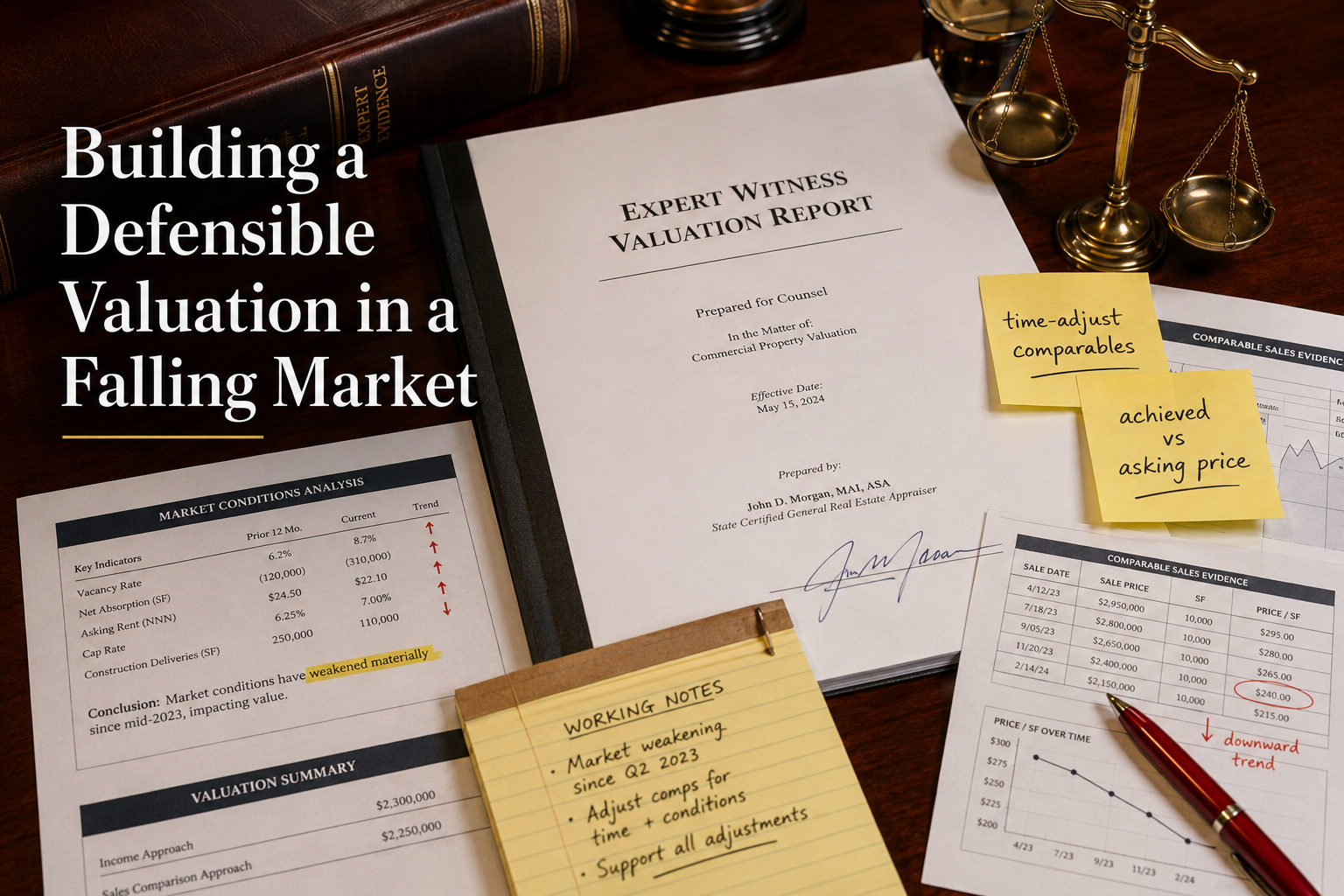
- Apply time adjustments where comparables predate the valuation date, with a clear explanation of the methodology used
- Reference market evidence — such as RICS survey data or local Land Registry trends — to support any time-based adjustment
Failing to do this leaves the expert open to the accusation that they have used stale evidence to support an inflated valuation.
2. Distinguishing Asking Prices from Achieved Prices
This distinction has always mattered. In a cooling market, it matters even more. Vail Williams notes that increased supply has "reinforced the need for realistic pricing" [2] — and that optimistic asking prices are being corrected downward.
An expert witness who cites asking prices as evidence of market value in a falling market will face serious challenge. Courts and tribunals apply the concept of open market value — what a willing buyer would pay a willing seller, both acting without compulsion. In a buyer's market, that figure is anchored to achieved prices, not aspirational listings.
Best practice for expert witnesses includes:
- ✅ Using only completed sale prices from Land Registry or verified sources as primary evidence
- ✅ Noting where comparable properties had price reductions before sale
- ✅ Explaining why any asking-price evidence has been discounted or excluded
- ✅ Referencing time on market as a proxy for demand pressure
3. Selecting and Justifying Comparable Evidence Rigorously
The selection of comparables is the most scrutinised element of any expert valuation report. In a cooling market with high stock levels, the pool of potential comparables is larger — but so is the opportunity for opposing experts to demonstrate bias.
A defensible comparable selection process in 2026 requires:
- Geographic proximity: Comparables should ideally be within the same street, postcode, or micro-market. Regional or borough-level averages are insufficient [see valuation factors guide]
- Physical similarity: Size, tenure, condition, and specification must be closely matched. A Level 3 building survey finding on a comparable property may explain a price differential that would otherwise appear anomalous
- Temporal proximity: Sales within 3 months of the valuation date are preferable; anything older requires explicit time-adjustment commentary
- Transparency of exclusions: Where comparable sales have been excluded, the report must explain why — otherwise, opposing counsel will raise them
4. Addressing Market Conditions Explicitly in the Report
One of the most common weaknesses in expert valuation reports is the failure to address market context head-on. In a rising market, this omission rarely matters. In a cooling market, it is a significant vulnerability.
Expert reports prepared in 2026 should include a dedicated section on market conditions that:
- References current RICS survey data and what it shows about local price trends [1][5]
- Acknowledges any negative price expectations and explains how they have been factored into the valuation
- Addresses the impact of increased stock levels on buyer negotiating power
- Distinguishes between the subject property's micro-market and broader regional trends
💬 "A tribunal will not assume the expert has considered market conditions — they must be shown, in writing, that the expert has done so."
5. Handling Retrospective Valuations in a Declining Market
Many expert witness instructions involve retrospective valuations — establishing what a property was worth at a past date, often when the market was at or near its peak. This is particularly common in professional negligence claims against surveyors who valued properties in 2022–2024.
The challenge is that the expert must reconstruct market conditions as they existed at the valuation date — not as they exist today. This requires:
- Sourcing contemporaneous market data from the relevant period (RICS surveys, Land Registry data, local agent reports)
- Avoiding hindsight bias — the valuation must reflect what was knowable at the time, not what subsequently happened
- Acknowledging the bracket of values that a competent valuer could reasonably have arrived at, rather than asserting a single figure with false precision
Building a Defensible Expert Witness Report in a Falling Market
The Structure Courts Expect
Expert witness reports in property disputes must comply with CPR Part 35 and the accompanying Practice Direction. Beyond the legal requirements, courts in 2026 expect expert valuation reports to demonstrate:
- Independence and objectivity — the expert's duty is to the court, not the instructing party
- Transparent methodology — every step from data collection to final figure must be explained
- Acknowledgement of uncertainty — in a volatile market, a single-point valuation without a stated margin of error invites challenge
- Engagement with opposing evidence — where the opposing expert has selected different comparables, the report must address why those comparables are less reliable
The Role of Registered RICS Valuers
Not every surveyor is qualified to act as an expert witness. The role demands both technical valuation expertise and the ability to withstand cross-examination. Registered RICS valuers bring the professional standing and methodological rigour that courts expect — particularly when valuations are contested in a complex, regionally divergent market.
Lease Extensions and Enfranchisement: A Special Case 🏢
Falling capital values have a direct and sometimes counterintuitive effect on leasehold valuation disputes. In collective enfranchisement and lease extension claims, the premium payable is partly a function of the freehold value and the relativity between leasehold and freehold interests. When capital values fall, the arithmetic of these premiums shifts — and expert witnesses must be prepared to explain those movements clearly. Collective enfranchisement valuations and freehold valuation instructions are therefore among the most technically demanding in a cooling market.
Common Pitfalls Expert Witnesses Must Avoid ⚠️
| Pitfall | Why It Matters in a Cooling Market |
|---|---|
| Using national average indices as primary evidence | Masks sharp regional divergence; courts will reject it |
| Failing to time-adjust comparables | Stale data inflates values in a declining market |
| Citing asking prices rather than achieved prices | Overstates open market value when buyers have negotiating power |
| Ignoring failed sales or withdrawn listings | Omits evidence of weak demand |
| Presenting a single-point valuation without commentary on uncertainty | Appears overconfident and is easily undermined |
| Not addressing opposing expert's comparables | Courts expect engagement, not silence |
Conclusion: Actionable Steps for Expert Witness Surveyors in 2026
The combination of negative buyer sentiment, regional price divergence, high stock levels, and extended marketing periods makes 2026 one of the most technically demanding environments for expert witness valuers in recent memory [1][2][5]. The days of relying on a rising tide to validate a valuation are over — at least in London, the South East, and East Anglia.
Actionable next steps for expert witnesses and instructing solicitors:
- Audit your comparable selection process — ensure every comparable is time-adjusted, geographically precise, and based on achieved rather than asking prices
- Include a dedicated market conditions section in every expert report, referencing current RICS survey data and local price trends
- State a valuation range alongside your primary figure, with commentary on the factors that could move the value toward either end
- Engage proactively with opposing comparables — address them in your report rather than waiting for cross-examination
- Instruct registered RICS valuers with demonstrable experience in expert witness work, particularly for leasehold, probate, and CGT disputes
- Review your retrospective methodology — ensure you are reconstructing past market conditions accurately, without the distortion of hindsight
The cooling UK housing market has not made expert witness valuation impossible. It has made rigour, transparency, and locality-specific evidence more important than ever. Surveyors who adapt their approach will produce reports that withstand scrutiny. Those who do not will find their evidence challenged — and potentially dismissed.
References
[1] UK Residential Survey February 2026 – https://www.rics.org/news-insights/uk-residential-survey-february-2026
[2] UK Residential Property Market Update Spring 2026 – https://www.vailwilliams.com/uk-residential-property-market-update-spring-2026/
[3] House Price Forecast – https://hoa.org.uk/advice/guides-for-homeowners/i-am-buying/house-price-forecast/
[4] UK Residential Market Survey February 2026 – https://www.rics.org/content/dam/ricsglobal/documents/market-surveys/uk-residential-market-survey/UK-Residential-Market-Survey_February-2026.pdf
[5] Gloom UK Housing Market Shows No Sign Lifting RICS Survey Shows 2026-05-13 – https://www.reuters.com/business/gloom-uk-housing-market-shows-no-sign-lifting-rics-survey-shows-2026-05-13/
[6] UK House Prices May 2026 South West London Buyer Guide – https://wimbledonsurveyors.com/uk-house-prices-may-2026-south-west-london-buyer-guide/
[7] RICS January 2026 Market Survey: What UK Building Surveyors and Valuers Really Need to Change in Their Reports – https://www.canterburysurveyors.com/blog/rics-january-2026-market-survey-what-uk-building-surveyors-and-valuers-really-need-to-change-in-their-reports/
[8] Expert Witness Surveyor Specializations in 2026: Building Your Practice Across Land, Property and Construction Disputes – https://wimbledonsurveyors.com/expert-witness-surveyor-specializations-in-2026-building-your-practice-across-land-property-and-construction-disputes/