Landlord instructions in the UK private rented sector fell by 27% in early 2026, yet rents climbed approximately 20% year-on-year — a paradox that is forcing institutional owners to squeeze every ounce of performance from the stock they retain [1]. Against that backdrop, the scope, depth, and reporting style of Building Surveys for PRS and Build‑to‑Rent Blocks: What Institutional Landlords Now Expect from RICS Surveyors has been transformed. A routine condition snapshot no longer satisfies a pension fund, REIT, or specialist build-to-rent (BTR) operator. What these clients now demand is a fully integrated diagnostic tool that links structural risk, regulatory compliance, energy performance, and capital expenditure directly to net operating income and long-term asset value.
Key Takeaways 📋
- Institutional landlords now default to RICS Level 3 building surveys for multi-unit PRS and BTR blocks, expecting quantified defect analysis and 5–10-year capex plans rather than simple condition ratings [3].
- Survey outputs must align with the RICS professional standard for valuing residential property purpose-built for renting, translating technical findings into income-driven valuation assumptions [6].
- Building safety and fire strategy (post-Grenfell) are non-negotiable elements of any institutional-grade block survey, with clear escalation pathways to specialist engineers [3].
- The Renters' Rights Act 2026 framework requires surveys to separate landlord and tenant repairing obligations and produce schedules of condition for rent-review and dispute-resolution purposes [2].
- ESG and energy performance commentary — including EPC upgrade pathways and net-zero capex prioritisation — is now a standard expectation in institutional survey briefs [6].
Why the PRS and BTR Sector Is Reshaping Survey Expectations
The build-to-rent sector is defined by professionally managed, long-term rental blocks backed by institutional capital, typically offering on-site services, amenity spaces, and branded tenant experiences [9]. This operational model is fundamentally different from a portfolio of scattered buy-to-let flats, and it demands a fundamentally different approach to technical due diligence.
Several converging pressures are driving the change:
- 🏗️ Portfolio scale: Institutional owners manage hundreds or thousands of units within single blocks or campuses. A defect in a communal plant room or roof affects every tenant simultaneously.
- 📋 Regulatory intensity: The post-Grenfell Building Safety Act regime, the Renters' Rights Act 2026, and tightening EPC minimum standards create compliance obligations that carry real financial penalties [2].
- 💰 Income sensitivity: With rents rising sharply, even short voids caused by enforcement action or emergency repairs translate directly into material income loss [1].
- 📊 Investor reporting: Funders, limited partners, and REIT shareholders expect asset managers to demonstrate evidence-based capex planning and ESG progress.
"Institutional landlords are no longer buying a survey — they are buying a risk management instrument."
Manchester-based surveyors working on institutional buy-to-let portfolio instructions report that Level 3 building surveys have become the default choice for multi-unit blocks, with fees structured per block and per number of units rather than per individual dwelling [3]. This scaling model reflects the reality that a single block-wide survey delivers far greater analytical value than aggregating individual flat reports.
For context on the different survey levels available, the comparison of different types of property survey is a useful starting point, and the detailed guide to the difference between Level 2 and Level 3 surveys explains why Level 3 is increasingly preferred for complex residential stock.
What Institutional Landlords Now Expect from RICS Surveyors: Scope and Reporting Standards
Moving Beyond Condition Ratings to Quantified Risk
The standard RICS Level 3 building survey already requires surveyors to analyse the causes of defects, their urgency, and the likely cost of repairs — examining roofs, sub-floors, lofts, external walls, structural movement, and under-floor areas where accessible [4]. But institutional clients push this further. They expect:
| Element | Standard Level 3 Output | Institutional BTR Expectation |
|---|---|---|
| Defect identification | Condition ratings (1–3) | Quantified repair-cost ranges |
| Structural analysis | Description of movement | Root-cause diagnosis + monitoring recommendation |
| M&E systems | General comment | Plant life expectancy + replacement schedule |
| Roof | Visual inspection | Drone/access survey with residual life estimate |
| Fire strategy | Noted if visible | Full compartmentation review + escalation pathway |
| Energy performance | EPC noted | Upgrade pathway with cost/benefit analysis |
| Capex planning | Not standard | 5–10-year block-level capex schedule |
This aggregated capex schedule is critical. Asset managers feed these numbers directly into discounted cash-flow models and service-charge budgeting across portfolios [3]. A survey that cannot deliver this output is, for many institutional clients, simply not fit for purpose.
Block-Wide Reporting: Common Parts, Plant Rooms, and Amenity Spaces
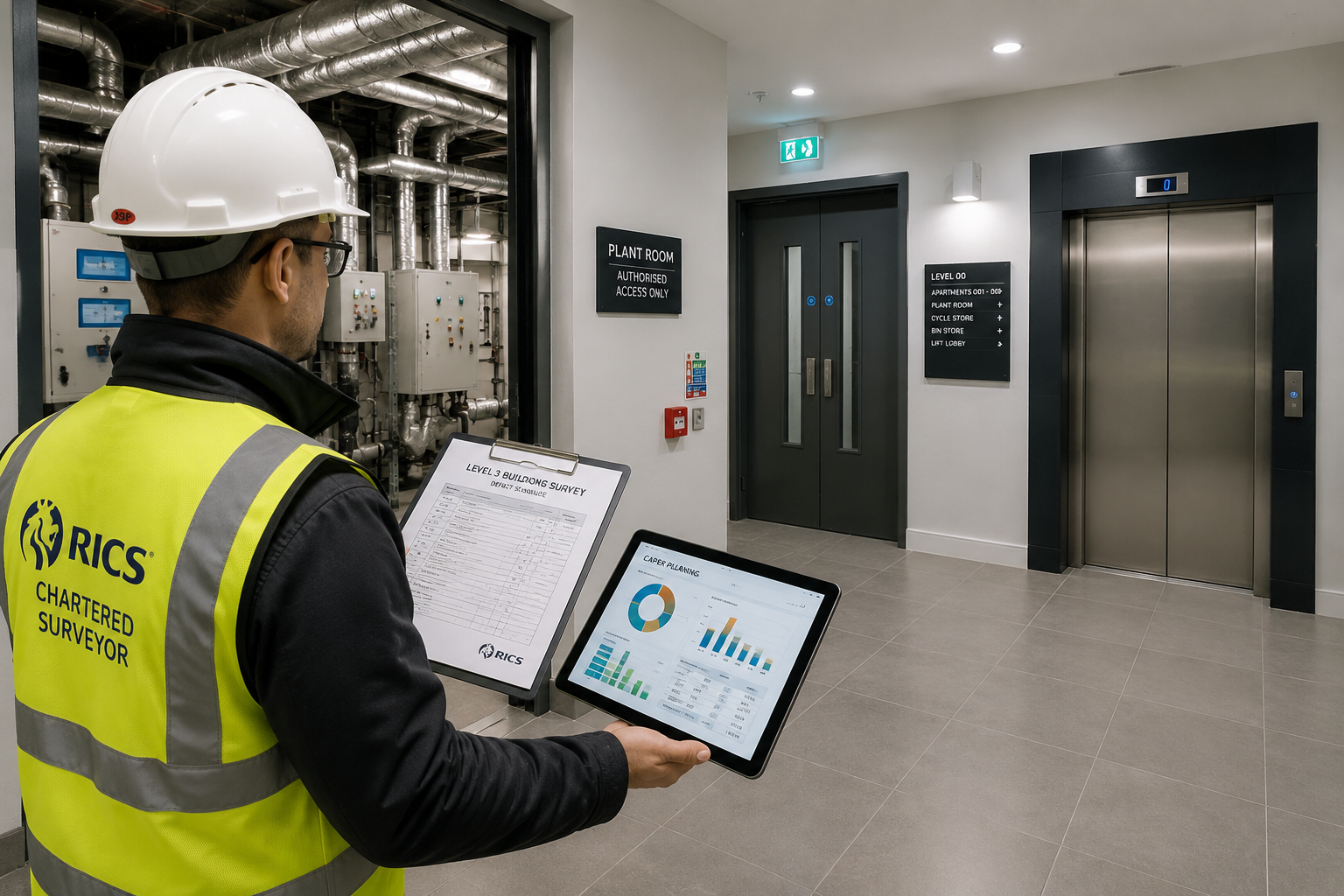
Unlike residential surveys focused on individual dwellings, institutional BTR surveys must cover the entire block as an operational asset. This means detailed reporting on:
- Lift installations — reliability history, maintenance contracts, residual life, and replacement cost
- Communal heating and hot water plant — efficiency ratings, compliance with current standards, and upgrade costs
- Gym, concierge, and amenity spaces — durability of finishes, equipment condition, and maintenance liabilities
- Roof terraces and external landscaping — waterproofing integrity and long-term maintenance obligations
- Car parks and cycle stores — structural condition and EV charging infrastructure readiness
- Fire doors and compartmentation — compliance with post-Grenfell requirements
Surveyors are also being asked to comment on design and maintenance issues that could affect letting, churn, and service-charge recoverability [9]. A gym with failing equipment or a lift with a poor reliability record directly impacts tenant satisfaction scores and, ultimately, void rates.
For blocks with complex floor structures, a solid floor slab survey may form part of the wider structural assessment, while damp surveys are frequently required for basement car parks and plant rooms.
Aligning Survey Outputs with RICS Valuation Standards
One of the most significant shifts in Building Surveys for PRS and Build‑to‑Rent Blocks is the expectation that technical findings feed directly into valuation. The re-issued RICS professional standard Valuing Residential Property Purpose Built for Renting (1st edition, reissued May 2023) requires an income-driven approach that explicitly recognises block-level operational risks: management intensity, amenity provision, void rates, and tenant profile [6].
Institutional landlords increasingly ask surveyors to translate building-survey outputs into the valuation cash-flow assumptions so that technical risk is directly reflected in net operating income and yield [6]. This means:
- Repair liabilities must be quantified and time-phased, not described in general terms
- Compliance risks must be costed so they can be modelled as potential income deductions
- Energy-upgrade capex must be separated into value-protective investment versus unavoidable regulatory spend
This integration between technical survey and valuation is a genuine step-change. It requires RICS surveyors working in the BTR space to understand both the building-pathology discipline and the income-capitalisation valuation methodology. For institutional clients, the registered RICS valuers who can bridge these two disciplines are particularly valued.
Regulatory Compliance, Building Safety, and the Renters' Rights Act 2026

Building Safety: The Non-Negotiable Element
For any block over 11 metres or with more than two storeys, building safety is the first and most critical section of any institutional survey brief [3]. Institutional clients — particularly funders and REITs — require surveyors to highlight potential regulatory exposures that could trigger remediation under the post-Grenfell building-safety regime, even when the Level 3 survey is non-intrusive.
Specific requirements include:
- ✅ Cladding and façade assessment — identification of potentially non-compliant materials with a clear recommendation for a specialist façade engineer where intrusive investigation is needed
- ✅ Compartmentation review — visual check of fire doors, cavity barriers, and penetrations through fire-rated elements
- ✅ Means of escape — assessment of staircase pressurisation, smoke ventilation, and emergency lighting
- ✅ Asbestos risk — for blocks built before 2000, a surveys for asbestos referral or preliminary assessment is standard
- ✅ Escalation pathways — clear recommendations for when façade engineers, fire engineers, or M&E specialists should be appointed
The expectation of clear escalation pathways is a relatively new feature of institutional survey briefs. Rather than simply noting a concern, surveyors must specify the type of specialist required, the likely scope of their investigation, and the timeline within which it should be commissioned [3].
The Renters' Rights Act 2026: Repairing Obligations and Schedules of Condition
The post-2026 regulatory framework is changing what landlords expect from survey reporting in a very practical way. Notting Hill-based valuation specialists note that under new rent-review rules, RICS valuers must carefully evidence condition, repair liabilities, and statutory-compliance risk when supporting rent-setting and reversionary valuations [2].
Institutional landlords therefore expect building surveys to deliver three specific outputs:
- Clear separation of landlord versus tenant repairing obligations — particularly important in BTR blocks where service-charge structures are complex
- A schedule of works needed to maintain compliance under the new regulatory regime, with cost estimates and priority ratings
- Schedules of condition to support rent-review and dispute-resolution processes [2]
This last point is significant. A well-prepared schedule of condition, produced at the start of a tenancy or at a rent-review date, provides the evidential baseline that landlords need if a rent tribunal or dispute-resolution process is triggered. The dilapidation surveys discipline, traditionally associated with commercial property, is now being applied systematically to large residential blocks for exactly this reason.
The RICS UK Residential Market Survey data for 2026 confirms the broader context: with landlord instructions down sharply and rents rising strongly, institutional owners who retain and maintain compliant stock are in a position of relative strength — but only if they can document that compliance rigorously [1][5].
ESG, Energy Performance, and Net-Zero Planning
Energy performance has moved from a footnote to a central element of institutional survey briefs. Institutional clients now expect specific commentary on:
- Current EPC ratings for individual units and communal systems
- The fabric-first upgrade pathway — insulation, glazing, and air-tightness improvements
- Plant replacement schedules — heat pumps, communal heat networks, and MVHR systems
- Quick-win energy measures versus major capital works, so that ESG targets can be phased realistically
- The likely impact of energy upgrades on rental income and valuation [6]
Market commentary from PRS valuation specialists confirms that institutional investors increasingly view capex on energy and services upgrades as value-protective rather than purely cost-driven [6]. A block with a clear, costed net-zero pathway is a more attractive asset to hold, refinance, or sell than one with an uncertain energy liability.
Surveyors working on institutional BTR instructions are therefore expected to have working knowledge of EPC methodology, minimum energy efficiency standards (MEES) trajectories, and the interaction between energy performance and rental income — a skill set that extends well beyond traditional building pathology.
Practical Implications for RICS Surveyors Accepting Institutional Instructions
Structuring the Survey Instruction and Fee
Institutional clients typically approach BTR block surveys with a detailed brief that specifies required outputs. Surveyors should expect to address:
- Block-level capex schedule (5–10 years, phased by urgency)
- Quantified repair-cost ranges for all significant defects
- Building-safety compliance assessment with escalation recommendations
- Schedule of condition for rent-review purposes
- ESG and energy-performance commentary
- M&E plant life-expectancy assessment
Fees are typically negotiated per block and per number of units, reflecting the economies of scale in a single-visit, block-wide inspection [3]. Surveyors should be clear in their terms of engagement about what specialist sub-consultants (façade engineers, M&E engineers, asbestos surveyors) are excluded from the building-survey scope and must be separately appointed.
When to Recommend Specialist Investigations
A key professional skill in institutional BTR surveys is knowing when to recommend intrusive or specialist investigation rather than simply noting a limitation. Institutional clients expect surveyors to be proactive in identifying:
- 🔍 Façade and cladding — where materials are unidentifiable from visual inspection, a specialist façade engineer must be recommended
- 🔍 Structural movement — where cracking patterns suggest active movement, a surveys for subsidence or structural engineer referral is appropriate
- 🔍 Damp and drainage — where basement or ground-floor damp is evident, a specialist damp survey should be recommended
- 🔍 M&E systems — where plant is at or near end of life, an M&E engineer should be appointed to assess replacement options and costs
For surveyors based in London and the South East — where the majority of institutional BTR stock is concentrated — the chartered surveyors in central London and chartered surveyors in South West London networks are well-positioned to handle these complex instructions.
Conclusion: Raising the Bar for Institutional-Grade Surveys
Building Surveys for PRS and Build‑to‑Rent Blocks: What Institutional Landlords Now Expect from RICS Surveyors represents a genuine evolution in professional practice — not a minor adjustment to an existing service. The combination of a tightening regulatory environment, rising rents, compressed landlord supply, and sophisticated institutional capital has created a market where the survey report must function as a strategic asset-management tool, not merely a condition document.
Actionable Next Steps for Surveyors and Institutional Clients
For RICS surveyors accepting BTR instructions:
- Review the RICS professional standard Valuing Residential Property Purpose Built for Renting and understand how technical findings translate into income-driven valuation assumptions [6].
- Develop a standard block-level capex schedule template that can be populated during inspection and delivered as a standalone appendix.
- Build relationships with specialist sub-consultants (façade engineers, M&E engineers, fire engineers) so that escalation pathways can be recommended with confidence.
- Invest in understanding EPC methodology and MEES trajectories to deliver credible energy-performance commentary.
For institutional landlords commissioning surveys:
- Provide a detailed brief specifying required outputs — do not assume a standard Level 3 report will cover BTR-specific requirements.
- Commission surveys before acquisition to ensure capex liabilities are reflected in pricing and valuation assumptions.
- Use survey outputs to populate discounted cash-flow models and service-charge budgets at portfolio level.
- Ensure building surveys are updated at each rent-review cycle to maintain an accurate schedule of condition for dispute-resolution purposes [2].
The PRS and BTR sectors will continue to grow in institutional importance throughout 2026 and beyond. Surveyors who invest in the skills, systems, and specialist networks needed to deliver institutional-grade building surveys will be well-positioned to serve this expanding market — and to add genuine, measurable value to their clients' portfolios.
References
[1] Rental Market Supply Crisis And Valuation Adjustments How 27 Landlord Instructions Reshape Prs Property Values In Spring 2026 – https://wimbledonsurveyors.com/rental-market-supply-crisis-and-valuation-adjustments-how-27-landlord-instructions-reshape-prs-property-values-in-spring-2026/
[2] Valuing Prs Properties Under New Rent Review Rules Rics Tactics Post Renters Rights Act 2026 – https://nottinghillsurveyors.com/blog/valuing-prs-properties-under-new-rent-review-rules-rics-tactics-post-renters-rights-act-2026
[3] Building Surveys For Institutional Buy To Let Portfolios Rics Protocols Amid 2026 Tenant Demand Surge – https://manchestersurveyors.com/building-surveys-for-institutional-buy-to-let-portfolios-rics-protocols-amid-2026-tenant-demand-surge/
[4] RICS Level 1, 2 & 3 Home Surveys Explained – https://www.youtube.com/watch?v=fKTVS0xu9dE
[5] Market Surveys – https://www.rics.org/news-insights/market-surveys
[6] Valuing Residential Property Purpose Built For Renting – https://www.rics.org/profession-standards/rics-standards-and-guidance/sector-standards/valuation-standards/valuing-residential-property-purpose-built-for-renting
[7] RICS Standards – https://www.isurv.com/downloads/176/rics_standards
[9] Build To Rent – https://www.ricsfirms.com/glossary/build-to-rent/