
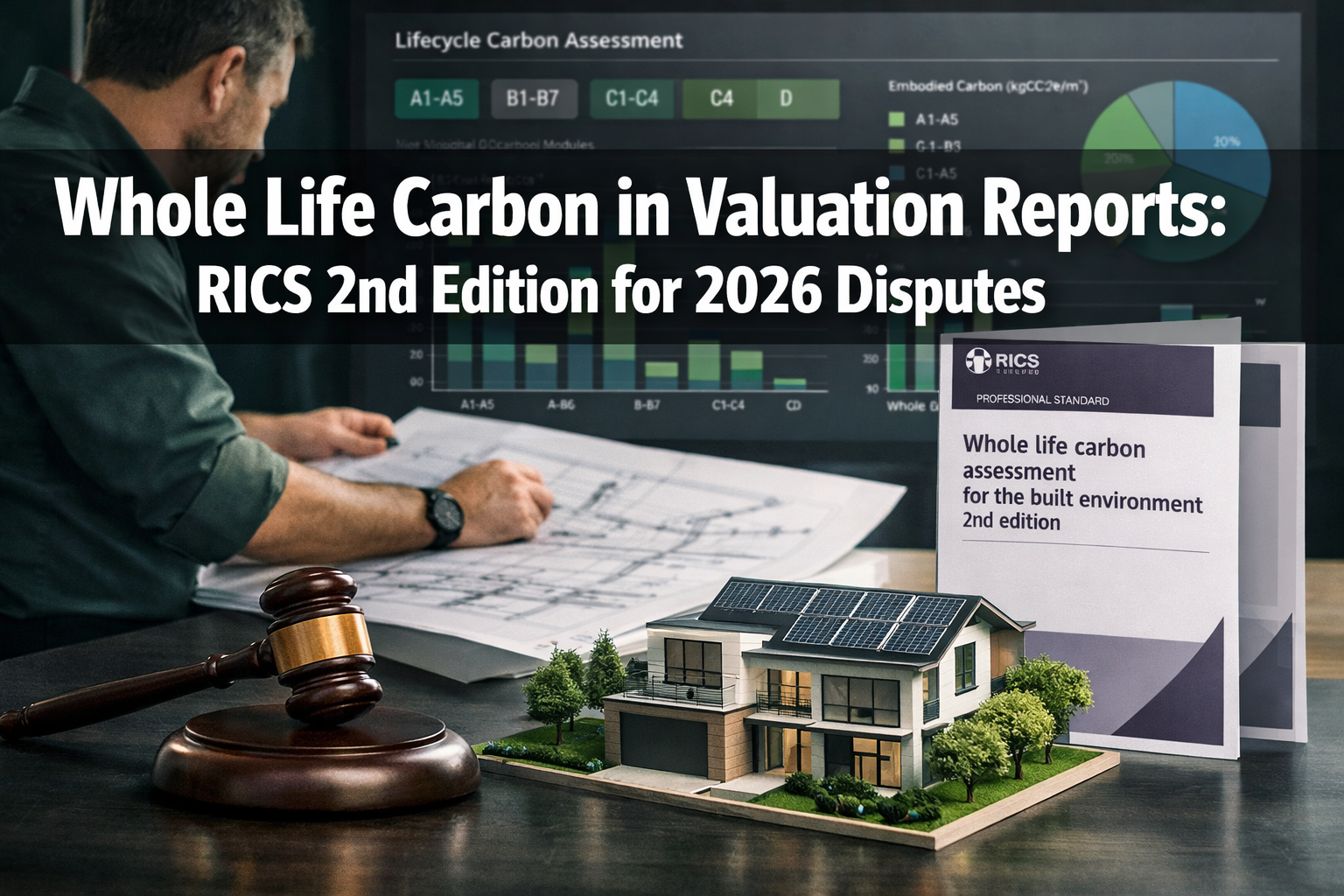
Property disputes in 2026 increasingly hinge on carbon performance rather than traditional metrics alone. With the RICS Professional Standard on Whole Life Carbon Assessment (2nd Edition) now mandatory since July 2024, chartered surveyors face a transformed landscape where carbon data directly impacts property valuations and expert witness testimony. Understanding how to properly integrate Whole Life Carbon Assessments in Valuation Reports: Applying RICS 2nd Edition Guidance for 2026 Disputes has become essential for professionals navigating sustainability-driven litigation.
The integration of whole life carbon into property valuations represents a fundamental shift in how built assets are assessed, valued, and contested. As environmental regulations tighten and market preferences shift toward sustainable properties, the ability to accurately measure and report carbon impacts throughout a building's lifecycle has moved from optional enhancement to mandatory requirement.
Key Takeaways
- Mandatory compliance: All RICS members must follow the 2nd edition standard for whole life carbon assessments since July 1, 2024, affecting all property valuation reports.
- Expanded scope: The standard now covers all built environment assets and infrastructure, not just buildings, requiring broader assessment capabilities.
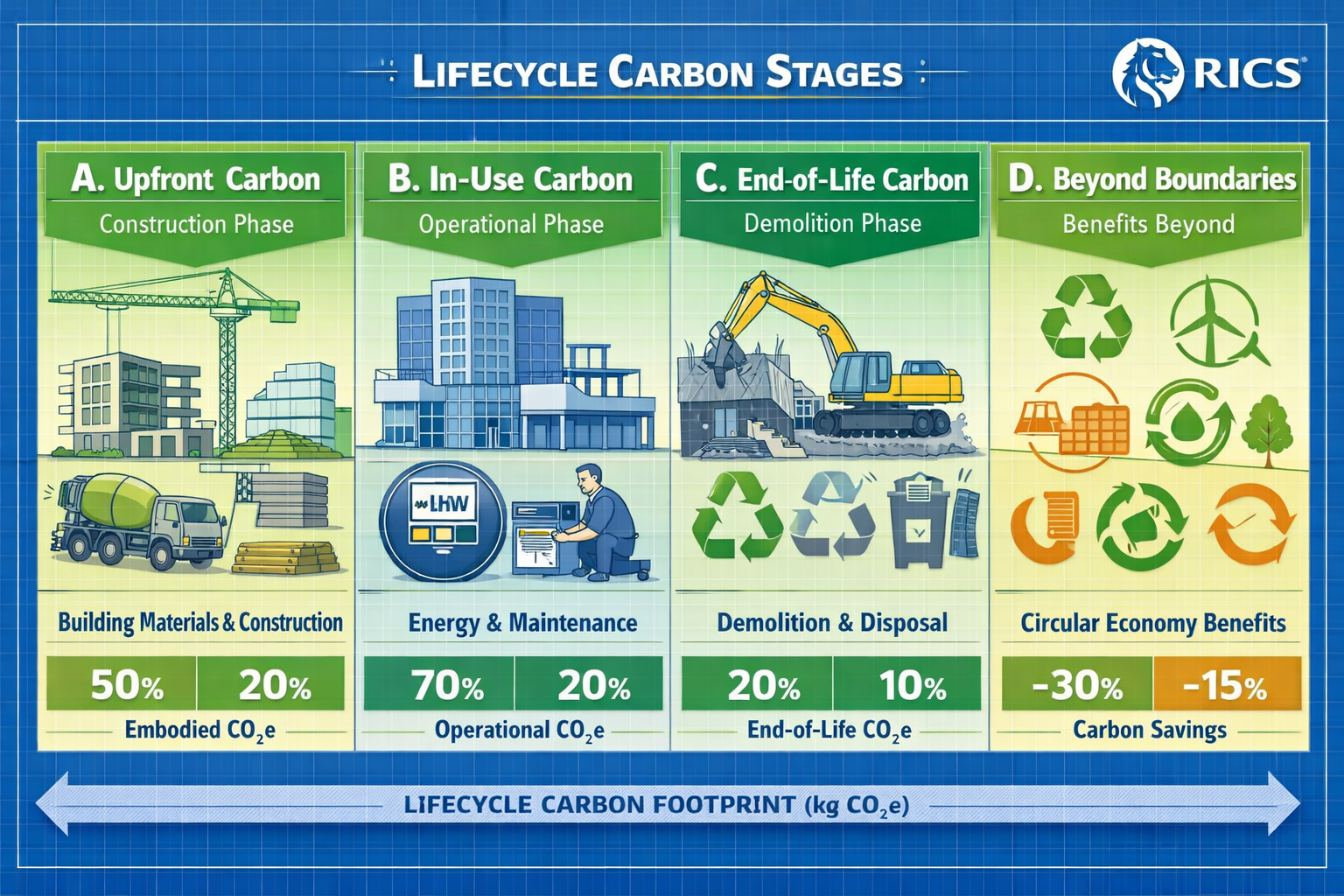
- Four-stage framework: Assessments must evaluate upfront carbon (Module A), operational carbon (Module B), end-of-life carbon (Module C), and benefits beyond boundaries (Module D).
- Dispute implications: Carbon performance data increasingly influences property disputes, requiring expert witnesses to demonstrate technical competency in WLCA methodology.
- Enhanced reporting requirements: New modules for preconstruction activities (A0) and commute emissions (B8) plus mandatory uncertainty analysis expand reporting obligations.
Understanding the RICS 2nd Edition Framework for Whole Life Carbon Assessments in Valuation Reports
The RICS Professional Standard on Whole Life Carbon Assessment, 2nd Edition, represents a significant evolution from its predecessor. Full implementation commenced on July 1, 2024, making compliance mandatory for all RICS members conducting carbon assessments.[6] This timing is critical for 2026 disputes, as properties assessed under the new standard present fundamentally different evidence profiles than those evaluated under earlier guidance.
What Changed in the 2nd Edition
The scope expanded dramatically to encompass all built environment assets rather than limiting coverage to buildings alone.[2][8] This expansion means that infrastructure projects, civil engineering works, and mixed-use developments now require the same rigorous carbon assessment methodology previously reserved for traditional building projects.
The standard introduced several new assessment modules that significantly impact commercial property valuations:
Module A0 – Preconstruction Activities 🏗️
- Design and survey carbon emissions
- Planning and feasibility study impacts
- Previously unaccounted carbon sources
Module B8 – User Commute and Transport 🚗
- Employee commute emissions
- Road vehicle impacts during operation
- Expanded operational carbon scope
These additions reflect a more comprehensive understanding of carbon impacts across the entire property lifecycle.[2]
The Four Primary Lifecycle Stages
Carbon assessments under the 2nd edition must evaluate four distinct lifecycle stages, each with specific reporting requirements:
| Lifecycle Stage | Module | Key Components | Typical % of Total Carbon |
|---|---|---|---|
| Upfront Carbon | A | Materials, construction, transport | 40-60% |
| In-Use Carbon | B | Operations, maintenance, refurbishment | 30-50% |
| End-of-Life | C | Demolition, disposal, waste processing | 5-10% |
| Beyond Boundaries | D | Recycling benefits, reuse potential | Variable credit |
This framework ensures that Red Book valuations incorporating carbon data provide a complete picture of environmental impact rather than focusing solely on operational energy consumption.
Alignment with International Standards
The 2nd edition aligns with the International Cost Management Standards (ICMS) 3rd Edition and the Built Environment Carbon Database (BECD).[2] This alignment creates consistency across jurisdictions and enables more reliable comparative analysis in dispute scenarios.
While the methodology is globally applicable, numerical assumptions and emissions factors are based on UK locations and practices due to data availability.[6] For international disputes, practitioners must adjust baseline data while maintaining methodological consistency.
Integrating Whole Life Carbon Data into Valuation Reports for 2026 Disputes
The practical integration of whole life carbon assessments into valuation reports requires a systematic approach that maintains professional standards while accommodating new environmental metrics. For disputes arising in 2026, this integration often determines the outcome of contested valuations.
Mandatory Reporting Requirements
The 2nd edition introduced mandatory uncertainty analysis requirements that directly impact valuation credibility.[2] A contingency allowance must be included to address uncertainty in early-stage assessments, with the percentage varying based on project stage:
- Concept stage: 40-60% contingency
- Design development: 20-40% contingency
- Detailed design: 10-20% contingency
- As-built verification: 5-10% contingency
These contingencies must be clearly documented in any valuation report that incorporates carbon data, as they directly affect the reliability of carbon-adjusted valuations.
Enhanced Biogenic Carbon Guidance
The 2nd edition provides substantially improved guidance on biogenic carbon accounting, addressing a significant gap in the first edition.[1][2] This enhancement is particularly relevant for disputes involving:
- Timber-framed structures
- Natural insulation materials
- Bio-based construction products
- Landscaping and sequestration claims
Biogenic carbon must be tracked separately from fossil carbon, with clear disclosure of calculation methodologies. This separation prevents inflated sustainability claims that could mislead valuation conclusions.
Software Compliance and Validation
RICS-validated software tools have emerged as essential for generating compliant reports. One Click LCA became the first RICS-validated software for whole life carbon assessment reports.[3] Using validated software provides several advantages in dispute scenarios:
✅ Defensible methodology: Pre-validated calculation methods reduce technical challenges
✅ Audit trails: Complete documentation of data sources and assumptions
✅ Consistency: Standardized reporting formats across comparable properties
✅ Expert credibility: Demonstrates adherence to professional standards
When preparing expert witness reports, the choice of assessment software can significantly impact the weight given to carbon-adjusted valuations.
Practical Application in Different Valuation Contexts
Different valuation purposes require tailored approaches to carbon integration:
For Probate Valuations 💼
Probate valuations increasingly require carbon data to establish fair market value, particularly for commercial properties where sustainability affects marketability and rental income potential.
For Capital Gains Tax 📊
Capital gains tax valuations must consider how carbon performance impacts property appreciation rates, as high-carbon properties face increasing obsolescence risk.
For Insurance Purposes 🏠
Insurance reinstatement valuations must account for the cost of rebuilding to current carbon standards, which may significantly exceed traditional construction costs.
Preparing Expert Witness Evidence for Sustainability-Driven Property Disputes
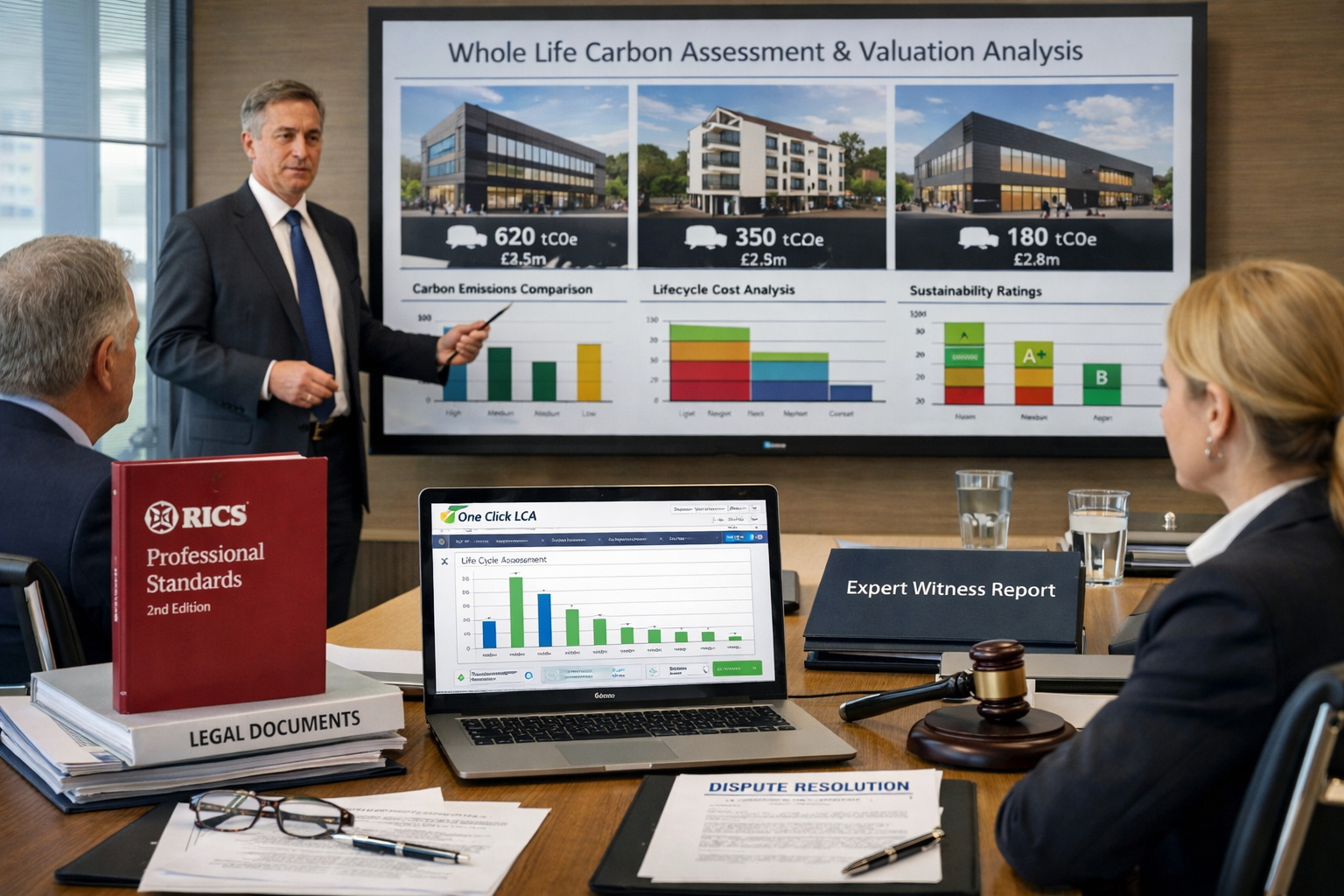
As whole life carbon assessments become standard in valuation reports, disputes increasingly center on the accuracy, methodology, and interpretation of carbon data. Expert witnesses must demonstrate technical competency in WLCA methodology while maintaining the objectivity required for litigation support.
Common Dispute Scenarios in 2026
Several dispute types have emerged as carbon considerations reshape property markets:
1. Valuation Discrepancies Based on Carbon Performance
Parties frequently dispute whether carbon performance justifies valuation premiums or discounts. Expert witnesses must demonstrate:
- Comparable evidence from similar properties
- Market recognition of carbon performance
- Quantifiable impact on rental income or sale prices
- Obsolescence risk for high-carbon assets
2. Compliance with Building Regulations and Standards
Disputes arise when properties fail to meet expected carbon performance standards, affecting value. These cases require detailed analysis of:
- Regulatory compliance status
- Remediation costs to achieve compliance
- Impact on marketability and financing
- Potential penalties or restrictions
3. Dilapidations and Carbon Upgrade Obligations
Dilapidations surveys increasingly incorporate carbon upgrade requirements, creating disputes over:
- Tenant obligations for carbon improvements
- Landlord responsibilities for building fabric
- Apportionment of retrofit costs
- Valuation of carbon-related improvements
Building Credible Expert Witness Reports
Expert witnesses providing evidence on Whole Life Carbon Assessments in Valuation Reports: Applying RICS 2nd Edition Guidance for 2026 Disputes must structure their reports to withstand rigorous cross-examination.
Essential Report Components:
📋 Clear Methodology Statement
- Specific RICS standard version applied
- Software tools and databases used
- Assumptions and limitations disclosed
- Uncertainty analysis included
📋 Data Source Documentation
- Primary data sources identified
- Secondary data justifications provided
- BECD database references
- Comparable property evidence
📋 Professional Qualifications
- RICS membership status
- Whole life carbon training completion
- Relevant project experience
- Independence declaration
The RICS Global Certificate in Whole Life Carbon Assessment training programme provides structured education specifically built around the 2nd edition standard.[7] Completion of this programme significantly enhances expert credibility in dispute proceedings.
Addressing Uncertainty and Contingency in Evidence
The mandatory uncertainty analysis requirement creates both challenges and opportunities for expert witnesses. While uncertainty might appear to weaken conclusions, properly documented contingency analysis actually strengthens expert credibility by demonstrating:
- Realistic assessment of data limitations
- Professional acknowledgment of variability
- Risk-adjusted valuation ranges
- Sensitivity analysis of key assumptions
Expert reports should present carbon-adjusted valuations as ranges rather than single-point estimates, with clear explanation of factors driving the range width.
Cross-Examination Preparation
Expert witnesses should anticipate challenges on several technical points:
Data Quality Questions 🔍
- How were emissions factors selected?
- What assumptions underpin operational carbon estimates?
- How were end-of-life scenarios determined?
- What comparable properties support carbon value adjustments?
Methodology Challenges ⚖️
- Why was specific software chosen?
- How were lifecycle boundaries defined?
- What alternatives were considered?
- How does the approach align with RICS 2nd edition requirements?
Valuation Impact Disputes 💰
- What market evidence supports carbon-based adjustments?
- How were obsolescence rates determined?
- What discount rates apply to future carbon costs?
- How do carbon metrics translate to monetary values?
Preparation should include reviewing recent case law, understanding opposing expert methodologies, and maintaining detailed working papers that document every calculation step.
PAS 2080:2023 Integration
While the RICS standard provides the assessment framework, PAS 2080:2023 offers complementary guidance on carbon management in infrastructure projects. Expert witnesses working on large-scale developments or infrastructure disputes should demonstrate familiarity with both standards and explain how they interact.
PAS 2080:2023 emphasizes:
- Carbon management through project governance
- Whole life value optimization
- Collaborative carbon reduction strategies
- Performance measurement and reporting
For disputes involving project management aspects, demonstrating knowledge of both frameworks strengthens expert positioning.
Practical Implementation Strategies for Surveyors and Valuers
Successfully incorporating whole life carbon assessments into standard valuation practice requires systematic changes to workflow, documentation, and professional development.
Building Technical Competency
Professional development in whole life carbon assessment should follow a structured path:
Stage 1: Foundation Knowledge 📚
- Complete RICS Global Certificate programme
- Study the 2nd edition standard thoroughly
- Review BECD database structure and content
- Understand lifecycle assessment principles
Stage 2: Software Proficiency 💻
- Train on RICS-validated assessment tools
- Practice with sample projects
- Develop template reporting formats
- Build internal quality assurance processes
Stage 3: Market Analysis Skills 📈
- Research carbon value premiums in local markets
- Build comparable evidence databases
- Track regulatory developments
- Monitor dispute case outcomes
Workflow Integration
Carbon assessment should integrate seamlessly with existing valuation workflows rather than operating as a separate process. Effective integration points include:
During Initial Instructions
- Clarify carbon reporting requirements
- Identify applicable standards and regulations
- Determine assessment scope and boundaries
- Establish data availability and quality expectations
During Property Inspection
- Gather carbon-relevant physical data
- Document construction materials and systems
- Photograph key carbon-intensive elements
- Collect operational energy records
Similar to conducting Level 3 RICS building surveys, carbon assessments require systematic data collection that cannot be easily replicated without site access.
During Analysis and Valuation
- Input data to validated assessment software
- Calculate lifecycle carbon metrics
- Apply uncertainty analysis and contingencies
- Adjust valuations based on carbon performance
- Document all assumptions and calculations
During Report Preparation
- Include executive summary of carbon findings
- Present lifecycle stage breakdowns
- Explain valuation adjustments clearly
- Provide uncertainty ranges and sensitivity analysis
- Attach detailed carbon assessment appendix
Quality Assurance and Peer Review
Given the technical complexity and dispute potential of carbon-adjusted valuations, robust quality assurance processes are essential:
✓ Internal peer review of carbon calculations
✓ Cross-checking against comparable properties
✓ Verification of emissions factors and assumptions
✓ Consistency checks across report sections
✓ Software output validation
✓ Regulatory compliance verification
For high-value properties or contentious matters, consider engaging specialist carbon consultants to review technical aspects before finalizing reports.
Documentation and Record Retention
Comprehensive documentation serves two critical purposes: supporting current valuation conclusions and preparing for potential future disputes. Essential records include:
- Complete calculation working papers
- Software input files and outputs
- Data source references and justifications
- Comparable property evidence
- Correspondence regarding assumptions
- Version control for iterative assessments
Retain these records for at least six years beyond report issuance, consistent with professional indemnity insurance requirements and potential dispute timelines.
Staying Current with Evolving Standards
The carbon assessment landscape continues to evolve rapidly. Professional obligations require ongoing monitoring of:
- RICS standard updates and guidance notes
- Building regulations changes
- Market practice developments
- Software tool enhancements
- Case law and dispute outcomes
- International standard harmonization
Regular participation in professional development activities, industry conferences, and technical working groups helps maintain cutting-edge expertise essential for expert witness credibility.
Conclusion
The integration of Whole Life Carbon Assessments in Valuation Reports: Applying RICS 2nd Edition Guidance for 2026 Disputes represents a fundamental transformation in property valuation practice. The mandatory implementation of the RICS 2nd edition standard since July 2024 has created new professional obligations, expanded assessment scope, and introduced sophisticated technical requirements that directly impact property values and dispute outcomes.
Chartered surveyors must now demonstrate competency across four lifecycle stages, properly account for biogenic carbon, apply mandatory uncertainty analysis, and utilize validated software tools to generate defensible carbon assessments. These technical requirements extend beyond traditional valuation skills, demanding specialized training and systematic workflow integration.
For expert witnesses, the stakes are particularly high. Sustainability-driven property disputes increasingly hinge on the accuracy and credibility of carbon assessments embedded in valuation reports. Successful expert testimony requires not only technical mastery of WLCA methodology but also the ability to communicate complex carbon concepts clearly, withstand rigorous cross-examination, and demonstrate compliance with evolving professional standards.
Next Steps for Property Professionals
Immediate Actions:
-
Complete RICS training: Enroll in the Global Certificate in Whole Life Carbon Assessment programme to build foundational competency.
-
Implement validated software: Adopt RICS-validated assessment tools like One Click LCA to ensure methodological compliance and defensible outputs.
-
Update report templates: Revise standard valuation report formats to incorporate carbon assessment sections, uncertainty analysis, and lifecycle stage breakdowns.
-
Build comparable databases: Begin systematically collecting carbon performance data from comparable properties to support future valuation adjustments.
-
Establish quality assurance: Develop internal peer review processes specifically for carbon-adjusted valuations to minimize technical errors and strengthen dispute readiness.
Ongoing Professional Development:
- Monitor RICS guidance updates and technical bulletins
- Participate in industry working groups and carbon assessment forums
- Track dispute case outcomes to understand evolving legal interpretations
- Maintain detailed CPD records demonstrating carbon competency
- Consider specialist accreditation in sustainability and carbon assessment
The convergence of environmental imperatives, regulatory requirements, and market preferences has permanently altered the property valuation landscape. Professionals who invest in developing robust whole life carbon assessment capabilities will be well-positioned to provide credible expert witness services, deliver defensible valuations, and navigate the increasingly complex sustainability-driven disputes that characterize the 2026 property market.
Whether conducting residential surveys or commercial property assessments, the integration of whole life carbon data is no longer optional—it is a professional obligation that demands technical excellence, methodological rigor, and unwavering commitment to evidence-based practice.
References
[1] New Rics Whole Life Carbon 2nd Edition – https://support.etool.app/index.php/knowledgebase/new-rics-whole-life-carbon-2nd-edition/
[2] Understanding The Rics Whole Life Carbon Assessment Standard – https://www.tsariley.com/news/understanding-the-rics-whole-life-carbon-assessment-standard/
[3] Rics Whole Life Carbon Assessment Wlca 2nd Edition – https://oneclicklca.com/regulations/rics-whole-life-carbon-assessment-wlca-2nd-edition
[6] Whole Life Carbon Assessment – https://www.rics.org/profession-standards/rics-standards-and-guidance/sector-standards/construction-standards/whole-life-carbon-assessment
[7] Wlca Delivering The Future Of Carbon Assessment In The Built Environment – https://www.rics.org/news-insights/wlca-delivering-the-future-of-carbon-assessment-in-the-built-environment
[8] Watch – https://www.youtube.com/watch?v=_48g6KJZgvg