
Only 14% of UK homes currently achieve an EPC rating of C or above — yet lenders, buyers, and regulators are converging on energy efficiency as a core driver of property value. For residential and small-block valuers, this creates a pressing practical challenge: how do you reach a defensible opinion of market value when a property has received retrofit grants, benefits from green mortgage products, or carries a schedule of planned energy-efficiency works?
Valuing properties with retrofit grants and green finance — including how surveyors treat subsidies, EPC uplifts and future works — is no longer a niche concern. In 2026, it sits at the heart of mainstream valuation practice. This article provides a practical framework for navigating these issues with confidence and rigour.
Key Takeaways 📋
- Retrofit grants are generally not added to market value — surveyors assess value based on the completed improvement, not the funding mechanism.
- EPC uplifts can generate a measurable "green premium", but only where robust comparable evidence supports it.
- Planned or incomplete works require a deduction from the "as-improved" value, not an uplift.
- Green mortgages influence buyer behaviour but do not directly alter the valuation figure — they affect demand and therefore market evidence.
- Transparency and documentation are critical: surveyors must clearly state assumptions about grants, works status, and EPC ratings in every report.
Why Retrofit Finance Is Reshaping Property Valuation
The UK government's net-zero commitments have triggered a cascade of funding mechanisms — from the Boiler Upgrade Scheme (BUS) and ECO4 to the Great British Insulation Scheme (GBIS) and local authority flex funds. Simultaneously, most major high-street lenders now offer green mortgage products with preferential rates for properties rated EPC A or B.
This policy and finance landscape means that a growing proportion of properties coming to market in 2026 will have:
- Received partial or full grant funding for energy-efficiency measures
- Had their EPC rating improved as a direct result
- Benefited from — or be eligible for — a green mortgage product
- A schedule of recommended but incomplete retrofit works
Each of these factors introduces complexity into the valuation process. Understanding how to treat them consistently and transparently is essential for any surveyor working in residential or small-block commercial settings. For those unfamiliar with the range of property valuation methods available, it is worth reviewing the fundamentals before diving into green finance adjustments.
How Surveyors Treat Retrofit Grants and Subsidies in Valuation
The Core Principle: Value the Improvement, Not the Funding
"Market value reflects what a willing buyer would pay — not how the seller funded the works."
This is the foundational principle when valuing properties with retrofit grants and green finance. A grant is a funding mechanism, not a value-creating event in itself. The value-creating event is the physical improvement to the property — better insulation, a new heat pump, solar PV panels — and the resulting improvement in energy performance.
In practice, this means:
| Scenario | Valuation Treatment |
|---|---|
| Grant-funded heat pump installed, works complete | Value the property with heat pump in situ; grant is irrelevant to market value |
| Partial grant received, works incomplete | Treat as future works — deduct estimated cost to complete from "as-improved" value |
| Grant available but not yet applied for | Note eligibility; do not add grant value to market value |
| Grant repayable on sale (clawback clause) | Flag as a legal encumbrance; may reduce market value |
Clawback Clauses: A Hidden Risk ⚠️
Some grant schemes — particularly those administered through local authorities or housing associations — include clawback provisions that require repayment if the property is sold within a defined period (typically 3–10 years). This is a material fact that must be:
- Identified during the survey and valuation process
- Reported clearly in the valuation report
- Referred to the client's solicitor for legal due diligence
A clawback clause can materially affect saleability and, in some cases, the market value itself — particularly in lower-value markets where the clawback sum represents a significant percentage of the property's worth.
ECO4 and Means-Tested Schemes
Properties improved under ECO4 (the Energy Company Obligation) are typically occupied by lower-income households. Valuers should note that the works themselves (cavity wall insulation, loft insulation, heat pumps) add genuine value, but the means-tested nature of the grant does not transfer to a new owner. A new buyer cannot assume eligibility. This distinction matters when advising clients on the sustainability of any "green premium."
EPC Uplifts and the Green Premium: What the Evidence Actually Shows
Does a Better EPC Rating Add Market Value?
The short answer in 2026 is: yes, but only where market evidence supports it. Research from multiple UK property market studies consistently shows a measurable price differential between properties at different EPC bands — particularly the step from D to C, and from C to B/A. However, the size of this premium varies significantly by:
- Location — urban markets with high buyer competition show stronger green premiums
- Property type — detached and semi-detached homes show clearer EPC-linked differentials than flats
- Price bracket — higher-value properties show stronger green premiums in percentage terms
- Buyer profile — owner-occupiers with long-term horizons value energy savings more than short-term investors
How to Apply EPC Evidence in Comparables Analysis
When using the comparable sales method, surveyors should:
- Identify the EPC rating of each comparable at the time of sale
- Adjust for EPC band differences using local market evidence — not national averages
- Avoid double-counting: if a comparable already reflects a green premium, do not apply a further adjustment
- Document assumptions clearly in the report
💡 Practical tip: Where comparable evidence is thin, surveyors can reference the cost of achieving the equivalent EPC rating as a cross-check — but this is a secondary method, not a primary one.
For properties in London and the South East, where green mortgage products are most actively marketed, the EPC premium is increasingly measurable. Surveyors working across West London and South West London are reporting growing buyer sensitivity to EPC ratings, particularly among first-time buyers using green mortgage products.
Green Mortgages: Influence on Value vs. Influence on Demand
Green mortgages offer preferential interest rates — typically 0.1% to 0.5% lower — for properties rated EPC A or B. This affects buyer demand and therefore market evidence, but it does not directly alter the valuation figure in the way that a physical improvement does.
The mechanism works like this:
- Green mortgage availability → expands the pool of motivated buyers for high-EPC properties
- Larger buyer pool → upward pressure on comparable sales prices
- Higher comparable sales prices → higher market value opinion (supported by evidence)
Surveyors should not add a "green mortgage premium" as a standalone adjustment. Instead, they should ensure their comparable evidence reflects current market conditions, which will naturally incorporate any demand effects from green finance products.
Treating Planned and Future Retrofit Works in Valuation
The "As-Improved" vs. "As-Is" Distinction
This is one of the most technically demanding aspects of valuing properties with retrofit grants and green finance: how surveyors treat subsidies, EPC uplifts and future works. The key question is: what is the current state of the property, and what is planned?
Three scenarios require different approaches:
Scenario 1: Works Complete
Value the property in its current, improved state. Reference comparables with similar specifications. Note the EPC rating achieved.
Scenario 2: Works in Progress
Adopt an "as-improved" value, then deduct the estimated cost to complete the works. Ensure the deduction reflects current contractor rates, not grant-subsidised costs. A building survey can help quantify the scope and cost of incomplete works accurately.
Scenario 3: Works Planned but Not Started
Do not uplift the current value for planned works. Instead, note the potential for improvement and, where instructed, provide a separate "as-improved" valuation as a special assumption. This must be clearly labelled and caveated.
Deferred Works and the Cost-to-Cure Approach
Where a property has a poor EPC rating and a schedule of recommended works, the cost-to-cure approach is appropriate:
Market Value = As-Improved Value − Cost of Works − Contractor's Profit/Risk Margin
This approach requires:
- A reliable estimate of works costs (ideally from a quantity surveyor or contractor)
- Evidence of the "as-improved" value from comparables
- A margin for risk, delay, and disruption (typically 10–15%)
Surveyors should be cautious about relying solely on grant-subsidised cost estimates, as these may not reflect the true market cost of the works — which is what matters for a willing buyer who may not be eligible for the same grant.
For more complex properties, a stock condition survey can provide a detailed schedule of works that forms the basis for cost-to-cure calculations.
Practical Framework for Valuers: A Step-by-Step Approach
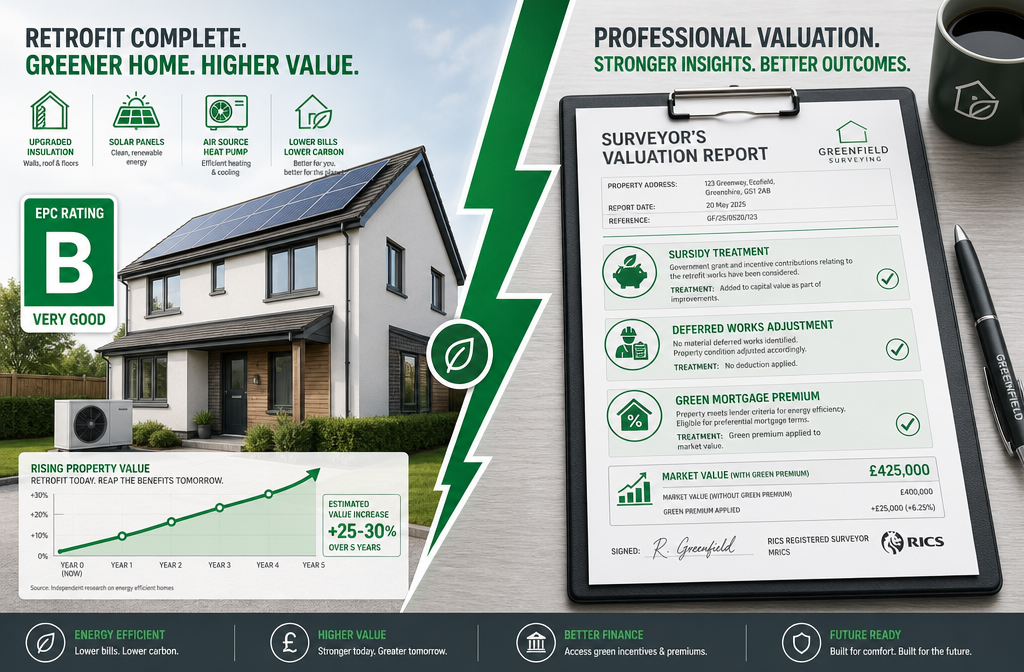
The following framework helps residential and small-block valuers approach these valuations consistently. This is the practical heart of valuing properties with retrofit grants and green finance: how surveyors treat subsidies, EPC uplifts and future works.
Step 1: Gather Documentation 📁
Before inspection, request:
- Current EPC certificate (and any previous versions)
- Details of any grants received, including scheme name, amount, and clawback terms
- Contractor warranties and guarantees for completed works
- Any green mortgage offer letters or eligibility confirmations
- Schedule of planned works (if applicable)
Step 2: Inspect and Verify
During inspection, verify that completed works match the documentation. Check:
- Installation quality and compliance with building regulations
- Whether works are covered by appropriate warranties (e.g., HIES, RECC, MCS certification for solar/heat pumps)
- Signs of incomplete or substandard installation that could affect value
Step 3: Identify the Valuation Basis
Determine whether the instruction requires:
- Market value as-is (most common)
- Market value on special assumption (as-improved, works complete)
- Both (for lending purposes with phased drawdown)
Step 4: Select and Adjust Comparables
- Filter comparables by EPC band where possible
- Apply evidence-based adjustments for EPC differences
- Do not apply grant values as uplifts
- Reflect any clawback liabilities as downward adjustments
Step 5: Report Transparently
Every report should include:
- A clear statement of the EPC rating relied upon
- Disclosure of any grants received and clawback terms
- The basis on which planned works have (or have not) been reflected
- Any assumptions made about green mortgage eligibility
For clients seeking a homebuyer survey alongside a valuation, it is worth noting that energy-efficiency observations should be consistent across both documents.
Common Errors and How to Avoid Them ❌
| Error | Why It Matters | How to Avoid |
|---|---|---|
| Adding grant value to market value | Inflates value; not market-reflective | Value the improvement, not the funding |
| Ignoring clawback clauses | Creates negligence risk | Always check grant terms; refer to solicitors |
| Using national EPC premium data without local evidence | Unreliable; can over- or under-value | Build local comparable databases |
| Treating planned works as complete | Misleads lenders and buyers | Clearly label special assumptions |
| Double-counting green mortgage effects | Inflates value | Ensure comparables already reflect market conditions |
Surveyors should also be alert to the risk of greenwashing — where a property is marketed as highly energy-efficient based on a theoretical EPC rating that does not reflect actual performance. The EPC is a modelled assessment, not a measured one, and real-world energy costs can differ significantly.
For properties with more complex structural or drainage considerations that may affect retrofit feasibility, a drainage survey or structural assessment may be warranted before finalising the valuation.
The Regulatory and Professional Standards Context
RICS guidance — particularly the RICS Valuation – Global Standards (Red Book) and associated UK national supplements — requires valuers to reflect all factors that a hypothetical willing buyer would consider. In 2026, energy efficiency and retrofit status are clearly within that scope.
Key professional obligations include:
- Transparency: All assumptions about retrofit status, grants, and EPC ratings must be stated
- Competence: Valuers must stay current with evolving grant schemes and green finance products
- Independence: Valuers must not be influenced by a client's desire to maximise value through grant inclusion
For complex cases — particularly small residential blocks where individual flat values interact with communal retrofit works — specialist advice may be needed. Commercial property surveyors with mixed-use experience can be valuable in these scenarios.
Understanding valuation factors more broadly also helps surveyors contextualise where energy efficiency sits within the wider matrix of value drivers.
Conclusion: Actionable Next Steps for Valuers in 2026
The intersection of retrofit grants, green finance, and property valuation is complex — but it is navigable with the right framework. Here are the key actions to take:
✅ Update your comparable database to include EPC ratings as a standard data field
✅ Build a checklist for grant documentation review before every inspection
✅ Develop local EPC premium evidence rather than relying on national benchmarks
✅ Review your report templates to ensure they include standard disclosures for retrofit status and green finance
✅ Stay current with evolving grant schemes — ECO4, BUS, and GBIS terms change regularly
✅ Refer clawback clauses to solicitors as a matter of course, not exception
✅ Engage with RICS guidance updates on sustainability and energy efficiency in valuation
The direction of travel is clear: energy efficiency will become an increasingly dominant value driver as lenders tighten EPC requirements and buyers factor running costs more carefully into purchase decisions. Surveyors who build robust, evidence-based approaches to valuing properties with retrofit grants and green finance now will be better positioned — professionally and commercially — as this becomes standard practice across the market.