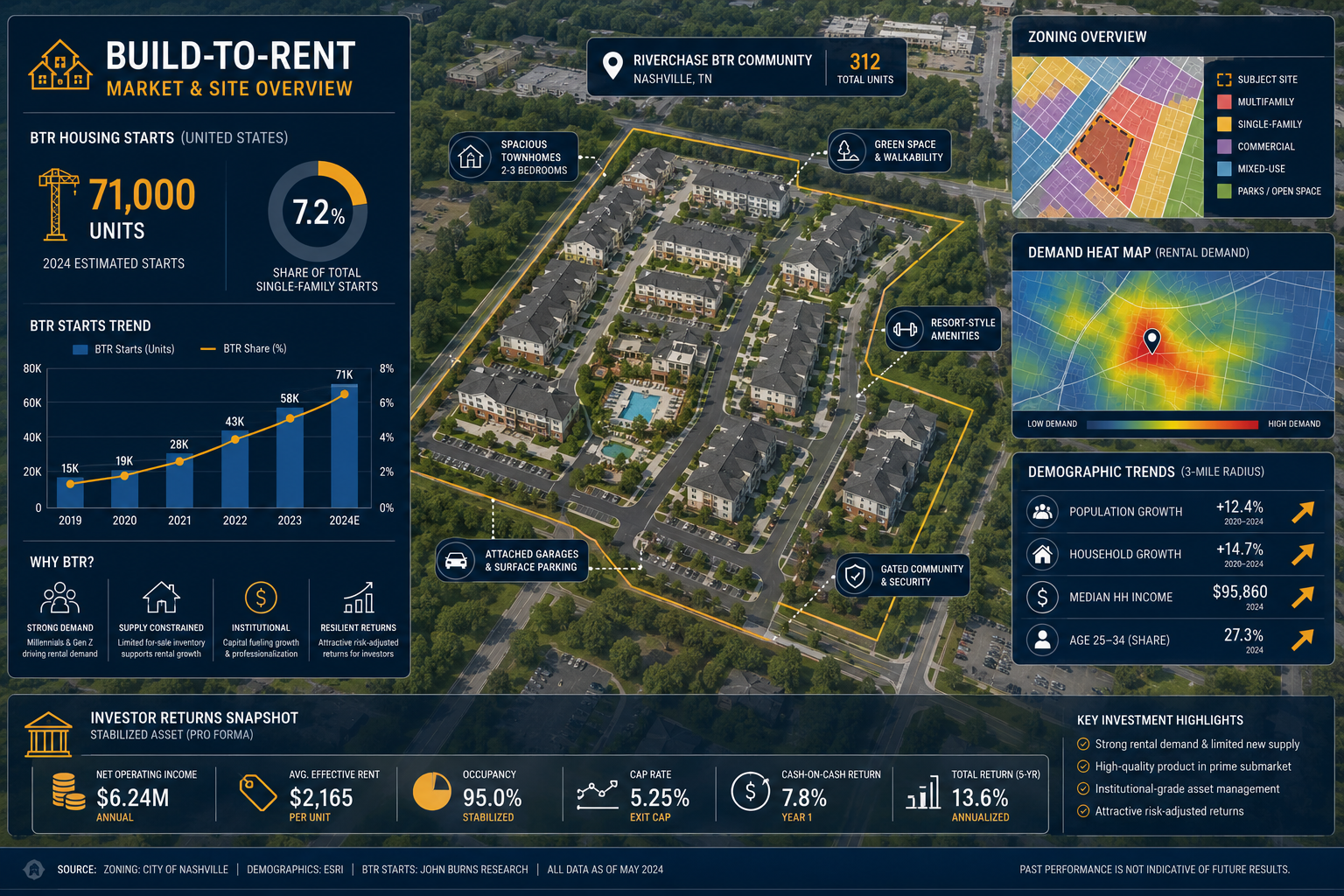
By 2026, roughly 71,000 single-family build-to-rent (BTR) units were started across the United States in a single 12-month period — a figure that would have seemed extraordinary just five years ago [1]. For surveyors, developers, and investors, this volume is not just a market statistic. It is a signal that the profession of property surveying must evolve rapidly to meet the unique technical, legal, and logistical demands of purpose-built rental communities. Surveying demands for build-to-rent communities: navigating new development trends is no longer a niche conversation — it sits at the heart of how modern residential development gets planned, approved, financed, and delivered.
Key Takeaways 📌
- BTR construction remains near historic highs in 2026, with ~71,000 units started in the past 12 months, creating sustained demand for specialist surveying services.
- Accurate land banking and site assessment are critical first steps in BTR development — errors at this stage compound across entire communities of dozens or hundreds of homes.
- Stock condition surveys and structural assessments play a growing role as BTR portfolios mature and investors demand reliable operating data.
- Surveying professionals must understand BTR-specific planning, drainage, and party wall considerations that differ from standard residential or commercial projects.
- Investor underwriting in 2026 has shifted toward cash-flow durability, making precise property valuation and condition reporting more important than ever.
The Build-to-Rent Boom: Understanding the Scale of Demand
What Is Driving BTR Growth in 2026?
The BTR sector has moved well beyond its post-pandemic origins. Today, it represents a structurally elevated share of the single-family housing market — 7.2% of all single-family starts for the year ending Q2 2025, compared to near-negligible levels before 2020 [1]. Even as the pace of starts has cooled slightly from the all-time peak of 92,000 units in Q3 2024, the pipeline remains deep and the fundamentals are strong [1].
Why? Because millions of households want the privacy, square footage, and neighbourhood feel of a single-family home but cannot — or choose not to — absorb the financial burden of ownership. BTR communities sit precisely in that gap: professionally managed, purpose-built, scalable rental neighbourhoods that offer something traditional apartment blocks cannot [6].
In March 2026, total U.S. housing starts reached a seasonally adjusted annual rate of 1.502 million, up 10.8% from March 2025, with single-family starts at 1.032 million SAAR [5]. That expanding construction backdrop provides the runway for BTR to sustain its structural share of the market — and for the surveying profession to grow alongside it [2].
💬 "Build-to-rent has evolved from a post-pandemic niche to a durable, mainstream residential strategy — and the surveying demands that come with it are equally durable."
The Demographic Engine Behind Sustained Demand
Several overlapping demographic forces are keeping BTR demand robust in 2026 [4]:
| Driver | Impact on BTR |
|---|---|
| High mortgage rates & home prices | Pushes would-be buyers into the rental market |
| Millennial household formation | Large cohort seeking family-sized rental space |
| Remote work flexibility | Demand for suburban BTR communities with home offices |
| Aging rental population | Long-term renters who value professional management |
| Institutional capital inflows | Investor confidence sustaining development pipelines |
For surveyors, each of these drivers translates into sustained project pipelines — from greenfield land assessments through to post-completion condition monitoring.
Surveying Demands for Build-to-Rent Communities: Navigating New Development Trends in Site Assessment and Land Banking
Why Land Banking Accuracy Is Non-Negotiable
In a standard one-off residential development, a surveying error might affect a single property. In a BTR community of 150 to 500 homes, the same error is multiplied across every plot. This is the defining challenge of surveying demands for build-to-rent communities: navigating new development trends at the land acquisition and site preparation stage.
Land banking — the process of acquiring and holding land for future BTR development — requires surveyors to deliver:
- ✅ Topographic surveys that accurately map gradients, drainage channels, and flood risk zones
- ✅ Boundary delineation precise enough to support master-planned community layouts
- ✅ Ground investigation reports informing foundation design across multiple plot types
- ✅ Environmental assessments covering contamination, ecology, and tree preservation
A single discrepancy in a boundary survey at the land banking stage can delay planning consent, trigger legal disputes with neighbouring landowners, or force costly redesigns of entire street layouts. Engaging experienced building surveyors from the earliest feasibility stage is not a luxury — it is a risk management essential.
Drainage and Infrastructure Mapping in Master-Planned Communities
BTR communities are, by design, high-density single-family developments. That density creates complex shared infrastructure challenges, particularly around drainage. A master-planned BTR site of 200 homes generates significantly more surface water runoff than 200 individually developed plots, because the drainage network must be designed holistically from the outset.
A professional drainage survey at the site assessment stage identifies:
- Existing watercourses, culverts, and easements that affect layout planning
- Soil permeability data for sustainable drainage systems (SuDS) design
- Connection points to public sewers and their capacity constraints
- Potential flood risk areas requiring mitigation in the masterplan
Neglecting drainage survey work at this stage is one of the most common — and most expensive — mistakes in large-scale residential development. In a BTR context, where the developer retains ownership and management responsibility for the entire community long-term, drainage failures are operational liabilities, not just construction defects.
Party Wall Considerations at Scale
When BTR communities are built in urban or suburban infill locations, party wall obligations become significant. Where new foundations are excavated within three metres of a neighbouring structure, the Party Wall etc. Act 1996 applies — and in a dense BTR scheme, this can mean dozens of individual party wall notices and awards.
Understanding the three-metre rule for excavations near neighbours is essential for BTR project managers and their surveying teams. Failing to serve correct notices before construction begins can halt an entire development phase, not just a single plot.
Surveying Demands for Build-to-Rent Communities: Navigating New Development Trends in Portfolio Management and Investor Due Diligence
From Construction to Cash Flow: The Surveying Role Evolves
By 2026, the BTR sector has matured significantly. Investors no longer evaluate BTR assets purely on projected rent growth — they want operating data, condition evidence, and cash-flow durability [4]. This shift has created a new and growing demand for surveying services at the portfolio management stage.
When an institutional investor acquires a stabilised BTR community — or when a developer refinances a completed scheme — the due diligence process now routinely includes:
- Stock condition surveys that assess the physical state of every home in the portfolio, identifying maintenance liabilities and capital expenditure requirements
- Structural surveys for any homes showing signs of movement, cracking, or defect
- Commercial building surveys for shared amenity buildings, management offices, and community facilities within the BTR scheme
A stock condition survey across a 300-home BTR community is a substantial undertaking. It requires a structured methodology, standardised condition ratings, and clear reporting that allows investors to model future maintenance costs with confidence. The output directly influences asset valuation, financing terms, and acquisition pricing.
Valuation Challenges Unique to BTR
Valuing a BTR community is not the same as valuing an equivalent number of individual homes. BTR assets are valued as investment properties — on the basis of their income-generating capacity — rather than on a sum-of-parts residential basis. This creates specific challenges for surveyors:
- Comparable evidence is limited, because BTR as an asset class is still relatively young in many markets
- Void rates, management costs, and maintenance reserves must be modelled accurately to support a credible income capitalisation approach
- Lease structures in BTR communities (typically assured shorthold tenancies with professional management) differ from both private rental and social housing, requiring careful interpretation
Surveyors working in this space benefit from a strong grounding in property valuation methodology and an understanding of how BTR income streams are assessed relative to other residential investment classes.
💬 "In 2026, BTR underwriting has shifted from chasing rent growth to stress-testing cash-flow resilience — and that shift puts precise surveying data at the centre of every investment decision."
Snagging and Handover Surveys in New-Build BTR
Because BTR homes are delivered at scale — often in phases of 30 to 80 units at a time — snagging surveys take on an industrial character. A developer handing over 60 homes to a management company in a single phase needs a structured, consistent snagging process that identifies defects before tenants move in.
A professional snagging survey in a BTR context covers:
- Internal finishes, fixtures, and fittings across every unit
- External envelope, roofing, and drainage connections
- Shared spaces including landscaping, car parking, and communal areas
- Mechanical and electrical systems including heating, ventilation, and fire safety
Getting snagging right at handover protects the developer's warranty position, reduces early tenant complaints, and establishes a clean baseline for ongoing condition monitoring.
Structural Engineering and Specialist Surveys in BTR Development
When Standard Surveys Are Not Enough
Not every BTR site is a clean greenfield opportunity. Many schemes are delivered on brownfield land — former industrial sites, redundant retail parks, or underutilised commercial zones — where the ground conditions and existing structures create additional surveying complexity.
On brownfield BTR sites, specialist structural engineering input is often required alongside standard survey work. This might include:
- Subsidence surveys where historic industrial activity has affected ground stability
- Asbestos surveys for existing structures that must be demolished before BTR construction begins
- Structural engineering assessments of retained structures being incorporated into the BTR masterplan
The integration of specialist surveying and structural engineering within a single project team — rather than treating them as separate commissions — is one of the hallmarks of well-managed BTR development [8].
Dilapidations and Schedule of Condition in BTR Contexts
For BTR schemes developed on leasehold land, or where the development involves conversion of existing buildings alongside new-build homes, schedule of condition and dilapidations surveying becomes relevant.
A schedule of condition report prepared at the outset of a ground lease or development agreement protects both the landowner and the developer by recording the exact state of the site before works begin. This is particularly important where:
- The BTR developer is taking a long leasehold interest in the land
- Existing buildings on the site are being retained and adapted
- Infrastructure shared with neighbouring landowners is affected by the development
Choosing the Right Surveying Partner for BTR Projects
What BTR Developers and Investors Should Look For
Not all surveying firms are equally equipped to handle the scale, complexity, and pace of BTR development. When selecting a surveying partner for a BTR project, developers and investors should prioritise:
- Experience with large residential schemes — the ability to mobilise teams across multiple plots simultaneously
- Familiarity with BTR-specific planning and regulatory requirements in the target geography
- Integrated service capability — covering land surveys, structural engineering, drainage, valuation, and condition reporting under one roof
- Digital reporting platforms that allow condition data to be aggregated across hundreds of units efficiently
- RICS accreditation — ensuring that survey reports meet the standards required by lenders, investors, and planning authorities
Understanding how to choose the right property survey for each stage of a BTR project is a skill in itself. The survey type appropriate for land acquisition due diligence is very different from what is needed at handover, refinancing, or portfolio sale.
The Geographic Dimension: Where BTR Is Growing
BTR development in the UK is concentrated in specific growth corridors — major cities, commuter belts, and regional centres where rental demand is structurally strong. Surveyors with local market knowledge in these areas offer a significant advantage:
- London and Greater London — including North London, East London, and Central London where infill BTR schemes are increasingly common
- Surrey and the Home Counties — areas like Surrey and Guildford where suburban BTR communities are expanding rapidly
- Hertfordshire — where Hertfordshire-based surveyors are supporting significant new-build BTR pipelines
Local expertise matters because planning policies, drainage requirements, and ground conditions vary significantly between regions. A surveying team that understands the specific regulatory environment of a target BTR location can save developers weeks of delay and thousands in abortive costs.
Conclusion: Actionable Next Steps for Navigating BTR Surveying Demands
Surveying demands for build-to-rent communities: navigating new development trends in 2026 requires a fundamentally different mindset from traditional residential surveying. The scale, pace, and investment sophistication of the BTR sector demand surveying professionals who can operate across the full development lifecycle — from land banking and site assessment through to portfolio management and investor due diligence.
The BTR market is not slowing down in any meaningful sense. With ~71,000 units started in the past 12 months [1], a construction backdrop of 1.502 million total housing starts in March 2026 [5], and institutional investors increasingly treating BTR as a core residential asset class [4], the pipeline of surveying work is substantial and growing.
✅ Actionable Next Steps
For BTR developers:
- Commission topographic and drainage surveys at the earliest feasibility stage — before land acquisition if possible
- Build a snagging survey protocol into every phase handover plan, not as an afterthought
- Engage structural engineers and surveyors as an integrated team on brownfield sites
For BTR investors:
- Require stock condition surveys as a standard component of acquisition due diligence
- Ensure valuation reports are prepared by surveyors with specific BTR experience and access to comparable transaction data
- Establish a rolling condition monitoring programme for stabilised portfolios
For surveying professionals:
- Invest in understanding BTR-specific planning, drainage, and party wall requirements
- Develop digital reporting capabilities that can scale across large portfolios
- Build relationships with BTR developers and fund managers in your target geography
The intersection of rising rental demand, institutional capital, and complex multi-plot development is where the most interesting — and most demanding — surveying work of the next decade will take place. The firms and professionals who invest in BTR-specific expertise now will be best positioned to lead in this growing market.
References
[1] Build To Rent Btr Development Continues To Outpace Historical Highs – https://arbor.com/blog/build-to-rent-btr-development-continues-to-outpace-historical-highs/
[2] Building The Future How Build To Rent Is Reshaping Housing In 2026 – https://informaconnect.com/building-the-future-how-build-to-rent-is-reshaping-housing-in-2026/
[3] Built To Rent Single Family Homes Double In 2022 – https://www.rentcafe.com/blog/rental-market/market-snapshots/built-to-rent-single-family-homes-double-in-2022/
[4] Build To Rent Investment Opportunities 2026 – https://www.catalystcp.com/build-to-rent-investment-opportunities-2026/
[5] Newresconst – https://www.census.gov/construction/nrc/pdf/newresconst.pdf
[6] Build To Rent Overview 2024 – https://www.cbre.com/insights/reports/build-to-rent-overview-2024
[7] Terner Center Comments On Build To Rent Provisions Of The 21st Century Road To Housing Act – https://ternercenter.berkeley.edu/blog/terner-center-comments-on-build-to-rent-provisions-of-the-21st-century-road-to-housing-act/
[8] Build Rent Special Report Supply Side Pressures Ease 2026 – https://www.northmarq.com/insights/research/build-rent-special-report-supply-side-pressures-ease-2026