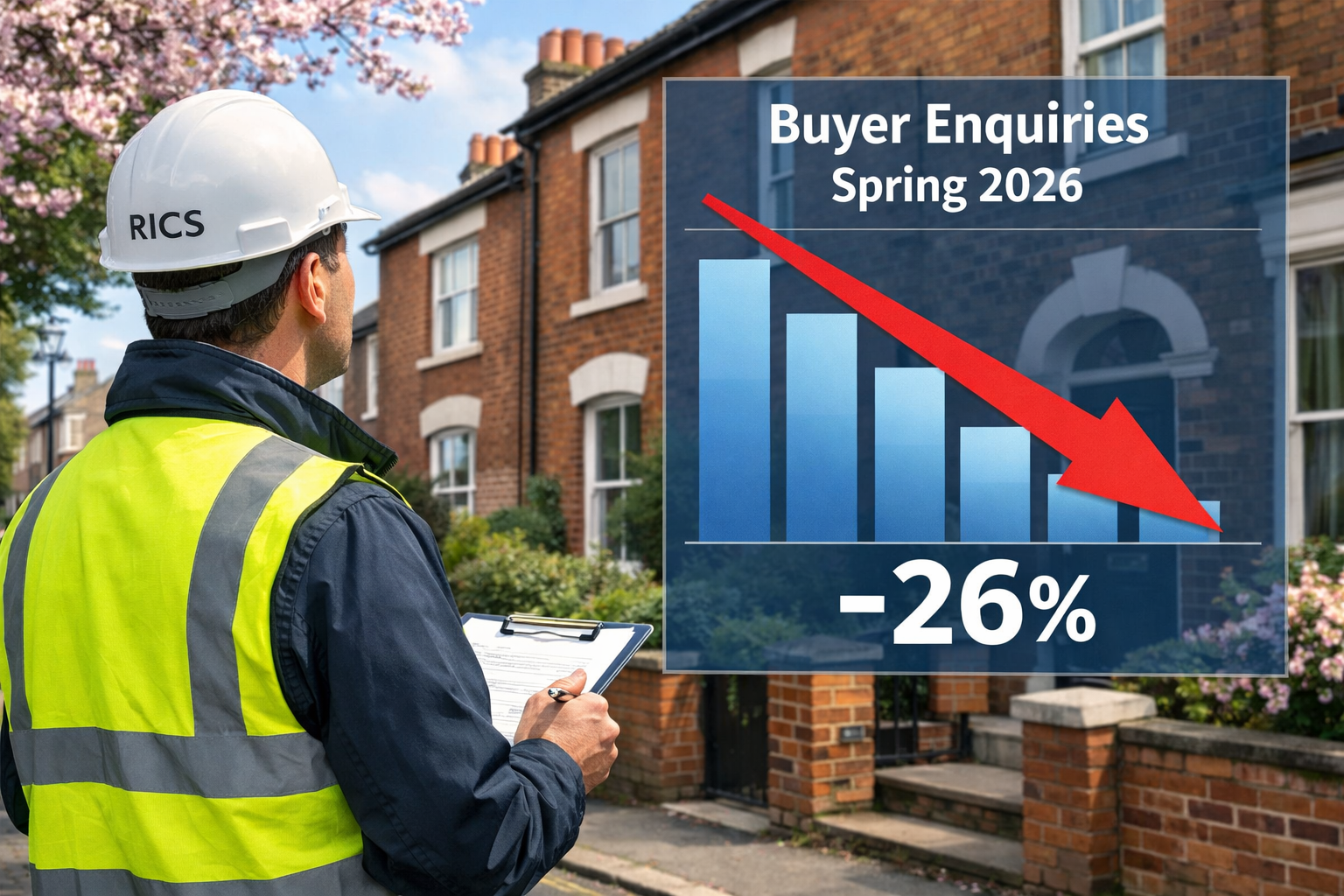
RICS data from February 2026 recorded buyer enquiries down 26% — the sharpest seasonal drop in over a decade — at the very moment spring should be driving the market's busiest weeks. That single figure is reshaping how building surveyors operate, what lenders demand, and how cautious buyers protect themselves in a market that has quietly shifted beneath everyone's feet.
The Spring 2026 housing market slowdown: adjusting building survey standards for -26% buyer enquiry decline is not simply a story of fewer transactions. It is a structural recalibration — one that demands surveyors raise their inspection depth, sharpen defect prioritisation, and communicate risk with far greater precision than a buoyant market ever required.
Key Takeaways 📋
- Buyer enquiries fell 26% in early 2026 according to RICS data, signalling a significant seasonal underperformance during what should be peak activity.
- Existing home sales are running at roughly 80% of normal spring pace, with homes spending up to 66 days on the market — the slowest February pace in a decade [5].
- Surveyors must adapt by increasing inspection depth, emphasising defect risk in reports, and aligning reporting standards with heightened lender scrutiny.
- Buyers now hold more negotiating power, with typical discounts of 1.8% off list price — making accurate survey findings directly valuable to price renegotiation [5].
- Choosing the right survey level has never been more important: a cautious market punishes undisclosed defects far more severely than a rising one.
Understanding the Spring 2026 Housing Market Slowdown
What the Numbers Actually Say
Spring is supposed to be the engine room of the UK and US property markets. In 2026, that engine is running cold. Existing home sales fell 3.6% month-over-month in March on a seasonally adjusted basis, with sales down 1% year-over-year — what the National Association of Realtors describes as a "prolonged sales slump" [1]. The market is operating at approximately 80% of normal spring pace, a figure that underscores just how far sentiment has deteriorated [1].
Homes are sitting. The typical property spent 66 days on the market in February — the slowest February pace in a full decade [5]. Pending home sales fell 0.8% month-over-month, and new listings dropped 1.2% on a seasonally adjusted basis in the same period [5].
💬 "Buyers are taking their time, and sellers are learning to negotiate. The balance of power has shifted." — Chicago Agent Magazine, April 2026 [7]
What makes this slowdown unusual is the contradiction at its core: median home prices hit record highs of $408,000 in March, marking 33 consecutive months of year-over-year price increases [1][6]. Prices are not crashing — but demand is retreating. That gap between price expectation and buyer willingness is exactly where survey quality becomes critical.
Why Buyers Are Standing Back
The causes are multiple and reinforcing:
| Factor | Impact on Buyer Behaviour |
|---|---|
| Mortgage rates at 6.3–6.37% (mid-April) | Reduced affordability, delayed decisions [4][6] |
| Global economic uncertainty & geopolitical tensions | Confidence erosion beyond rate concerns [1][4] |
| Rising transport and grocery costs | Household budgets squeezed [1] |
| Record-high prices vs. stagnant wages | Affordability gap widens [6] |
| Inventory at ~4 months supply (below balanced 5–6 months) | Limited choice, no urgency to act [6] |
The National Association of Realtors has downgraded its 2026 existing-home sales forecast from 14% growth to just 4% growth, while new-home sales are now expected to remain flat [6]. These are not temporary tremors — they represent a sustained recalibration of market expectations.
How the -26% Buyer Enquiry Decline Changes Building Survey Standards
The Shift in Surveyor Responsibility
When markets are rising and buyers compete aggressively, some purchasers skip surveys or accept lighter-touch reports. A 26% drop in buyer enquiries changes that dynamic entirely. The buyers who are transacting in spring 2026 are more cautious, more informed, and more likely to use survey findings as negotiation tools — or as grounds to withdraw.
This places a new burden on building surveyors. Reports that might have been adequate in a seller's market now need to:
- ✅ Go deeper on structural condition, not just visible defects
- ✅ Clearly grade and prioritise risks using plain, accessible language
- ✅ Flag items that could affect mortgage lending decisions
- ✅ Provide realistic cost ranges for remedial works
- ✅ Address energy performance and compliance issues that affect resale value
Lenders are also tightening. With inventory growth that dropped sharply from over 30% last year to just a few percent in some markets [3], lenders are increasingly cautious about valuations that may not reflect true market depth. Survey reports feed directly into lending decisions — and in a slowdown, lenders want more, not less, detail.
Choosing the Right Survey Level in a Weakening Market
The type of survey a buyer commissions matters enormously when the market is uncertain. A RICS Home Survey provides a solid baseline for modern, well-maintained properties, but in a market where buyers are negotiating an average 1.8% off list price — the largest February discount since 2023 [5] — a more comprehensive assessment often pays for itself immediately.
For older or more complex properties, a RICS Level 3 Building Survey provides the depth of inspection that a cautious market demands. It covers the full construction, materials, and condition of a property — including concealed areas where defects often hide. When buyers are already nervous and lenders are scrutinising valuations, a Level 3 report gives all parties the evidence base they need to transact with confidence.
For buyers who suspect a specific problem — damp, subsidence, roof deterioration — a RICS Specialist Defect Survey can isolate and cost a single issue with precision. This is increasingly valuable when that finding directly supports a price renegotiation.
📌 Key Point: In a rising market, buyers absorb risk. In a declining one, surveyors must surface it — clearly, completely, and with actionable guidance.
Adapting Inspection Depth and Defect Prioritisation
The Spring 2026 housing market slowdown: adjusting building survey standards for -26% buyer enquiry decline requires surveyors to rethink not just what they inspect, but how they communicate findings.
Three areas where standards must rise:
1. Structural and Subsidence Risk
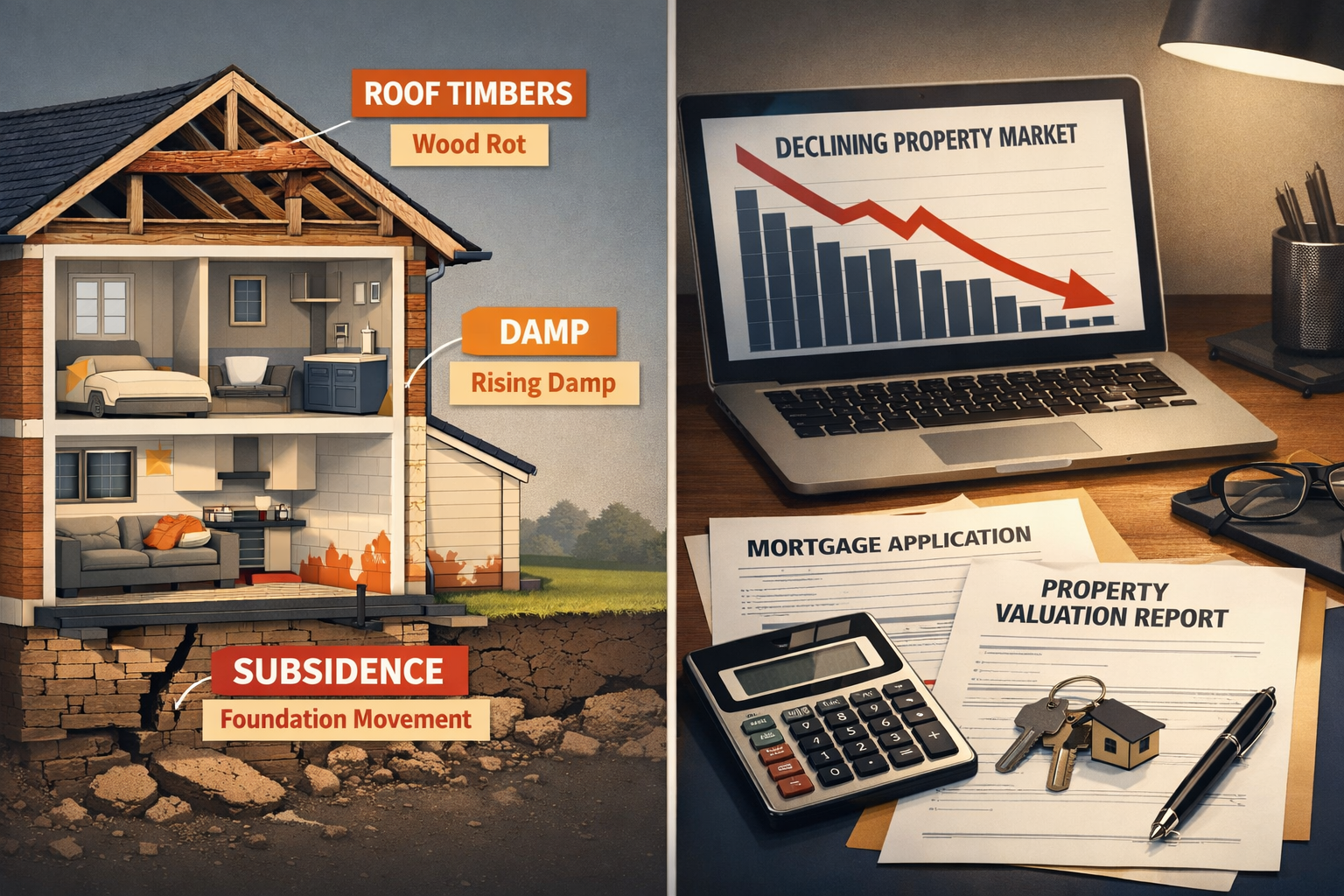
With buyers spending more time evaluating properties and lenders applying greater scrutiny, structural assessments must go beyond visible cracking. Surveyors should reference ground conditions, drainage proximity, and tree root risk — particularly in areas with clay soils.
2. Damp and Water Ingress
Damp remains the most commonly disputed defect in post-sale disputes. In a slow market, undisclosed damp becomes a legal and financial liability. Reports should specify the type of damp (rising, penetrating, or condensation), its likely cause, and a realistic remediation cost range.
3. Roof and Drainage Condition
Roof defects are among the most expensive to remedy. In a market where buyers are already stretching affordability, a clear assessment of remaining roof life and drainage integrity gives buyers the information they need to negotiate — or walk away before exchange.
Surveyors working across London and the South East can explore RICS Building Surveys that cover all these areas comprehensively, with reports tailored to both residential and commercial building survey requirements.
Practical Guidance for Buyers, Sellers, and Surveyors in Spring 2026

For Buyers: Use Survey Findings Strategically
The shift in negotiating power documented in spring 2026 data [7] means survey reports are no longer just due diligence documents — they are negotiation instruments. A well-evidenced survey finding, clearly costed, gives buyers legitimate grounds to request price reductions or require sellers to complete works before exchange.
Practical steps for buyers in 2026:
- Commission the right level of survey — don't default to the cheapest option. See choosing the right property survey for a clear breakdown.
- Request cost estimates for all Category 2 and Category 3 defects identified in the report.
- Share findings with your solicitor before exchange — not after.
- Use the report in price negotiation — in a market where buyers are averaging 1.8% discounts [5], a documented defect is a legitimate basis for further reduction.
- Understand surveyor pricing — surveyor rates vary by property type and location, and the cost of a thorough survey is almost always less than the cost of an undisclosed defect.
For Sellers: Prepare for Greater Scrutiny
Sellers entering the spring 2026 market with high price expectations [7] need to understand that buyers are better armed than they were 12 months ago. A survey that reveals significant defects in a slow market does not just reduce the price — it can kill the transaction entirely.
Sellers should consider:
- Commissioning a pre-sale survey to identify and address issues before listing
- Obtaining quotes for visible defects so they can respond credibly to buyer challenges
- Pricing realistically — inventory at just four months of supply [6] means buyers have options, even if choice is limited
For Surveyors: Raising the Standard in a Cautious Market
The Spring 2026 housing market slowdown: adjusting building survey standards for -26% buyer enquiry decline is a professional inflection point. Surveyors who adapt their approach — going deeper, communicating more clearly, and aligning with lender requirements — will build the trust that a cautious market demands.
Key adaptations for 2026:
| Adaptation | Why It Matters |
|---|---|
| Expand structural commentary | Lenders and buyers want evidence, not assumptions |
| Use plain language for defect grading | Cautious buyers need clarity, not jargon |
| Include cost ranges for remediation | Enables price negotiation and financial planning |
| Flag mortgage-affecting issues explicitly | Prevents transaction collapse at lender stage |
| Reference energy efficiency and compliance | Increasingly relevant to both value and saleability |
Surveyors operating across London — from East London to Surrey — are already seeing increased demand for Level 3 surveys and specialist defect reports as buyers seek greater certainty before committing in an uncertain market.
The Broader Market Outlook
The data suggests this is not a short-term blip. The NAR's revised forecast of just 4% growth in existing-home sales [6], combined with mortgage rates holding above 6% [4][5] and economic uncertainty showing no sign of rapid resolution [1][4], points to a market that will remain measured and selective through the remainder of 2026.
That measured quality is not entirely negative. As Chicago Agent Magazine noted in April 2026, buyers and sellers are finding a new balance — one where transactions happen, but on terms that reflect genuine market conditions rather than speculative momentum [7]. For surveyors, that balance creates an environment where thorough, well-communicated reports are valued more highly than at any point in recent memory.
Conclusion: Raising Standards When the Market Demands It Most
A 26% drop in buyer enquiries is not a reason to lower standards — it is the strongest possible argument for raising them. The Spring 2026 housing market slowdown demands that building surveyors deliver inspection depth, defect clarity, and cost transparency that genuinely serves cautious buyers and scrutinising lenders.
Actionable next steps:
- 🔍 Buyers: Commission a Level 2 Homebuyer Survey or Level 3 Building Survey before exchange — not as a formality, but as a negotiation tool.
- 🏠 Sellers: Get ahead of scrutiny with a pre-sale condition assessment and realistic pricing.
- 📋 Surveyors: Expand structural commentary, use plain defect grading, and include remediation cost ranges in every report.
- 💷 All parties: Understand that in a slow market, the cost of a thorough survey is always less than the cost of a hidden defect discovered after completion.
The buyers transacting in spring 2026 are doing so carefully and deliberately. They deserve survey reports that match that care — and surveyors who deliver them will be the ones building lasting reputations in a market that rewards precision over speed.
References
[1] Uncertainty Means A Slower Spring Housing Market – https://www.marketplace.org/story/2026/04/14/uncertainty-means-a-slower-spring-housing-market
[3] Watch – https://www.youtube.com/watch?v=GYdellbLpbU
[4] Spring Housing Market Slows As High Mortgage Rates And Global Tensions Sideline Buyers – https://www.nbcpalmsprings.com/2026/04/16/spring-housing-market-slows-as-high-mortgage-rates-and-global-tensions-sideline-buyers
[5] Homebuyers Taking Their Time 2026 – https://www.redfin.com/news/homebuyers-taking-their-time-2026/
[6] Lackluster Beginning To Spring Homebuying Season With Nar Downgrading 2026 Forecast National Association Of Realtors Bankrate Housing Market – https://foxbaltimore.com/news/nation-world/lackluster-beginning-to-spring-homebuying-season-with-nar-downgrading-2026-forecast-national-association-of-realtors-bankrate-housing-market
[7] Spring 2026 Housing Market Buyers Sellers Find Balance – https://chicagoagentmagazine.com/2026/04/29/spring-2026-housing-market-buyers-sellers-find-balance/