Over 250,000 properties in England are listed on short-term rental platforms — yet until now, most have existed in a planning grey area with no dedicated use class of their own. That is about to change. The proposed holiday let C5 use class 2026 marks the most significant shift in short-term let regulation in a generation, and for Airbnb hosts, holiday cottage owners, and property investors across Canterbury and Kent, understanding what is coming is no longer optional.
Key Takeaways 📋
- A new C5 use class is proposed to formally distinguish short-term holiday lets from standard residential dwellings (C3).
- Permitted development rights will allow switching between C3 and C5 — unless your local council applies an Article 4 Direction.
- A mandatory national registration scheme launches from April 2026, with a voluntary phase already under way.
- London's 90-day rule does not apply in Kent — but planning rules still matter for year-round commercial lets.
- Surveyors play a critical role in helping hosts navigate change-of-use, safety compliance, and holiday let mortgage valuations.
What Is the Proposed C5 Use Class?
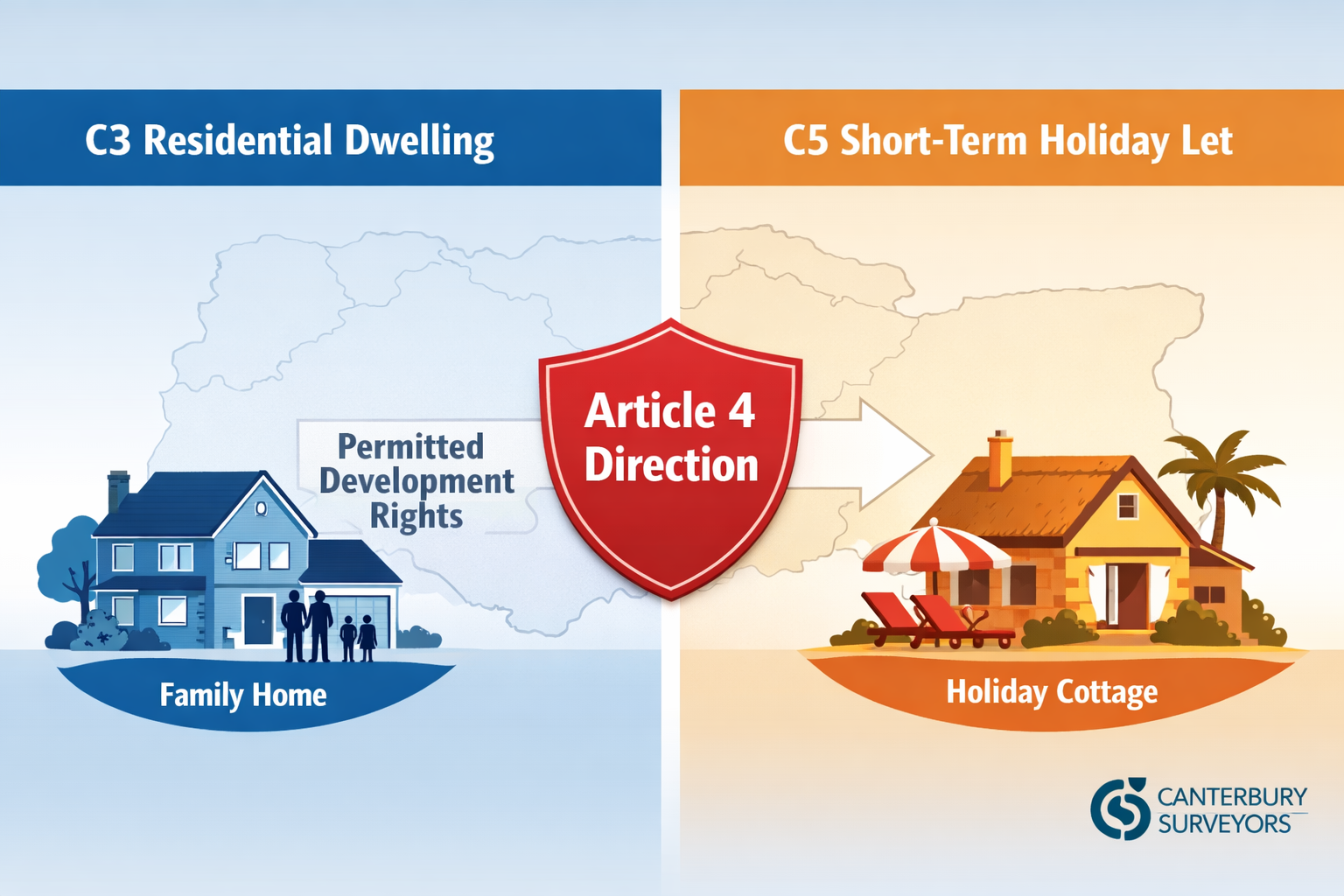
At present, most holiday lets in England sit awkwardly within the C3 residential dwellinghouse use class — the same category as your neighbour's family home. Hotels and guesthouses occupy the C1 class. Short-term lets fall somewhere in between, and that ambiguity has made planning enforcement notoriously difficult.
The proposed C5 use class would create a dedicated planning category specifically for properties let on a short-term basis that are not used as the owner's sole or main home. In practical terms, this means a cottage in Whitstable let to tourists on Airbnb would carry a different planning designation to the house next door where a family lives permanently.
💡 Pull quote: "The C5 use class converts a longstanding planning grey area into a defined category that councils can actively manage — and that hosts must actively plan for."
Wales already operates a comparable system: Class C5 covers second homes occupied for 183 days or fewer, while Class C6 covers commercial short-term lets with a maximum 31-day stay per booking. England's proposed framework draws heavily on this Welsh model.
The C5 proposal was first announced in February 2024 by the then-Conservative government. In January 2025, Labour planning minister Matthew Pennycook signalled openness to progressing it — potentially extending scope to second homes — though no formal legislative announcement has followed. In 2026, the C5 framework is being introduced alongside a broader package of reforms including the abolition of the Furnished Holiday Let (FHL) tax regime, mandatory registration, updated safety standards, and revised mortgage requirements.
Permitted Development Rights, Article 4 Directions & the Holiday Let C5 Use Class 2026
One of the most practically important aspects of the holiday let C5 use class 2026 framework is how properties will move between use classes.
Permitted Development Between C3 and C5
Under the proposed nationally permitted development routes, property owners would be able to switch between C3 (residential) and C5 (short-term let) without applying for planning permission. This provides genuine flexibility: a homeowner could list their property on Airbnb for part of the year and return it to residential use without a formal application.
Importantly, homeowners who use a property as their main residence can let it for up to 90 nights per year without the property being reclassified as C5 at all. This mirrors the existing London 90-day rule in concept — but note that London's specific 90-day statutory rule does not apply in Kent. In Canterbury, Folkestone, or Whitstable, there is currently no equivalent statutory cap, though the 90-night threshold within the C5 framework will be nationally relevant once implemented.
How Article 4 Directions Change the Picture
Councils in high-demand tourist areas can apply Article 4 Directions to remove permitted development rights. Where an Article 4 Direction is in place, changing a property's use from C3 to C5 would require a full planning application — and councils can refuse it.
Key rules governing Article 4 Directions include:
| Requirement | Detail |
|---|---|
| Justification | Council must demonstrate clear local housing impact |
| Geographic scope | Must be geographically limited — not blanket borough-wide |
| Notice period | Up to 12 months' notice before taking effect |
| Enforcement | Non-compliance treated as a planning breach |
Some councils have already begun using Article 4 Directions ahead of formal C5 implementation, signalling a clear regulatory direction of travel. Kent hosts should monitor Canterbury City Council and other district council announcements closely throughout 2026.
The National Short-Term Let Registration Scheme
Alongside the planning reforms, a mandatory national short-term let registration scheme is launching from April 2026, following an initial voluntary phase. This applies across England, including Kent.
Registration will require hosts to demonstrate compliance with key safety standards before a registration number is issued. Platforms such as Airbnb and Vrbo are expected to require valid registration numbers before listings can remain active.
What Registration Will Require 🏠
- ✅ Valid gas safety certificate (where gas appliances are present)
- ✅ Up-to-date Electrical Installation Condition Report (EICR)
- ✅ Current fire risk assessment and appropriate fire safety measures
- ✅ Evidence of appropriate buildings and contents insurance
- ✅ Compliance with any applicable planning consent
Properties operating as year-round, commercial-scale holiday lets — or self-contained annexes marketed separately — are likely to require full planning permission rather than relying on permitted development rights, regardless of the C5 framework.
When Is Planning Permission Still Required?
The permitted development route between C3 and C5 will not cover every scenario. Planning permission remains necessary in several situations:
- Year-round commercial lets where the property is never used as a main or second home
- Self-contained annexes marketed and let independently from the main dwelling
- Properties in Article 4 Direction areas where permitted development rights have been removed
- Listed buildings or properties in conservation areas (common in Canterbury's historic centre)
- Change of use from C1 or other non-residential classes to C5
If you are unsure whether your property needs planning permission, taking professional advice before the registration scheme becomes mandatory is strongly advisable. Properties currently operating in a legal grey area are better placed to regularise their position now — retrospective regularisation is likely to become more difficult once C5 is formally implemented.
How a Surveyor Supports Holiday Let Owners in 2026
The regulatory changes surrounding the holiday let C5 use class 2026 create several areas where professional surveying input is genuinely valuable — not just useful.
Change-of-Use Planning Support
A chartered surveyor can assess whether your property's current use is lawful, advise on the likelihood of a planning application succeeding, and prepare supporting documentation. For properties in Canterbury's historic core or Kent's Areas of Outstanding Natural Beauty, this professional input can be the difference between approval and refusal.
Building Surveys
Before converting a residential property into a holiday let — or purchasing one for that purpose — a thorough RICS Level 3 building survey will identify structural defects, damp, roofing issues, and other defects that could affect both safety compliance and mortgage eligibility. For lower-risk properties, a Level 2 HomeBuyer Survey may be appropriate. Our team can help you compare different survey types to find the right level of inspection for your property.
Safety Reports
Registration compliance will hinge on fire safety, EICR, and gas safety documentation. A surveyor can coordinate or advise on these inspections as part of a broader pre-registration review.
Holiday Let Mortgage Valuations
Holiday let mortgages are assessed differently to standard buy-to-let products. Lenders require a RICS Red Book valuation that accounts for short-term rental income potential, seasonal occupancy, and the property's condition. Our valuation services cover the full range of holiday let and investment property needs across Canterbury and Kent.
Damp and Structural Surveys
Many older Kent properties — particularly coastal cottages and period homes — carry hidden risks. A professional damp survey can identify moisture ingress before it becomes a costly problem or a reason for a failed safety inspection.
Conclusion: Act Before the Grey Area Closes
The holiday let C5 use class 2026 framework, combined with mandatory registration and the abolition of FHL tax reliefs, represents a fundamental reset for the short-term let market in England. For Canterbury and Kent hosts, the message is clear: the window to operate informally is closing.
Actionable next steps for Kent holiday let owners:
- 📋 Register early under the voluntary national scheme to identify any compliance gaps before mandatory registration takes effect.
- 🏠 Check your planning position — confirm whether your property's current use is lawful and whether an Article 4 Direction applies or is proposed in your area.
- 🔍 Commission a building survey if you are purchasing or converting a property for holiday letting use.
- 📊 Obtain a holiday let mortgage valuation if you are remortgaging or seeking new finance in light of the regulatory changes.
- 📞 Speak to Canterbury Surveyors — our team of RICS-qualified surveyors supports holiday let owners across Canterbury, Kent, and beyond with surveys, valuations, and planning-related advice.
👉 Contact Canterbury Surveyors today to discuss your holiday let property's needs and ensure you are fully prepared for the changes ahead.