
Canterbury & Kent
Valuation Divergence Post-RICS February 2026: Expert Witness Strategies for Regional Disputes
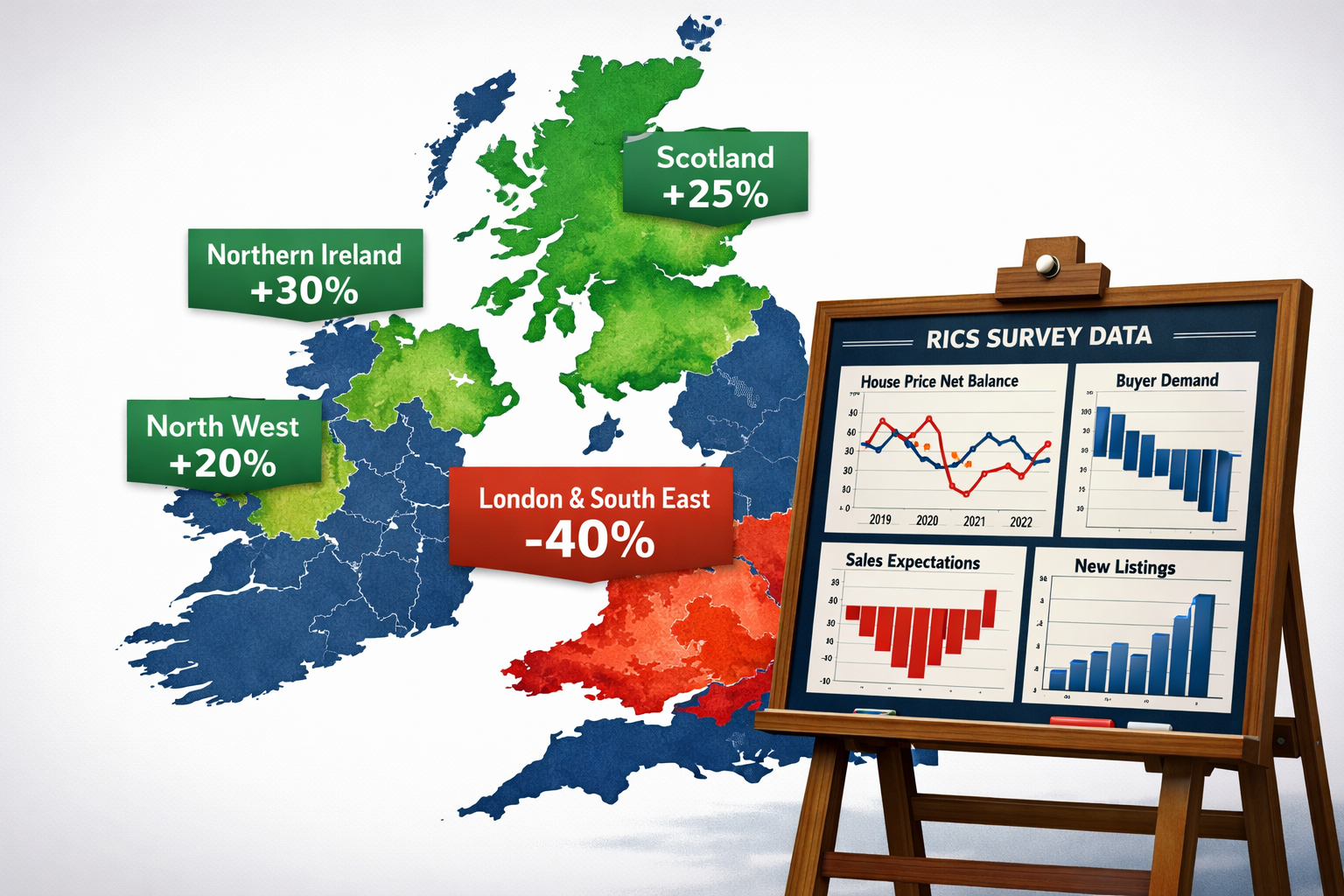
London’s residential property market recorded a net balance of -40% for house prices in February 2026 — more than three times the national average decline of -12% — while Northern Ireland and Scotland continued to post price increases in the same period [4]. That single data point encapsulates why Valuation Divergence Post-RICS February 2026: Expert Witness Strategies for Regional Disputes has become one of the most pressing issues facing chartered surveyors, solicitors, and tribunal panels across England and Wales in 2026.
When two qualified valuers inspect the same asset class and reach figures that differ by tens of thousands of pounds, courts and arbitration panels need more than professional opinion — they need structured, evidence-based methodology. This article outlines exactly how expert witnesses can build robust, court-ready arguments using RICS survey data, regional comparables, and standardised frameworks.
Key Takeaways 📌
- The February 2026 RICS survey confirmed a widening north-south price divide, with London at -40% net balance versus positive readings in Scotland and Northern Ireland [4].
- Near-term price expectations fell sharply to -18% net balance in February 2026, intensifying the risk of valuation disputes in the short term [4].
- RICS accreditation through the Expert Witness Accreditation Service (EWAS) is now considered essential for credibility in 2026 valuation disputes [1].
- Root causes of divergence include inconsistent assumptions, flawed methodologies, and confusion between market value and investment value [3].
- Expert witnesses must anchor opinions to standardised RICS frameworks and region-specific comparable evidence to withstand cross-examination.
Understanding the Scale of Regional Valuation Divergence in 2026
The North-South Split in Numbers
The RICS UK Residential Market Survey for February 2026 is unambiguous: regional divergence is not a marginal trend — it is a structural feature of the current market [4].
| Region | Net Balance (Feb 2026) | Direction |
|---|---|---|
| London | -40% | ⬇️ Declining |
| South East | -24% | ⬇️ Declining |
| National Average | -12% | ⬇️ Declining |
| North West England | Positive | ⬆️ Rising |
| Scotland | Positive | ⬆️ Rising |
| Northern Ireland | Positive | ⬆️ Rising |
This divergence was already visible in January 2026, when RICS identified “a widening divergence across different parts of the UK,” particularly between Northern Ireland, Scotland, and southern regions [5]. By February, that gap had deepened considerably.
Why Is This Happening?
Several forces are driving the split:
- 🏦 Higher interest rates and tighter credit: Mortgage affordability constraints hit high-value southern markets hardest, contributing to what analysts describe as a “profound structural reset” in property values [3].
- 🌍 Geopolitical headwinds: Escalating conflict in the Middle East dampened early-year market momentum, pushing new buyer enquiries to a net balance of -26% in February 2026 — down from -15% in January [4].
- 📉 Near-term pessimism: Three-month price expectations collapsed to -18% net balance in February, from just -6% the previous month [4].
- 🏠 Subdued landlord instructions: The landlord instructions measure sat at -27% net balance in February 2026, indicating a weak flow of rental listings [4].
Despite this, the twelve-month outlook remains cautiously optimistic: +33% of RICS survey contributors expect prices to stabilise or increase over the next year [4].
💬 “Growing disconnects stem from inconsistent assumptions, flawed methodologies, and confusion between market and investment value.” — FTI Consulting [3]
For expert witnesses, this volatile and regionally fractured landscape creates fertile ground for disputes — and demands a higher standard of evidence than ever before.
Expert Witness Strategies for Valuation Divergence Post-RICS February 2026

Strategy 1: Anchor Every Opinion to RICS Survey Data
The most powerful tool available to an expert witness in 2026 is the RICS UK Residential Market Survey itself. Courts and arbitration panels recognise RICS as an authoritative body, and citing specific net balance figures — rather than anecdotal market commentary — immediately elevates the credibility of a valuation report.
Practical steps:
- Quote the specific net balance figures for the relevant region and month. For London flat disputes, the -40% February 2026 reading is directly relevant [4].
- Show the trajectory, not just a snapshot. Comparing January’s -15% buyer enquiry balance to February’s -26% demonstrates momentum, not just a static position [4].
- Reference the January 2026 survey to establish that divergence was already confirmed before the valuation date in question [5].
Working with registered RICS valuers who stay current with monthly survey releases ensures that valuation reports reflect the most up-to-date market intelligence.
Strategy 2: Build Region-Specific Comparable Evidence
Generic comparable evidence is a common weakness in disputed valuations. In a market where London flats are falling while northern terraced houses are rising, using cross-regional comparables — or even comparables from the wrong London postcode — can fatally undermine an expert’s position under cross-examination.
Best practice framework for regional comparables:
- ✅ Use comparables within the same local authority where possible
- ✅ Apply time adjustments reflecting the sharp Q1 2026 price movements
- ✅ Distinguish between market value and investment value — a confusion that FTI Consulting identifies as a primary driver of divergence [3]
- ✅ Document why each comparable was selected or rejected
- ✅ Cross-reference against RICS survey data for the specific region
For complex leasehold disputes involving London flats, understanding collective enfranchisement valuation methodology is particularly important, as declining capital values directly affect premium calculations.
Strategy 3: Obtain RICS Expert Witness Accreditation
RICS accreditation through the Expert Witness Accreditation Service (EWAS) is increasingly essential — not merely desirable — for credibility in 2026 valuation disputes [1]. Tribunals and courts are scrutinising the qualifications of expert witnesses more carefully as the volume of valuation disputes grows.
Why EWAS accreditation matters:
- It signals training in legal procedure and the duties of an expert witness
- It demonstrates familiarity with CPR Part 35 (Civil Procedure Rules)
- It reduces the risk of reports being excluded or discounted by the court
- It provides a competitive advantage when opposing counsel challenges credentials
Valuers who regularly handle Canterbury property valuations and other regional instructions should treat EWAS accreditation as a baseline requirement for any instruction involving litigation support.
Strategy 4: Address Methodology Transparently
One of the most common grounds for challenging a valuation in court is methodological opacity. If an expert cannot clearly explain how they arrived at their figure — including which approach they used, what assumptions they made, and how they weighted different evidence — the report becomes vulnerable.
The three core valuation approaches and when to use them:
| Method | Best Used For | Key Risk in Divergent Markets |
|---|---|---|
| Comparable Sales | Residential, standard assets | Comparables may be stale or cross-regional |
| Income Capitalisation | Investment property | Yield assumptions may not reflect local conditions |
| Depreciated Replacement Cost | Specialist property | Rarely appropriate for residential disputes |
For commercial property disputes, understanding rent review valuation methodology is equally critical, particularly where rental price expectations diverge from capital value trends — as they do in February 2026, where +20% of respondents expect rental prices to rise even as capital values fall [4].
Strategy 5: Use a Single Joint Expert Where Appropriate
In many regional valuation disputes, the court may direct or encourage the appointment of a Single Joint Expert (SJE). This approach reduces costs and often produces faster resolution. However, it places significant responsibility on the appointed valuer to be genuinely impartial and methodologically sound.
Key considerations for SJE appointments:
- The SJE must be geographically competent — an expert based in London should not be appointed to value a Manchester property without demonstrable local knowledge
- The SJE’s report must acknowledge divergence explicitly and explain how regional market conditions have been factored in
- Both parties retain the right to put written questions to the SJE under CPR 35.6
Understanding valuation factors specific to the subject property and its region is non-negotiable for any SJE instruction.
Applying These Strategies: London Flats vs Northern Recovery Cases

The London Flat Scenario
London flat prices face a perfect storm in 2026: a -40% net balance on prices [4], declining buyer enquiries, and weak landlord instructions at -27% [4]. In a dispute involving a London flat — whether a lease extension premium, a dilapidations claim, or a matrimonial asset valuation — the expert witness must:
- Establish the baseline: Cite the February 2026 RICS net balance of -40% for London [4]
- Demonstrate the trajectory: Show the deterioration from January to February 2026 [4][5]
- Apply appropriate comparables: Use only local, recent, and verified sales data
- Address leasehold-specific factors: Declining capital values affect freehold valuation and lease extension premiums directly
For leasehold flat disputes specifically, the interaction between falling capital values and the Leasehold Reform (Ground Rent) Act creates additional complexity that expert witnesses must address head-on.
The Northern Recovery Scenario
In contrast, expert witnesses instructed in northern England, Scotland, or Northern Ireland disputes face the opposite challenge: justifying upward valuations in a market where national sentiment is negative. The risk here is that a court applies national average data inappropriately.
Strategies for northern recovery cases:
- 🗺️ Cite the RICS January and February 2026 surveys explicitly, which confirm that northern regions are outperforming the national trend [4][5]
- 📊 Present regional comparable evidence showing actual transaction prices, not just asking prices
- 🏘️ Distinguish between property types — terraced housing in northern cities is behaving very differently from prime London flats
- 📋 Address the twelve-month positive outlook (+33% net balance nationally) to support longer-term valuation assumptions [4]
The Danger of Ignoring Regional Context
💬 “Higher interest rates and tighter credit conditions are contributing to a profound structural reset in property values, driving diverging valuations across markets.” — FTI Consulting [3]
An expert witness who applies a uniform national adjustment — or who fails to distinguish London from Leeds — risks producing a report that is internally inconsistent with published market data. Courts increasingly expect expert witnesses to engage with RICS survey data directly, and failure to do so can result in adverse cost orders or the report being given little weight.
For complex commercial property disputes, commercial property surveyors with regional expertise offer an important layer of local market knowledge that generic national valuers cannot replicate.
Common Pitfalls to Avoid in Regional Valuation Disputes 🚫
Even experienced valuers make avoidable errors when instructed as expert witnesses in regionally divergent markets. The most common pitfalls include:
- Using pre-2026 comparables without adjustment: The market shifted sharply in Q1 2026; older data needs explicit time adjustment
- Conflating market value with investment value: These are distinct concepts under RICS Red Book Global Standards, and confusion between them is a leading cause of divergence [3]
- Failing to disclose assumptions: Every assumption must be stated, including those about market conditions, tenure, and condition
- Ignoring the rental market data: With +20% of respondents expecting rental price increases [4], rental value evidence may be highly relevant in investment property disputes
- Overstating certainty: In a market with a -18% three-month price expectation [4], expressing a single-point valuation without a range or sensitivity analysis is difficult to defend
For disputes involving insurance reinstatement valuations, regional divergence in construction costs adds another layer of complexity that must be addressed separately from market value considerations.
Conclusion: Turning Market Volatility Into Robust Expert Evidence
The data from the RICS February 2026 survey is not just a market commentary — it is a toolkit for expert witnesses. The pronounced regional divergence it documents, from London’s -40% net balance to the positive readings in Scotland and Northern Ireland [4], provides the empirical foundation that courts and tribunals need to evaluate competing valuations fairly.
Actionable next steps for expert witnesses and instructing solicitors in 2026:
- ✅ Download and cite the RICS UK Residential Market Survey for February 2026 in every regional valuation dispute report
- ✅ Obtain or confirm EWAS accreditation before accepting expert witness instructions [1]
- ✅ Build region-specific comparable databases that reflect Q1 2026 market conditions
- ✅ Distinguish clearly between market value and investment value in every report [3]
- ✅ Engage a locally qualified valuer — not just a nationally recognised firm — for northern or Scottish instructions
- ✅ Review the twelve-month outlook data (+33% positive) when advising on longer-term asset values [4]
Valuation divergence post-RICS February 2026 is not a problem to be managed — it is a reality to be evidenced, explained, and argued with precision. The expert witnesses who master that discipline will define the standard for regional property disputes in 2026 and beyond.
References
[1] Expert Witness Testimonies In 2026 Valuation Disputes Rics Strategies Amid Stabilising House Prices And Regional Divides – https://nottinghillsurveyors.com/blog/expert-witness-testimonies-in-2026-valuation-disputes-rics-strategies-amid-stabilising-house-prices-and-regional-divides
[2] Expert Witness Valuations In 2026 Housing Disputes Rics Protocols For North South Price Divergence Cases – https://nottinghillsurveyors.com/blog/expert-witness-valuations-in-2026-housing-disputes-rics-protocols-for-north-south-price-divergence-cases
[3] Podcast Fti Experts Hub Why Property Valuations Diverge – fticonsulting.com
[4] Uk Residential Market Survey February 2026 – rics.org
[5] Uk Residential Market Survey January 2026 – rics.org
Related services from Canterbury Surveyors
- Building expert witness surveyors
- Dilapidations surveyors
- RICS property valuations
- Structural engineers in Canterbury & Kent
Get a fixed-fee quote or call 0204 579 8270.