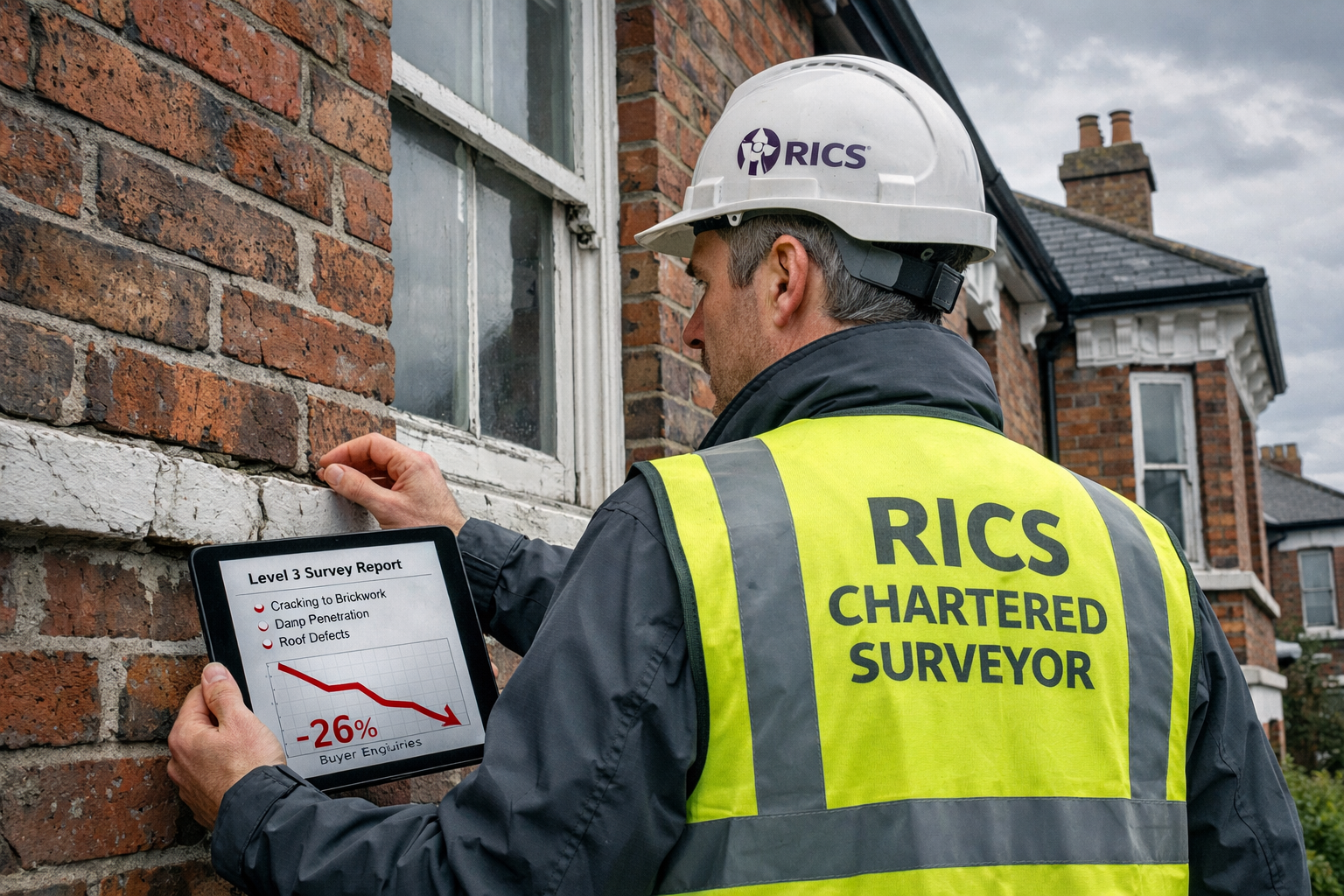
A 26% drop in buyer enquiries does not simply mean fewer transactions — it means every transaction that does proceed carries a heavier burden of scrutiny. In the cautious Spring 2026 housing market, adjusting Level 3 building surveys for the -26% buyer enquiry dip has become one of the most strategically important decisions a property professional can make this season.
Homes are now sitting on the market for an average of 64 days — the longest stretch in six years [1]. Pending sales fell 3.3% year-over-year through early February 2026 [1]. Buyers who are proceeding are doing so carefully, armed with more information and less urgency than at any point since the pandemic era. For surveyors, this shift creates both a challenge and a clear professional opportunity: when buyers move slowly, the quality of the survey they commission must move faster than ever to keep pace with their expectations.
Key Takeaways 📋
- Buyer enquiries have dropped -26%, creating a low-momentum market where surviving transactions face intense scrutiny.
- Homes are on the market for 64 days on average — the longest in six years — giving buyers more time to demand thorough due diligence [1].
- Level 3 Building Surveys must be adapted to reflect current defect risks, particularly in properties that have sat unsold and unmaintained.
- Surveyors who expand their scope — covering roof structures, drainage, damp, and structural movement in greater detail — provide the certainty buyers need to commit.
- The cautious Spring 2026 housing market rewards professionals who communicate findings clearly and position surveys as risk-management tools, not just transaction formalities.
Understanding the Spring 2026 Market: Why Buyer Caution Has Deepened
Spring is traditionally the busiest season for UK and US property markets alike. In 2026, that seasonal uplift has been muted. Mortgage rates sit at approximately 6.1% — near a three-year low but still roughly double pre-pandemic levels [1]. The median home-sale price has reached $379,950, up just 1.2% year-over-year, with the typical monthly mortgage payment at $2,559 [1].
💬 "Buyers are re-entering the market with a measured and thoughtful approach rather than urgency — many are hesitating due to economic uncertainty and ongoing waves of layoffs." [3]
The macroeconomic backdrop reinforces this caution. GDP growth is projected at 2% to 2.25%, unemployment sits around 4.7%, and inflation hovers between 2.3% and 3% [2]. This is not a collapsing economy — but it is one where buyers feel no pressure to rush. Housing supply is expected to reach approximately 4.6 months of inventory in 2026, up from 3–4 months previously [2], further reducing the fear of missing out that drove hasty decisions in earlier years.
New listings increased 1.1% year-over-year through early February 2026 [1], meaning buyers have more choice. More choice means more comparison. More comparison means more due diligence. And more due diligence means the Level 3 Building Survey — the most comprehensive residential survey available — is no longer a premium add-on. It is the baseline expectation for cautious buyers navigating a flat-price, slow-moving market.
The -26% Enquiry Dip: What It Means for Property Professionals
A -26% drop in buyer enquiries creates a specific and underappreciated risk: properties that linger on the market may have deferred maintenance. Sellers who expected a quick sale in early 2025 are now in month six or seven of their listing. During that time, a leaking roof goes unrepaired. Damp in a basement worsens. A hairline crack in a party wall widens. The longer a property sits, the greater the structural and defect risk it accumulates — and the more a thorough survey is needed to protect the buyer.
Adjusting Level 3 Building Surveys for the -26% Buyer Enquiry Dip
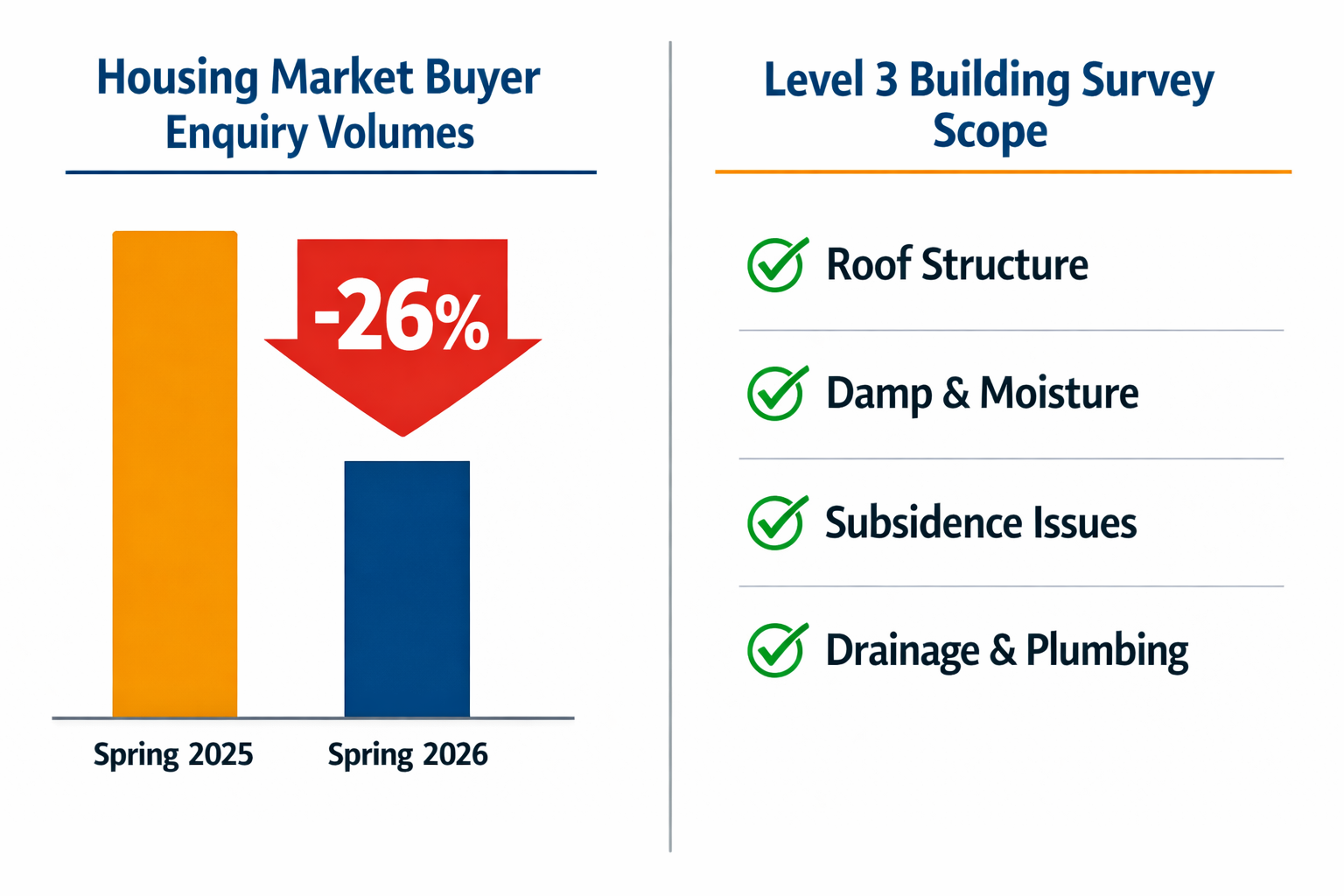
The cautious Spring 2026 housing market calls for surveyors to rethink not just the scope of a Level 3 survey but also how findings are communicated and prioritised. A RICS Level 3 Building Survey is already the most detailed residential inspection available — but in a slow market, "detailed" is not enough. Surveys must be actionable.
Expanded Defect Categories for 2026 Conditions
In a market where properties sit longer, surveyors should consider expanding their standard Level 3 scope to include enhanced attention to the following:
| Defect Category | Why It Matters in 2026 | Recommended Action |
|---|---|---|
| Roof Structure | Extended vacancy accelerates deterioration | Full roof survey assessment including felt, battens, and ridge tiles |
| Damp & Timber | Unheated or poorly ventilated properties develop mould faster | Detailed moisture mapping; consider separate damp and timber report |
| Structural Movement | Subsidence and settlement worsen over time without intervention | Crack monitoring notes; flag for specialist defect survey where needed |
| Drainage & Groundworks | Blocked or collapsed drains are a hidden cost in older stock | CCTV drain survey recommendation |
| Solid Floors & Slabs | Rising damp from failed DPMs in older properties | Cross-reference with solid floor slab survey findings |
Communicating Risk in a Buyer's Market
In previous years, a survey flagging a Category 3 (urgent) defect might have caused a buyer to renegotiate. In Spring 2026, the same finding might cause them to walk away entirely — because they can. With 4.6 months of supply [2] and no bidding war pressure, buyers have the leverage to be selective.
This means surveyors must shift from purely technical reporting to risk-stratified communication:
- ✅ Prioritise defects by cost impact, not just severity category
- ✅ Provide indicative repair cost ranges where RICS guidance permits
- ✅ Distinguish between immediate safety risks and long-term maintenance items
- ✅ Flag issues that could affect mortgage lending — particularly in a rate-sensitive environment
- ✅ Recommend follow-up specialist reports rather than leaving findings open-ended
Buyers who receive a well-structured Level 3 report are more likely to proceed — even with defects flagged — because they feel informed rather than alarmed. Uncertainty kills deals in a cautious market. Clarity saves them.
Choosing the Right Survey Level
Not every buyer in Spring 2026 needs a Level 3. Some properties — newer builds, recently renovated flats — may be adequately covered by a Level 2 HomeBuyer Survey. The key is matching the survey level to the property's age, construction type, and condition — not defaulting to the cheapest option because the buyer is already stretched on affordability.
A useful framework for surveyors advising clients:
- Pre-1919 properties → Level 3 as standard; extended scope for roof and structural elements
- 1919–1980 properties → Level 3 recommended; focus on cavity wall insulation, flat roofs, and electrics
- Post-1980 properties → Level 2 may suffice; Level 3 if extensions or alterations are present
- New builds → Snagging survey rather than Level 3
For buyers unsure which survey is right for their property, the guide to choosing the right property survey provides a practical starting point.
Strategies for Surveyors: Providing Certainty in Volatile Conditions
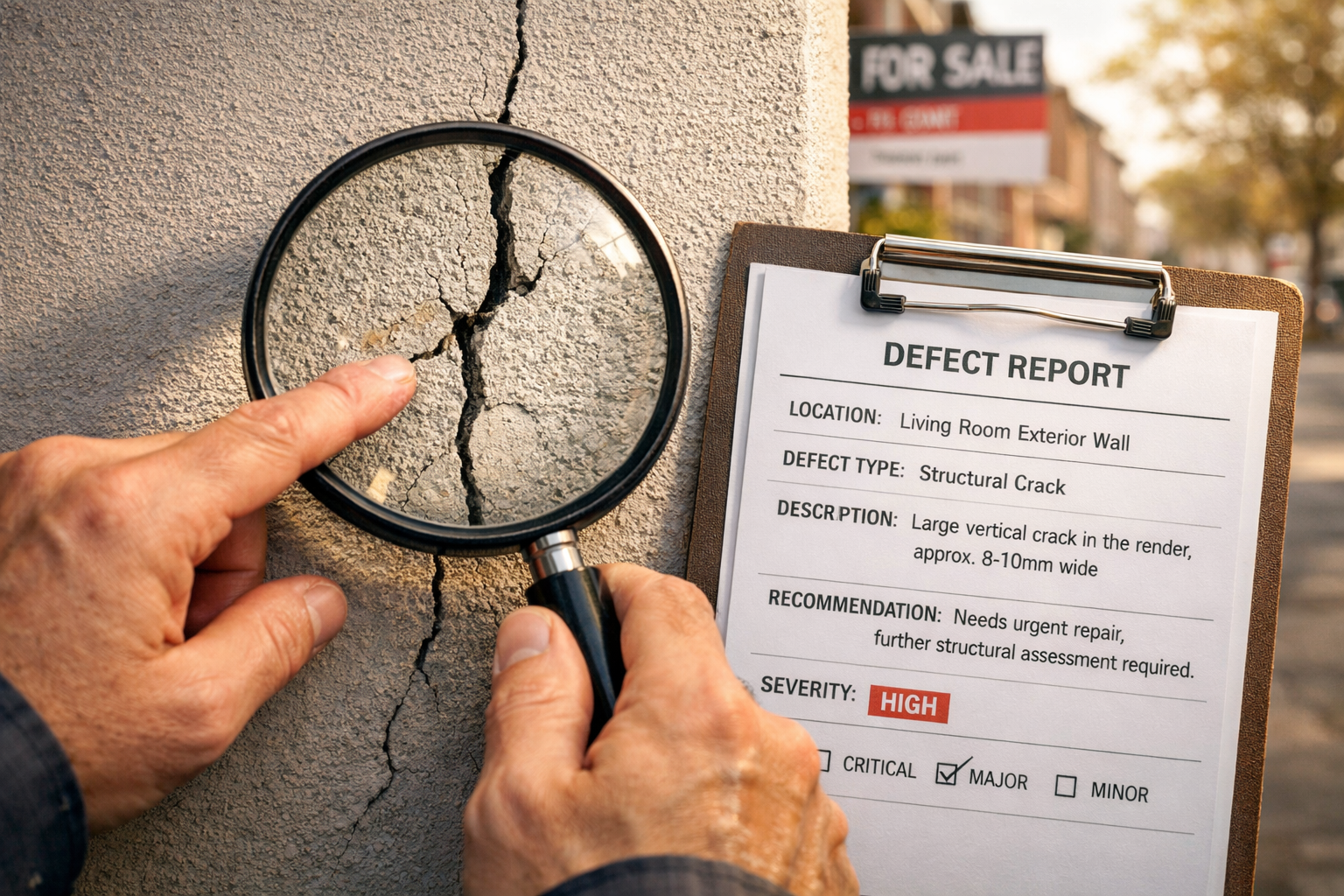
The cautious Spring 2026 housing market, with its -26% buyer enquiry dip and flat price growth, creates a specific professional opportunity for surveyors who position themselves as certainty providers rather than form-fillers. Here are the key strategies that matter most right now.
🏗️ Strategy 1: Front-Load the Survey Conversation
Builder sentiment has improved slightly in early 2026, with increased foot traffic and engagement — but remains low by historical standards [3]. Mortgage application activity is rising, suggesting buyers are entering the early stages of the process [3]. This is the moment to engage them.
Surveyors who make contact before a buyer formally instructs — through estate agent relationships, mortgage broker partnerships, or direct digital content — can shape expectations early. A buyer who understands what a Level 3 survey covers before they instruct it is less likely to be shocked by the findings and more likely to use the report constructively.
📊 Strategy 2: Use Market Data to Contextualise Findings
Spring 2026 has less predictability than previous seasons. Both buyers and sellers are acutely aware of interest rate volatility, creating a mix of urgency and caution rarely seen in standard seasonal cycles [4]. Surveyors can add significant value by contextualising defect findings within this market reality.
For example: a roof requiring £8,000 of remediation work is a different proposition when the buyer knows the vendor has been trying to sell for seven months in a slow market. That context — which a good surveyor can reference without overstepping their professional role — empowers buyers to negotiate with confidence.
🔍 Strategy 3: Expand Scope Without Expanding Liability
The instinct to broaden survey scope in a risk-heavy market must be balanced against professional liability considerations. RICS guidance is clear: surveyors should inspect what is reasonably accessible and flag what requires specialist investigation. In practice, this means:
- Documenting limitations clearly — what was not inspected and why
- Recommending specialist follow-up for areas of concern (structural engineers, damp specialists, drainage contractors)
- Using condition ratings consistently to avoid ambiguity
Understanding structural survey pricing is also important for surveyors advising clients on the total cost of due diligence — including any specialist reports that may follow.
⏱️ Strategy 4: Manage Turnaround Time Carefully
With homes spending 64 days on the market [1], there is less transactional urgency than in boom years — but that does not mean buyers are patient. A buyer who has finally committed to a property after months of hesitation wants their survey quickly. Understanding how long a homebuyer's survey takes — and communicating realistic timelines upfront — prevents the frustration that can cause cautious buyers to second-guess their decision.
💼 Strategy 5: Consider the Commercial Dimension
The slow residential market has a parallel effect on commercial property. Businesses relocating, downsizing, or restructuring in response to economic conditions are also transacting with caution. Surveyors with capacity freed up by the residential enquiry dip may find opportunity in commercial building surveys, where the same principles of thorough defect identification and clear risk communication apply.
The Broader Picture: What Spring 2026 Signals for the Survey Profession
The -26% buyer enquiry dip is not a permanent feature of the market. Mortgage application activity is rising [3], new listings are growing [1], and builder confidence — while restrained — is improving [3]. The fundamentals suggest a market in rebalancing mode, not freefall.
For the survey profession, this moment is instructive. Markets that move slowly reward thoroughness. When buyers have time to read their survey report carefully, compare it against asking prices, and consult specialists, the quality of that report matters more — not less.
The surveyors who thrive in Spring 2026 will be those who:
- Adapt their Level 3 scope to reflect the specific defect risks of properties that have sat on the market
- Communicate findings in plain language that empowers rather than alarms
- Position themselves as trusted advisors — not just inspection technicians
- Use market data to help clients understand the context of what they are buying
The cautious Spring 2026 housing market is not an obstacle for the survey profession. It is an argument for exactly what Level 3 building surveys, done well, have always offered: independent, expert certainty in an uncertain transaction.
Conclusion: Actionable Next Steps for Buyers and Surveyors
The cautious Spring 2026 housing market, shaped by a -26% buyer enquiry dip, 64-day average days on market, and persistent affordability pressures, demands a higher standard of property due diligence — not a lower one.
For buyers, the message is straightforward: do not let the slower pace of the market lull you into skipping or downgrading your survey. A property that has been on the market for months may have accumulated defects that a Level 2 survey will not catch. Commission the right level of inspection for the property type and age.
For surveyors, the opportunity is clear: expand scope thoughtfully, communicate findings with precision, and use this period of low transaction volume to deepen client relationships and refine reporting quality.
Immediate next steps:
- 🔎 Review your standard Level 3 scope against the defect categories most likely to affect long-listed properties in your area
- 📞 Build or strengthen referral relationships with estate agents who are managing slow-moving stock
- 📄 Update your report templates to include clearer cost-impact language and specialist referral pathways
- 📈 Monitor mortgage application trends — rising applications signal the next wave of instructions
- 🏠 Ensure clients understand the full range of survey types available so they can make informed choices
The market will recover. The surveyors who use this cautious season to raise their professional standards will be best placed when it does.
References
[1] Housing Market Update 2026 Housing Market Mood – https://www.redfin.com/news/housing-market-update-2026-housing-market-mood/
[2] Is The U S Housing Market Headed For A Crash In 2026 – https://www.kavout.com/market-lens/is-the-u-s-housing-market-headed-for-a-crash-in-2026
[3] Spring Housing Market 2026 Buyers Are Warming Up But Still Moving Carefully – https://www.mattklages.com/blog/spring-housing-market-2026-buyers-are-warming-up-but-still-moving-carefully/
[4] Spring 2026 Housing Market Outlook – https://www.mtb.com/library/article/spring-2026-housing-market-outlook