
More than one in five privately rented homes in England currently fails to meet the Decent Homes Standard — a figure that represents hundreds of thousands of tenants living in substandard conditions [6]. With the Renters' Rights Act 2025 now in force and the Government's formal policy statement on the new Decent Homes Standard published in January 2026, the private rented sector (PRS) is entering its most significant regulatory transformation in a generation [1][3].
The Decent Homes Standard in PRS Post-Renters' Rights Act: Building Surveyor Checklists for 2026 Compliance is no longer a distant planning exercise. Section 21 "no-fault" evictions are abolished from 1 May 2026 [1][5], Awaab's Law is being extended to private rentals, and local authorities now carry real enforcement teeth — including fines of up to £40,000 for non-compliant landlords [3]. For building surveyors, landlords, and property managers, understanding what these changes mean on the ground — and how to inspect for them — is now business-critical.
Key Takeaways 📋
- Five criteria define the new Decent Homes Standard: freedom from Category 1 hazards, reasonable state of repair, modern facilities, thermal comfort, and absence of damp and mould.
- Full enforcement begins in 2035, but Category 1 hazard enforcement is already active, with civil penalties of up to £7,000 for serious failures.
- Awaab's Law extends to the PRS, mandating specific response timescales for damp and mould — making Level 3 building surveys essential for landlords.
- Maximum fines for non-compliance have increased to £40,000, up from the previous £30,000 threshold.
- A nine-year transition window exists, but proactive surveying now protects landlords from escalating penalties and valuation risk.
The New Regulatory Landscape: What Changed in 2026
The Renters' Rights Act 2025 and Its Immediate Impact
The Renters' Rights Act 2025 received Royal Assent and has been rolling out its provisions in stages. The most headline-grabbing change — the abolition of Section 21 no-fault evictions — takes effect on 1 May 2026 [1][5]. This means landlords can no longer remove tenants simply to avoid dealing with property condition complaints. Tenants now have far greater security of tenure, which directly raises the stakes for compliance.
Alongside this, the Act introduces:
- A mandatory Private Rented Sector (PRS) database — expected in late 2026 — requiring all landlords to register and pay a fee [2][4].
- A PRS Ombudsman scheme for dispute resolution between landlords and tenants [2].
- Extension of Awaab's Law to the private rented sector, requiring landlords to investigate and repair hazardous damp and mould within defined timeframes [1][4].
💬 "The Renters' Rights Act fundamentally shifts the power dynamic in private renting. Landlords who ignore property condition issues can no longer use eviction as a pressure valve."
Awaab's Law: What It Means for PRS Landlords
Awaab's Law — named after two-year-old Awaab Ishak, who died in 2020 as a result of prolonged exposure to mould in a social housing property — originally applied only to social housing. Its extension to the PRS creates binding obligations on private landlords to:
- Investigate reports of damp and mould within a set timeframe.
- Begin repair work within a further defined period.
- Complete all remediation in a timely manner.
Specific timeframes for the PRS are being confirmed through secondary legislation, but the principle is clear: inaction on damp and mould is no longer an option. This makes professional damp surveys an essential tool for any landlord seeking to demonstrate compliance.
Understanding the Five Criteria: A Building Surveyor's Framework
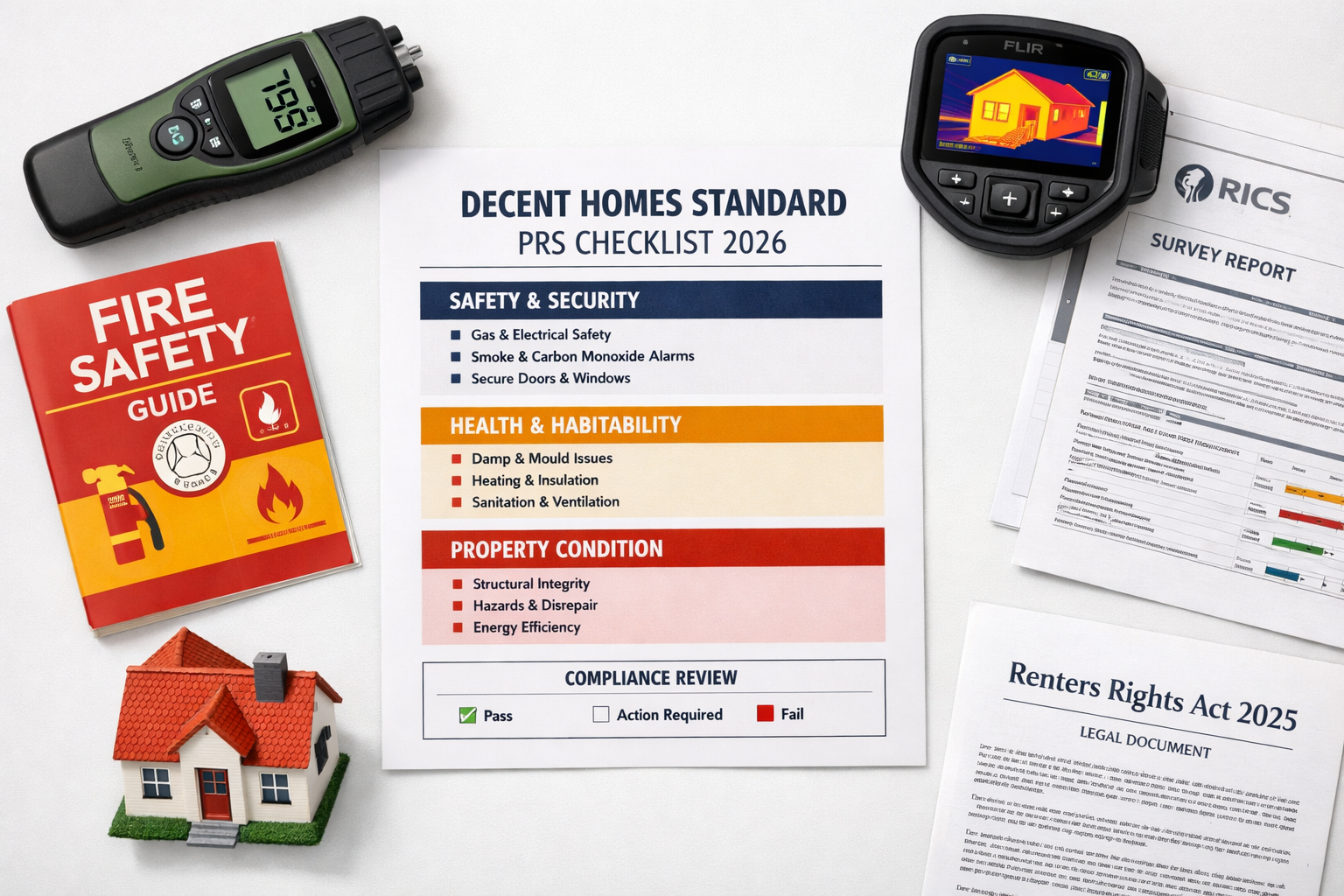
The Decent Homes Standard in PRS Post-Renters' Rights Act: Building Surveyor Checklists for 2026 Compliance is structured around five core criteria. Each criterion maps directly to specific inspection protocols that chartered surveyors must apply when assessing PRS properties [3].
Criterion A — Free from Category 1 Hazards (HHSRS)
This is the most legally significant criterion. The Housing Health and Safety Rating System (HHSRS) identifies 29 categories of hazard. Category 1 hazards are those assessed as posing the most serious risk to health or safety.
Common Category 1 hazards in PRS properties include:
| Hazard Type | Typical Surveyor Findings |
|---|---|
| Excess cold | Inadequate heating, poor insulation, single glazing |
| Damp and mould | Rising damp, penetrating damp, condensation mould |
| Falls on stairs | Broken balustrades, inadequate lighting |
| Electrical hazards | Outdated wiring, no RCD protection |
| Fire | No smoke alarms, blocked escape routes |
| Structural collapse | Cracked lintels, failing roof structure |
Local authorities have a legal duty to act on Category 1 hazards — not merely discretionary powers [3]. For serious failures where landlords have not taken reasonably practicable steps, civil penalties of up to £7,000 can be issued immediately [1][3].
Surveyor checklist — Criterion A:
- ✅ Full HHSRS assessment completed
- ✅ Electrical Installation Condition Report (EICR) reviewed
- ✅ Smoke and carbon monoxide alarm compliance checked
- ✅ Structural elements (lintels, roof, floors) visually inspected
- ✅ Damp meter readings taken at all external walls
For properties with suspected structural issues, a Level 3 RICS Building Survey provides the most comprehensive assessment, covering all accessible elements of the building fabric.
Criterion B — Reasonable State of Repair
A property must be free from significant disrepair that affects its structural stability or the safety of occupants. This criterion focuses on the physical condition of key building elements.
Key elements assessed:
- Roof coverings and chimneys
- External walls, windows, and doors
- Internal walls, floors, and ceilings
- Plumbing and drainage systems
Surveyors should note that "reasonable" is assessed against the age and character of the property. A Victorian terrace is not expected to perform like a modern build — but its key elements must be in functional condition. Understanding the difference between Level 2 and Level 3 surveys is important here: older or non-standard properties almost always warrant the more detailed Level 3 approach.
Criterion C — Modern Facilities and Services
Properties must have reasonably modern kitchens, bathrooms, and common area facilities. The standard does not require brand-new installations but sets minimum age thresholds:
- Kitchen: Must not be more than 30 years old and in poor condition
- Bathroom: Must not be more than 30 years old and in poor condition
- Electrical installations: Must meet current safety standards
Surveyor checklist — Criterion C:
- ✅ Kitchen installation date confirmed and condition assessed
- ✅ Bathroom sanitary ware condition and age documented
- ✅ Adequate kitchen space for storage and appliances verified
- ✅ Noise insulation between dwellings assessed (HMOs)
Criterion D — Thermal Comfort
This criterion requires properties to have effective insulation and an efficient heating system. In 2026, this intersects directly with Energy Performance Certificate (EPC) requirements.
Key policy detail: Properties achieving an EPC Band C rating before 1 October 2029 will be considered compliant with Minimum Energy Efficiency Standards (MEES) until that EPC expires — potentially extending compliance to 2039 given the 10-year EPC validity period [3][5].
Surveyor checklist — Criterion D:
- ✅ Current EPC rating confirmed and expiry date noted
- ✅ Boiler age and efficiency rating checked
- ✅ Loft insulation depth measured (minimum 270mm recommended)
- ✅ Cavity wall insulation status confirmed
- ✅ Double or secondary glazing presence verified
For properties with unusual construction methods, a non-standard construction survey may be needed to assess insulation options accurately.
Criterion E — Free from Damp and Mould 🏚️
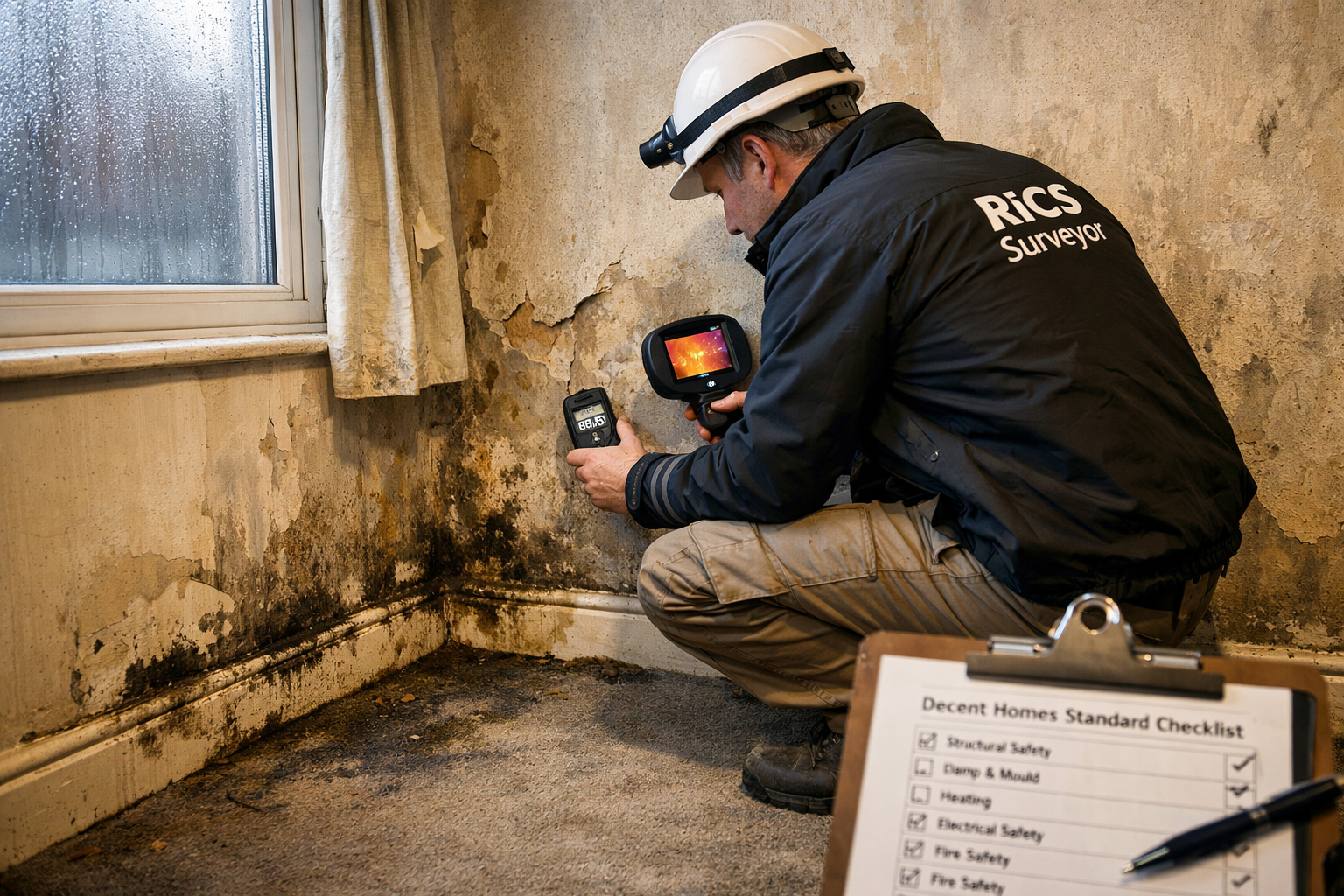
Given Awaab's Law, this criterion carries exceptional weight in 2026. Surveyors must go beyond visual inspection and use diagnostic tools to identify:
- Rising damp (hygroscopic salt testing)
- Penetrating damp (moisture meter profiling)
- Condensation-related mould (thermal imaging, ventilation assessment)
Surveyor checklist — Criterion E:
- ✅ Moisture meter readings at all ground-floor walls (internal and external faces)
- ✅ Thermal imaging camera used to identify cold bridges
- ✅ Roof space inspected for water ingress evidence
- ✅ Ventilation adequacy assessed (bathroom, kitchen, habitable rooms)
- ✅ All mould growth photographed, mapped, and categorised
A professional damp survey distinguishes between condensation, rising damp, and penetrating damp — each requiring a different remediation approach.
Enforcement, Penalties, and Valuation Impact for PRS Landlords
The Two-Tier Enforcement Model
The Government has established a two-tier enforcement approach [3]:
| Tier | Hazard Type | Local Authority Power | Maximum Penalty |
|---|---|---|---|
| Tier 1 | Category 1 hazards (Criterion A) | Legal duty to act | £7,000 civil penalty (immediate) |
| Tier 2 | Other DHS breaches (Criteria B–E) | Discretionary powers | £40,000 maximum fine |
The increase in maximum fines from £30,000 to £40,000 reflects inflation since the standard was first established and signals the Government's intent to make non-compliance genuinely costly [3].
Full enforcement of the Decent Homes Standard for private rentals is scheduled for 2035, giving landlords a nine-year transition period [5][8]. However, this does not mean enforcement is dormant. Category 1 hazard enforcement is active now, and the PRS database (expected late 2026) will give local authorities much better visibility of non-compliant properties [2].
Valuation Impacts in a Cautious Market 📉
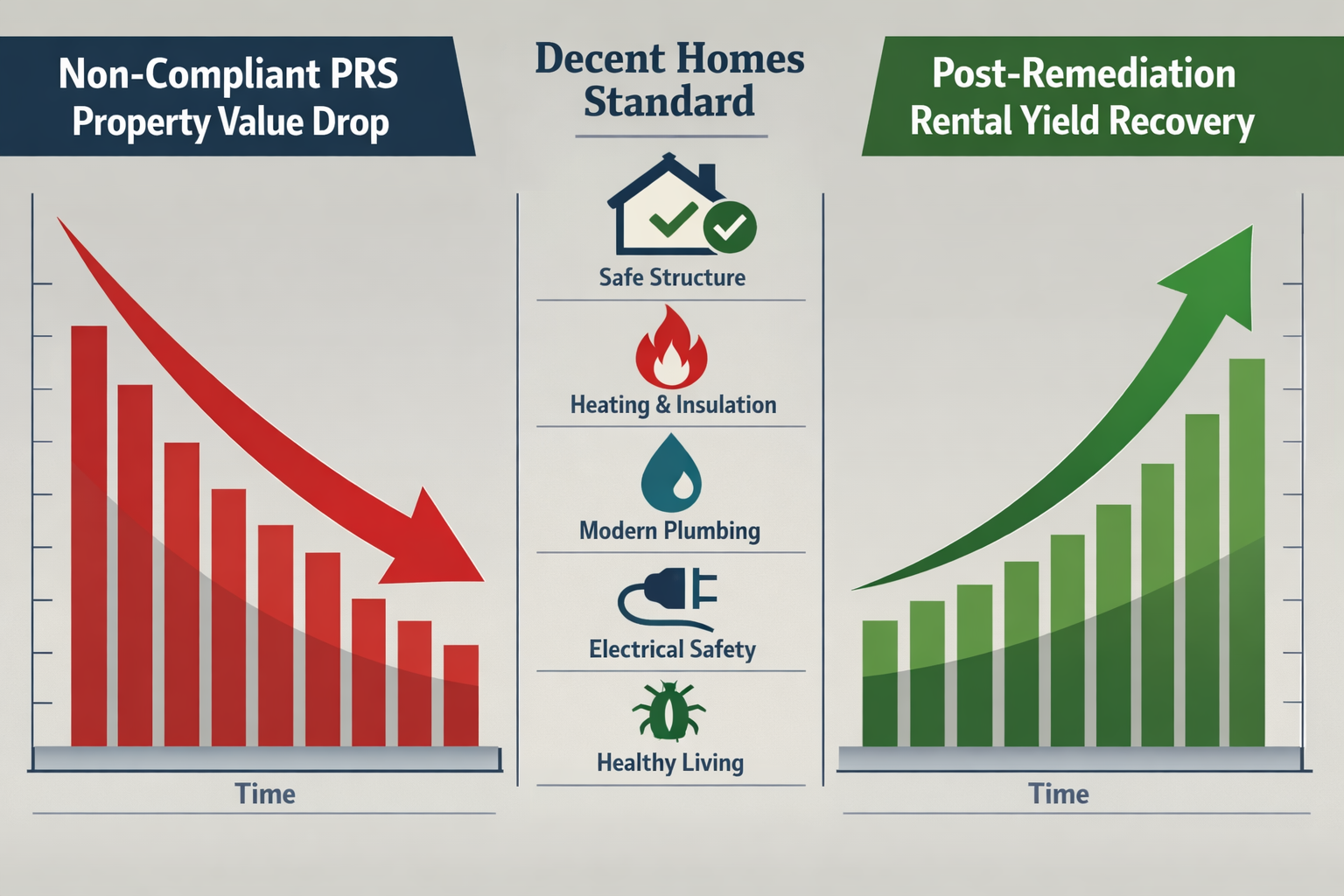
Non-compliance with the Decent Homes Standard carries direct financial consequences beyond fines. In 2026's cautious property market, lenders and valuers are increasingly factoring regulatory risk into assessments.
Key valuation risks for non-compliant landlords:
- Mortgage restrictions: Some lenders are tightening criteria for buy-to-let properties with poor EPC ratings or outstanding Category 1 hazards.
- Reduced rental yield: Tenants with greater security of tenure are more likely to challenge substandard conditions formally, leading to rent reduction orders.
- Reduced capital value: Properties requiring significant remediation to reach DHS compliance may be discounted at sale — particularly in cautious regional markets.
- Void periods: Enforcement action can result in prohibition orders preventing rental, creating extended void periods.
Landlords considering the financial case for remediation should understand how structural survey costs compare to the cost of enforcement action and rental income loss.
The PRS Database and Ombudsman: Late 2026 Additions
The planned PRS database will require landlords to register properties and provide condition information. This creates a compliance paper trail — and a risk register for local authorities [2][4]. Landlords who invest in professional surveys now will have documented evidence of their compliance efforts, which is valuable protection if enforcement action is ever initiated.
The PRS Ombudsman scheme will provide tenants with a formal route to raise complaints about property conditions without going to court [2]. This makes proactive condition management — supported by regular professional surveys — a sound risk management strategy.
Practical Steps for Building Surveyors and Landlords in 2026
Choosing the Right Survey Type
Not all surveys are equal. For PRS compliance purposes:
- Level 2 (Homebuyer Survey): Suitable for modern, conventional properties in good condition. Provides condition ratings but limited detail on older defects. See the RICS Level 2 Homebuyer Survey for more detail.
- Level 3 (Building Survey): Recommended for all pre-1980 properties, non-standard construction, or any property showing signs of disrepair. Provides full structural analysis and detailed defect reporting. A full RICS Building Survey is the gold standard for DHS compliance evidence.
💬 "A Level 3 survey is not an expense — it is a compliance document, a negotiating tool, and a legal shield rolled into one."
Recommended Survey Frequency for PRS Properties
| Property Age | Recommended Survey Frequency |
|---|---|
| Post-2000 build | Every 5 years or at tenancy change |
| 1945–2000 build | Every 3 years or at tenancy change |
| Pre-1945 build | Every 2 years or at tenancy change |
| HMOs (all ages) | Annual inspection minimum |
Documentation Best Practice
Surveyors and landlords should maintain a compliance file for each property containing:
- Most recent RICS survey report
- Current EPC certificate
- EICR (Electrical Installation Condition Report)
- Gas Safety Certificate
- Damp and timber survey (if applicable)
- Photographic record of all remediation works
- Correspondence with local authority
This documentation is essential if a landlord needs to demonstrate they have taken "reasonably practicable steps" to address hazards — the legal threshold that determines whether a civil penalty applies [1][3].
Conclusion: Act Now, Not in 2035
The Decent Homes Standard in PRS Post-Renters' Rights Act: Building Surveyor Checklists for 2026 Compliance represents a genuine step-change in how private rentals are regulated in England. With over 20% of PRS properties currently below standard [6], the scale of required improvement is substantial — but the nine-year transition window means landlords who act now have time to manage costs strategically.
Actionable next steps for landlords and surveyors in 2026:
- 📋 Commission a Level 3 Building Survey for any pre-1980 PRS property or any property showing signs of disrepair.
- 🌡️ Arrange a professional damp survey to establish a baseline before Awaab's Law enforcement timescales are confirmed for the PRS.
- 📄 Check EPC ratings — properties that achieve Band C before October 2029 benefit from extended transitional compliance.
- 🗂️ Build a compliance file for each property with all certificates, survey reports, and remediation records.
- 🏛️ Register for the PRS database when it launches in late 2026 — proactive registration demonstrates good faith to local authorities.
- 💼 Seek professional valuation advice to understand how DHS compliance (or non-compliance) affects your portfolio's capital and rental value.
The regulatory direction of travel is clear. Landlords who treat professional surveys as a compliance investment — rather than an overhead — will be best positioned to protect both their tenants and their portfolios through the decade ahead.
References
[1] The New Decent Homes Standard What Landlords And Tenants Need To Know – https://gowlingwlg.com/en/insights-resources/articles/2026/the-new-decent-homes-standard-what-landlords-and-tenants-need-to-know
[2] Renters Rights Act A Compliance Guide For Landlords – https://www.hibberts.com/renters-rights-act-a-compliance-guide-for-landlords/
[3] The New Decent Homes Standard Policy Statement – https://www.gov.uk/government/consultations/consultation-on-a-reformed-decent-homes-standard-for-social-and-privately-rented-homes/outcome/the-new-decent-homes-standard-policy-statement
[4] Alerts Realestate Impacts Of The Renters Rights Act – https://www.goodwinlaw.com/en/insights/publications/2026/01/alerts-realestate-impacts-of-the-renters-rights-act
[5] Decent Homes Standard – https://buildingenergyexperts.co.uk/resources/decent-homes-standard/
[6] What Is The Decent Homes Standard And How Will It Apply To Private Landlords – https://housemartin.co/what-is-the-decent-homes-standard-and-how-will-it-apply-to-private-landlords/
[8] Decent Homes Standard Introduced 2035 – https://www.nrla.org.uk/news/decent-homes-standard-introduced-2035
[9] Renters Rights Act Implementation Roadmap Now Published – https://www.hoganlovells.com/en/publications/renters-rights-act-implementation-roadmap-now-published