
Over 4.6 million households in England currently live in the private rented sector — and as of 2026, the regulatory ground beneath landlords and surveyors has shifted dramatically. Building Survey Protocols for Awaab's Law 2026 Expansion: Assessing New Hazards in Private Rental Properties are no longer a matter of best practice. They are a legal necessity, with survey reports now forming part of the formal compliance record that can be scrutinised in enforcement proceedings.
Awaab's Law — named after two-year-old Awaab Ishak, who died in 2020 from prolonged mould exposure in a social housing property — was initially introduced to tackle damp and mould hazards. Phase 2 of the legislation, rolling out in 2026, dramatically widens the scope. Excess cold, excess heat, fire risks, electrical hazards, and structural collapse are now regulated categories under the Housing Health and Safety Rating System (HHSRS) [3]. For building surveyors and landlords operating in the private rental sector, this expansion demands a complete rethink of inspection checklists, documentation standards, and reporting timelines.
Key Takeaways 📋
- Phase 2 (2026) of Awaab's Law extends regulated hazards beyond damp and mould to include excess cold, heat, fire, electrical faults, and structural collapse [3].
- Survey reports are now legal documents — not advisory notes — forming the compliance audit trail for landlords and housing providers [1].
- Emergency hazards require investigation within 24 hours; significant hazards must be investigated within 10 working days [3].
- Person-centred assessment is mandatory: a hazard's severity must account for the specific vulnerabilities of the tenant, not just standard HHSRS scoring [3].
- Private rental properties are now within scope, requiring surveyors to adapt protocols that were previously focused primarily on social housing.
Understanding the 2026 Expansion: What Has Changed and Why It Matters
From Damp and Mould to a Broader Hazard Framework
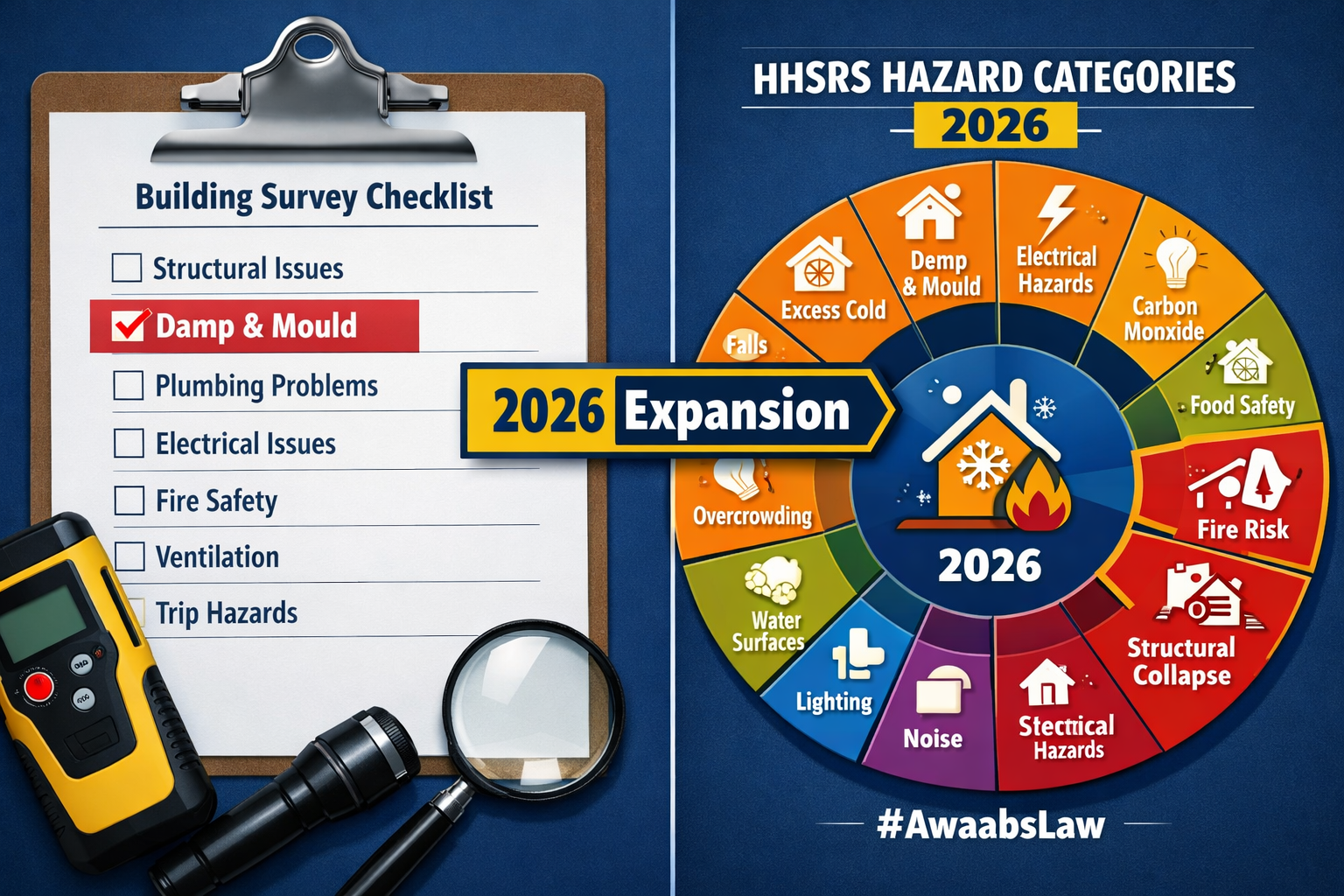
When Awaab's Law first came into force, its focus was clear and specific: landlords must act swiftly when damp and mould are reported. But the Phase 2 expansion in 2026 signals a far more ambitious regulatory vision. Under the updated framework, the following hazard categories are now subject to mandatory investigation and remediation timelines [3]:
| Hazard Category | Examples |
|---|---|
| Excess Cold | Inadequate heating, poor insulation, cold bridging |
| Excess Heat | Overheating in top-floor flats, lack of ventilation |
| Fire | Blocked escape routes, missing smoke alarms, combustible cladding |
| Electrical Hazards | Faulty wiring, overloaded circuits, unsafe installations |
| Structural Collapse | Subsidence, failing roof structures, unstable walls |
Phase 3, scheduled for 2027, will extend coverage further to include asbestos, biocides, and carbon monoxide, alongside all remaining HHSRS hazards (excluding overcrowding) [3]. Surveyors who begin adapting protocols now will be significantly better positioned for that next wave.
Why Private Rental Properties Are Now in the Spotlight
The original Awaab's Law provisions applied primarily to social housing. The 2026 expansion brings private rental properties firmly within scope, creating new obligations for landlords who may have previously operated under less prescriptive inspection regimes. This is not a minor administrative update — it fundamentally changes the relationship between a building survey and a landlord's legal liability.
💡 Pull Quote: "Survey reports are no longer advisory documents. They have become part of the legal record of compliance — the foundation for demonstrating whether landlords are meeting their statutory obligations." [1]
For surveyors working across London and the South East, understanding how these changes apply to the diverse stock of private rental properties — from Victorian terraces to purpose-built flats — is essential. A RICS home survey conducted today must reflect the expanded hazard categories now regulated under Awaab's Law.
Building Survey Protocols for Awaab's Law 2026 Expansion: Core Inspection Requirements
The Four Conditions That Trigger Landlord Liability
Before a surveyor can document a hazard as falling under Awaab's Law, four specific conditions must be established. A hazard triggers landlord liability when it:
- Exists on land or in a building the landlord is responsible for
- Is within the landlord's control to repair
- Presents a risk to the health or safety of the tenant
- Falls within one of the regulated HHSRS hazard categories [3]
This four-part test means surveyors must go beyond simply identifying a defect. The survey report must explicitly connect the defect to the tenant's health risk and confirm the landlord's responsibility for remediation. This is a significant shift from traditional reporting conventions.
Mandatory Investigation Timelines Surveyors Must Know
One of the most operationally significant aspects of Awaab's Law is its strict timeline framework. Surveyors advising landlords or producing compliance reports must understand these deadlines:
- 🚨 Emergency hazards: Investigation must begin within 24 hours of becoming aware of the hazard [3]
- ⏱️ Significant hazards: Full investigation must be completed within 10 working days [3]
- 📄 Written summary to tenant: Must be provided within 3 working days after investigation concludes [3]
- 🔧 Safety works completion: Must be completed within 5 working days of investigation conclusion [3]
- 🏗️ Complex/long-term works: Steps to begin must be taken within 5 working days, with works starting no later than 12 weeks after investigation [3]
These timelines are not aspirational targets. They are statutory obligations. A building survey that fails to flag hazards clearly — or that omits recommended remediation timeframes — could leave a landlord unknowingly in breach.
The Person-Centred Assessment Requirement
One of the most nuanced — and potentially misunderstood — aspects of the 2026 framework is the person-centred approach to hazard assessment. Standard HHSRS scoring provides a baseline, but Awaab's Law requires surveyors to layer in tenant-specific vulnerability [3].
What this means in practice:
- A small patch of mould in a bathroom might score as Category 2 under standard HHSRS methodology
- If the tenant is elderly, has asthma, or is immunocompromised, that same patch may qualify as a "significant hazard" requiring the full 10-working-day investigation protocol [3]
- Surveyors must therefore document tenant circumstances as part of the hazard assessment — not just the physical condition of the property
This represents a meaningful departure from purely condition-based surveying. For surveyors, it raises important questions about data collection, tenant consultation, and the scope of professional duty of care.
Adapting Inspection Checklists: Assessing New Hazards in Private Rental Properties
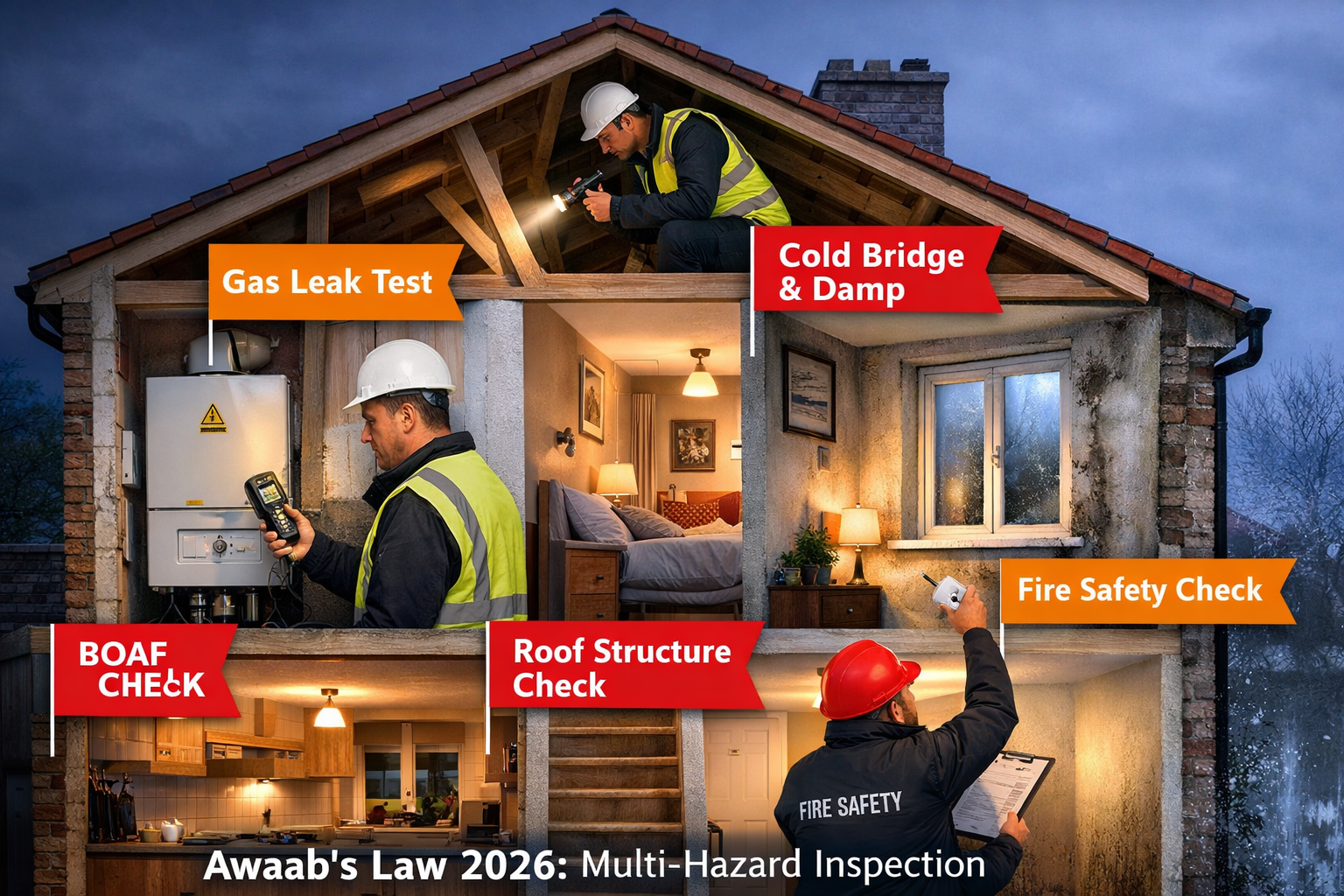
Electrical Hazards: What Surveyors Must Now Document
Electrical hazards have become a regulated category under the Phase 2 expansion, and building survey protocols must now include structured assessment of electrical safety [2]. Key inspection points include:
- Age and condition of the consumer unit — older fuse boxes without RCD protection present elevated risk
- Visible wiring condition — signs of deterioration, amateur modifications, or overloaded circuits
- Socket and switch condition — cracked faceplates, scorch marks, or loose fittings
- Compliance with current wiring regulations — particularly in pre-1970s rental stock
- Presence and condition of earthing and bonding in kitchens and bathrooms [2]
Surveyors should note that while a full Electrical Installation Condition Report (EICR) remains a specialist document, the building survey must now flag electrical concerns with sufficient specificity to trigger appropriate follow-up action. Vague references to "dated wiring" will no longer satisfy the documentation standard required under Awaab's Law [1].
Excess Cold and Heat: Thermal Performance Assessment
The inclusion of excess cold and excess heat as regulated hazards requires surveyors to assess thermal performance with greater rigour. For private rental properties — many of which are older, poorly insulated stock — this is a significant challenge.
Excess cold indicators to document:
- U-values of walls, roofs, and floors where assessable
- Single glazing or poorly performing double glazing
- Absence or inadequacy of central heating
- Cold bridging at window reveals, corners, and floor/wall junctions
Excess heat indicators to document:
- Top-floor flats with inadequate roof insulation or ventilation
- South-facing properties without external shading or openable windows
- Lack of mechanical ventilation in rooms with high solar gain
A damp survey often reveals the intersection between thermal performance and moisture — cold bridges that cause condensation are simultaneously an excess cold hazard and a damp hazard, requiring dual documentation under the expanded framework.
Fire Risk and Structural Collapse: Elevated Documentation Standards
Fire risk assessment within a building survey context now requires explicit documentation of:
- Means of escape — particularly in HMOs and converted properties
- Fire door condition and self-closing mechanisms
- Smoke and heat detector placement and functionality
- Storage of combustible materials in communal areas [2]
Structural collapse hazards — including subsidence, failing roof structures, and unstable retaining walls — must be assessed with reference to the landlord's repair obligations. Surveyors should cross-reference findings with a structural survey where significant concerns are identified, and consider whether subsidence surveys are warranted.
For properties where asbestos is suspected — particularly pre-2000 stock — surveyors should flag the need for specialist asbestos surveys, noting that asbestos will become a regulated hazard under Phase 3 in 2027 [3].
Enhanced Documentation: What Reports Must Now Include
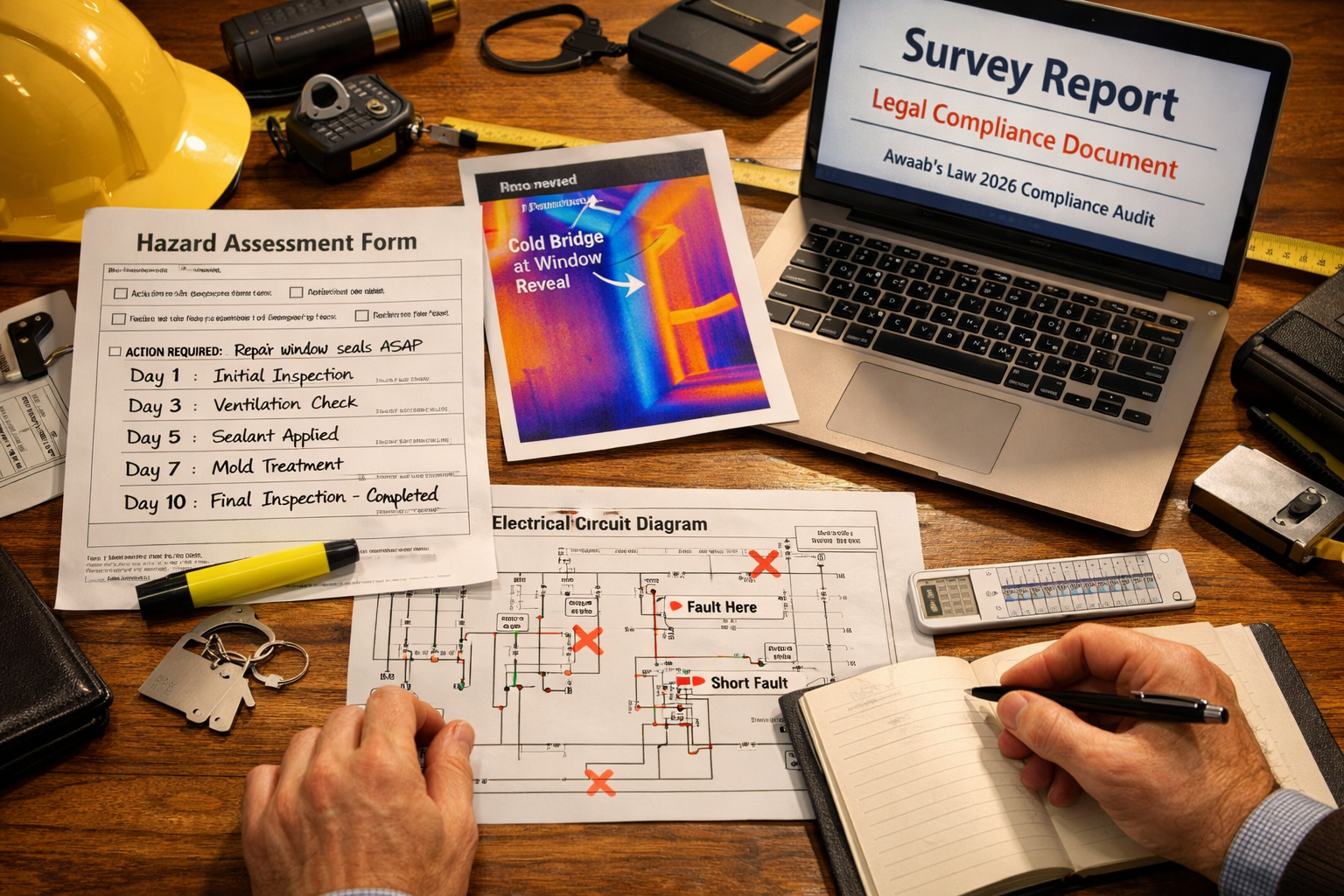
The legal elevation of survey reports under Awaab's Law means that documentation standards must be significantly enhanced [1]. For each identified hazard, the report must now include:
✅ Location and extent — precise description, not general references to "areas of concern"
✅ Probable cause — structural, ventilation-related, or condensation-driven
✅ Health risk assessment — including consideration of tenant vulnerability
✅ Recommended remediation timeframe — aligned with statutory deadlines
✅ Landlord responsibility confirmation — explicitly linking the defect to the landlord's repair obligation [1]
This level of specificity creates an audit trail demonstrating that hazards were identified, prioritised, and resolved within regulatory requirements. Surveyors who produce reports that lack this structure expose both themselves and their landlord clients to enforcement risk.
For landlords and surveyors working across the South East, understanding how to choose the right level of survey is critical — the guide to different types of survey provides a useful starting point for matching survey scope to property risk profile.
Practical Compliance: What Landlords and Surveyors Should Do Now
Immediate Actions for Landlords
- Audit existing tenancy agreements to confirm repair responsibilities are clearly defined
- Commission updated building surveys that reflect the expanded 2026 hazard categories
- Establish a hazard reporting and response system with documented timelines
- Train property management staff on the four-condition liability test and investigation deadlines
- Review insurance cover to ensure it reflects the expanded scope of landlord liability
Immediate Actions for Surveyors
- Update inspection checklists to include all Phase 2 hazard categories
- Revise report templates to meet the enhanced documentation standards required under Awaab's Law [1]
- Develop a person-centred assessment protocol — including tenant vulnerability screening questions
- Clarify the boundary between building survey findings and specialist referrals (EICR, asbestos surveys, structural engineering)
- Consider CPD focused on HHSRS scoring methodology and Awaab's Law compliance
For properties in London and the surrounding regions, local chartered surveyors with specific knowledge of regional housing stock — including the prevalence of Victorian terraces, converted flats, and purpose-built blocks — are best placed to deliver compliant assessments.
Landlords with portfolios spanning multiple areas may also benefit from stock condition surveys, which provide a systematic baseline assessment across an entire property portfolio — a practical starting point for identifying where Awaab's Law compliance gaps are most acute.
Conclusion: Adapting to a New Standard of Care
The 2026 expansion of Awaab's Law marks a watershed moment for building surveying in the private rental sector. What was once a professional advisory exercise has become a legally significant act — one that can determine whether a landlord is compliant or exposed to enforcement action.
Building Survey Protocols for Awaab's Law 2026 Expansion: Assessing New Hazards in Private Rental Properties now require surveyors to:
- Assess a wider range of hazards — from electrical faults to structural collapse
- Apply a person-centred lens that accounts for tenant vulnerability
- Produce reports that function as legal compliance documents, not advisory notes
- Align recommendations with statutory investigation and remediation timelines
The good news is that surveyors who adapt now — updating checklists, enhancing documentation, and deepening their HHSRS expertise — will be well positioned not just for Phase 2, but for the Phase 3 expansion in 2027.
Actionable next steps:
- 📋 Review and update your survey report template against the documentation checklist above
- 🏠 Commission a baseline stock condition survey for any portfolio property not assessed since 2024
- 📞 Consult a chartered surveyor experienced in HHSRS assessment to review your current compliance position
- 📅 Diarise Phase 3 (2027) preparation — asbestos and carbon monoxide protocols will require specialist input
The regulatory direction of travel is clear. Proactive adaptation is not just good practice — in 2026, it is the law.
References
[1] Awaabs Law And Surveyors What Your Reports Must Include In 2026 – https://goreport.com/awaabs-law-and-surveyors-what-your-reports-must-include-in-2026/
[2] Electrical Hazards And Fire Risk Assessment In Building Surveys Awaabs Law 2026 Extensions And Surveyor Liability – https://nottinghillsurveyors.com/blog/electrical-hazards-and-fire-risk-assessment-in-building-surveys-awaabs-law-2026-extensions-and-surveyor-liability
[3] Awaabs Law Is Here The Surveyors Guide For Compliance – https://www.surventrix.com/blog/awaabs-law-is-here-the-surveyors-guide-for-compliance
[4] Awaabs Law 2026 Social Landlords Housing Associations – https://www.villageheating.co.uk/awaabs-law-2026-social-landlords-housing-associations/
[5] Awaabs Law Extensions To Prs In 2026 Party Wall And Building Survey Protocols For New Hazard Categories – https://nottinghillsurveyors.com/blog/awaabs-law-extensions-to-prs-in-2026-party-wall-and-building-survey-protocols-for-new-hazard-categories