
Construction project values with planning permission surged by 95% in Yorkshire and Humber and 79% in the North East in the three months to February 2026 — figures that signal not just economic momentum, but a fast-approaching wave of boundary disputes waiting to happen [2]. As cranes multiply across northern skylines and developers race to break ground, the legal framework governing shared walls and excavations becomes more critical than ever. Understanding Party Wall Agreements in Northern Construction Uptick 2026: Preventing Disputes in High-Growth Areas is no longer a procedural afterthought — it is a frontline risk management tool for every builder, developer, and homeowner operating in these booming regions.
Key Takeaways
- Northern England and Scotland are experiencing some of the steepest construction growth rates in the UK in 2026, dramatically increasing the likelihood of party wall disputes.
- The Party Wall etc. Act 1996 applies to England and Wales only; Scottish projects rely on common law, requiring different dispute prevention strategies.
- Serving correct and timely party wall notices is the single most effective step to prevent costly legal conflicts during construction.
- A Schedule of Condition report, completed before work begins, protects both building owners and adjoining owners from unfounded damage claims.
- Engaging a qualified party wall surveyor early — ideally before planning permission is granted — reduces delays, legal costs, and neighbour relations damage.
The Northern Construction Boom: Why Party Wall Risk Is Surging in 2026
The UK construction industry is projected to grow by 2.2% in 2026, driven by robust investment in housing and commercial sectors [5]. Experian's forecasts go further, projecting output growth of 2.8% in 2026 and 4.2% in 2027 [9]. These headline numbers, however, mask a sharp regional divergence that has direct implications for party wall compliance.
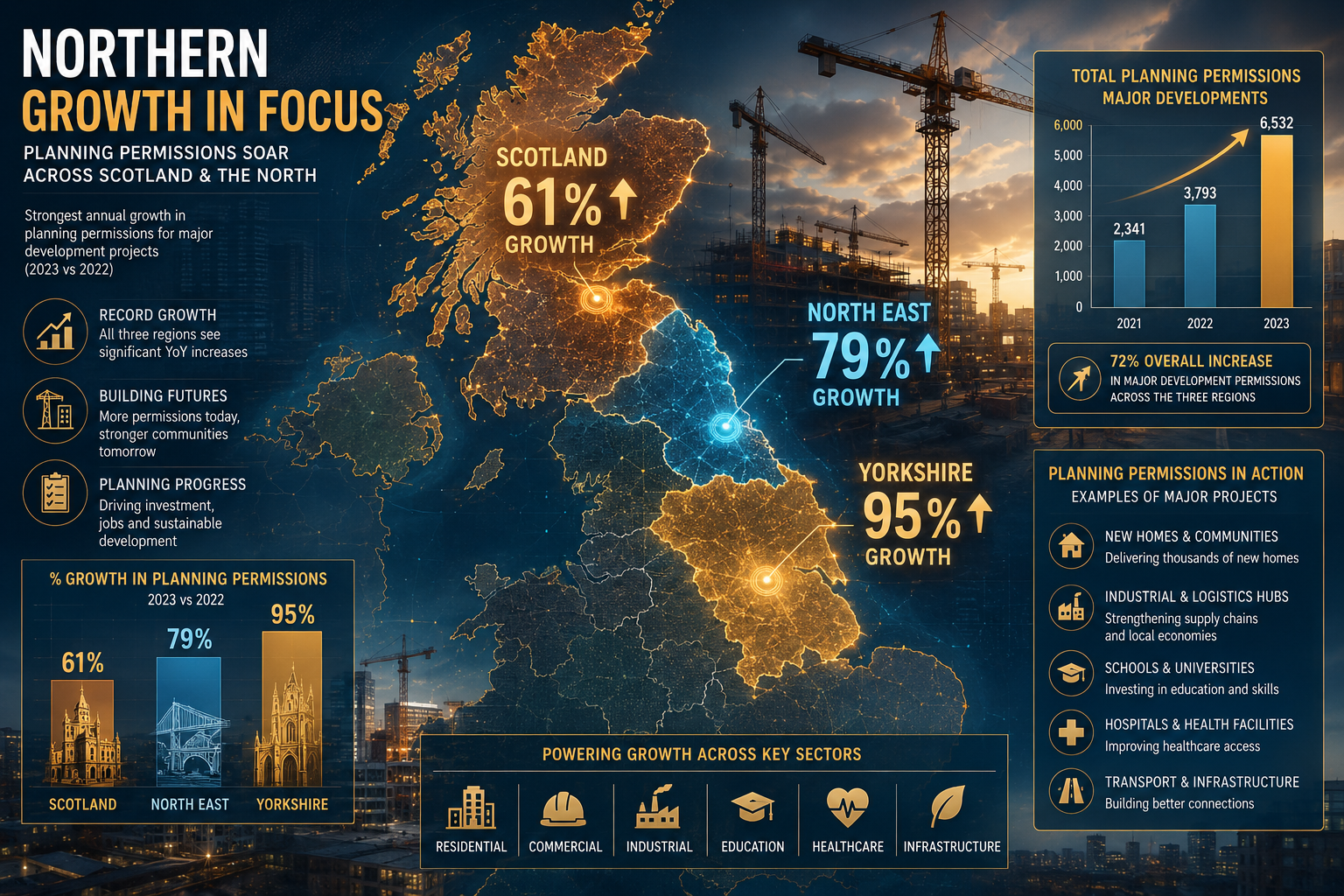
In Q1 2026, 944 projects were published on construction market intelligence platforms — up from 804 in Q4 2025 and significantly higher than 624 in Q1 2025 [6]. Much of this acceleration is concentrated in the North. Hotel and leisure construction has seen particularly dramatic growth, with planning-approved project values rising 61% in Scotland, 79% in the North East, and 95% in Yorkshire and Humber [2]. Meanwhile, infrastructure workload expectations have risen to a net balance of +32%, underpinned by energy-related projects [3].
What does this mean for party wall compliance?
High-density urban environments — terraced streets in Leeds, back-to-back Victorian housing in Sheffield, converted industrial units in Manchester — are precisely the settings where the Party Wall etc. Act 1996 applies most frequently. When construction activity accelerates rapidly in these areas, the volume of required party wall notices, agreements, and awards rises in direct proportion.
"A construction boom without proportionate party wall compliance is a dispute waiting to be filed."
The Act applies to England and Wales. It does not apply in Scotland or Northern Ireland, where common law governs party wall issues [4]. This distinction matters enormously in 2026, as Scottish construction growth is among the strongest in Britain. Developers working across the border must understand that the legal protections and procedures differ significantly from those in English cities like Leeds or Newcastle.
Key Construction Growth Indicators for Northern Regions in 2026
| Region | Planning-Approved Project Value Growth (3 months to Feb 2026) | Party Wall Act Applicable? |
|---|---|---|
| Yorkshire and Humber | +95% | Yes (England) |
| North East | +79% | Yes (England) |
| Scotland | +61% | No (Common Law) |
| National Average (GB) | Varies by sector | England/Wales only |
For those operating in high-growth northern English areas, the volume of party wall disputes is set to rise sharply unless proactive compliance measures are taken now.
Party Wall Agreements in Northern Construction Uptick 2026: Step-by-Step Compliance Framework
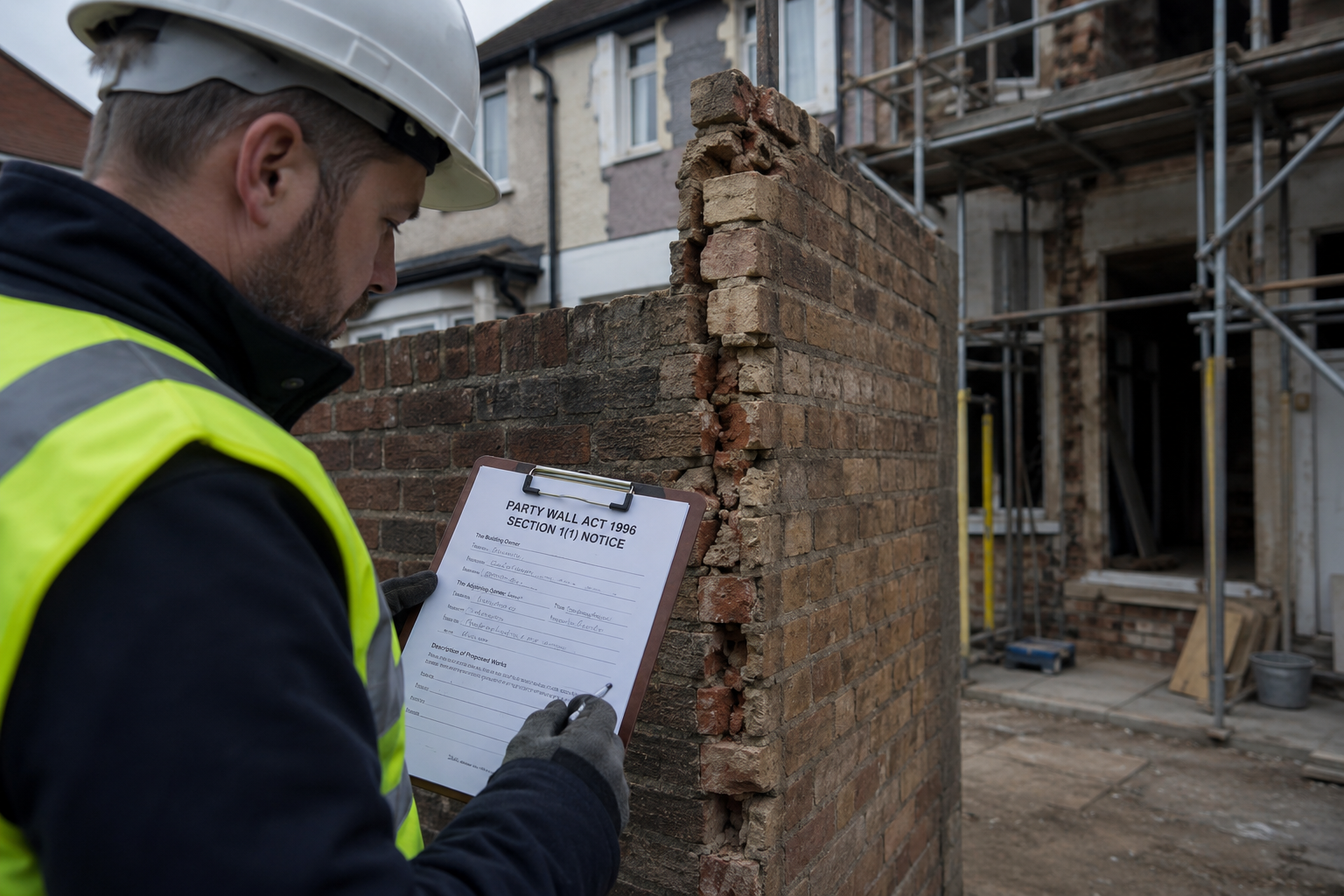
The Party Wall etc. Act 1996 establishes a clear procedural framework. Following it correctly is the most reliable way to prevent disputes from escalating into costly legal battles. The steps below are tailored to the realities of the 2026 northern construction environment, where compressed timelines and high project density increase the risk of procedural shortcuts.
Step 1: Identify Whether the Act Applies to Your Project
Not every construction project triggers the Act. It applies when work involves:
- Party structures — walls or floors shared between two or more owners (common in terraced and semi-detached properties).
- Boundary walls — walls built on or near the boundary line between properties.
- Excavations — digging within 3 or 6 metres of a neighbouring structure, depending on the depth of the proposed foundations.
In northern cities where Victorian terraced housing dominates, almost every extension, loft conversion, or basement project will engage at least one of these categories. Understanding the notice requirements for excavation near a neighbour is particularly important for new-build and deep-foundation projects surging across the region.
Step 2: Serve the Correct Party Wall Notice
Once it is established that the Act applies, the building owner must serve written notice on all adjoining owners. The type of notice depends on the work:
- Party Structure Notice — for work on a shared wall or structure. Must be served at least two months before work begins.
- Line of Junction Notice — for building a new wall at or on the boundary. Must be served at least one month before work begins.
- Three-Metre or Six-Metre Notice — for excavations near neighbouring foundations. Must be served at least one month before work begins.
Common mistakes in high-growth areas:
- Serving notice too late due to compressed project timelines.
- Failing to identify all adjoining owners, particularly in multi-unit developments.
- Using informal communication (email or verbal notice) rather than a formal written notice.
In the current northern boom, where developers are pushing projects forward quickly to capitalise on market conditions, these procedural errors are becoming more frequent. Understanding the full process for obtaining consent for party wall work from the outset prevents delays that can cost far more than the surveyor fees avoided.
Step 3: Await Consent or Trigger the Dispute Resolution Process
Once notice is served, the adjoining owner has 14 days to respond. Three outcomes are possible:
- Consent — the adjoining owner agrees in writing. Work can proceed, though a Schedule of Condition is still advisable.
- Dissent with agreed surveyor — both parties appoint a single agreed surveyor to produce a Party Wall Award.
- Dissent with separate surveyors — each party appoints their own surveyor. The two surveyors then appoint a third surveyor if they cannot agree.
In practice, the dispute resolution pathway is triggered far more often in high-activity construction zones. When multiple projects are running simultaneously on the same street — a scenario increasingly common in northern regeneration areas — adjoining owners become more cautious and more likely to dissent.
Step 4: Commission a Schedule of Condition
A Schedule of Condition for party wall work is a detailed photographic and written record of the adjoining property's condition before construction begins. It is not legally mandated, but it is one of the most powerful dispute-prevention tools available.
Why it matters in 2026:
- In high-density northern areas, vibration and ground movement from nearby construction can cause pre-existing cracks to worsen or new ones to appear.
- Without a pre-construction record, it is impossible to determine whether damage was caused by the current project or existed beforehand.
- A thorough Schedule of Condition protects the building owner from fraudulent or exaggerated damage claims, and protects the adjoining owner by documenting genuine pre-existing issues.
The schedule should be completed by a qualified surveyor before any work begins — not after the first signs of cracking appear.
Step 5: Obtain the Party Wall Award
Where consent is not given, the appointed surveyor or surveyors produce a Party Wall Award (also called a party wall agreement in common usage). This legally binding document sets out:
- The work to be carried out.
- The hours during which work may take place.
- The method of construction.
- The right of access for the adjoining owner's surveyor.
- How any damage will be assessed and compensated.
The Award is enforceable in the County Court. In the context of the 2026 northern construction uptick, where projects are larger and timelines tighter, the Award provides the legal certainty that keeps projects moving without neighbour disputes derailing them.
Understanding the full party wall cost implications — including surveyor fees, potential compensation, and the cost of delays caused by non-compliance — helps developers and homeowners budget accurately from the start.
Preventing Disputes in High-Growth Areas: Practical Strategies for 2026
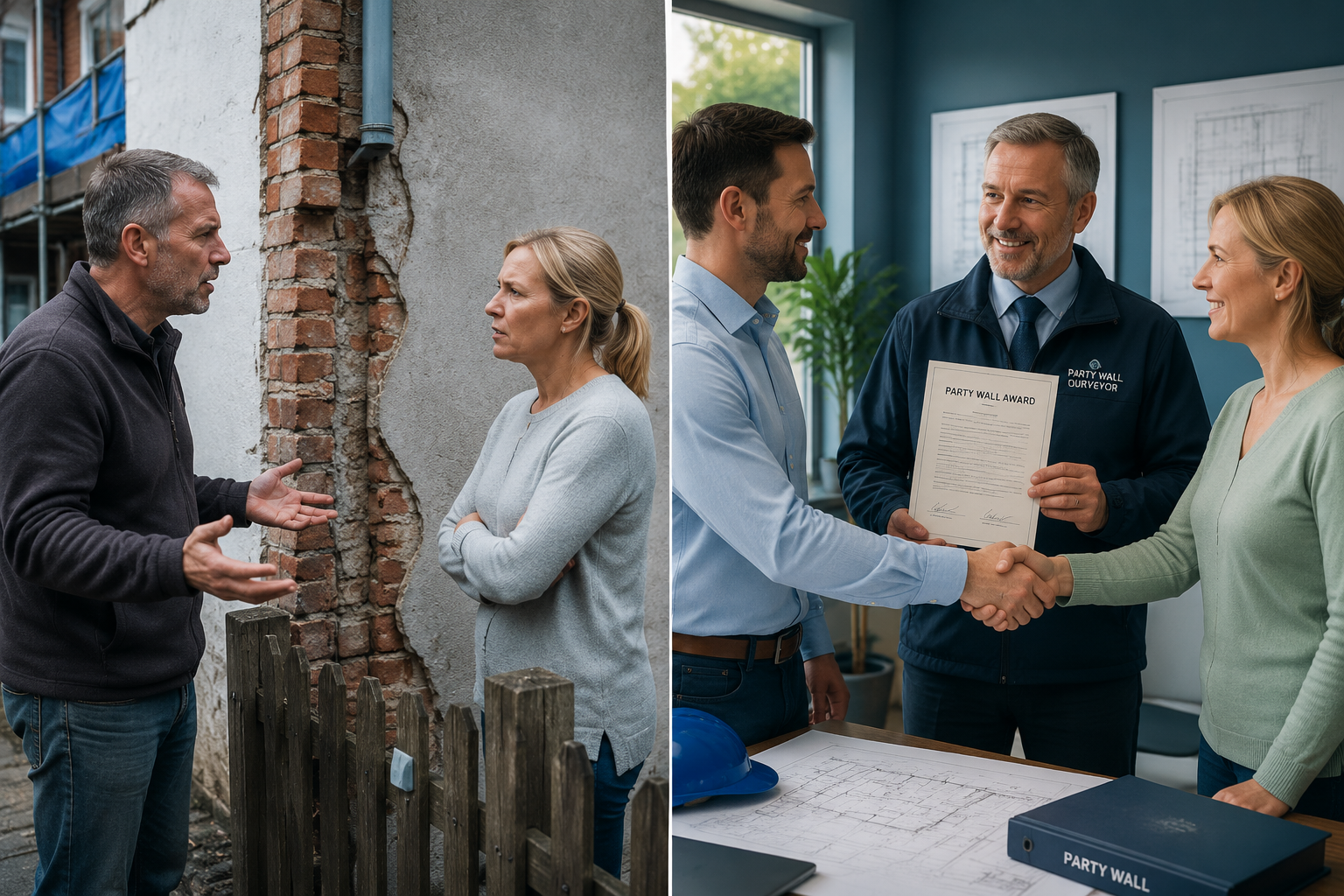
Compliance with the Act's procedural steps is necessary but not always sufficient to prevent disputes in the most active construction zones. The following strategies address the specific pressures created by the 2026 northern construction uptick.
Engage a Party Wall Surveyor Before Planning Permission Is Granted
Most developers and homeowners wait until planning permission is secured before thinking about party wall obligations. In a high-growth market, this approach creates dangerous timeline compression. Engaging a chartered surveyor in North London or a local specialist in northern regions at the design stage allows:
- Early identification of all affected party structures and boundaries.
- Notice periods to run concurrently with planning timelines.
- Design modifications that reduce the scope of party wall obligations before they become fixed.
This approach is particularly valuable for hotel and leisure developments — the fastest-growing sector in northern regions in 2026 [2] — where large footprints often mean multiple adjoining owners and complex multi-party notice requirements.
Use RICS Activity Signals as a Compliance Trigger
The Royal Institution of Chartered Surveyors (RICS) publishes regular construction market activity data that serves as a reliable leading indicator of dispute pressure. When RICS data shows infrastructure workload expectations rising to net balances of +32% [3], as seen in late 2025 and early 2026, this signals that the pipeline of projects requiring party wall compliance is growing rapidly.
Developers and project managers should treat strong RICS forward indicators as a prompt to:
- Review all live and pipeline projects for party wall obligations.
- Ensure notice periods are calculated accurately for each project.
- Confirm that Schedule of Condition reports are commissioned and completed before groundworks begin.
Address Non-Standard Construction Early
Northern cities contain a significant proportion of properties built using non-standard construction methods — stone-built terraces, timber-framed buildings, and converted industrial structures. These present unique challenges for party wall surveyors, as the structural behaviour of shared walls differs from standard brick construction.
Understanding the implications of non-standard construction for party wall work is essential for accurate Award drafting and for ensuring that the method of construction specified in the Award is appropriate for the actual materials involved.
Maintain Clear Communication with Adjoining Owners
Legal compliance and good neighbour relations are not mutually exclusive. In practice, disputes escalate most quickly when adjoining owners feel ignored or blindsided by construction activity. Beyond the formal notice requirements, proactive communication — explaining the project timeline, introducing the surveyor, and providing a direct contact for concerns — significantly reduces the likelihood of formal dissent.
This is especially important in residential regeneration areas, where long-established communities may be experiencing multiple simultaneous construction projects and where trust between developers and residents is already under strain.
Understand the Costs of Non-Compliance
Ignoring party wall obligations is not a cost-saving strategy. The consequences of proceeding without a valid agreement include:
- Injunctions — a court can halt work entirely until compliance is achieved.
- Damages — compensation for any harm caused to the adjoining property.
- Legal costs — which can dwarf the original surveyor fees avoided.
- Project delays — which in a rising-cost environment translate directly into budget overruns.
In Q1 2026, construction output rose by 1.05% on a monthly basis — the fastest growth since May 2024 [7]. In a market moving at this pace, a court-ordered work stoppage carries severe financial consequences.
Conclusion: Acting Now to Protect Projects and Relationships in 2026
The data is unambiguous. Northern construction is accelerating at a pace not seen in years, with Yorkshire, the North East, and Scotland leading growth in planning-approved project values [2]. The UK construction market is projected to expand by 2.8% in 2026 [9], and Q1 2026 project volumes are already tracking well above 2025 levels [6]. This is a genuine opportunity — but it is one that carries proportionate legal and relational risk for anyone working near shared walls and boundaries.
Party Wall Agreements in Northern Construction Uptick 2026: Preventing Disputes in High-Growth Areas demand a structured, proactive approach. The five steps outlined above — identifying Act applicability, serving correct notices, managing the consent process, commissioning a Schedule of Condition, and obtaining a valid Party Wall Award — form the foundation of that approach.
Actionable next steps for developers, builders, and homeowners:
- Audit all current and pipeline projects in northern regions for party wall obligations before breaking ground.
- Engage a qualified party wall surveyor at the design stage, not after planning permission is granted.
- Serve notices with sufficient lead time — at least two months for party structure work — to avoid compressed timelines forcing procedural shortcuts.
- Commission a Schedule of Condition report for every project involving a shared wall or excavation near a neighbouring structure.
- Use RICS construction activity data as a forward indicator to anticipate dispute pressure and resource surveyor capacity accordingly.
The cost of getting party wall compliance right is modest. The cost of getting it wrong — in legal fees, project delays, and damaged neighbour relationships — can be severe. In the fastest-growing construction markets in the UK right now, the margin for error is narrower than ever.
References
[1] Construction Building Materials Commentary May 2026 – https://www.gov.uk/government/statistics/building-materials-and-components-statistics-may-2026/construction-building-materials-commentary-may-2026?utm_source=openai
[2] Article Desc 11725 Northern%20growth%20boosting%20hotel%20%26%20leisure%20construction – https://developmentfinancetoday.co.uk/article-desc-11725_Northern%20growth%20boosting%20hotel%20%26%20leisure%20construction?utm_source=openai
[3] Uk Construction Activity Remains Subdued As Forward Indicators Signal Gradual Recovery – https://specificationonline.co.uk/articles/2026-02-06/rics/uk-construction-activity-remains-subdued-as-forward-indicators-signal-gradual-recovery?utm_source=openai
[4] Party Wall Agreements What You Need To Know – https://www.fmb.org.uk/find-a-builder/ultimate-guides-to-home-renovation/party-wall-agreements-what-you-need-to-know.html?utm_source=openai
[5] United Kingdom Construction Market Report 2026 Uk Aims To Generate 95 Of Electricity From Clean Sources By 2030 – https://www.globenewswire.com/news-release/2026/05/06/3288956/0/en/United-Kingdom-Construction-Market-Report-2026-UK-Aims-to-Generate-95-of-Electricity-from-Clean-Sources-by-2030.html?utm_source=openai
[6] Construction Market Reports Q1 2026 – https://www.constructionline.co.uk/insights/market-reports/construction-market-reports-q1-2026/?utm_source=openai
[7] Construction Output – https://tradingeconomics.com/united-kingdom/construction-output?utm_source=openai
[8] Party Walls The Party Wall Act – https://partywallact.co.uk/party-walls-the-party-wall-act/?utm_source=openai
[9] Construction Building Materials Commentary February 2026 – https://www.gov.uk/government/statistics/building-materials-and-components-statistics-february-2026/construction-building-materials-commentary-february-2026?utm_source=openai