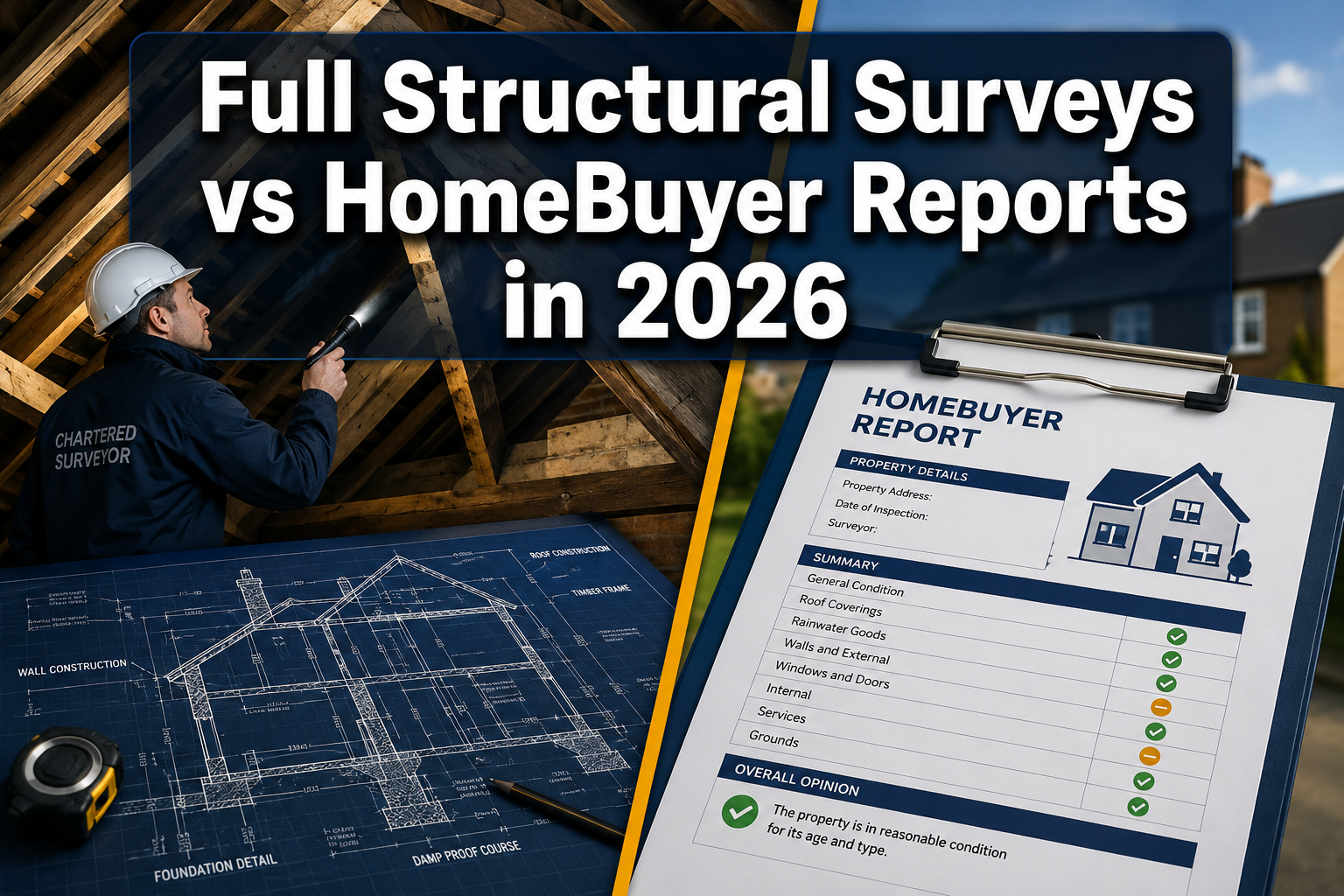
Nearly one in three property transactions in the UK falls through after an offer is accepted — and a significant share of those collapses trace back to survey findings that buyers were not prepared for. In 2026's cautious buyer market, where mortgage rates have stayed stubbornly elevated and inventory has shifted toward a more balanced 4.6-month supply [4], the choice between a Full Structural Survey and a HomeBuyer Report is no longer a minor administrative decision. It is a financial risk-management call. Understanding the distinction between these two survey levels — and matching the right one to the right property — can mean the difference between a sound investment and a costly mistake.
This article breaks down the key differences in Full Structural Surveys vs HomeBuyer Reports in 2026's cautious buyer market, covering scope, cost, best-use cases, and how today's harder-negotiating buyers are using survey findings to their advantage.
Key Takeaways
- A HomeBuyer Report (RICS Level 2) suits conventional properties in reasonable condition; a Full Structural Survey (RICS Level 3) is essential for older, altered, or non-standard properties.
- In 2026's cautious buyer market, detailed survey findings are being used actively as negotiation tools to reduce asking prices or secure repair commitments.
- Full Structural Surveys cost more upfront but can prevent five- or six-figure repair bills post-completion.
- Mortgage rates remaining above 6% [3] have made buyers more financially stretched, raising the stakes for every pound spent on a property.
- Technology including thermal imaging and AI-assisted reporting is improving the accuracy of both survey types in 2026.
Understanding the Two Survey Types: RICS Levels Explained
The Royal Institution of Chartered Surveyors (RICS) classifies residential property surveys into three levels. For most buyers, the relevant choice sits between Level 2 and Level 3.
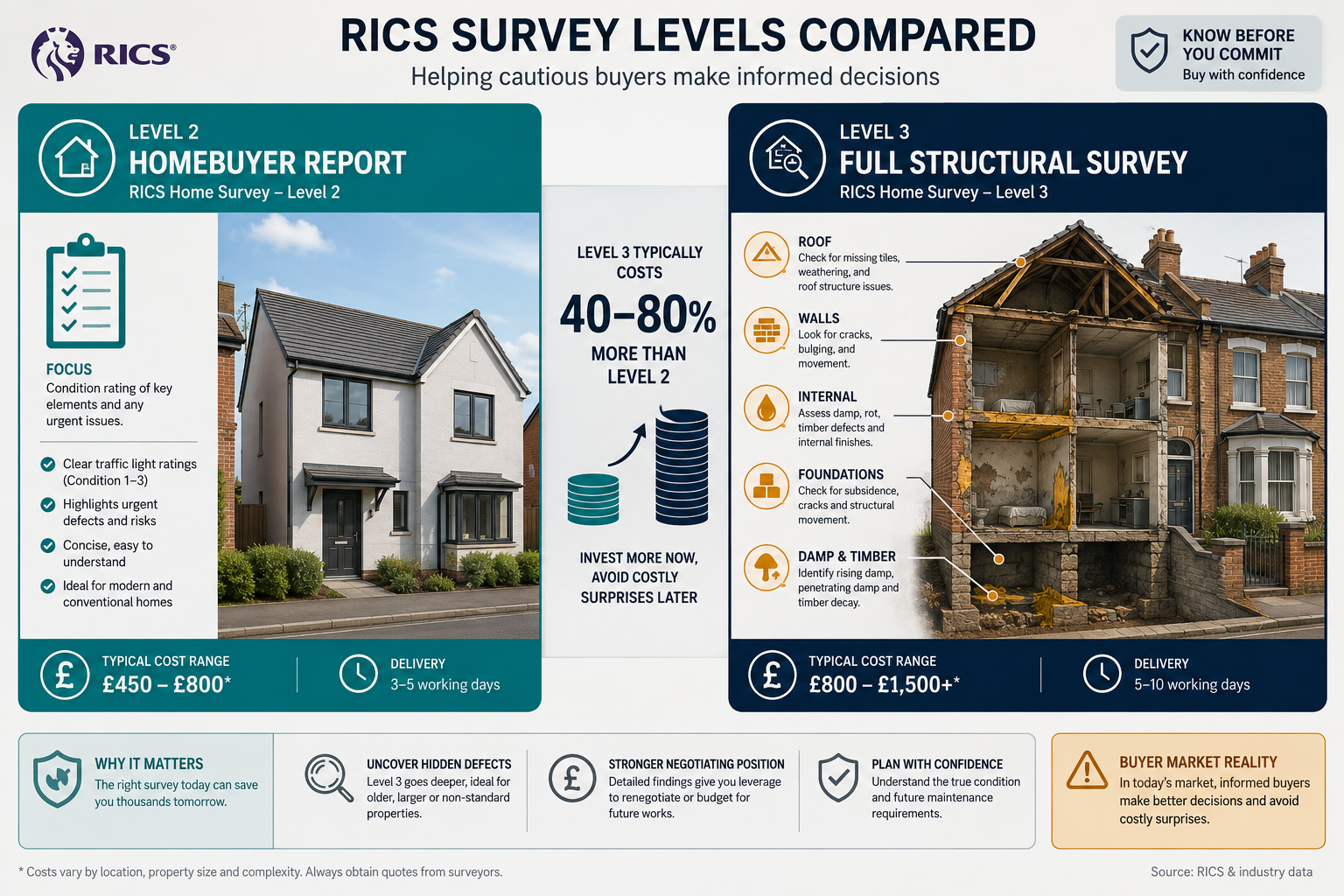
RICS Level 2: The HomeBuyer Report
A HomeBuyer Survey is a standardised visual inspection of a property's accessible and visible elements. The surveyor works through a structured RICS template, rating each component using a traffic-light condition system:
- Condition Rating 1 — No repair needed
- Condition Rating 2 — Defects requiring attention but not urgent
- Condition Rating 3 — Serious defects requiring immediate action
The report covers the roof (from ground level or accessible hatches), walls, floors, windows, services, and grounds. It also includes a market valuation and reinstatement cost estimate in most cases.
What it does not do: A Level 2 survey does not lift floorboards, open up wall cavities, or investigate behind finishes. It is a snapshot of visible condition, not a forensic investigation.
Best suited for: Properties built after 1930, in standard construction, with no significant alterations, and in broadly good condition.
RICS Level 3: The Full Structural Survey
A Full Structural Survey — also called a Building Survey — is a bespoke, in-depth assessment. The surveyor inspects all accessible parts of the property, including roof spaces, underfloor voids where accessible, and areas behind panels or cladding where permission is granted. The report is written in prose rather than a template format, providing detailed descriptions of defects, their likely causes, and recommended remedial action.
What it covers that a HomeBuyer Report does not:
- Structural movement and cracking patterns
- Hidden damp and moisture ingress (often supported by specialist damp surveys)
- Roof structure integrity beyond surface-level observation
- Non-standard construction materials such as concrete frames or prefabricated panels
- Advice on maintenance priorities and estimated repair costs
Best suited for: Properties built before 1930, listed buildings, properties with extensions or conversions, non-standard construction, or any property where the buyer has concerns. For a deeper understanding of the difference between Level 2 and Level 3 surveys, the distinction in scope is substantial.
How 2026's Cautious Buyer Market Is Reshaping Survey Decisions
The housing market mood in 2026 is defined by caution on both sides of the transaction [2]. Buyers are stretching budgets further than at any point in the previous decade, with 30-year fixed mortgage rates holding above 6% since late 2022 [3]. Every unexpected repair bill carries greater weight when monthly mortgage payments are already high.
At the same time, rising inventory levels have shifted negotiating power. A 4.6-month supply of existing homes [4] means buyers have more choice and more leverage. This combination — financial pressure plus negotiating power — has made the survey report a central tool in price renegotiation.
Surveys as Negotiation Instruments
Buyers in 2026 are not simply ordering surveys to satisfy mortgage lenders. They are using findings to:
- Renegotiate the purchase price based on the estimated cost of identified defects
- Request repairs before exchange of contracts
- Walk away from transactions where structural issues exceed their risk appetite
A Full Structural Survey, with its detailed cost estimates and prioritised repair schedules, gives buyers a documented, professional basis for these conversations. A HomeBuyer Report's traffic-light system, while useful, rarely provides the granular cost data needed to support a meaningful price reduction.
"In a market where buyers are negotiating harder than at any point in recent memory, a comprehensive survey report is not an expense — it is a negotiating document." [2]
Regional Price Sensitivity
Market conditions vary significantly by region. Some areas have experienced notable price corrections, with certain markets recording year-on-year price declines in mid-2026 [5]. In price-sensitive conditions, overpaying for a property with hidden defects compounds the financial risk. A Full Structural Survey provides the clearest picture of true condition, helping buyers assess whether an asking price reflects the property's actual state.
Comparing Costs, Timescales, and Findings
Cost Comparison
Survey costs vary by property size, location, and surveyor. As a general guide in 2026:
| Survey Type | Typical Cost Range | Turnaround Time |
|---|---|---|
| HomeBuyer Report (Level 2) | £400 – £900 | 3-5 working days |
| Full Structural Survey (Level 3) | £600 – £1,500+ | 5-10 working days |
For detailed current pricing, the structural survey pricing guide provides a useful breakdown by property type and size.
The cost difference between the two survey types is real but should be weighed against context. A Full Structural Survey on a Victorian terrace costing £900 that identifies £25,000 of structural repairs delivers an obvious return. The same survey on a 2010-built flat in good condition may yield little additional value over a HomeBuyer Report.
For information on how long a HomeBuyer Survey takes, timescales depend on property complexity and surveyor availability.
What Each Survey Typically Finds
The findings profile differs substantially between the two levels:
HomeBuyer Report typical findings:
- Visible damp patches or condensation
- Roof covering condition (from ground or hatch)
- Window and door condition
- Obvious structural cracks rated by severity
- Services condition (visual only)
Full Structural Survey typical findings:
- Cause and extent of structural movement
- Hidden damp behind plaster or under floors
- Roof structure condition including rafters and purlins
- Foundation concerns including subsidence indicators
- Condition of non-standard construction elements
- Asbestos risk in properties built before 2000 (often flagged for specialist asbestos surveys)
- Detailed maintenance schedule
Choosing the Right Survey: A Practical Decision Framework

The right survey is not always the most expensive one. The decision should be driven by property characteristics, buyer risk tolerance, and the specific concerns raised during viewings.
When a HomeBuyer Report Is Sufficient
A Level 2 HomeBuyer Report is a proportionate choice when:
- The property was built after 1930 in standard brick or block construction
- There have been no significant extensions, conversions, or structural alterations
- The property appears well-maintained with no obvious defects
- The buyer is experienced and has viewed the property multiple times
- The property is a modern flat or new-build (though a snagging list may be more appropriate for new builds)
When a Full Structural Survey Is Essential
A Level 3 Full Structural Survey should be the default choice when:
- The property was built before 1930
- The property is listed or in a conservation area
- There are visible signs of structural movement, damp, or roof deterioration
- The property has had extensions, loft conversions, or significant internal alterations
- The construction is non-standard (timber frame, concrete, prefab panels)
- The property has been empty for an extended period
- The buyer intends to carry out significant renovation work
- The purchase price is at the higher end of the buyer's budget
Supplementary Specialist Reports
In some cases, neither survey level alone is sufficient. Specific concerns may warrant additional specialist investigations alongside the main survey:
- Damp and timber surveys for properties with suspected moisture issues
- Roof surveys via specialist roof inspection for complex or inaccessible roof structures
- Subsidence investigations where cracking patterns suggest foundation movement
- Specific defect reports for a targeted single-issue assessment when one concern dominates
These targeted reports can be commissioned independently or alongside a Full Structural Survey to build a complete picture of a property's condition.
Technology and the Evolving Survey Landscape in 2026
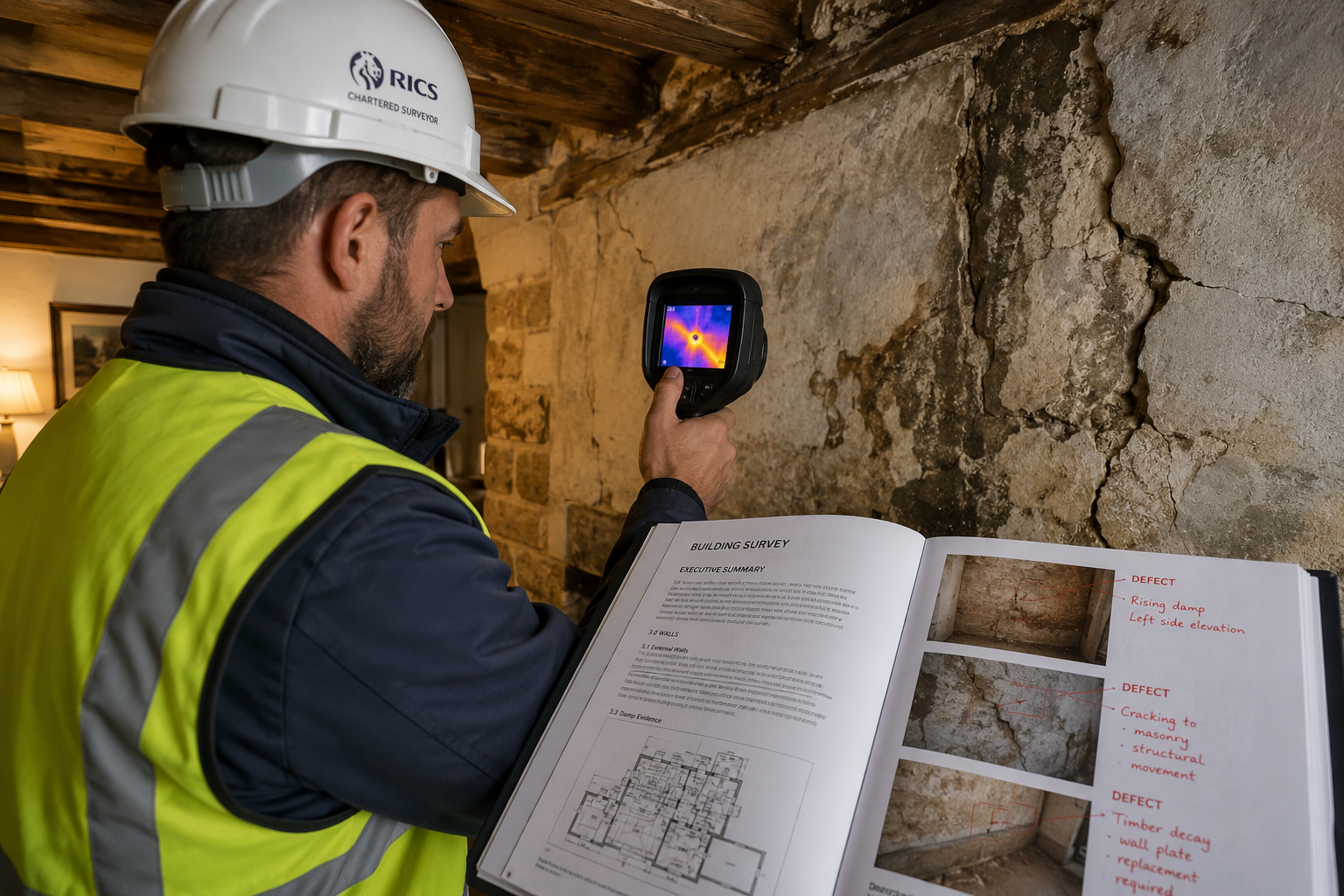
The integration of advanced technology into property surveys is improving outcomes for buyers in 2026. AI-assisted reporting tools, thermal imaging cameras, and drone-based roof inspections are becoming standard features of high-quality survey practices [6]. These technologies allow surveyors to identify issues that would previously have required invasive investigation — detecting heat loss, moisture patterns, and structural anomalies with greater precision and less disruption.
For buyers, this means that even a HomeBuyer Report from a technologically equipped surveyor may capture more detail than a basic visual inspection of five years ago. However, the fundamental distinction remains: technology enhances the surveyor's ability to investigate, but it does not change the scope of what each survey level is contractually required to cover. A Level 2 survey using thermal imaging is still a Level 2 survey. The surveyor's obligation to investigate, report, and advise is defined by the RICS standard, not the tools used.
Buyers should ask prospective surveyors directly about the technologies they employ and whether thermal imaging or drone inspection is included in the quoted fee.
Making the Final Decision in a Cautious Market
The market conditions of 2026 reward preparation. With cautious optimism characterising buyer sentiment [4] and inventory levels giving buyers more room to negotiate, the survey report has become a more powerful document than it was during the frenzied market conditions of 2021-2022. Sellers know that a well-evidenced survey finding can reopen price negotiations, and buyers who invest in the right level of survey are better positioned to use that leverage effectively.
The core principle is straightforward: match the survey level to the property's risk profile, not to the minimum required by the mortgage lender. Lenders typically require only a mortgage valuation — a brief assessment of whether the property provides adequate security for the loan. This is not a survey. It provides no protection for the buyer and identifies no defects. Relying on a mortgage valuation alone in 2026's market is a significant risk.
For buyers uncertain about which level is appropriate, a brief consultation with a local chartered surveyor before instructing a survey can clarify the most proportionate approach for the specific property.
Conclusion
The choice between Full Structural Surveys vs HomeBuyer Reports in 2026's cautious buyer market comes down to one question: how much risk can the buyer afford to carry? In a market defined by elevated mortgage costs, rising inventory, and buyers who are negotiating harder than at any point in recent years, the survey is not a formality — it is a financial safeguard.
Actionable next steps for buyers in 2026:
- Assess the property's age and condition before instructing any survey. Properties built before 1930, altered, or visibly deteriorated should default to a Full Structural Survey.
- Request a pre-instruction consultation with a chartered surveyor to discuss specific concerns identified during viewings.
- Ask about technology — confirm whether thermal imaging or drone inspection is included and what additional specialist reports may be recommended.
- Use survey findings proactively — obtain cost estimates for identified defects and use them as the basis for a renegotiation conversation with the seller.
- Do not rely on a mortgage valuation as a substitute for an independent survey at either level.
The upfront cost of a comprehensive survey is modest relative to the purchase price of any property. In 2026's cautious market, it is one of the most cost-effective decisions a buyer can make.
References
[1] Full Survey Vs Homebuyer Report Key Differences Strut – https://strutsurveyors.com/full-survey-vs-homebuyer-report-key-differences-strut/?utm_source=openai
[2] Housing Market Update 2026 Housing Market Mood – https://www.redfin.com/news/housing-market-update-2026-housing-market-mood/?utm_source=openai
[3] Housing Realtors Fleeing Frozen Market – https://theweek.com/business/housing-realtors-fleeing-frozen-market?utm_source=openai
[4] 2026 Housing Outlook Ongoing Challenges Cautious Optimism And Incremental Gains – https://www.nahb.org/news-and-economics/press-releases/2026/02/2026-housing-outlook-ongoing-challenges-cautious-optimism-and-incremental-gains?utm_source=openai
[5] Seattle Housing Market Cooling Home Prices Inventory King County Listings – https://www.axios.com/local/seattle/2026/06/01/seattle-housing-market-cooling-home-prices-inventory-king-county-listings?utm_source=openai
[6] Zillow Expects Calmer 2026 Housing Market Improved Affordability – https://www.housingwire.com/articles/zillow-expects-calmer-2026-housing-market-improved-affordability/?utm_source=openai