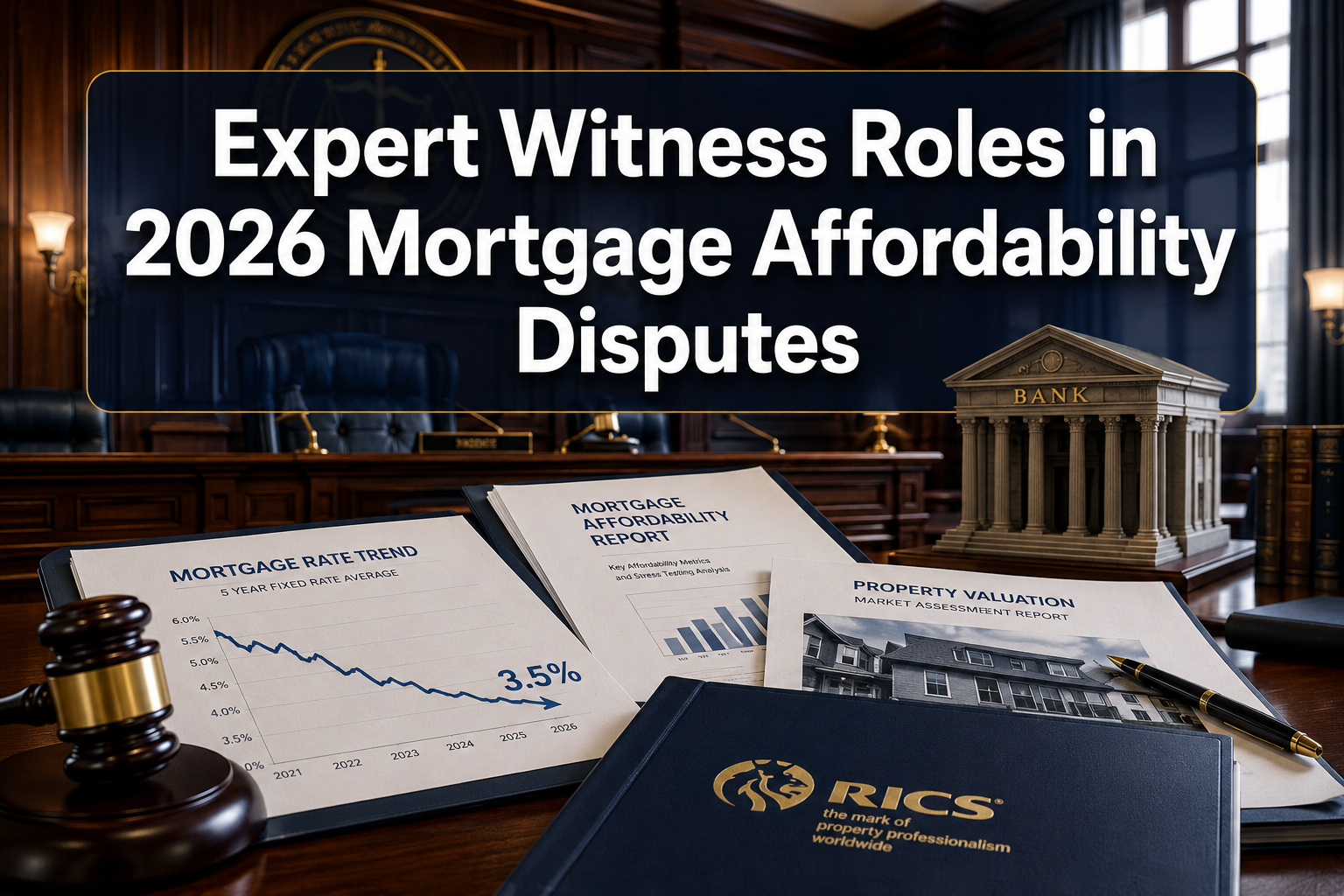
Mortgage rates in the UK fell to approximately 3.5% in early 2026, the lowest sustained level since before the post-pandemic rate surge, and the legal consequences are already arriving in courtrooms and tribunals. When borrowers, lenders, and regulators disagree about whether a loan was affordable, fairly priced, or correctly underwritten, the dispute almost always turns on one question: what did the prevailing market standard actually require? That question belongs to an expert witness.
Expert Witness Roles in 2026 Mortgage Affordability Disputes: Navigating Lower Rates and Lending Flexibility have become a focal point for chartered surveyors, valuers, and finance professionals across England and Wales. As high-activity Northern markets see renewed first-time buyer demand and lenders experiment with relaxed income multiples and longer terms, the volume of contested mortgage decisions is rising. Understanding what courts expect from expert witnesses in this environment is no longer optional for senior practitioners.
Key Takeaways
- Expert witnesses in mortgage affordability disputes owe their primary duty to the court, not to the party that instructs them.
- In 2026, falling rates and more flexible lending criteria have increased both transaction volumes and the risk of contested affordability assessments.
- Chartered surveyors acting as expert witnesses must distinguish clearly between the role of advocate and the role of independent expert.
- Written expert reports must comply with Civil Procedure Rules Part 35 and RICS practice guidance to be admissible and persuasive.
- First-time buyer disputes and fair-lending claims in Northern markets are among the fastest-growing categories of mortgage litigation this year.
What Courts Expect From Expert Witnesses in Mortgage Disputes
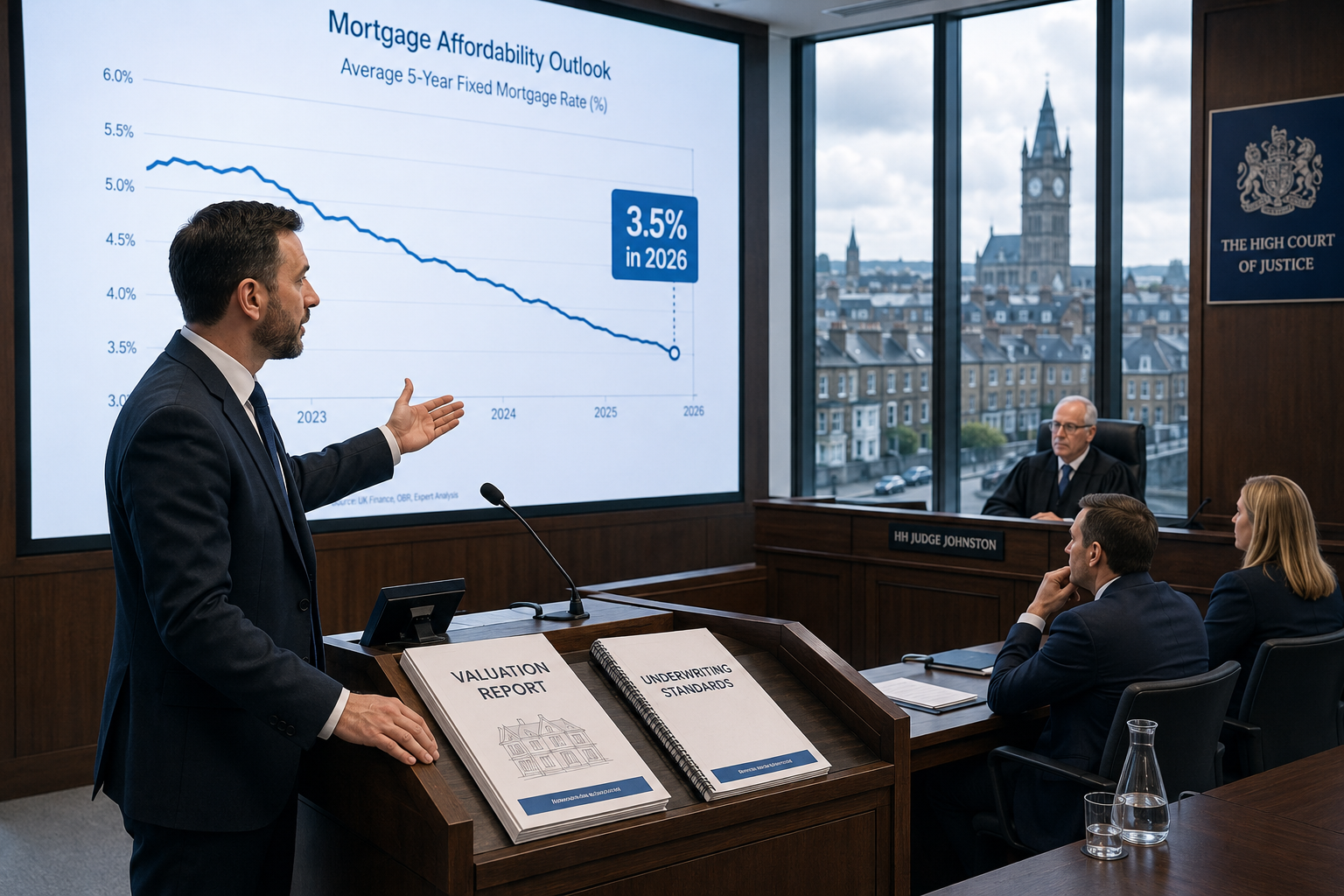
The foundational principle governing all expert witness work in England and Wales is straightforward: the expert's overriding duty is to the court, not to the instructing solicitor or client [5]. This obligation is codified in Civil Procedure Rules Part 35 and reinforced by RICS guidance for members acting in dispute resolution contexts. For surveyors and valuers, this means that even when instructed by a lender defending a mis-selling claim, or by a borrower challenging a repossession, the expert must present an objective, balanced opinion.
In mortgage affordability disputes specifically, courts rely on expert witnesses to explain three core matters:
- Industry standards: What did responsible lenders require at the time the mortgage was originated?
- Underwriting and servicing practices: Were the lender's internal processes consistent with those standards? [4]
- Valuation accuracy: Was the property valued correctly, and did that valuation support the loan-to-value ratio used?
The distinction between an expert and an advocate is not merely procedural. An advocate argues a position; an expert assists the court in understanding a technical field [5]. Surveyors who blur this line risk having their evidence excluded or given little weight. RICS practice alerts have repeatedly reminded members that partisan language, selective data, or failure to address contrary evidence will undermine credibility at tribunal [5].
What qualifies someone as a mortgage expert witness? Typically, courts look for seasoned professionals with direct experience in mortgage origination, underwriting, valuation, or regulatory compliance [4]. A chartered surveyor with a track record of residential valuations and knowledge of lender affordability criteria is well-placed to provide expert evidence on property-related aspects of a dispute. For the financial underwriting elements, a specialist mortgage or banking expert may be jointly instructed [2].
The 2026 Lending Landscape and Why It Generates Disputes
The drop in mortgage rates to around 3.5% has not simply made homes more affordable in the abstract. It has changed the risk calculus for lenders, altered the pool of eligible borrowers, and introduced new products with features that were rare during the higher-rate period. Each of these shifts creates new categories of dispute.
Relaxed Income Multiples and Stress Testing
Several major lenders responded to the rate environment by increasing their maximum loan-to-income ratios, in some cases offering up to 5.5 times income for borrowers with strong credit profiles. When a borrower later encounters payment difficulties, the question of whether the original affordability assessment was adequate becomes legally significant. Expert witnesses are asked to opine on whether the lender's stress test methodology reflected the standard of a prudent lender at the time of origination.
Understanding methods of valuation used in the mortgage process is essential background for any surveyor preparing expert evidence on these matters. The comparison method, investment method, and residual method each carry different assumptions about market conditions, and courts need expert guidance on which approach was appropriate given the 2026 market context.
Longer Mortgage Terms
Thirty-five and forty-year mortgage terms have become more common as lenders seek to reduce monthly payments for first-time buyers. These products raise affordability questions that did not arise with standard twenty-five-year terms. An expert witness may be asked whether a forty-year term was appropriate for a borrower who was forty years old at origination, or whether the lender adequately explained the total interest cost.
Northern Market Activity and Valuation Disputes
Cities including Manchester, Leeds, Sheffield, and Liverpool have seen above-average transaction volumes in 2026 as buyers priced out of the South take advantage of lower rates. This activity has concentrated a disproportionate share of mortgage disputes in these markets. Surveyors providing RICS building surveys and valuations in these areas are increasingly being asked to provide retrospective expert evidence on whether a valuation carried out at the point of mortgage origination was within the acceptable range of professional opinion.
A key issue in Northern market disputes is the speed of price movement. When values rise quickly, a valuation that appeared conservative at origination may look very different six months later. Expert witnesses must explain to courts how valuers account for market momentum, and why a valuation within the RICS Red Book framework can be defensible even if it differs from the eventual sale price.
For surveyors who need to understand the regulatory framework underpinning these valuations, the guidance on Red Book valuation provides the authoritative standard against which expert evidence will be measured.
How Expert Witness Roles in 2026 Mortgage Affordability Disputes Shape Legal Outcomes
The practical mechanics of Expert Witness Roles in 2026 Mortgage Affordability Disputes: Navigating Lower Rates and Lending Flexibility require surveyors to understand both the legal process and the technical content of their evidence. A well-structured expert report can resolve a dispute before trial; a poorly prepared one can expose the instructing party to adverse costs orders.

The Structure of an Expert Report
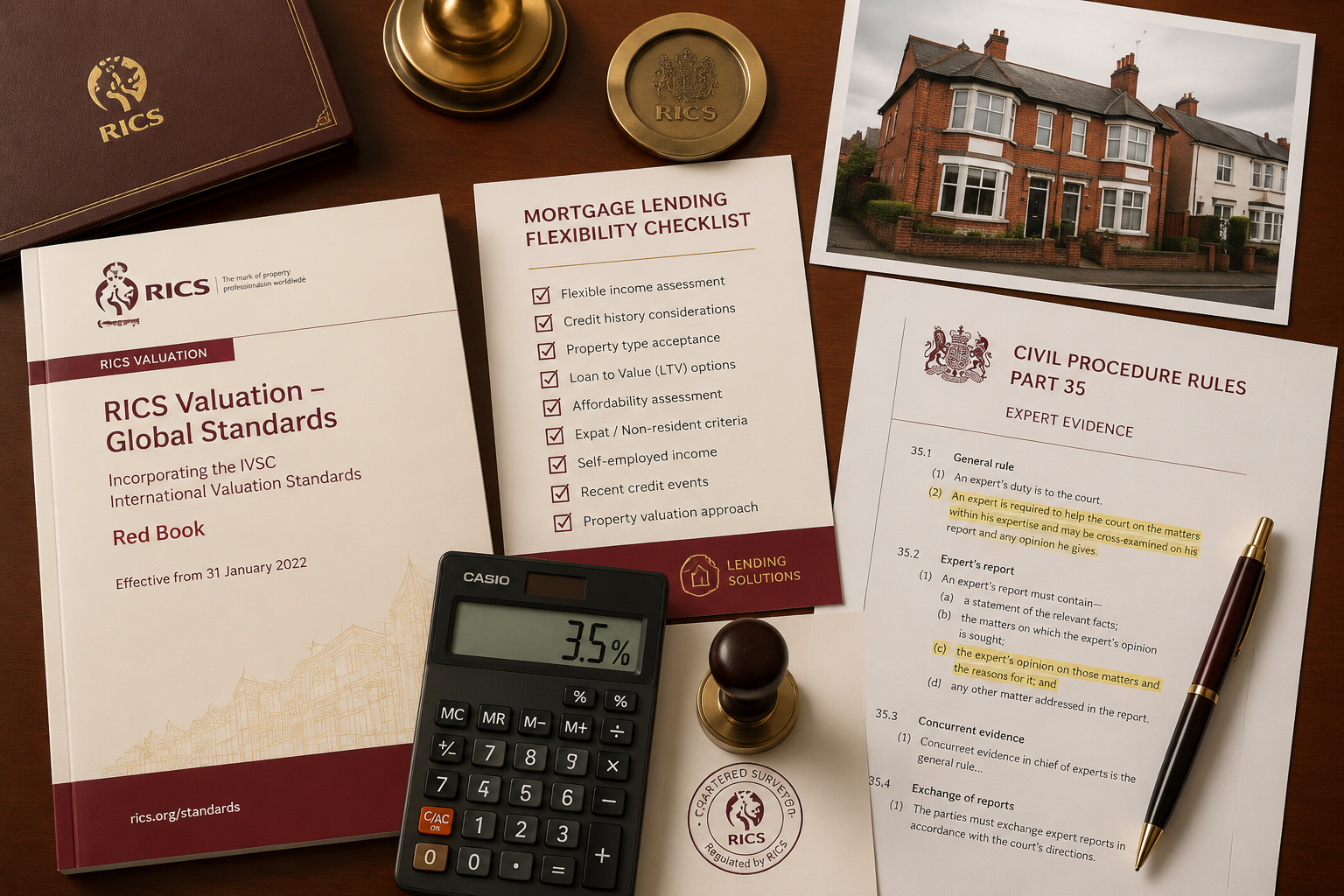
Civil Procedure Rules Part 35 sets out mandatory requirements for expert reports used in litigation [7]. The report must:
| Requirement | Detail |
|---|---|
| Statement of truth | Confirms the expert understands their duty to the court |
| Qualifications | Sets out the expert's relevant experience and credentials |
| Instructions | Summarises the questions the expert was asked to address |
| Facts and assumptions | Distinguishes between facts relied upon and assumptions made |
| Opinion | States the expert's conclusions clearly and with reasoning |
| Caveats | Identifies any matters that fall outside the expert's expertise |
RICS members acting as expert witnesses must also comply with the RICS Surveyors Acting as Expert Witnesses practice statement, which sets additional requirements around independence, conflicts of interest, and the duty to update opinions if new evidence emerges [5].
Single Joint Experts and Party-Appointed Experts
In lower-value mortgage disputes, courts frequently direct the parties to use a single joint expert (SJE) rather than each appointing their own. This reduces costs and avoids the adversarial "battle of experts" that can make technical evidence difficult for judges to assess. Surveyors asked to act as SJEs must be especially careful to avoid any perception of bias, since they are serving both parties simultaneously.
In higher-value or more complex cases, each party may appoint their own expert. In these situations, the experts are required to meet, produce a joint statement identifying areas of agreement and disagreement, and narrow the issues before trial [7]. This process often resolves the majority of technical disputes, leaving only genuine points of professional disagreement for the judge to decide.
Fair Lending and Discrimination Claims
Fair-lending disputes represent a growing category of mortgage litigation in 2026 [3]. When a lender's affordability criteria or rate-setting practices produce outcomes that differ systematically across protected characteristics, borrowers may bring claims under the Equality Act 2010. Expert witnesses in these cases are asked to analyse lending data, compare approval rates and pricing across demographic groups, and opine on whether observed differences are explained by legitimate risk factors or by impermissible discrimination [3].
This is technically demanding work. The expert must understand both the statistical methods used to identify disparate impact and the underwriting logic that the lender claims justifies its criteria. Surveyors with experience in registered RICS valuers standards and lender panel requirements are well-placed to contribute to the property valuation elements of these claims, while a specialist mortgage banking expert typically addresses the underwriting and pricing analysis [2].
First-Time Buyer Claims
First-time buyers are disproportionately represented in 2026 mortgage disputes for two reasons. First, the combination of lower rates and government-backed schemes has brought many buyers into the market who have limited financial resilience. Second, first-time buyers are less likely to have sought independent legal or financial advice, which can become relevant when a lender argues that the borrower was adequately warned of the risks.
Expert witnesses in first-time buyer cases are often asked to address whether the information provided to the borrower at the point of sale met the standard required by FCA mortgage conduct of business rules, and whether the property valuation used to support the mortgage was appropriate for a buyer with a small deposit. Surveyors familiar with help-to-buy valuation requirements will recognise many of the issues that arise in these disputes.
Practical Guidance for Surveyors Accepting Expert Witness Instructions
Accepting an expert witness instruction is a significant professional commitment. Before agreeing to act, surveyors should assess the following:
Competence: Does the instruction fall within the surveyor's genuine area of expertise? An expert who strays outside their competence will be exposed in cross-examination and may face regulatory consequences [5].
Conflicts of interest: Has the surveyor previously acted for either party, or for a related entity? Even an appearance of partiality can undermine the weight given to the evidence.
Capacity: Expert witness work requires substantial time for report preparation, document review, and potentially attendance at a joint meeting or trial. Underestimating this commitment is a common error.
Fee arrangements: Fees must not be contingent on the outcome of the case. Contingency fee arrangements for expert witnesses are prohibited because they create an obvious incentive for partiality [5].
For surveyors considering how expert witness work fits within a broader professional practice, the dedicated expert witness surveyor service offered by Canterbury Surveyors provides a useful reference point for the scope and standards expected of qualified practitioners.
Surveyors should also be familiar with the costs implications of expert evidence. Courts have the power to disallow expert fees where the evidence was not reasonably required or where the report did not comply with procedural requirements. Understanding surveyor pricing in the context of litigation support helps practitioners set appropriate fees and manage client expectations.
Where a dispute involves structural issues with the mortgaged property, such as undisclosed defects that affected the valuation, surveyors may also need to draw on structural survey expertise to provide a complete picture of the property's condition at the relevant date.
Key Differences Between Expert Witness and Other Professional Roles
It is worth stating explicitly what an expert witness is not. In the context of mortgage affordability disputes, surveyors sometimes receive instructions that blur the boundaries between expert witness work and other professional roles.
- An expert witness is not a consultant: A consultant advises the instructing party on strategy. An expert witness advises the court on technical matters.
- An expert witness is not a valuer for the transaction: A retrospective expert valuation for litigation purposes is governed by different rules than a Red Book valuation for mortgage purposes.
- An expert witness is not a fact witness: A fact witness gives evidence about what they personally observed. An expert witness gives opinion evidence based on their professional expertise applied to the facts of the case.
These distinctions matter because the duty of care, the professional standards, and the litigation privilege rules differ across these roles. Surveyors who are unclear about which role they are playing risk providing evidence that is inadmissible or that exposes them to professional liability.
Conclusion
The convergence of lower mortgage rates, more flexible lending criteria, and increased transaction volumes in 2026 has created a demanding environment for expert witnesses in mortgage affordability disputes. Courts are seeing more claims from first-time buyers, more fair-lending challenges, and more valuation disputes in high-activity Northern markets. In each of these contexts, the quality of expert evidence often determines the outcome.
Actionable next steps for surveyors and valuers:
- Review RICS guidance on expert witness obligations and ensure your practice procedures comply with the current practice statement before accepting any instruction.
- Assess each potential instruction against your genuine area of competence. Decline or limit your evidence to the aspects where you can genuinely assist the court.
- Familiarise yourself with Civil Procedure Rules Part 35 and the requirements for expert reports in the courts where you are likely to be instructed.
- Keep detailed contemporaneous records of valuations and survey work, since these may be required as supporting documents in any subsequent expert report.
- Engage with specialist litigation support providers early if the case involves complex financial modelling or statistical analysis that falls outside your primary expertise.
- Ensure fee arrangements are fixed or time-based, never contingent on outcome.
Expert Witness Roles in 2026 Mortgage Affordability Disputes: Navigating Lower Rates and Lending Flexibility will continue to evolve as the market adjusts to the new rate environment. Surveyors who invest in understanding the legal framework, the RICS standards, and the specific issues driving current litigation will be well-positioned to provide genuinely valuable evidence and to protect their own professional standing in the process.
References
[1] Legal Obligations Issue 8 Accessible – https://www.gov.uk/government/publications/legal-obligations-issue-8/legal-obligations-issue-8-accessible
[2] Mortgages S 134 – https://www.jurispro.com/category/mortgages-s-134
[3] Fair Lending – https://www.rmbankingexpert.com/fair-lending
[4] Mortgage – https://www.expertinstitute.com/expert-witness/mortgage/
[5] Hdr Expert Witness Practice Alert – https://www.rics.org/content/dam/ricsglobal/documents/regulation/HDR-expert-witness-practice-alert.pdf
[10] Mortgage – https://www.cahnlitigation.com/expert-discipline/mortgage/