
A net balance of -39% in buyer enquiries by March 2026 represents more than just market correction—it signals a fundamental shift in how geopolitical uncertainty translates into measurable valuation impacts. The Royal Institution of Chartered Surveyors (RICS) February 2026 survey data reveals that Middle East conflict escalation has triggered the sharpest deterioration in buyer sentiment since January 2024, creating unprecedented challenges for property professionals navigating valuation disputes and expert witness testimony [1][2].
Understanding the Geopolitical Impacts on Spring 2026 Valuations: Expert Witness Strategies from RICS February Survey Data has become essential for surveyors, valuers, and legal professionals managing property disputes in an increasingly volatile global landscape.

Key Takeaways
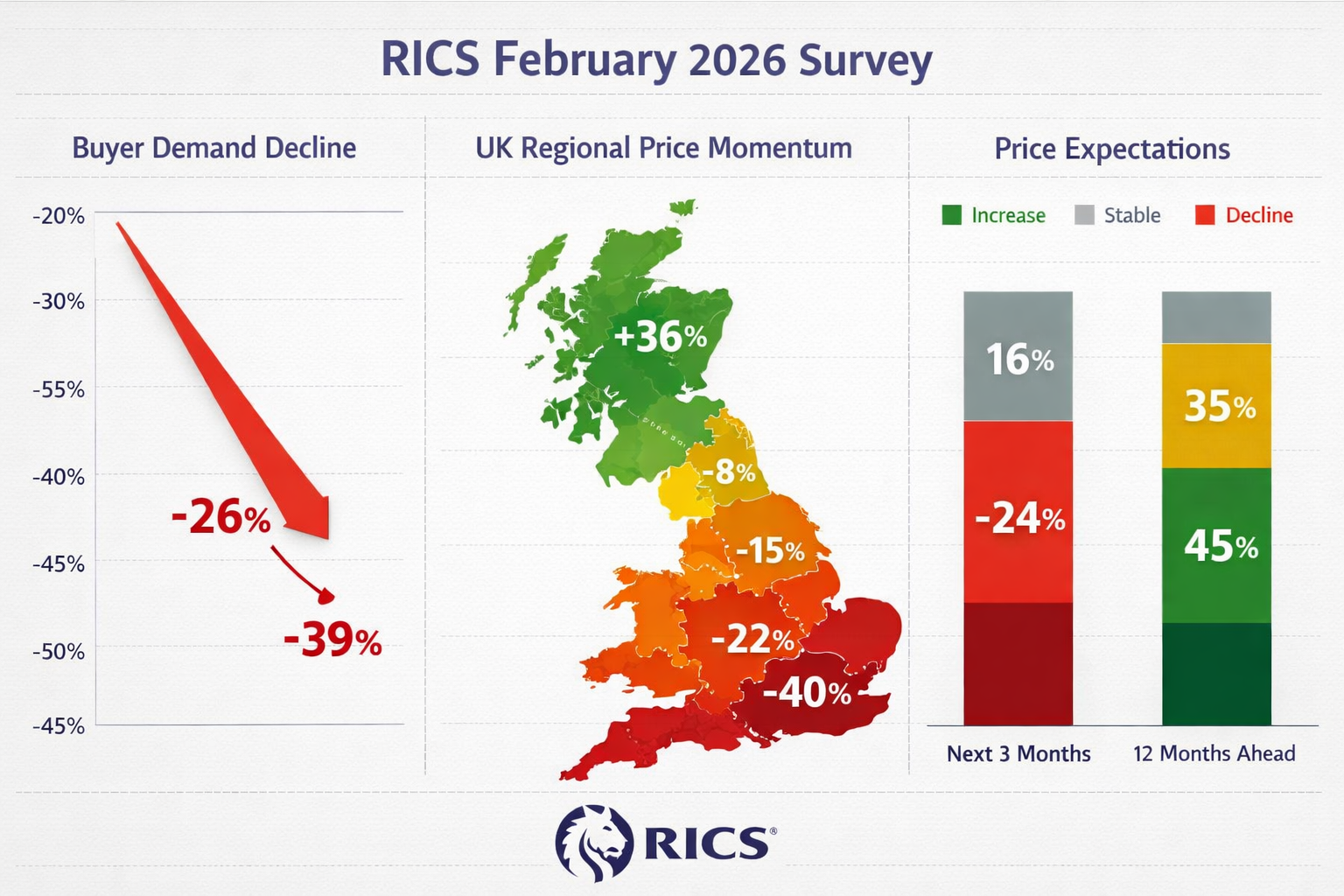
- Buyer demand plummeted from -26% to -39% net balance between February and March 2026, directly attributable to Middle East geopolitical tensions and rising borrowing costs
- London market sentiment collapsed 49 percentage points in a single month, with 12-month price expectations dropping from +56% to +7%
- Regional divergence reached extreme levels, with London experiencing -40% price pressure while Scotland maintained +36% positive momentum
- Expert witnesses must quantify geopolitical risk adjustments using RICS survey benchmarks to support valuation evidence in litigation and arbitration
- Energy price inflation concerns have extended mortgage rate expectations, creating compounding uncertainty for property valuations
Understanding the Geopolitical Shock: RICS February 2026 Survey Findings
The RICS February 2026 survey provides unprecedented insight into how geopolitical events translate into measurable market impacts. Tarrant Parsons, RICS Head of Market Research, explicitly stated that "the deterioration in the geopolitical backdrop has clearly weighed on confidence," with multiple respondents specifically citing the Iran conflict as the primary dampening factor on market sentiment [1].
Quantifying the Demand Collapse
The data reveals a systematic deterioration across multiple metrics:
| Metric | January 2026 | February 2026 | March 2026 | Change |
|---|---|---|---|---|
| New Buyer Enquiries | -26% | -26% | -39% | ⬇️ 13 points |
| Agreed Sales | N/A | -12% | N/A | Subdued |
| Near-term Sales Expectations | N/A | -2% | N/A | Minimal momentum |
| Near-term Price Expectations | -6% | -18% | N/A | ⬇️ 12 points |
| 12-month Price Expectations | N/A | +33% | N/A | Moderate positive |
This data provides commercial property surveyors with quantifiable evidence of market sentiment shifts that can be directly attributed to geopolitical factors [2][3].
The Middle East Conflict Impact Mechanism
The survey commentary explicitly linked energy price inflation to persistent mortgage rate concerns, noting that "recent rise in oil and energy prices has also increased the likelihood that mortgage rates will remain higher for longer" [1]. This creates a dual pressure mechanism:
- Direct confidence impact from geopolitical instability
- Indirect financial impact through energy costs affecting borrowing expectations
For professionals conducting RICS commercial building surveys, understanding this mechanism becomes critical when adjusting valuations for market conditions.
Regional Divergence and Geopolitical Impacts on Spring 2026 Valuations
The extreme regional variation in price momentum represents one of the most significant findings from the RICS February survey data, with implications for expert witness testimony in valuation disputes.
London's Dramatic Sentiment Reversal
London experienced the most severe confidence collapse, with 12-month price expectations dropping from +56% in January to only +7% in February—a 49-percentage-point reversal in professional confidence within a single month [1]. The current price net balance stood at -40%, representing the strongest downward pressure in the UK.
This dramatic shift provides critical evidence for expert witnesses defending lower valuations in London property disputes. The data demonstrates that professional surveyors—not just market participants—fundamentally reassessed London's near-term prospects in response to geopolitical developments.
Regional Performance Comparison
Areas experiencing strongest downward pressure:
- 🔴 London: -40% net balance
- 🔴 South East: -24% net balance
- 🔴 East Anglia: -26% net balance
Areas showing relative resilience:
- 🟢 Northern Ireland: Firmer price trends
- 🟢 Scotland: +36% net balance (though momentum declining)
- 🟢 North West England: Positive momentum maintained
The Scottish market deserves particular attention. While prices continued rising at +36% net balance in March, this represented the first time in over two years that respondents expected prices to be lower within three months [4]. This leading indicator suggests that even resilient markets are beginning to feel geopolitical pressure.
For surveyors working across regions—from chartered surveyors in Surrey to chartered surveyors in North London—understanding these regional variations is essential for defensible valuations.
Expert Witness Strategies: Leveraging RICS Data for Valuation Evidence
The Geopolitical Impacts on Spring 2026 Valuations: Expert Witness Strategies from RICS February Survey Data provide a framework for building credible, defensible valuation adjustments in litigation and arbitration contexts.
Establishing Causation: Geopolitical Events to Market Impact
Expert witnesses must demonstrate clear causal links between geopolitical events and valuation adjustments. The RICS February survey provides three critical evidential elements:
1. Temporal Correlation
The sharp deterioration from February to March 2026 coincides precisely with Middle East conflict escalation. Expert witnesses can reference the specific timing of survey responses to demonstrate that professional surveyors—not just market participants—identified geopolitical factors as material considerations [1][2].
2. Professional Consensus
RICS survey data represents the collective judgment of qualified chartered surveyors across the UK. This provides significantly stronger evidence than individual opinion, as it demonstrates industry-wide professional consensus on market conditions.
3. Quantified Impact Metrics
The specific net balance figures (-39% buyer enquiries, -18% near-term price expectations) provide quantifiable benchmarks for valuation adjustments. Expert witnesses can reference these figures when explaining percentage reductions in market value.
Valuation Adjustment Methodology
When preparing expert witness reports incorporating geopolitical impacts, consider this structured approach:
Step 1: Establish Baseline Valuation
- Complete standard valuation methodology using comparable evidence
- Document assumptions regarding market conditions
- Apply appropriate valuation standards (RICS Red Book)
Step 2: Identify Geopolitical Risk Factors
- Reference specific RICS survey data points relevant to the valuation date
- Document regional-specific impacts (e.g., London vs. Scotland differential)
- Cite energy price inflation and borrowing cost expectations
Step 3: Quantify Market Sentiment Adjustment
- Apply percentage adjustments based on RICS net balance data
- Consider both near-term (-18%) and 12-month (+33%) expectations
- Weight adjustments based on property type and location
Step 4: Sensitivity Analysis
- Provide range of values reflecting uncertainty
- Document assumptions for best-case, base-case, and worst-case scenarios
- Reference comparable survey data from previous geopolitical events
Professionals conducting building surveys should integrate these methodologies when market conditions materially affect property values.
Defending Valuation Reductions in Cross-Examination
Expert witnesses must anticipate challenges to geopolitical risk adjustments. The RICS February survey data provides several defensive positions:
Challenge: "Geopolitical concerns are temporary and shouldn't affect long-term value"
Response: Reference the 12-month expectations data (+33% net balance) alongside near-term expectations (-18%), demonstrating that professional surveyors distinguish between short-term volatility and longer-term trends. However, the valuation date requires reflection of market sentiment at that specific time [1].
Challenge: "Regional variations show the market isn't uniformly affected"
Response: Acknowledge regional divergence using specific RICS data, then demonstrate why the subject property's location experiences particular sensitivity. London's -40% net balance vs. Scotland's +36% illustrates that location-specific adjustments are professionally recognized [4].
Challenge: "Survey data reflects sentiment, not actual transaction prices"
Response: Explain that professional surveyors base opinions on actual market activity, including agreed sales data (-12% net balance). Survey respondents are qualified professionals observing real transactions, not speculative market participants [3].
Supply-Side Dynamics and Transaction Volume Evidence
While demand-side metrics dominate headlines, the RICS February survey reveals critical supply-side dynamics that expert witnesses must consider when assessing market conditions.
Instruction Trends as Leading Indicators
New instructions remained broadly stable at +2% in February, but this masks significant regional variation [3]. Scottish instructions to sell fell -13% in March, marking the first decline since end of 2025 and indicating deterioration in seller confidence alongside buyer hesitation [4].
This supply-side hesitation creates a paradoxical market condition:
- Reduced buyer demand suggests downward price pressure
- Reduced seller instructions limits available stock
- Net effect depends on which force dominates in specific submarkets
Expert witnesses must analyze both sides of the transaction equation when defending valuations in dispute contexts.
Transaction Volume as Confidence Indicator
Agreed sales remained subdued at -12% net balance in February, with near-term sales expectations softening to -2% [3]. This minimal immediate transaction momentum provides critical context for valuations:
For buyers seeking valuation reductions: Transaction volume decline demonstrates reduced competition and weakened negotiating position for sellers, supporting lower valuations.
For sellers defending higher valuations: Limited transaction evidence makes comparable analysis more challenging, potentially supporting wider valuation ranges that include higher figures.
The strategic positioning depends on which party the expert witness represents, but the RICS data provides objective evidence for both perspectives.

Practical Application: Case Study Scenarios
To illustrate how Geopolitical Impacts on Spring 2026 Valuations: Expert Witness Strategies from RICS February Survey Data apply in practice, consider these scenarios:
Scenario 1: Commercial Lease Rent Review Dispute
Context: Central London office property, rent review date March 15, 2026
Landlord Position: Market rents remain strong based on comparable evidence from Q4 2025
Tenant Position: Geopolitical uncertainty and borrowing cost increases justify reduced rental valuation
Expert Witness Strategy Using RICS Data:
- Reference London-specific -40% net balance on current prices [1]
- Cite 49-percentage-point collapse in 12-month expectations (January to February)
- Document energy price inflation impact on occupier costs
- Apply moderate adjustment (5-10%) to Q4 2025 comparables based on sentiment deterioration
- Provide sensitivity analysis showing range of defensible positions
Professionals handling rent review matters can leverage this approach to build credible evidence.
Scenario 2: Residential Property Purchase Dispute
Context: Surrey family home, buyer seeking to renegotiate agreed purchase price from January 2026
Buyer Position: Market conditions have materially deteriorated since agreement
Seller Position: Agreed price reflects fair market value; buyer experiencing cold feet
Expert Witness Strategy Using RICS Data:
- Document South East regional net balance (-24%) vs. national average [1]
- Reference buyer enquiry collapse from -26% to -39% between agreement date and current
- Analyze local market transaction volume trends
- Consider 12-month expectations (+33%) suggesting recovery potential
- Recommend modest adjustment (3-5%) reflecting short-term uncertainty vs. longer-term stability
Those conducting homebuyer surveys should be prepared to address market condition changes between survey date and completion.
Scenario 3: Portfolio Valuation for Financial Reporting
Context: Multi-regional UK residential portfolio, March 31, 2026 valuation date
Challenge: Applying consistent methodology across regions with divergent performance
Expert Witness Strategy Using RICS Data:
- Create regional adjustment matrix based on RICS net balance data
- Apply location-specific adjustments: London (-8%), South East (-5%), Scotland (+3%)
- Document energy price inflation impact on operational costs
- Reference professional consensus through RICS survey methodology
- Provide detailed assumptions schedule citing specific survey data points
This approach ensures commercial valuation work meets professional standards while reflecting market realities.
Documentation Standards for Expert Witness Reports
When incorporating Geopolitical Impacts on Spring 2026 Valuations into expert witness reports, documentation standards become critical for credibility and defensibility.
Essential Documentation Elements
1. Primary Source Citation
- Reference specific RICS survey publication (February 2026)
- Include survey methodology description
- Cite exact net balance figures and dates
- Provide context for survey respondent qualifications
2. Temporal Analysis
- Document valuation date precisely
- Show timeline of geopolitical events relative to valuation date
- Reference survey data closest to valuation date
- Explain any timing gaps between survey data and valuation date
3. Regional Specificity
- Identify subject property's specific region/submarket
- Reference region-specific RICS data where available
- Explain how national trends apply to local market
- Document any local factors amplifying or moderating national trends
4. Assumption Transparency
- Clearly state all assumptions regarding geopolitical impact duration
- Document sensitivity of valuation to assumption changes
- Provide alternative scenarios with different assumptions
- Explain basis for selecting primary scenario
5. Professional Judgment Explanation
- Distinguish between objective data (RICS survey) and professional judgment (application to subject property)
- Explain weighting given to different data sources
- Document consideration of contradictory evidence
- Justify final adjustment percentages
Professionals conducting structural surveys should apply similar documentation rigor when market conditions affect repair cost assumptions.
Limitations and Caveats: Responsible Use of Survey Data
Expert witnesses must acknowledge limitations of RICS survey data to maintain credibility and comply with professional standards.
Survey Data Limitations
Sentiment vs. Transaction Evidence
RICS survey data primarily reflects professional sentiment and expectations rather than completed transaction prices. While respondents base opinions on observed market activity, survey data represents forward-looking assessments that may not perfectly correlate with realized outcomes.
Sample Size and Regional Variation
National net balance figures may mask significant local market variations. Expert witnesses should supplement RICS data with local transaction evidence where available, particularly for properties in smaller submarkets.
Temporal Lag
Survey responses reflect conditions during the survey period (typically mid-month), but publication occurs several weeks later. Expert witnesses must consider whether conditions have evolved between survey period and valuation date.
Response Bias
Survey respondents may be more active in certain market segments (e.g., residential vs. commercial, urban vs. rural), potentially skewing results. Expert witnesses should acknowledge this when applying data to specialized property types.
Appropriate vs. Inappropriate Applications
✅ Appropriate Uses:
- Demonstrating professional consensus on market conditions
- Establishing temporal correlation between geopolitical events and sentiment shifts
- Providing quantified benchmarks for market adjustment ranges
- Supporting regional variation analysis
❌ Inappropriate Uses:
- Mechanically applying net balance percentages as direct valuation adjustments
- Substituting survey data for actual comparable transaction evidence
- Ignoring property-specific factors in favor of market-wide trends
- Using survey data as sole basis for valuation conclusions
Future Outlook: Longer-Term Valuation Considerations
The 12-month price expectations of +33% net balance in the RICS February survey reveal important longer-term context that expert witnesses must consider [1].
Recovery Expectations and Valuation Timing
Professional surveyors anticipate "more moderate pace" of growth than previously expected, but maintain positive 12-month outlook despite near-term pessimism. This creates strategic considerations for valuation disputes:
For valuations with near-term effective dates: Greater weight should be given to near-term expectations (-18% net balance), reflecting immediate market conditions.
For valuations with longer-term perspectives (e.g., development appraisals, investment valuations): 12-month expectations (+33%) provide important context for residual value assumptions and exit strategies.
First-Time Buyer Segment as Recovery Driver
RICS respondents identified the first-time buyer segment as critical to anticipated recovery, noting that supply pipeline stability will be essential [3]. Expert witnesses should consider:
- Property type and size appeal to first-time buyers
- Affordability relative to first-time buyer budgets
- Location accessibility for typical first-time buyer demographics
- Mortgage availability for this segment
Properties well-positioned for the first-time buyer market may justify more optimistic longer-term assumptions than luxury or investment properties.
Energy Price Trajectory Uncertainty
The survey explicitly linked energy price inflation to mortgage rate expectations, creating ongoing uncertainty [1]. Expert witnesses should document this linkage and consider scenarios for:
- Sustained elevated energy prices extending higher borrowing costs
- Energy price normalization enabling earlier rate reductions
- Regional variation in energy cost sensitivity
Those conducting insurance reinstatement valuations should also consider energy cost impacts on rebuild costs.
Professional Standards and RICS Red Book Compliance
When incorporating Geopolitical Impacts on Spring 2026 Valuations into expert witness work, compliance with RICS Valuation – Global Standards (Red Book) remains mandatory.
Key Red Book Requirements
VPS 3 (Valuation Reports) requires valuers to:
- State assumptions clearly and unambiguously
- Identify special assumptions explicitly
- Provide sufficient detail for intended users to understand the valuation
- Include appropriate caveats regarding uncertainty
VPGA 10 (Matters that May Give Rise to Material Valuation Uncertainty) specifically addresses situations where market disruption creates uncertainty. Geopolitical impacts clearly fall within this guidance.
Material Valuation Uncertainty Declarations
When geopolitical factors create significant uncertainty, expert witnesses should consider including Material Valuation Uncertainty declarations in reports, noting:
- Specific geopolitical events creating uncertainty
- Quantified impact on market sentiment (citing RICS survey data)
- Range of reasonable valuation outcomes
- Recommendation for periodic revaluation as conditions evolve
This approach maintains professional standards while acknowledging real market conditions affecting valuation confidence.
Conclusion
The Geopolitical Impacts on Spring 2026 Valuations: Expert Witness Strategies from RICS February Survey Data provide property professionals with unprecedented evidence for understanding and quantifying market disruption caused by Middle East conflict escalation and associated economic pressures.
The dramatic deterioration from -26% to -39% net balance in buyer enquiries, coupled with London's 49-percentage-point collapse in 12-month expectations, demonstrates that geopolitical factors have created measurable, quantifiable impacts on UK property markets [1][2]. Expert witnesses can leverage this data to build credible, defensible valuation adjustments in litigation and arbitration contexts.
Key Strategic Recommendations
For Expert Witnesses:
- 📊 Cite specific RICS net balance figures to establish professional consensus on market conditions
- 🗺️ Apply regional adjustments based on location-specific survey data (-40% London vs. +36% Scotland)
- ⏰ Distinguish near-term vs. longer-term impacts using both -18% near-term and +33% 12-month expectations
- 📝 Document assumptions transparently regarding geopolitical impact duration and magnitude
- ⚖️ Provide sensitivity analysis showing range of defensible positions under different scenarios
For Property Professionals:
- Integrate RICS survey data into regular market analysis and reporting
- Monitor monthly survey releases for emerging trends and sentiment shifts
- Consider engaging commercial property surveyors for complex valuation scenarios
- Maintain detailed documentation of market conditions at transaction dates
- Seek specialist advice for dilapidations surveys where market conditions affect repair cost assumptions
For Legal Professionals:
- Brief expert witnesses on specific geopolitical timeline relevant to dispute
- Request detailed explanation of survey data application to subject property
- Challenge mechanical application of survey percentages without property-specific analysis
- Ensure expert reports address both near-term and longer-term market expectations
Actionable Next Steps
- Download and review the complete RICS February 2026 survey report to understand full methodology and regional breakdowns
- Establish monitoring systems for monthly RICS survey releases to track evolving market conditions
- Develop template documentation for incorporating survey data into expert witness reports with appropriate caveats
- Build regional adjustment matrices based on RICS net balance data for consistent application across portfolio valuations
- Engage qualified surveyors for complex valuation scenarios requiring expert witness testimony
The geopolitical landscape of 2026 has fundamentally altered the UK property market's trajectory, creating both challenges and opportunities for property professionals. Those who master the strategic application of RICS survey data to valuation evidence will be best positioned to navigate disputes, defend professional opinions, and serve clients effectively in this uncertain environment.
For comprehensive support with property valuations affected by market volatility, consider consulting experienced chartered surveyors who can provide expert guidance tailored to your specific circumstances.
References
[1] Uk Residential Survey February 2026 – https://www.rics.org/news-insights/uk-residential-survey-february-2026
[2] Uk Residential Market Survey March 2026 – https://www.rics.org/content/dam/ricsglobal/documents/market-surveys/uk-residential-market-survey/UK-Residential-Market-Survey-March-2026.pdf
[3] Latest Rics Survey Reveals Global Headwinds Are Weighing On Housing Market Confidence – https://www.buyassociationgroup.com/en-gb/news/latest-rics-survey-reveals-global-headwinds-are-weighing-on-housing-market-confidence/
[4] Rics Scottish Housing Market Slows Amid Rising Borrowing Costs And Geopolitical Uncertainty – https://www.scottishhousingnews.com/articles/rics-scottish-housing-market-slows-amid-rising-borrowing-costs-and-geopolitical-uncertainty