

Blocked downpipes and failed guttering are responsible for an estimated 25% of all water ingress claims in UK residential and commercial properties — yet the majority of resulting disputes collapse not because of weak evidence, but because the expert reports underpinning them fail to meet court standards. Expert Witness Valuations for Defective Guttering and Drainage Disputes: Site Investigation and CPR Compliance sits at the intersection of building pathology, forensic investigation, and legal procedure, demanding a level of rigour that goes far beyond a standard survey report.
This guide breaks down exactly how qualified surveyors should prepare expert reports for water ingress claims, what a compliant site investigation looks like, and how diminution in value assessments are structured for use in neighbour disputes, insurance litigation, and dilapidations claims.
Key Takeaways 📋
- CPR Part 35 compliance is non-negotiable: every expert report must include a formal declaration of duty to the court, not the instructing party.
- Site investigation methodology must distinguish between design defects, workmanship failures, and maintenance neglect before fault attribution can be made.
- Diminution in value assessments require both a defect quantification and a market impact analysis — one without the other is insufficient.
- RICS-credentialled surveyors with demonstrable experience in building envelope pathology carry the most weight in court and tribunal settings.
- Structured report templates reduce the risk of a report being challenged or excluded on procedural grounds.
Why Guttering and Drainage Disputes Are Legally Complex
Water damage claims involving defective guttering rarely present a single, clean line of liability. A typical dispute involves overlapping responsibilities: a freeholder who failed to maintain shared gutters, a contractor whose installation deviated from BS EN 12056-3, a neighbour whose blocked soakaway caused backflow, or a managing agent who ignored repeated repair requests.
💬 "The technical complexity of drainage failures means that courts rely almost entirely on expert evidence to understand causation — which places an enormous burden on the quality and structure of the expert report." [1]
This complexity is why Expert Witness Valuations for Defective Guttering and Drainage Disputes: Site Investigation and CPR Compliance has become a specialist discipline in its own right. Surveyors entering this field must understand not just building pathology, but also the procedural rules that govern how their evidence is received.
Common dispute types include:
| Dispute Type | Typical Parties | Key Legal Framework |
|---|---|---|
| Neighbour water ingress | Adjacent freeholders / leaseholders | Tort (nuisance), Rylands v Fletcher |
| Contractor workmanship | Property owner vs. builder | Contract / NHBC warranty |
| Dilapidations claim | Landlord vs. tenant | Lease covenants, s.18 LTA 1927 |
| Insurance subrogation | Insurer vs. third party | Civil Procedure Rules |
| Leasehold service charge | Leaseholder vs. freeholder | LTA 1985, FTT jurisdiction |
For leasehold disputes in particular, a dilapidations survey can establish the baseline condition against which deterioration caused by drainage failures is measured.
The Site Investigation: Protocol for Expert Witness Valuations for Defective Guttering and Drainage Disputes
The site investigation is the foundation of any credible expert report. A poorly documented inspection — regardless of the surveyor's credentials — will be dismantled under cross-examination. The following protocol reflects best practice for drainage-related expert investigations. [1][7]
Pre-Inspection Preparation
Before attending site, the expert should:
- Review all disclosed documents: lease terms, maintenance logs, previous survey reports, photographs, correspondence between parties, and any contractor invoices.
- Identify the scope of instruction: is the expert instructed as a single joint expert (SJE) or as a party-appointed expert? This affects the framing of the report.
- Research applicable standards: BS EN 12056-3 (gravity drainage systems), BS 8000-13 (workmanship), and any relevant local authority drainage requirements.
- Arrange access: confirm scaffolding or access equipment where high-level guttering inspection is required.
On-Site Investigation Methodology
A thorough site investigation for a guttering or drainage dispute should cover the following:
1. Visual Survey of the Building Envelope
- Inspect all guttering runs, joints, brackets, and downpipes for visible defects, misalignment, sagging, or corrosion.
- Document water staining, moss growth, overflow marks, and efflorescence on external walls — these are indicators of chronic overflow or leakage.
- Check fascia boards and soffits for rot or moisture damage consistent with gutter overflow.
2. Drainage Performance Testing
- Where possible, conduct a flow test using controlled water introduction to observe drainage capacity and identify blockages or undersized sections.
- A drainage survey using CCTV inspection of underground drainage runs can identify root intrusion, pipe collapse, or incorrect falls that contribute to surface water backing up.
3. Moisture Mapping
- Use a calibrated moisture meter to map dampness levels on internal and external walls adjacent to the drainage failure.
- Thermal imaging (infrared thermography) can reveal hidden moisture pathways not visible to the naked eye.
- Document all readings with GPS-tagged photographs and a floor plan showing measurement locations.
4. Defect Classification
Each defect identified must be classified into one of three categories:
- 🔴 Design defect: inadequate gutter sizing, incorrect fall gradient, missing expansion joints.
- 🟡 Workmanship defect: poorly sealed joints, brackets fixed at wrong centres, downpipe discharge points not connected to drainage.
- 🟢 Maintenance failure: accumulated debris, blocked outlets, deferred repairs.
This classification is critical for fault attribution — particularly in disputes where multiple parties share responsibility. [5][7]
5. Photographic and Documentary Evidence
- All photographs must be time-stamped, geotagged, and cross-referenced to a site plan.
- A specific defect report format is useful for isolating individual failure points with supporting imagery and technical commentary.
Schedule of Condition as a Baseline
Where a dispute involves an ongoing tenancy or lease, a schedule of condition report prepared at the outset of the lease provides an invaluable baseline. Without it, the expert must reconstruct the pre-damage condition from historical photographs, maintenance records, and comparable properties — a far weaker evidential position.
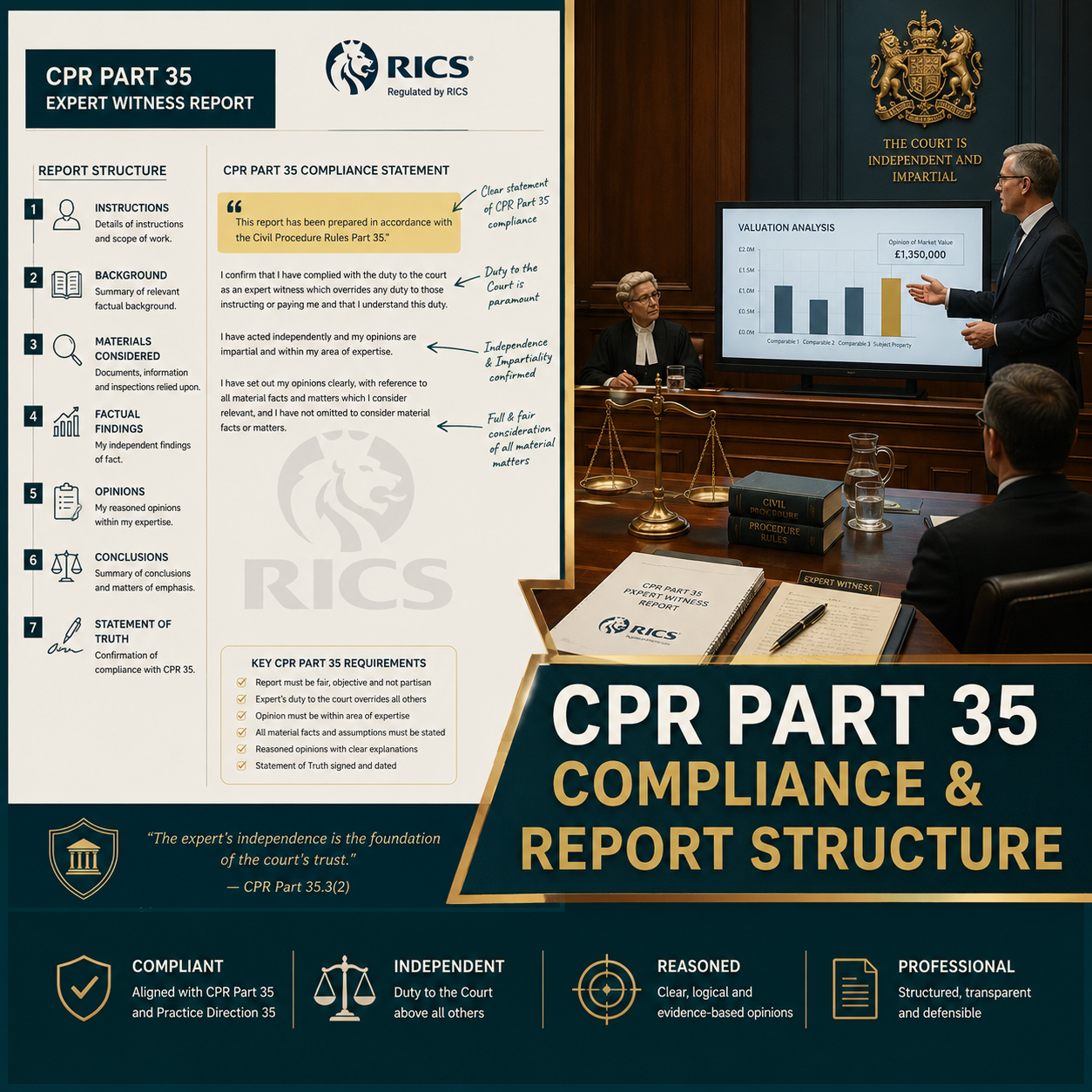
CPR Part 35 Compliance: Structuring the Expert Report
CPR Part 35 governs the use of expert evidence in civil proceedings in England and Wales. Non-compliance — even in a technically excellent report — can result in the evidence being excluded or its weight significantly reduced. [1][5]
Mandatory Report Components
A CPR Part 35-compliant expert report for a guttering or drainage dispute must include:
- Statement of expert's qualifications: RICS membership, relevant experience, and any specialist accreditations.
- Statement of instructions: a summary of the instructions received and the questions the expert has been asked to address.
- Scope of investigation: dates of inspection, access arrangements, documents reviewed, and any limitations on the investigation.
- Factual findings: an objective account of what was observed during the site investigation, supported by photographic evidence.
- Expert opinion: clearly distinguished from factual findings, with reasoning explained in plain language.
- Areas of uncertainty: any matters where the expert cannot reach a definitive conclusion, and why.
- CPR Part 35 compliance statement: the mandatory declaration that the expert understands their duty to the court and that the report is complete and accurate to the best of their knowledge.
💬 "The compliance statement is not a formality — it is the legal anchor of the entire report. Courts have excluded reports where this declaration was absent or inadequately worded." [1]
The Compliance Statement: Template Language
The following template reflects the required declaration under CPR Part 35.14 and Practice Direction 35:
"I confirm that I have made clear which facts and matters referred to in this report are within my own knowledge and which are not. Those that are within my own knowledge I confirm to be true. The opinions I have expressed represent my true and complete professional opinions on the matters to which they refer.
I understand that my duty is to the court, not to the party by whom I am instructed or by whom I am paid. I have complied with and will continue to comply with that duty.
I am aware of the requirements of CPR Part 35, its Practice Direction and the Protocol for the Instruction of Experts to give Evidence in Civil Claims."
Single Joint Expert vs. Party-Appointed Expert
| Feature | Single Joint Expert (SJE) | Party-Appointed Expert |
|---|---|---|
| Instructed by | Both parties jointly | One party only |
| Impartiality | Highest — report serves the court | Must still be impartial but can advocate within bounds |
| Written questions | Either party may submit | Opposing party may submit CPR 35.6 questions |
| Cost | Shared between parties | Borne by instructing party |
| Court weight | Generally higher | Subject to challenge by opposing expert |
For lower-value disputes — particularly those heard in the First-tier Tribunal (Property Chamber) — courts increasingly prefer SJE appointments to control costs and reduce adversarial complexity. [2][5]
Diminution in Value Assessments in Drainage Disputes
Once defects are established and liability is attributed, the financial quantum of the claim must be determined. Expert Witness Valuations for Defective Guttering and Drainage Disputes: Site Investigation and CPR Compliance requires the expert to address two distinct valuation questions:
- Cost of remediation: what will it cost to repair or replace the defective drainage system and make good consequential damage?
- Diminution in value: has the property's market value been reduced by the defects, and if so, by how much?
These are not the same figure. Courts have consistently held that the measure of loss in property damage cases is the lower of remediation cost and diminution in value — though this principle is subject to the specific legal basis of the claim.
Remediation Cost Assessment
The remediation schedule should be prepared in a format consistent with a reinstatement cost valuation approach, itemising:
- Gutter and downpipe replacement: material specification, linear metres, labour rates.
- Consequential damage repairs: render, masonry, internal plaster, decoration, flooring.
- Drainage infrastructure works: CCTV survey, drain lining, soakaway replacement.
- Preliminaries: scaffolding, access, temporary weatherproofing.
- Contingency: typically 10–15% for unforeseen works in older properties.
All rates should be referenced to a recognised pricing database (e.g., BCIS, Spon's) with the base date stated.
Diminution in Value: Methodology
Diminution in value in property disputes is assessed using a before-and-after methodology:
- "Before" value: the open market value of the property in its undamaged condition, assessed at the relevant valuation date.
- "After" value: the open market value of the property with the defects present and known to a hypothetical purchaser.
- Diminution: the difference between the two figures, expressed as a monetary sum and a percentage.
The expert must support both valuations with comparable market evidence. For residential properties, a Canterbury property valuation or equivalent local market analysis provides the evidential foundation.
📌 Key point: In neighbour disputes, diminution in value is often claimed in addition to — not instead of — repair costs, particularly where the defect has caused reputational damage to the property (e.g., a history of flooding disclosed on sale).
Stigma and Residual Diminution
Even after full remediation, some properties retain a stigma discount — a reduction in market value attributable to the known history of water ingress. This is particularly relevant where:
- The property has been subject to insurance claims visible on a CLUE report or equivalent.
- The defect caused structural damage (e.g., subsidence, timber decay) requiring disclosure on sale.
- The property is in a leasehold block where the drainage failure has affected multiple units.
Stigma discounts typically range from 2% to 8% of open market value, depending on the severity and visibility of the historic defect. The expert must justify any stigma allowance with reference to market evidence and comparable transactions. [3][4]
RICS Compliance and the Expert's Duty of Impartiality
RICS members acting as expert witnesses are bound by both CPR Part 35 and the RICS guidance note Surveyors Acting as Expert Witnesses (4th edition). These two frameworks are complementary but not identical — the RICS guidance adds professional conduct obligations on top of the procedural requirements of CPR. [7]
Key RICS obligations include:
- Independence: the expert must not have a prior commercial relationship with any party that could compromise objectivity.
- Competence: the expert must only accept instructions within their demonstrable area of expertise — a residential valuer should not, for example, provide expert evidence on commercial drainage infrastructure without appropriate experience.
- Transparency: any assumptions made in the report must be clearly stated and capable of being tested.
- Updating: if new evidence emerges after the report is filed, the expert has a duty to update their opinion and notify the court.
For complex multi-party disputes, a commercial building survey may be required to establish the full extent of drainage-related defects across a building, with the expert report drawing on that survey as a primary source document.
When to Instruct an Expert Witness Surveyor
Not every drainage dispute requires expert witness evidence. The decision to instruct should be based on:
- Claim value: disputes below £10,000 in the Small Claims Track rarely justify the cost of a full CPR Part 35 report.
- Technical complexity: where causation is disputed and requires specialist knowledge to resolve.
- Jurisdictional requirement: FTT proceedings, TCC litigation, and arbitration under construction contracts almost always require expert evidence.
An expert witness surveyor with specific experience in building envelope pathology and drainage systems will carry significantly more evidential weight than a generalist surveyor offering an opinion outside their core specialism. [1][2]
Common Pitfalls That Undermine Expert Reports
Even experienced surveyors make avoidable errors that weaken their reports in dispute proceedings. The most common include:
- ❌ Conflating fact and opinion: presenting inferences as observations without clearly distinguishing between the two.
- ❌ Failing to address the opposing case: a CPR-compliant report must acknowledge and engage with alternative explanations for the defects observed.
- ❌ Inadequate photographic evidence: photographs without scale references, timestamps, or location markers are routinely challenged.
- ❌ Overstating certainty: courts are suspicious of experts who express absolute certainty on matters that are inherently probabilistic.
- ❌ Ignoring maintenance history: failure to consider whether the defect was pre-existing or exacerbated by inadequate maintenance can fatally undermine fault attribution.
- ❌ Omitting the compliance statement: this is the single most common procedural failure and the easiest to avoid. [1][5]
Conclusion: Actionable Next Steps for Practitioners and Property Owners
Expert Witness Valuations for Defective Guttering and Drainage Disputes: Site Investigation and CPR Compliance is a discipline that rewards preparation, methodological rigour, and procedural discipline in equal measure. The quality of the site investigation determines the quality of the expert opinion; the quality of the report structure determines whether that opinion is heard.
Actionable Steps 🎯
- Instruct early: engage an expert witness surveyor at the pre-action stage to avoid evidence being gathered under time pressure after proceedings have commenced.
- Commission a drainage survey: a CCTV drainage investigation provides objective, reproducible evidence of underground defects that cannot be disputed on the basis of visual interpretation alone.
- Establish a baseline: where a lease or tenancy is involved, ensure a schedule of condition is in place before works commence.
- Use the correct report structure: follow the CPR Part 35 template rigorously, including the compliance statement, scope of instructions, and clear separation of fact from opinion.
- Quantify both remediation cost and diminution: present both figures to give the court or tribunal the full picture of financial loss.
- Seek RICS-credentialled expertise: only instruct surveyors with demonstrable experience in building envelope pathology and expert witness work — generalist credentials are insufficient for complex drainage disputes.
Whether the dispute involves a leaking shared gutter between neighbours, a contractor's failed installation, or a landlord's breach of repairing covenant, the strength of the expert evidence will almost always determine the outcome. Investing in a properly structured, CPR-compliant expert report is not a legal formality — it is the difference between winning and losing.
References
[1] Expert Witness Surveyors For Defective Guttering And Building Envelope Disputes Cpr Compliant Reporting Protocols – https://wimbledonsurveyors.com/expert-witness-surveyors-for-defective-guttering-and-building-envelope-disputes-cpr-compliant-reporting-protocols/?utm_source=openai
[2] Expert Witness – https://www.wci.co.uk/consulting-engineers/expert-witness/?utm_source=openai
[3] Forensic Engineering Expert Witness – https://www.socotec.us/services/geotechnical-engineering-testing/forensic-engineering-expert-witness?utm_source=openai
[4] generalforensicengineers – https://www.generalforensicengineers.com/?utm_source=openai
[5] Expert Witness Services – https://www.smythandassociates.co.uk/expert-witness-services.php?utm_source=openai
[7] expertwitnesssurveyors.co.uk – https://www.expertwitnesssurveyors.co.uk/?utm_source=openai