
The abolition of Section 21 'no fault' evictions following the Renters' Rights Act 2025 has fundamentally transformed how landlords regain possession of rental properties in 2026. With Section 8 grounds now the sole pathway for evictions, property condition assessments and accurate valuations have become critical battlegrounds in possession proceedings. This shift has elevated the importance of Expert Witness Roles in Section 8 Eviction Valuation Disputes: RICS Guidance for Post-Renters' Rights Act 2026, as chartered surveyors increasingly find themselves providing crucial testimony on property standards, market rents, and compliance issues that determine case outcomes.
The Renters' Rights Act received Royal Assent on 27 October 2025, establishing new regulatory frameworks that affect private rental sector valuations throughout 2026.[2] Unlike the straightforward Section 21 process, Section 8 evictions require landlords to prove specific grounds for possession—many of which hinge on property condition, rent arrears calculations, or valuation disputes where expert witness surveyors provide essential evidence.
Key Takeaways
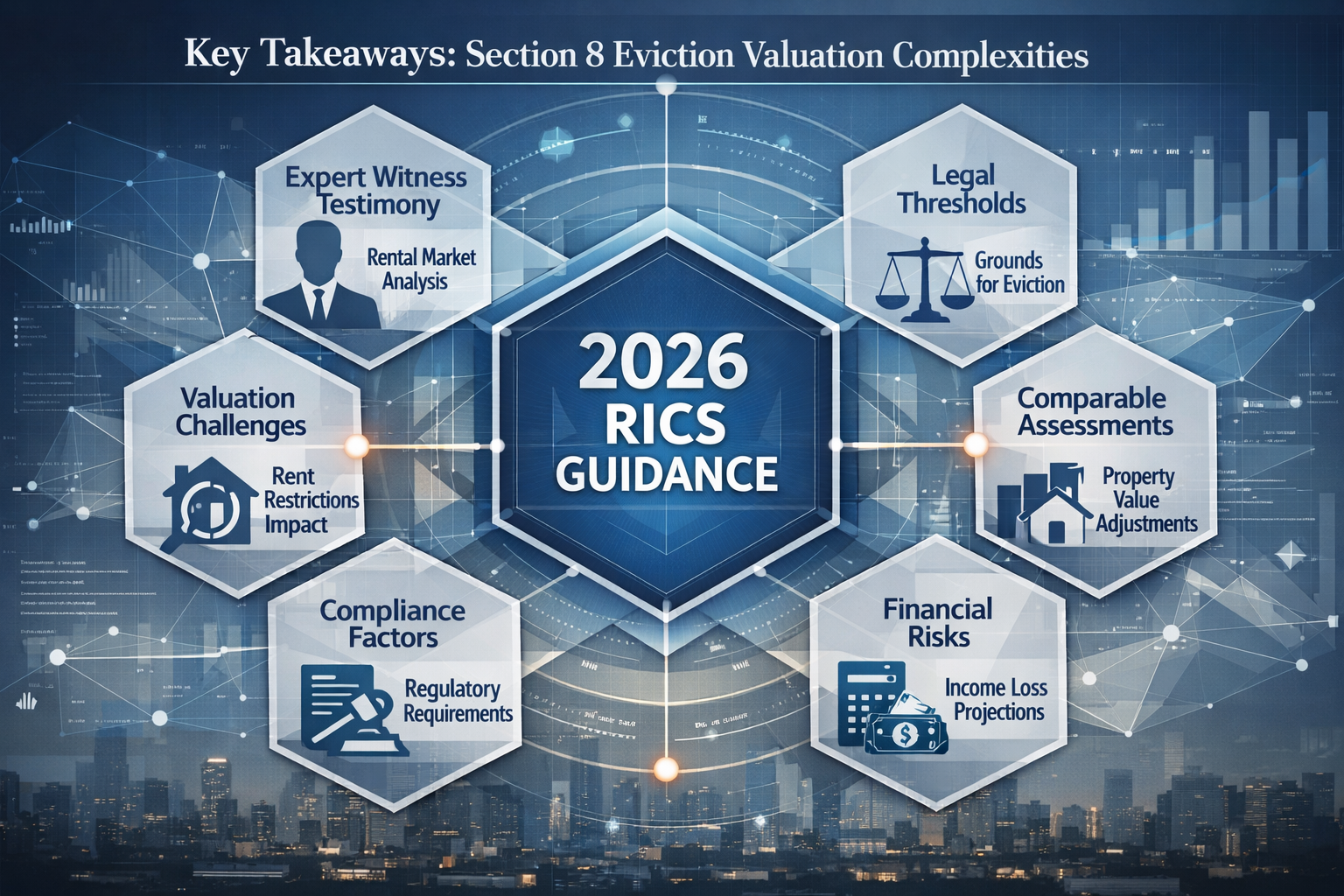
- 📋 Section 8 evictions now require substantive evidence including property condition assessments and accurate market valuations, making expert witness testimony essential
- 🏛️ RICS guidance confirms vacant possession assumptions remain valid when applying professional judgment on a case-by-case basis despite tenancy structure changes
- ⚖️ Expert witnesses must navigate new compliance requirements including Decent Homes Standards and enhanced due diligence when providing valuation evidence
- 📊 Valuation disputes increasingly center on rent reasonableness with annual increase restrictions requiring robust comparable evidence analysis
- 🔍 Specialist PRS valuation expertise is critical as tribunals scrutinize pre- and post-Act comparable evidence to assess market impacts
Understanding Section 8 Grounds in the Post-2026 Landscape
Section 8 of the Housing Act 1988 provides specific grounds for possession that landlords can use to evict tenants. Unlike Section 21, which required no justification, Section 8 demands proof of specific circumstances ranging from rent arrears to property condition breaches. The abolition of Section 21 evictions means these grounds now represent the only legal pathway for landlords to regain possession.[2]
The Shift from No-Fault to Evidence-Based Evictions
The transformation from Assured Shorthold Tenancies (ASTs) to periodic monthly rolling tenancies has eliminated minimum term requirements, allowing tenants to end tenancies with two months' notice.[2] However, landlords face significantly higher evidentiary burdens when seeking possession.
Common Section 8 grounds requiring expert valuation evidence include:
- Ground 8: Serious rent arrears (at least two months overdue)
- Ground 10: Rent arrears at notice and hearing dates
- Ground 11: Persistent rent delays
- Ground 13: Property condition deterioration due to tenant behavior
- Ground 14: Nuisance or illegal use affecting property value
- Ground 17: False statements inducing tenancy grant
Each ground requires different types of expert evidence, but valuation disputes frequently arise when determining appropriate market rent, assessing property damage impacts on value, or establishing compliance with statutory standards.
Why Expert Witness Roles Have Become Critical
In 2026, tribunals and courts demand objective, professional assessments from qualified surveyors who can provide impartial testimony. The expert witness services provided by RICS-qualified professionals carry substantial weight because they:
✅ Provide independent, unbiased property assessments
✅ Apply recognized valuation methodologies consistently
✅ Demonstrate technical expertise in property condition analysis
✅ Understand legal requirements for admissible evidence
✅ Can withstand cross-examination on valuation assumptions
Expert Witness Roles in Section 8 Eviction Valuation Disputes: Core Responsibilities
When disputes arise in Section 8 proceedings, expert witnesses serve multiple critical functions that extend beyond simple property valuation. Their responsibilities encompass technical assessment, regulatory compliance verification, and clear communication of complex property matters to legal decision-makers.
Property Condition Assessment and Deterioration Evidence
One of the most frequent requirements in Section 8 cases involves demonstrating property condition changes attributable to tenant actions. Expert witnesses must:
Conduct comprehensive condition surveys documenting current property state with photographic evidence, detailed descriptions, and measurements of defects or damage.
Compare against baseline conditions using tenancy commencement records, schedule of condition documents, or industry-standard expectations for properties of similar age and type.
Quantify repair costs providing detailed cost estimates for remediation work required to restore the property to its appropriate condition.
Distinguish tenant damage from fair wear and tear applying professional judgment to separate normal deterioration from actionable breaches—a distinction that often determines case outcomes.
The structural surveys and condition assessments performed by expert witnesses must meet rigorous standards, as opposing parties will scrutinize every assumption and conclusion.
Market Rent Valuation and Reasonableness Assessments
The Renters' Rights Act 2025 introduced new restrictions prohibiting rent increases during the first 12 months of tenancy, with only one annual increase thereafter subject to market value considerations.[2] This has made rent reasonableness disputes increasingly common in Section 8 proceedings.
Expert witnesses provide crucial testimony on:
| Valuation Component | Expert Witness Responsibility |
|---|---|
| Comparable Evidence | Identify and analyze similar properties in the locality with recent lettings |
| Market Rent Assessment | Determine current open market rental value using recognized methodologies |
| Adjustment Factors | Account for property-specific features, condition, and location attributes |
| Temporal Analysis | Distinguish market conditions before and after Act implementation |
| Compliance Impact | Assess how regulatory requirements affect achievable rents |
RICS emphasizes that valuations in the private rented sector are specialist in nature, requiring valuers to reflect market dynamics and appropriately interrogate comparable evidence from before and after Act implementation.[2]
Vacant Possession Valuation Assumptions
A critical question facing expert witnesses in 2026 concerns whether the traditional 'vacant possession assumption' remains appropriate given the abolition of Section 21 evictions. RICS guidance provides clarity: the vacant possession assumption is still considered reasonable when applying professional judgment on a case-by-case basis, as Section 8 possession grounds remain available.[2]
However, expert witnesses must:
🔍 Justify the assumption explicitly in valuation reports, explaining why it applies to the specific property and circumstances
🔍 Consider possession timeline impacts acknowledging that Section 8 processes may take longer than previous Section 21 routes
🔍 Assess ground-specific factors evaluating the strength of available possession grounds when forming valuation opinions
🔍 Document market evidence showing how similar properties are valued and transacted in the current regulatory environment
This nuanced approach requires expert witnesses to balance established valuation principles with emerging market realities in the post-Renters' Rights Act landscape.

RICS Guidance for Expert Witness Roles in Section 8 Eviction Valuation Disputes Post-Renters' Rights Act 2026
The Royal Institution of Chartered Surveyors has provided specific guidance addressing how valuers should approach private rental sector assessments following the regulatory changes. This guidance shapes Expert Witness Roles in Section 8 Eviction Valuation Disputes: RICS Guidance for Post-Renters' Rights Act 2026 by establishing professional standards and best practices.
Specialist Valuation Requirements and Enhanced Due Diligence
RICS explicitly recognizes that private rented sector valuations require specialist expertise rather than general valuation competence.[2] Expert witnesses working in Section 8 disputes must demonstrate:
Market Knowledge: Deep understanding of local rental markets, tenant demand patterns, and landlord supply dynamics specific to the relevant geographic area.
Regulatory Competence: Comprehensive knowledge of the Renters' Rights Act 2025 provisions, Decent Homes Standards, Deposit Protection Scheme requirements, and other compliance obligations affecting property values.
Comparable Analysis Skills: Ability to identify, verify, and adjust comparable evidence appropriately, distinguishing between pre-Act and post-Act market conditions.
Professional Judgment: Capacity to exercise reasoned judgment when evidence is limited or conflicting, clearly explaining the basis for conclusions reached.
The enhanced due diligence requirements in 2026 mean expert witnesses must verify compliance with multiple regulatory frameworks that can materially impact property valuations. These include:
- ✔️ Decent Homes Standards compliance verification
- ✔️ Energy Performance Certificate ratings and improvement requirements
- ✔️ Electrical safety certification status
- ✔️ Gas safety record currency
- ✔️ Deposit Protection Scheme compliance
- ✔️ Licensing scheme adherence where applicable
Failure to identify compliance deficiencies can undermine expert testimony credibility and lead to inaccurate valuations that don't reflect actual market conditions or achievable rents.
Interrogating Comparable Evidence Across Regulatory Transitions
One of the most challenging aspects of providing expert witness testimony in 2026 involves analyzing comparable evidence that spans the regulatory transition. Properties let before the Renters' Rights Act implementation may have achieved rents or values that differ from post-Act transactions.
RICS guidance emphasizes that expert witnesses must appropriately interrogate comparable evidence to determine whether observed differences reflect:
📊 Genuine market shifts caused by regulatory changes affecting landlord returns or tenant demand
📊 Property-specific factors unrelated to the Act, such as condition improvements or location changes
📊 Temporal market movements reflecting broader economic conditions, interest rates, or housing supply dynamics
📊 Data quality issues where comparable transactions lack verification or relevant details
Expert witnesses should maintain detailed records of their comparable analysis methodology, documenting why certain transactions were included or excluded and how adjustments were applied. This transparency strengthens testimony credibility when challenged during cross-examination.
Professional Standards for Expert Witness Reports
Expert witness reports in Section 8 eviction valuation disputes must meet rigorous standards established by both RICS professional requirements and legal admissibility criteria. The commercial valuation principles applied to residential lettings demand:
Clear Statement of Instructions: Explicitly documenting what questions the expert was asked to address and any limitations on the scope of investigation.
Methodology Transparency: Detailed explanation of valuation approaches used, data sources consulted, and analytical techniques applied.
Assumption Declaration: Comprehensive listing of all assumptions made, including the vacant possession assumption and any property condition presumptions.
Evidence Base Documentation: Full disclosure of comparable evidence relied upon, including transaction details, dates, and adjustment rationale.
Professional Opinion Clarity: Unambiguous statement of conclusions reached, distinguishing between established facts and professional judgment.
Independence Confirmation: Clear declaration that the expert's duty is to the tribunal or court rather than the instructing party.
These standards ensure that expert witness testimony meets legal requirements while maintaining professional integrity and providing decision-makers with reliable information.
Practical Applications: Section 8 Grounds Requiring Valuation Expertise
Different Section 8 grounds present distinct valuation challenges requiring tailored expert witness approaches. Understanding these practical applications helps both legal professionals and property owners recognize when specialist valuation testimony becomes essential.
Rent Arrears Cases (Grounds 8, 10, 11)
Rent arrears grounds appear straightforward but often involve complex valuation questions:
Was the rent charged reasonable for the property? Expert witnesses may need to demonstrate that the contractual rent aligns with market rates, particularly if tenants claim excessive charges.
How should partial payments be allocated? When tenants make irregular payments, expert testimony may clarify whether arrears calculations correctly account for payment application against rent, utilities, or other charges.
What impact do property condition issues have on rent obligations? If tenants claim disrepair justifies withholding rent, expert witnesses assess whether condition problems materially affect the property's rental value.
The new rent increase restrictions in 2026—limiting increases to once annually after the first 12 months and requiring market value justification[2]—make expert valuation evidence increasingly relevant in arrears disputes where tenants challenge rent reasonableness.
Property Condition Deterioration (Ground 13)
Ground 13 allows possession when property condition has deteriorated due to tenant waste, neglect, or default. Expert witnesses play crucial roles in:
🏠 Establishing baseline condition using tenancy commencement records or industry-standard expectations
🏠 Documenting current condition through comprehensive surveys with photographic evidence
🏠 Quantifying deterioration impact on property value and rental potential
🏠 Distinguishing actionable damage from normal wear and tear or landlord maintenance failures
🏠 Estimating remediation costs providing detailed repair schedules and cost projections
These assessments require technical expertise in building pathology, construction standards, and property maintenance expectations. The RICS building surveys methodology provides the framework for rigorous condition assessment.
Nuisance and Property Value Impact (Ground 14)
When landlords seek possession based on tenant nuisance or antisocial behavior, expert witnesses may need to demonstrate how such conduct affects property value. This specialized analysis involves:
Comparable evidence of stigmatized properties showing market discounts applied to properties with negative histories.
Neighborhood impact assessment evaluating how tenant behavior affects the property's marketability relative to similar properties without such issues.
Remediation cost analysis quantifying expenses required to restore the property's reputation or address physical damage resulting from problematic tenant conduct.
Rental income loss calculations demonstrating reduced achievable rents or extended void periods attributable to the tenant's actions.
This type of valuation work requires sensitivity to legal constraints on evidence while providing tribunals with objective financial impact assessments.
Compliance Challenges and Valuation Impacts in 2026
The Renters' Rights Act 2025 introduced multiple compliance requirements that create potential valuation impacts expert witnesses must consider. These regulatory obligations affect both property values and the strength of Section 8 possession claims.
Decent Homes Standards and Property Valuation
The Act's enhanced property standards requirements mean expert witnesses must assess whether properties meet Decent Homes Standards when providing valuation evidence. Non-compliance can affect:
💷 Achievable market rents as tenants increasingly demand compliant properties
💷 Capital values reflecting costs to achieve compliance
💷 Possession claim strength as landlords may face counterclaims if seeking eviction from non-compliant properties
💷 Investment returns with compliance costs reducing net yields
Expert witnesses should quantify compliance gaps and associated remediation costs, incorporating these factors into valuation assessments where material.
Deposit Protection and Valuation Disputes
Deposit Protection Scheme compliance has become a critical consideration in Section 8 proceedings. Expert witnesses may be asked to:
- Assess whether property damage exceeds protected deposit amounts
- Provide independent valuations of repair costs for deposit adjudication
- Evaluate whether landlords properly protected deposits when claiming possession
The valuation services provided by expert witnesses in deposit disputes require careful documentation and objective assessment to withstand scrutiny from both landlords and tenants.
Licensing Scheme Compliance Impacts
Properties subject to selective or additional licensing schemes face specific compliance requirements that expert witnesses must consider. Non-compliance can:
❌ Invalidate Section 8 possession claims until remedied
❌ Reduce achievable rents due to market stigma
❌ Trigger rent repayment orders affecting landlord returns
❌ Impact property marketability and capital values
Expert witnesses should verify licensing status and incorporate compliance considerations into valuation opinions where relevant to the dispute.
Emerging Trends in Section 8 Valuation Disputes
As the private rental sector adjusts to the post-Renters' Rights Act environment in 2026, several trends are shaping how expert witnesses approach valuation disputes.
Increased Scrutiny of Comparable Evidence
Tribunals and courts are applying heightened scrutiny to comparable evidence, particularly when distinguishing pre-Act and post-Act market conditions. Expert witnesses report that decision-makers increasingly:
🔎 Demand verification of comparable transaction details
🔎 Question adjustment methodologies and magnitudes
🔎 Require temporal analysis separating regulatory impacts from market movements
🔎 Challenge vacant possession assumptions more rigorously
This trend emphasizes the importance of thorough comparable research and transparent methodology documentation in expert reports.
Greater Emphasis on Specialist PRS Expertise
RICS guidance that private rental sector valuations are "specialist in nature"[2] has translated into tribunals giving greater weight to expert witnesses with demonstrated PRS expertise versus general residential valuers. Specialist knowledge areas include:
- Rental market dynamics and tenant demand patterns
- Landlord investment return calculations and yield analysis
- Regulatory compliance requirements and cost implications
- Tenancy law and possession procedure understanding
- Local authority licensing and enforcement practices
Expert witnesses should clearly establish their specialist credentials in reports and testimony to maximize credibility.
Integration of Regulatory Compliance in Valuation Methodology
Traditional valuation approaches focused primarily on physical property characteristics and market comparables. In 2026, expert witnesses increasingly incorporate regulatory compliance assessment as a core valuation component, recognizing that:
- Non-compliant properties face restricted marketability
- Compliance costs materially impact net investment returns
- Regulatory risk affects purchaser demand and pricing
- Enforcement action can eliminate rental income entirely
This integrated approach provides tribunals with more accurate valuations reflecting actual market conditions and achievable values.
Longer Possession Timelines Affecting Valuation Assumptions
The shift from Section 21 to Section 8 as the sole possession route has extended average possession timelines. Expert witnesses must consider whether this affects:
Vacant possession assumptions – whether longer possession periods justify valuation discounts
Investment return calculations – how extended void periods impact landlord yield projections
Comparable evidence analysis – whether transactions reflect market pricing of possession risk
Property marketing strategies – how possession uncertainty affects buyer behavior and pricing
RICS guidance confirms vacant possession assumptions remain reasonable[2], but expert witnesses should address timeline considerations explicitly in reports.
Best Practices for Expert Witnesses in Section 8 Valuation Disputes
Chartered surveyors providing expert witness services in Section 8 eviction valuation disputes should adopt best practices that enhance testimony credibility and effectiveness.
Maintain Strict Independence and Objectivity
Expert witnesses owe their primary duty to the tribunal or court, not the instructing party. This requires:
✓ Declining instructions where conflicts of interest exist
✓ Providing objective opinions even when unfavorable to the instructing party
✓ Disclosing limitations in evidence or methodology
✓ Resisting pressure to advocate rather than inform
✓ Maintaining professional skepticism when reviewing party-provided information
The expert witness surveyor role demands unwavering commitment to impartiality and professional integrity.
Document Methodology Comprehensively
Detailed methodology documentation serves multiple purposes:
📝 Demonstrates professional rigor in analysis and opinion formation
📝 Enables peer review by opposing experts or tribunal-appointed assessors
📝 Supports cross-examination defense by providing clear reasoning trails
📝 Facilitates quality assurance through internal review processes
📝 Creates audit trails for professional indemnity and regulatory purposes
Expert reports should include sufficient detail that another competent valuer could replicate the analysis and understand the reasoning supporting conclusions.
Stay Current with Regulatory Developments
The private rental sector regulatory environment continues evolving in 2026. Expert witnesses must maintain current knowledge through:
- Regular RICS professional development activities
- Monitoring legislative changes and guidance updates
- Participating in specialist PRS valuation forums
- Reviewing tribunal and court decisions establishing precedents
- Engaging with market participants to understand practical impacts
This ongoing education ensures expert testimony reflects current regulatory requirements and market realities.
Communicate Complex Concepts Clearly
Tribunals and courts often include non-technical decision-makers who require clear explanations of valuation concepts. Expert witnesses should:
🗣️ Avoid unnecessary jargon or define technical terms when used
🗣️ Use visual aids like photographs, diagrams, and charts to illustrate points
🗣️ Provide context for numerical conclusions with plain-language explanations
🗣️ Structure reports logically with clear headings and executive summaries
🗣️ Anticipate questions and address them proactively in reports
Effective communication enhances the impact of expert testimony and helps decision-makers apply technical evidence to legal questions.
Conclusion
The abolition of Section 21 evictions and implementation of the Renters' Rights Act 2025 has fundamentally transformed the landscape for possession proceedings in 2026. Expert Witness Roles in Section 8 Eviction Valuation Disputes: RICS Guidance for Post-Renters' Rights Act 2026 have become increasingly critical as landlords must now prove specific grounds for possession, many of which require robust property condition assessments and accurate market valuations.
RICS guidance provides essential clarity for expert witnesses navigating this new environment, confirming that vacant possession assumptions remain appropriate when applying professional judgment on a case-by-case basis.[2] However, the specialist nature of private rental sector valuations demands that expert witnesses demonstrate deep market knowledge, regulatory competence, and rigorous methodology when interrogating comparable evidence across the regulatory transition.
Key Takeaways for Property Professionals
For landlords, tenants, and legal practitioners involved in Section 8 proceedings, several critical points emerge:
✅ Engage specialist PRS valuers with demonstrated expertise rather than general residential valuers
✅ Instruct experts early to allow comprehensive property assessment and evidence gathering
✅ Ensure compliance with Decent Homes Standards and other regulatory requirements before pursuing possession
✅ Document property condition thoroughly at tenancy commencement to establish baselines for deterioration claims
✅ Challenge unsupported assumptions in opposing expert reports, particularly regarding comparable evidence and adjustments
Next Steps
Property owners facing Section 8 eviction proceedings should:
- Consult with qualified RICS chartered surveyors experienced in rent review and expert witness work to assess the strength of valuation-dependent grounds
- Gather comprehensive documentation including tenancy agreements, condition records, correspondence, and financial records
- Verify regulatory compliance across all applicable standards to strengthen possession claims and avoid counterclaims
- Commission independent valuations early to understand likely tribunal assessments of rent reasonableness or property condition impacts
- Consider alternative dispute resolution where expert valuation evidence suggests weak grounds or significant compliance vulnerabilities
The evolving regulatory landscape will continue generating valuation disputes as the market adjusts to new norms in 2026 and beyond. Expert witnesses who maintain rigorous professional standards, stay current with regulatory developments, and communicate complex concepts clearly will provide invaluable service to tribunals, courts, and parties navigating these challenging disputes.
References
[1] Expert Witness Testimonies In 2026 Valuation Disputes Rics Strategies Amid Stabilising House Prices And Regional Divides – https://nottinghillsurveyors.com/blog/expert-witness-testimonies-in-2026-valuation-disputes-rics-strategies-amid-stabilising-house-prices-and-regional-divides
[2] Consideration Of Implications Of Renters Rights Act On Valuation – https://www.rics.org/news-insights/consideration-of-implications-of-renters-rights-act-on-valuation
[3] Property Valuations – https://osborneslaw.com/blog/property-valuations/