By 2026, over 40% of the UK's total carbon emissions are attributable to the built environment — and yet, until recently, most property valuations treated carbon as an afterthought rather than a core financial variable. That gap is closing fast. Whole Life Carbon Assessments in Valuation Surveys: Applying RICS 2nd Edition and PAS 2080:2023 Standards has become one of the most consequential areas of professional practice for chartered surveyors, reshaping how properties are assessed, priced, and defended in sustainability disputes.
This article breaks down exactly how surveyors incorporate whole life carbon metrics into 2026 valuations under updated RICS guidance — and what those obligations mean when expert witness challenges arise.
Key Takeaways 📌
- The RICS Whole Life Carbon Assessment (WLCA) 2nd Edition became effective 1 July 2024, establishing a globally applicable methodology covering embodied, operational, and user carbon across a building's full lifecycle. [2]
- PAS 2080:2023 provides the complementary management framework, specifying governance and systems-thinking processes for carbon reduction across the value chain. [3]
- Mandatory WLCA stages include A1–A5 (product and construction), B4 (component replacement), and B6 (operational energy). [5]
- The Greater London Authority requires WLCA for all major developments under London Plan Policy SI 2, making compliance a planning prerequisite. [5]
- Carbon performance now directly influences asset value, investment risk, and dilapidations liability, creating new expert witness obligations for surveyors.
Understanding the Standards: RICS WLCA 2nd Edition and PAS 2080:2023
What the RICS WLCA 2nd Edition Actually Requires
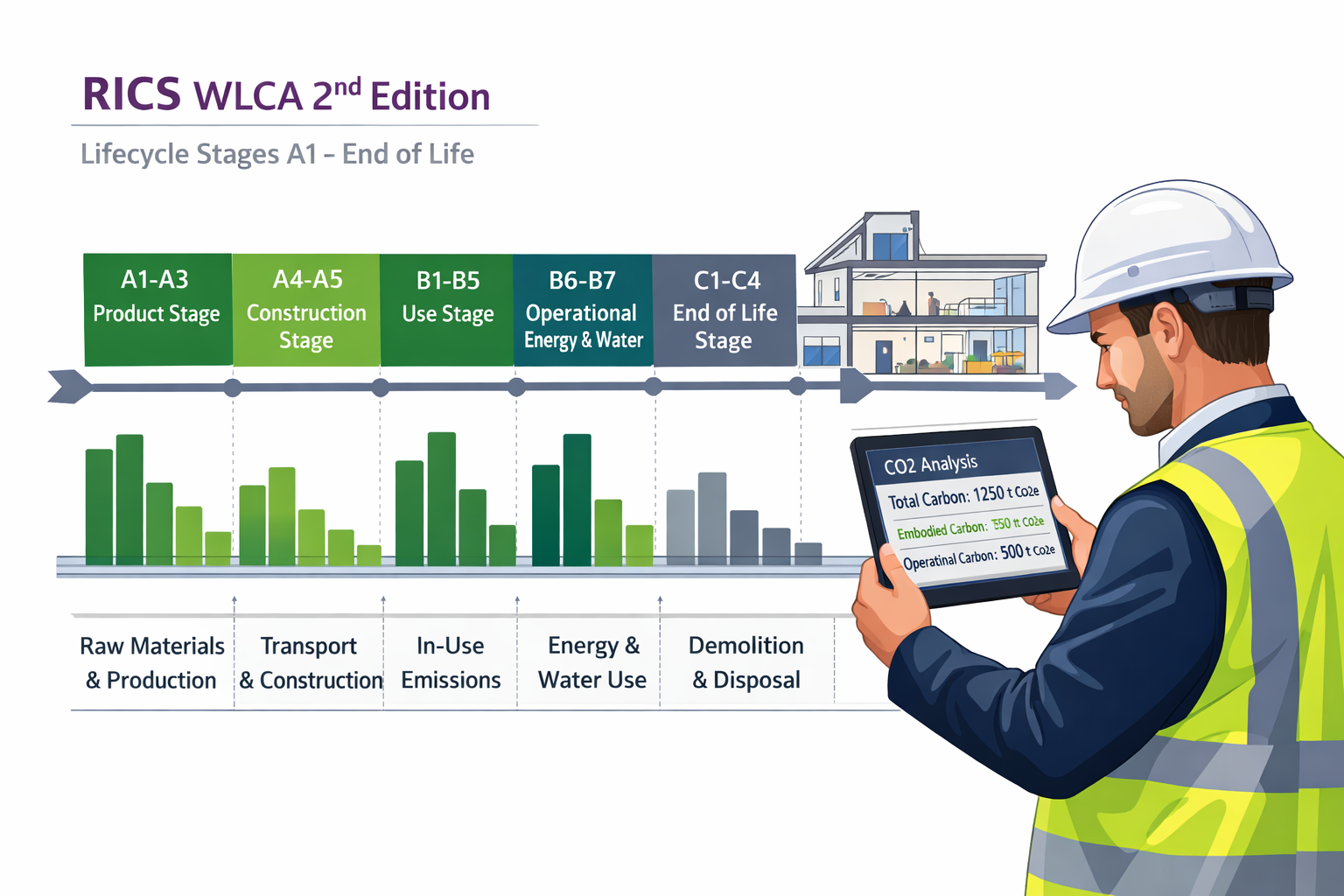
The RICS Whole Life Carbon Assessment 2nd Edition took effect on 1 July 2024, replacing earlier guidance with a more rigorous, globally applicable methodology. [4] It measures carbon emissions across every phase of a building's life — from raw material extraction through construction, occupation, maintenance, and eventual deconstruction, reuse, or recycling. [2]
The standard covers three carbon categories:
| Carbon Type | Definition | Key Stages |
|---|---|---|
| Embodied Carbon | Emissions from materials and construction | A1–A5, B4, C1–C4 |
| Operational Carbon | Emissions from energy use in occupation | B6 |
| User Carbon | Emissions from occupant activities | B7–B8 |
Critically, the standard does not treat all stages as optional. Mandatory stages for WLCA compliance include A1–A5 (product manufacturing and construction processes), B4 (replacement of building components over the asset's life), and B6 (operational energy consumption). [5] Omitting these stages renders an assessment non-compliant — a fact with direct implications for valuations and planning submissions.
The RICS WLCA 2nd Edition also integrates with the International Cost Management Standards (ICMS) 3rd Edition, enabling practitioners to present carbon and life cycle cost data side by side. [2] This integration matters enormously for valuers: it means carbon performance can now be expressed in financial terms within the same reporting framework as construction and maintenance costs.
💡 Pull Quote: "Early-stage design decisions lock in the majority of a project's carbon footprint — structural systems, material specifications, and construction methods are the key leverage points." [5]
How PAS 2080:2023 Complements the RICS Framework
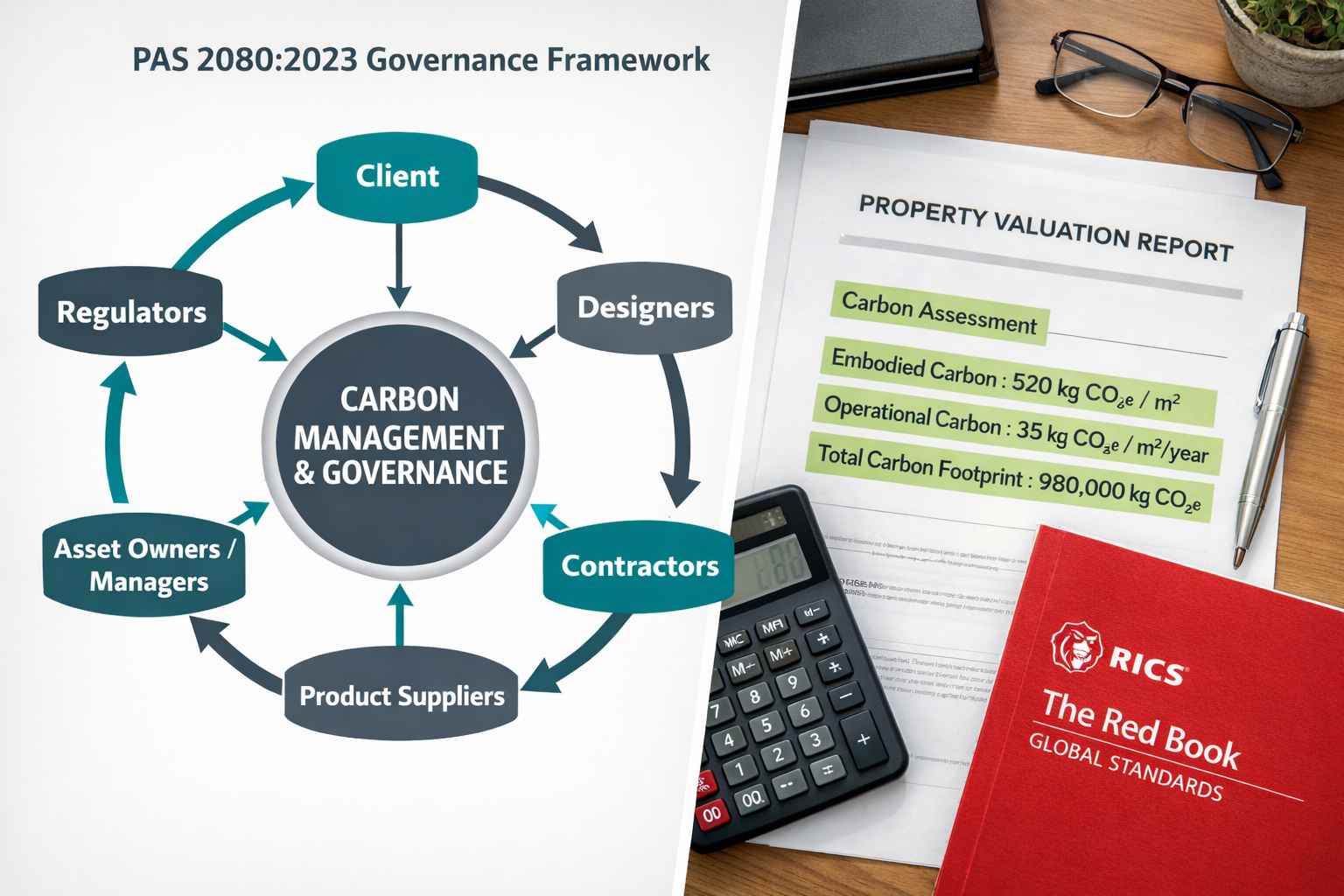
Where the RICS WLCA 2nd Edition provides the measurement methodology, PAS 2080:2023 provides the management framework. Published by BSI, PAS 2080:2023 applies systems thinking to carbon governance across the full building and infrastructure lifecycle. [2]
Key features of PAS 2080:2023 include:
- 🔄 Value chain accountability: All members — clients, designers, contractors, and operators — must declare their roles and demonstrate conformity with carbon management requirements. [3]
- 📊 Carbon management plans: Organisations must establish, implement, and maintain documented processes for identifying and reducing carbon.
- 🔗 Systems thinking: PAS 2080 treats carbon reduction as an integrated, cross-disciplinary challenge rather than a siloed technical exercise.
RICS and the Institution of Civil Engineers (ICE) have formally harmonised their messaging on these two standards, establishing them as a "consistent and complementary framework" for measuring and managing lifecycle carbon in both new and existing assets. [2] For surveyors, this means the two standards should be read together — not applied in isolation.
The RICS WLCA 2nd Edition also aligns with ISO/TC 59/SC 17 sustainability standards and relevant EN standards on construction sustainability, ensuring that UK-based assessments are internationally consistent. [2] Although numerical assumptions in the standard are grounded in UK data, the methodology is applicable across all world regions. [4]
Incorporating Whole Life Carbon Assessments in Valuation Surveys: Applying RICS 2nd Edition and PAS 2080:2023 Standards in Practice
Carbon as a Valuation Variable in 2026
The integration of whole life carbon data into property valuations is no longer aspirational — it is becoming a professional expectation. In 2026, surveyors conducting RICS Red Book valuations must consider how carbon performance affects market value, particularly for commercial assets where institutional investors now apply ESG screening criteria as standard practice.
For commercial property valuations, the carbon profile of an asset influences several key value drivers:
- Rental demand: Occupiers with net-zero commitments increasingly prefer low-carbon buildings, creating rental premiums for compliant assets and discounts for non-compliant ones.
- Obsolescence risk: Buildings with high embodied or operational carbon face accelerating stranded asset risk as regulations tighten.
- Reinstatement costs: Carbon-efficient materials and construction methods affect reinstatement cost valuations and insurance reinstatement figures.
- Capital expenditure forecasting: WLCA data on component replacement (Stage B4) feeds directly into life cycle cost models used in investment appraisals.
The Greater London Authority's requirement for WLCA at the planning stage under London Plan Policy SI 2 has made carbon assessment a pre-condition for major development consent. [5] Surveyors advising on development viability or Canterbury property valuations in planning contexts must now factor WLCA compliance into their assessments.
Practical Steps for Surveyors Conducting WLCA-Informed Valuations
Applying Whole Life Carbon Assessments in Valuation Surveys: Applying RICS 2nd Edition and PAS 2080:2023 Standards effectively requires a structured approach:
Step 1 — Establish the assessment boundary
Define which lifecycle stages are in scope. For existing buildings, this typically means B stages (in-use) and C stages (end of life), with A stages relevant where refurbishment is planned.
Step 2 — Gather carbon data
Use verified Environmental Product Declarations (EPDs), manufacturer data, or recognised databases. The RICS WLCA 2nd Edition acknowledges data limitations and requires practitioners to apply mandatory contingency factors and sensitivity analysis to communicate uncertainty ranges rather than presenting results as absolute values. [5]
Step 3 — Apply the ICMS integration
Where life cycle costs are also being assessed, align carbon reporting with ICMS 3rd Edition categories to produce an integrated carbon and cost profile. [2]
Step 4 — Document governance under PAS 2080:2023
Confirm that all relevant value chain parties have declared their roles and that carbon management responsibilities are documented. [3]
Step 5 — Reflect carbon findings in the valuation narrative
Translate carbon metrics into financial language — obsolescence adjustments, rental yield impacts, capital expenditure allowances — within the valuation report.
For RICS building surveys, particularly Level 3 building surveys on older or complex properties, whole life carbon data can also inform recommendations on refurbishment versus demolition — a decision with significant embodied carbon implications.
Whole Life Carbon in Dilapidations and Schedule of Condition Contexts
Carbon assessment is increasingly relevant in dilapidations disputes. Where a tenant has undertaken alterations using high-embodied-carbon materials, or where reinstatement works would generate substantial carbon emissions, the carbon cost of reinstatement becomes a legitimate consideration. Dilapidations surveys conducted under the RICS framework must now engage with this dimension.
Similarly, schedule of condition reports prepared at lease commencement should ideally record the carbon profile of existing materials and systems — creating a baseline against which future alterations and reinstatement obligations can be assessed.
Expert Witness Challenges in Whole Life Carbon Assessments in Valuation Surveys: Applying RICS 2nd Edition and PAS 2080:2023 Standards
The Growing Role of Carbon in Sustainability Disputes
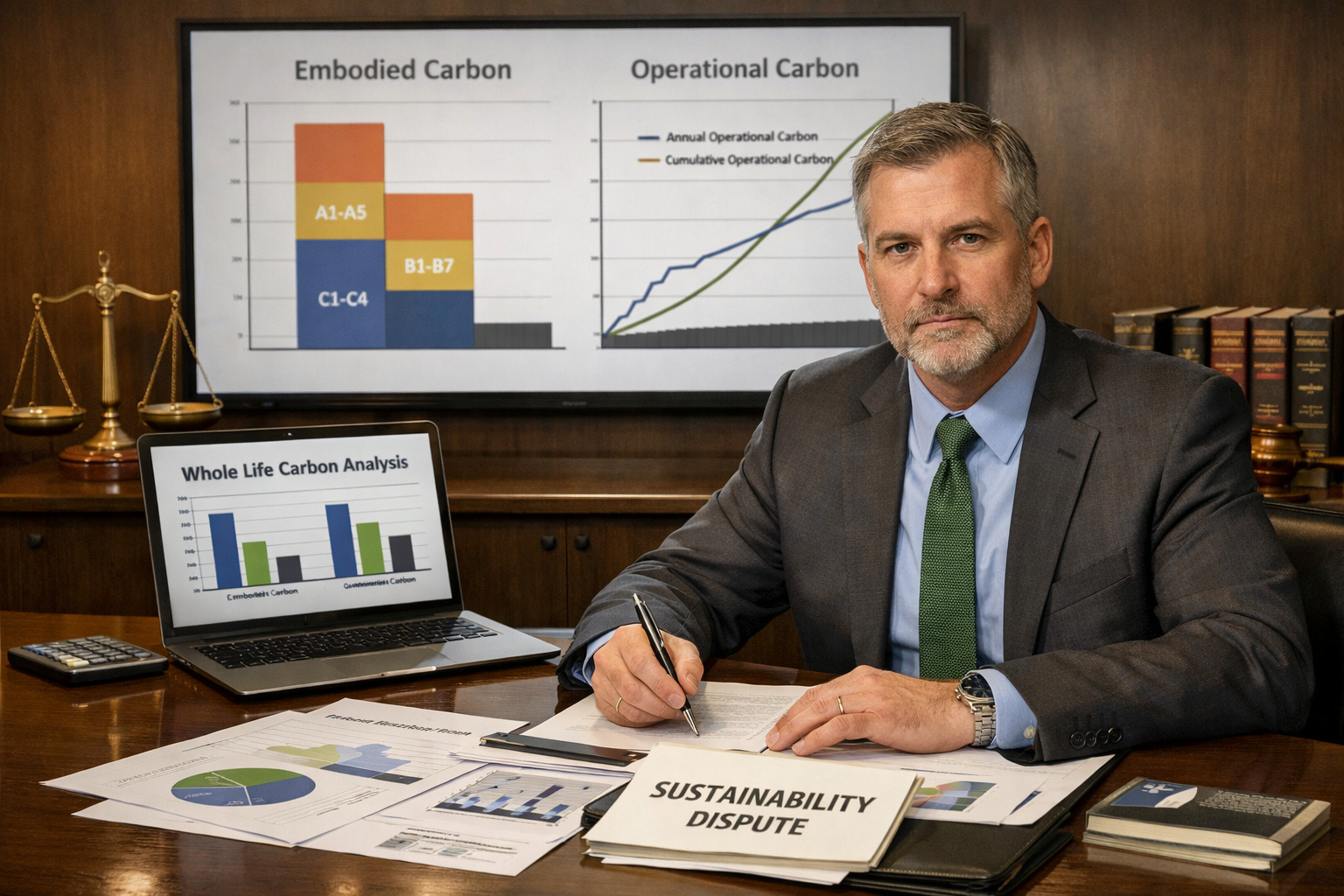
As carbon compliance becomes embedded in planning, investment, and lease frameworks, disputes involving whole life carbon data are multiplying. Surveyors acting as expert witnesses in these cases face a distinct set of challenges that the RICS WLCA 2nd Edition and PAS 2080:2023 are specifically designed to address — but which require careful navigation in practice.
Common dispute scenarios in 2026 include:
| Dispute Type | Carbon Issue | Relevant Standard |
|---|---|---|
| Planning refusals | Non-compliant WLCA at application stage | RICS WLCA 2nd Edition [4] |
| Dilapidations claims | High-carbon reinstatement costs | PAS 2080:2023 [3] |
| Investment disputes | Stranded asset risk from carbon non-compliance | RICS WLCA + ICMS [2] |
| Development viability | Carbon cost overruns in lifecycle models | RICS WLCA 2nd Edition [5] |
| Lease negotiations | Green lease obligations and carbon performance | PAS 2080:2023 [3] |
Addressing Uncertainty in Expert Evidence
One of the most significant challenges for expert witnesses is the inherent uncertainty in carbon data. The RICS WLCA 2nd Edition explicitly requires practitioners to apply contingency factors and present sensitivity analyses rather than single-point estimates. [5] In dispute contexts, this means:
- Expert reports must clearly communicate uncertainty ranges and the assumptions underpinning them.
- Carbon figures presented as absolute values without sensitivity analysis are technically non-compliant with the standard and may be challenged.
- Where opposing experts have used different data sources or assessment boundaries, the expert witness must be able to demonstrate that their approach aligns with the mandatory stages and methodology set out in the RICS WLCA 2nd Edition. [4]
💡 Pull Quote: "Maximum WLCA value requires embedding throughout the design process — coordination between disciplines, early engagement of sustainability consultants, and client commitment to carbon reduction as a project priority." [5]
Demonstrating Compliance with Both Standards
For expert witnesses, demonstrating compliance with both the RICS WLCA 2nd Edition and PAS 2080:2023 is increasingly important. Courts and tribunals are becoming more sophisticated in their understanding of these frameworks, and a failure to engage with the governance requirements of PAS 2080 — such as value chain role declarations — can undermine the credibility of an expert's evidence. [3]
Surveyors preparing expert reports in carbon-related disputes should:
✅ Reference the specific edition of the RICS WLCA standard applied and confirm its effective date (1 July 2024). [4]
✅ Confirm which lifecycle stages were assessed and justify any exclusions.
✅ Document data sources, contingency factors, and sensitivity analysis outputs. [5]
✅ Address PAS 2080:2023 governance requirements where the dispute involves organisational carbon management obligations. [3]
✅ Align carbon findings with financial metrics using the ICMS 3rd Edition framework where investment value is in dispute. [2]
For commercial property surveyors advising on complex assets, this level of technical rigour is now a baseline expectation rather than a differentiator.
Conclusion: Actionable Next Steps for Surveyors in 2026
Whole life carbon is no longer a specialist add-on — it is a core competency for any surveyor involved in valuation, building surveys, or dispute resolution in 2026. The combined framework of the RICS WLCA 2nd Edition and PAS 2080:2023 provides clear, internationally aligned guidance for both measurement and management of lifecycle carbon. [2]
Actionable next steps for surveyors:
- 📚 Review the RICS WLCA 2nd Edition in full and confirm familiarity with mandatory stages A1–A5, B4, and B6. [4]
- 🔗 Read PAS 2080:2023 alongside the RICS standard to understand governance obligations for value chain members. [3]
- 💼 Update valuation report templates to include a carbon performance section that translates WLCA data into financial variables.
- 🏗️ Engage sustainability consultants early on complex instructions, particularly for major developments subject to GLA planning requirements. [5]
- ⚖️ Develop expert witness protocols for carbon disputes, including standard approaches to uncertainty disclosure and sensitivity analysis. [5]
- 🔄 Integrate ICMS 3rd Edition into life cycle cost models to enable combined carbon and cost reporting. [2]
The built environment's carbon transition is accelerating, and the surveyors who master these standards now will be best placed to serve clients, withstand expert scrutiny, and contribute to a lower-carbon property sector. For guidance on how these principles apply to specific survey and valuation instructions, explore the full range of RICS building surveys and valuation services available to property owners and investors.
References
[1] Whole Life Carbon Assessment In Building Surveys Rics Pas 2080 2nd Edition And Valuation Resilience In 2026 – https://nottinghillsurveyors.com/blog/whole-life-carbon-assessment-in-building-surveys-rics-pas-2080-2nd-edition-and-valuation-resilience-in-2026
[2] Rics And Ice Harmonise Messaging On Carbon Assessment And Manage – https://www.rics.org/news-insights/rics-and-ice-harmonise-messaging-on-carbon-assessment-and-manage
[3] Pas 2080 – https://www.bsigroup.com/siteassets/pdf/en/insights-and-media/insights/brochures/pas_2080.pdf
[4] Whole Life Carbon Assessment – https://www.rics.org/profession-standards/rics-standards-and-guidance/sector-standards/construction-standards/whole-life-carbon-assessment
[5] What Is Whole Life Carbon Assessment Wlca A Beginners Guide For Design Engineers – https://cerclos.com/what-is-whole-life-carbon-assessment-wlca-a-beginners-guide-for-design-engineers/