
When builder confidence crashes to its lowest point since September 2025 — hitting just 34 on the NAHB/Wells Fargo Housing Market Index in April 2026 — the instinct for many buyers is to pause, retreat, and wait [1]. But that instinct may be precisely backwards. Building Survey Certainty in Uncertain Times: How Level 3 Protocols Address Client Risk Management in 2026's -26% Buyer Enquiry Decline is not merely a phrase — it captures a strategic reality: the buyers who do proceed in a cautious market need more information, not less. And that is exactly where a RICS Level 3 Building Survey becomes an indispensable tool.
This article explores why the current market downturn makes comprehensive surveying more critical than ever, how Level 3 protocols directly manage client risk, and what both buyers and surveyors should understand about positioning professional surveys as certainty-building investments.
Key Takeaways 📋
- Builder confidence fell to 34 in April 2026 — the lowest since September 2025 — with prospective buyer traffic dropping to just 22 [1][4].
- A -26% decline in buyer enquiries signals extreme market caution, but committed buyers face higher individual risk, not lower.
- Level 3 Building Surveys provide the most comprehensive property assessment available under RICS protocols, directly addressing the risk management needs of cautious buyers.
- 70% of builders reported pricing uncertainty due to material cost volatility — a trend that makes hidden defect costs even more financially dangerous [4].
- Commissioning a thorough survey is one of the most cost-effective risk management decisions a buyer can make in a volatile market.
Why a Falling Market Increases — Not Decreases — the Need for Comprehensive Surveys
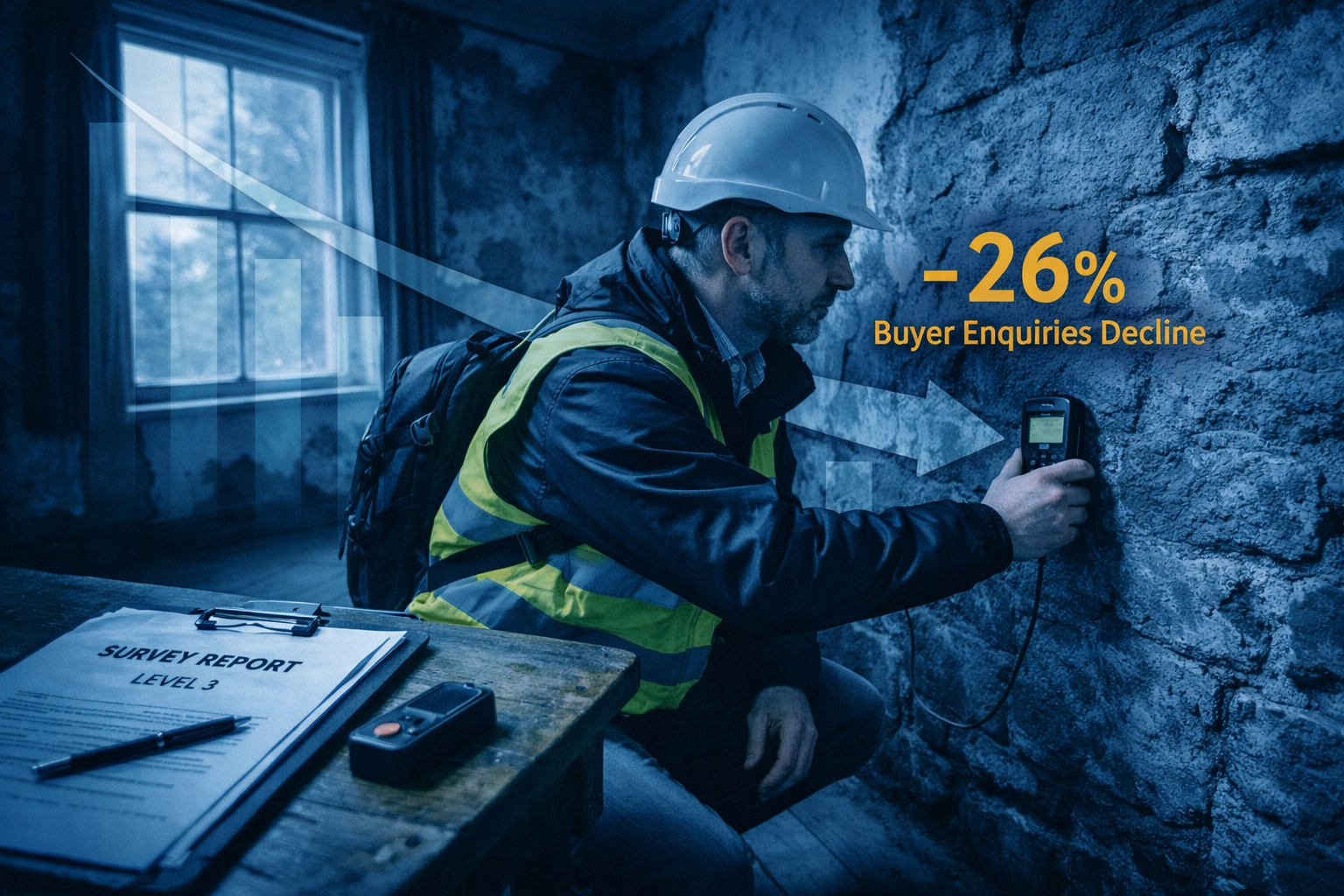
There is a common misconception that a quiet property market reduces the stakes for buyers. In reality, the opposite is true. When buyer enquiries fall by 26%, the buyers who remain active are typically those with genuine intent: those purchasing for long-term occupation, investors seeking value, or buyers who have already committed emotionally and financially. These individuals have the most to lose from an undiscovered defect.
The 2026 Market Context: Numbers That Matter
The data paints a stark picture of the current environment:
| Metric | April 2026 Value | Change |
|---|---|---|
| NAHB Builder Confidence Index | 34 | Lowest since Sept 2025 |
| Current Sales Conditions | 37 | ↓ 4 points |
| Future Sales Expectations | 42 | ↓ 7 points |
| Prospective Buyer Traffic | 22 | ↓ 3 points |
| Builders Offering Incentives | 60% | 13th consecutive month |
| Builders Cutting Prices | 36% | Avg. reduction of 5% |
Sources: [1][4]
"Demand uncertainty is reshaping builder strategy across land planning, capital allocation, and merger-and-acquisition decisions." [3]
This uncertainty does not evaporate at the point of sale. It flows directly into the transaction. When 62% of builders report higher material costs due to fuel price increases, and 70% face pricing challenges from future cost uncertainty [4], the knock-on effect for buyers is clear: repair and remediation costs are also rising. An undetected structural issue that might have cost £8,000 to fix in 2023 may now cost significantly more.
Why Fewer Buyers Means Greater Individual Exposure
With fewer competing buyers in the market, individual purchasers lose the implicit protection of competitive due diligence. In a hot market, multiple buyers scrutinise the same property. In a slow market, a single buyer may be the only one asking questions. That makes a comprehensive building survey not a luxury, but a fundamental protection mechanism.
Understanding Level 3 Protocols: What Sets Them Apart
Not all surveys are equal. The RICS framework offers three levels of survey, and understanding the distinction is essential for risk management.
Level 1 vs. Level 2 vs. Level 3: A Quick Comparison
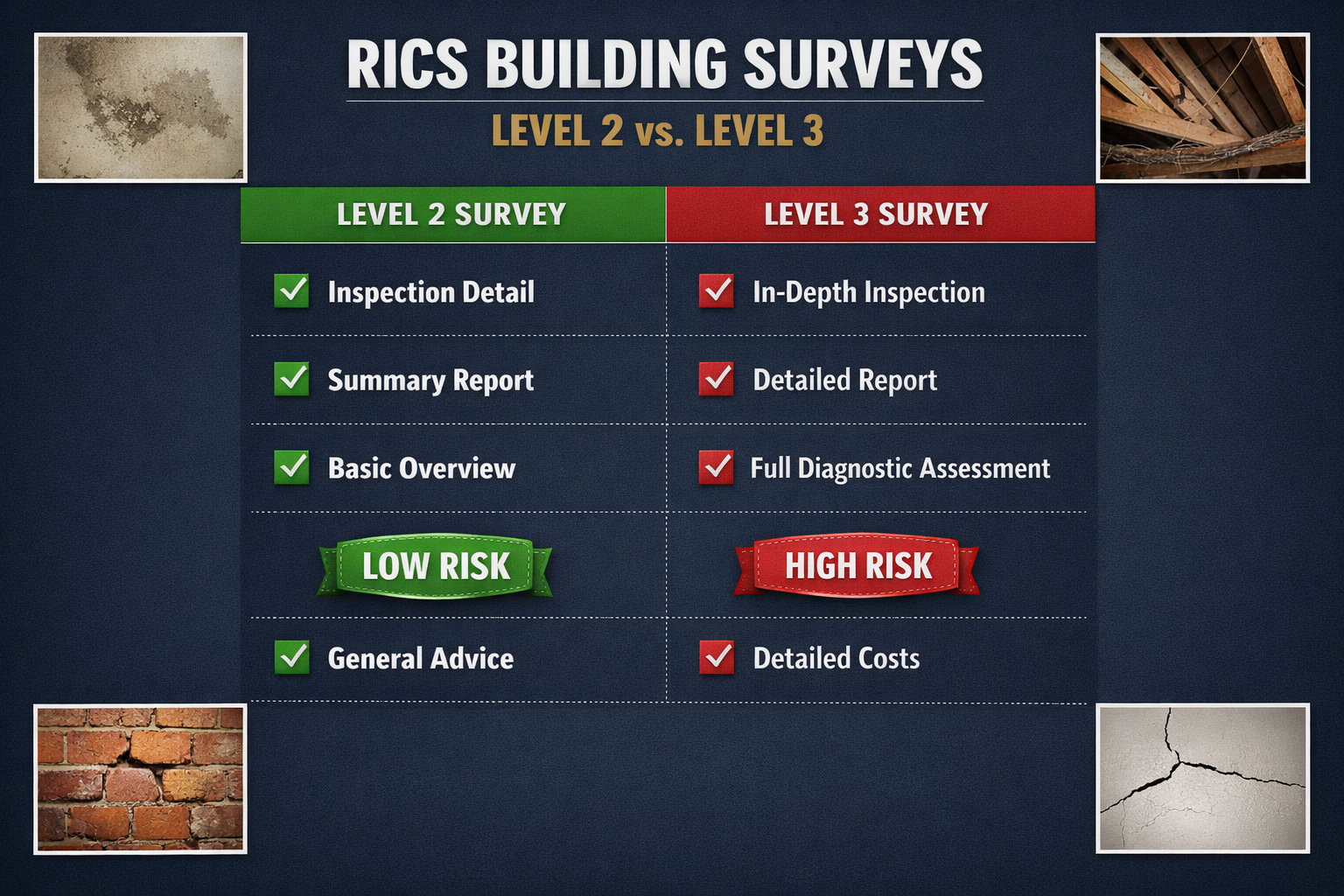
- Level 1 (Condition Report): Basic traffic-light condition ratings. Suitable only for new or near-new properties in good condition.
- Level 2 (Homebuyer Survey): A mid-range survey covering visible defects. Appropriate for conventional properties in reasonable condition. See our guide to Level 2 Homebuyer Surveys.
- Level 3 (Building Survey): The most thorough inspection available. Covers construction, materials, structural integrity, and all accessible areas. Includes detailed advice on defects, risks, and maintenance.
A RICS Level 3 Building Survey is specifically designed for:
✅ Older properties (pre-1900 construction)
✅ Properties that have been significantly altered or extended
✅ Buildings in poor or uncertain condition
✅ High-value purchases where financial exposure is significant
✅ Non-standard construction (timber frame, thatched, listed buildings)
✅ Any property where the buyer wants maximum information
What Level 3 Protocols Actually Examine
A Level 3 survey goes far beyond a visual walkthrough. Key inspection areas include:
- Structural elements: Walls, floors, roof structure, foundations
- Dampness and moisture: Using specialist meters and thermal imaging where appropriate
- Roof coverings: Tiles, flashings, gutters, chimneys — often supported by specialist roof surveys
- Services: Condition and visible adequacy of electrical, plumbing, and heating systems
- Drainage: Visible inspection of drainage runs and gullies
- Grounds and outbuildings: Paths, retaining walls, garages, and ancillary structures
- Legal and planning considerations: Observations on potential issues requiring legal investigation
The output is a detailed written report that does not just flag problems — it explains their likely cause, probable consequence if left unaddressed, and the urgency of action required.
Building Survey Certainty in Uncertain Times: How Level 3 Protocols Address Client Risk Management in 2026's -26% Buyer Enquiry Decline
The core value proposition of a Level 3 survey in 2026's market is straightforward: certainty is the scarcest commodity in an uncertain market. When economic signals are mixed, interest rates remain elevated, and material costs are volatile [1][4], buyers cannot afford surprises. A Level 3 survey systematically eliminates the most financially dangerous category of surprise — hidden structural and material defects.
Risk Management Through Information Depth
Risk management in property purchase operates on a simple principle: you cannot manage a risk you do not know exists. Level 3 protocols address this by maximising the information available before exchange of contracts.
Consider the following risk categories and how Level 3 surveys address them:
| Risk Category | Level 3 Response |
|---|---|
| Structural movement or subsidence | Detailed assessment with crack mapping and monitoring recommendations |
| Damp penetration or rising damp | Moisture readings, source identification, remediation advice |
| Roof failure | Full inspection of accessible roof space and coverings |
| Timber decay or infestation | Visual and probe inspection of exposed timbers |
| Drainage failure | Observation of visible drainage; recommendations for CCTV survey |
| Asbestos-containing materials | Identification of likely locations; advice on management |
For buyers concerned about subsidence risks or damp-related issues, the Level 3 survey provides the foundational assessment that determines whether specialist investigations are needed.
The Financial Case: Survey Cost vs. Defect Cost
Critics of comprehensive surveys sometimes point to cost as a barrier. This argument collapses under scrutiny.
A typical Level 3 Building Survey costs between £600 and £1,500 depending on property size, age, and location. Compare this to:
- Structural repairs: £5,000–£50,000+
- Roof replacement: £8,000–£25,000
- Damp remediation: £2,000–£15,000
- Drainage repairs: £1,500–£10,000
💡 The survey cost is rarely more than 2-5% of the remediation costs it might uncover. In a market where 36% of builders are already cutting prices by an average of 5% [4], a survey finding can directly support a renegotiation that covers its own cost many times over.
For buyers wanting to understand structural survey pricing in more detail, the investment calculus almost always favours commissioning the most comprehensive survey available.
How Surveyors Can Position Level 3 as a Competitive Differentiator
For surveying practices, the 2026 market presents a genuine opportunity. As [2] notes, professional protocols that reduce transaction risk represent a competitive advantage in uncertain markets. Surveyors who communicate clearly — not just what they inspect, but why that depth of inspection matters in the current climate — will convert more cautious buyers into confident clients.
Key messaging themes that resonate in 2026:
- "Know before you commit" — framing the survey as pre-commitment intelligence
- "Your negotiating tool" — emphasising the renegotiation value of findings
- "Your exit strategy" — highlighting that a survey can justify withdrawal before exchange
- "Your maintenance roadmap" — positioning the report as a long-term asset management document
Practical Steps: Commissioning a Level 3 Survey in 2026's Market
Understanding the value of a Level 3 survey is one thing. Knowing how to commission one effectively is another.
Step 1: Choose the Right Surveyor
Look for:
- ✅ Full RICS membership (MRICS or FRICS)
- ✅ Demonstrable experience with the property type in question
- ✅ Local market knowledge — a surveyor familiar with London's chartered surveying landscape will understand regional construction patterns
- ✅ Clear, jargon-free reporting style
- ✅ Professional indemnity insurance
Step 2: Understand the Scope Before Booking
Ask your surveyor specifically:
- What areas will and will not be inspected?
- Will specialist sub-reports (e.g., drainage CCTV, asbestos sampling) be recommended?
- How long will the inspection take? (See our guide on how long a homebuyers survey takes for context.)
- What format will the report take, and how quickly will it be delivered?
Step 3: Use the Report Actively
A Level 3 survey report is not a pass/fail document. It is a risk register. Use it to:
- Prioritise findings by urgency (immediate action vs. monitor vs. future maintenance)
- Obtain contractor quotes for Category 3 (urgent) defects before exchange
- Renegotiate the purchase price based on documented remediation costs
- Plan post-purchase maintenance using the surveyor's recommendations
- Inform insurance applications — some findings will affect building insurance terms
Step 4: Consider Specialist Add-Ons
Depending on the property, a Level 3 survey may recommend or benefit from supplementary investigations:
- Structural surveys for properties with visible movement
- Drainage surveys for older or extended properties
- Asbestos surveys for pre-2000 construction
- Solid floor slab surveys where ground floor construction is uncertain
Building Survey Certainty in Uncertain Times: Regional Variations and What They Mean for Risk
Market conditions are not uniform across the UK. The NAHB data shows significant regional variation in builder confidence — Northeast at 42, Midwest at 41, South at 35, and West at 29 [1][4]. While this is US data, it reflects a broader truth: property market risk is geographically variable.
In the UK context, this means:
- London and South East: High property values amplify the financial stakes of undiscovered defects. A 5% price reduction on a £700,000 property is £35,000 — often more than the total cost of the defects that justified it.
- Regional markets: Lower transaction volumes mean less comparable data, making independent survey findings even more valuable as a basis for negotiation.
- Older housing stock: The UK's Victorian and Edwardian housing stock presents consistent structural survey challenges — subsidence, damp, original drainage — that make Level 3 protocols particularly appropriate.
Buyers working with local chartered surveyors who understand the specific construction patterns and ground conditions of their area gain an additional layer of contextual insight that generic survey providers cannot match.
Conclusion: Certainty Is the Investment That Pays for Itself
The 2026 property market is defined by hesitation. Builder confidence at 34, prospective buyer traffic at 22, and a 26% decline in buyer enquiries all point to a market in which caution is the dominant emotion [1][4]. But caution without information is not protection — it is paralysis.
Building Survey Certainty in Uncertain Times: How Level 3 Protocols Address Client Risk Management in 2026's -26% Buyer Enquiry Decline is ultimately about a simple reframe: the buyers who proceed in this market are not reckless — they are decisive. And decisive buyers deserve the best possible information to support their decisions.
A RICS Level 3 Building Survey provides exactly that. It transforms uncertainty into a structured risk register, turns potential surprises into negotiating leverage, and converts a stressful purchase into a managed process.
Actionable Next Steps for Buyers in 2026:
- Do not skip the survey to save money — the cost-benefit calculation almost always favours commissioning one.
- Upgrade to Level 3 if the property is older, altered, or of non-standard construction.
- Engage a RICS-qualified local surveyor with direct experience of the property type and area.
- Use the report actively — as a negotiation tool, a maintenance plan, and an insurance reference document.
- Commission specialist investigations where the survey recommends them — do not leave flagged risks uninvestigated.
In a market where 70% of builders are uncertain about future material costs [4], every buyer should be equally rigorous about the condition of the asset they are about to purchase. A Level 3 survey is not an expense — it is the most rational investment a cautious buyer can make.
References
[1] Builder Sentiment Posts Notable Decline On Economic Uncertainty – https://www.nahb.org/news-and-economics/press-releases/2026/04/builder-sentiment-posts-notable-decline-on-economic-uncertainty
[2] Building Survey Certainty As Competitive Advantage How Professional Protocols Reduce Transaction Risk In 2026s Uncertain Market – https://nottinghillsurveyors.com/blog/building-survey-certainty-as-competitive-advantage-how-professional-protocols-reduce-transaction-risk-in-2026s-uncertain-market
[3] Survey Reveals Demand Uncertainty Is Changing 2026 Homebuilding Strategy – https://www.housingwire.com/articles/survey-reveals-demand-uncertainty-is-changing-2026-homebuilding-strategy/
[4] Builder Sentiment Posts Sharp Decline Driven By Economic Uncertainty – https://themortgagepoint.com/2026/04/24/builder-sentiment-posts-sharp-decline-driven-by-economic-uncertainty/