
Builder activity indicators fell to 48 in Q1 2026—below the neutral 50 threshold for the first time in over a year—signaling that construction professionals face a fundamentally different operating environment than the boom years of 2021-2022 [4]. This contraction creates unique challenges for property owners and surveyors managing Party Wall Surveys Amid Cautious Q2 2026 Housing Recovery: Managing Notices in Low-Transaction Volumes, where reduced development activity paradoxically increases the complexity of each individual case.
The UK housing market's tentative recovery in Q2 2026 presents a distinctive operational landscape. With transaction volumes remaining suppressed despite modest improvement signals, party wall surveyors must adapt their notice management strategies to accommodate longer timelines, heightened neighbour sensitivity, and evolving legislative requirements. Understanding how to navigate party wall procedures efficiently during this period of market uncertainty becomes essential for homeowners, developers, and construction professionals alike.

Key Takeaways
- Transaction volumes remain 15-20% below pre-pandemic levels in Q2 2026, creating extended timelines for party wall agreement processes and requiring adjusted project scheduling
- New 2026 legislative changes have repositioned tenant rights as central to party wall notices for buy-to-let properties, demanding updated compliance procedures [2]
- Efficient party wall management during low-activity periods requires proactive neighbour engagement, clear documentation, and strategic timing to avoid costly delays
- Professional surveyor involvement becomes more critical when market uncertainty increases neighbour caution and potential for disputes
- Cost management strategies can reduce party wall survey expenses by 20-30% through early planning and streamlined agreement processes
Understanding the Q2 2026 Housing Market Context
Market Fundamentals Shaping Party Wall Activity
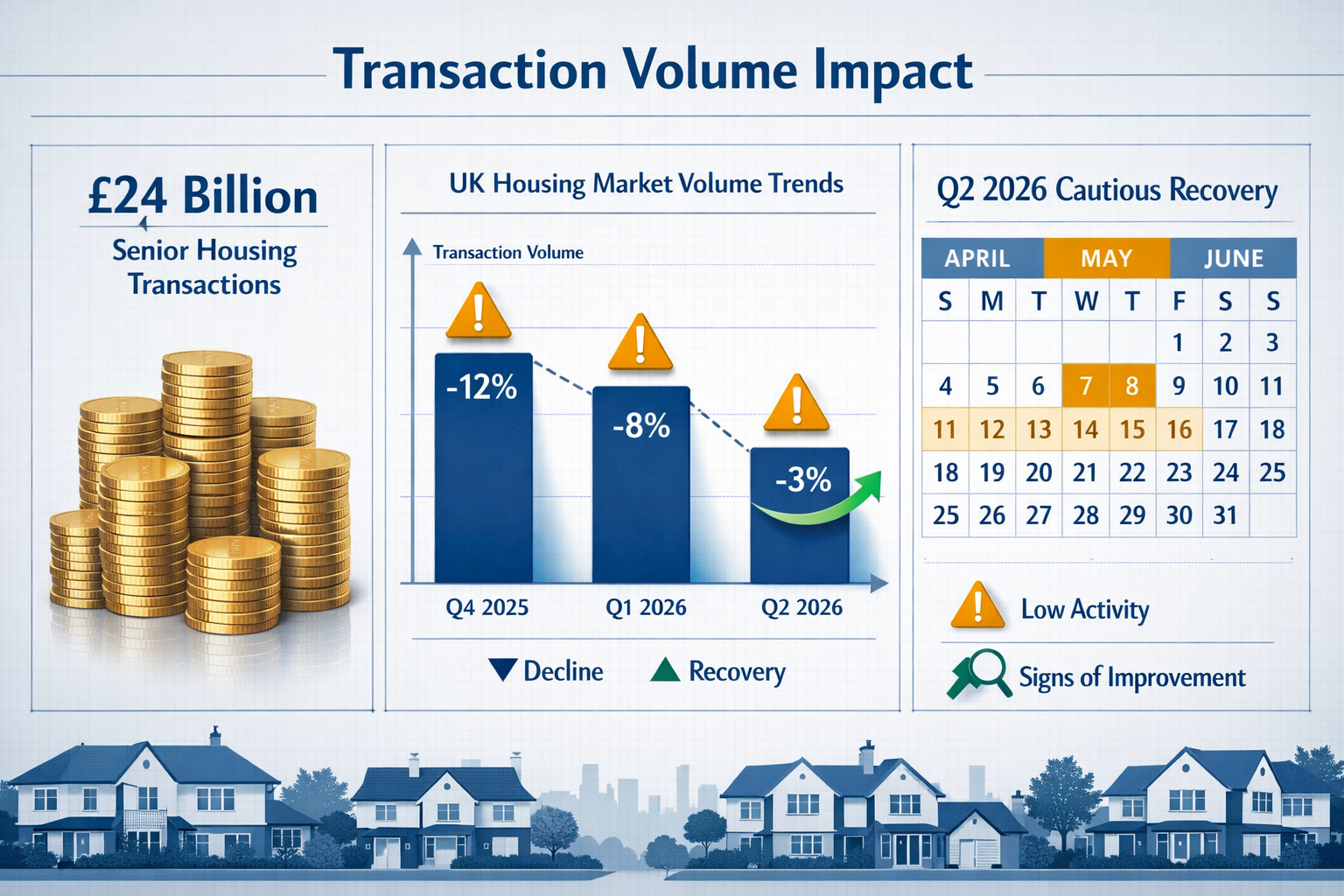
The housing recovery entering Q2 2026 exhibits characteristics distinctly different from previous market cycles. U.S. construction spending is projected to reach approximately $2.2 trillion in 2026, representing only a 1% increase following a 1% decline in 2025 [3]. This modest growth trajectory reflects persistent uncertainty among both institutional investors and individual homeowners.
Senior housing transactions reached $24 billion by year-end 2025—the highest level since Q2 2015—indicating that institutional capital is returning selectively to real estate sectors [1]. However, this institutional confidence hasn't yet translated to broader residential construction activity, where builder confidence remains fragile.
The implications for party wall surveys are significant:
- Fewer concurrent projects mean neighbours are less accustomed to construction disruption
- Extended project timelines increase the duration of party wall agreements
- Higher scrutiny from adjoining owners concerned about property values in uncertain markets
- Reduced surveyor availability in some regions as professionals consolidate practices
Legislative Changes Impacting 2026 Party Wall Procedures
The 2026 Party Wall legislative changes have fundamentally repositioned tenant rights within all party wall notices and procedures, particularly affecting institutional buy-to-let properties [2]. These reforms require building owners to:
✅ Provide enhanced notice provisions to tenants occupying adjoining properties
✅ Document tenant consultation processes before commencing notifiable works
✅ Implement additional safeguards when works may affect leasehold interests
✅ Maintain compliance records demonstrating adherence to new Section 8 ground requirements
For property owners planning extensions, loft conversions, or excavations near boundaries, understanding these requirements prevents costly compliance failures. The notice for excavation near a neighbour process now incorporates additional documentation steps that extend timelines by 2-4 weeks in typical cases.
Party Wall Surveys Amid Cautious Q2 2026 Housing Recovery: Strategic Timing Considerations
Optimizing Notice Timing in Low-Activity Markets
The subdued market momentum documented in Q2 2026 construction data creates both challenges and opportunities for party wall notice management. When transaction volumes remain suppressed, property owners can leverage reduced construction competition to negotiate more favorable surveyor rates and secure faster appointment scheduling.
Strategic timing advantages in Q2 2026 include:
| Timing Factor | Impact on Party Wall Process | Recommended Action |
|---|---|---|
| Reduced surveyor demand | 15-25% faster appointment availability | Book initial consultations 3-4 weeks ahead rather than 6-8 weeks |
| Neighbour availability | Higher likelihood of prompt response to notices | Serve notices during traditional planning periods (Jan-Mar, Sep-Oct) |
| Contractor scheduling | More flexible start dates reduce timeline pressure | Coordinate party wall agreements with contractor availability windows |
| Material costs | Stabilized pricing enables accurate party wall cost projections | Lock in surveyor fees early to avoid potential rate increases |
Managing Extended Response Timelines
Homebuilder surveys reveal that demand uncertainty is fundamentally reshaping land strategy, capital planning, and M&A decisions across the construction sector [5]. This caution extends to individual homeowners receiving party wall notices, who may delay responses due to:
- Financial uncertainty about their own property plans
- Concern about property value impacts during market recovery
- Increased scrutiny of technical details and potential risks
- Desire for additional professional advice before consenting
To manage these extended timelines effectively, building owners should:
- Serve notices 12-14 weeks before planned works (versus the traditional 8-10 weeks)
- Include comprehensive explanatory materials with initial notices to reduce follow-up questions
- Offer early informal discussions before formal notice service
- Provide clear contact information for surveyor inquiries to streamline communication
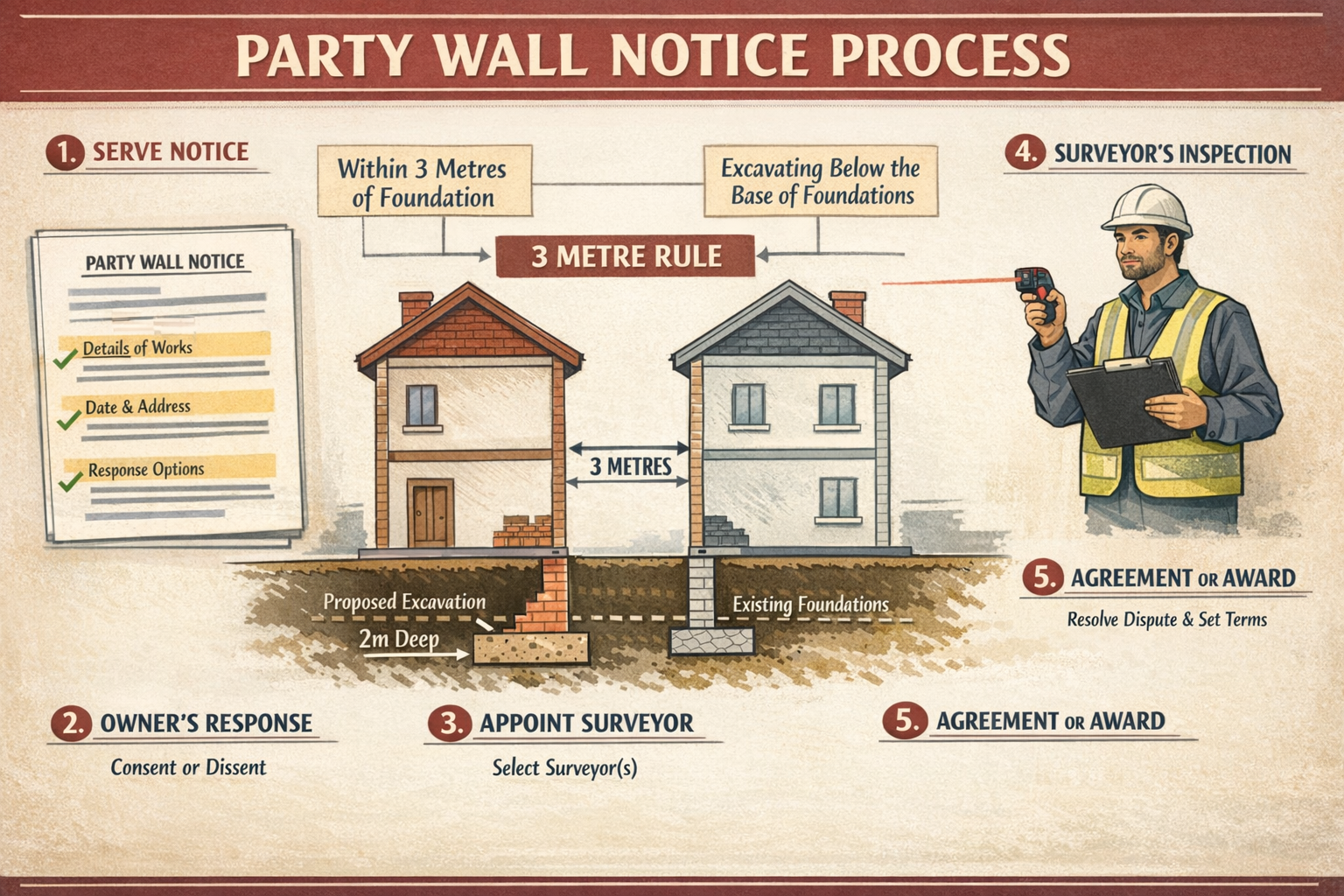
Understanding what is the three meter rule helps property owners determine whether their excavation works trigger party wall notice requirements, avoiding unnecessary delays from incorrect notice service.
Managing Notices in Low-Transaction Volumes: Practical Strategies
Proactive Neighbour Engagement Techniques
When housing transaction volumes remain suppressed, neighbours often exhibit heightened sensitivity to construction activities that might affect property values or marketability. The structural housing deficit of 1.5 million units estimated by NAHB Economics [7] creates competitive pressure in desirable neighborhoods, making adjoining owners particularly protective of their property interests.
Effective engagement strategies for Q2 2026 conditions include:
🏘️ Pre-Notice Informal Discussion: Arrange a casual conversation 2-3 weeks before serving formal notices to explain project scope and address concerns early
📋 Comprehensive Information Packages: Provide detailed project descriptions, timeline estimates, and noise/disruption mitigation plans alongside statutory notices
🤝 Collaborative Problem-Solving: Invite neighbours to suggest scheduling preferences or specific concerns to incorporate into work plans
💼 Professional Presentation: Use chartered surveyors to demonstrate project legitimacy and commitment to proper procedures
The importance of addressing potential obstruction in party wall scenarios early cannot be overstated, as discovering structural complications mid-project creates expensive delays and neighbour relationship damage.
Streamlining Agreement Processes
Proposed homebuying process reforms could require 1-1.5 million additional building assessments annually if universal survey requirements are implemented [6]. This potential surge in surveyor workload makes efficient party wall agreement processes increasingly valuable.
Process optimization techniques include:
1. Early Surveyor Appointment
Engage your appointed surveyor 6-8 weeks before notice service to:
- Review project plans for party wall implications
- Identify potential dispute areas requiring pre-emptive solutions
- Prepare comprehensive notice documentation
- Establish communication protocols with adjoining owners
2. Standardized Documentation Templates
Utilize professionally prepared templates for:
- Party wall notices (Section 1, Section 3, Section 6)
- Schedule of condition reports documenting pre-work property status
- Party wall awards specifying work parameters and safeguards
- Photographic evidence protocols
3. Digital Communication Platforms
Implement secure document-sharing systems enabling:
- Real-time notice delivery confirmation
- Centralized correspondence tracking
- Quick reference to agreement terms during construction
- Dispute evidence preservation
4. Agreed Surveyor Arrangements
When adjoining owners consent, appointing a single "agreed surveyor" reduces costs by 40-60% compared to separate surveyor appointments while maintaining impartiality through professional RICS standards.
Handling Dissent and Dispute Resolution
The cautious market environment of Q2 2026 increases the likelihood of neighbours dissenting to party wall notices, triggering the statutory dispute resolution process. Understanding the consequences of proceeding with no party wall agreement helps building owners avoid potentially catastrophic legal and financial complications.
Dispute resolution framework under current conditions:
Week 1-2: Initial Dissent
- Adjoining owner refuses consent or fails to respond within 14 days
- Building owner must appoint their own surveyor
- Adjoining owner must appoint their surveyor or allow building owner's surveyor to make appointment
Week 3-6: Surveyor Engagement
- Surveyors inspect properties and review work specifications
- Schedule of condition documentation establishes baseline property status
- Technical discussions resolve construction methodology concerns
- Cost allocation negotiations determine expense responsibility
Week 7-10: Award Preparation
- Surveyors draft party wall award specifying:
- Permitted work scope and methods
- Access rights and scheduling restrictions
- Protective measures and monitoring requirements
- Cost responsibility allocation
- Dispute resolution procedures for variations
Week 11+: Award Implementation
- Formal award service to both parties
- 14-day appeal period (appeals rare but extend timelines 8-12 weeks)
- Work commencement upon award finalization
- Ongoing compliance monitoring
Cost Management in Uncertain Markets
Party wall survey costs vary significantly based on project complexity, property type, and whether disputes arise. In the cautious Q2 2026 environment, building owners should budget conservatively while implementing cost-control strategies.
Typical cost ranges for 2026:
- Simple party wall notice (agreed surveyor): £700-£1,200
- Standard residential extension (separate surveyors): £1,500-£2,800
- Complex excavation works: £2,500-£4,500
- Commercial or multi-party scenarios: £4,000-£8,000+
Cost reduction strategies include:
💰 Early engagement reduces rushed fees and emergency surveyor premiums (typically 20-35% higher)
💰 Clear project specifications minimize surveyor time spent clarifying ambiguous work descriptions
💰 Proactive neighbour relations increase agreed surveyor acceptance rates, halving typical costs
💰 Bundled services combining party wall surveys with building surveys or structural engineering consultations achieve 15-25% fee efficiencies
For comprehensive property assessments beyond party wall requirements, choosing the right property survey ensures appropriate investigation scope without unnecessary expense.
Technical Considerations for 2026 Party Wall Projects
Excavation and Foundation Works
Foundation excavations trigger party wall notice requirements when works extend within three meters of neighbouring structures and below their foundation depth, or within six meters when excavating below a 45-degree plane from the neighbour's foundation base [3]. The 2026 ALTA/NSPS Guidelines effective February 23, 2026, provide updated standards for commercial property boundary surveys that inform party wall assessment protocols [8].
Critical excavation considerations include:
🔧 Soil condition assessment through preliminary damp surveys and ground investigation
🔧 Temporary works design specifying shoring, underpinning, or support systems protecting adjoining properties
🔧 Monitoring protocols establishing baseline measurements and ongoing settlement tracking
🔧 Contingency planning for unexpected ground conditions requiring design modifications
Structural Alterations and Load Considerations
Inserting new beams, removing chimney breasts, or creating openings in party walls requires careful structural analysis to prevent load transfer issues affecting adjoining properties. Modern beam calculations must account for both immediate construction impacts and long-term structural behavior.
Essential structural safeguards:
- Pre-work structural surveys documenting existing crack patterns, settlement, and defects
- Load path analysis confirming adequate support for redistributed forces
- Temporary propping specifications maintaining stability during construction phases
- Post-work inspection protocols verifying structural integrity and neighbour property protection
Insulation and Thermal Performance Upgrades
Energy efficiency improvements increasingly involve party wall considerations as property owners upgrade insulation in party walls to meet modern performance standards. While insulation installation on one's own side of a party wall typically doesn't require notice, works affecting the wall's structural integrity or requiring access to the neighbour's property do trigger party wall procedures.
Professional Surveyor Selection and Management
Qualifications and Expertise Requirements
The complex legislative landscape of 2026, combined with cautious market conditions, makes professional surveyor selection critically important. Qualified party wall surveyors should demonstrate:
✓ RICS membership (Chartered status preferred)
✓ Specific party wall expertise with demonstrable case history
✓ Local market knowledge understanding regional construction practices
✓ Professional indemnity insurance (minimum £2 million coverage)
✓ Clear fee structures with transparent billing practices
Local chartered surveyors offer advantages in understanding regional building characteristics, local authority requirements, and established relationships with area construction professionals.
Surveyor Communication Protocols
Effective surveyor management during low-transaction periods requires establishing clear communication expectations:
Initial appointment phase:
- Define response time expectations (24-48 hours for routine inquiries)
- Establish preferred communication channels (email, phone, video calls)
- Clarify reporting frequency and format preferences
- Confirm document delivery methods and timelines
Active project phase:
- Schedule regular progress updates (weekly or bi-weekly)
- Implement issue escalation procedures for urgent concerns
- Maintain centralized correspondence files accessible to all parties
- Document all site visits and inspection findings contemporaneously
Future-Proofing Party Wall Strategies
Anticipating Market Recovery Impacts
As Q2 2026 progresses toward potential market strengthening in late 2026 and 2027, party wall processes will evolve in response to:
📈 Increased transaction volumes reducing neighbour response times as construction activity normalizes
📈 Surveyor capacity constraints potentially increasing fees and extending appointment availability
📈 Regulatory refinements as 2026 legislative changes undergo practical implementation testing
📈 Technology adoption expanding digital notice service, virtual inspections, and automated documentation
Property owners planning works in the 12-24 month horizon should monitor these trends and adjust timing strategies accordingly.
Technology Integration Opportunities
Digital transformation offers significant efficiency improvements for party wall processes:
- Virtual inspection capabilities reducing site visit requirements by 30-40% for straightforward projects
- Digital signature platforms accelerating agreement execution from weeks to days
- Cloud-based documentation systems providing instant access to historical records and correspondence
- Automated compliance checking flagging potential notice requirement triggers during design phases
Conclusion: Navigating Party Wall Surveys in the 2026 Recovery Landscape
Party Wall Surveys Amid Cautious Q2 2026 Housing Recovery: Managing Notices in Low-Transaction Volumes demands strategic adaptation to market conditions that simultaneously create challenges and opportunities. The subdued transaction environment extends timelines and increases neighbour caution, yet also provides reduced surveyor demand, more flexible scheduling, and opportunities for cost-effective agreement processes.
Success requires proactive planning, starting party wall procedures 12-14 weeks before intended work commencement rather than the traditional 8-10 weeks. Professional surveyor engagement early in the design phase prevents costly mid-project complications and demonstrates commitment to proper procedures that reassures cautious neighbours. Clear communication and comprehensive documentation reduce dispute likelihood while protecting all parties' interests throughout the construction process.
The 2026 legislative changes affecting tenant rights and buy-to-let properties necessitate updated compliance procedures that building owners must integrate into standard party wall protocols. Understanding these requirements prevents enforcement actions and project delays that become exponentially more expensive in low-transaction markets where construction financing costs remain elevated.
Actionable Next Steps
For property owners planning works requiring party wall procedures in Q2 2026 and beyond:
- Conduct preliminary assessment determining which works trigger notice requirements under current legislation
- Engage qualified chartered surveyors 6-8 weeks before intended notice service
- Initiate informal neighbour discussions 2-3 weeks before formal notice delivery
- Prepare comprehensive documentation including project plans, timeline estimates, and disruption mitigation strategies
- Budget conservatively for surveyor fees and potential dispute resolution costs
- Monitor market conditions adjusting project timing to optimize cost and efficiency outcomes
The cautious housing recovery of 2026 will eventually transition to more robust market activity. Property owners who master efficient party wall management during this challenging period position themselves advantageously for future projects while protecting their most valuable asset—positive neighbour relationships that endure long after construction concludes.
For comprehensive property assessment services beyond party wall requirements, explore surveys covering structural integrity, building condition, and specialized investigations tailored to your specific property needs.
References
[1] The State Of The Senior Housing Market Fall 2026 – https://havenseniorinvestments.com/the-state-of-the-senior-housing-market-fall-2026/
[2] Party Wall Surveys For Renters Rights Act Compliance Managing Notices When Landlord Initiated Works Face New Section 8 Ground Requirements – https://nottinghillsurveyors.com/blog/party-wall-surveys-for-renters-rights-act-compliance-managing-notices-when-landlord-initiated-works-face-new-section-8-ground-requirements
[3] 98222 Fmi 2026 Construction Outlook Shows Uneven Gains – https://www.wconline.com/articles/98222-fmi-2026-construction-outlook-shows-uneven-gains
[4] Q2 Housing Data Shows Hope Spring Growth – https://hbsdealer.com/q2-housing-data-shows-hope-spring-growth
[5] Survey Reveals Demand Uncertainty Is Changing 2026 Homebuilding Strategy – https://www.housingwire.com/articles/survey-reveals-demand-uncertainty-is-changing-2026-homebuilding-strategy/
[6] Homebuying Process Reforms 2026 Impact On Early Building Surveys And Valuation Timing – https://nottinghillsurveyors.com/blog/homebuying-process-reforms-2026-impact-on-early-building-surveys-and-valuation-timing
[7] Supply Side Challenges Will Persist In The Eventual Housing Recovery – https://nhc.org/newsletter/supply-side-challenges-will-persist-in-the-eventual-housing-recovery/
[8] What 2026 Alta Nsps Updates Mean For Cre Professionals – https://www.partneresi.com/resources/articles/what-2026-alta-nsps-updates-mean-for-cre-professionals/