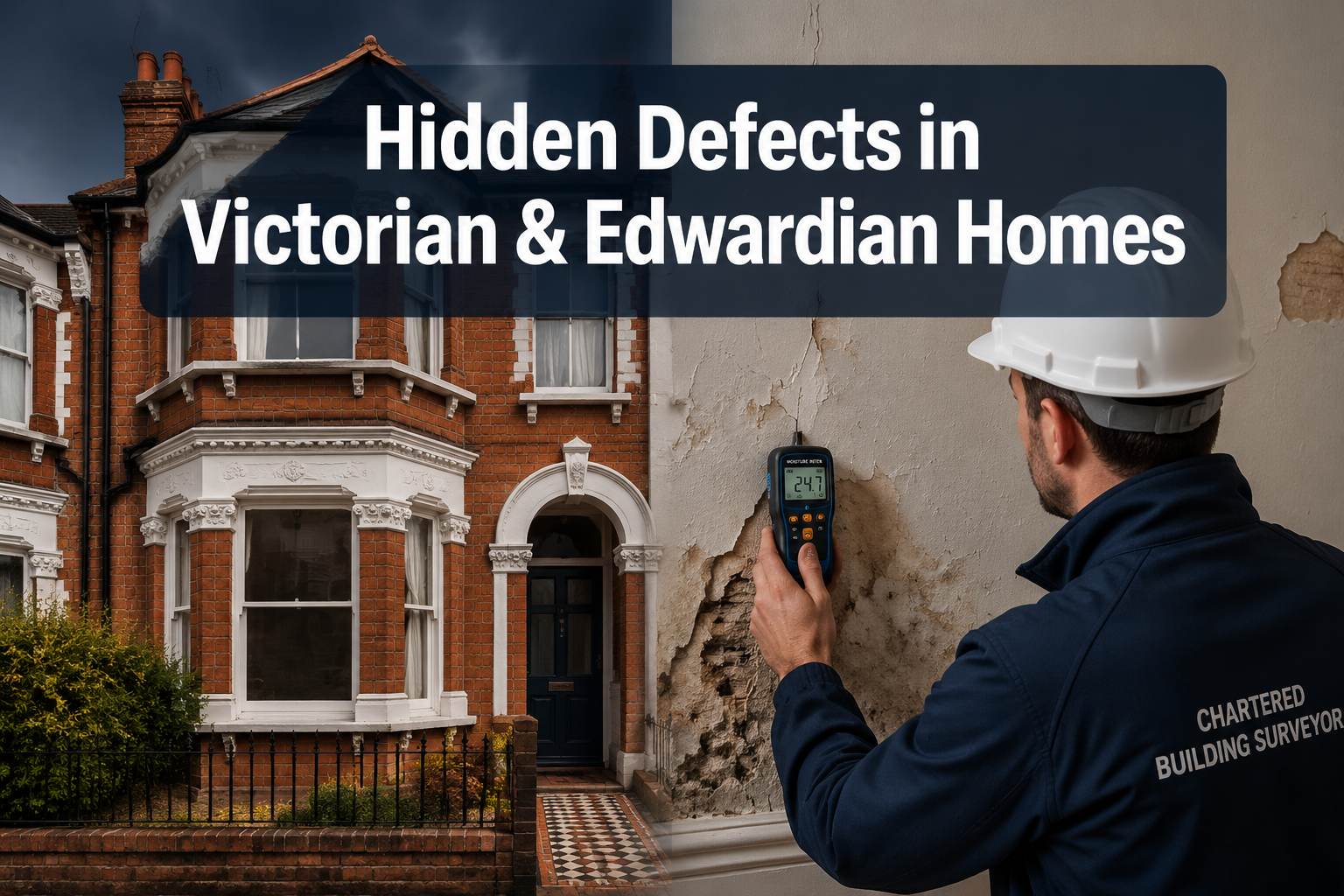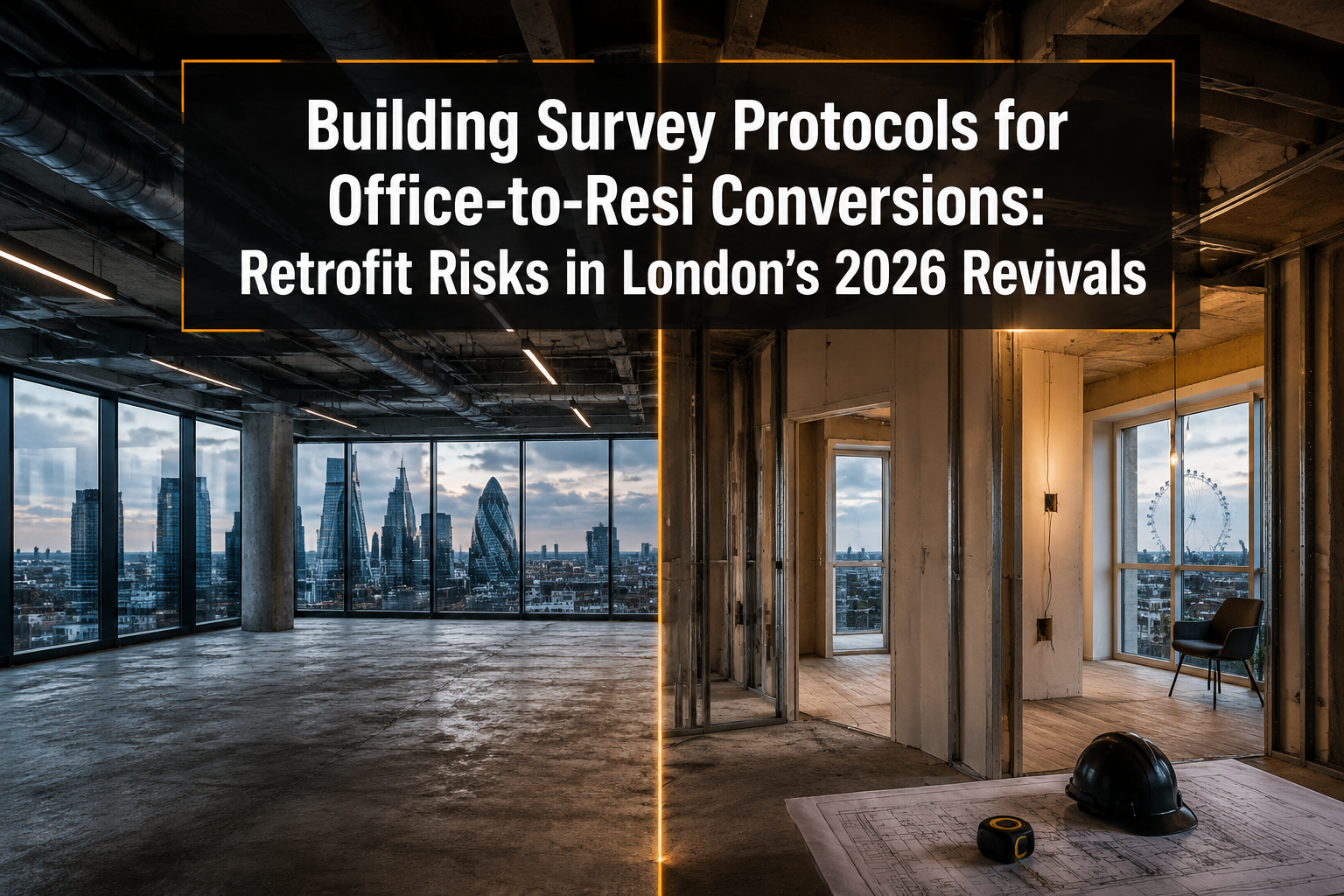

Fewer than one in three office-to-residential conversions in the UK complete on their original budget, according to industry cost-tracking data — a sobering figure that exposes just how routinely developers underestimate what lies behind a commercial building's facade. As London's 2026 revival of stalled office conversion schemes gathers pace, Building Survey Protocols for Office-to-Resi Conversions: Retrofit Risks in London's 2026 Revivals have moved from a niche technical concern to a front-line investment risk. Getting the survey stage right is no longer optional; it is the single most effective lever available to protect project viability.
Key Takeaways
- Office-to-residential conversions carry hidden structural, environmental, and regulatory risks that a standard visual inspection will not reveal.
- RICS-aligned Level 3 building surveys and intrusive investigations are now considered essential before committing capital to any conversion scheme.
- Deep floor plates, centralised cores, and legacy MEP systems create specific retrofit challenges that must be quantified at survey stage.
- EPC upgrade requirements and fire safety compliance under the Building Safety Act add significant cost layers that must be modelled early.
- Coordinated specialist input — structural engineers, asbestos consultants, M&E engineers, and fire safety advisors — is required to produce a reliable risk picture.
Why London's 2026 Conversion Wave Demands Rigorous Survey Protocols
London's office market has produced a large stock of underperforming or vacant buildings, particularly in inner and outer boroughs where hybrid working has permanently reduced occupier demand. Local authorities and the Mayor of London have signalled strong support for residential conversion as a route to housing delivery, and permitted development rights (PDR) continue to offer a streamlined planning pathway for many schemes.
However, the financial arithmetic is tighter than it appears. Developers who move quickly from acquisition to planning without commissioning thorough surveys regularly encounter cost overruns that erode or eliminate projected margins [4]. The Grove House project in Hammersmith — an office block being converted to a 171-room hotel — illustrates the pattern well: planning delays and structural limitations that were not fully scoped at the outset added both time and cost to a scheme that looked straightforward on paper [1].
The lesson for residential conversions is direct. Buildings that were designed and built for commercial occupation between the 1960s and 1990s carry a specific set of physical characteristics that conflict with residential requirements. Identifying those conflicts before contracts are exchanged is the purpose of a properly structured building survey protocol.
The stabilising Southern London market context
In boroughs such as Bromley, Croydon, Richmond, and parts of South East London, office values have stabilised at levels that make conversion financially viable — but only when conversion costs are accurately known. Surveyors operating across South East London and West London are reporting increased instruction volumes for pre-acquisition surveys on commercial stock, reflecting developer awareness that the margin for error is slim.
Core Elements of Building Survey Protocols for Office-to-Resi Conversions: Retrofit Risks in London's 2026 Revivals
A robust survey protocol for an office-to-residential conversion goes well beyond the scope of a standard Level 2 homebuyer report. The appropriate instrument is a RICS Level 3 building survey supplemented by specialist investigations. The following sections set out the key assessment areas.
Structural Integrity and Floor Plate Analysis
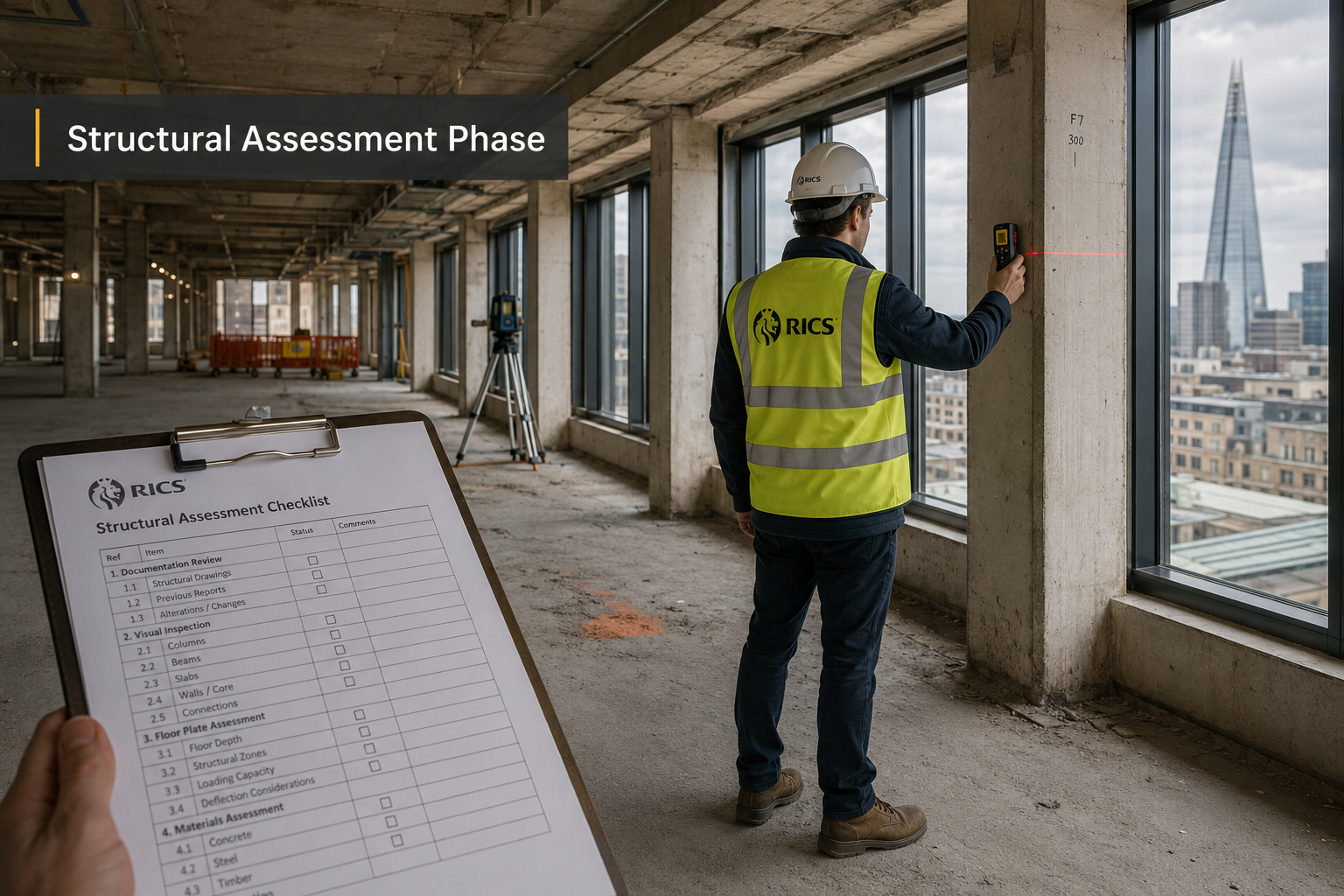
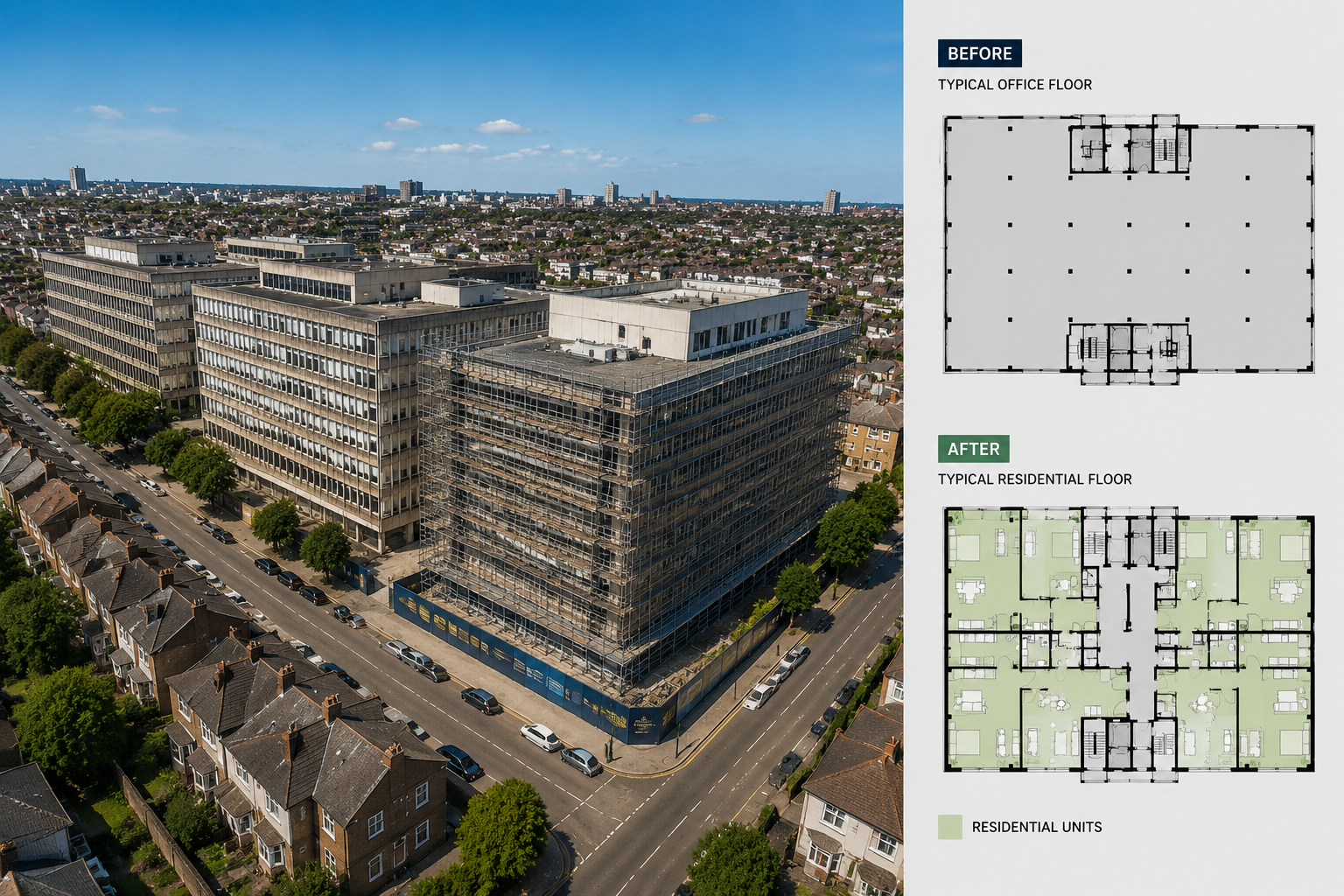
Office buildings — particularly those constructed between 1960 and 1995 — typically feature deep floor plates ranging from 15 to 25 metres in depth. This configuration supports open-plan commercial layouts but creates serious problems for residential conversion, because habitable rooms require natural light and ventilation that deep plates cannot provide without significant structural intervention [3].
A structural survey must assess:
- Slab and beam capacity: Residential loading patterns differ from commercial ones; the structural engineer must confirm whether existing slabs can carry partition walls, bathroom pods, and the increased point loads associated with domestic use.
- Core location: Centralised service cores in office buildings often sit where residential corridors need to run, forcing costly rerouting.
- Column grid: Wide-span column grids that suit open-plan offices rarely align with efficient residential unit layouts.
- Facade condition: Curtain wall systems common in 1970s-1990s offices frequently require full replacement to meet thermal and acoustic standards for residential use.
Engaging a structural engineering specialist at survey stage — rather than after planning consent — allows these constraints to be costed into the acquisition model.
Intrusive Surveys: No Longer Optional
Reliance on historical records and visual inspections has repeatedly proven insufficient for conversion projects [10]. Strip-out phases regularly uncover hidden defects, undocumented alterations, and hazardous materials that were invisible during desktop due diligence [2].
Intrusive surveys involve physical opening-up works to inspect:
- Voids above suspended ceilings
- Structural connections behind cladding
- Sub-floor conditions and drainage runs
- The condition of hidden steelwork and concrete
The cost of an intrusive survey is modest relative to the cost of discovering the same issues during construction. A specific defect report focused on identified high-risk elements can also be commissioned where full intrusive access is not yet available.
Asbestos and Hazardous Materials
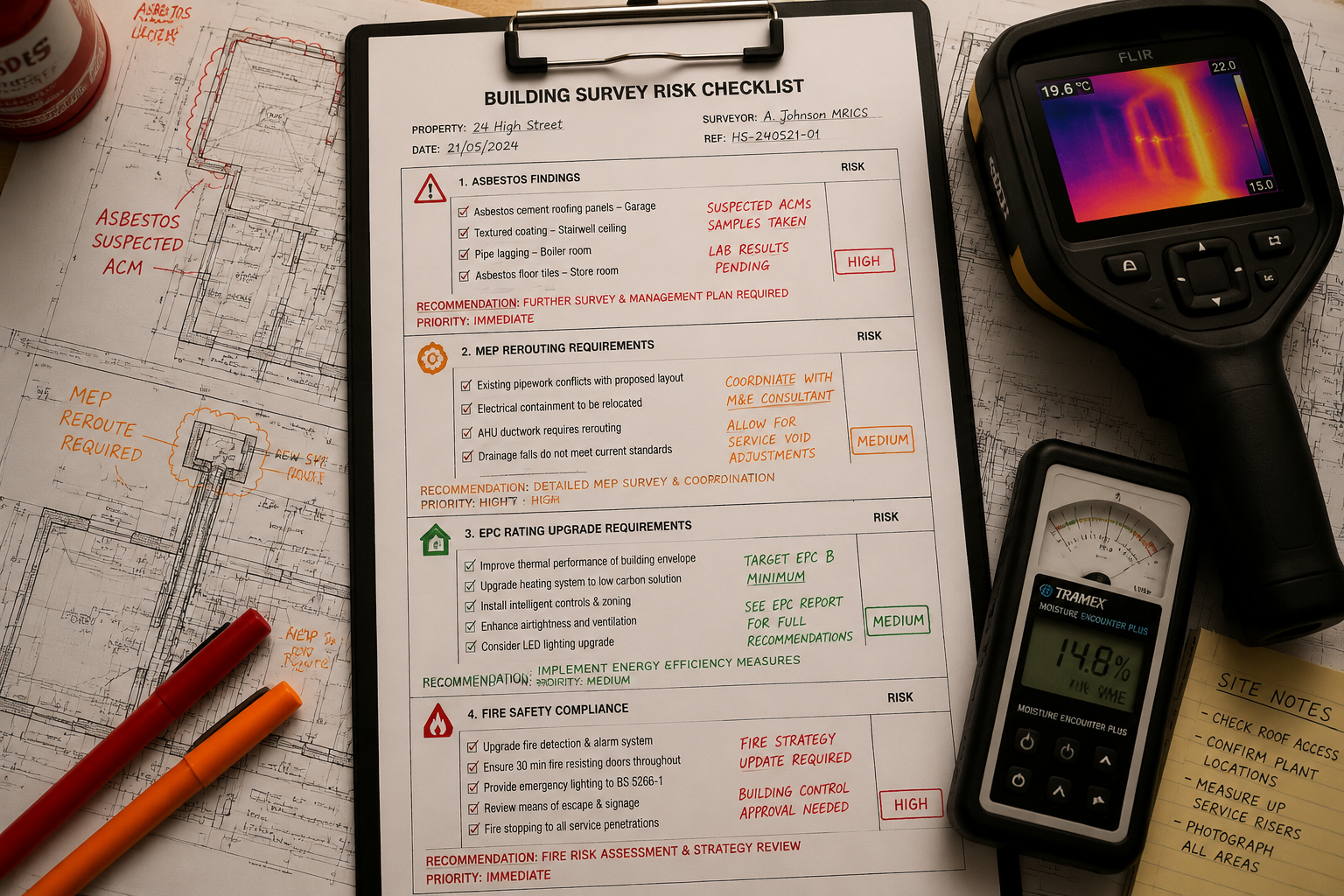
Any office building constructed before 2000 must be treated as a potential asbestos risk. Asbestos-containing materials (ACMs) were widely used in ceiling tiles, floor tiles, pipe lagging, fire-stopping compounds, and spray coatings. A management survey is the minimum requirement; a refurbishment and demolition survey is mandatory before any strip-out works begin.
Failure to identify ACMs before works commence creates both legal liability and significant cost exposure. Specialist asbestos surveys should be commissioned as a standalone instruction running parallel to the structural assessment, not as an afterthought.
MEP Systems, EPC Ratings, and Fire Safety: The Hidden Cost Drivers
Mechanical, Electrical, and Plumbing Challenges
Mechanical, electrical, and plumbing (MEP) systems in office buildings are designed around commercial occupancy patterns — centralised air handling units, raised access floors for cable management, and single-riser electrical distribution. None of these configurations translate efficiently to residential use [6].
The survey protocol must include an M&E audit covering:
| System | Office Configuration | Residential Requirement | Typical Risk |
|---|---|---|---|
| Ventilation | Centralised AHU | Individual MVHR per unit | Full replacement likely |
| Electrical | Single distribution board | Individual metered supplies | Major rerouting required |
| Plumbing | Centralised WC cores | Bathrooms and kitchens per unit | New riser design needed |
| Gas/Heat | Centralised plant | Individual or communal heat network | Plant room redesign |
The cost of MEP replacement is consistently one of the largest underestimated items in conversion budgets [4]. Surveyors should flag any building where the existing MEP infrastructure is more than 15 years old as carrying a high probability of full replacement cost.
EPC Upgrade Requirements
Achieving the Energy Performance Certificate ratings required for residential use frequently demands:
- External wall insulation (EWI) or internal wall insulation (IWI), both of which reduce net internal area
- Window replacement: Commercial glazing systems rarely meet Part L thermal requirements for dwellings
- Roof insulation upgrades
- Air-tightness works across the entire building envelope
These upgrades reduce the net saleable or lettable area of the converted building, directly affecting revenue projections [7]. A survey protocol that does not include a preliminary energy assessment is incomplete. The reduction in net internal area caused by insulation upgrades can be material — in some cases exceeding 5% of gross internal area — and must be factored into viability appraisals from the outset.
Fire Safety and the Building Safety Act
Converting offices to residential use triggers full compliance with the Building Safety Act 2022 and the associated suite of secondary legislation. For buildings over 18 metres in height, the requirements are particularly demanding, including the appointment of a Principal Designer and Principal Contractor with defined competency requirements [8].
The survey protocol must assess:
- Means of escape: Office staircore configurations rarely provide the compartmentation and travel distances required for residential occupation
- Structural fire resistance: Existing fire protection to structural elements must be verified, not assumed
- Cladding systems: Post-Grenfell, any external cladding must be assessed for combustibility and compliance
- Sprinkler requirements: Many converted buildings will require full sprinkler installation
Fire safety compliance is not a design-stage issue; it is a survey-stage issue, because the cost of achieving compliance can determine whether a scheme is viable at all.
Overheating Risk
A frequently overlooked risk in office-to-residential conversion is overheating. Office buildings with large areas of south or west-facing glazing, designed for commercial use where mechanical cooling is standard, can produce unacceptable internal temperatures in residential occupation, particularly in small self-contained flats [9]. The urban heat island effect in inner London boroughs amplifies this risk.
The survey should flag glazing orientation, window-to-wall ratios, and the presence or absence of external shading as overheating risk indicators. Mitigation — solar control glazing, external blinds, or mechanical cooling — adds cost that must be captured at the appraisal stage.
Practical Survey Checklist for Office-to-Resi Conversions in London
The following checklist summarises the minimum scope for a pre-acquisition building survey on an office-to-residential conversion candidate. This is not exhaustive, but it covers the areas most frequently responsible for cost overruns and project failures [5].
Structural Assessment
- Confirm slab type, span, and load capacity
- Identify column grid and assess alignment with proposed residential layout
- Inspect facade system and assess replacement or upgrade cost
- Check for evidence of settlement, movement, or underpinning history
- Review any available structural drawings and compare against as-built condition
Environmental and Hazardous Materials
- Commission refurbishment and demolition asbestos survey
- Check for contaminated land risk (particularly on former industrial sites)
- Assess drainage condition via drainage survey
- Identify any ground contamination or groundwater risk
MEP and Energy
- Audit existing M&E systems and estimate replacement scope
- Commission preliminary energy assessment and EPC projection
- Identify thermal bridge risks at structural junctions
- Assess roof condition and insulation upgrade potential via roof survey
Fire Safety and Regulatory Compliance
- Assess existing means of escape against residential standards
- Identify cladding type and combustibility classification
- Confirm building height and applicable Building Safety Act tier
- Check for any existing enforcement notices or outstanding compliance issues
Planning and Permitted Development
- Confirm whether the site falls within a PDR-restricted area
- Check for conservation area or listed building constraints
- Identify any Article 4 directions removing PDR
Coordinating Specialist Inputs: The Multi-Discipline Survey Model
No single surveyor can cover all the risk areas described above. Effective Building Survey Protocols for Office-to-Resi Conversions: Retrofit Risks in London's 2026 Revivals require coordinated input from a team of specialists whose findings are synthesised into a single risk register before any acquisition decision is made.
The core team typically includes:
- RICS Chartered Building Surveyor: Lead role, structural and fabric assessment, overall report coordination. A commercial building survey provides the foundation.
- Structural Engineer: Slab, frame, and foundation assessment
- M&E Engineer: MEP audit and replacement cost estimate
- Environmental Consultant: Asbestos, contamination, and drainage
- Fire Safety Consultant: Means of escape, cladding, and Building Safety Act compliance
- Energy Assessor: EPC projection and thermal upgrade specification
The absence of any one of these inputs creates a gap in the risk picture that will almost certainly surface as a cost overrun during construction [5]. Developers and their funders should treat a multi-discipline survey report as a prerequisite for credit approval on any conversion scheme.
"The cost of a comprehensive pre-acquisition survey is typically less than 0.5% of total project cost. The cost of discovering the same issues during construction is routinely 10 to 20 times higher."
Damp and Moisture Assessment
Office buildings with flat or low-pitch roofs, basement car parks, or ground-floor retail units often carry significant latent damp risk. A damp survey should be included in the protocol, particularly where the building has been vacant for an extended period. Vacant buildings deteriorate rapidly once heating and ventilation systems are switched off, and moisture ingress through failed flat roofs or blocked gutters can cause structural damage that is not visible without intrusive investigation.
Financial Modelling and Survey Findings: Closing the Loop
Survey findings are only useful if they feed directly into the financial appraisal. A common failure mode in conversion projects is the commissioning of surveys whose findings are then discounted or ignored under commercial pressure to proceed with an acquisition [4].
Best practice requires that:
- Survey findings are translated into cost ranges by quantity surveyors before heads of terms are finalised
- The acquisition price is adjusted to reflect survey-identified risks
- Contingency allowances are set at a level that reflects the degree of survey certainty — higher contingency where intrusive access was limited
- A formal risk register is maintained and updated as the design develops
In London's stabilising Southern markets, where office values have settled but construction costs remain elevated, the margin between a viable and an unviable scheme is often determined by the accuracy of the pre-acquisition cost model. A rigorous survey protocol is the most reliable input to that model.
Conclusion
Building Survey Protocols for Office-to-Resi Conversions: Retrofit Risks in London's 2026 Revivals represent a discipline that has matured rapidly in response to hard lessons from failed or overrun schemes. The combination of structural complexity, hazardous materials risk, MEP replacement cost, EPC upgrade requirements, and fire safety compliance creates a risk profile that demands systematic, specialist-led assessment before any commitment is made.
Actionable next steps for developers, investors, and their advisors:
- Commission a RICS Level 3 building survey as the minimum starting point for any office-to-residential conversion candidate.
- Supplement the building survey with specialist asbestos, structural engineering, M&E, and fire safety assessments before exchange of contracts.
- Require intrusive survey access as a condition of any acquisition where the building has been vacant or substantially altered.
- Translate all survey findings into costed risk ranges and incorporate them into the financial appraisal before finalising the acquisition price.
- Engage a lead surveyor with demonstrable experience of commercial-to-residential conversion projects in London, not simply general residential survey experience.
- Revisit the survey scope at planning consent stage, as design development frequently reveals new risk areas not visible at pre-acquisition stage.
The buildings being converted in 2026 are not straightforward. The surveys that assess them should not be either.
References
[1] London Office To Hotel Retrofit Risk – https://www.constructionmagazine.uk/2026/04/london-office-to-hotel-retrofit-risk.html?utm_source=openai
[2] Office Retrofit Strip Out Risk – https://www.constructionmagazine.uk/2026/05/office-retrofit-strip-out-risk.html?utm_source=openai
[3] Why Office To Residential Conversions Rarely Work In Dc – https://globalrealassets.georgetown.edu/insight/why-office-to-residential-conversions-rarely-work-in-dc/?utm_source=openai
[4] Uk Office To Residential Conversion Opportunities Guide B17283 – https://fraserbond.com/blog/article/uk-office-to-residential-conversion-opportunities-guide-b17283?utm_source=openai
[5] Building Survey Protocols For Office To Residential Conversions Spotting Risks In 2026 Revivals – https://princesurveyors.co.uk/blog/building-survey-protocols-for-office-to-residential-conversions-spotting-risks-in-2026-revivals/?utm_source=openai
[6] Office To Residential Mep Structural Red Flags – https://gdiengdesign.com/office-to-residential-mep-structural-red-flags/?utm_source=openai
[7] Public Housing Insights Cost Opportunities And Limitations Of Converting Offices To Housing – https://nla.london/news/public-housing-insights-cost-opportunities-and-limitations-of-converting-offices-to-housing?utm_source=openai
[8] Commercial To Residential Conversions – https://www.onformgroup.co.uk/insights/commercial-to-residential-conversions?utm_source=openai
[9] Office To Resi Conversions Safety Warning – https://centralhousinggroup.com/office-to-resi-conversions-safety-warning/?utm_source=openai
[10] Intrusive Surveys Mandatory Reuse – https://www.constructionmagazine.uk/2025/12/intrusive-surveys-mandatory-reuse.html?utm_source=openai