For the first time in Red Book history, environmental, social, and governance (ESG) considerations have become mandatory in all commercial property valuations—a seismic shift that fundamentally changes how chartered surveyors assess property values across the UK and globally. The Royal Institution of Chartered Surveyors (RICS) Red Book Valuation Standards for 2026: RICS Updates for Accurate Property Assessments represent the most comprehensive overhaul of valuation practices in decades, with changes that took effect on January 31, 2025, reshaping how professionals approach both residential and commercial property assessments.[1]
These updates arrive at a critical moment for UK property markets, where economic uncertainty, sustainability pressures, and technological advancement intersect. Whether conducting Canterbury property valuations or assessing large-scale commercial portfolios, surveyors must now navigate new mandatory requirements for ESG data integration, AI technology governance, and enhanced data management protocols.
Key Takeaways
- ESG factors are now mandatory in all commercial property valuations, requiring surveyors to record environmental, social, and governance data and assess their impact on values for the first time[1]
- AI and advanced technology usage is permitted with appropriate governance, provided human professional judgment remains central to all valuation decisions[1][3]
- New data management standards ensure transparency, confidentiality, and protection of data rights as valuers increasingly rely on multiple data sources[1]
- Valuation Practice Statements have been renumbered, with VPS 2, 3, and 4 changing positions to improve logical flow and usability[7]
- A fourth edition of the RICS ESG and Sustainability Standard becomes effective April 30, 2026, providing detailed practical guidance for implementing mandatory ESG requirements[4]
Understanding the Red Book Valuation Standards for 2026: RICS Updates for Accurate Property Assessments
The RICS Red Book serves as the global benchmark for property valuation standards, establishing mandatory practices that all RICS members must follow when conducting valuations. The current edition, published in December 2024 and effective from January 31, 2025, represents the culmination of extensive consultation and responds to fundamental shifts in how property markets operate.[6]
What Makes the 2026 Red Book Different? 🏢
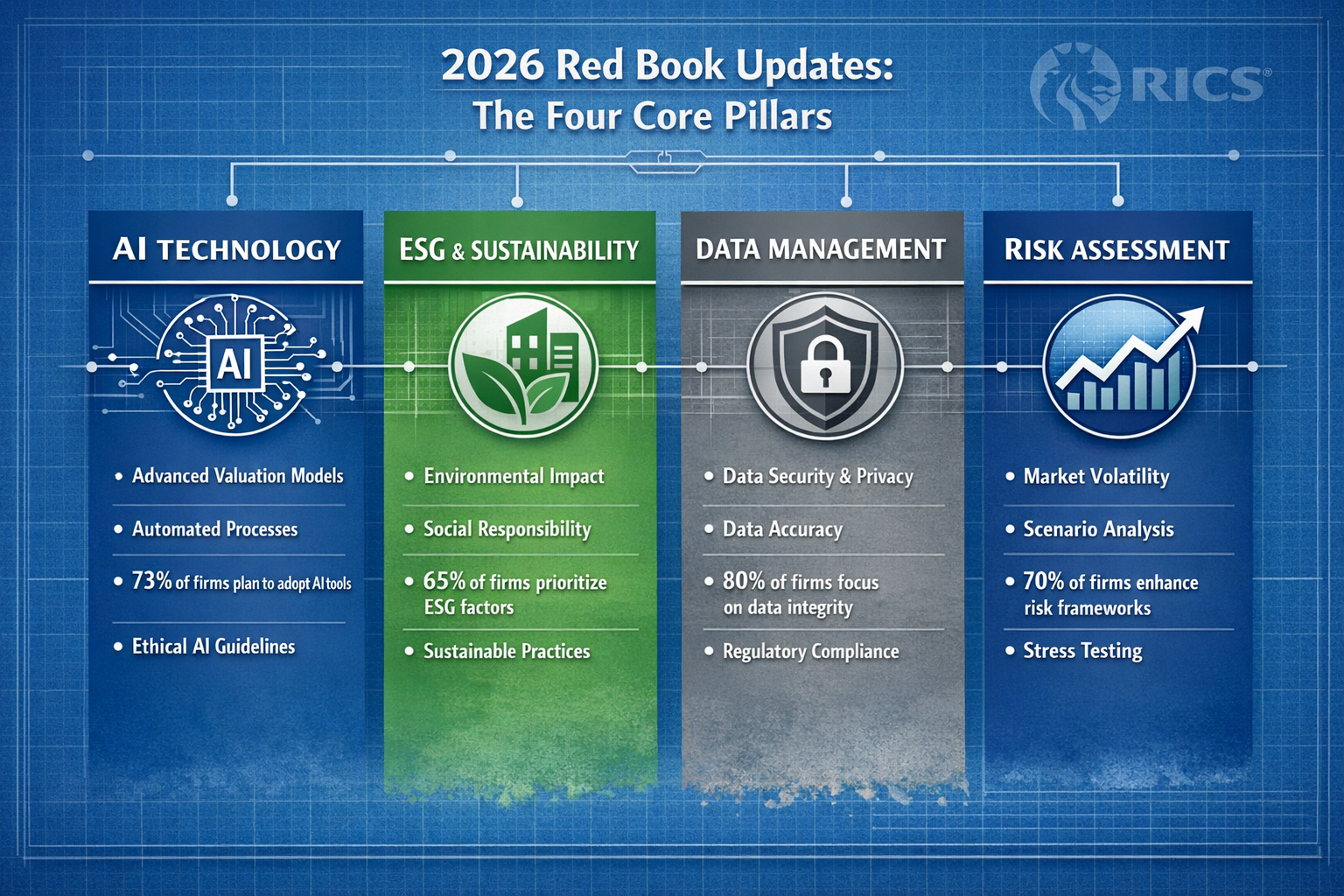
The Red Book Valuation Standards for 2026: RICS Updates for Accurate Property Assessments focus on four core areas that reflect contemporary valuation challenges:
- Valuation modeling – Enhanced methodologies for complex property assessments
- Risk assessment – Improved frameworks for identifying and quantifying valuation uncertainties
- ESG data integration – Mandatory consideration of sustainability factors
- AI and new technologies – Governance frameworks for technology-assisted valuations[1]
These updates align with International Valuation Standards (IVS) and incorporate recommendations from the RICS Valuation Review, ensuring consistency across global valuation frameworks while addressing UK-specific market conditions.[1]
The ESG Revolution in Property Valuation 🌱
Perhaps the most significant change in the Red Book Valuation Standards for 2026: RICS Updates for Accurate Property Assessments is the mandatory integration of ESG considerations into commercial property valuations. This requirement fundamentally alters how surveyors approach commercial property assessments.
What ESG factors must valuers now consider?
- Energy efficiency ratings and potential improvement costs
- Carbon footprint and emissions data
- Climate risk exposure including flood risk and extreme weather vulnerability
- Social factors such as accessibility, community impact, and health considerations
- Governance elements including building safety compliance and regulatory adherence[3][4]
The fourth edition of the RICS ESG and Sustainability Standard, effective April 30, 2026, provides detailed practical guidance on reflecting these factors in commercial property valuations worldwide.[4] This standard applies to all RICS members and firms undertaking commercial property valuations globally, responding to significant regulatory, market, and professional developments.
"ESG considerations are no longer optional add-ons—they're fundamental components of property value that must be recorded, analyzed, and reflected in every commercial valuation." – RICS Valuation Standards Committee
Key Changes in Valuation Practice Statements
The Red Book Valuation Standards for 2026: RICS Updates for Accurate Property Assessments include a significant restructuring of Valuation Practice Statements (VPS) to improve logical flow and usability for practitioners conducting everything from probate valuations to complex commercial assessments.
VPS Renumbering and Reorganization 📋
The new VPS structure effective January 31, 2025:[7]
| Previous Number | New Number | Statement Title |
|---|---|---|
| VPS 1 | VPS 1 | Terms of engagement (unchanged) |
| VPS 2 | VPS 4 | Inspections, investigations and records |
| VPS 3 | VPS 6 | Valuation reports |
| VPS 4 | VPS 2 | Bases of value |
| – | VPS 3 | Valuation approaches and methods |
| – | VPS 5 | Valuation review and quality assurance |
This reorganization places bases of value earlier in the sequence, reflecting its foundational importance to the valuation process. The new VPS 5 on valuation review and quality assurance represents an entirely new addition, emphasizing the importance of internal quality control procedures.[7]
Enhanced Inspection and Investigation Requirements
VPS 4 (formerly VPS 2) now includes strengthened requirements for property inspections, particularly relevant for RICS building surveys and specialist assessments. Surveyors must:
✅ Document the extent and limitations of their inspection clearly
✅ Record observable ESG-relevant factors during site visits
✅ Identify and note any AI-assisted data collection methods used
✅ Maintain comprehensive records of all investigations and data sources
✅ Clearly state assumptions where direct inspection was limited or not possible
These requirements ensure transparency and provide clients with clear understanding of what the valuation encompasses and its limitations.

Technology and AI Integration in Valuation Practice
One of the most forward-thinking aspects of the Red Book Valuation Standards for 2026: RICS Updates for Accurate Property Assessments is the explicit recognition and governance of AI and advanced technology in valuation processes.
When Can Surveyors Use AI? 🤖
The updated standards permit AI and advanced technology usage in valuations, provided that:
- Human professional judgment remains central to all valuation conclusions
- Appropriate governance frameworks are established and maintained
- Clear disclosure is made in valuation reports when AI-driven data analysis is adopted
- Technology limitations and assumptions are explicitly stated
- Data sources and algorithms are appropriately validated[1][3]
This balanced approach recognizes technology's potential to enhance valuation accuracy while maintaining the irreplaceable role of professional expertise and judgment.
Expanded Comparable Data Sources 📊
The Red Book Valuation Standards for 2026: RICS Updates for Accurate Property Assessments now explicitly allow comparable property information to include:
- Key performance indicators (KPIs) from property databases
- Metrics and benchmarking data from specialized service providers
- Market intelligence platforms and aggregated transaction data
- ESG performance databases and sustainability ratings
This expansion increases consistency and better aligns with global reporting standards, though professional judgment remains essential in determining the reliability and relevance of such data sources.[1]
Mandatory Data Management Standards 🔒
As valuers increasingly rely on multiple data sources—from traditional comparables to AI-generated insights—the updated Red Book introduces mandatory data management standards to ensure:
| Requirement | Purpose | Implementation |
|---|---|---|
| Transparency | Clear disclosure of data sources | Document all sources in valuation reports |
| Confidentiality | Protection of sensitive information | Secure data handling protocols |
| Data rights | Respect for intellectual property | Proper licensing and attribution |
| Quality control | Verification of data accuracy | Regular audits and validation procedures |
| Security | Protection against breaches | Cybersecurity measures and encryption |
These standards are particularly crucial for firms conducting commercial valuations across multiple jurisdictions where data protection regulations vary.
Practical Checklists for UK Surveyors
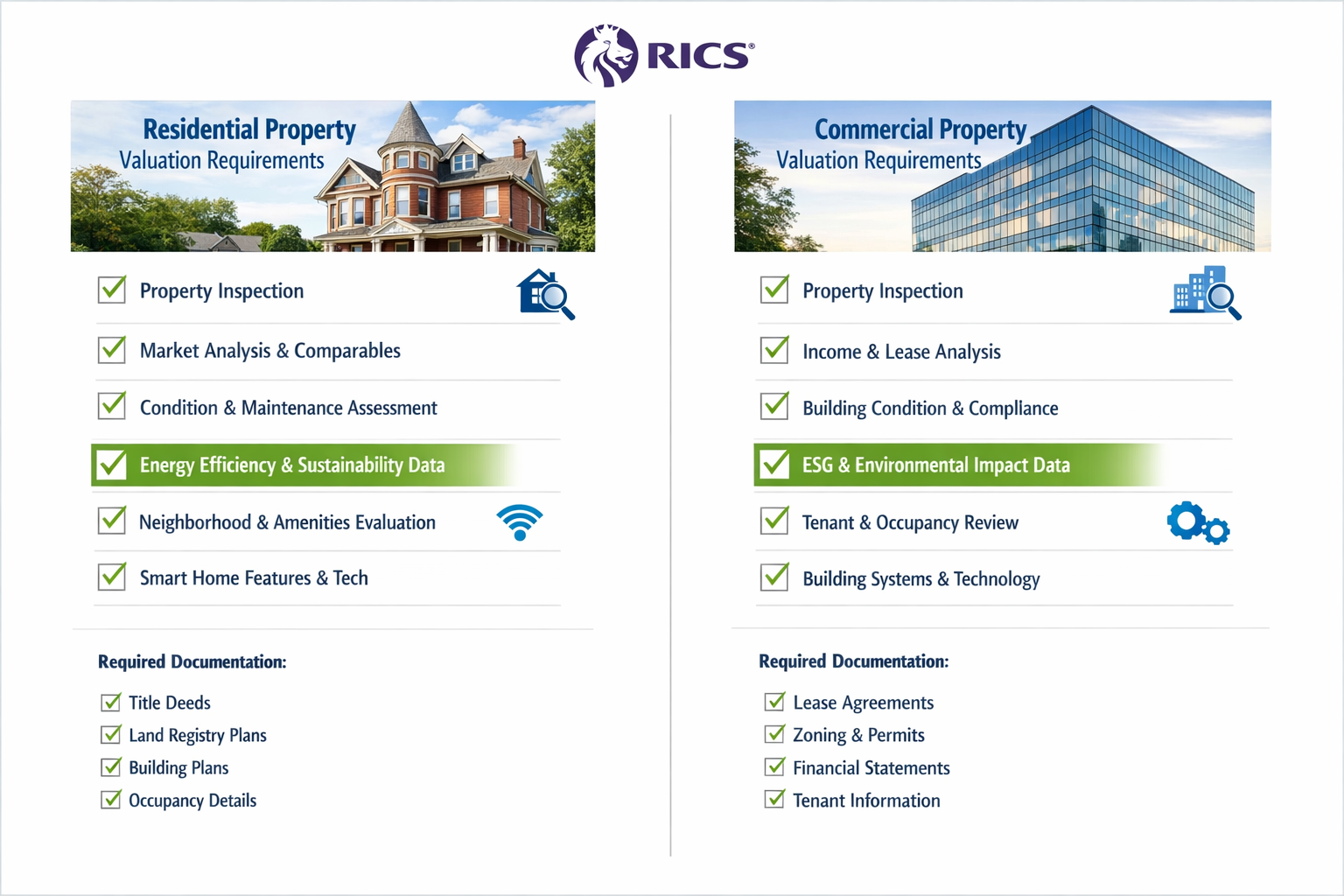
The Red Book Valuation Standards for 2026: RICS Updates for Accurate Property Assessments require surveyors to adapt their workflows significantly. Here are practical checklists for implementing these changes in residential and commercial contexts.
Residential Property Valuation Checklist 🏠
When conducting residential valuations under the new standards:
Pre-Inspection Preparation:
- ☑️ Review available ESG data (EPC ratings, flood risk, conservation area status)
- ☑️ Identify relevant comparable properties with similar characteristics
- ☑️ Prepare technology tools (if using AI-assisted valuation platforms)
- ☑️ Confirm terms of engagement comply with VPS 1 requirements
- ☑️ Establish data management protocols for client information
During Site Inspection:
- ☑️ Document observable sustainability features (insulation, glazing, heating systems)
- ☑️ Note any environmental concerns (damp, subsidence, structural issues)
- ☑️ Record property condition affecting energy efficiency
- ☑️ Photograph key features and defects
- ☑️ Assess accessibility and social factors if relevant
Post-Inspection Analysis:
- ☑️ Apply appropriate basis of value (typically market value for residential)
- ☑️ Analyze comparables with professional judgment
- ☑️ Consider ESG factors' impact on value (particularly EPC ratings)
- ☑️ Document any technology-assisted analysis used
- ☑️ Complete quality assurance review before report issuance
Report Preparation:
- ☑️ Clearly state basis of value and valuation approach (VPS 2)
- ☑️ Disclose inspection extent and limitations (VPS 4)
- ☑️ Include ESG considerations where material to value
- ☑️ State assumptions and special assumptions explicitly
- ☑️ Ensure compliance with VPS 6 reporting requirements
For specialized residential valuations such as lease extension valuations or shared ownership properties, additional considerations apply regarding leasehold interests and statutory frameworks.
Commercial Property Valuation Checklist 🏢
Commercial property valuations face more extensive ESG requirements under the Red Book Valuation Standards for 2026: RICS Updates for Accurate Property Assessments:
Mandatory ESG Data Collection:
- ☑️ Energy Performance Certificate (EPC) rating and potential improvements
- ☑️ BREEAM or similar certification status and ratings
- ☑️ Carbon emissions data and net-zero pathway analysis
- ☑️ Climate risk assessment (physical and transition risks)
- ☑️ Building safety compliance (particularly post-Grenfell requirements)
- ☑️ Accessibility standards and social value considerations
- ☑️ Governance factors including ownership structure and regulatory compliance
Valuation Approach Considerations:
- ☑️ Assess ESG impact on rental values and yields
- ☑️ Consider obsolescence risk from sustainability requirements
- ☑️ Evaluate capital expenditure needed for ESG improvements
- ☑️ Analyze tenant demand patterns related to ESG performance
- ☑️ Review comparable evidence with ESG characteristics
- ☑️ Apply appropriate adjustments for ESG differentials
Technology and Data Integration:
- ☑️ Document all data sources (market databases, ESG platforms, AI tools)
- ☑️ Validate data accuracy and relevance
- ☑️ Disclose any AI-assisted analysis in report
- ☑️ Maintain data security and confidentiality
- ☑️ Ensure compliance with data protection regulations
Report Requirements:
- ☑️ Include dedicated ESG section in valuation report
- ☑️ State how ESG factors influenced the valuation conclusion
- ☑️ Provide clear reasoning for ESG-related adjustments
- ☑️ Disclose data sources and methodologies
- ☑️ Address uncertainty and limitations explicitly
For complex commercial assessments including ATED valuations or capital gains tax valuations, additional statutory requirements apply alongside Red Book standards.
Navigating Multi-Jurisdictional Challenges
An important change in the Red Book Valuation Standards for 2026: RICS Updates for Accurate Property Assessments is the removal of cross-references to national supplements within the main global standards document.[1] While national supplements like the UK Red Book were reissued in January 2025 to complement the global standards, this change presents challenges for professionals managing multi-jurisdictional portfolios.[6]
UK-Specific Considerations 🇬🇧
Surveyors operating in the UK must ensure compliance with both:
- Global Red Book standards (mandatory for all RICS members)
- UK Red Book supplement (addressing UK-specific regulatory and market contexts)
- UK legislation including Building Safety Act, MEES regulations, and planning requirements
- Professional indemnity insurance requirements reflecting new standards
The UK supplement provides guidance on applying Red Book standards within the UK legal and regulatory framework, particularly important for statutory valuations and tribunal work.
Economic Context for 2026 UK Valuations 📈
The Red Book Valuation Standards for 2026: RICS Updates for Accurate Property Assessments must be applied within the current UK economic environment characterized by:
- Interest rate volatility affecting property yields and investment returns
- Inflation pressures impacting construction costs and replacement values
- Regulatory changes including strengthened building safety and ESG requirements
- Market uncertainty requiring careful consideration of valuation assumptions
- Technology disruption changing how property is used and valued
Surveyors must exercise heightened professional judgment in this environment, clearly stating assumptions and addressing uncertainty in their reports. The new VPS 5 on quality assurance provides frameworks for internal review processes that help maintain valuation reliability during volatile market conditions.
Specialized Valuation Applications
The Red Book Valuation Standards for 2026: RICS Updates for Accurate Property Assessments apply across all valuation types, though specific applications vary by purpose.
Statutory and Tax Valuations 💷
For statutory purposes including:
- Probate valuations – Market value at date of death
- Capital gains tax – Establishing base cost or disposal value
- ATED – Annual Tax on Enveloped Dwellings valuations
- Charities Act valuations – Disposal of charity property
The Red Book provides the framework, but surveyors must also comply with specific statutory requirements and HMRC guidance. The Charities Act valuation guide demonstrates how Red Book standards integrate with statutory obligations.
Leasehold Valuations 🔑
Leasehold valuations for enfranchisement, lease extensions, or freehold purchase must apply Red Book standards within the statutory framework of the Leasehold Reform Act and related legislation. The new standards' emphasis on transparency and clear assumptions is particularly valuable in these often-contentious valuations.
Insurance and Reinstatement Valuations 🏗️
Reinstatement cost valuations for insurance purposes require special consideration under the updated standards, particularly regarding:
- Building materials and specifications affected by sustainability requirements
- Construction cost inflation in current economic conditions
- Building regulations compliance including enhanced energy efficiency standards
- Professional fees and additional costs reflecting current market rates
Implementation Timeline and Transition Considerations
Understanding the effective dates for the Red Book Valuation Standards for 2026: RICS Updates for Accurate Property Assessments is crucial for compliance:
| Standard/Requirement | Effective Date | Key Considerations |
|---|---|---|
| Main Red Book (Global) | January 31, 2025 | Mandatory for all RICS members |
| UK Red Book Supplement | January 31, 2025 | UK-specific guidance and applications |
| ESG & Sustainability Standard (4th Edition) | April 30, 2026 | Detailed ESG implementation guidance |
| Renumbered VPS | January 31, 2025 | Updated references in reports required |
Transition Best Practices ✅
Surveying firms should:
- Update templates and reports to reflect new VPS numbering and requirements
- Train staff on ESG data collection and integration methodologies
- Review technology systems for compliance with data management standards
- Establish AI governance frameworks if using technology-assisted valuations
- Update professional indemnity insurance to ensure coverage under new standards
- Review quality assurance procedures in line with new VPS 5 requirements
- Develop ESG data sources and partnerships for commercial valuations
Common Pitfalls and How to Avoid Them ⚠️
As surveyors implement the Red Book Valuation Standards for 2026: RICS Updates for Accurate Property Assessments, several common mistakes should be avoided:
Pitfall 1: Treating ESG as Optional
The Problem: Some surveyors may view ESG considerations as "nice to have" rather than mandatory.
The Solution: ESG data recording and impact assessment is mandatory for all commercial property valuations. Establish systematic processes for ESG data collection during every commercial inspection.[1][4]
Pitfall 2: Over-Reliance on Technology
The Problem: Assuming AI-generated valuations can replace professional judgment.
The Solution: Technology must support, not replace professional expertise. Always apply critical analysis to technology-generated outputs and clearly state the role of AI in your methodology.[1][3]
Pitfall 3: Inadequate Data Management
The Problem: Failing to document data sources, maintain confidentiality, or secure client information.
The Solution: Implement comprehensive data management protocols covering transparency, security, and rights management for all data sources used in valuations.[1]
Pitfall 4: Ignoring VPS Renumbering
The Problem: Using outdated VPS references in reports and documentation.
The Solution: Update all templates, reports, and procedures to reflect the new VPS numbering effective January 31, 2025.[7]
Pitfall 5: Insufficient Assumption Disclosure
The Problem: Making assumptions without clearly stating them in valuation reports.
The Solution: Explicitly state all assumptions and special assumptions in accordance with VPS 4 and VPS 6 requirements, particularly regarding ESG data availability and market conditions.
Professional Development and Continuing Competence
The Red Book Valuation Standards for 2026: RICS Updates for Accurate Property Assessments require surveyors to maintain competence in evolving areas including:
- ESG assessment methodologies and sustainability metrics
- Technology governance and AI-assisted valuation techniques
- Data management and cybersecurity protocols
- Market analysis in volatile economic conditions
- Regulatory compliance with building safety and environmental legislation
RICS members should engage in continuing professional development (CPD) activities focused on these areas to ensure they can competently apply the updated standards. Many professional bodies and training providers offer specialized courses on Red Book compliance and ESG integration in property valuation.
Conclusion
The Red Book Valuation Standards for 2026: RICS Updates for Accurate Property Assessments represent a fundamental evolution in how property professionals approach valuation work. The mandatory integration of ESG considerations, explicit governance of AI and technology, enhanced data management standards, and restructured Valuation Practice Statements collectively create a more robust, transparent, and future-focused framework for property assessment.
For UK surveyors navigating economic uncertainty and rapid regulatory change, these standards provide essential guidance while demanding higher levels of professional competence and diligence. Whether conducting residential property valuations or complex commercial assessments, compliance with the updated Red Book is not merely a regulatory obligation—it's a pathway to more accurate, defensible, and valuable professional advice.
Action Steps for Surveyors 🎯
Immediate Actions (Complete by Q2 2026):
- Review and update all valuation report templates with new VPS numbering
- Implement ESG data collection protocols for commercial valuations
- Establish data management and security procedures
- Train staff on mandatory Red Book changes
- Review and update professional indemnity insurance coverage
Ongoing Development:
- Build ESG expertise through targeted CPD activities
- Develop technology governance frameworks if using AI tools
- Establish quality assurance procedures aligned with VPS 5
- Monitor market developments affecting ESG valuation impacts
- Maintain awareness of regulatory changes affecting property valuation
Before April 30, 2026:
- Prepare for full implementation of the ESG & Sustainability Standard 4th edition
- Develop comprehensive ESG assessment methodologies
- Establish relationships with ESG data providers
- Create client communication materials explaining ESG integration
The Red Book Valuation Standards for 2026: RICS Updates for Accurate Property Assessments position the profession to meet contemporary challenges while maintaining the highest standards of professional practice. By embracing these changes and implementing them systematically, surveyors can deliver more comprehensive, accurate, and valuable property assessments that serve clients and the broader public interest in an era of rapid change.
References
[1] Changing Playbook What Rics Red Book Revisions Mean For Cre Valuations – https://www.altusgroup.com/insights/changing-playbook-what-rics-red-book-revisions-mean-for-cre-valuations/
[3] Rics Publish New Edition Of The Global Red Book – https://www.terracottaproperty.com/blog/rics-publish-new-edition-of-the-global-red-book
[4] Rics Publishes Updated Global Standard Esg Sustainability Commercial Property Valuation – https://www.rics.org/news-insights/rics-publishes-updated-global-standard-esg-sustainability-commercial-property-valuation
[6] Press Release What Is A Red Book Valuation – https://www.fhp.co.uk/wp-content/uploads/2026/01/Press-Release-What-is-a-Red-Book-Valuation.pdf
[7] Red Book Global – https://www.rics.org/profession-standards/rics-standards-and-guidance/sector-standards/valuation-standards/red-book/red-book-global