When construction work begins on a shared wall between properties, the risk of damage disputes can escalate quickly. A single crack, a patch of discoloration, or a structural defect discovered after completion can trigger costly legal battles—unless there's clear evidence of what existed before the work started. Schedule of Condition Best Practices: Preventing False Damage Claims After Party Wall Works provides property owners and surveyors with essential protection against unfounded allegations and ensures fair resolution when genuine damage occurs.
The reality facing building owners in 2026 is stark: case law has shifted the burden of proof onto those undertaking construction work to demonstrate that damage wasn't caused by their activities.[1] Without comprehensive pre-works documentation, defending against false claims becomes nearly impossible, potentially costing thousands in unnecessary repairs or legal fees.
Key Takeaways
- Legal protection is essential: Building owners bear the burden of proving they didn't cause damage, making detailed schedules of condition critical defensive documentation
- Professional documentation prevents disputes: Comprehensive photographic and written records establish clear baselines that distinguish pre-existing defects from new damage
- Not legally required but highly recommended: While the Party Wall Act 1996 doesn't mandate schedules of condition, they serve as vital protective records even when neighbors consent to works[2]
- Timing and thoroughness matter: Schedules must be completed immediately before works commence and include all visible defects, no matter how minor
- Both parties benefit: Accurate condition records protect building owners from false claims while ensuring adjoining owners receive fair compensation for genuine damage
Understanding Schedules of Condition in Party Wall Context
What Is a Schedule of Condition?
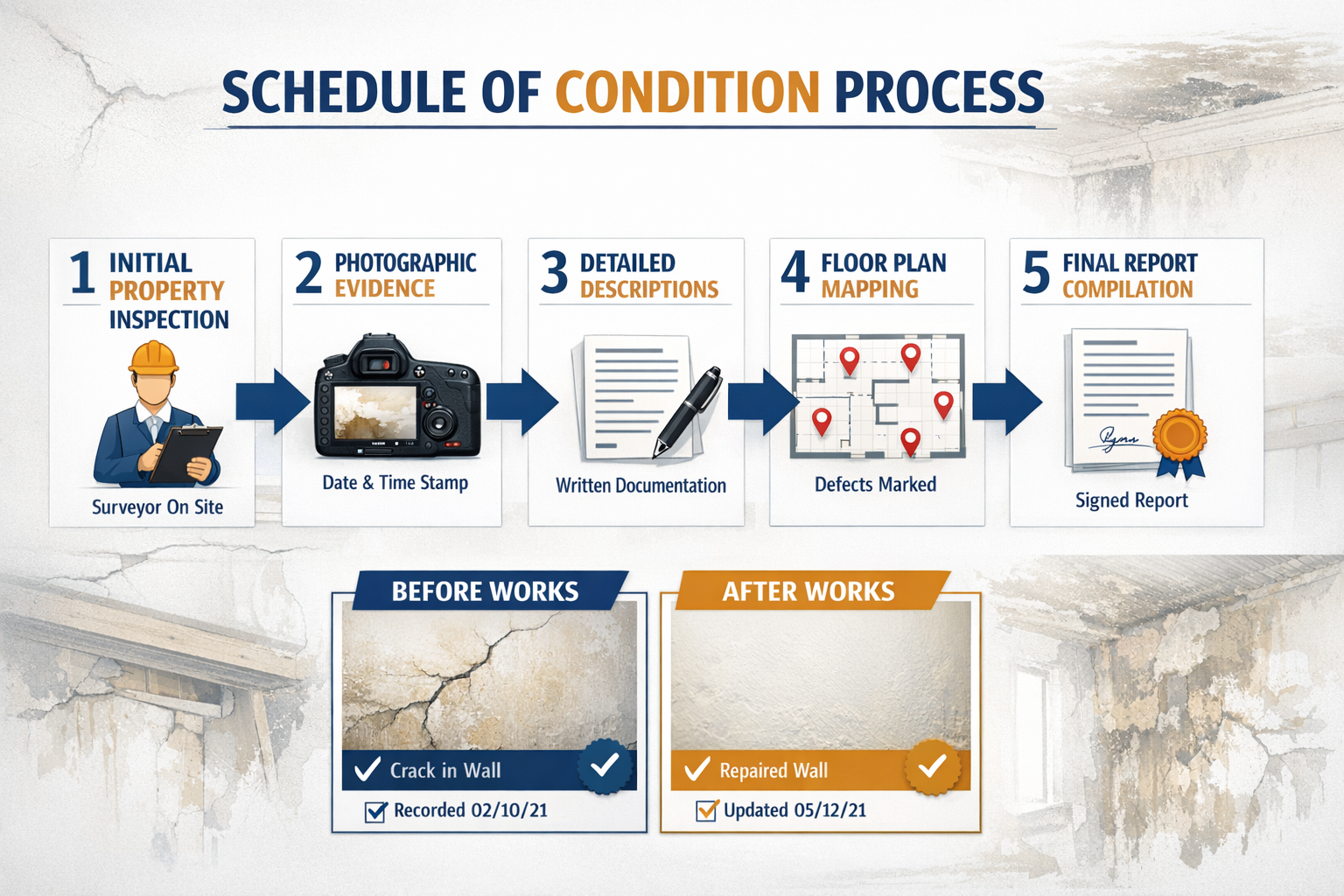
A schedule of condition represents a detailed, time-stamped record of a property's physical state at a specific moment—typically immediately before construction work begins. This professional document combines written descriptions with photographic evidence to create an indisputable baseline for assessing any changes that occur during or after building works.
Unlike general property surveys, schedules of condition focus specifically on documenting defects and existing damage rather than assessing overall property value or structural integrity. The surveyor conducting this inspection records only what is immediately apparent through non-intrusive examination, creating an objective snapshot that both parties can reference if disputes arise.[1]
The Legal Landscape: Why Documentation Matters
The legal framework surrounding party wall works places significant responsibility on building owners. When damage claims emerge after construction completion, courts typically require the building owner to prove their works didn't cause the alleged damage—a challenging position without solid evidence.
This reversed burden of proof makes schedules of condition invaluable protective tools. Rather than scrambling to demonstrate what conditions existed before work began, building owners can simply reference their professionally prepared documentation. The schedule becomes a factual baseline that enables surveyors to determine liability accurately and prevents costly disputes from escalating.[3]
Understanding party wall procedures and obtaining proper guidance for party wall awards provides essential context for implementing effective condition documentation strategies.
When Schedules of Condition Are Recommended
While not legally mandated under the Party Wall Act 1996, schedules of condition are strongly recommended in several scenarios:
- Major structural alterations: Basement excavations, loft conversions, or significant extensions
- Works affecting party walls: Any construction involving shared walls, floors, or foundations
- High-value properties: Where potential damage claims could involve substantial repair costs
- Properties with existing defects: Buildings already showing signs of wear, settlement, or previous damage
- Contentious neighbor relationships: When trust is limited or previous disputes have occurred
- Even with consent: When adjoining owners agree to works, documentation still protects against later claims about pre-existing damage[2]
The relatively modest investment in a professional schedule of condition provides disproportionate value compared to the potential costs of defending unfounded damage claims or resolving party wall disputes.
Schedule of Condition Best Practices: Creating Defensible Documentation
Pre-Inspection Planning and Preparation
Successful schedules of condition begin with thorough preparation before the surveyor arrives at the property. Timing is critical—the inspection should occur as close as possible to the commencement date of works, ideally within one week, to minimize the risk of intervening damage that could complicate the record.
Essential Preparation Steps
Access arrangements: Coordinate with adjoining owners to ensure complete access to all relevant areas, including rooms directly adjacent to party walls, ceilings below shared floors, and any external areas where works might cause impact.
Lighting conditions: Schedule inspections during daylight hours when natural light reveals defects most clearly. Supplementary artificial lighting should be available for darker spaces.
Clear access to surfaces: Remove furniture, stored items, and decorations that might obstruct wall surfaces, corners, or ceiling areas requiring documentation.
Property information gathering: Compile relevant documents including previous survey reports, building plans, and records of any prior repairs or alterations that might explain existing defects.
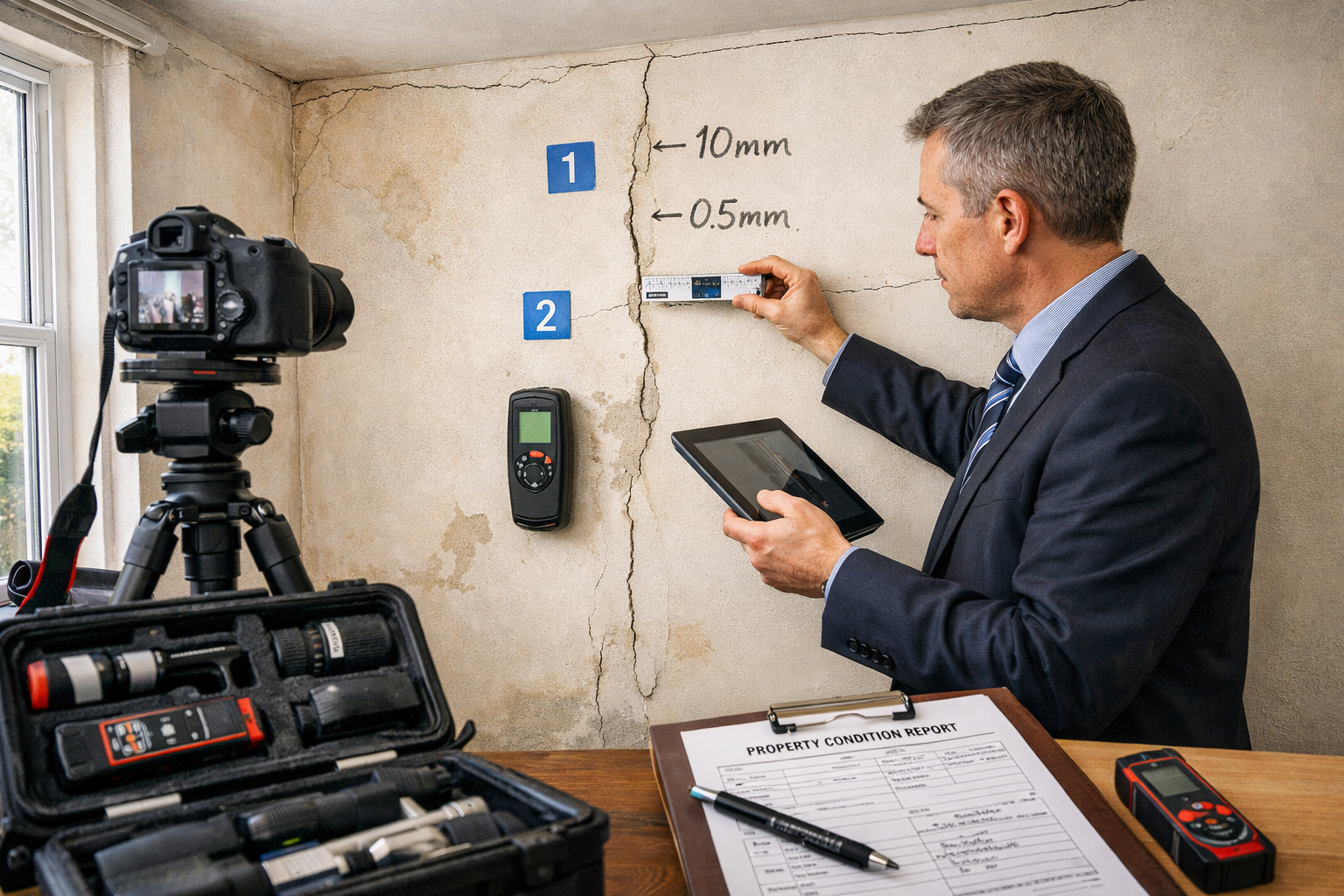
Equipment checklist: Professional surveyors typically bring high-resolution cameras, measuring tools, moisture meters, crack width gauges, and detailed floor plans for marking defect locations.
Photographic Documentation Standards
Photography forms the cornerstone of defensible schedules of condition. Images must be clear, comprehensive, and properly referenced to withstand scrutiny months or years later when disputes arise.
Photography Best Practices
📸 Equipment quality: Use professional-grade cameras capable of capturing high-resolution images (minimum 12 megapixels) with accurate color reproduction and minimal distortion.
📸 Systematic coverage: Photograph every room from multiple angles, ensuring complete coverage of walls, ceilings, floors, and architectural features. Include wide-angle shots showing overall room condition plus close-ups of specific defects.
📸 Defect documentation: Each crack, stain, chip, or imperfection requires individual close-up photographs with measuring references (rulers, coins, or crack width gauges) showing scale.
📸 Metadata preservation: Ensure camera date and time settings are accurate. Modern cameras embed this information in image files, creating verifiable timestamps that prove when documentation occurred.
📸 Reference markers: Use numbered labels or colored markers in photographs to correspond with written descriptions and floor plan annotations, creating clear cross-references throughout the document.
📸 Consistent lighting: Avoid using flash that might wash out defects or create misleading shadows. Natural light supplemented with consistent artificial lighting produces the most accurate representations.
Written Descriptions and Technical Detail
While photographs capture visual evidence, written descriptions provide essential context, measurements, and technical observations that images alone cannot convey. The combination creates comprehensive documentation that surveyors can confidently rely upon when assessing post-works conditions.
Elements of Effective Written Records
Room-by-room structure: Organize descriptions systematically, typically starting from ground floor and working upward, with each room receiving its own section clearly identified by name or number.
Precise measurements: Record exact dimensions of cracks (length and width), stains, or damaged areas. Use metric measurements for consistency and precision.
Technical terminology: Employ accurate construction terminology when describing defects: "hairline crack in plaster," "efflorescence on brickwork," "delamination of paint surface," rather than vague descriptions like "mark on wall."
Location specificity: Describe exactly where defects appear: "diagonal crack extending from top left corner of window frame to ceiling rose, approximately 1.2m in length, 2mm maximum width."
Condition assessment: Note the apparent age and stability of defects where observable: "historic settlement crack with no evidence of recent movement," or "fresh plaster damage with sharp edges suggesting recent occurrence."
Cross-referencing: Link each written description to corresponding photographs and floor plan annotations using consistent numbering systems.
Floor Plans and Defect Mapping
Visual mapping provides immediate spatial understanding that written descriptions alone cannot achieve. Annotated floor plans showing defect locations create powerful reference tools when comparing pre-works and post-works conditions.
| Mapping Element | Purpose | Best Practice |
|---|---|---|
| Base Plans | Provide spatial context | Use accurate scaled drawings or measured sketches |
| Defect Markers | Identify specific locations | Number sequentially, matching photos and descriptions |
| Color Coding | Categorize defect types | Cracks (red), stains (blue), structural (orange), cosmetic (green) |
| Severity Indicators | Show relative importance | Symbol sizes or shading to indicate minor vs. significant defects |
| Reference Keys | Enable quick navigation | Clear legends explaining all symbols, colors, and numbering systems |
Professional surveyors often create multiple plan versions: overview plans showing all documented defects and detailed room plans highlighting specific areas of concern. This layered approach accommodates both quick reference and detailed analysis.
Documentation of Adjacent Areas
Party wall works can affect properties beyond the immediate shared structure. Vibration, excavation, and structural alterations can impact rooms throughout neighboring buildings, making comprehensive documentation essential.
Extended Documentation Scope
✅ Rooms directly adjoining party walls: Primary focus areas requiring the most detailed documentation
✅ Floors above and below work areas: Particularly important for excavation or structural alteration projects
✅ External walls and facades: May show movement or cracking resulting from party wall works
✅ Ceilings and cornices: Often reveal structural movement through crack patterns
✅ Doors and windows: Operation and alignment can indicate structural shifts
✅ Services and fixtures: Pipes, radiators, and built-in fixtures may show displacement or damage
The scope of documentation should reflect the nature and extent of proposed works. Major structural projects warrant more extensive condition records than minor alterations. Experienced surveyors assess each situation individually, balancing thoroughness with practical considerations and party wall costs.
Schedule of Condition Best Practices: Implementation and Dispute Prevention
Engaging Qualified Professionals
The credibility of a schedule of condition depends heavily on the qualifications and reputation of the surveyor who prepares it. While property owners might be tempted to create their own documentation, professionally prepared schedules carry significantly more weight in dispute resolution and legal proceedings.
Selecting the Right Surveyor
Professional qualifications: Look for chartered surveyors with RICS (Royal Institution of Chartered Surveyors) accreditation who specialize in party wall matters and condition surveys. These professionals understand both the technical requirements and legal implications of their documentation.
Relevant experience: Prioritize surveyors with demonstrated experience in party wall works and dispute resolution. Ask about previous cases where their schedules of condition were used to resolve claims.
Independence and impartiality: The surveyor should be perceived as neutral, particularly when preparing schedules that might later serve as evidence. While building owners typically commission the work, the documentation must be objective and comprehensive.
Insurance coverage: Verify that surveyors carry appropriate professional indemnity insurance, protecting all parties if documentation proves inadequate or inaccurate.
Local knowledge: Surveyors familiar with regional construction types, common defect patterns, and local building practices provide more informed assessments. Consider chartered surveyors with specific expertise in your area.
Timing and Scheduling Considerations
The temporal relationship between documentation and works commencement critically affects schedule validity. Documentation completed too early risks missing intervening damage, while last-minute inspections may face access challenges or incomplete coverage.
Optimal Timing Strategies
Immediate pre-commencement: Schedule condition surveys within 1-7 days before works begin, creating minimal opportunity for intervening damage while allowing adequate preparation time.
Coordination with notices: Align scheduling with party wall notice procedures and award timelines, ensuring documentation is current when works actually commence.
Weather considerations: For properties with existing moisture issues or weather-dependent defects, conduct inspections during conditions representative of typical building performance rather than extreme weather events.
Seasonal factors: Some defects appear or worsen seasonally (thermal movement cracks, condensation issues). Consider whether seasonal timing might affect baseline documentation accuracy.
Multiple visits: Complex properties or extensive works may warrant staged documentation, with initial surveys followed by supplementary inspections immediately before each work phase begins.
Distribution and Record Keeping
Properly prepared schedules of condition provide protection only when properly stored, distributed, and accessible when needed. Establishing clear protocols for document management prevents situations where critical evidence becomes unavailable during disputes.
Documentation Management Protocol
📋 Multiple copies: Create and distribute at least three complete sets—one for the building owner, one for the adjoining owner, and one for the party wall surveyor(s).
📋 Digital and physical formats: Maintain both high-quality printed versions and digital copies with original-resolution photographs and metadata intact.
📋 Secure storage: Store documents in locations protected from damage, loss, or deterioration. Cloud-based storage with appropriate backup provides excellent long-term security for digital versions.
📋 Accessibility: Ensure all parties know how to access documentation quickly if questions or disputes arise during or after works.
📋 Retention periods: Maintain complete records for at least 6-12 years after works completion, covering typical limitation periods for legal claims related to construction damage.
📋 Version control: Clearly mark any supplementary documentation or amendments with dates and version numbers, maintaining clear audit trails.
Integration with Party Wall Awards
Schedules of condition function most effectively when properly integrated with formal party wall awards. The award document should explicitly reference the schedule, incorporating it as an official part of the agreement between parties.[1]
Award Integration Elements
Explicit references: Party wall awards should specifically mention the schedule of condition, including its date, preparer, and scope.
Condition precedent: Awards may stipulate that works cannot commence until the schedule of condition is completed and distributed to all parties.
Damage assessment procedures: Awards should outline how the schedule will be used to assess any damage claims, including who will conduct post-works inspections and how comparisons will be made.
Cost allocation: Clearly specify who bears the cost of preparing the schedule (typically the building owner) and any follow-up inspections.
Dispute resolution mechanisms: Establish procedures for resolving disagreements about whether damage existed pre-works or resulted from construction activities.
Post-Works Inspection and Comparison
The true value of a schedule of condition emerges during post-works inspection when surveyors compare current conditions against the baseline documentation. This comparison process requires the same systematic approach and attention to detail as the original survey.
Comparison Methodology
Systematic re-inspection: Follow the same room-by-room sequence used in the original schedule, photographing from identical positions where possible to enable direct visual comparison.
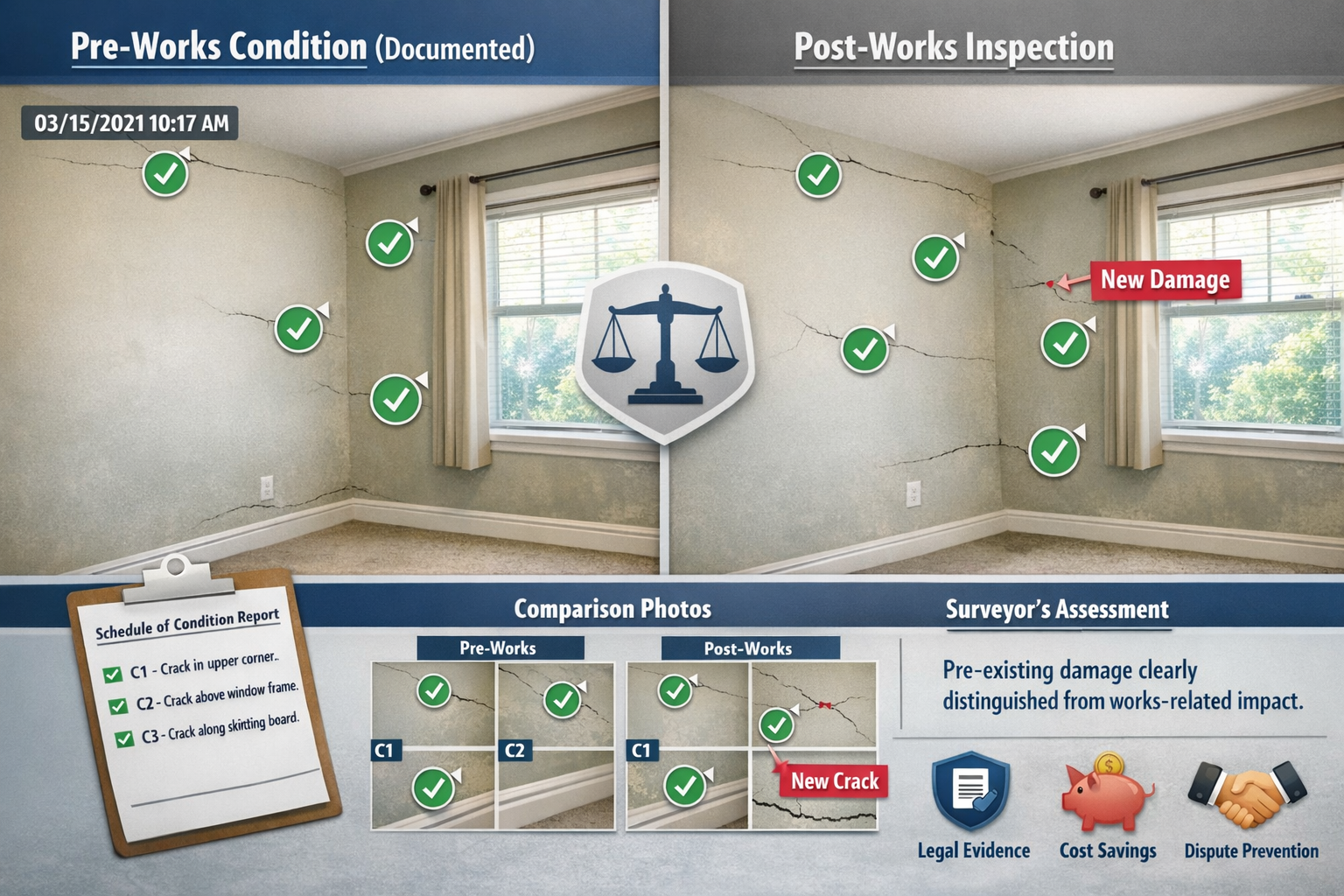
Side-by-side analysis: Compare current photographs with original images, looking for new cracks, movement in existing defects, or other changes not documented in the pre-works survey.
Measurement verification: Re-measure documented defects to determine whether existing cracks have widened, extended, or otherwise changed during works.
New defect identification: Document any damage not present in the original schedule using the same photographic and written description standards.
Causation assessment: Evaluate whether new damage patterns are consistent with the type and location of works undertaken, considering factors like vibration, excavation, or structural loading changes.
Professional judgment: Experienced surveyors apply technical knowledge to distinguish between damage caused by works and unrelated deterioration that occurred coincidentally during the construction period.
Common Pitfalls and How to Avoid Them
Even well-intentioned documentation efforts can fail to provide adequate protection if common mistakes undermine their credibility or completeness. Understanding these pitfalls enables proactive prevention.
Critical Mistakes to Avoid
❌ Insufficient photographic coverage: Failing to document all areas potentially affected by works leaves gaps that undermine the entire schedule's credibility.
❌ Poor image quality: Blurry, poorly lit, or low-resolution photographs cannot reliably show defect details, rendering them useless for comparison purposes.
❌ Inadequate written detail: Vague descriptions like "crack in wall" without measurements, locations, or characteristics provide insufficient baseline information.
❌ Missing cross-references: Photographs without corresponding written descriptions or floor plan annotations create confusion and reduce documentation utility.
❌ Delayed timing: Conducting surveys weeks before works commence allows intervening damage to occur, compromising the baseline's accuracy.
❌ Incomplete distribution: Failing to provide copies to all relevant parties can lead to disputes about document authenticity or allegations of selective documentation.
❌ Ignoring minor defects: Omitting small cracks or imperfections because they seem insignificant can backfire if they later expand or if disputes arise about their pre-existence.
Cost Considerations and Value Proposition
Professional schedules of condition represent an investment that property owners must balance against the potential costs of disputes. Understanding typical pricing and the protection provided helps inform decisions about when and how extensively to document conditions.
Investment Analysis
Typical costs: Professional schedules of condition for standard residential properties typically range from £300-£800, depending on property size, complexity, and the extent of areas requiring documentation. Larger or more complex properties may exceed these ranges.
Cost factors: Pricing varies based on property size, number of rooms requiring documentation, accessibility challenges, surveyor qualifications and experience, and whether multiple visits are needed.
Dispute cost comparison: Resolving damage disputes without clear baseline documentation can easily cost £5,000-£20,000 or more in surveyor fees, legal costs, and potential repair expenses—making the schedule's cost appear minimal by comparison.
Insurance considerations: Some building insurance policies may cover schedule of condition costs as part of party wall works, or may offer premium reductions when proper documentation exists.
Value beyond disputes: Even when no disputes arise, schedules of condition provide peace of mind, facilitate smooth neighbor relationships, and demonstrate professional diligence in managing construction projects.
For context on broader surveying costs and how schedules of condition fit within overall project budgets, review general surveyor pricing information.
Leveraging Technology for Enhanced Documentation
Modern technology offers tools that significantly enhance schedule of condition quality, accessibility, and defensibility. Forward-thinking surveyors increasingly incorporate these innovations into their documentation practices.
Technological Enhancements
Digital photography with GPS: Modern cameras embed location data in image files, providing additional verification of where photographs were taken.
3D scanning and modeling: Laser scanning technology creates detailed three-dimensional models of property conditions, offering unprecedented accuracy for complex spaces or historically significant buildings.
Drone photography: For external elevations, rooflines, or difficult-to-access areas, drone imagery provides comprehensive coverage impossible with traditional methods.
Cloud-based platforms: Specialized software enables real-time documentation sharing, collaborative annotation, and secure long-term storage with automatic backup.
Time-stamped video: Supplementing still photography with video walkthroughs provides additional context and creates continuous documentation that's difficult to dispute.
Moisture mapping: Thermal imaging cameras detect hidden moisture issues that might not be visible in standard photographs, documenting conditions that could worsen during works.
While these technologies enhance documentation quality, they complement rather than replace fundamental best practices around systematic coverage, detailed descriptions, and professional expertise.
Resolving Disputes Using Schedule of Condition Evidence
The Evidential Weight of Professional Documentation
When damage disputes arise after party wall works, professionally prepared schedules of condition carry substantial evidential weight in both informal negotiations and formal legal proceedings. Courts and arbitrators recognize that objective, contemporaneous documentation prepared by qualified professionals provides more reliable evidence than retrospective claims or memories about pre-works conditions.[4]
The legal principle is straightforward: clear photographic and written evidence of conditions immediately before works commenced establishes a factual baseline that's difficult to dispute. When building owners can produce comprehensive schedules showing that alleged damage existed before their works began, claims typically collapse or settle quickly on favorable terms.
Conversely, adjoining owners benefit from schedules that accurately document their property's pre-works condition, ensuring they receive fair compensation for genuine damage while preventing building owners from attributing pre-existing defects to the works.
Negotiation and Settlement Strategies
Most damage disputes resolve through negotiation rather than formal legal action, particularly when clear schedule of condition evidence exists. Understanding effective negotiation strategies helps parties reach fair settlements efficiently.
Effective Settlement Approaches
Early evidence sharing: Promptly provide relevant portions of the schedule of condition when claims arise, demonstrating transparency and establishing the factual baseline for discussions.
Professional assessment: Engage the original surveyor or an independent expert to compare current conditions against the schedule, providing objective analysis of whether damage is new or pre-existing.
Proportionate responses: When schedules clearly show damage existed before works, building owners can confidently reject unfounded claims while remaining open to addressing genuine new damage.
Partial settlements: In cases where some claimed damage is new while other defects pre-existed, schedules enable parties to identify and compensate only legitimate claims.
Cost-benefit analysis: Even when schedules support building owners' positions, sometimes modest settlement payments prove more economical than extended disputes, particularly for minor claims.
Documentation of agreements: Record all settlement terms in writing, including acknowledgment of the schedule of condition's role in determining outcomes.
When Professional Intervention Is Required
Despite best efforts at amicable resolution, some disputes require formal intervention through party wall surveyors, expert witnesses, or legal proceedings. Schedules of condition become even more critical in these escalated scenarios.
Professional surveyors acting as expert witnesses rely heavily on schedule of condition documentation when providing opinions about damage causation, timing, and appropriate remediation. The quality and comprehensiveness of the original schedule directly impacts the expert's ability to provide definitive conclusions.
In formal proceedings, judges and arbitrators expect parties to present clear evidence supporting their positions. A professionally prepared schedule of condition, with its systematic documentation, professional authorship, and contemporaneous timing, typically proves far more persuasive than alternative evidence forms like witness testimony about remembered conditions or retrospective assessments.
Case Study Applications
Consider a typical scenario: a building owner undertakes basement excavation requiring underpinning of the party wall. Three months after works complete, the adjoining owner claims that multiple cracks in their property resulted from the excavation work and demands £15,000 for repairs.
Without a schedule of condition: The building owner faces significant challenges. They must somehow prove that cracks existed before their works—a nearly impossible task without contemporaneous evidence. The dispute likely involves expensive surveyor investigations, potential legal proceedings, and possible settlement or judgment against the building owner, even if the cracks genuinely pre-existed.
With a comprehensive schedule of condition: The building owner's surveyor reviews the pre-works documentation, identifying that the schedule photographed and described all claimed cracks before excavation commenced. The evidence is clear, contemporaneous, and professionally prepared. When presented with this documentation, the adjoining owner's claim collapses, potentially with the claimant bearing costs of the investigation. The dispute resolves in days rather than months, saving thousands in professional fees and preserving neighbor relationships.
This scenario illustrates why Schedule of Condition Best Practices: Preventing False Damage Claims After Party Wall Works represents essential risk management rather than optional documentation.
Broader Applications Beyond Party Wall Works
While this article focuses on party wall contexts, schedule of condition principles apply across numerous construction and property management scenarios where establishing baseline conditions provides protection against future disputes.
Lease and Tenancy Applications
Commercial and residential landlords frequently commission schedules of condition at the beginning of tenancies, documenting property condition before tenants take occupation. These records protect landlords against excessive dilapidation claims while ensuring tenants aren't held responsible for pre-existing damage.
Similar documentation at lease end enables fair assessment of tenant obligations, distinguishing reasonable wear and tear from damage requiring compensation. The same best practices—comprehensive photography, detailed descriptions, and professional preparation—apply equally in tenancy contexts.
Construction Contract Documentation
Major construction projects often include schedule of condition requirements for neighboring properties within the contract documents. These protect contractors and developers against claims that their works damaged nearby buildings, particularly when projects involve significant excavation, piling, or vibration-generating activities.
Conservation and Heritage Projects
For listed buildings or properties in conservation areas, schedules of condition serve additional purposes beyond damage claim prevention. They create detailed records of historic fabric and architectural features before any works occur, ensuring that restoration or alteration projects can be assessed against accurate baselines and that any inadvertent damage to heritage elements is identified and addressed.
Insurance and Risk Management
Property insurers increasingly recognize the value of schedule of condition documentation as risk management tools. Some insurers require such documentation before covering certain types of construction work, while others offer premium reductions when comprehensive baseline records exist.
Conclusion
Schedule of Condition Best Practices: Preventing False Damage Claims After Party Wall Works represents far more than bureaucratic documentation—it provides essential protection for all parties involved in construction projects affecting shared structures. In 2026's increasingly litigious environment, where building owners bear the burden of proving their works didn't cause damage, comprehensive pre-works documentation has evolved from optional best practice to practical necessity.
The investment required for professional schedules of condition—typically a few hundred pounds—pales in comparison to the potential costs of defending unfounded damage claims or resolving disputes without clear evidence. Beyond financial protection, proper documentation facilitates better neighbor relationships, smoother project execution, and peace of mind throughout construction processes.
Key Implementation Steps
✓ Commission professional surveys: Engage qualified chartered surveyors with party wall expertise to prepare schedules of condition
✓ Time documentation appropriately: Conduct inspections within one week of works commencement to ensure accuracy
✓ Ensure comprehensive coverage: Document all areas potentially affected by works, not just rooms immediately adjacent to party walls
✓ Maintain proper records: Distribute copies to all relevant parties and store documents securely for long-term accessibility
✓ Integrate with party wall awards: Explicitly reference schedules in formal party wall agreements
✓ Plan for post-works comparison: Establish procedures for systematic comparison of conditions after works complete
Taking Action
Property owners planning construction work affecting party walls should prioritize schedule of condition preparation as early as possible in project planning. Engaging surveyors during the party wall notice period ensures documentation is ready when works commence, providing protection from day one.
For those currently undertaking works without pre-existing schedules, immediate documentation of current conditions—even mid-project—provides some protection for remaining work phases, though it cannot replicate the value of true pre-commencement baselines.
Adjoining property owners should actively participate in schedule of condition processes when offered, ensuring their properties receive thorough documentation. When building owners don't voluntarily commission schedules, adjoining owners can request them as conditions within party wall awards or commission independent documentation at the building owner's expense.
The fundamental principle remains constant: clear, professional, contemporaneous documentation of property conditions before works commence provides the strongest possible foundation for preventing disputes, resolving claims fairly, and protecting all parties' legitimate interests.
By implementing the best practices outlined in this guide, property owners, surveyors, and construction professionals can navigate party wall works with confidence, knowing that robust evidence exists to distinguish pre-existing conditions from any damage that might occur during construction activities.
For expert guidance on party wall matters and professional schedule of condition services, consult with experienced chartered surveyors who understand both the technical requirements and legal implications of comprehensive condition documentation.
References
[1] Schedule Of Condition – https://www.ansteyhorne.co.uk/news/schedule-of-condition
[2] Schedule Of Condition – https://www.partywall.expert/party-wall-blog/schedule-of-condition/
[3] Party Walls Specimen Schedule Of Condition – https://www.isurv.com/downloads/download/32/party_walls_specimen_schedule_of_condition
[4] Schedules Of Condition Everything You Need To Know – https://fourthwallbc.com/blog/schedules-of-condition-everything-you-need-to-know/