
When construction work affects a shared wall between properties, confusion and conflict can quickly arise. Understanding Party Wall Awards: What Building Owners and Surveyors Need to Know becomes essential for anyone planning building work that impacts adjoining properties. These legally binding documents serve as protective shields for both building owners and neighbors, establishing clear guidelines that prevent costly disputes and spurious damage claims. Whether you're a property developer, homeowner, or surveyor, mastering the party wall award process ensures smooth project execution while maintaining neighborly relations.

Key Takeaways
- Party wall awards are legally binding documents that outline construction specifications, timelines, and responsibilities when work affects shared boundaries between properties
- Qualified surveyors must possess both legal and construction expertise to draft enforceable awards that protect all parties and comply with 2026 regulatory requirements
- Awards must include specific elements such as Schedule of Condition with photographs, insurance details, access arrangements, and working hours to be considered valid
- Early engagement with surveyors prevents disputes and refusals, making informal discussions before formal notification a strategic best practice
- Invalid objections based solely on inconvenience cannot block legitimate construction work, but neighbors retain rights to proper documentation and protection
What Is a Party Wall Award? 📋
A party wall award represents a formal legal document that governs construction work affecting shared walls, boundaries, or structures between adjoining properties. Unlike a simple agreement, an award carries the weight of legal enforcement and establishes binding obligations for all parties involved.
At its core, a party wall award is created when neighboring property owners cannot reach informal agreement after receiving a Party Wall Notice. The award appoints an agreed surveyor (or separate surveyors for each party) to manage wall agreement matters and resolve disputes that may arise from non-consent to the notice[2]. This document outlines what work should happen, how and when it will be carried out, and who will pay for which part[2].
The Legal Framework Behind Awards
The Party Wall etc. Act 1996 provides the statutory foundation for party wall awards in England and Wales. This legislation empowers surveyors to create binding determinations when neighbors cannot agree on proposed construction work. Recent guidance addresses party wall awards under updated 2026 regulatory requirements, ensuring current practice aligns with evolving legal standards[1].
The Act remains a critical consideration for residential property developers, particularly in densely populated areas like London, and should never be treated as an afterthought in development projects[3]. Understanding the complete party wall process helps building owners navigate these legal requirements effectively.
When Awards Become Necessary
Awards become essential in several scenarios:
- Neighbor dissent: When the adjoining owner refuses to consent to the Party Wall Notice within 14 days
- No response: When neighbors fail to respond to notices within the statutory timeframe
- Complex projects: When construction work involves significant structural alterations to shared boundaries
- Preventive measures: When building owners want formal protection against future damage claims
The guidance for party wall awards provides detailed information about when formal awards offer the best protection for construction projects.
Essential Components of Understanding Party Wall Awards: What Building Owners and Surveyors Need to Know
Creating a comprehensive party wall award requires meticulous attention to detail and inclusion of specific mandatory elements. Missing even one critical component can render an award unenforceable or create vulnerabilities for either party.
Mandatory Documentation Requirements
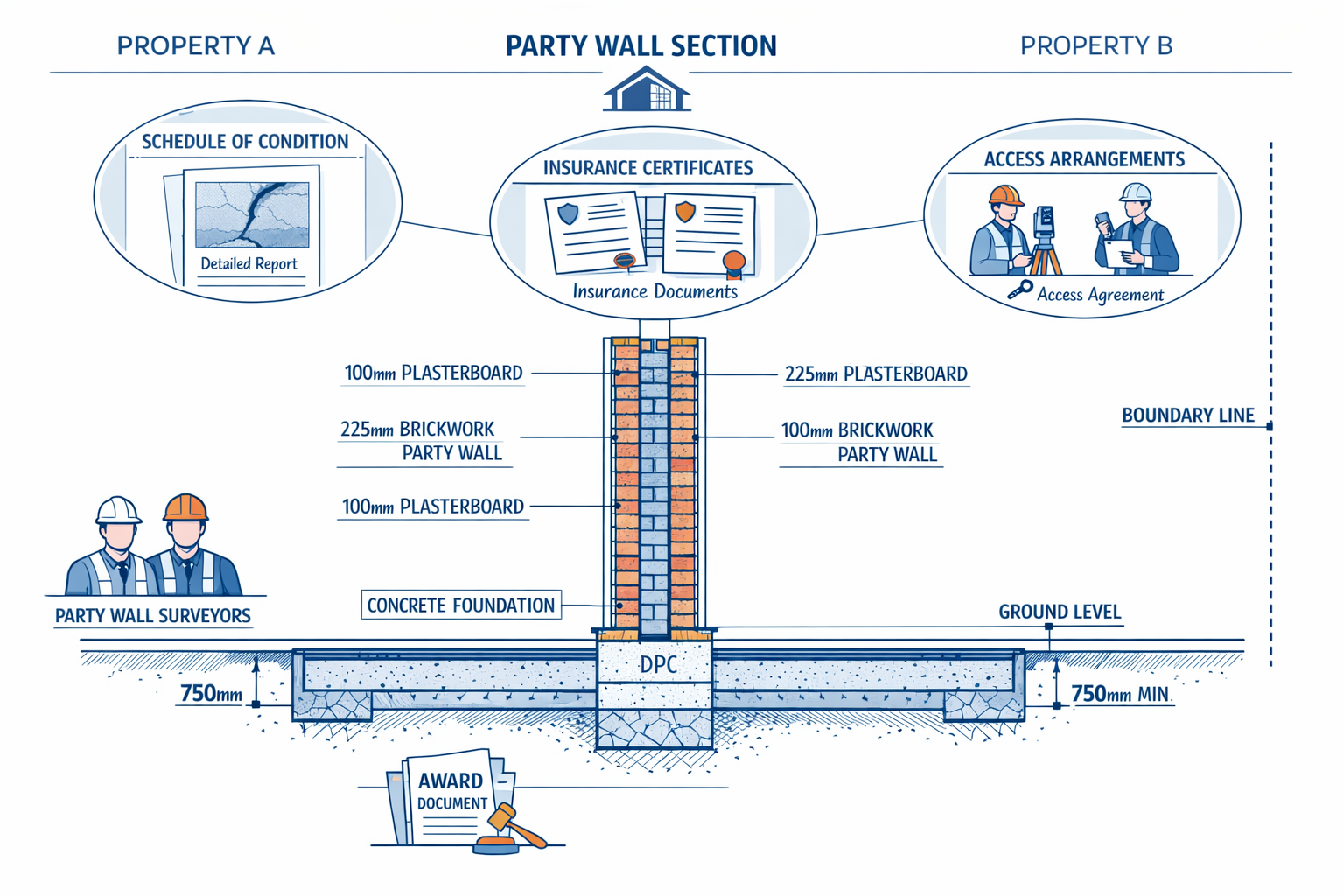
Every valid party wall award must include the following elements[2]:
| Component | Purpose | Details Required |
|---|---|---|
| Schedule of Condition | Baseline property documentation | Detailed photographs and written descriptions of adjoining property's current state |
| Insurance Details | Liability protection | Contractor's full liability insurance with coverage amounts and policy numbers |
| Project Specifications | Work scope definition | Complete construction plans, drawings, and technical specifications |
| Surveyor Fees | Cost allocation | Clear statement of neighbor's surveyor fees and payment responsibility |
| Building Owner's Insurance | Neighbor protection | Insurance policy favoring neighbors against construction-related damage |
| Access Arrangements | Entry permissions | Specific times, dates, and conditions for surveyor and contractor access |
| Property Addresses | Identification | Complete addresses for both building owner and adjoining owner properties |
| Working Hours | Operational limits | Permitted days and times for construction activities |
| Commencement Timeline | Project deadline | One-year average time limit to start work after award issuance |
The Schedule of Condition: Your Protection Policy
The Schedule of Condition stands as arguably the most critical component of any party wall award. This detailed photographic and written record documents the adjoining property's condition before construction begins, creating an objective baseline for evaluating any future damage to property in party wall scenarios.
"A comprehensive Schedule of Condition protects building owners from spurious damage claims while ensuring neighbors have documented proof if legitimate damage occurs during construction."
Professional surveyors typically photograph every room, external elevation, and structural element visible from the adjoining property. These images, combined with written descriptions, create an irrefutable record that prevents disputes about pre-existing conditions versus construction-related damage.
Insurance and Liability Provisions
Awards must specify two distinct insurance requirements:
Contractor's Liability Insurance: Full details of the building contractor's public liability insurance, including policy numbers, coverage amounts (typically minimum £5-10 million), and validity periods. This protects all parties if accidents or damage occur during construction.
Building Owner's Insurance: A separate insurance policy taken out by the building owner that specifically favors the adjoining owners. This provides additional financial protection beyond contractor insurance and demonstrates good faith commitment to making neighbors whole if problems arise.
Understanding party wall costs helps building owners budget appropriately for these insurance requirements alongside surveyor fees and construction expenses.
The Surveyor's Role in Understanding Party Wall Awards: What Building Owners and Surveyors Need to Know
Party wall surveyors occupy a unique professional position requiring dual expertise in both legal frameworks and construction technicalities. A standard licensed surveyor qualification may prove insufficient for handling the complexity of party wall matters[2], making specialist knowledge essential.
Required Expertise and Qualifications
Effective party wall surveyors must demonstrate proficiency in:
- Legal interpretation: Understanding the Party Wall etc. Act 1996 and related case law
- Construction knowledge: Recognizing structural implications of proposed work
- Conflict resolution: Mediating between parties with opposing interests
- Technical documentation: Drafting legally enforceable awards with precise language
- Building pathology: Identifying pre-existing defects versus construction-related damage
Many surveyors pursue additional training through the Faculty of Party Wall Surveyors or similar professional bodies to develop these specialized skills. When selecting a surveyor, property owners should verify specific party wall experience rather than relying solely on general surveying credentials.
Appointed Surveyor vs. Agreed Surveyor
The Party Wall Act allows for two distinct surveyor arrangements:
Separate Surveyors (Appointed Surveyor): Each party appoints their own surveyor who then work together to produce a joint award. This approach provides independent representation but typically costs more due to dual fees. The appointed surveyors must also select a "Third Surveyor" who can resolve any disagreements between them.
Single Surveyor (Agreed Surveyor): Both parties agree to appoint one surveyor who acts impartially for both sides. This streamlined approach reduces costs and accelerates the process, but requires confidence in the surveyor's impartiality.
Regardless of arrangement, surveyors owe duties to both parties under the Act, even when appointed by only one side. This statutory obligation ensures fairness throughout the award process.
Negotiation and Award Drafting Process
Creating a party wall award involves several stages:
- Initial assessment: Surveyor reviews proposed work and Party Wall Notice
- Property inspection: Detailed examination of both properties to create Schedule of Condition
- Consultation: Discussion with both parties about concerns and requirements
- Draft award preparation: Surveyor creates comprehensive document incorporating all mandatory elements
- Review period: Parties examine draft and provide feedback
- Finalization: Surveyor issues final award with any necessary modifications
- Service: Award formally served on both parties, becoming legally binding
Throughout this process, final conclusions regarding when and how work will be carried out are executed by the surveyor when disputes cannot be resolved informally[2]. This authority enables surveyors to break deadlocks while ensuring fair treatment for all parties.
Professional surveyors understand that surveyor pricing must reflect the complexity and responsibility inherent in party wall work, which often exceeds standard survey assignments.
Protecting Building Owners Through Party Wall Awards
For property developers and homeowners undertaking construction, party wall awards provide essential legal protection that extends far beyond simple neighborly agreements.
Defense Against Spurious Claims
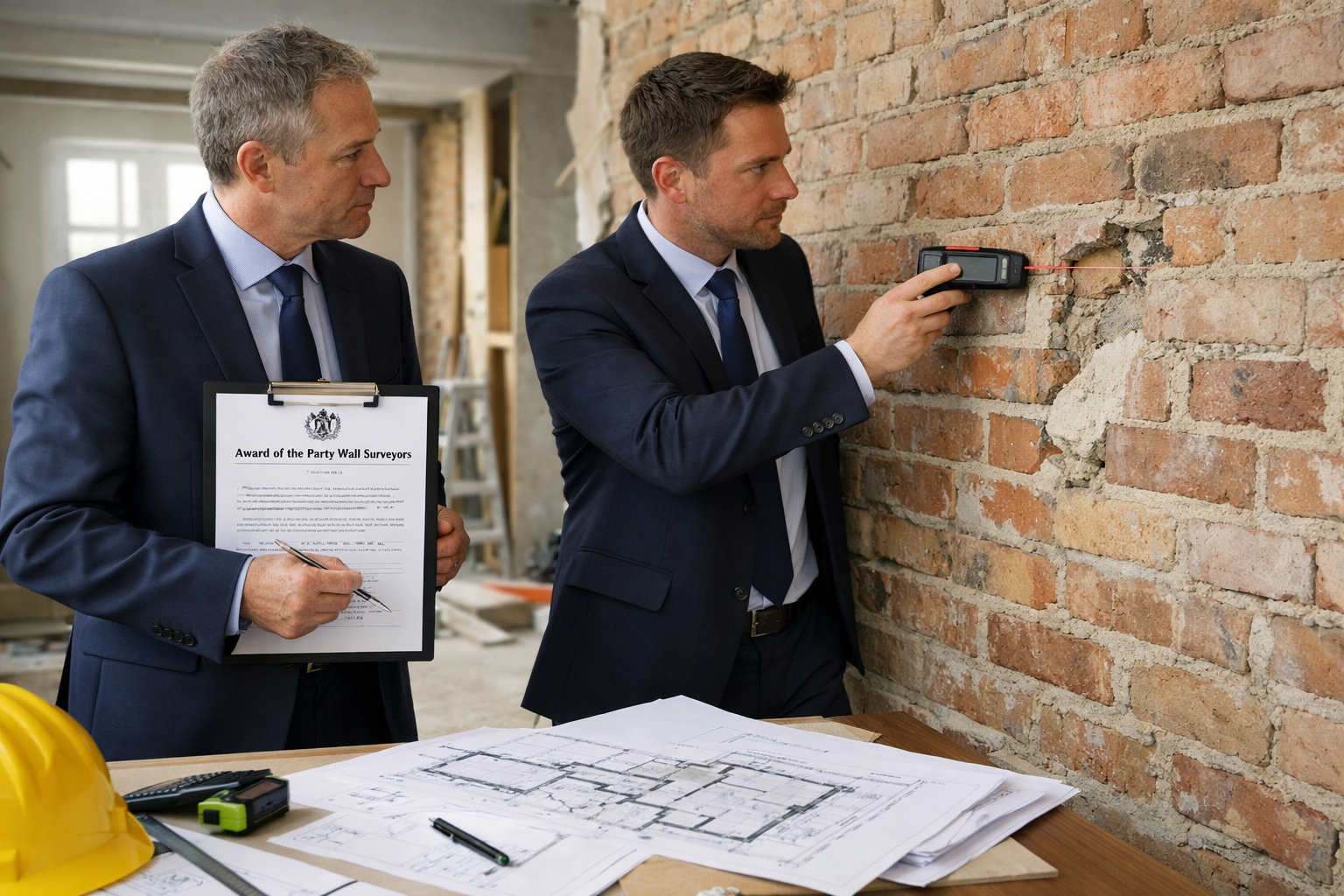
One of the most valuable functions of a properly drafted award is protection against unfounded damage allegations. The comprehensive Schedule of Condition creates an objective record that can refute claims about pre-existing conditions being attributed to construction work.
Without this documentation, building owners face significant vulnerability. Neighbors might claim that cracks, settlement, or other defects resulted from construction when these issues existed previously. The financial and legal costs of defending against such claims can quickly exceed the initial investment in a proper party wall award.
Clear Cost Allocation
Awards establish unambiguous responsibility for various expenses:
- Surveyor fees: Typically, the building owner pays for both their own surveyor and the neighbor's surveyor fees
- Construction costs: Building owner bears all costs for the actual work
- Remedial work: If construction causes damage, the award specifies repair obligations and payment responsibility
- Access facilitation: Costs associated with providing surveyor access to properties
This clarity prevents ongoing disputes about financial obligations and enables accurate project budgeting from the outset.
Timeline Protection
The typical one-year commencement deadline included in awards protects building owners' right to proceed with approved work within a reasonable timeframe. Once the award is issued, neighbors cannot indefinitely delay or obstruct the project, provided work begins within the specified period.
This timeline certainty proves particularly valuable for commercial developments where financing arrangements, contractor schedules, and market conditions require predictable project commencement.
Protecting Adjoining Owners Through Party Wall Awards
While building owners initiate the party wall process, awards provide equally important protections for neighboring property owners who might otherwise feel vulnerable to construction impacts.
Documentation of Pre-Existing Conditions
The Schedule of Condition protects adjoining owners by creating an authoritative record of their property's state before construction begins. If damage occurs during building work, this documentation provides clear evidence for pursuing remediation and compensation.
Without this baseline, adjoining owners face the challenging task of proving that damage resulted from construction rather than pre-existing conditions. The Schedule shifts this burden appropriately to the building owner while providing objective evidence for legitimate claims.
Guaranteed Access for Monitoring
Awards specify surveyor access arrangements, ensuring adjoining owners' representatives can monitor construction progress and verify compliance with agreed specifications. This oversight capability provides peace of mind and early detection of potential problems.
Regular monitoring visits enable surveyors to identify issues while they remain minor and easily correctable, rather than discovering major problems only after construction completion.
Insurance Protection
The mandatory insurance provisions in awards create multiple layers of financial protection for adjoining owners:
- Contractor's liability insurance covers accidents and direct damage
- Building owner's insurance provides additional coverage specifically favoring neighbors
- Surveyor oversight ensures insurance remains current throughout construction
These protections mean adjoining owners don't rely solely on the building owner's financial resources if damage occurs, significantly reducing their risk exposure.
Working Hours and Access Limitations
Awards establish specific parameters for construction activities, including:
- Permitted working hours (typically weekdays during business hours)
- Weekend and holiday restrictions
- Access routes and methods
- Noise mitigation measures
- Dust and debris control requirements
These provisions balance the building owner's right to proceed with work against the adjoining owner's right to reasonable enjoyment of their property.
Common Disputes and How Awards Resolve Them
Understanding how party wall awards address typical conflicts helps both building owners and surveyors anticipate and prevent problems before they escalate.
Invalid Grounds for Refusal
The Party Wall Act establishes that neighbors cannot refuse consent based solely on inconvenience factors. If neighbors disagree with a party wall notice, they must state justifiable reasons; objections based solely on work inconvenience and noise are not considered valid grounds for refusal[2].
Invalid objection reasons include:
- General opposition to construction noise
- Temporary inconvenience during work period
- Personal dislike of the building owner
- Aesthetic preferences about proposed work
- Concerns about property value impacts
Valid concerns that surveyors must address:
- Structural safety of proposed work methods
- Inadequate insurance or financial security
- Insufficient Schedule of Condition documentation
- Unreasonable working hours or access requirements
- Lack of proper notice periods
When neighbors raise invalid objections, surveyors can proceed with award preparation while addressing any legitimate underlying concerns through appropriate conditions and safeguards.
Resolving What Happens When Disputes Arise
Even with comprehensive awards in place, disagreements sometimes emerge during construction. The award framework provides clear resolution mechanisms:
Minor disputes: The appointed surveyor(s) can issue supplementary awards or clarifications addressing issues not fully covered in the original document.
Surveyor disagreements: When separate surveyors cannot agree, the pre-selected Third Surveyor makes binding determinations.
Award challenges: Parties can appeal awards to the County Court within 14 days of service, though courts generally defer to surveyor expertise unless clear errors exist.
Understanding what constitutes a party wall dispute helps parties recognize when formal resolution mechanisms become necessary versus when informal discussion can resolve concerns.
Enforcement Mechanisms
Party wall awards carry legal weight equivalent to court orders. If either party fails to comply with award terms, the other party can:
- Seek court enforcement of specific award provisions
- Pursue damages for non-compliance
- Obtain injunctions preventing continued violations
- Recover legal costs associated with enforcement actions
This enforcement capability ensures awards function as more than advisory documents, creating genuine accountability for all parties.
Strategic Best Practices for Building Owners and Surveyors
Experience with hundreds of party wall matters reveals several strategies that consistently produce better outcomes for all parties involved.
Early Engagement: The Key to Success
Involving a party wall surveyor at an early stage, starting with informal discussions before formal notification, can prevent disagreements or refusals from occurring[2]. This proactive approach offers multiple advantages:
For building owners:
- Identifies potential neighbor concerns before formal notice
- Allows design modifications to address legitimate issues
- Builds goodwill through transparent communication
- Reduces overall timeline by preventing disputes
- Enables accurate cost and schedule budgeting
For adjoining owners:
- Provides early awareness of planned work
- Creates opportunity for input before plans finalize
- Demonstrates building owner's good faith intentions
- Allows time to arrange their own surveyor if desired
Many successful projects begin with building owners meeting neighbors informally to discuss plans, showing preliminary drawings, and explaining the party wall process before serving formal notices. This human connection often prevents adversarial dynamics from developing.
Advance Notification Requirements
Building owners must serve written notice to neighbors two months in advance for most party wall works[2]. Strategic timing considerations include:
- Design finalization: Serve notices only after plans are sufficiently developed to accurately describe proposed work
- Contractor scheduling: Coordinate notice timing with contractor availability to utilize the one-year commencement window effectively
- Seasonal factors: Consider weather impacts on construction scheduling when determining notice timing
- Financing arrangements: Ensure funding is secured before serving notices to avoid delays that might exceed the commencement deadline
Professional surveyors can advise on optimal notice timing based on project-specific circumstances and local construction market conditions.
Selecting the Right Surveyor
Choosing an appropriate party wall surveyor significantly impacts process efficiency and outcome quality. Key selection criteria include:
✅ Specific party wall experience: Verify the surveyor has handled similar projects, not just general surveying work
✅ Local knowledge: Surveyors familiar with local construction practices and typical property types provide more relevant guidance
✅ Professional qualifications: Look for membership in the Faculty of Party Wall Surveyors or equivalent specialist credentials
✅ Communication skills: Effective surveyors explain complex legal and technical matters clearly to non-specialist clients
✅ Availability: Ensure the surveyor can meet project timeline requirements without causing delays
✅ Insurance coverage: Verify professional indemnity insurance adequate for the project value
Building owners should interview potential surveyors about their approach, typical timelines, and fee structures before making appointments. Working with local chartered surveyors who understand regional construction patterns often produces more efficient outcomes.
Documentation Excellence
The quality of documentation directly correlates with award effectiveness. Best practices include:
Photography standards:
- High-resolution images with proper lighting
- Date and time stamps on all photographs
- Multiple angles of each room and elevation
- Close-ups of any existing defects or concerns
- Exterior shots showing relationship between properties
Written descriptions:
- Room-by-room condition notes
- Specific mention of cracks, settlement, or defects
- Measurements of any concerning features
- Description of finishes, materials, and construction type
- Notes about property age and maintenance condition
Professional surveyors often use specialized software to organize and present Schedule of Condition materials in clear, accessible formats that serve as reliable reference documents throughout construction and beyond.
Understanding Party Wall Awards in 2026: Current Regulatory Landscape
The party wall framework continues evolving to address modern construction practices and emerging legal precedents. Understanding current 2026 requirements ensures compliance and optimal protection.
Recent Regulatory Updates
Guidance addressing party wall awards under updated 2026 regulatory requirements reflects several important developments[1]:
- Enhanced documentation standards: Increased emphasis on comprehensive photographic evidence and detailed written descriptions
- Insurance requirements: Clarified minimum coverage levels and policy terms for contractor and building owner insurance
- Digital service: Expanded acceptance of electronic notice service and digital award documentation
- Sustainability considerations: Integration of environmental impact assessments for certain types of party wall work
- Accessibility provisions: Requirements ensuring award documents are accessible to parties with disabilities
These updates don't fundamentally change the Party Wall Act itself but refine how surveyors interpret and apply its provisions in contemporary practice.
Technology Integration
Modern party wall practice increasingly incorporates technology:
- Digital photography: High-resolution images with embedded metadata for Schedule of Condition documentation
- 3D scanning: Laser scanning technology creating precise baseline records of property conditions
- Project management software: Digital platforms tracking notice periods, deadlines, and compliance requirements
- Electronic signatures: Streamlined award execution through secure digital signature platforms
- Cloud storage: Secure document repositories ensuring all parties can access award materials throughout construction
These technological advances improve accuracy, accessibility, and efficiency while maintaining the legal robustness that makes awards effective protection mechanisms.
Regional Considerations
While the Party Wall Act applies throughout England and Wales, practical implementation varies by region:
London and urban areas: High property density and frequent construction make party wall matters routine, with established local practices and experienced surveyor networks. The Act remains particularly critical for London property developers[3].
Suburban developments: Less frequent party wall work may mean fewer experienced local surveyors, potentially requiring engagement of specialists from nearby urban centers.
Rural areas: Party wall matters occur less frequently but can involve more complex agricultural structures and boundary arrangements.
Understanding regional patterns helps building owners set realistic expectations about surveyor availability, typical timelines, and local construction norms that influence award provisions.
Conclusion
Understanding Party Wall Awards: What Building Owners and Surveyors Need to Know represents essential knowledge for anyone involved in construction affecting shared property boundaries. These legally binding documents serve as protective frameworks that balance building owners' rights to develop their properties with adjoining owners' rights to protection from damage and disruption.
Comprehensive party wall awards include mandatory elements—Schedule of Condition, insurance details, project specifications, access arrangements, and working hours—that create clear expectations and accountability for all parties. When drafted by qualified surveyors with both legal and construction expertise, awards prevent spurious damage claims while ensuring legitimate concerns receive proper attention.
The strategic value of early engagement cannot be overstated. Building owners who involve surveyors before formal notice periods and engage neighbors through transparent communication consistently achieve smoother project execution with fewer disputes. Similarly, adjoining owners who participate constructively in the award process secure stronger protections for their properties.
Next Steps for Building Owners 🏗️
If you're planning construction work that may affect party walls or boundaries:
- Consult a specialist surveyor early in your planning process, ideally before finalizing designs
- Review your project plans to identify all potential party wall implications
- Engage neighbors informally to discuss your plans before serving formal notices
- Verify insurance coverage meets party wall award requirements
- Budget appropriately for surveyor fees, insurance, and Schedule of Condition preparation
- Serve notices with proper timing to align with your construction schedule
Next Steps for Adjoining Owners 🏡
If you've received a Party Wall Notice:
- Respond within 14 days to preserve your rights under the Act
- Consider appointing your own surveyor to ensure independent representation of your interests
- Request a comprehensive Schedule of Condition before consenting to any work
- Verify insurance details provide adequate protection for your property
- Clarify access arrangements and working hours that minimize disruption
- Maintain communication with the appointed surveyor throughout construction
Understanding party wall awards transforms what might seem like complex legal proceedings into manageable processes that protect everyone involved. With proper documentation, qualified surveyor guidance, and good-faith engagement from all parties, construction projects can proceed smoothly while maintaining the neighborly relationships that make communities thrive.
For comprehensive support with party wall matters, professional surveyors provide the expertise needed to navigate this specialized area of property law effectively. Whether you're a building owner planning development or an adjoining owner receiving notice, investing in proper party wall procedures delivers value far exceeding the initial cost through dispute prevention and legal protection.
References
[1] Evergreen Guide To Party Wall Awards Drafting Enforceable Agreements Under 2026 Regulatory Updates – https://nottinghillsurveyors.com/blog/evergreen-guide-to-party-wall-awards-drafting-enforceable-agreements-under-2026-regulatory-updates
[2] Why Party Wall Agreement Is Important – https://geoinfotech.ng/geoinfotech-blog/why-party-wall-agreement-is-important/
[3] What London Property Developers Need To Know About The Party Wall Act Before They Break Ground – https://dailybusinessgroup.co.uk/2026/03/what-london-property-developers-need-to-know-about-the-party-wall-act-before-they-break-ground/