When a party wall dispute escalates to litigation, the credibility of your expert witness report can determine the outcome. In 2026, surveyors providing expert witness valuations in party wall disputes face stringent requirements under Practice Direction 35, where impartiality, methodical evidence gathering, and regulatory compliance separate compelling testimony from dismissed opinions. Understanding how to build credible cases while maintaining objectivity is essential for any professional entering the courtroom arena.
Key Takeaways
- Duty to the court supersedes client obligations: Expert witnesses must provide objective, unbiased opinions that assist the court, not advocate for the party instructing them[1][3]
- Practice Direction 35 compliance is mandatory: All expert reports must include specific declarations and follow prescribed formats to be admissible in court proceedings[1]
- Evidence quality determines credibility: Systematic property inspections, comprehensive documentation, and transparent methodology form the foundation of persuasive expert testimony
- Single joint expert appointments are increasingly common: Courts may direct parties to share a single expert when proportionate, requiring absolute impartiality[1]
- Professional qualifications and experience matter: RICS-accredited surveyors with demonstrable expertise in party wall matters carry greater weight in court
Understanding the Expert Witness Role in Party Wall Disputes
The Primary Duty: Serving the Court, Not the Client
The fundamental principle governing expert witness valuations in party wall disputes under Practice Direction 35 is clear: the expert's duty to the court overrides any obligation to the instructing party[3]. This requirement transforms the traditional surveyor-client relationship into something fundamentally different.
When acting as an expert witness, professionals must provide opinions based solely on evidence and expertise, regardless of whether those conclusions favor their instructing party. This impartiality requirement extends throughout the entire process—from initial property inspection through courtroom testimony.
"Experts must assist the court with objective, unbiased opinions and should not act as advocates for the party instructing them."[1][3]
Key Responsibilities Under Practice Direction 35
Expert witnesses in party wall disputes must:
✅ Provide independent, objective opinions based on factual evidence
✅ Clearly identify matters outside their expertise and acknowledge limitations
✅ State all facts and assumptions underlying their opinions
✅ Maintain professional standards consistent with RICS guidelines
✅ Respond promptly to court directions and procedural requirements
✅ Participate constructively in discussions with opposing experts
The consequences of failing these duties can be severe. Courts may disregard expert evidence entirely, award costs against the instructing party, or even refer professionals to their regulatory bodies for disciplinary action.
When Expert Witness Valuations Become Necessary
Party wall disputes requiring expert witness testimony typically involve:
- Significant structural damage claims where causation and valuation are contested
- Complex technical issues requiring specialized knowledge beyond lay understanding
- Disputes over diminution in property value following party wall works
- Disagreements about repair costs and appropriate remediation methods
- Cases where no party wall agreement was established and retrospective assessment is needed
Understanding when a dispute crosses the threshold from routine party wall matter to litigation requiring expert witness involvement helps surveyors prepare appropriately from the outset.
Gathering Compelling Evidence During Property Inspections
Pre-Inspection Preparation and Documentation Review
Building credible cases under Practice Direction 35 begins long before stepping onto the property. Thorough preparation establishes the foundation for defensible expert opinions.
Essential pre-inspection activities include:
- Reviewing all available documentation: Party wall notices, awards, schedules of condition, correspondence, photographs, and previous survey reports
- Understanding the chronology: Creating detailed timelines of events, notifications, and alleged damage occurrence
- Identifying technical issues: Determining which aspects require expert analysis and which fall within established facts
- Preparing inspection checklists: Ensuring systematic coverage of all relevant structural elements and damage claims
- Arranging appropriate access: Coordinating with both parties to ensure comprehensive property examination
This preparatory phase also involves identifying any conflicts of interest that might compromise impartiality. Previous professional relationships with either party, financial interests in the outcome, or prior involvement in the dispute as a non-expert capacity must be disclosed immediately.
Conducting Systematic Property Inspections
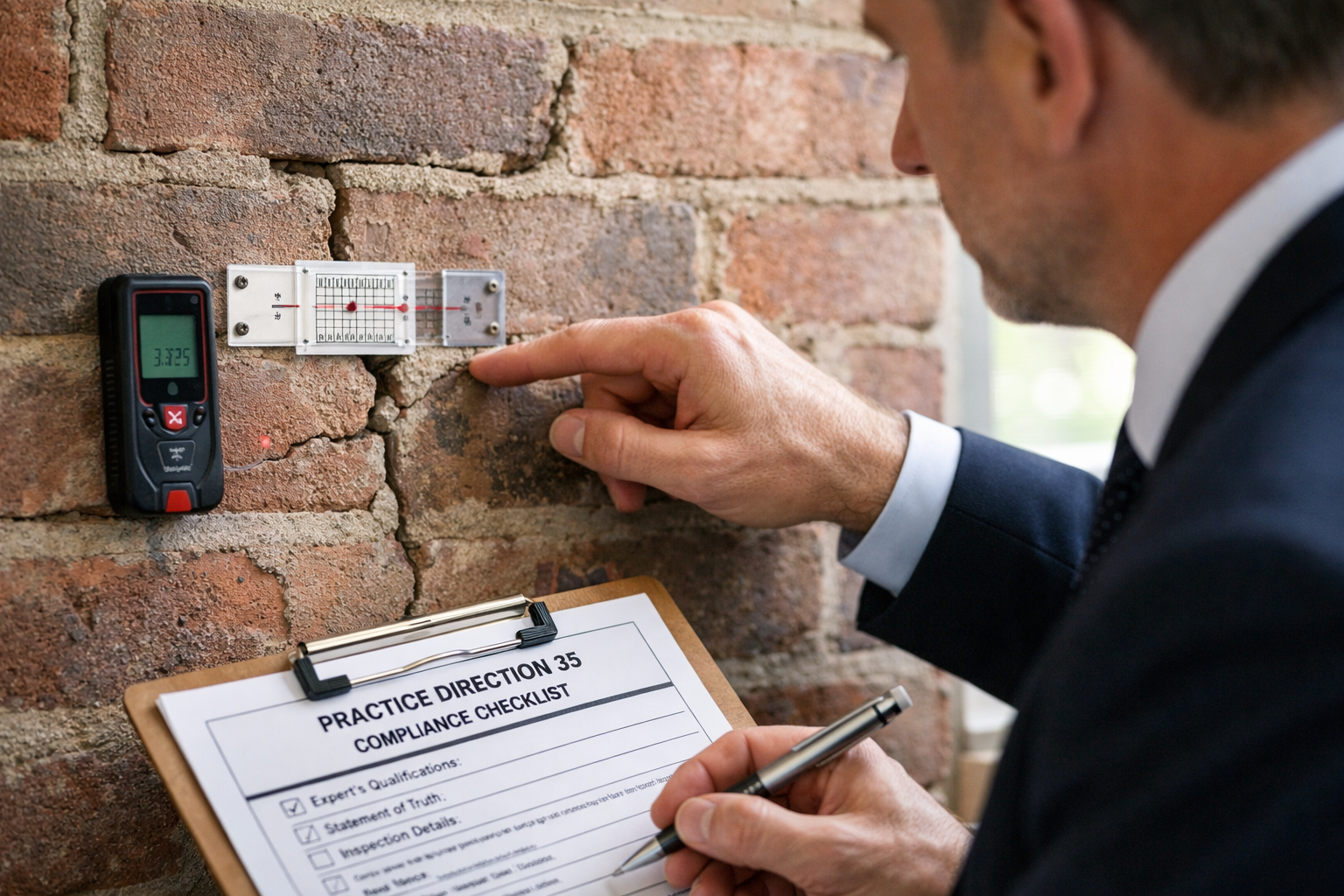
The inspection methodology directly impacts the credibility of expert witness valuations in party wall disputes. Courts scrutinize how evidence was gathered, making systematic approaches essential.
🔍 Inspection Best Practices
Photographic documentation: Capture comprehensive images showing:
- Overall context and property relationships
- Specific defects from multiple angles with measurement scales
- Comparison shots showing progression or severity
- Surrounding conditions that might influence interpretation
Measurement and quantification: Record precise:
- Crack widths, lengths, and patterns using appropriate gauges
- Deflection measurements and out-of-plumb conditions
- Moisture readings where dampness is alleged
- Dimensional changes or settlement amounts
Contemporaneous note-taking: Document observations immediately, including:
- Objective descriptions of conditions observed
- Ambient conditions during inspection (weather, lighting, access limitations)
- Statements made by parties present (attributed and dated)
- Initial impressions requiring further investigation
Material sampling considerations: When destructive investigation is necessary:
- Obtain appropriate permissions from property owners
- Document sampling locations and methodology photographically
- Preserve samples properly for potential laboratory analysis
- Minimize damage while gathering necessary evidence
Distinguishing Pre-Existing Conditions from New Damage
One of the most contentious aspects of party wall disputes involves determining whether damage existed before works commenced or resulted from the adjacent owner's activities. Expert witnesses must approach this analysis methodically.
Evidence sources for establishing pre-existing conditions:
| Evidence Type | Reliability | Typical Availability |
|---|---|---|
| Professional schedule of condition | High | Common in properly managed party wall matters |
| Estate agent photographs | Medium-High | Often available from recent sales |
| Insurance surveys | Medium-High | May be obtainable with owner consent |
| Street view historical imagery | Low-Medium | Publicly available but limited detail |
| Witness testimony | Variable | Subject to memory limitations and bias |
When party wall notices were not served properly, establishing baseline conditions becomes more challenging but remains essential for credible expert opinions.
Technical Investigation Methods
Depending on the nature of alleged damage, expert witnesses may need to employ specialized investigation techniques:
Structural assessment tools:
- Crack monitoring gauges to determine whether movement is ongoing or historic
- Level surveys to quantify settlement patterns
- Endoscopic inspection of concealed structural elements
- Ground investigation where foundation issues are suspected
Causation analysis:
- Review of construction methodologies used during party wall works
- Assessment of vibration impacts from excavation or demolition
- Evaluation of temporary support adequacy
- Analysis of drainage changes affecting ground conditions
The key principle throughout all investigations is transparency. Every method, limitation, and assumption must be clearly documented for inclusion in the expert report.

Preparing Expert Reports That Meet Practice Direction 35 Requirements
Mandatory Report Contents and Structure
Practice Direction 35 prescribes specific requirements for expert reports that must be followed precisely. Non-compliance can result in reports being excluded from evidence entirely.
Required elements include:[1]
-
Details of the expert's qualifications: RICS membership, relevant experience, specialist training in party wall matters and valuation methods
-
A statement setting out the substance of all material instructions: Both written and oral instructions must be summarized, including questions the expert was asked to address
-
Details of literature or other material relied upon: Reference to technical standards, RICS guidance, Building Regulations, and relevant case law
-
Statement of truth: Confirming the expert understands their duty to the court and has complied with that duty[1]
-
Statement that the report includes all facts within the expert's knowledge: Which might adversely affect the validity of their opinion
-
Summary of conclusions: Clear, unambiguous opinions on each issue addressed
-
Statement of any qualifications: To opinions expressed, including matters requiring further investigation
Writing for Clarity and Judicial Comprehension
Judges and legal representatives are not technical specialists. Expert reports must communicate complex surveying and valuation concepts in accessible language without sacrificing accuracy.
Effective communication strategies:
📝 Use plain English: Avoid unnecessary jargon; define technical terms when first introduced
📝 Employ visual aids: Annotated photographs, diagrams, and comparison tables enhance understanding
📝 Structure logically: Progress from observations through analysis to conclusions
📝 Separate fact from opinion: Clearly distinguish what was observed from interpretative conclusions
📝 Acknowledge uncertainty: Identify where evidence is incomplete or conclusions are qualified
Remember that your report may be read by the instructing solicitor, opposing solicitor, the opposing expert, and ultimately the judge. Each audience requires clarity, but the court is your primary audience under Practice Direction 35.
Valuation Methodology and Transparency
When expert witness valuations in party wall disputes involve quantifying diminution in property value or repair costs, methodology must be explicit and defensible.
Valuation approaches commonly employed:
Repair cost method: Itemized schedules of necessary remediation works with:
- Detailed descriptions of each repair element
- Quantities measured during inspection
- Unit rates based on published cost data or contractor quotations
- Allowances for professional fees, VAT, and contingencies
Diminution in value approach: Comparative analysis showing:
- Property value before alleged damage (using comparable sales data)
- Property value in current damaged condition
- Adjustment methodology accounting for market conditions
- Consideration of whether damage is readily repairable
Loss of amenity considerations: Quantifying intangible impacts such as:
- Temporary loss of use during repair works
- Ongoing anxiety about structural integrity
- Aesthetic impacts affecting enjoyment of property
All valuations should reference appropriate RICS standards, particularly the RICS Red Book where formal valuation opinions are provided.
The Declaration of Truth and Expert Statement
Every expert report must conclude with a formal declaration. This is not mere formality—it represents a solemn undertaking to the court with potential consequences for false statements.
Standard declaration format:
"I confirm that I have made clear which facts and matters referred to in this report are within my own knowledge and which are not. Those that are within my own knowledge I confirm to be true. The opinions I have expressed represent my true and complete professional opinions on the matters to which they refer.
I understand that proceedings for contempt of court may be brought against anyone who makes, or causes to be made, a false statement in a document verified by a statement of truth without an honest belief in its truth."[1]
This declaration underscores the gravity of the expert witness role and the absolute requirement for honesty and accuracy in all aspects of report preparation.
Common Pitfalls to Avoid
❌ Advocacy: Presenting arguments favoring the instructing party rather than objective analysis
❌ Selective evidence: Omitting facts or observations that don't support preferred conclusions
❌ Overstating certainty: Failing to acknowledge limitations or alternative interpretations
❌ Inadequate explanation: Assuming technical knowledge the court doesn't possess
❌ Missing qualifications: Not clearly stating assumptions or matters requiring further investigation
❌ Insufficient basis: Drawing conclusions not adequately supported by evidence gathered
Each of these errors can fatally undermine report credibility and potentially expose the expert to professional consequences.
Maintaining Impartiality Throughout the Litigation Process
The Single Joint Expert Scenario
Courts increasingly direct parties to instruct a single joint expert rather than each party appointing their own expert. This approach, permitted under Practice Direction 35, aims to reduce costs and expedite proceedings[1].
Implications for surveyors acting as single joint experts:
🔹 Absolute impartiality is essential: Neither party can be favored in any aspect of investigation or reporting
🔹 Equal communication: Both parties must receive identical information simultaneously
🔹 Balanced consideration: Questions and concerns from both sides must be addressed fairly
🔹 Independent decision-making: The expert determines investigation scope and methodology without party influence
The single joint expert role can be challenging when parties have fundamentally opposed positions, but it represents the purest expression of the expert's duty to the court rather than to any party.
Discussions Between Experts
When both parties have appointed experts, the court typically directs those experts to meet and identify areas of agreement and disagreement. These discussions, often called "without prejudice" meetings, serve to narrow issues for trial.
Effective expert discussions involve:
- Preparing thoroughly: Reviewing the opposing expert's report carefully and identifying specific points of disagreement
- Focusing on technical matters: Avoiding legal arguments or advocacy for parties' positions
- Seeking common ground: Identifying agreed facts, methodologies, and conclusions where possible
- Clearly articulating differences: Explaining precisely why opinions diverge and what evidence would resolve disagreements
- Documenting outcomes: Preparing a joint statement recording areas of agreement and disagreement as directed by the court
These discussions often reveal that experts agree on more than initially apparent, with remaining disagreements typically involving interpretation of ambiguous evidence rather than fundamental technical principles.
Responding to Challenges and Cross-Examination
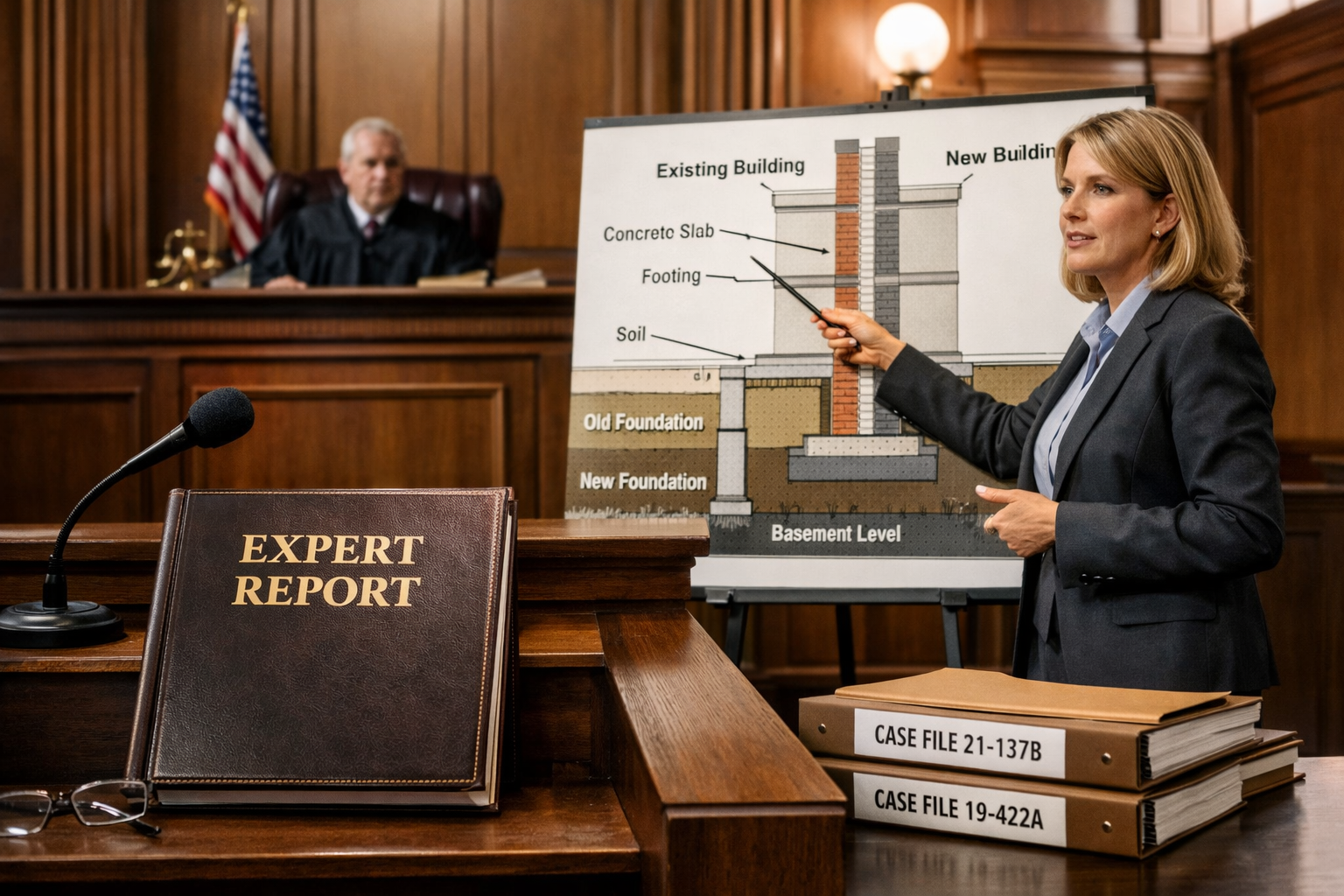
Expert witnesses must be prepared to defend their opinions under cross-examination. Credibility depends on demonstrating that conclusions are based on sound methodology and evidence rather than assumptions favoring the instructing party.
Preparation strategies include:
📚 Thorough file review: Ensuring complete familiarity with every aspect of the case
📚 Anticipating challenges: Identifying weaknesses or alternative interpretations in advance
📚 Practicing explanations: Developing clear, concise responses to likely questions
📚 Maintaining composure: Responding professionally to aggressive questioning without becoming defensive
📚 Acknowledging limitations: Admitting when questions fall outside expertise or evidence is inconclusive
The most credible expert witnesses are those who demonstrate intellectual honesty—willing to acknowledge where they might be wrong rather than defending every position regardless of merit.
Practical Considerations for Surveyors Entering Expert Witness Work
Professional Qualifications and Continuing Development
Courts give greater weight to experts with demonstrable qualifications and experience. For surveyors working in party wall disputes, this means:
Essential credentials:
- RICS membership (MRICS or FRICS) with relevant pathway experience
- Specialist knowledge of the Party Wall etc. Act 1996 and related case law
- Experience conducting building surveys and structural assessments
- Understanding of valuation principles and methodologies
- Familiarity with construction techniques and building pathology
Continuing professional development:
- Attending courses on expert witness duties and court procedures
- Studying recent party wall case law and judicial decisions
- Maintaining technical knowledge of construction standards and regulations
- Participating in professional forums discussing expert witness issues
The expert's CV becomes an exhibit in court proceedings, so maintaining an accurate, comprehensive record of qualifications and experience is essential.
Fee Structures and Independence
Expert witness fees must be structured to avoid any suggestion that payment is contingent on outcomes or that the expert has a financial interest in favoring the instructing party.
Appropriate fee arrangements:
✓ Hourly or daily rates: Based on time spent regardless of conclusions reached
✓ Fixed fees for specific deliverables: Report preparation, court attendance, etc.
✓ Regular billing: Avoiding large outstanding fees that might create pressure
Inappropriate arrangements:
✗ Contingency fees: Payment based on case outcome
✗ Success bonuses: Additional payment if instructing party prevails
✗ Deferred payment: Fees only paid if case succeeds
Any fee arrangement that creates financial incentive to reach particular conclusions undermines the expert's independence and credibility.
Insurance and Risk Management
Providing expert witness services carries professional liability risks distinct from standard surveying work. Appropriate insurance coverage is essential.
Key insurance considerations:
- Professional indemnity insurance: Ensuring expert witness work is covered (some policies exclude or limit this)
- Coverage limits: Adequate for potential claims given property values involved
- Run-off cover: Protection continuing after retirement or practice closure
- Disclosure requirements: Informing insurers of expert witness appointments
Surveyors should consult with insurance brokers specializing in professional indemnity to ensure appropriate coverage before accepting expert witness instructions.
Building an Expert Witness Practice
For surveyors interested in developing expertise in party wall dispute resolution and expert witness work, a strategic approach helps build credibility and referrals.
Development pathway:
-
Gain foundational experience: Work as a party wall surveyor in non-contentious matters, understanding typical issues and resolution approaches
-
Develop specialist knowledge: Focus on particular property types or dispute categories where you can build demonstrable expertise
-
Seek mentorship: Learn from experienced expert witnesses about court procedures and effective report writing
-
Start with smaller cases: Build experience in lower-value disputes before accepting high-stakes instructions
-
Maintain detailed records: Document cases, methodologies, and outcomes to demonstrate track record
-
Cultivate professional reputation: Present at conferences, publish articles, and engage with the professional community
The expert witness field rewards those who demonstrate consistent impartiality, technical competence, and clear communication over many cases rather than those seeking quick entry to lucrative work.
Case Study: Applying Practice Direction 35 Principles
Scenario: Loft Conversion Dispute
Consider a typical party wall dispute requiring expert witness valuation. The adjoining owner alleges that party wall loft conversion works by the building owner caused structural damage, including:
- Cracking to bedroom ceilings and walls
- Separation between wall and ceiling junctions
- Cosmetic damage to recently decorated rooms
The building owner contends that cracks were pre-existing and unrelated to the loft works, which were conducted with appropriate temporary support and in accordance with the party wall award.
Expert Approach Under Practice Direction 35
Investigation phase:
- Review documentation: Party wall notices, award, building control approvals, contractor method statements, and any pre-works condition schedule
- Inspect both properties: Examine the loft conversion works and alleged damage areas systematically
- Analyze crack patterns: Determine whether damage is consistent with settlement, structural movement, or other causes
- Consider timeline: Assess whether damage appearance correlates with construction activities
- Evaluate alternative causes: Consider seasonal movement, ground conditions, or unrelated building alterations
Report preparation:
The expert report would clearly separate:
- Agreed facts: The loft conversion occurred, cracks exist in specific locations
- Technical analysis: Crack patterns, structural load paths, construction methodology assessment
- Opinion on causation: Whether works caused or contributed to damage, with reasoning and qualifications
- Valuation: Repair costs if damage is attributable to party wall works
Key Practice Direction 35 compliance:
✅ Acknowledging limitations where evidence is incomplete
✅ Identifying where further investigation might clarify matters
✅ Presenting alternative interpretations fairly
✅ Clearly stating assumptions underlying opinions
✅ Including formal declaration of truth
This approach demonstrates how impartiality and methodical evidence gathering create credible expert opinions that assist the court in resolving disputes fairly.
Conclusion
Expert witness valuations in party wall disputes under Practice Direction 35 represent a specialized professional service requiring technical competence, absolute impartiality, and clear communication. The expert's duty to the court supersedes all other obligations, transforming the traditional surveyor-client relationship into one focused solely on assisting judicial decision-making through objective analysis[1][3].
Building credible cases begins with systematic property inspections that gather comprehensive evidence while maintaining transparency about methodology and limitations. Expert reports must comply precisely with Practice Direction 35 requirements, including mandatory declarations and clear separation of fact from opinion[1]. Throughout the litigation process, from initial instruction through potential courtroom testimony, maintaining independence and intellectual honesty determines professional credibility and effectiveness.
Actionable Next Steps for Surveyors
If you're considering expert witness work:
- Assess your qualifications: Ensure you have sufficient technical expertise and experience in party wall matters before accepting instructions
- Obtain appropriate training: Complete courses on expert witness duties, court procedures, and Practice Direction 35 requirements
- Review your insurance: Confirm professional indemnity coverage extends to expert witness services
- Develop systematic approaches: Create inspection checklists and report templates ensuring Practice Direction 35 compliance
- Seek mentorship: Connect with experienced expert witnesses who can provide guidance on effective practice
If you're currently instructed as an expert:
- Review your report against Practice Direction 35: Ensure all mandatory elements are included and properly formatted
- Examine your methodology: Confirm evidence gathering was systematic and transparent
- Test your impartiality: Honestly assess whether conclusions are driven by evidence or unconscious advocacy
- Prepare for challenges: Anticipate cross-examination questions and ensure you can defend opinions with reference to evidence
The field of expert witness work in party wall disputes offers professionally rewarding opportunities for surveyors willing to embrace the rigorous standards of impartiality and methodical analysis that Practice Direction 35 demands. By prioritizing duty to the court above all other considerations, experts contribute to fair resolution of disputes while maintaining the highest professional standards.
For surveyors seeking guidance on party wall matters or requiring expert witness services, professional consultation ensures compliance with legal requirements and effective dispute resolution.
References
[1] Pd Part35 – https://www.justice.gov.uk/courts/procedure-rules/civil/rules/part35/pd_part35
[2] Practice Direction 35 Experts And Assessors – https://www.expertwitness.co.uk/articles/news/practice-direction-35-experts-and-assessors
[3] Experts Recent Developments Practices 538962942 – https://vlex.com/vid/experts-recent-developments-practices-538962942
[4] Risk Management Expert Witness – https://seakexperts.com/specialties/risk-management-expert-witness