
The property market is experiencing a fundamental shift in 2026, with survey demand reaching unprecedented levels as regulatory changes and technological innovations converge to transform how properties change hands. The Survey Demand Surge in 2026: How Property Condition Assessments Are Reshaping the Transaction Timeline represents more than just increased workload for surveyors—it signals a complete restructuring of the property transaction process that professionals must understand and adapt to immediately.

With the property condition assessment market projected to reach $5.8 billion by 2030 and growing at a compound annual growth rate of 9.1%[1], surveyors face both tremendous opportunity and significant operational challenges. Consultations on mandatory upfront property assessments are gaining momentum, promising to shift surveys from a mid-transaction checkpoint to an essential pre-listing requirement. 🏠
Key Takeaways
- Market expansion: Property condition assessment sector growing at 9.1% annually, reaching $5.8 billion by 2030[1]
- Regulatory transformation: Mandatory upfront assessments under consultation will fundamentally change transaction workflows
- Technology integration: AI-driven tools, drone inspections, and BIM-based evaluations becoming standard practice[1]
- Timeline compression: Early-stage surveys reducing overall transaction times while increasing surveyor workload at listing phase
- Professional adaptation: Surveyors must invest in new technologies and adjust capacity planning for front-loaded demand
Understanding the Survey Demand Surge in 2026
The Numbers Behind the Boom
The property assessment industry is experiencing explosive growth driven by multiple converging factors. The market's 9.1% compound annual growth rate reflects not just increased transaction volumes but a fundamental shift in how property assessments fit into the buying and selling process[1].
Key growth metrics include:
| Metric | 2024 Baseline | 2026 Projection | Growth Rate |
|---|---|---|---|
| Market Value | $4.2 billion | $5.1 billion | +21% |
| Survey Requests | Standard | +35-40% | Significant surge |
| Digital Assessments | 30% adoption | 65% adoption | +117% |
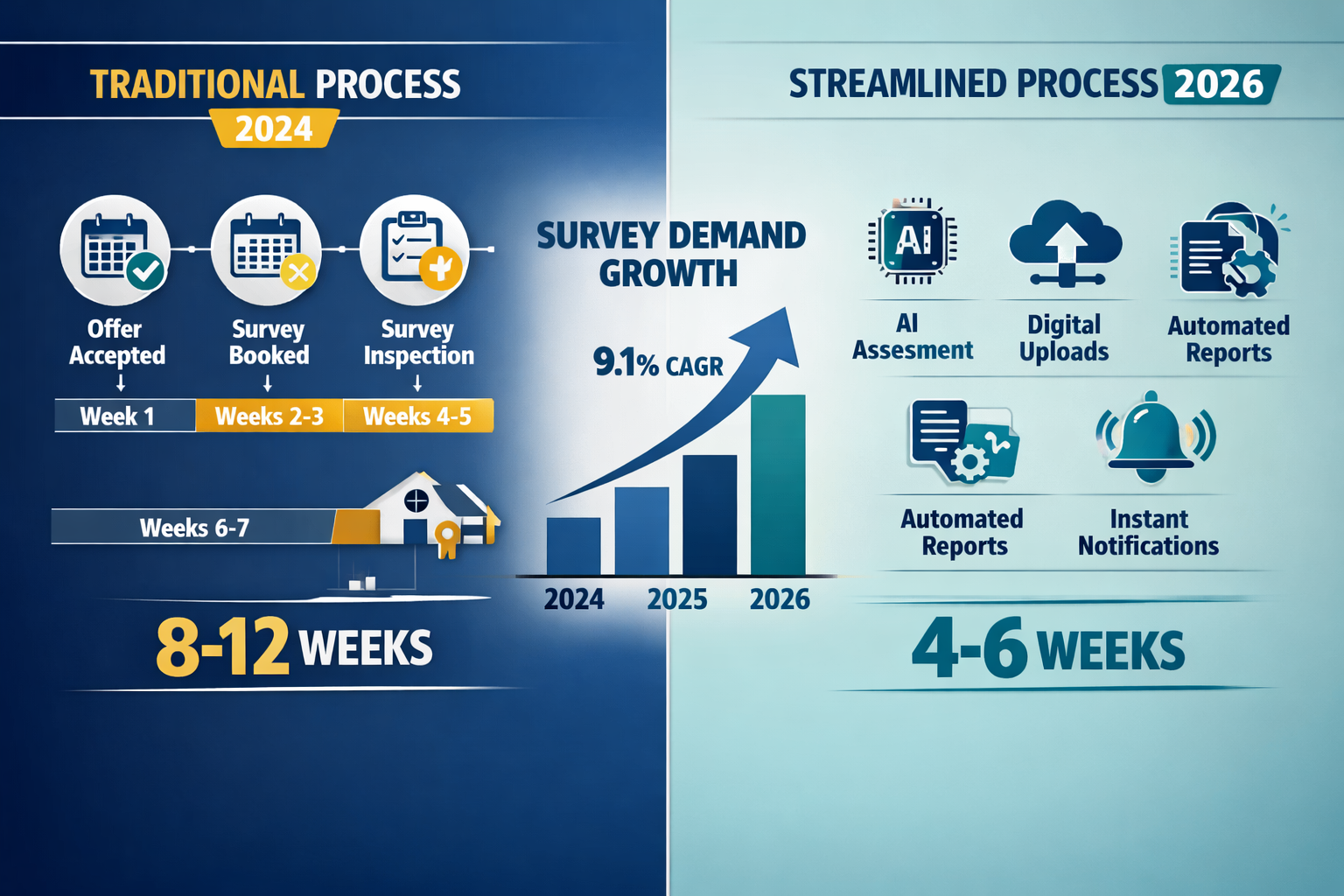
| Average Timeline | 8-12 weeks | 4-6 weeks | -50% |
This surge isn't merely cyclical—it represents structural changes in the property market. The anticipated 14% increase in home sales nationwide through 2026, supported by lower mortgage rates and reduced inventory constraints[4], creates baseline demand pressure. However, regulatory discussions around mandatory upfront assessments threaten to concentrate this demand at the beginning of the transaction timeline.
Regulatory Drivers Reshaping the Market
The push toward mandatory upfront property condition assessments stems from multiple regulatory concerns:
Building safety compliance has become paramount following high-profile structural failures and fire safety incidents. Regulators increasingly view comprehensive property assessments as essential consumer protection measures[1]. This emphasis on safety is driving proposals that would require sellers to commission building surveys before listing properties.
Transparency requirements aim to reduce transaction failures and buyer complaints. By moving assessments earlier in the process, regulators hope to eliminate surprises that currently derail deals mid-transaction. This shift would make property condition information available during the viewing and offer stages, fundamentally changing buyer decision-making.
Market efficiency goals reflect government and industry desires to streamline property transactions. The current system, where surveys occur after offers are accepted, creates bottlenecks and contributes to lengthy completion times. Upfront assessments promise to compress overall timelines while front-loading surveyor workload.

How Property Condition Assessments Are Reshaping Transaction Workflows
The Traditional Timeline vs. 2026 Reality
Historically, property transactions followed a predictable sequence:
Traditional Process (2024 and earlier):
- 📋 Property listed without formal assessment
- 🏡 Viewings and offers submitted
- ✅ Offer accepted
- 📊 Survey commissioned by buyer
- 🔍 Survey reveals issues
- 💰 Renegotiation or withdrawal
- 📝 Transaction proceeds or fails
This model placed surveys at week 4-6 of an 8-12 week process, creating a critical decision point where many transactions collapsed. Understanding how long a homebuyers survey takes became essential for managing buyer expectations during this vulnerable period.
Emerging 2026 Model:
- 📊 Seller commissions comprehensive assessment pre-listing
- 📋 Property marketed with survey report available
- 🏡 Informed viewings with condition transparency
- ✅ Realistic offers reflecting known issues
- 🚀 Accelerated legal and financial processes
- 📝 Faster completion with fewer surprises
This transformation fundamentally changes surveyor workflows. Instead of responding to individual buyer requests throughout the year, surveyors face concentrated demand from sellers preparing listings. The Survey Demand Surge in 2026: How Property Condition Assessments Are Reshaping the Transaction Timeline creates a "feast or famine" dynamic that requires sophisticated capacity planning.
Impact on Different Property Types
The assessment surge affects various property sectors differently:
Residential Properties 🏘️
Standard residential transactions see the most dramatic impact. Sellers of family homes, apartments, and smaller properties must now budget for comprehensive surveys before marketing. This creates opportunities for homebuyer surveys and RICS Level 3 building surveys as standard pre-listing requirements.
The residential sector benefits most from timeline compression. With condition information available upfront, buyers make informed offers, reducing renegotiation and withdrawal rates. However, this concentrates surveyor demand at the listing preparation stage.
Commercial Properties 🏢
Commercial real estate already employed more rigorous due diligence, but 2026 trends accelerate this further. Despite macroeconomic uncertainties, 65% of commercial real estate professionals expect improved market conditions through 2026[3], driving transaction volumes.
Commercial property surveyors face increased demand for comprehensive assessments covering structural integrity, mechanical systems, environmental compliance, and lifecycle asset management. The integration of building information modeling (BIM)-based evaluations[1] becomes standard practice for commercial assessments.
Specialist Properties 🏛️
Properties with unique characteristics—historic buildings, non-standard construction, properties with known issues—require specialized assessment approaches. Demand surges for surveys for subsidence, structural surveys, and specialist evaluations.
These properties benefit significantly from upfront transparency. Sellers can address issues proactively or price accordingly, while buyers enter transactions with realistic expectations.
Technology Integration Driving Efficiency
The Survey Demand Surge in 2026: How Property Condition Assessments Are Reshaping the Transaction Timeline would be unsustainable without parallel technological advances:
AI-Driven Assessment Tools 🤖
Artificial intelligence is moving from experimental to mission-critical in property assessments[5]. AI applications include:
- Automated defect detection analyzing photographs and thermal imaging
- Predictive maintenance insights forecasting future issues based on property characteristics
- Report generation creating standardized documentation from field data
- Risk scoring quantifying property condition for lenders and insurers
These tools don't replace professional surveyors but augment their capabilities, allowing professionals to assess more properties without compromising quality.
Remote Inspection Technologies 📱
Drone-enabled property assessments have transitioned from novelty to necessity[1]. Drones provide:
- Safe roof and chimney inspections without scaffolding
- Comprehensive external envelope documentation
- Thermal imaging for insulation and moisture detection
- Rapid site surveys for large commercial properties
Combined with cloud-based PCA software platforms[1], remote technologies enable surveyors to conduct preliminary assessments efficiently, reserving detailed on-site time for complex issues.
Building Information Modeling (BIM) Integration 🏗️
BIM-based evaluations[1] create digital twins of properties, enabling:
- Three-dimensional condition visualization
- Historical maintenance tracking
- Future intervention planning
- Integration with smart building systems
For commercial properties and new-build residential developments, BIM integration provides unprecedented assessment detail and ongoing condition monitoring.
Preparing for the Survey Demand Surge: Strategies for Surveyors
Capacity Planning and Resource Allocation
The concentration of survey demand at the pre-listing stage requires surveyors to rethink capacity planning fundamentally:
Demand Forecasting 📊
Traditional surveying businesses operated on relatively predictable demand patterns tied to transaction volumes. The 2026 model creates more volatile demand patterns:
- Seasonal spikes as sellers prepare properties for peak listing seasons
- Market-driven surges when interest rates or economic conditions favor selling
- Regulatory deadlines if mandatory assessment requirements phase in gradually
Successful firms will implement sophisticated forecasting using historical listing data, market indicators, and regulatory timelines to anticipate demand surges.
Flexible Staffing Models 👥
Fixed staffing struggles with the new demand pattern. Innovative approaches include:
- Associate surveyor networks providing surge capacity
- Technology-enabled productivity allowing existing staff to handle increased volume
- Specialized teams focusing on high-volume standard assessments versus complex specialist surveys
- Strategic partnerships with estate agents and property platforms for steady workflow
Geographic Expansion 🗺️
The survey surge creates opportunities for firms to expand service areas. Establishing presence in multiple markets—from chartered surveyors in London to regional coverage including Sussex, Hertfordshire, and Oxfordshire—diversifies demand patterns and maximizes capacity utilization.
Technology Investment Priorities
Surveyors must strategically invest in technology to handle increased demand without proportional cost increases:
Essential Technology Stack for 2026:
- Mobile inspection platforms enabling efficient field data capture
- Cloud-based reporting systems accelerating report production and delivery
- Drone equipment and certification for comprehensive external assessments
- Thermal imaging cameras for moisture and insulation evaluation
- AI-assisted analysis tools for defect detection and risk assessment
- Client portal systems providing transparent progress tracking and report access
- Integrated scheduling software optimizing surveyor deployment and reducing travel time
The property condition assessment market's growth is explicitly tied to adoption of AI-driven assessment tools, predictive maintenance insights, remote inspection technologies, and BIM-based evaluations[1]. Firms that lag in technology adoption will struggle to compete on speed, cost, and quality.
Service Differentiation and Specialization
The survey surge creates opportunities for differentiation:
Tiered Service Offerings 📋
Not all properties require identical assessment depth. Developing tiered services allows sellers to choose appropriate levels:
- Basic condition reports for newer properties in good condition
- Standard surveys for typical residential properties (Level 2 homebuyer surveys)
- Comprehensive building surveys for older or complex properties (Level 3 surveys)
- Specialist assessments for unique issues or property types
Specialist Expertise 🔍
Developing recognized expertise in specific areas creates competitive advantages:
- Period property specialists understanding historic construction methods
- Non-standard construction experts assessing unusual building types
- Commercial assessment teams handling complex multi-use properties
- Environmental specialists evaluating contamination and sustainability issues
Choosing the right property survey becomes more complex when assessments occur pre-listing, creating opportunities for surveyors to provide consultative guidance to sellers.
Client Relationship Management
The shift to seller-commissioned surveys fundamentally changes client relationships:
Estate Agent Partnerships 🤝
Estate agents become critical referral sources as they guide sellers through pre-listing preparation. Developing strong relationships with agents—including providing:
- Fast turnaround commitments for their clients
- Transparent pricing enabling agents to set seller expectations
- Marketing-friendly reports highlighting property strengths alongside condition issues
- Educational resources helping agents understand survey requirements
Seller Education 📚
Sellers traditionally avoided survey costs, viewing them as buyer responsibilities. Educating sellers about:
- Transaction acceleration benefits of upfront surveys
- Pricing strategy advantages of transparent condition information
- Reduced fall-through rates when buyers have realistic expectations
- Competitive differentiation in crowded markets
Lender and Legal Professional Engagement ⚖️
As upfront surveys become standard, lenders and conveyancers adjust their processes. Surveyors should engage these stakeholders to:
- Ensure reports meet lender requirements for mortgage purposes
- Align assessment standards with legal due diligence expectations
- Develop standardized formats reducing legal review time
- Create feedback loops improving report utility
Market Consolidation and Industry Evolution
Strategic Acquisitions and Partnerships
The property condition assessment market is experiencing consolidation as firms position for growth. The acquisition of Binary Group Inc. by Property Condition Assessments LLC in August 2024[1] exemplifies this trend.
Consolidation drivers include:
- Technology investment requirements favoring larger firms with capital
- Geographic coverage demands from national clients
- Specialist capability aggregation combining diverse expertise
- Operational efficiency through shared systems and resources
Smaller surveying practices face strategic decisions: remain independent and specialized, join larger networks, or pursue niche markets underserved by consolidated competitors.
Professional Standards and Quality Assurance
Increased survey volumes create quality assurance challenges. The industry must maintain rigorous standards despite pressure for speed and cost reduction:
RICS Standards Compliance ✅
The Royal Institution of Chartered Surveyors provides essential quality frameworks. Firms must ensure:
- All assessments meet RICS building survey standards
- Surveyors maintain appropriate qualifications and continuing professional development
- Professional indemnity insurance covers increased volumes and earlier-stage assessments
- Complaints and dispute resolution procedures handle seller and buyer concerns
Quality Control Systems 🔍
As firms scale to meet demand, systematic quality control becomes essential:
- Peer review processes for complex or high-value assessments
- Standardized reporting templates ensuring consistency
- Client feedback mechanisms identifying improvement opportunities
- Regular audits maintaining standards across surveyor teams
Emerging Service Models
Innovation in service delivery responds to the survey surge:
Subscription Assessment Services 💳
Some firms experiment with subscription models where:
- Estate agents or property platforms subscribe for bulk capacity
- Sellers access surveys through platform memberships
- Ongoing monitoring services track property condition over time
Instant Digital Assessments ⚡
For straightforward properties, automated assessment tools provide:
- Preliminary condition reports based on property data and imagery
- Risk scoring for lenders and insurers
- Triage determining which properties require full surveyor inspection
These complement rather than replace professional surveys, handling simple cases while freeing surveyor capacity for complex assessments.
Regional Variations and Local Market Dynamics
The Survey Demand Surge in 2026: How Property Condition Assessments Are Reshaping the Transaction Timeline manifests differently across regions:
London and Southeast England
The most active property market experiences the most acute survey demand pressure. Firms serving areas from central London to surrounding regions including Battersea, Islington, Fulham, and Kingston face:
- Highest transaction volumes creating sustained demand
- Property diversity requiring varied assessment expertise
- Price sensitivity where survey costs represent smaller transaction percentages
- Competition intensity among surveying firms
Regional Markets
Areas including Hertfordshire, Sussex, and Oxfordshire experience:
- Commuter market dynamics with London influence
- Mix of property types from period cottages to new developments
- Seasonal demand patterns tied to family moving cycles
- Local specialist requirements understanding regional construction characteristics
Emerging Markets
Growing property markets present expansion opportunities for surveying firms willing to establish local presence and expertise.
Financial Implications and Pricing Strategies
Cost Structures in the New Model
The survey surge affects surveyor economics:
Fixed vs. Variable Costs 💰
Traditional surveying businesses operated with relatively high fixed costs (staff, offices, equipment) and low variable costs per survey. The 2026 model requires:
- Technology investment increasing fixed costs but reducing variable costs
- Flexible capacity shifting more costs to variable through associate networks
- Marketing expenses capturing seller and estate agent attention
Pricing Pressure and Opportunities 📈
Increased demand creates pricing power, but also competition. Successful pricing strategies include:
- Volume discounts for estate agents and platforms providing consistent workflow
- Premium pricing for specialist assessments and rapid turnaround
- Transparent tiered pricing helping sellers choose appropriate service levels
- Value-added services including pre-listing advice and post-survey consultation
Return on Investment for Technology
Technology investment requires careful ROI analysis:
| Technology | Initial Investment | Annual Cost | Surveys/Year Increase | Break-Even Point |
|---|---|---|---|---|
| Basic drone kit | £2,000-5,000 | £500 | +50-100 | 6-12 months |
| Thermal camera | £3,000-8,000 | £300 | +30-50 | 12-18 months |
| Cloud platform | £5,000-15,000 | £3,000-8,000 | +100-200 | 12-24 months |
| AI analysis tools | £10,000-25,000 | £5,000-12,000 | +200-400 | 18-36 months |
These investments become essential as the market expects technology-enabled efficiency and quality.
Challenges and Risk Management
Quality vs. Speed Tensions
The demand surge creates pressure to prioritize speed over thoroughness. Managing this tension requires:
Clear Service Definitions 📋
Explicitly defining what each assessment level includes prevents scope creep and manages client expectations. Sellers must understand that rapid turnaround basic assessments differ fundamentally from comprehensive structural surveys.
Professional Judgment Protocols ⚖️
Surveyors must maintain professional standards despite commercial pressure:
- Declining inappropriate timescales when thorough assessment requires more time
- Recommending specialist investigations when initial assessments reveal complex issues
- Documenting limitations when access or conditions prevent complete evaluation
Liability Considerations
Seller-commissioned surveys create novel liability questions:
Who Relies on the Report? 🤔
Traditional buyer-commissioned surveys create clear reliance relationships. Seller-commissioned reports potentially create liability to:
- The commissioning seller
- Prospective buyers relying on the report
- Lenders financing purchases based on the assessment
- Subsequent owners if issues were missed
Professional indemnity insurance and clear report terms of engagement must address these expanded liability scenarios.
Market Resistance and Adoption Barriers
Not all market participants embrace mandatory upfront assessments:
Seller Resistance 💸
Many sellers resist bearing survey costs, viewing them as buyer responsibilities. Overcoming this requires demonstrating:
- Transaction acceleration reducing carrying costs and uncertainty
- Pricing optimization through transparent condition information
- Reduced fall-through rates minimizing wasted marketing time
Buyer Skepticism 🤨
Some buyers distrust seller-commissioned surveys, preferring independent assessments. Addressing this requires:
- Independent professional standards ensuring objectivity
- Buyer rights to commission additional surveys if desired
- Transparent reporting providing confidence in assessment quality
Future Outlook: Beyond 2026
Long-Term Market Evolution
The Survey Demand Surge in 2026: How Property Condition Assessments Are Reshaping the Transaction Timeline represents an inflection point, not a temporary phenomenon. Long-term trends include:
Continuous Condition Monitoring 📊
Properties may transition from periodic assessments to continuous monitoring through:
- Smart building sensors tracking structural movement, moisture, and system performance
- Blockchain-based condition records creating transparent property histories
- Predictive maintenance platforms forecasting intervention requirements
This evolution transforms surveyors from periodic assessors to ongoing property health advisors.
Integration with PropTech Ecosystems 🌐
Property technology platforms increasingly integrate assessment data with:
- Automated valuation models incorporating condition information
- Transaction platforms embedding survey data in property listings
- Smart contracts triggering actions based on assessment outcomes
Surveyors must position themselves within these ecosystems rather than operating independently.
Regulatory Development Trajectories
Current consultations on mandatory upfront assessments likely lead to:
Phased Implementation 📅
Regulations may phase in by:
- Property value thresholds (starting with higher-value properties)
- Property type (residential before commercial, or vice versa)
- Geographic regions (pilot areas before national rollout)
Standardization Requirements 📏
Mandatory assessments drive standardization in:
- Report formats and content requirements
- Minimum qualification standards for assessors
- Technology and methodology specifications
- Quality assurance and oversight mechanisms
Professional Development Imperatives
Surveyors must invest in ongoing professional development:
Technical Skills 🔧
- Drone operation and aerial inspection techniques
- Thermal imaging interpretation
- BIM software proficiency
- AI-assisted analysis tool utilization
Business Skills 💼
- Capacity planning and resource optimization
- Technology investment evaluation
- Client relationship management
- Marketing and business development
Regulatory Knowledge 📖
- Evolving assessment requirements
- Building safety legislation
- Environmental compliance standards
- Professional liability frameworks
Conclusion: Embracing the Survey Demand Transformation
The Survey Demand Surge in 2026: How Property Condition Assessments Are Reshaping the Transaction Timeline represents both significant challenge and tremendous opportunity for property surveyors. The convergence of regulatory pressure, technological innovation, and market evolution is fundamentally restructuring how property assessments fit into transaction workflows.
Key success factors for navigating this transformation include:
✅ Strategic technology investment in AI-driven tools, remote inspection capabilities, and cloud-based platforms that enable efficient scaling
✅ Flexible capacity planning through associate networks, geographic expansion, and sophisticated demand forecasting
✅ Service innovation with tiered offerings, specialist expertise development, and value-added consultation
✅ Stakeholder engagement building strong relationships with estate agents, sellers, lenders, and legal professionals
✅ Quality assurance maintaining rigorous professional standards despite volume and speed pressures
✅ Continuous adaptation staying current with regulatory developments, market trends, and technological advances
The property condition assessment market's projected growth to $5.8 billion by 2030[1] reflects genuine structural change, not temporary fluctuation. Surveyors who embrace this transformation—investing in technology, adjusting business models, and positioning themselves as essential transaction facilitators rather than optional checkpoints—will thrive in the evolving market.
Actionable Next Steps
For Surveying Firms:
- Assess current capacity and identify technology gaps preventing efficient scaling
- Develop estate agent partnerships establishing referral relationships for seller-commissioned work
- Invest in priority technologies starting with mobile platforms and remote inspection capabilities
- Create tiered service offerings providing options for different property types and seller needs
- Implement quality control systems ensuring standards maintain as volumes increase
For Individual Surveyors:
- Pursue specialist qualifications in high-demand areas like period properties or commercial assessments
- Develop technology proficiency in drone operation, thermal imaging, and digital reporting
- Build professional networks connecting with estate agents and property professionals
- Stay informed about regulatory consultations and industry developments
- Consider geographic expansion into underserved markets with growing demand
For Property Market Stakeholders:
- Engage with consultation processes shaping mandatory assessment regulations
- Adapt transaction workflows anticipating upfront survey requirements
- Educate clients about benefits of early-stage property condition transparency
- Develop integrated platforms connecting assessment data with transaction processes
- Support quality standards ensuring survey surge doesn't compromise assessment rigor
The transformation is underway. Those who prepare strategically will find themselves well-positioned to capitalize on sustained growth in property condition assessment demand, while those who resist adaptation risk being left behind as the market fundamentally reshapes transaction timelines and expectations.
References
[1] Emerging Growth Trends Driving Rapid Expansion In The Property – https://www.openpr.com/news/4408941/emerging-growth-trends-driving-rapid-expansion-in-the-property
[2] Property Management Trends 2026 – https://westpointproperty.com/property-management-trends-2026/
[3] Commercial Real Estate Outlook – https://www.deloitte.com/us/en/insights/industry/financial-services/commercial-real-estate-outlook.html
[4] 2026 Real Estate Outlook What Leading Housing Economists Are Watching – https://www.nar.realtor/magazine/real-estate-news/2026-real-estate-outlook-what-leading-housing-economists-are-watching
[5] 2026 Property Management Industry Report – https://www.buildium.com/resource/2026-property-management-industry-report/