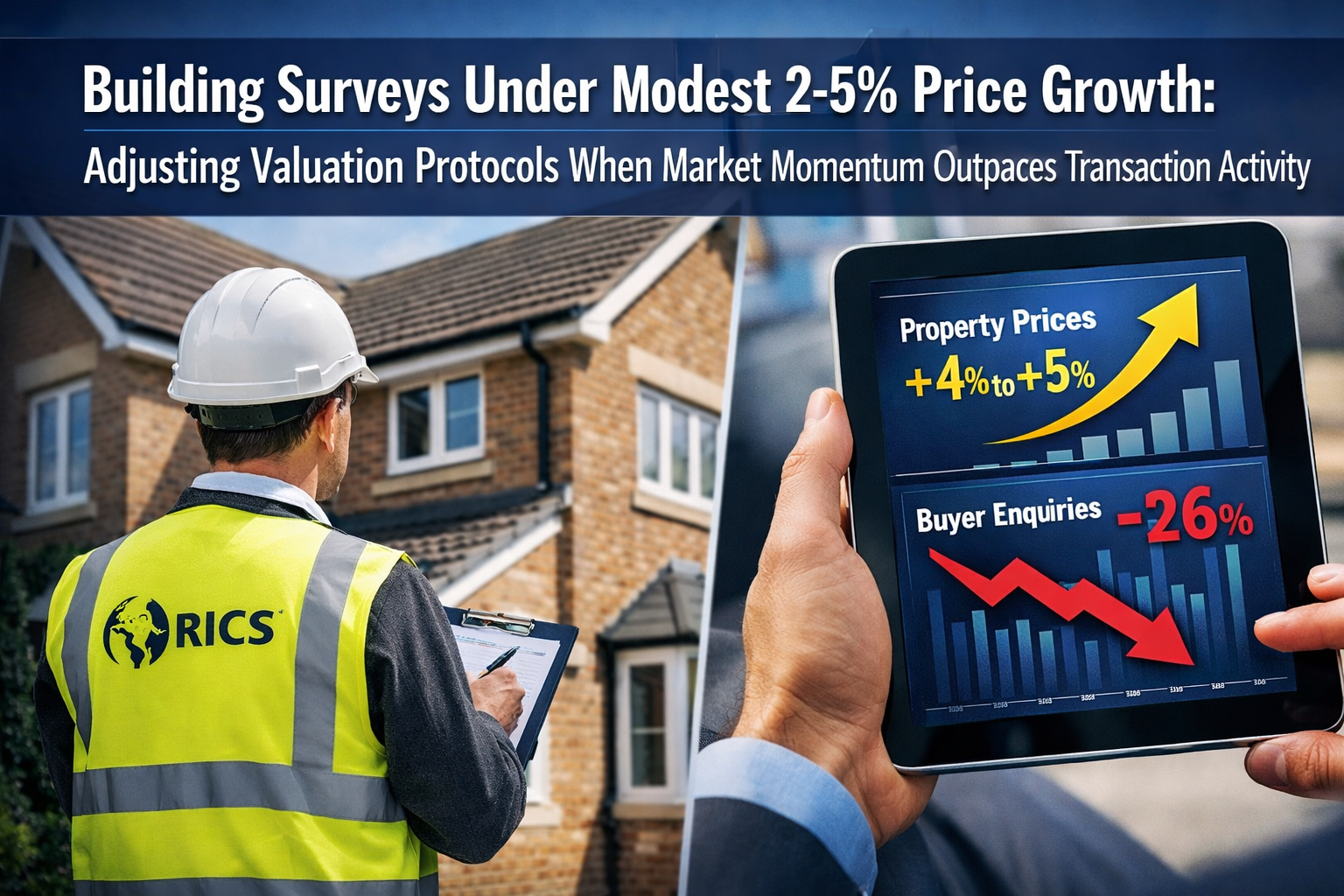
The property market in 2026 presents a peculiar paradox: forecasts predict steady price growth of 4-5% across residential sectors, yet buyer enquiries have plummeted to a -26% net balance. This disconnect between market momentum and transaction activity creates unprecedented challenges for surveyors conducting building surveys under modest 2-5% price growth: adjusting valuation protocols when market momentum outpaces transaction activity requires a fundamental recalibration of traditional assessment methods.
For chartered surveyors and valuation professionals, this environment demands more than routine adjustments—it requires a complete rethinking of how condition assessments inform property valuations when theoretical growth contradicts actual market behavior. The gap between predicted appreciation and buyer confidence signals that standard comparable sales methodologies may no longer provide accurate valuations.
Key Takeaways
- 📊 Market Disconnect: Property prices forecast at 4-5% growth while buyer enquiries decline by -26%, creating valuation challenges
- 🔍 Enhanced Survey Protocols: Building surveys must now incorporate broader market sentiment indicators beyond traditional structural assessments
- 📈 Adjusted Valuation Methods: Comparable sales data requires weighting adjustments to account for reduced transaction volumes
- ⚡ Regulatory Changes: 2026 ALTA standards and mandatory UK condition assessments fundamentally alter survey workflows[1][2]
- 🎯 Risk-Adjusted Approaches: Valuations must balance optimistic forecasts against subdued buyer confidence through scenario modeling
Understanding the 2026 Market Paradox: Growth Forecasts vs. Buyer Sentiment
The Current Market Landscape
The property market in 2026 operates under contradictory forces. Economic forecasts from major financial institutions project consistent residential property appreciation between 4% and 5% throughout the year. These predictions stem from several fundamental factors:
- Limited housing supply in key markets
- Stabilizing interest rates following previous volatility
- Improved mortgage affordability ratios
- Government incentives for first-time buyers[3]
Yet despite these positive indicators, buyer sentiment tells a dramatically different story. The -26% net balance in buyer enquiries represents one of the sharpest declines in recent years, suggesting potential purchasers remain hesitant despite favorable conditions.
Why This Matters for Building Surveys
This disconnect directly impacts how surveyors approach RICS building surveys and subsequent valuations. Traditional survey methodologies assume a relatively stable relationship between property condition, comparable sales, and market activity. When forecasts predict growth but transactions stagnate, surveyors face critical questions:
- Should valuations reflect optimistic forecasts or current transaction reality?
- How do condition findings translate to value when comparable sales are scarce?
- What weight should be given to market momentum versus actual buyer behavior?
The 2026 regulatory landscape compounds these challenges. The introduction of mandatory upfront condition assessments in the UK fundamentally alters transaction workflows[2]. Sellers must now commission comprehensive surveys before listing properties, shifting the traditional survey timeline and changing how valuation data flows through the market.
Regulatory Framework Changes in 2026
The American Land Title Association (ALTA) and National Society of Professional Surveyors released updated Minimum Standard Detail Requirements effective February 23, 2026[1]. These revisions emphasize:
- Enhanced documentation requirements for all survey findings
- Improved transparency regarding property encumbrances
- Stricter standards for supporting evidence in valuation reports
For surveyors conducting valuation reports, these changes mean more rigorous documentation protocols precisely when market conditions make valuation determinations more complex.
Building Surveys Under Modest 2-5% Price Growth: Adjusting Valuation Protocols When Market Momentum Outpaces Transaction Activity
Recalibrating Survey Methodologies for Divergent Markets
When conducting building surveys under modest 2-5% price growth while adjusting valuation protocols when market momentum outpaces transaction activity, surveyors must implement several strategic adjustments to their standard methodologies.
1. Enhanced Market Context Documentation
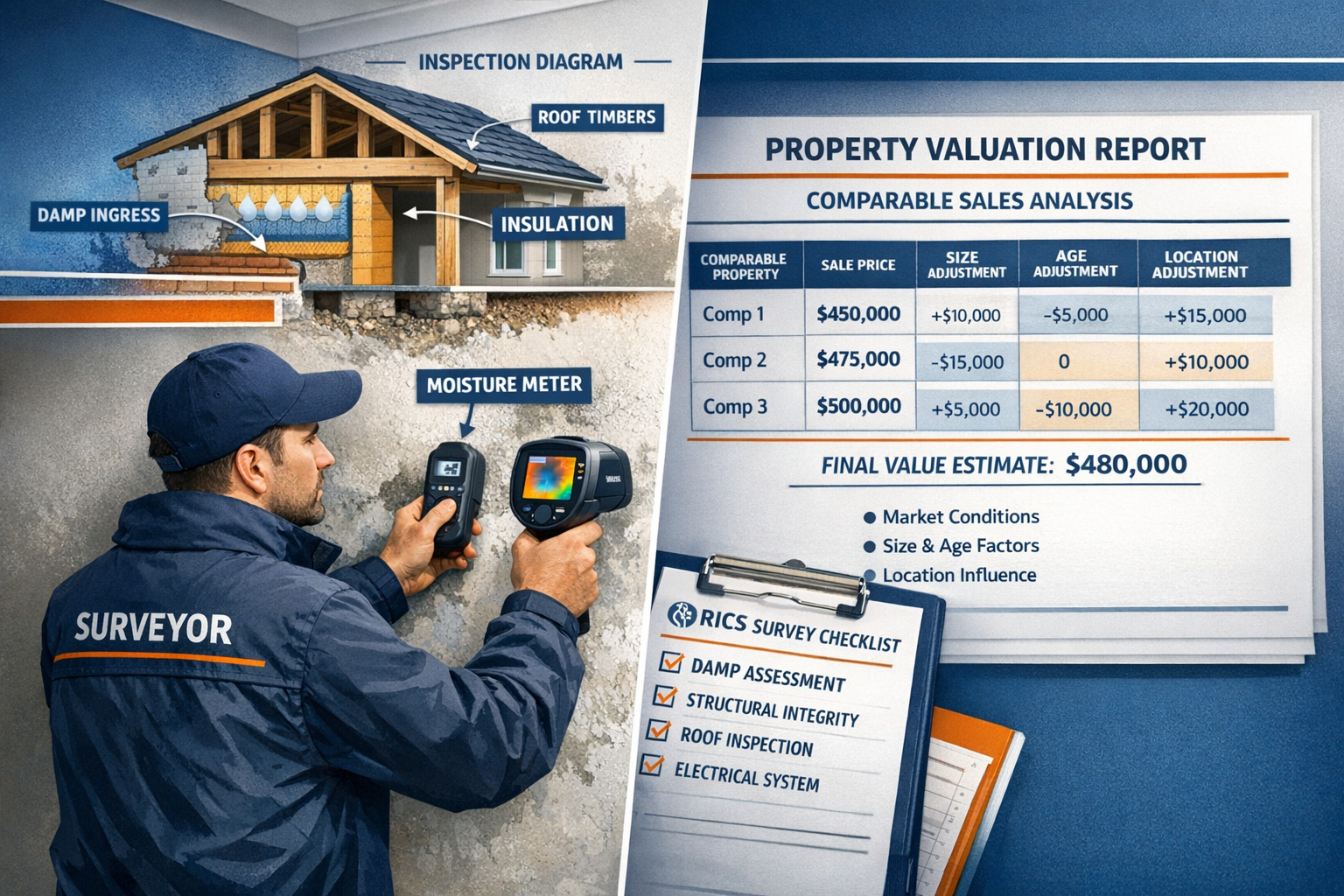
Traditional structural surveys focus primarily on physical condition—structural integrity, damp issues, roof condition, and mechanical systems. In 2026's paradoxical market, surveys must now incorporate comprehensive market context sections that address:
- Local transaction velocity: Days on market compared to historical averages
- Comparable sales scarcity: Availability and recency of genuine comparables
- Buyer demographic shifts: Changes in purchaser profiles affecting demand
- Economic sentiment indicators: Regional employment, wage growth, and confidence metrics
This expanded scope doesn't diminish the importance of physical condition assessment but recognizes that valuation accuracy depends on understanding market dynamics alongside structural findings.
2. Weighted Comparable Sales Analysis
Standard comparable sales methodology assumes recent transactions provide reliable value indicators. However, when buyer enquiries decline by -26% while forecasts predict 4-5% growth, transaction volumes drop significantly, making recent sales potentially unrepresentative.
Surveyors should implement weighted comparable analysis that considers:
| Factor | Traditional Weight | Adjusted 2026 Weight | Rationale |
|---|---|---|---|
| Recent sales (0-3 months) | 50% | 35% | Limited volume may not reflect true market |
| Recent sales (3-6 months) | 30% | 35% | Broader timeframe captures more data |
| Forecast adjustments | 10% | 20% | Incorporate professional market predictions |
| Condition differential | 10% | 10% | Remains constant priority |
This reweighting acknowledges that sparse recent transactions may not accurately represent value, while forecast data gains importance in filling information gaps.
3. Scenario-Based Valuation Ranges
Rather than providing single-point valuations, surveyors should adopt scenario-based approaches that reflect market uncertainty:
- Conservative scenario: Valuation based solely on recent comparable sales with minimal growth assumptions (0-2% appreciation)
- Moderate scenario: Balanced approach incorporating both transaction data and modest forecast growth (2-4% appreciation)
- Optimistic scenario: Valuation reflecting full forecast growth assumptions (4-5% appreciation)
This range-based methodology provides clients with realistic expectations while acknowledging the genuine uncertainty created by the momentum-transaction disconnect. For commercial valuations, this approach proves particularly valuable given the higher stakes involved.
Adjusting for Condition Findings in Low-Transaction Markets
Physical condition findings take on heightened importance when transaction comparables are scarce. A property requiring £25,000 in roof repairs represents a clearer deduction from value than attempting to interpret limited comparable sales data.
Condition-based adjustments should follow this enhanced protocol:
✅ Quantify all defects financially: Convert every significant finding into estimated repair costs
✅ Apply conservative multipliers: In uncertain markets, use 1.2-1.5x multipliers on repair estimates to account for buyer risk perception
✅ Document urgency timelines: Clearly distinguish immediate repairs from longer-term maintenance needs
✅ Consider buyer financing impact: Note which defects might affect mortgage approval or require retention
This approach ensures that regardless of market momentum uncertainty, the physical condition assessment provides concrete, defensible value adjustments.
Integration of Mandatory Condition Assessments
The UK's 2026 requirement for mandatory seller-commissioned condition assessments[2] fundamentally changes how building surveys inform valuations. Previously, buyers commissioned surveys after agreeing to purchase, creating information asymmetry. Now, comprehensive condition data exists before price negotiations begin.
This shift requires surveyors to:
- Validate pre-existing reports: When buyers commission additional surveys, cross-reference findings with seller-provided assessments
- Identify disclosure gaps: Note any conditions not adequately addressed in mandatory assessments
- Adjust for information transparency: Markets with full condition disclosure may exhibit different pricing dynamics than those with information asymmetry
The transparency created by mandatory assessments should theoretically reduce the momentum-transaction gap by giving buyers greater confidence. However, in 2026's market, this hasn't yet materialized, suggesting other factors drive the buyer hesitancy.
Practical Implementation: Valuation Protocol Adjustments for 2026 Market Conditions

Developing a Systematic Adjustment Framework
Implementing building surveys under modest 2-5% price growth while adjusting valuation protocols when market momentum outpaces transaction activity requires a systematic framework that surveyors can apply consistently across different property types and locations.
Step 1: Comprehensive Market Intelligence Gathering
Before conducting the physical survey, surveyors should compile:
- Transaction volume data: Compare current quarter sales to 12-month and 5-year averages
- Listing inventory levels: Assess supply pressure in the specific market segment
- Price per square foot trends: Track asking vs. achieved prices over 6-12 months
- Financing conditions: Current mortgage approval rates and lending criteria
This preliminary research establishes the market context within which the physical survey findings will be interpreted. Understanding methods of valuation becomes crucial when selecting the most appropriate approach for current conditions.
Step 2: Enhanced Physical Survey with Market-Aware Documentation
During the physical inspection, surveyors should:
Document features with market appeal: Note characteristics that align with current buyer preferences (energy efficiency, home office space, outdoor areas)
Assess competitive positioning: Evaluate the property against current listings rather than just sold comparables
Identify value-limiting factors: Highlight conditions that might disproportionately deter buyers in a cautious market (deferred maintenance, outdated systems, functional obsolescence)
Photograph comprehensively: Create visual documentation that supports both condition assessment and market positioning analysis
This market-aware approach to physical inspection ensures the survey captures information relevant to both structural condition and marketability—critical when buyer selectivity increases.
Step 3: Multi-Method Valuation Synthesis
Rather than relying exclusively on comparable sales, surveyors should employ multiple valuation approaches and synthesize findings:
Comparable Sales Method (Adjusted)
- Identify 5-8 recent sales within 0.5 miles (or appropriate market area)
- Apply time adjustments reflecting forecast growth (2-5% annually)
- Weight by transaction recency and similarity
- Document scarcity and reliability concerns
Cost Approach (Enhanced Role)
- Calculate replacement cost minus depreciation
- Particularly valuable when comparables are scarce
- Adjust for functional and economic obsolescence
- Consider land value separately in appreciating markets
Income Approach (Where Applicable)
- For investment properties, calculate based on rental yields
- Adjust capitalization rates for market uncertainty
- Consider rental market strength vs. sales market weakness
Forecast Integration
- Incorporate professional market forecasts as supplementary data
- Apply appropriate discount for forecast uncertainty
- Document assumptions and limitations
The final valuation should represent a weighted synthesis of these approaches, with weights adjusted based on data availability and reliability in the specific market context.
Communicating Uncertainty to Clients
Perhaps the most critical adjustment for 2026 involves how surveyors communicate valuation findings to clients. When market momentum outpaces transaction activity, transparency about limitations becomes essential.
Effective communication strategies include:
📋 Executive Summary with Context: Begin reports with a clear explanation of current market conditions and how they affect valuation confidence
📊 Visual Data Presentation: Use charts and graphs to illustrate the momentum-transaction disconnect and its implications
⚠️ Explicit Limitation Statements: Clearly articulate which aspects of the valuation carry higher uncertainty
🎯 Scenario Presentation: Present the range-based valuations with clear explanations of assumptions underlying each scenario
💡 Actionable Recommendations: Provide specific guidance on how clients should use the valuation given market conditions
This enhanced communication approach helps clients make informed decisions while protecting surveyors from liability when market conditions evolve unexpectedly.
Technology Integration for Enhanced Market Analysis
Modern surveying practices increasingly leverage technology to improve accuracy and efficiency. In 2026's complex market environment, technological tools become even more valuable:
Automated Valuation Models (AVMs): Use as supplementary data points, but recognize their limitations in low-transaction environments
Market Analytics Platforms: Subscribe to services providing real-time transaction data, inventory levels, and sentiment indicators
Comparative Market Analysis Software: Employ tools that automatically weight comparables based on similarity and recency
Digital Reporting Platforms: Utilize systems that facilitate scenario presentation and interactive data visualization
However, technology should augment rather than replace professional judgment. The unique circumstances of 2026's market—where forecasts and activity diverge—require human interpretation that algorithms cannot fully replicate.
Specific Considerations for Different Property Types
The momentum-transaction disconnect affects various property segments differently, requiring tailored approaches:
Residential Properties
- First-time buyer properties may show stronger activity due to government incentives[3]
- Larger family homes face greater buyer hesitancy due to higher price points
- Properties requiring significant work face disproportionate buyer resistance
Commercial Properties
- Commercial property valuations must consider occupancy rates and lease terms
- Income-producing properties may show more stable valuations than owner-occupied
- Retail and hospitality sectors face sector-specific challenges beyond general market conditions
Investment Properties
- Rental yields provide alternative valuation foundation when sales comparables are scarce
- Consider both capital appreciation forecasts and income stability
- Account for landlord regulatory changes affecting investment appeal
Understanding these segment-specific dynamics ensures valuation protocols appropriately address the unique factors affecting each property type.
Professional Standards and Liability Considerations
The 2026 regulatory environment, particularly the updated ALTA standards[1] and mandatory UK condition assessments[2], creates heightened liability exposure for surveyors. When market conditions are uncertain and valuations prove challenging, adherence to professional standards becomes paramount.
Key liability protection measures:
✅ Maintain comprehensive documentation of all assumptions, data sources, and methodologies
✅ Clearly communicate limitations and uncertainties in written reports
✅ Follow RICS Valuation Standards (Red Book) guidance for reporting in uncertain markets
✅ Obtain appropriate professional indemnity insurance with coverage adequate for current market conditions
✅ Participate in continuing professional development focused on valuation in challenging market environments
✅ Consider peer review for complex or high-value valuations where market uncertainty is significant
The goal is not defensive practice but rather ensuring that professional standards are maintained even when market conditions make accurate valuation more difficult.
Conclusion
Building surveys under modest 2-5% price growth while adjusting valuation protocols when market momentum outpaces transaction activity represents one of the most significant professional challenges facing chartered surveyors in 2026. The disconnect between optimistic forecasts and subdued buyer activity creates genuine uncertainty that cannot be resolved through traditional methodologies alone.
The path forward requires:
🔍 Enhanced market intelligence gathering that extends beyond comparable sales to incorporate sentiment indicators, transaction velocity, and economic context
📊 Multi-method valuation synthesis that combines comparable sales, cost approach, and forecast data with appropriate weighting based on data reliability
📈 Scenario-based reporting that acknowledges uncertainty while providing clients with actionable information across a range of possible outcomes
⚡ Rigorous documentation that meets heightened regulatory standards while protecting professional liability
🎯 Clear client communication that explains market complexities and valuation limitations transparently
The surveyors who successfully navigate this environment will be those who recognize that traditional methods require thoughtful adaptation rather than abandonment. Physical condition assessment remains foundational, but must be integrated with sophisticated market analysis that acknowledges the unique dynamics of 2026's property landscape.
Next Steps for Surveying Professionals
For chartered surveyors looking to implement these adjusted protocols:
- Review current valuation templates to ensure they accommodate scenario-based reporting and enhanced market context documentation
- Invest in market intelligence tools that provide real-time transaction data and sentiment indicators
- Participate in professional development focused on valuation in uncertain market conditions
- Establish peer review processes for complex valuations where market uncertainty is significant
- Update client communication materials to explain how current market conditions affect valuation confidence
- Consult with professional indemnity insurers to ensure coverage adequately addresses current market challenges
By approaching building surveys and valuations with methodologies specifically adapted to 2026's paradoxical market conditions, surveyors can continue providing valuable professional services while managing the inherent uncertainties created when market momentum outpaces transaction activity.
For guidance on specific survey types and valuation approaches, explore our comprehensive resources on different types of surveys and registered RICS valuers.
References
[1] 2026 Alta Survey Standards Updates – https://www.hklaw.com/en/insights/publications/2026/03/2026-alta-survey-standards-updates
[2] Transaction Speed Demands In 2026 Building Surveys And Valuations Under 6 Week Completion Pressure – https://nottinghillsurveyors.com/blog/transaction-speed-demands-in-2026-building-surveys-and-valuations-under-6-week-completion-pressure
[3] Valuing First Time Buyer Properties In 2026 Rics Tactics Amid Improving Affordability And Supply – https://nottinghillsurveyors.com/blog/valuing-first-time-buyer-properties-in-2026-rics-tactics-amid-improving-affordability-and-supply