
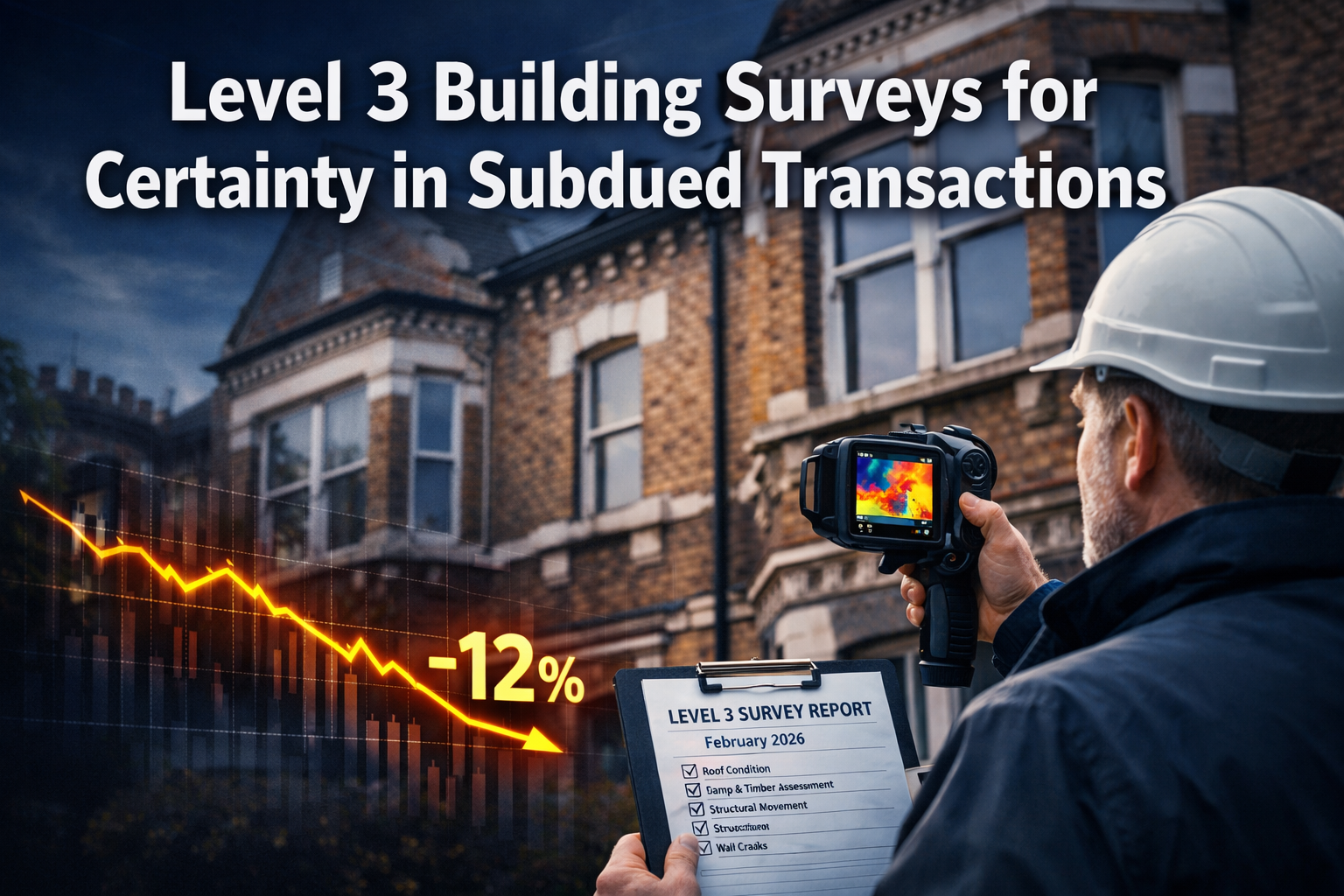
The property market in February 2026 has delivered a sobering reality check for buyers and sellers alike. With agreed sales plummeting by 12% and market sentiment growing increasingly cautious, the importance of comprehensive due diligence has never been more critical. In this environment of uncertainty, Level 3 Building Surveys for Certainty in Subdued Transactions: Protocols as Agreed Sales Hit -12% in February 2026 represent the gold standard for risk mitigation and informed decision-making. 🏚️
As transaction volumes decline and buyers adopt a more defensive stance, the comprehensive nature of RICS Building Surveys Level 3 provides the detailed intelligence necessary to navigate challenging market conditions with confidence. This article explores why Level 3 surveys have become essential tools for certainty in subdued transactions and how updated protocols align with the cautious approach demanded by today's market realities.
Key Takeaways
- Market downturn demands diligence: The -12% decline in agreed sales during February 2026 reflects heightened buyer caution, making comprehensive Level 3 surveys essential for transaction certainty
- Level 3 surveys provide comprehensive protection: These detailed inspections examine all accessible areas of a property, identifying structural defects, maintenance issues, and potential repair costs that could derail transactions
- Updated protocols enhance reliability: Recent improvements to survey standards and methodologies ensure more consistent, thorough assessments aligned with current market conditions
- Risk mitigation justifies investment: In subdued markets with flat or declining prices, the cost of a Level 3 survey represents valuable insurance against expensive post-purchase surprises
- Transaction confidence supports completion rates: Comprehensive survey data helps buyers negotiate effectively and proceed with realistic expectations, reducing fall-through rates
Understanding Level 3 Building Surveys in the Current Market Context
What Makes Level 3 Surveys Different
A Level 3 Building Survey, formerly known as a structural survey, represents the most comprehensive property inspection available to buyers. Unlike the more basic Level 2 Homebuyer Survey, which provides a traffic-light rating system for visible defects, Level 3 surveys involve detailed examination of all accessible areas of a property.
Key characteristics of Level 3 surveys include:
- Comprehensive inspection scope: Surveyors examine foundations, walls, roofs, floors, windows, doors, and all structural elements
- Detailed defect analysis: Every issue is documented with descriptions, photographs, and severity assessments
- Repair cost guidance: Estimates for addressing identified problems help buyers budget accurately
- Maintenance recommendations: Long-term upkeep advice prevents future deterioration
- Specialist referrals: When necessary, surveyors recommend additional investigations such as damp surveys or structural engineering assessments
The thoroughness of Level 3 surveys makes them particularly valuable for older properties, buildings with unusual construction, properties that have undergone significant alterations, or any situation where buyers need maximum certainty about condition and potential costs.
The February 2026 Market Decline: Context for Caution
The -12% drop in agreed sales during February 2026 reflects multiple converging pressures on the property market. Economic uncertainty, interest rate concerns, and affordability challenges have combined to create a more subdued transaction environment where buyers exercise greater caution before committing to purchases.
In this context, Level 3 Building Surveys for Certainty in Subdued Transactions: Protocols as Agreed Sales Hit -12% in February 2026 have become increasingly relevant as buyers seek to minimize risk in an uncertain market. When property values face downward pressure, discovering significant defects after completion can prove financially devastating, making pre-purchase due diligence more critical than ever.
Recent updates to survey standards have enhanced the reliability and consistency of building assessments. The 2026 ALTA/NSPS Land Title Survey Standards, while primarily focused on commercial land surveys in the United States, reflect broader industry trends toward more rigorous protocols and clearer reporting standards [1][2]. These improvements in professional standards have influenced surveying practices across residential and commercial sectors internationally.
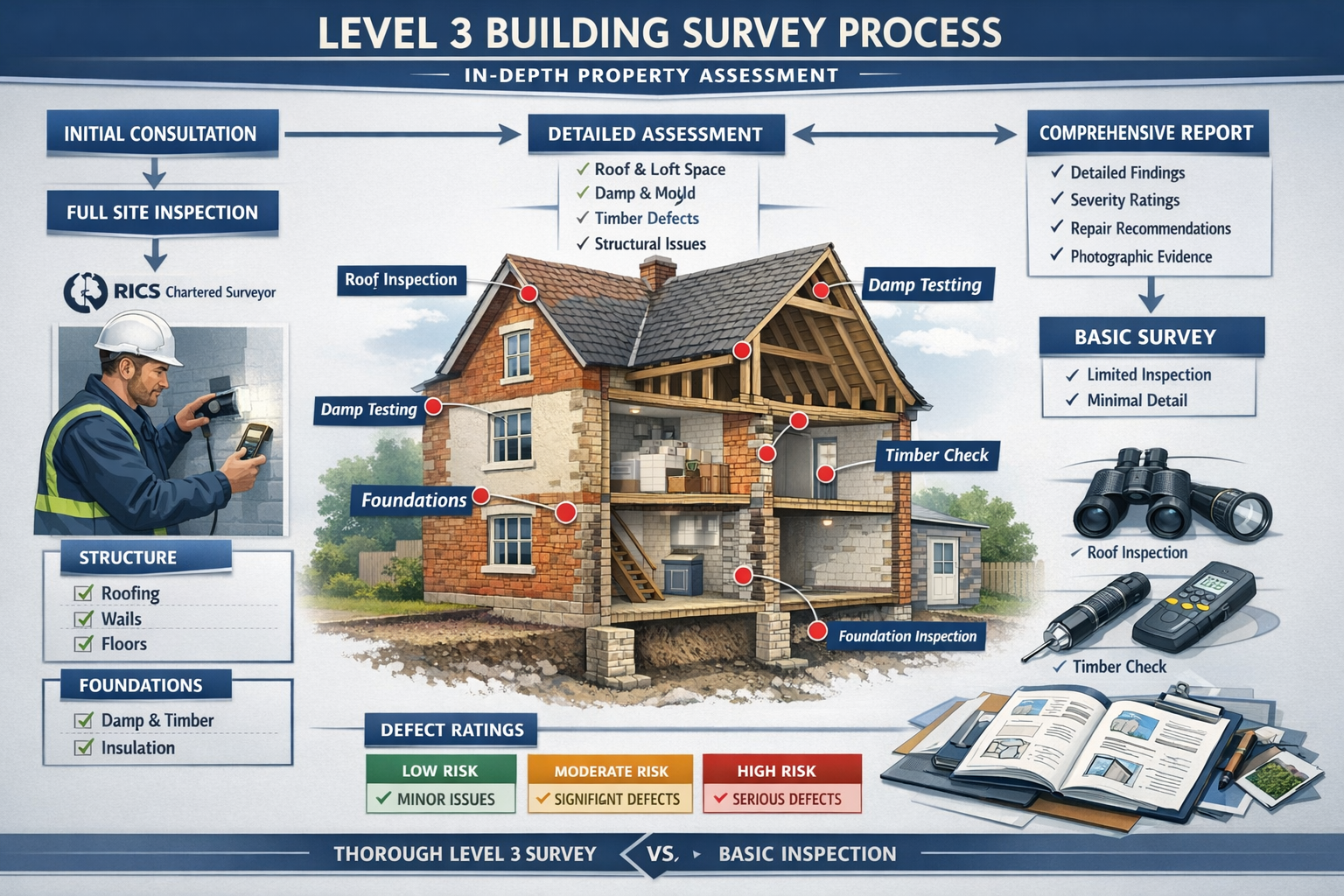
Level 3 Survey Protocols: Enhanced Standards for Transaction Certainty
Updated Inspection Methodologies
The protocols governing Level 3 Building Surveys have evolved to address contemporary construction challenges and buyer concerns. Modern survey methodologies incorporate advanced diagnostic tools and systematic approaches that provide more reliable assessments than traditional visual inspections alone.
Contemporary Level 3 survey protocols typically include:
- Moisture detection: Thermal imaging and moisture meters identify hidden damp problems that visual inspection might miss
- Structural movement analysis: Detailed crack mapping and level measurements assess whether defects are historic or ongoing
- Roof void inspection: Where accessible, surveyors examine roof structures, insulation, and potential water ingress
- Service assessment: Evaluation of electrical, plumbing, heating, and drainage systems within the surveyor's competence
- Boundary and legal considerations: Identification of potential encroachments, rights of way, or other legal issues
- Environmental concerns: Assessment of potential issues like asbestos, contamination, or flood risk
These enhanced protocols ensure that buyers receive comprehensive information about property condition, enabling informed decisions in challenging market conditions. The systematic approach reduces the likelihood of overlooking significant defects that could affect value or safety.
Reporting Standards and Clarity
The value of a Level 3 survey depends heavily on the clarity and comprehensiveness of the final report. Updated reporting standards emphasize accessibility, ensuring that buyers without technical expertise can understand findings and their implications.
Modern Level 3 survey reports typically feature:
- Executive summary: Clear overview of critical issues requiring immediate attention
- Photographic evidence: Extensive images documenting defects and conditions
- Priority ratings: Classification of issues by urgency (immediate, short-term, long-term)
- Repair cost estimates: Guidance on likely expenditure for addressing problems
- Maintenance schedules: Recommendations for ongoing property care
- Specialist recommendations: Clear guidance on when additional investigations are needed
This structured approach to reporting ensures that buyers can assess transaction risk effectively and make informed decisions about proceeding, negotiating price adjustments, or withdrawing from purchases that present unacceptable risk.
Integration with Transaction Processes
In the context of subdued markets where transaction certainty is paramount, Level 3 surveys have become more tightly integrated with the broader conveyancing and financing processes. Lenders increasingly require comprehensive survey evidence before approving mortgages on older or non-standard properties, while solicitors use survey findings to identify potential legal issues requiring investigation.
The timing of Level 3 surveys has also evolved, with many buyers commissioning assessments earlier in the transaction process to avoid wasting legal fees on properties that prove unsuitable. This front-loading of due diligence aligns with the cautious approach characteristic of subdued markets, where buyers prioritize certainty over speed.
Understanding the difference between Level 2 and Level 3 surveys helps buyers select the appropriate level of investigation for their circumstances, with Level 3 surveys offering the comprehensive certainty needed in challenging market conditions.
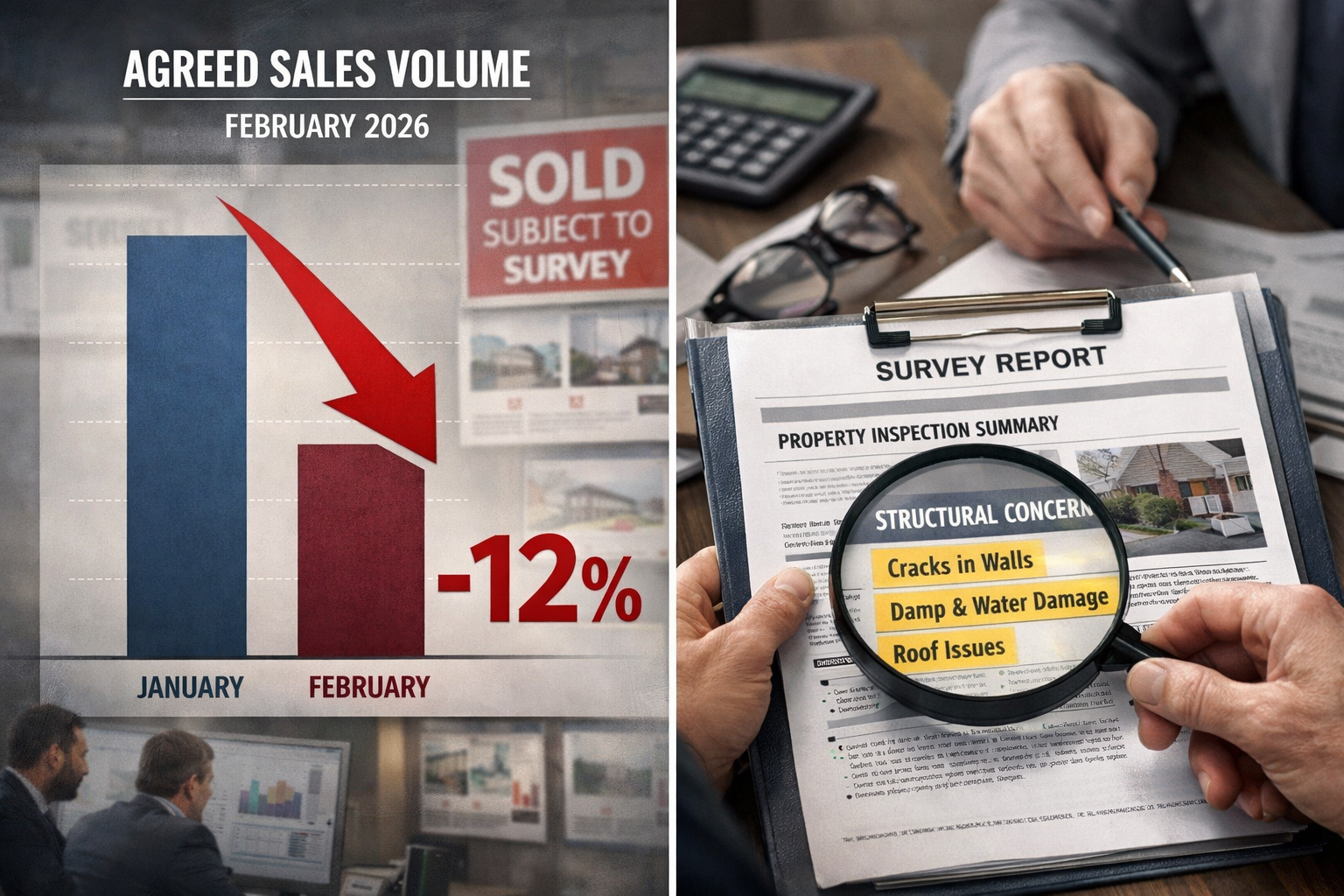
Why Level 3 Surveys Provide Essential Certainty in Subdued Markets
Risk Mitigation in Declining Markets
When property prices face downward pressure, as evidenced by the -12% decline in agreed sales during February 2026, buyers face amplified risk from undiscovered defects. In a rising market, property appreciation may offset the cost of unexpected repairs, but in flat or declining markets, significant defects can immediately place buyers in negative equity.
Level 3 surveys mitigate this risk by:
- Identifying deal-breakers early: Discovering major structural issues before legal commitment allows buyers to withdraw without significant financial loss
- Enabling accurate budgeting: Comprehensive repair cost estimates prevent post-purchase financial shocks
- Supporting price negotiations: Documented defects provide objective evidence for requesting price reductions
- Informing insurance decisions: Survey findings help buyers secure appropriate coverage and understand exclusions
- Preventing transaction collapse: Thorough pre-purchase assessment reduces the likelihood of late-stage discoveries that derail completions
In subdued transaction environments, where buyer confidence is already fragile, the certainty provided by Level 3 surveys can mean the difference between completing a purchase and abandoning it. This certainty benefits all parties by reducing wasted time and costs associated with collapsed transactions.
Institutional Perspectives on Due Diligence
Institutional landlords and commercial property investors have long recognized the value of comprehensive building surveys as essential risk management tools. Recent analysis of building survey due diligence for institutional landlords emphasizes how thorough assessments help navigate portfolio risk in challenging market conditions [5].
The principles that guide institutional approaches to property due diligence apply equally to residential buyers in subdued markets:
- Systematic risk assessment: Comprehensive surveys provide structured evaluation of property condition
- Long-term cost modeling: Understanding maintenance requirements enables accurate lifetime cost projections
- Portfolio protection: For buyers building property portfolios, consistent survey standards prevent accumulation of problematic assets
- Regulatory compliance: Surveys identify issues requiring remediation to meet current building standards
While institutional investors operate at larger scales, the fundamental need for transaction certainty through comprehensive due diligence remains constant across all market segments. In February 2026's challenging environment, this institutional discipline has become increasingly relevant for individual buyers seeking to protect their investments.
Specialist Surveys and Complementary Investigations
Level 3 Building Surveys often identify issues requiring specialist investigation to fully assess risk and cost implications. The integration of these complementary surveys provides the comprehensive certainty that subdued markets demand.
Common specialist surveys that complement Level 3 assessments include:
| Specialist Survey Type | When Required | Value Provided |
|---|---|---|
| Structural Engineering Assessment | Significant cracking, subsidence concerns, structural alterations | Detailed analysis of structural integrity and repair specifications |
| Damp Surveys | Evidence of moisture penetration, condensation, or rising damp | Identification of damp sources and appropriate remediation strategies |
| Drainage Surveys | Suspected drainage problems, frequent blockages, property age | CCTV inspection of underground drainage identifying defects and blockages |
| Asbestos Surveys | Properties built before 2000 with potential asbestos-containing materials | Identification and risk assessment of asbestos requiring management or removal |
| Roof Surveys | Inaccessible roof areas, complex roof structures, evidence of water ingress | Detailed assessment of roof condition and remaining life expectancy |
The willingness to commission these additional investigations when recommended demonstrates the thorough approach necessary for transaction certainty in challenging markets. While these surveys add to upfront costs, they prevent far more expensive post-purchase surprises that could prove financially catastrophic in subdued market conditions.
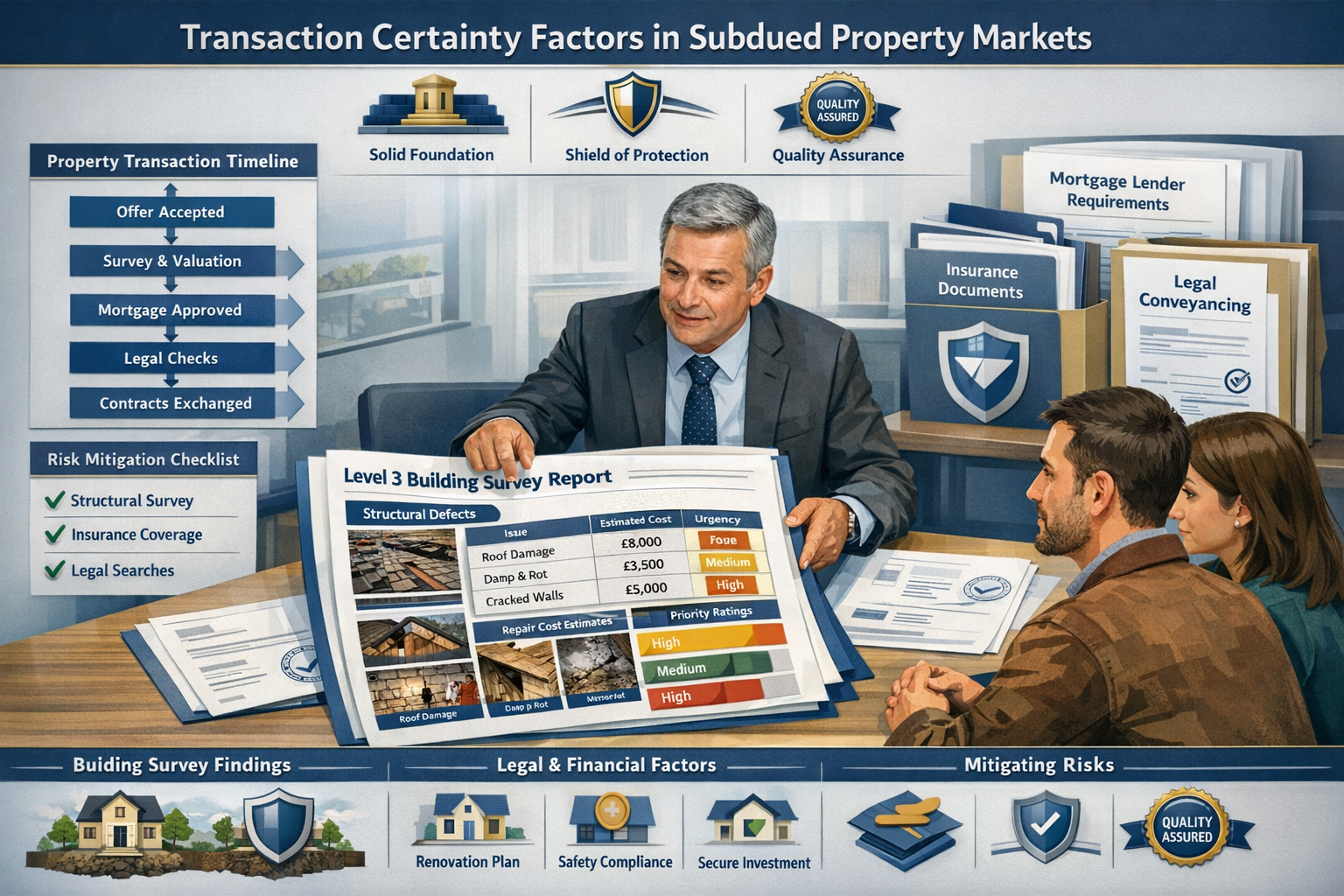
The Economics of Level 3 Surveys in Subdued Transaction Environments
Cost-Benefit Analysis in Uncertain Markets
The investment required for a comprehensive Level 3 Building Survey typically ranges from £600 to £1,500 or more, depending on property size, complexity, and location. In subdued markets where buyers face financial pressure, this cost requires careful justification.
The economic case for Level 3 surveys becomes compelling when considering:
- Prevented disasters: A single undiscovered structural issue could cost tens of thousands to remediate
- Negotiation leverage: Survey findings often justify price reductions exceeding survey costs
- Transaction confidence: Reduced risk of late-stage collapse saves wasted legal and survey fees
- Insurance implications: Comprehensive pre-purchase knowledge prevents coverage disputes
- Peace of mind: The intangible value of certainty in uncertain markets
In February 2026's challenging environment, where the -12% decline in agreed sales reflects widespread buyer caution, the relatively modest cost of a Level 3 survey represents prudent risk management rather than optional luxury. For properties requiring significant investment, this due diligence becomes essential rather than discretionary.
Understanding structural survey pricing helps buyers budget appropriately and recognize the value provided relative to potential risks avoided.
Impact on Transaction Completion Rates
One of the less obvious benefits of comprehensive Level 3 surveys is their positive impact on transaction completion rates. While thorough surveys may identify issues that prevent some purchases from proceeding, they significantly reduce the likelihood of late-stage transaction collapse due to unexpected discoveries.
Level 3 surveys support completion by:
- Setting realistic expectations: Buyers proceed with full knowledge of property condition and required expenditure
- Facilitating mortgage approval: Lenders gain confidence from comprehensive condition assessments
- Reducing renegotiation friction: Issues are identified and addressed early rather than emerging during later stages
- Supporting legal due diligence: Survey findings inform solicitor investigations and searches
- Building buyer confidence: Comprehensive information reduces anxiety and buyer's remorse
In subdued markets where transaction volumes are already suppressed, anything that improves completion rates provides value to the entire property ecosystem. Estate agents, solicitors, surveyors, and mortgage lenders all benefit from reduced transaction fall-through rates, making Level 3 surveys a positive influence on market efficiency even in challenging conditions.
Choosing the Right Survey Level
Not every property transaction requires a Level 3 survey, and understanding when this comprehensive approach is necessary versus when a Level 2 Homebuyer Survey suffices helps buyers allocate resources effectively.
Level 3 surveys are particularly appropriate for:
- Properties built before 1900 or of unusual construction
- Buildings that have undergone significant alterations or extensions
- Properties in poor or neglected condition
- Buyers planning major renovation or conversion projects
- High-value properties where comprehensive certainty justifies additional cost
- Situations where buyers need detailed repair cost estimates for budgeting
For modern properties in good condition with standard construction, a Level 2 survey may provide adequate certainty at lower cost. However, in subdued markets where buyer caution is heightened, many purchasers opt for the comprehensive certainty that Level 3 surveys provide, viewing the additional cost as worthwhile insurance against uncertainty.
Resources on choosing the right property survey help buyers make informed decisions about the appropriate level of investigation for their circumstances.
Practical Considerations for Commissioning Level 3 Surveys
Selecting Qualified Surveyors
The value of a Level 3 Building Survey depends entirely on the competence and thoroughness of the surveyor conducting the inspection. In subdued markets where transaction certainty is paramount, selecting appropriately qualified professionals becomes critical.
Key qualifications and characteristics to seek include:
- RICS membership: Chartered surveyors regulated by the Royal Institution of Chartered Surveyors maintain professional standards and insurance
- Local expertise: Surveyors familiar with regional construction methods and common issues provide more relevant assessments
- Experience with property type: Surveyors who regularly inspect similar properties offer more insightful analysis
- Clear communication: The ability to explain technical issues in accessible language enhances report value
- Professional indemnity insurance: Adequate coverage protects buyers if negligent surveys miss significant defects
The professional standards maintained by RICS-qualified surveyors provide assurance of competence and accountability. When commissioning a RICS Building Survey, buyers gain the confidence that comes from regulated professional standards and established complaint procedures if issues arise.
Timing and Logistics
The timing of Level 3 surveys within the transaction process significantly affects their value and efficiency. In subdued markets where buyers exercise heightened caution, early survey commissioning has become increasingly common.
Optimal timing considerations include:
- Pre-offer surveys: Some buyers commission surveys before making offers, ensuring they only pursue suitable properties
- Subject to survey offers: Most buyers make offers subject to satisfactory survey, commissioning inspections after acceptance
- Access coordination: Arranging convenient access with sellers and estate agents prevents delays
- Weather considerations: Some inspections benefit from dry conditions to assess drainage and water ingress
- Sequential investigations: Planning for potential specialist surveys following initial Level 3 assessment
Understanding how long surveys take helps buyers plan transaction timelines effectively and avoid unnecessary delays that could jeopardize purchases in competitive situations.
Acting on Survey Findings
The ultimate value of a Level 3 survey lies in how buyers respond to its findings. In subdued markets, survey results inform critical decisions about proceeding with transactions, renegotiating terms, or withdrawing from unsuitable purchases.
Effective responses to survey findings include:
- Prioritizing issues: Distinguishing between critical structural problems and minor maintenance items
- Obtaining repair quotes: Commissioning detailed cost estimates for significant remedial works
- Negotiating price adjustments: Using objective survey evidence to request reductions reflecting repair costs
- Planning remediation: Developing realistic timelines and budgets for addressing identified issues
- Reconsidering suitability: Honestly assessing whether the property remains appropriate given revealed condition
In the context of Level 3 Building Surveys for Certainty in Subdued Transactions: Protocols as Agreed Sales Hit -12% in February 2026, the willingness to walk away from problematic properties represents prudent risk management rather than excessive caution. The subdued market environment provides buyers with negotiating leverage that should be exercised when surveys reveal significant issues.
Future Outlook: Survey Standards and Market Evolution
Emerging Technologies in Building Assessment
The surveying profession continues to evolve through adoption of new technologies that enhance inspection capabilities and reporting quality. These innovations promise to further improve the certainty that Level 3 surveys provide in challenging market conditions.
Emerging technologies influencing building surveys include:
- Thermal imaging: Advanced infrared cameras detect heat loss, moisture, and insulation defects invisible to visual inspection
- Drone surveys: Unmanned aerial vehicles enable detailed roof and chimney inspection without scaffolding or access equipment
- 3D scanning: Laser measurement creates precise property models identifying structural movement and alterations
- Moisture mapping: Sophisticated sensors produce detailed moisture distribution maps revealing hidden damp problems
- Digital reporting: Interactive reports with embedded photographs, videos, and clickable floor plans enhance accessibility
As these technologies become more widely adopted, the comprehensiveness and reliability of Level 3 surveys will continue to improve, providing even greater transaction certainty for buyers navigating uncertain markets.
Regulatory Developments and Professional Standards
The surveying profession operates within an evolving regulatory framework that influences inspection protocols and reporting standards. Recent updates to survey standards in various jurisdictions reflect ongoing efforts to enhance consistency, clarity, and reliability [1][2][3][4][7].
While specific regulatory requirements vary by location and property type, the general trend toward more rigorous standards and clearer reporting benefits buyers by ensuring more consistent survey quality. Professional bodies like RICS continuously review and update guidance to reflect contemporary construction challenges, emerging defect patterns, and evolving buyer expectations.
These regulatory developments support the role of Level 3 surveys in providing transaction certainty, particularly in subdued markets where buyers demand maximum assurance before committing to purchases.
Market Recovery and Sustained Survey Importance
As property markets eventually recover from the subdued conditions reflected in February 2026's -12% decline in agreed sales, the importance of comprehensive building surveys will persist. While buyer caution may moderate in more buoyant conditions, the fundamental need for due diligence remains constant across all market cycles.
Level 3 surveys provide enduring value by:
- Protecting individual investments: Regardless of market conditions, avoiding problematic properties benefits buyers
- Supporting market efficiency: Accurate property condition information enables more rational pricing
- Preventing disputes: Comprehensive pre-purchase assessment reduces post-completion conflict
- Informing maintenance: Survey recommendations guide long-term property care and preservation
- Building buyer confidence: Professional assessment provides reassurance supporting transaction completion
The lessons learned from navigating subdued markets in 2026 will likely influence buyer behavior long after conditions improve, with comprehensive due diligence becoming a more established norm across all market segments.
Conclusion
The challenging property market conditions of February 2026, marked by a -12% decline in agreed sales, have underscored the critical importance of comprehensive due diligence in property transactions. Level 3 Building Surveys for Certainty in Subdued Transactions: Protocols as Agreed Sales Hit -12% in February 2026 represent an essential tool for buyers seeking to navigate uncertain markets with confidence and protection.
The comprehensive nature of Level 3 surveys—examining all accessible areas of properties, identifying defects, estimating repair costs, and providing detailed maintenance guidance—delivers the transaction certainty that subdued markets demand. Enhanced protocols and reporting standards ensure that buyers receive reliable, accessible information supporting informed decision-making.
While Level 3 surveys require upfront investment, the risk mitigation they provide proves invaluable in markets where property values face pressure and unexpected defects could prove financially catastrophic. The economic case for comprehensive surveys becomes particularly compelling when considering prevented disasters, negotiation leverage, and improved transaction completion rates.
Actionable Next Steps
For buyers navigating today's challenging property market:
- Assess your survey needs: Determine whether your target property requires a comprehensive Level 3 survey based on age, condition, and construction type
- Select qualified surveyors: Engage RICS-chartered professionals with relevant experience and local expertise
- Commission surveys early: Front-load due diligence to avoid wasting costs on unsuitable properties
- Act on findings decisively: Use survey evidence to negotiate effectively or withdraw from problematic purchases
- Plan for specialist investigations: Budget for additional surveys when Level 3 assessments identify issues requiring expert analysis
- Maintain perspective: Remember that survey costs represent prudent risk management rather than unnecessary expense
The subdued transaction environment of 2026 has reinforced fundamental truths about property purchase: comprehensive due diligence protects investments, professional assessment provides certainty, and informed decision-making prevents costly mistakes. By embracing the thoroughness that Level 3 Building Surveys provide, buyers can proceed with confidence even in uncertain markets, securing properties whose condition and costs they fully understand.
For professional guidance on comprehensive building surveys and property assessment, explore our range of RICS building survey services tailored to provide the certainty today's cautious buyers require.
References
[1] 2026 Alta Survey Standards Updates – https://www.hklaw.com/en/insights/publications/2026/03/2026-alta-survey-standards-updates
[2] Alta Nsps Key Changes And Updates In The 2026 Standards – https://www.beneschlaw.com/insight/alta-nsps-key-changes-and-updates-in-the-2026-standards/
[3] Nsps Land Title – https://www.parkerpoe.com/news/2026/02/key-takeaways-from-the-2026-alta/nsps-land-title
[4] The 2026 Alta Nsps Land Title Survey Standards What Do Commercial Real Estate Professionals Need To Know – https://www.gouldratner.com/publication/the-2026-alta-nsps-land-title-survey-standards-what-do-commercial-real-estate-professionals-need-to-know-
[5] Building Survey Due Diligence For Institutional Landlords Navigating Tax Pressures And Portfolio Risk In 2026 – https://nottinghillsurveyors.com/blog/building-survey-due-diligence-for-institutional-landlords-navigating-tax-pressures-and-portfolio-risk-in-2026
[6] Why Alta Surveys Matter In Commercial Real Estate – https://mcsteen.com/why-alta-surveys-matter-in-commercial-real-estate/
[7] New 2026 Alta Nsps Survey Standards What Developers And Counsel Should Know – https://hallrender.com/2026/02/23/new-2026-alta-nsps-survey-standards-what-developers-and-counsel-should-know/