'
The UK property market stands at a critical juncture in 2026. As industry experts project optimistic growth scenarios and average house prices approach the £300,000 milestone, property transactions are experiencing renewed momentum after years of uncertainty. However, beneath these encouraging headlines lies a complex reality: actual national price growth forecasts hover around 2-2.5%, well below the 4-5% threshold that would signal genuine market acceleration[5]. For buyers, sellers, and mortgage lenders navigating this landscape, Building Surveys for 4-5% National Price Growth Forecasts: Identifying Risks in the 2026 Property Reset have become essential tools—not just for identifying structural defects, but for understanding the true value and risk profile of properties in an evolving market.

Key Takeaways
- 🏠 Actual growth projections remain modest: National forecasts predict 2-2.5% annual growth in 2026, not the 4-5% optimistic scenarios, making thorough building surveys critical for accurate property valuation
- 📊 Regional disparities create hidden risks: Northern regions and Scotland may see stronger growth while London and the South East face affordability constraints, requiring location-specific survey focus
- 🔍 Defect detection protects transaction value: With transaction volumes recovering, comprehensive RICS Level 3 building surveys identify structural issues that could derail purchases or renegotiate prices
- ⚠️ Property type performance varies significantly: Terraced and semi-detached houses outperform flats and maisonettes, necessitating targeted survey approaches for different property segments
- 💰 Economic headwinds require risk mitigation: Slowing GDP growth, suppressed consumer confidence, and wage growth at three-year lows make pre-purchase surveys essential for protecting investment value
Understanding the 2026 Property Market Context
The Reality Behind Growth Forecasts
The narrative surrounding UK property prices in 2026 requires careful examination. While optimistic projections suggest 4-5% growth could materialize under favorable conditions, mainstream forecasts from major financial institutions paint a more conservative picture. Lloyds Banking Group projects national house price growth of just 2-2.5% for 2026[5], while UBS analysis indicates moderate growth supported by rising incomes and favorable credit conditions—but without specifying acceleration to 4-5% levels[1].
Recent data reinforces this cautious outlook. Annual house price growth slowed to 1.7% in November 2025, significantly below the 20-year average of 3.3%[1]. Although Rightmove reported a record 2.8% month-on-month jump in January 2026, year-on-year growth remained at just 0.5%—a clear indication of seasonal volatility rather than sustained acceleration[3].
Economic Factors Shaping the Market Reset
Several macroeconomic forces are constraining property price growth in 2026:
- Mortgage rate stabilization: The Bank of England base rate is expected to fall to approximately 3.25%, with mortgage rates stabilizing near 4%[5]—providing support but not acceleration
- Wage growth deceleration: Annual wage growth has slowed to around 4%, limiting nominal income growth that would support higher property valuations[1]
- Consumer confidence suppression: The GfK consumer confidence index stood at negative 19 in February 2026, indicating hesitant buyer sentiment[1]
- GDP growth slowdown: Economic growth forecasts have been revised downward, with unemployment potentially edging higher to around 5%[1]
These conditions create a market environment where property values are supported but not rapidly appreciating—making thorough building surveys essential for buyers to avoid overpaying in a moderately growing market.
Building Surveys for 4-5% National Price Growth Forecasts: Regional Risk Assessment
Geographic Disparities in Price Performance
One of the most significant features of the 2026 property market is the stark regional variation in price performance. Understanding these disparities is crucial when commissioning building surveys, as different regions present distinct risk profiles.
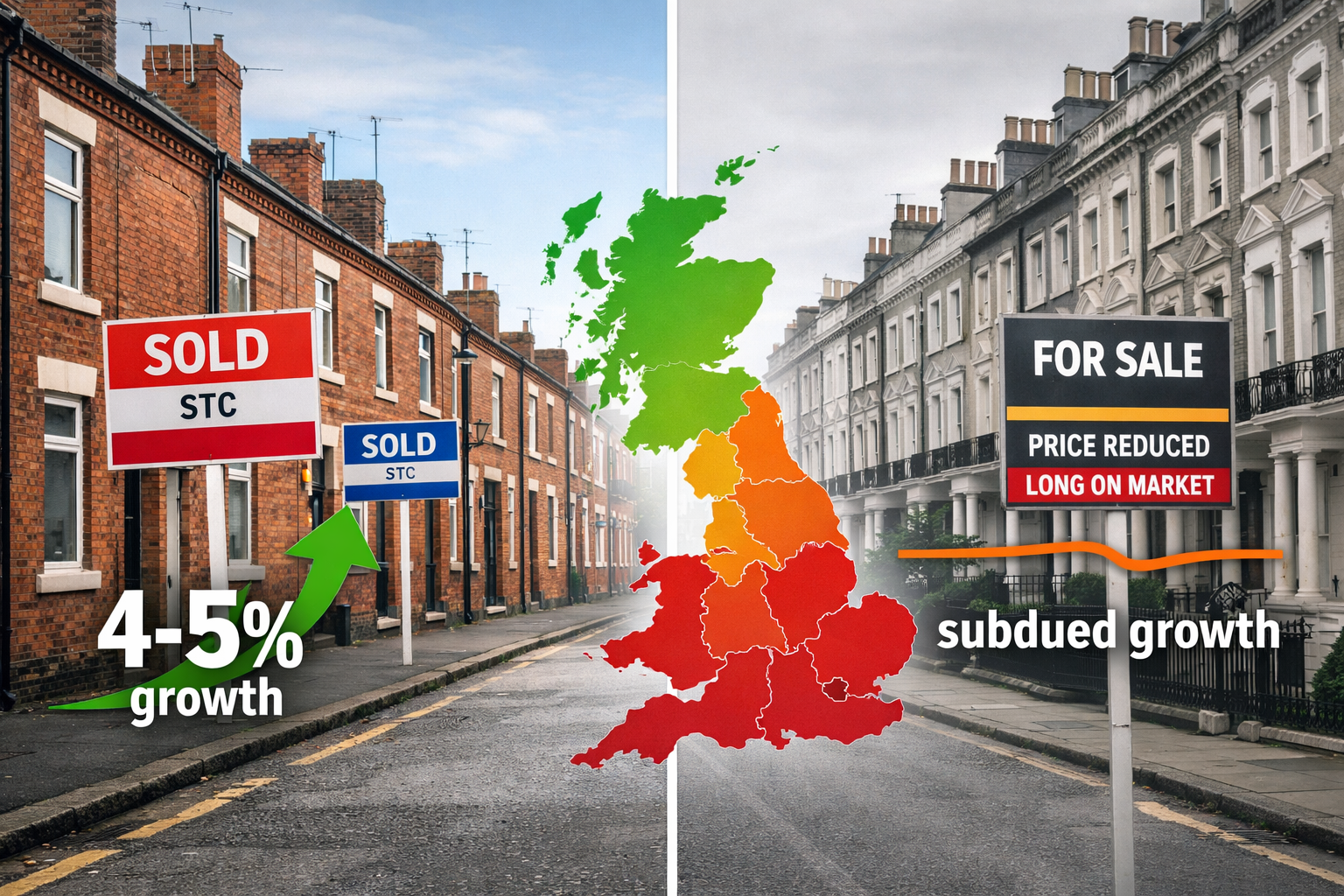
According to Lloyds Banking Group analysis, northern regions, North Wales, Scotland, and parts of the Midlands are expected to see greater price increases due to lower income-to-price ratios[5]. These areas offer better affordability metrics, attracting buyers priced out of southern markets. Conversely, London and the South East face subdued growth due to persistent affordability constraints[5].
| Region | Expected Growth | Key Risk Factors | Survey Focus Areas |
|---|---|---|---|
| Northern England | Above national average (3-4%) | Older housing stock, historical industrial legacy | Subsidence surveys, mining risk assessment |
| London & South East | Below national average (1-2%) | Affordability constraints, high prices | Leasehold issues, building quality in conversions |
| Scotland | Above national average (3-4%) | Variable property standards | Traditional construction defects, damp surveys |
| Midlands | Near national average (2-3%) | Mixed property types | Standard structural assessment |
| Wales | Above national average (3-4%) | Rural property challenges | Non-standard construction, drainage issues |
Location-Specific Survey Considerations
When Building Surveys for 4-5% National Price Growth Forecasts: Identifying Risks in the 2026 Property Reset are commissioned, location should fundamentally shape the survey scope:
In high-growth northern regions, where buyer competition may be intensifying, surveys should prioritize:
- Historical structural issues common in Victorian and Edwardian terraces
- Mining subsidence risk in former industrial areas
- Drainage and flooding concerns in valley locations
- Cavity wall insulation defects in 1970s-1980s properties
In constrained southern markets, where prices remain elevated despite slower growth, surveys must focus on:
- Leasehold complications and service charge liabilities
- Quality of conversions and extensions in high-density areas
- Building safety issues in apartment blocks
- Ground rent and lease length implications on value
Professional chartered surveyors with local expertise can tailor survey approaches to regional risk profiles, ensuring buyers receive relevant intelligence for their specific market context.
Property Type Disparities and Survey Implications
The Performance Gap Between Property Segments
The 2026 market demonstrates clear property type performance disparities that directly impact survey requirements. According to market analysis, terraced and semi-detached houses are leading price performance, while flats and maisonettes have become the weakest segment[1].
This divergence reflects several underlying factors:
Houses outperforming flats due to:
- ✅ Post-pandemic preference for space and outdoor access
- ✅ Lower service charge and ground rent burdens
- ✅ Greater potential for value-adding improvements
- ✅ Stronger appeal to families (the core buyer demographic)
Flats underperforming due to:
- ❌ Building safety concerns post-Grenfell
- ❌ Cladding remediation costs and uncertainty
- ❌ Rising service charges and insurance premiums
- ❌ Leasehold reform uncertainty affecting buyer confidence
Tailoring Building Surveys to Property Types
When commissioning Building Surveys for 4-5% National Price Growth Forecasts: Identifying Risks in the 2026 Property Reset, property type should determine survey depth and focus:
For terraced and semi-detached houses (strong performers):
- Comprehensive structural assessment of party walls
- Roof condition and shared responsibility issues
- Extension and alteration quality (often DIY or non-compliant)
- Drainage systems and shared access rights
- Detailed RICS Home Survey covering all elements
For flats and maisonettes (underperformers requiring extra scrutiny):
- Building safety compliance and cladding assessment
- Service charge review and reserve fund adequacy
- Lease length implications (under 80 years triggers value reduction)
- Shared building defects and remediation liability
- Management company financial health
- Fire safety compliance and EWS1 certification status
For commercial properties transitioning to residential:
- Commercial building surveys assessing conversion quality
- Building regulation compliance for change of use
- Sound insulation between units
- Shared services and maintenance arrangements
The performance gap between property types means flat buyers face heightened risk and should invest in more comprehensive surveys, potentially including specialist assessments of building safety, lease terms, and management arrangements.
Critical Defects to Identify in the 2026 Market Reset
Structural Issues That Impact Transaction Value
As transaction volumes recover in 2026, building surveys must prioritize defect detection that directly affects property value and mortgage lending decisions. Certain structural issues can derail purchases entirely or trigger significant price renegotiations.
High-priority defects requiring immediate identification:
🔴 Subsidence and structural movement
- Foundation failure or inadequate depth
- Tree root damage to foundations
- Clay soil shrinkage in drought-prone areas
- Requires specialist subsidence surveys and monitoring
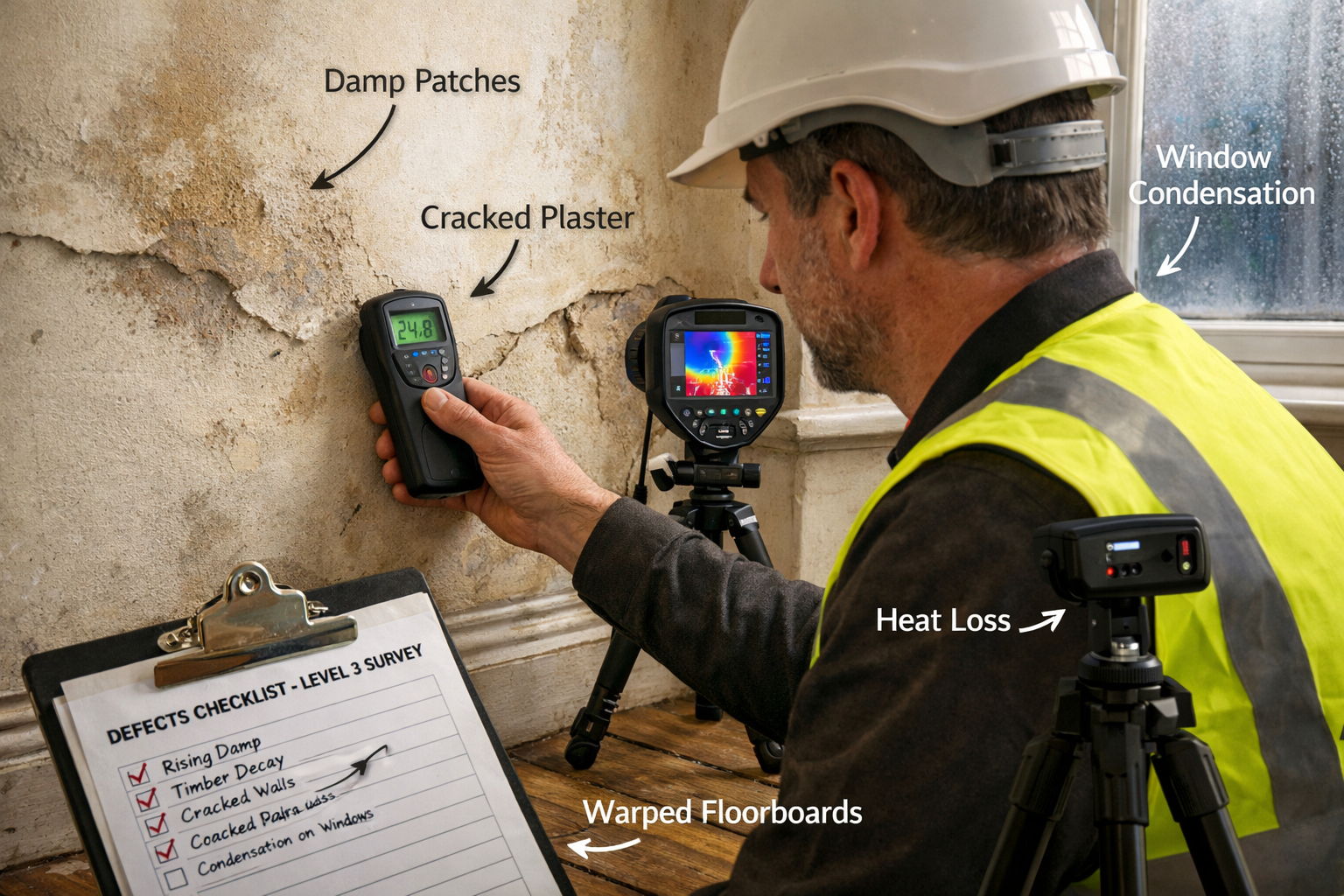
🔴 Damp and moisture penetration
- Rising damp from failed damp-proof courses
- Penetrating damp through walls and roofs
- Condensation and ventilation deficiencies
- Black mold growth indicating serious moisture issues
- Comprehensive damp surveys essential for accurate diagnosis
🔴 Roof defects
- Missing or slipped tiles allowing water ingress
- Failed valley gutters and flashings
- Timber decay in roof structure
- Inadequate roof covering lifespan remaining
🔴 Non-standard construction issues
- Pre-cast concrete systems (PRC) with limited mortgage availability
- Steel-frame properties requiring specialist assessment
- Timber-frame construction with specific defect patterns
- Non-standard construction requiring specialist surveys and valuations
Hidden Defects That Emerge in Market Transitions
During market resets, when properties change hands more frequently, previously concealed defects often surface. Experienced surveyors look beyond cosmetic presentations to identify:
Concealment indicators:
- Fresh paint or wallpaper covering damp stains
- Recently installed furniture obscuring wall cracks
- New flooring hiding structural floor issues
- Hastily applied external render covering wall defects
Service and installation defects:
- Electrical installations not complying with current regulations
- Boiler and heating systems nearing end of life
- Drainage systems with recurring blockages or collapses
- Asbestos-containing materials in pre-2000 properties
Boundary and legal issues:
- Encroachments onto neighboring land
- Unauthorized alterations without building regulation approval
- Planning breaches affecting future saleability
- Party wall issues requiring retrospective agreements
A comprehensive RICS Level 3 building survey provides the most thorough defect identification, particularly valuable for older properties, those in poor condition, or properties where significant alterations have been undertaken.
Mortgage Lending and Valuation Risks in 2026
The Intersection of Surveys and Lending Decisions
In 2026's moderately growing market, mortgage lenders are exercising heightened caution when assessing property security. Building surveys play a crucial role in supporting lending decisions and protecting both lenders and borrowers from value overestimation.
Mortgage approvals have stabilized at around 60,000 per month as of January 2026[1], indicating steady but not accelerating lending activity. Lenders require confidence that property values justify loan amounts, particularly when:
- Loan-to-value ratios exceed 75% (higher risk exposure)
- Properties have non-standard construction (limited resale market)
- Significant defects are identified (repair costs reduce equity)
- Leasehold terms are unfavorable (affects future saleability)
Survey Impact on Property Valuations
Professional property valuations in 2026 must account for identified defects and market conditions. Building survey findings directly influence valuation adjustments:
Typical valuation reductions based on survey findings:
| Defect Type | Typical Value Impact | Lender Response |
|---|---|---|
| Minor cosmetic issues | 0-2% reduction | Usually acceptable |
| Moderate structural defects | 5-10% reduction | May require retention or reduced LTV |
| Major structural failure | 15-25% reduction | Often mortgage declined |
| Non-standard construction | Variable (5-20%) | Limited lender panel, higher rates |
| Severe damp/timber decay | 10-20% reduction | Retention until remediated |
Cushman & Wakefield's 2026 residential forecast notes that the new Mansion Tax and higher rental income tax are expected to mainly impact super prime and buy-to-let markets[4], creating segment-specific valuation risks that surveys must address through detailed condition assessment.
Protecting Transaction Value Through Surveys
For buyers navigating Building Surveys for 4-5% National Price Growth Forecasts: Identifying Risks in the 2026 Property Reset, comprehensive surveys provide multiple protections:
- Price renegotiation leverage: Documented defects justify price reductions
- Mortgage security: Lenders gain confidence in property condition
- Repair cost budgeting: Accurate estimates prevent post-purchase financial stress
- Transaction certainty: Early defect identification reduces deal collapse risk
- Future saleability assessment: Understanding defects that may deter future buyers
Buyers should choose the right property survey level based on property age, type, and condition—with Level 3 surveys recommended for properties built before 1970, those in poor condition, or where significant alterations are evident.
Economic Headwinds and Survey Risk Mitigation
Navigating Uncertainty Through Due Diligence
The 2026 property market operates against a backdrop of economic uncertainty that makes thorough building surveys more valuable than ever. With GDP growth slowing, unemployment potentially rising to 5%, and consumer confidence remaining suppressed at negative 19[1], buyers face genuine financial risk if property purchases prove problematic.
Key economic pressures affecting property buyers in 2026:
📉 Wage growth at three-year lows (around 4%[1])
- Reduced capacity to absorb unexpected repair costs
- Tighter household budgets limiting renovation spending
- Greater need for accurate property condition assessment
📉 Mortgage rate stabilization near 4% (not falling further[5])
- Higher borrowing costs than 2020-2021 period
- Reduced affordability cushion for taking on fixer-uppers
- Premium on move-in ready properties with no defects
📉 Consumer confidence suppression
- Buyers more risk-averse and detail-focused
- Greater scrutiny of property condition before commitment
- Higher survey demand as due diligence intensifies
Survey Cost vs. Risk Exposure
Some buyers question whether comprehensive building surveys represent good value, particularly when structural survey pricing can range from £500-£1,500 depending on property size and complexity. However, in the context of Building Surveys for 4-5% National Price Growth Forecasts: Identifying Risks in the 2026 Property Reset, this investment provides substantial risk mitigation.
Cost-benefit analysis of comprehensive surveys:
| Survey Investment | Typical Cost | Potential Savings/Protection |
|---|---|---|
| RICS Level 3 Survey | £800-£1,500 | £5,000-£50,000+ in undiscovered defects |
| Specialist damp survey | £200-£400 | £3,000-£15,000 in remediation costs |
| Structural engineer assessment | £400-£800 | £10,000-£100,000+ in structural repairs |
| Drainage survey | £250-£500 | £2,000-£10,000 in drainage repairs |
In a market where price growth is modest (2-2.5% nationally), avoiding a property with £20,000 of hidden defects is more valuable than capturing 2-3 years of price appreciation. The survey investment protects against downside risk—particularly important when economic headwinds limit buyers' financial flexibility.
The Role of Professional Surveyors in Market Transitions
As the property market experiences its 2026 reset, the expertise of qualified surveyors becomes increasingly valuable. Professional surveyors provide:
✅ Objective condition assessment free from emotional attachment
✅ Market context understanding of how defects impact value in current conditions
✅ Technical expertise to identify issues non-specialists miss
✅ Repair cost estimation for accurate budgeting
✅ Negotiation support with documented evidence of defects
Engaging registered RICS surveyors ensures professional standards, insurance protection, and adherence to established methodologies—critical when survey findings may form the basis of price renegotiations or legal disputes.
Strategic Survey Planning for 2026 Property Transactions
Timing Surveys Within the Transaction Process
Strategic timing of building surveys maximizes their value in protecting buyers while maintaining transaction momentum. In the 2026 market, where Building Surveys for 4-5% National Price Growth Forecasts: Identifying Risks in the 2026 Property Reset are essential, optimal survey timing follows this sequence:
Recommended survey timeline:
-
Pre-offer stage (ideal but often impractical)
- Allows informed offer pricing
- Prevents emotional commitment before condition known
- Requires seller cooperation for access
-
Post-offer, pre-exchange (most common)
- Balances speed with due diligence
- Allows price renegotiation based on findings
- Provides exit opportunity before legal commitment
-
Survey contingency in offer (recommended approach)
- Offer made "subject to satisfactory survey"
- Protects buyer's position
- Allows withdrawal or renegotiation without penalty
-
Coordination with mortgage valuation
- Schedule building survey shortly after mortgage valuation
- Ensures comprehensive condition understanding
- Identifies issues that may affect lending decision
Integrating Specialist Assessments
For properties with specific risk indicators, comprehensive surveys should integrate specialist assessments:
When to commission additional specialist surveys:
🔍 Electrical installation condition report when:
- Property has not been rewired in 30+ years
- Visible outdated wiring or consumer units
- Insurance requires electrical certification
🔍 Drainage survey (CCTV) when:
- Property built pre-1960 with original drains
- Evidence of drainage issues or nearby tree roots
- Shared drainage with neighboring properties
🔍 Asbestos survey when:
- Property built before 2000
- Planned renovations or alterations
- Visible suspect materials (textured coatings, old insulation)
🔍 Timber and damp specialist assessment when:
- Building survey identifies potential timber decay
- Evidence of active woodworm or rot
- Moisture readings indicate active damp issues
🔍 Structural engineer consultation when:
- Significant cracking or structural movement evident
- Major alterations or extensions of uncertain quality
- Non-standard construction requiring specialist knowledge
Integrating these assessments into the overall survey process provides comprehensive risk identification, supporting informed purchase decisions in the 2026 market environment.
Conclusion: Protecting Investment Value Through Comprehensive Surveys
The UK property market in 2026 presents a nuanced landscape that demands careful navigation. While optimistic scenarios suggest 4-5% growth potential, the reality of 2-2.5% national forecasts[5], regional disparities, property type performance variations, and persistent economic headwinds creates a market where thorough due diligence is more valuable than ever.
Building Surveys for 4-5% National Price Growth Forecasts: Identifying Risks in the 2026 Property Reset serve as essential risk mitigation tools, protecting buyers from overpaying in a moderately growing market and identifying defects that could significantly impact property value and future saleability.
Actionable Next Steps for Property Buyers in 2026
To navigate the 2026 property market successfully, buyers should:
- Commission comprehensive RICS Level 3 surveys for properties built before 1970, those in poor condition, or where significant alterations are evident
- Engage local chartered surveyors with regional expertise who understand area-specific risks and market conditions
- Budget for specialist assessments when initial surveys identify potential issues requiring deeper investigation
- Use survey findings strategically to renegotiate purchase prices or request seller-funded remediation
- Consider economic context when evaluating whether to proceed with properties requiring significant repair investment
- Verify survey credentials by engaging registered RICS professionals with appropriate insurance coverage
- Integrate survey timing with mortgage application processes to ensure lending decisions reflect accurate property condition
The modest growth environment of 2026, combined with economic uncertainty and regional market variations, makes the difference between a sound property investment and a costly mistake often rest on the quality of pre-purchase due diligence. Comprehensive building surveys provide the foundation for confident, informed property decisions in this complex market landscape.
For buyers seeking to protect their investment value while navigating the 2026 property reset, professional building surveys represent not an optional extra, but an essential component of responsible property acquisition—one that pays dividends through risk identification, price negotiation leverage, and long-term value protection.
References
[1] Uk House Prices Expected To Rise Modestly In 2026 Amid Improving Affordability 4584495 – https://www.investing.com/news/economy-news/uk-house-prices-expected-to-rise-modestly-in-2026-amid-improving-affordability-4584495
[2] Watch – https://www.youtube.com/watch?v=NjLFUTZtXNI
[3] Record January House Price Jump Jan26 – https://www.rightmove.co.uk/news/articles/record-january-house-price-jump-jan26/
[4] Residential Forecast – https://www.cushmanwakefield.com/en/united-kingdom/insights/residential-forecast
[5] Whats Next For The Uk Housing Market In 2026 – https://www.lloydsbankinggroup.com/insights/whats-next-for-the-uk-housing-market-in-2026.html