
The property market in 2026 faces an unprecedented challenge: buyer expectations have plummeted to just 6.78 weeks for transaction completion, yet the industry average still hovers around 123 days. This dramatic gap between expectation and reality creates enormous pressure on chartered surveyors to deliver comprehensive assessments without compromising quality. Building Survey Protocols for Accelerated 6-Week Completions: RICS Strategies Amid 2026 Buyer Demand Surge represents a critical evolution in professional practice, combining updated RICS standards with innovative inspection methodologies to meet modern market demands.
The surge in buyer activity throughout 2026 has intensified competition for quality properties. Sellers increasingly favor buyers who can demonstrate rapid completion capability, making survey turnaround times a decisive competitive advantage. For surveyors, this means reimagining traditional workflows while maintaining the rigorous standards that protect clients from costly defects and structural issues.
Key Takeaways
- ⚡ Speed without compromise: New RICS protocols enable 6-week completions through standardized inspection checklists and digital reporting systems
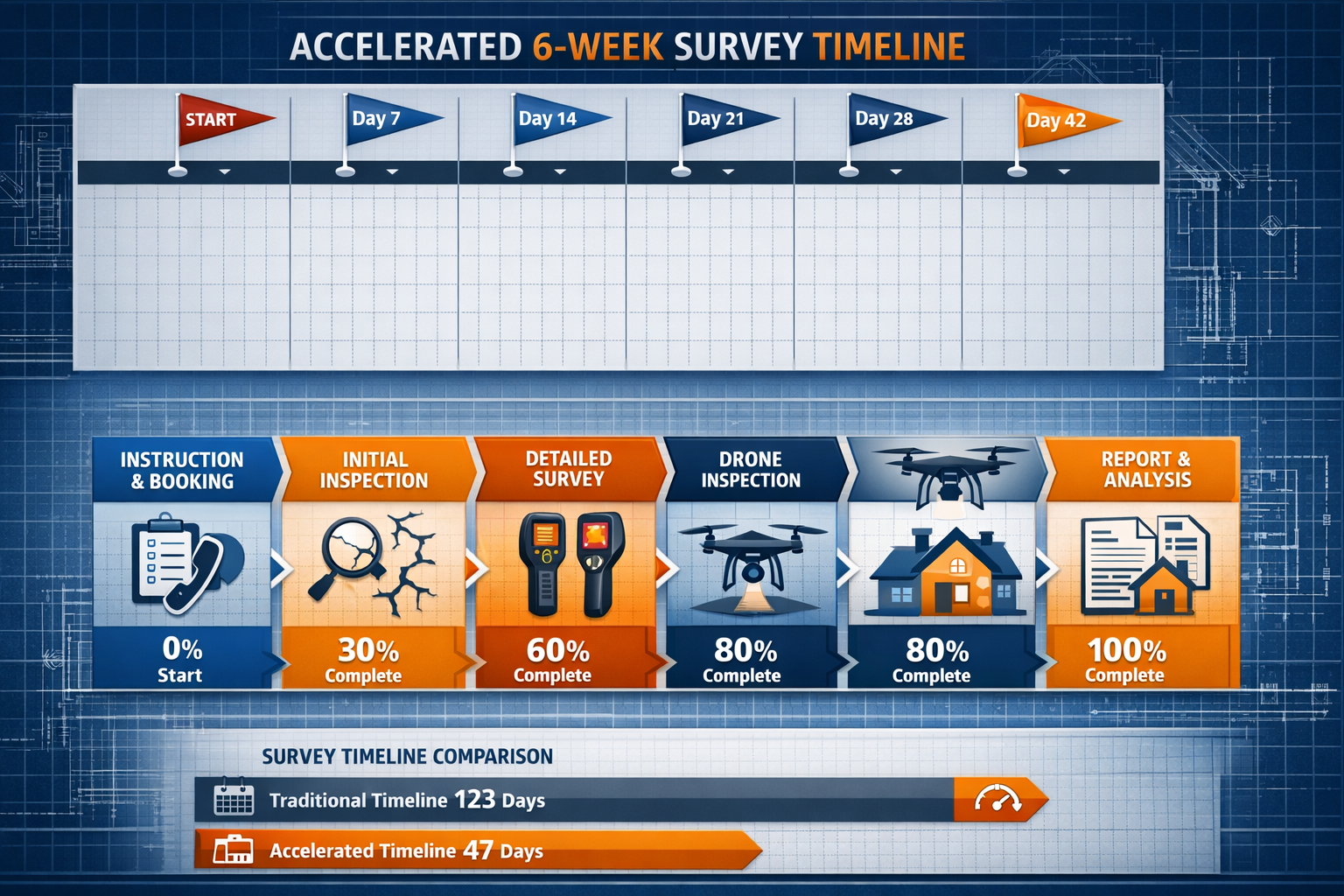
- 📊 Market pressure: Average transaction times of 123 days clash with buyer expectations of 47 days, creating urgent demand for accelerated survey processes
- 🏗️ Three-tier clarity: Updated RICS standards categorize surveys as basic, intermediate, or advanced, streamlining service selection and reducing delays
- 💻 Technology integration: Digital tools, thermal imaging, and cloud-based reporting cut assessment time by 40-60% while improving defect detection
- ✅ Consistent standards: Expanded RICS Appendix A ensures uniform inspection quality regardless of surveyor, location, or firm, supporting faster approvals
Understanding the 2026 Market Pressure for Faster Survey Completions
The property transaction landscape has transformed dramatically in 2026. Buyers no longer accept lengthy waiting periods that characterized previous decades. With average expectations now sitting at approximately 6.78 weeks from offer acceptance to completion, every day counts in securing competitive properties.
The Transaction Timeline Gap
Traditional property transactions in the UK have historically averaged 123 days from initial offer to final completion. This extended timeline encompasses multiple stages:
- Initial offer and acceptance (3-7 days)
- Mortgage application and approval (14-21 days)
- Survey instruction and completion (14-28 days)
- Legal searches and conveyancing (30-45 days)
- Exchange and completion (7-14 days)
However, 2026 buyers operate in a fundamentally different environment. Online mortgage decisions, digital identity verification, and streamlined legal processes have compressed timelines across most transaction stages. Property surveys remain the critical bottleneck, often requiring 3-4 weeks from instruction to final report delivery.
Why Survey Speed Matters More Than Ever
Several converging factors make survey turnaround time crucial in 2026:
🏠 Competitive Property Markets: Desirable properties receive multiple offers within days. Sellers prioritize buyers who demonstrate ability to complete quickly, making survey speed a competitive differentiator.
💰 Mortgage Offer Validity: Most mortgage offers remain valid for 3-6 months. Delays in survey completion eat into this window, potentially requiring reapplication if offers expire.
📉 Price Volatility: Market fluctuations mean buyers want to lock in agreed prices quickly. Extended survey periods increase risk of renegotiation or deal collapse.
🔄 Chain Dependencies: In property chains, one slow survey can delay multiple transactions. Fast survey completion reduces chain break risk and maintains momentum.
For chartered surveyors operating in this environment, adapting protocols to deliver comprehensive assessments within accelerated timeframes has become essential to remaining competitive and serving client needs effectively.
Building Survey Protocols for Accelerated 6-Week Completions: Core RICS Framework Updates
The Royal Institution of Chartered Surveyors (RICS) has responded to market pressures with significant updates to its Home Survey Standard. These changes directly support Building Survey Protocols for Accelerated 6-Week Completions by establishing clearer service definitions and standardized inspection requirements.[3]
The Three-Tier Service Classification
RICS has restructured its survey offerings into three distinct categories designed to help consumers quickly identify appropriate service levels:
Basic Level Surveys provide essential property assessment suitable for:
- Modern properties in good condition
- New build homes requiring basic verification
- Properties where comprehensive inspection isn't warranted
- Budget-conscious buyers seeking fundamental assurance
Intermediate Level Surveys offer balanced assessment including:
- Visual inspection of accessible areas
- Identification of urgent defects and potential issues
- Condition ratings for major property elements
- Suitable for conventional properties in reasonable condition
Advanced Level Surveys (Level 3 Building Surveys) deliver comprehensive analysis featuring:
- Detailed inspection of all accessible areas
- In-depth defect analysis and causation assessment
- Extensive reporting on construction, condition, and repairs
- Recommended for older, altered, or unconventional properties
This classification system eliminates confusion about service scope, enabling faster client decision-making and reducing pre-instruction delays that previously added days to the process.
Standardized Inspection Protocols: Appendix A Expansion
Perhaps the most significant change supporting accelerated completions is the expanded Appendix A within RICS standards. This enhancement ensures consistent inspection levels regardless of which surveyor, locality, or regulated firm conducts the assessment.[3]
Key benefits of standardized protocols include:
| Protocol Element | Traditional Approach | 2026 Standardized Approach |
|---|---|---|
| Inspection checklist | Varied by surveyor preference | Mandatory standardized checklist |
| Defect categorization | Inconsistent terminology | Uniform condition ratings (1-3) |
| Reporting format | Firm-specific templates | RICS-compliant standard format |
| Inspection duration | Variable (2-6 hours) | Defined by property type/size |
| Photo documentation | Optional supplementary | Required minimum standards |
This standardization directly accelerates completion timelines by:
✅ Reducing report review time: Mortgage lenders and conveyancers can process standardized reports faster due to familiar formatting and consistent condition ratings.
✅ Minimizing clarification requests: Clear, uniform terminology reduces follow-up questions that traditionally delayed transactions by 3-7 days.
✅ Enabling quality assurance: Standardized checklists allow firms to implement rapid internal review processes without compromising thoroughness.
✅ Supporting digital integration: Consistent data structures facilitate automated reporting systems that cut report production time by 40-60%.
Cost Considerations in Accelerated Survey Protocols
Professional survey assessments in 2026 start at approximately £320 for basic services, with comprehensive Level 3 surveys typically ranging from £600-£1,500 depending on property size and complexity.[1]
While accelerated service might seem to justify premium pricing, competitive market dynamics and improved efficiency through digital tools have actually stabilized costs. Surveyors implementing streamlined protocols often find they can maintain standard pricing while improving turnaround times, gaining market share through service quality rather than price competition.
For buyers evaluating survey pricing, the value proposition extends beyond the fee itself. A £900 comprehensive survey that completes in 10 days versus 28 days can save a competitive property purchase, easily justifying the investment through successful transaction completion.
Digital Tools and Technology Integration for Rapid Survey Delivery
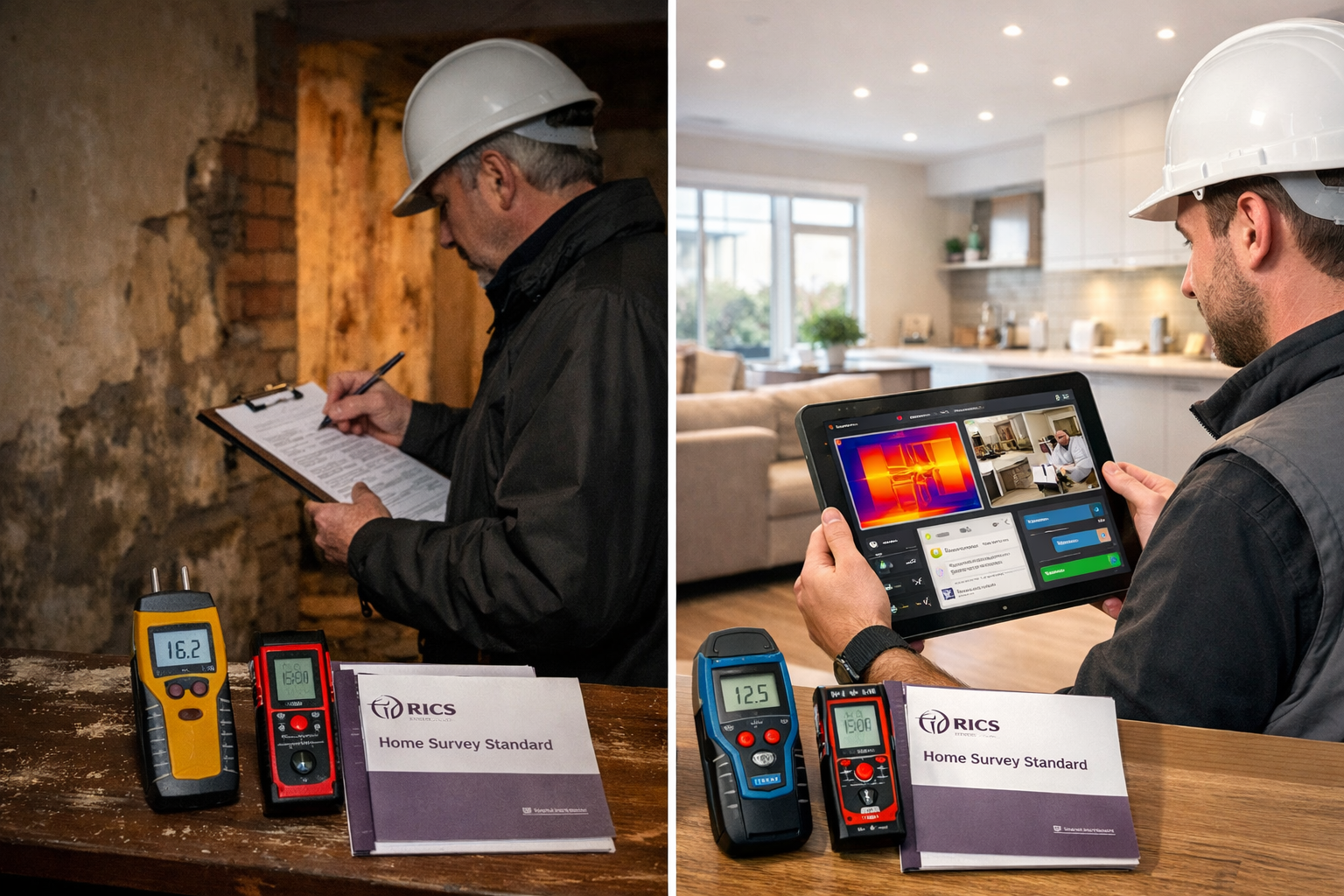
Technology represents the single most powerful enabler of Building Survey Protocols for Accelerated 6-Week Completions: RICS Strategies Amid 2026 Buyer Demand Surge. Forward-thinking surveying practices have embraced digital transformation across every stage of the assessment process.
Cloud-Based Reporting Systems
Traditional survey reporting involved on-site handwritten notes, office transcription, report drafting, internal review, and final production—a process consuming 7-14 days post-inspection. Modern cloud-based systems compress this to 24-48 hours through:
Real-Time Data Capture: Surveyors input observations directly into tablets or smartphones during inspection, eliminating transcription delays and reducing errors.
Template Automation: Pre-configured report templates with standardized RICS-compliant sections allow rapid population of property-specific details while maintaining consistency.
Collaborative Review: Cloud platforms enable simultaneous review by multiple team members, compressing quality assurance from sequential (3-5 days) to parallel processing (same day).
Instant Client Delivery: Digital reports transmit to clients, mortgage lenders, and solicitors simultaneously upon completion, eliminating postal delays and version control issues.
Advanced Inspection Technologies
Modern survey equipment dramatically improves both speed and accuracy of defect detection:
📸 High-Resolution Photography: Professional cameras with GPS tagging and automatic cloud upload create comprehensive visual records during inspection, supporting detailed analysis without return visits.
🌡️ Thermal Imaging Cameras: Infrared technology identifies hidden moisture penetration, insulation defects, and heat loss patterns in minutes—issues that might otherwise require invasive investigation or multiple visits.
📏 Laser Distance Measurers: Instant accurate measurements of rooms, ceiling heights, and structural elements eliminate time-consuming manual measuring and calculation errors.
🚁 Drone Surveys: Aerial inspection of roofs, chimneys, and elevated structures provides comprehensive assessment without scaffolding or access equipment, saving days of preparation and cost.
For properties requiring specialized assessment, structural surveys benefit particularly from these technological advances, enabling thorough evaluation of complex structural concerns within compressed timeframes.
Mobile-First Workflow Design
Progressive surveying firms have redesigned workflows around mobile-first principles:
- Digital Instruction: Clients book surveys through online portals, providing property details and uploading relevant documents instantly
- Automated Scheduling: AI-powered systems optimize surveyor calendars, minimizing travel time and maximizing daily inspection capacity
- On-Site Efficiency: Surveyors access previous reports, planning documents, and comparable properties via mobile devices during inspection
- Immediate Processing: Report drafting begins during site inspection using voice-to-text and standardized checklists
- Client Communication: Automated updates notify clients at each stage, reducing inquiry calls and administrative burden
This integrated approach can reduce total process time from instruction to report delivery from 21-28 days to just 7-10 days for standard homebuyer surveys.
Practical Implementation: Surveyor Checklists for 6-Week Completions
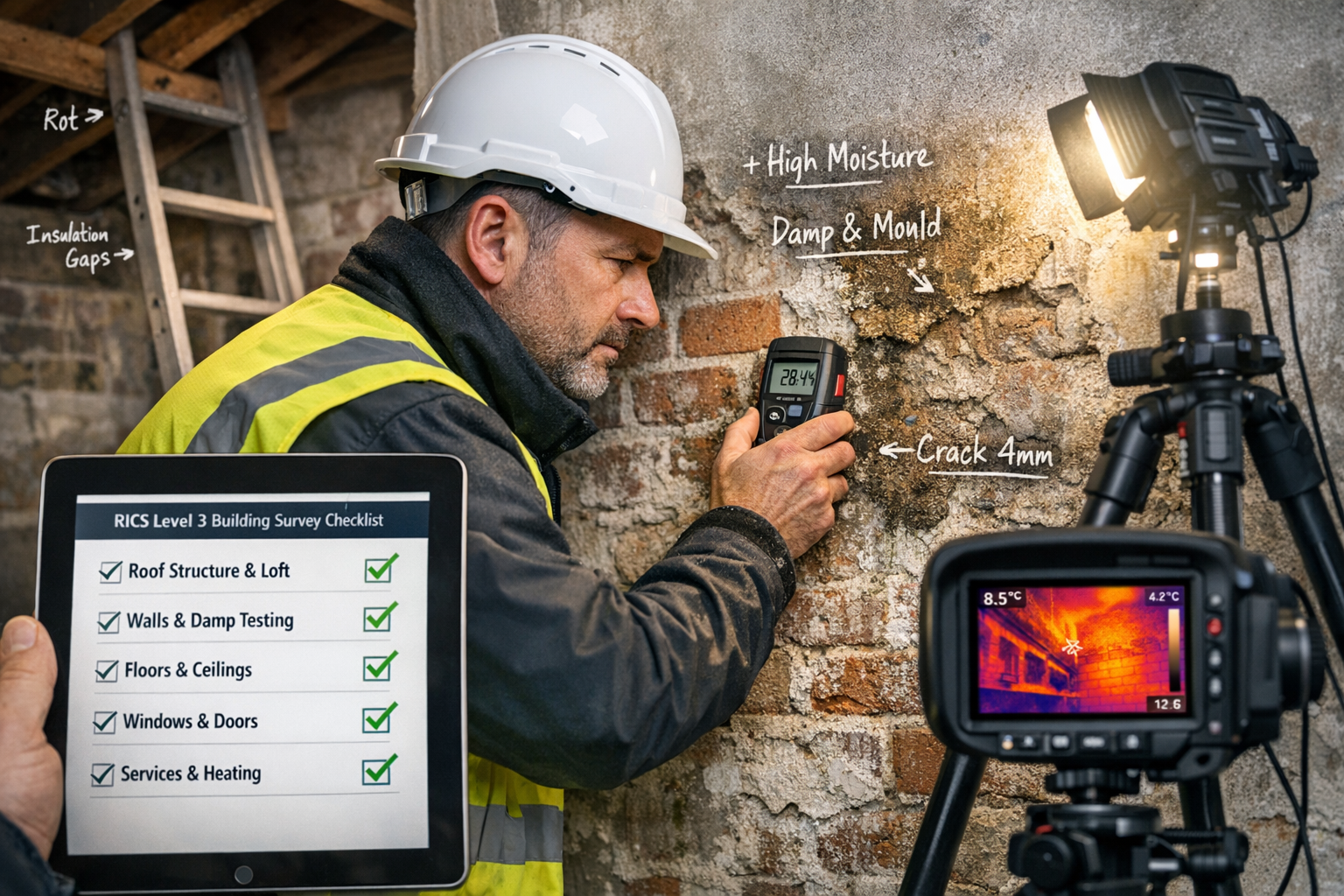
Achieving consistent 6-week completions requires surveyors to implement systematic protocols that balance thoroughness with efficiency. The following frameworks provide practical guidance for delivering accelerated surveys without compromising professional standards.
Pre-Instruction Efficiency Protocols
Before the survey is even booked, several steps can eliminate common delays:
✓ Clear Service Definition: Use RICS three-tier classification to guide clients toward appropriate survey level immediately, avoiding mid-process scope changes.
✓ Digital Onboarding: Collect all necessary information (property address, access arrangements, special concerns) through online forms, eliminating phone tag and email exchanges.
✓ Preliminary Research: Automated systems can pull planning history, flood risk data, and comparable property information before site visit, enabling more focused on-site time.
✓ Access Confirmation: Automated reminders to estate agents and vendors 48 hours before inspection prevent wasted journeys and rescheduling delays.
On-Site Inspection Optimization
Efficient site inspection represents the cornerstone of accelerated survey protocols. RICS building surveys following these principles maintain comprehensive coverage while minimizing time:
Systematic Room-by-Room Progression:
- Follow consistent inspection sequence (typically roof to foundation)
- Use standardized checklist ensuring no elements overlooked
- Capture photographs at each stage for later reference
- Record voice notes for complex observations requiring detailed explanation
Priority Defect Identification:
- Focus initial attention on Category 2 and 3 defects (serious and urgent issues)
- Document evidence comprehensively for significant concerns
- Flag potential deal-breakers immediately for client communication
- Note minor cosmetic issues efficiently without excessive detail
Technology-Enhanced Assessment:
- Deploy thermal imaging in all properties for hidden defect detection
- Use moisture meters on suspicious areas identified visually or thermally
- Photograph all defects with scale references for accurate assessment
- Record measurements digitally for immediate report integration
For properties with specific concerns like dampness, specialized damp surveys can be integrated within the standard inspection protocol using these technologies, avoiding separate appointments that extend timelines.
Post-Inspection Report Production
The period between site inspection and report delivery offers the greatest opportunity for time compression:
Same-Day Report Initiation:
- Begin report drafting immediately after inspection while observations remain fresh
- Use voice-to-text for detailed defect descriptions during travel time
- Upload and organize photographs within 2 hours of inspection completion
- Complete property description and construction sections same day
Structured Report Development (Days 1-2):
- Follow RICS standardized format for consistent section completion
- Apply uniform condition ratings (1-3) using defined criteria
- Include mandatory elements: executive summary, defect schedule, recommendations
- Integrate photographs with annotations highlighting specific concerns
Quality Assurance Process (Day 2-3):
- Automated checks verify all mandatory sections completed
- Senior surveyor review focuses on significant defects and recommendations
- Technical review ensures consistency between observations and conclusions
- Client-facing review confirms clarity and accessibility of language
Delivery and Follow-Up (Day 3):
- Simultaneous distribution to client, mortgage lender, and solicitor
- Automated email includes report access instructions and follow-up availability
- Client portal provides FAQ resources reducing common inquiry calls
- Booking system enables immediate scheduling of clarification calls if needed
Managing Complex Properties Within Accelerated Timeframes
Not all properties suit standard accelerated protocols. Older buildings, significantly altered properties, or those with apparent serious defects require additional consideration. For these cases:
🏚️ Heritage and Period Properties: Extended inspection time (4-6 hours vs. 2-3 hours) accounts for complex construction, multiple alterations, and detailed architectural features requiring specialized assessment.
🏗️ Properties with Significant Defects: When major structural concerns emerge, immediate specialist consultation may be necessary. Rather than delaying the entire report, issue preliminary findings within standard timeframe with specialist assessment to follow.
🏘️ Commercial Properties: Commercial building surveys involve additional complexity including mechanical systems, fire safety compliance, and accessibility requirements. These typically require 10-14 day turnaround even with optimized protocols.
🔧 Properties Requiring Specialist Input: When specific concerns (subsidence, structural movement, contamination) require specialist investigation, coordinate specialists immediately rather than waiting for main report completion. Parallel processing maintains timeline momentum.
The key principle: communicate timeline implications immediately when complexity emerges. Clients appreciate transparency and can adjust expectations or transaction timelines accordingly, preventing last-minute surprises that derail completions.
Risk Management in Accelerated Survey Protocols
Speed must never compromise professional standards or expose surveyors to liability. Robust risk management frameworks ensure Building Survey Protocols for Accelerated 6-Week Completions maintain quality while meeting market demands.
Quality Assurance Checkpoints
Implementing mandatory quality gates throughout the accelerated process:
Pre-Inspection Review:
- Verify surveyor qualifications match property complexity
- Confirm appropriate equipment available for property type
- Review any previous survey reports if available
- Identify known area-specific issues (mining, flooding, contamination)
During Inspection:
- Mandatory photographic evidence for all significant defects
- Real-time supervisor consultation available for complex observations
- Minimum inspection duration requirements based on property size
- Standardized checklist completion verification before leaving site
Report Production:
- Automated consistency checks (e.g., flagging Category 3 defects without corresponding urgent recommendations)
- Peer review for all reports identifying significant defects
- Senior surveyor sign-off before client delivery
- Version control ensuring final approved report reaches all parties
Professional Indemnity Considerations
Accelerated protocols must not increase professional liability exposure. Key protective measures include:
📋 Comprehensive Documentation: Digital systems create audit trails showing systematic inspection methodology and decision-making processes.
⚖️ Clear Scope Definition: Written terms of engagement explicitly define inspection limitations, particularly for accelerated services.
🎓 Continuous Training: Regular updates ensure all surveyors understand current RICS standards and accelerated protocol requirements.
🛡️ Adequate Insurance: Professional indemnity coverage reflects increased transaction volumes and accelerated service offerings.
When to Decline Accelerated Timelines
Professional judgment sometimes requires declining unrealistic client expectations:
❌ Insufficient access arrangements preventing comprehensive inspection
❌ Property complexity exceeding available assessment time
❌ Specialist input required that cannot be coordinated within timeline
❌ Incomplete information about property history or alterations
❌ Safety concerns requiring additional access equipment or preparation
Declining inappropriate acceleration requests protects both client interests and professional reputation, ultimately supporting long-term business sustainability.
Training and Team Development for Accelerated Service Delivery
Implementing Building Survey Protocols for Accelerated 6-Week Completions: RICS Strategies Amid 2026 Buyer Demand Surge requires investment in surveyor skills and organizational capability.
Essential Competencies for Modern Surveyors
Beyond traditional technical knowledge, 2026 surveyors require:
💻 Digital Proficiency: Comfortable with tablets, mobile apps, cloud platforms, and digital photography. Ability to troubleshoot basic technical issues in the field.
⏱️ Time Management: Skilled at estimating inspection duration accurately, maintaining systematic progression, and avoiding scope creep during site visits.
📱 Communication Skills: Clear written expression for reports, effective client communication for complex findings, and collaborative approach with specialists and colleagues.
🔍 Defect Prioritization: Ability to distinguish between urgent issues requiring immediate attention and minor concerns suitable for brief notation.
📊 Technology Utilization: Proficient with thermal imaging, moisture meters, laser measurers, and other diagnostic equipment enhancing inspection efficiency.
Organizational Systems Supporting Acceleration
Individual surveyor capability alone cannot deliver consistent accelerated service. Firms must implement supporting infrastructure:
Standardized Templates: RICS-compliant report templates with automated sections, consistent formatting, and integrated photograph placement.
Knowledge Management: Centralized database of common defects, repair methodologies, and cost guidance enabling rapid report development.
Scheduling Optimization: Geographic clustering of appointments minimizing travel time and maximizing daily inspection capacity.
Administrative Support: Dedicated staff handling booking, client communication, and report distribution freeing surveyors to focus on technical work.
Technology Investment: Regular equipment updates, software licenses, and digital infrastructure maintenance ensuring reliable operation.
Client Communication Strategies for Managing Expectations
Even with optimized protocols, clear communication remains essential for successful 6-week completions.
Setting Realistic Timelines
Transparency from instruction: Provide clients with detailed timeline breakdown showing each stage and potential variables affecting duration.
Property-specific considerations: Explain how property type, size, age, and complexity influence inspection and reporting time.
Dependencies beyond surveyor control: Clarify that 6-week completion requires coordination across all transaction parties (mortgage lender, solicitor, estate agent).
Progress Updates
Automated communication at key milestones:
- Inspection scheduled (immediate confirmation)
- Inspection completed (same day notification)
- Report in production (next day update)
- Report delivered (immediate notification with access instructions)
This proactive communication reduces client anxiety and inquiry calls, freeing administrative capacity for productive work.
Managing Unexpected Delays
When complications arise:
🚨 Immediate notification: Contact client as soon as delay becomes apparent
📋 Clear explanation: Describe specific issue causing delay and steps being taken
📅 Revised timeline: Provide updated completion estimate with contingency buffer
💡 Options presentation: Offer alternatives where possible (preliminary findings, phased reporting)
Clients tolerate delays far better when kept informed than when left wondering about progress.
Future Developments: Beyond 2026
The evolution of survey protocols continues beyond current 2026 practices. Emerging trends likely to further accelerate timelines include:
🤖 Artificial Intelligence: AI analysis of photographs identifying potential defects for surveyor verification, reducing on-site time and improving detection consistency.
🏠 Smart Home Integration: Properties with building management systems providing historical data on heating, moisture, and structural movement informing survey assessment.
⛓️ Blockchain Verification: Immutable records of previous surveys, repairs, and alterations accessible instantly during new assessments.
📡 Remote Inspection Elements: Hybrid models combining on-site inspection with client-facilitated video walkthroughs for preliminary assessment or follow-up clarification.
🔬 Advanced Materials Analysis: Portable spectrometry and materials testing providing instant identification of construction materials and potential hazards.
These innovations promise further compression of survey timelines while maintaining or enhancing assessment quality, continuing the trajectory toward truly seamless property transactions.
Conclusion
Building Survey Protocols for Accelerated 6-Week Completions: RICS Strategies Amid 2026 Buyer Demand Surge represents a fundamental shift in how chartered surveyors deliver professional services. The gap between traditional 123-day transaction timelines and modern buyer expectations of 6.78 weeks creates both challenge and opportunity for forward-thinking practices.
The updated RICS standards providing three-tier service classification and standardized inspection protocols form the foundation for consistent, efficient delivery.[3] Combined with digital tools—cloud-based reporting, thermal imaging, mobile workflows—these frameworks enable comprehensive property assessment within dramatically compressed timeframes without compromising professional standards or increasing liability risk.
Success requires more than simply working faster. It demands systematic process redesign, technology investment, team training, and robust quality assurance. Surveyors who implement these protocols position themselves competitively in a market where transaction speed increasingly differentiates winning from losing offers.
For property buyers, understanding these protocols enables more informed decision-making about survey selection and realistic completion expectations. For sellers, recognizing the value of buyers with accelerated survey capability can inform offer evaluation beyond simple price comparison.
Actionable Next Steps
For Surveying Practices:
- Audit current processes identifying specific bottlenecks extending turnaround times
- Invest in digital reporting platforms and mobile inspection tools
- Implement standardized RICS-compliant templates and checklists
- Train team members on accelerated protocols and technology utilization
- Establish quality assurance checkpoints preventing speed-induced errors
For Property Buyers:
- Engage local chartered surveyors experienced in accelerated protocols early in your property search
- Understand which survey level suits your property type and risk tolerance
- Provide complete property information and ensure access arrangements immediately upon instruction
- Coordinate with mortgage lender and solicitor to ensure all parties work to compatible timelines
- Budget appropriately for professional assessment—starting from £320 for basic surveys[1]
For Estate Agents and Conveyancers:
- Partner with surveying practices demonstrating consistent accelerated delivery capability
- Educate clients about realistic survey timelines and factors affecting duration
- Facilitate smooth access arrangements and information transfer
- Recognize survey speed as competitive advantage when evaluating multiple offers
The property market continues evolving toward greater efficiency and speed. Those who adapt their practices to meet these expectations while maintaining professional excellence will thrive in 2026 and beyond. The protocols outlined here provide a roadmap for that adaptation, balancing market demands with the fundamental responsibility to protect clients through thorough, competent property assessment.
Understanding how long surveys take under modern protocols empowers all transaction parties to set realistic expectations and coordinate effectively toward successful 6-week completions.
References
[1] Building Survey Protocols For New Build Properties In 2026 Spotting Defects Amid 2 5 Price Growth Forecasts – https://nottinghillsurveyors.com/blog/building-survey-protocols-for-new-build-properties-in-2026-spotting-defects-amid-2-5-price-growth-forecasts
[2] Building Survey Protocols For Professional Landlord Acquisitions Assessing Yields In 2026s Bullish Buy To Let Recovery – https://nottinghillsurveyors.com/blog/building-survey-protocols-for-professional-landlord-acquisitions-assessing-yields-in-2026s-bullish-buy-to-let-recovery
[3] Understanding The Rics Home Survey Standard Proposal – https://www.rics.org/news-insights/understanding-the-rics-home-survey-standard-proposal