
Canterbury & Kent
Whole Life Carbon in Expert Witness Valuations: Applying RICS 2nd Edition PAS 2080 to 2026 Development Dispute Reports
Expert witnesses who fail to incorporate whole life carbon assessments into 2026 development dispute reports are not just behind the curve — they risk producing reports that courts and tribunals will find methodologically indefensible. The convergence of the RICS Whole Life Carbon Assessment (WLCA) 2nd Edition with PAS 2080:2023 has created an authoritative, standardised framework that is now expected as a baseline in any credible valuation touching on sustainable development disputes [1]. For professionals preparing reports under CPR Part 35, this is no longer optional territory.
This article examines how Whole Life Carbon in Expert Witness Valuations: Applying RICS 2nd Edition PAS 2080 to 2026 Development Dispute Reports works in practice — covering the standards, the methodology, the tools, and the professional obligations that shape defensible carbon-informed expert evidence in 2026.
Key Takeaways 📋
- The RICS WLCA 2nd Edition and PAS 2080:2023 now form the combined authoritative baseline for whole life carbon assessments in development dispute valuations.
- The CLEAR coalition (launched April 2026) is harmonising global carbon reporting standards, directly affecting how expert witnesses benchmark carbon data.
- Expert witnesses must quantify green premiums, retrofit costs, and embodied carbon liabilities using standardised lifecycle stages (A1–C4) in CPR Part 35 reports.
- Leading software tools including One Click LCA and eTool are now aligned with RICS 2nd Edition, enabling auditable, court-ready carbon calculations.
- Failure to apply recognised carbon assessment standards in dispute reports exposes expert witnesses to credibility challenges and potential professional liability.
Why Whole Life Carbon Now Belongs in Every Development Dispute Report
The built environment accounts for approximately 40% of global energy-related carbon emissions. In the UK alone, embodied carbon — the carbon emitted during the manufacture, transport, and construction of building materials — represents around 11% of total global emissions. Against this backdrop, disputes over sustainable development schemes increasingly hinge on carbon-related valuation questions: What is the green premium on a net-zero-ready building? What does a full retrofit to PAS 2035 standards cost in carbon terms? How does an abandoned low-carbon specification affect residual land value?
These are not peripheral questions. They sit at the heart of planning disputes, contractor negligence claims, development appraisal disagreements, and rent review arbitrations involving green lease clauses. The expert witness who cannot answer them with reference to a recognised standard is vulnerable to cross-examination.
The RICS WLCA 2nd Edition is specifically designed to “enable professionals to make prudent decisions to limit the whole life carbon impact of buildings” [2]. When applied alongside PAS 2080:2023 — the BSI carbon management standard for the built environment — the combined framework provides unprecedented clarity for valuation professionals operating in dispute contexts [1].
The Lifecycle Carbon Stages: What Expert Witnesses Must Account For
The RICS 2nd Edition organises whole life carbon into clearly defined lifecycle stages. Understanding these stages is essential for any expert preparing a development dispute report:
| Stage | Description | Relevance to Disputes |
|---|---|---|
| A1–A3 | Product & manufacturing (embodied carbon) | Material specification disputes |
| A4–A5 | Transport & construction | Contractor performance claims |
| B1–B7 | In-use operational carbon | Green lease, energy performance disputes |
| B8 | Deconstruction energy | End-of-life planning disputes |
| C1–C4 | End-of-life carbon | Demolition, remediation claims |
| D | Beyond boundary (reuse/recycling) | Sustainability credit disputes |
💡 Pull Quote: “A whole life carbon assessment that stops at operational energy misses the majority of the carbon story in modern low-energy buildings — and misses the majority of the valuation argument too.”
For commercial valuations involving sustainable development schemes, stages A1–A5 (embodied carbon) and B6 (operational energy) typically drive the largest valuation differentials and generate the most contested expert evidence.
Applying RICS 2nd Edition PAS 2080 to 2026 Development Dispute Reports: The Methodology
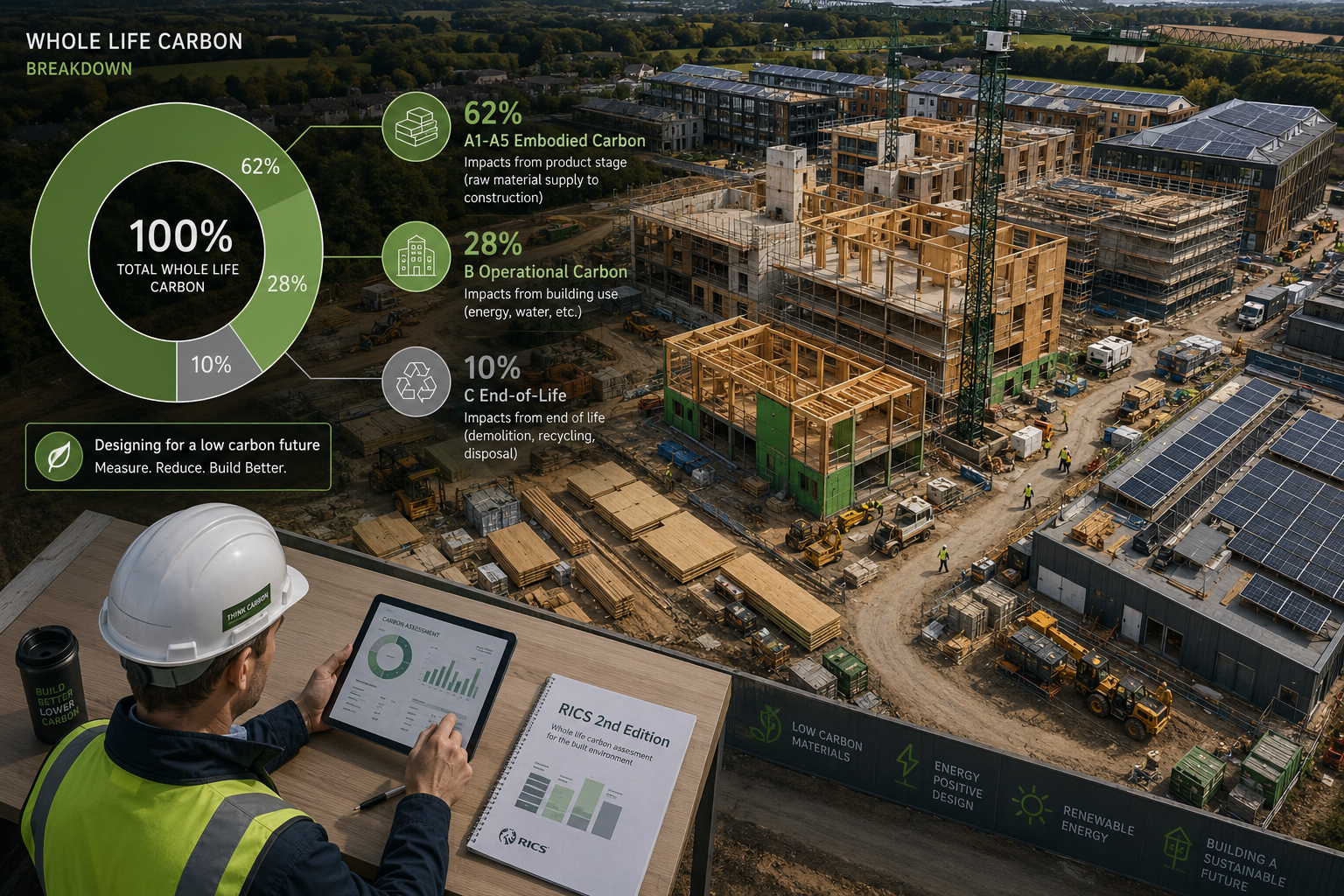
The convergence of RICS WLCA 2nd Edition with PAS 2080:2023 creates a standardised carbon accounting methodology that is directly applicable to infrastructure and development disputes [3]. For expert witnesses, applying this framework involves four core methodological steps.
Step 1: Define the Assessment Scope and System Boundary
PAS 2080:2023 requires that the system boundary — which lifecycle stages are included — is explicitly defined and justified. In dispute contexts, this matters enormously: opposing experts who use different system boundaries will produce incomparable carbon figures, and tribunals need to understand why.
The expert witness must document:
- Which lifecycle stages are included (and why others are excluded)
- The reference study period (typically 60 years for residential; 25–50 years for commercial)
- The functional unit (per m², per dwelling, per development phase)
Step 2: Select Carbon Data Sources
The RICS 2nd Edition mandates the use of recognised, auditable carbon data. The RICS Built Environment Carbon Database (BECD) provides a key reference point, and its integration into the CLEAR coalition framework (discussed below) strengthens its authority as a source for dispute reports [4].
Acceptable data sources in 2026 include:
- ✅ RICS BECD verified datasets
- ✅ Environmental Product Declarations (EPDs) from manufacturers
- ✅ ICE Database (Inventory of Carbon and Energy)
- ✅ CIBSE TM65 for building services embodied carbon
- ❌ Unverified manufacturer claims
- ❌ Generic industry averages without provenance
Step 3: Calculate and Benchmark Carbon Performance
Software alignment with RICS 2nd Edition is now well established. Tools including One Click LCA and eTool have aligned their calculation engines with the 2nd Edition standards [6][7], enabling expert witnesses to produce auditable, reproducible carbon calculations. This reproducibility is critical in dispute contexts where opposing parties may seek to interrogate the methodology.
Benchmarking against RIBA 2030 Climate Challenge targets or the UKGBC Net Zero Carbon Buildings Framework allows the expert to contextualise the carbon performance of a disputed development within recognised industry thresholds — a persuasive tool in tribunal proceedings.
Step 4: Translate Carbon Data into Valuation Impact
This is where whole life carbon assessment meets traditional valuation methodology. The expert witness must bridge the gap between carbon figures (expressed in kgCO₂e/m²) and financial values (expressed in £/m² or yield adjustment). The key valuation adjustments typically include:
- Green premium quantification: The value uplift attributable to verified low-carbon credentials (EPC A, BREEAM Outstanding, net-zero certification)
- Retrofit cost liability: The present value of future carbon-related upgrade costs under evolving regulatory requirements
- Stranded asset risk: The discount applied where a building’s carbon performance creates obsolescence risk before the end of its economic life
- Carbon compliance costs: The cost of purchasing carbon credits or paying carbon levies under future regulatory regimes
For valuation factors analysis in dispute contexts, each of these adjustments requires explicit, evidenced justification — not assumption.
The CLEAR Coalition: How April 2026 Changed the Expert Witness Landscape
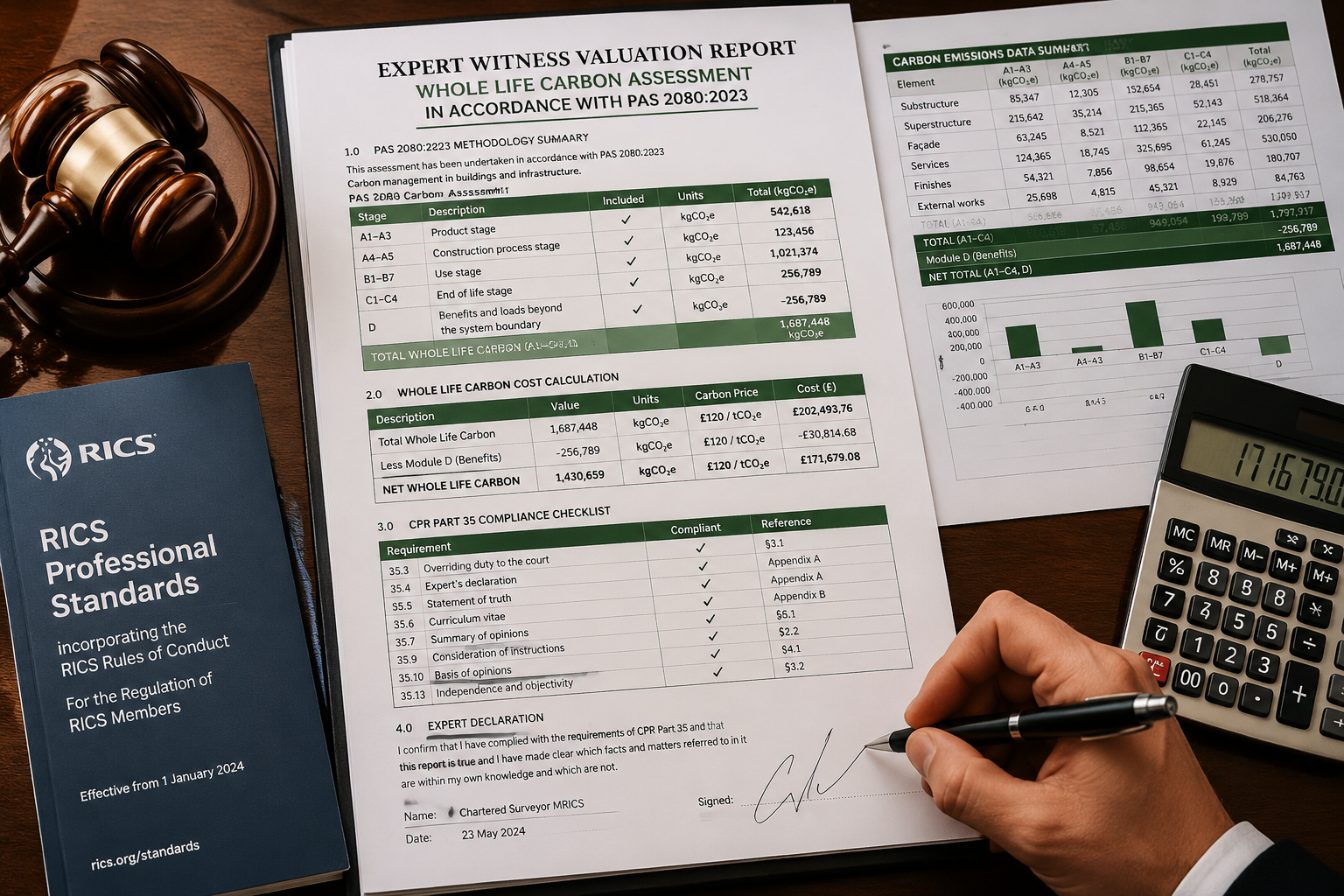
On 20–22 April 2026, RICS announced the launch of the Coalition for Life Cycle Emissions Alignment and Reporting (CLEAR) at the Sustainable Buildings and Construction Summit in Lausanne, Switzerland [4]. This development has direct and immediate implications for expert witnesses preparing development dispute reports.
CLEAR has been established specifically to “create a more consistent and trusted approach to whole-life carbon assessment, improve confidence in carbon data and support faster progress towards decarbonisation targets” [4]. For expert witnesses, this means:
What CLEAR Means for Dispute Reports in 2026
🌍 Global Harmonisation of Standards
CLEAR’s long-term ambition includes developing a harmonised global framework enabling “more effective reporting, stronger benchmarking and more confident carbon-related decision-making across the built environment” [4]. In cross-border development disputes — increasingly common in the UK’s international investment market — this harmonisation provides a defensible basis for comparing carbon assessments across jurisdictions.
📊 Improved Data Confidence
The coalition brings together standard setters, industry coalitions, developers, owners, manufacturers, software providers, investors, and carbon measurement specialists [4]. This multi-sector participation strengthens the credibility of CLEAR-aligned data sources in dispute proceedings.
🔍 First-Year Priorities (2026)
In its first year, CLEAR is prioritising coalition building, analysing existing whole-life carbon assessment methodologies, and developing resources for both industry and policy stakeholders [4]. Expert witnesses should monitor CLEAR outputs closely, as new guidance may affect the standard of care expected in dispute reports filed later in 2026 and beyond.
📚 RICS 2nd Edition as Foundation
The RICS 2nd Edition guidance is recognised as part of CLEAR’s foundation, alongside International Cost Management Standards and International Property Measurement Standards [4]. This recognition establishes the 2nd Edition as the authoritative baseline — not merely best practice — for 2026 valuations in dispute contexts.
💡 Pull Quote: “CLEAR’s launch in April 2026 effectively elevated RICS 2nd Edition from professional guidance to the recognised international standard for whole life carbon assessment in built environment disputes.”
CPR Part 35 Compliance: Structuring the Expert Witness Report
The Civil Procedure Rules Part 35 governs expert witness reports in English and Welsh civil proceedings. Applying Whole Life Carbon in Expert Witness Valuations: Applying RICS 2nd Edition PAS 2080 to 2026 Development Dispute Reports within a CPR Part 35 framework requires careful structural discipline.
The Seven Elements of a Carbon-Compliant Expert Report
- Statement of compliance — Explicit reference to RICS WLCA 2nd Edition and PAS 2080:2023 as the methodological basis
- Scope definition — Clear statement of lifecycle stages assessed and system boundary
- Data provenance — Full citation of carbon data sources, EPDs, and database references
- Calculation transparency — Software used, version number, input assumptions, and sensitivity analysis
- Benchmarking — Comparison against recognised industry targets (RIBA 2030, UKGBC, LETI)
- Valuation translation — Explicit methodology for converting carbon data into financial impact
- Limitations declaration — Honest statement of data gaps, uncertainty ranges, and areas requiring further investigation
For methods of valuation in development dispute contexts, the investment method and residual method both require adaptation to incorporate carbon-related adjustments. An expert who applies a standard residual appraisal without accounting for carbon compliance costs in a dispute involving a sustainable development scheme will face serious credibility challenges.
Common Pitfalls in Carbon-Related Expert Reports
❌ Using operational carbon only — Ignoring embodied carbon (stages A1–A5) in disputes involving new-build schemes misrepresents the full carbon liability
❌ Applying generic emission factors — Without EPD-level specificity, carbon figures are contestable and unreliable
❌ Failing to benchmark — Carbon figures presented in isolation, without comparison to recognised targets, lack persuasive force
❌ Conflating carbon cost with carbon value — The cost of reducing carbon and the market value of having reduced it are different figures requiring separate analysis
❌ Ignoring future regulatory risk — Failure to account for evolving MEES regulations, ETS exposure, or carbon pricing trajectories understates long-term valuation impact
For party wall disputes involving sustainable construction methods — particularly where insulation specifications or structural systems are contested — whole life carbon evidence is increasingly relevant to establishing the reasonableness of a proposed construction approach.
Quantifying Green Premiums and Retrofit Costs: Practical Guidance
The most contested valuation questions in 2026 sustainable development disputes involve two figures: the green premium and the retrofit cost liability.
Green Premium Valuation
Research consistently demonstrates that buildings with strong environmental credentials command measurable value premiums. In 2026, expert witnesses should reference:
- EPC differential studies — The value gap between EPC A/B and EPC D/E properties, adjusted for asset class and location
- BREEAM certification premiums — Documented yield compression for BREEAM Excellent/Outstanding commercial assets
- Net zero certification uplift — Emerging evidence on the premium commanded by independently verified net-zero buildings
The expert must distinguish between market-evidenced premiums (supported by comparable transactions) and theoretical premiums (derived from energy cost savings or regulatory compliance value). Courts prefer market evidence; where it is thin, the methodology for deriving a theoretical premium must be especially rigorous.
Retrofit Cost Liability
Where a disputed development fails to meet current or anticipated carbon standards, the expert must quantify the cost of bringing it into compliance. This requires:
- A PAS 2035 retrofit assessment framework for residential schemes
- A RICS cost plan for the proposed retrofit works
- A carbon impact assessment of the retrofit under RICS 2nd Edition
- A present value calculation discounting future retrofit costs at an appropriate rate
For rent review disputes involving green lease clauses, the retrofit cost liability may directly affect the headline rent achievable — and therefore the rent review outcome. Expert witnesses in these cases must demonstrate fluency in both carbon assessment methodology and conventional rent review valuation.
Whole Life Carbon in Expert Witness Valuations: Tools, Data, and Professional Standards
The practical application of Whole Life Carbon in Expert Witness Valuations: Applying RICS 2nd Edition PAS 2080 to 2026 Development Dispute Reports is supported by an increasingly mature ecosystem of tools and data sources.
Software Tools Aligned with RICS 2nd Edition
| Tool | RICS 2nd Edition Alignment | Key Strength |
|---|---|---|
| One Click LCA | ✅ Full alignment [7] | EPD database depth, audit trail |
| eTool | ✅ Full alignment [6] | Whole lifecycle modelling |
| CIBSE TM65 | ✅ Complementary | Building services embodied carbon |
| BECD | ✅ RICS native | Benchmark data, UK-specific |
For expert witness purposes, the choice of software must be disclosed and justified. The audit trail produced by these tools — showing inputs, assumptions, and calculation steps — is essential for CPR Part 35 compliance and for withstanding cross-examination.
Professional Standards and Obligations
RICS members preparing expert witness reports are bound by:
- RICS Professional Standard: Whole Life Carbon Assessment (2nd Edition) [5]
- RICS Practice Statement: Surveyors Acting as Expert Witnesses (4th Edition)
- CPR Part 35 and the Ikarian Reefer principles on expert independence
- PAS 2080:2023 for infrastructure and development carbon management
The valuation resilience framework provided by the RICS 2nd Edition gives expert witnesses a defensible methodology for addressing carbon-related development disputes through standardised, auditable approaches [1]. This is not merely about professional protection — it is about producing evidence that genuinely assists the court or tribunal.
For building surveys that underpin development dispute valuations, the condition of existing fabric directly affects both the embodied carbon of any proposed retrofit and the operational carbon baseline. A thorough building survey is therefore a prerequisite for a credible whole life carbon assessment in dispute contexts.
Conclusion: Actionable Next Steps for Expert Witnesses in 2026
The integration of RICS WLCA 2nd Edition and PAS 2080:2023 — now reinforced by the CLEAR coalition launched in April 2026 — has fundamentally changed what a credible development dispute expert report looks like. Carbon is no longer a specialist add-on; it is a core valuation variable that expert witnesses must address with the same rigour as yield, rental evidence, and comparable transactions.
Immediate Actions for Expert Witnesses 🎯
- Audit your methodology — Review current expert report templates against RICS WLCA 2nd Edition requirements and identify gaps
- Upskill on lifecycle carbon — Complete CPD covering PAS 2080:2023, RICS 2nd Edition, and CLEAR coalition developments
- Adopt aligned software — Implement One Click LCA or eTool for carbon calculations, ensuring full audit trail capability
- Build your data library — Establish access to RICS BECD, ICE Database, and relevant EPDs for your asset classes
- Review your report structure — Ensure CPR Part 35 compliance sections explicitly address carbon methodology, data sources, and valuation translation
- Monitor CLEAR outputs — Subscribe to RICS CLEAR updates as new guidance emerges through 2026 and beyond
- Collaborate early — Engage carbon assessment specialists as part of the expert team on complex sustainable development disputes
The courts and tribunals of 2026 are increasingly carbon-literate. Expert witnesses who bring the same literacy — grounded in RICS 2nd Edition, PAS 2080, and the emerging CLEAR framework — will produce reports that carry genuine authority. Those who do not will find their evidence challenged at the most inconvenient moment.
References
[1] Whole Life Carbon Assessment In Building Surveys Rics Pas 2080 2nd Edition And Valuation Resilience In 2026 – https://nottinghillsurveyors.com/blog/whole-life-carbon-assessment-in-building-surveys-rics-pas-2080-2nd-edition-and-valuation-resilience-in-2026
[2] Whole Life Carbon Assessment Wlca Built Environment – globalabc.org
[3] Whole Life Carbon Assessments In 2026 Valuations Rics 2nd Edition Standards For Surveyors – https://nottinghillsurveyors.com/blog/whole-life-carbon-assessments-in-2026-valuations-rics-2nd-edition-standards-for-surveyors
[4] Rics And Global Partners Launch Clear – rics.org
[5] Whole Life Carbon Assessment – rics.org
[6] New Rics Whole Life Carbon Assessment – cerclos.com
[7] 275698 Uk Whole Life Carbon Assessment Rics 2nd Edition – help.oneclicklca.com
Meta Title: Whole Life Carbon Expert Witness: RICS 2nd Edition PAS 2080 Guide
Meta Description: Learn how expert witnesses must apply RICS WLCA 2nd Edition and PAS 2080:2023 to 2026 development dispute reports — covering green premiums, retrofit costs, and CPR Part 35 compliance.
Related services from Canterbury Surveyors
- Party wall surveyors in Canterbury & Kent
- Boundary surveys
- Building expert witness surveyors
- RICS property valuations
Get a fixed-fee quote or call 0204 579 8270.