

Over one-third of UK construction firms now describe the quantity surveyor shortage as critical — not a future risk, but a present constraint on project delivery [2]. For building surveyors, this structural gap has a direct and growing consequence: the QS shortage impact on building surveyor workloads is reshaping how firms handle everything from dilapidations schedules to party wall disputes. Strategies for handling dilapidations and party wall overlaps in 2026 are no longer optional refinements — they are operational necessities.
This article sets out practical, RICS-compliant protocols for building surveyors navigating expanded responsibilities in a market where QS capacity has become genuinely scarce.
Key Takeaways 📋
- The UK construction sector needs 349,000 net new workers in 2026, with the QS talent pool shrinking due to retirement, international recruitment competition, and sector migration [4].
- Building surveyors are increasingly absorbing QS-adjacent tasks, particularly in dilapidations cost assessment and party wall cost management.
- Cross-skilling in cost control, NEC4 contract basics, and digital take-off tools is now a competitive advantage for building surveying firms.
- Structured triage protocols and digital tools can help firms manage higher workloads without breaching RICS professional standards.
- Proactive client communication and clear scope-of-service agreements are essential to managing liability when working at the edge of traditional building surveyor competency.
Understanding the QS Shortage and Its Knock-On Effect on Building Surveyors
The Scale of the Problem in 2026
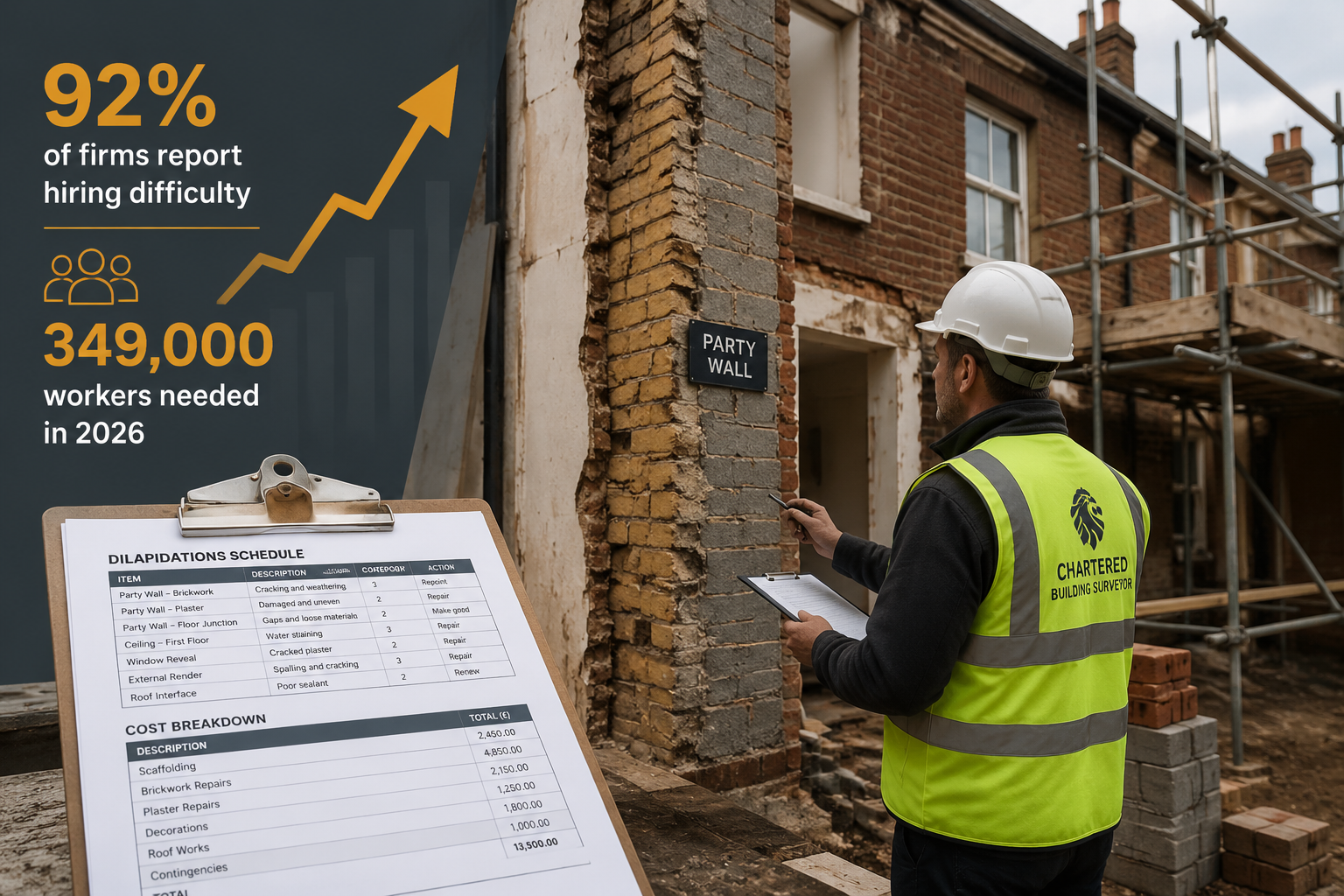
The numbers behind the QS shortage impact on building surveyor workloads are stark. A 20% retirement rate among senior quantity surveyors is rapidly draining the experienced talent pool [1]. RICS data confirms that a significant share of the chartered QS workforce has reached retirement age within the last 24 months, and the pipeline of newly qualified professionals is not keeping pace.
Compounding this, 92% of construction firms report difficulty finding workers to hire — a figure that signals a structural, not cyclical, problem [4]. The shortage is not confined to one region or project type. It is industry-wide.
Several forces are pulling experienced QSs away from traditional contracting roles:
| Pull Factor | Effect on Domestic QS Supply |
|---|---|
| Data centre construction (5.88% annual growth) | Draws MEP-specialist QSs to high-value projects [1] |
| Renewable energy infrastructure (solar, wind, battery) | Attracts QSs with stronger margins and specialist work [1] |
| US and Middle East recruitment | Salary uplifts above 30%, sometimes tax-free [1] |
| Digital skills mismatch | Fewer QSs can bridge traditional practice and carbon surveying [1] |
💬 Pull quote: "Commercial knowledge is leaving the industry faster than it is being replaced — particularly around lifecycle costing, procurement strategy, and final account negotiation." [1]
Why Building Surveyors Are Feeling the Pressure
When QS capacity shrinks, the gap does not simply disappear. Clients still need cost advice on defects. Landlords still need dilapidations schedules priced. Developers still need party wall costs managed. In many cases, the building surveyor — already on-site, already instructed, already trusted — becomes the default point of contact for these questions.
This is not inherently problematic. Building surveyors hold broad competencies that naturally overlap with QS territory, particularly in condition assessment, defect quantification, and schedule preparation. The risk arises when those overlaps are not managed with clear protocols, defined scope, and appropriate professional indemnity cover.
For firms offering dilapidation surveys or commercial dilapidations services, the pressure to provide cost estimates alongside condition reports is already a daily reality in 2026.
Strategies for Handling Dilapidations When QS Support Is Unavailable
Defining the Building Surveyor's Legitimate Cost Role
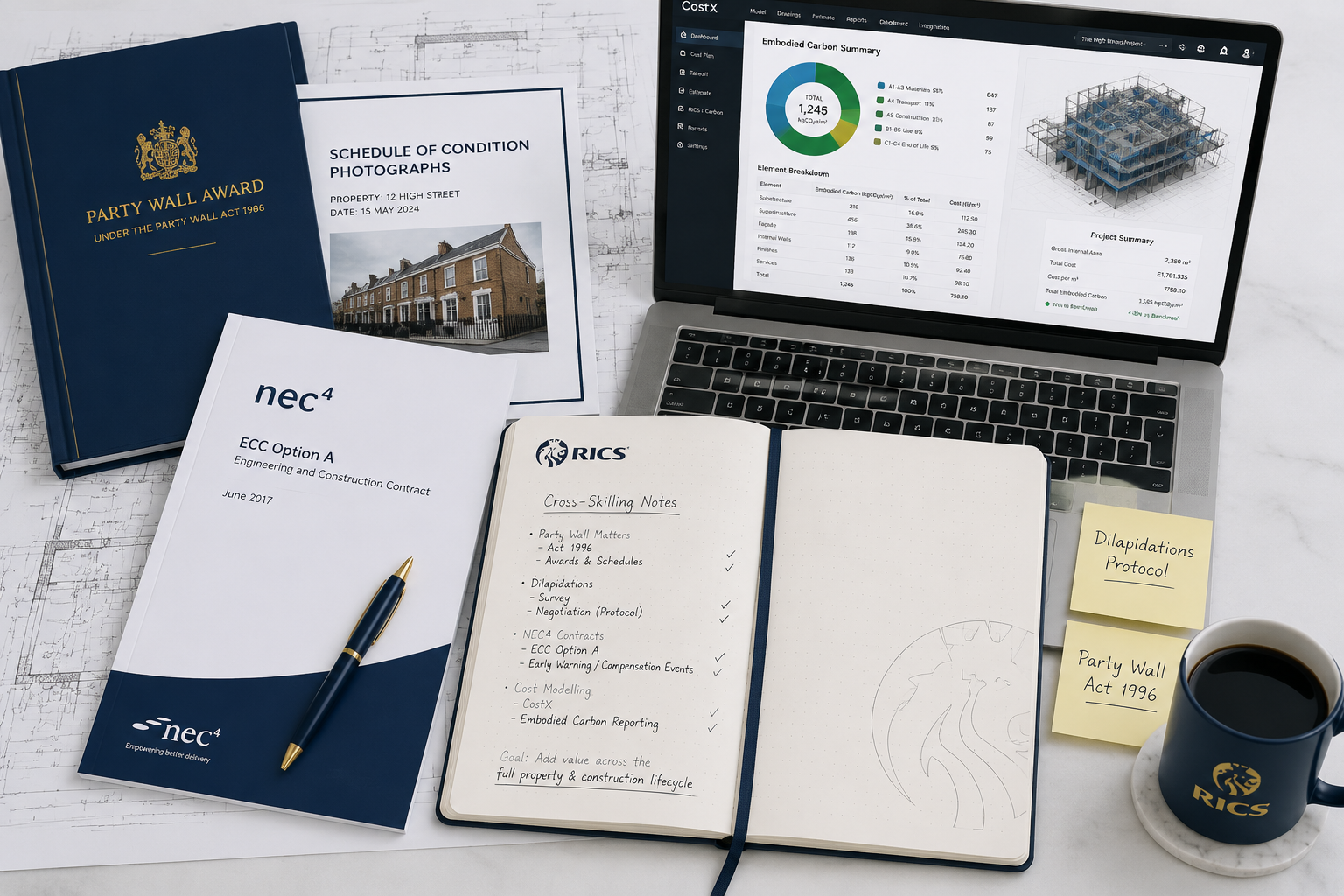
The first strategy is clarity. Building surveyors must define — in writing, in every instruction — exactly what cost-related services they are and are not providing. This is not about limiting service; it is about protecting both the client and the firm.
In dilapidations work, building surveyors can legitimately:
- ✅ Prepare detailed schedules of dilapidation with condition descriptions
- ✅ Quantify the extent and nature of disrepair
- ✅ Apply indicative rates to defects using recognised pricing guides (e.g., Spon's, BCIS)
- ✅ Advise on the diminution in value cap under the Leasehold Property (Repairs) Act 1938
- ✅ Negotiate with the opposing surveyor on matters of condition and repair
What requires either QS collaboration or explicit competency declaration:
- ⚠️ Detailed elemental cost planning
- ⚠️ Procurement advice on contractor selection
- ⚠️ NEC4 or JCT contract administration on remedial works
- ⚠️ Final account settlement on complex reinstatement contracts
A schedule of condition for leasehold properties forms the foundation of any dilapidations claim. Surveyors who invest time in thorough condition recording at lease commencement dramatically reduce the complexity — and the cost advice burden — at lease end.
Practical Triage Protocol for Dilapidations Instructions
When QS resource is unavailable, the following triage model helps building surveyors allocate effort efficiently:
Tier 1 — Standard residential or small commercial dilapidations (under £50,000 estimated liability):
Handle in-house using BCIS rates and standard pricing guides. Document methodology clearly. Flag to client that figures are indicative.
Tier 2 — Mid-range commercial dilapidations (£50,000–£250,000 estimated liability):
Prepare the schedule and condition assessment in-house. Engage a QS on a limited-scope basis for cost validation only. This reduces QS time requirements while maintaining accuracy.
Tier 3 — Complex or high-value dilapidations (above £250,000 or involving specialist plant/fit-out):
Full QS collaboration required. Building surveyor leads on condition; QS leads on cost. Do not attempt to absorb this tier without qualified cost support.
This tiered approach allows firms to serve more clients without overextending professional competency. It also creates a defensible audit trail if costs are later challenged.
Using Digital Tools to Bridge the Gap
70% of project managers and QSs report that AI and automated quantity take-off tools help reduce workload [1]. Building surveyors can access many of the same platforms. Tools such as CostX, Buildsoft, and BCIS Online allow non-QS professionals to generate credible indicative cost schedules from measured survey data.
The key discipline: always label outputs as indicative estimates, not QS-certified cost plans. This single step manages client expectations and limits liability exposure.
Managing Party Wall Overlaps: Cost, Condition, and Compliance in 2026
Where Party Wall Work and QS Competency Intersect
Party wall matters generate cost questions at almost every stage. Understanding party wall costs — both surveyor fees and remediation costs — is an area where building surveyors are routinely expected to advise, even without QS backup.
The most common cost-adjacent questions in party wall instructions include:
- What will it cost to make good damage to property caused by party wall works?
- How should remediation costs be allocated between building owner and adjoining owner?
- What is the cost implication of party wall obstructions or access disputes?
- What does party wall insulation add to project costs?
In each case, the building surveyor is the natural first point of contact. With QS capacity scarce, that contact increasingly needs to provide a credible answer — or at minimum, a structured framework for reaching one.
Protocols for Cost Allocation in Party Wall Awards
The party wall award is the legal instrument that governs works and their consequences. Building surveyors drafting awards in 2026 should incorporate explicit cost allocation clauses, particularly where:
- Remediation of damage is anticipated
- Shared elements (such as shared chimney stacks) require repair or reinstatement
- Access arrangements will generate consequential costs for the adjoining owner
Best practice for cost clauses in party wall awards:
- Reference a pricing mechanism — specify whether costs will be assessed by reference to BCIS rates, competitive tender, or agreed schedule of rates.
- Set a threshold for QS involvement — for example, any remediation cost above £10,000 requires independent QS verification before the building owner is invoiced.
- Include a dispute resolution pathway — specify how cost disagreements will be resolved without returning to court.
- Document the pre-works condition — a thorough photographic and written record limits cost disputes after works complete.
These clauses protect all parties and reduce the likelihood of post-works disputes that consume surveyor time without generating fee income.
The Risk of Proceeding Without a Party Wall Agreement
One consequence of stretched surveyor capacity is that some building owners are attempting to proceed without proper party wall notices or agreements. The risks of proceeding without a party wall agreement — or where a party wall notice has not been served — include injunctions, damages claims, and significantly higher remediation costs if disputes arise mid-construction.
Building surveyors should actively advise clients on this risk, particularly in 2026 when construction programmes are tight and the cost of delay is high. Proactive compliance advice is a genuine value-add service that does not require QS competency.
Building Surveyor Firm Strategies: Cross-Skilling, Delegation, and Digital Adoption
Cross-Skilling: What Building Surveyors Should Learn in 2026
The QS shortage impact on building surveyor workloads creates a genuine opportunity for firms willing to invest in structured cross-skilling. The goal is not to replace QSs — it is to reduce dependency on QS input for routine cost tasks, freeing QS capacity for complex work.
Priority cross-skilling areas for building surveyors in 2026:
| Skill Area | Relevance to Dilapidations/Party Wall | Recommended CPD Route |
|---|---|---|
| BCIS and Spon's pricing guides | Direct — indicative cost schedules | RICS CPD modules |
| Elemental cost analysis basics | Direct — dilapidations cost assessment | RICS online learning |
| NEC4 contract awareness | Indirect — remediation contract oversight | NEC Academy short courses |
| Digital take-off tools (CostX, Buildsoft) | Direct — measured survey cost conversion | Software provider training |
| Embodied carbon assessment basics | Emerging — sustainability-linked dilapidations | RICS carbon competency pathway |
The digital skills mismatch identified in RICS data [1] is particularly relevant here. Building surveyors who can operate digital cost-modelling tools — even at a basic level — are significantly more self-sufficient when QS support is unavailable.
Delegation and Team Structure
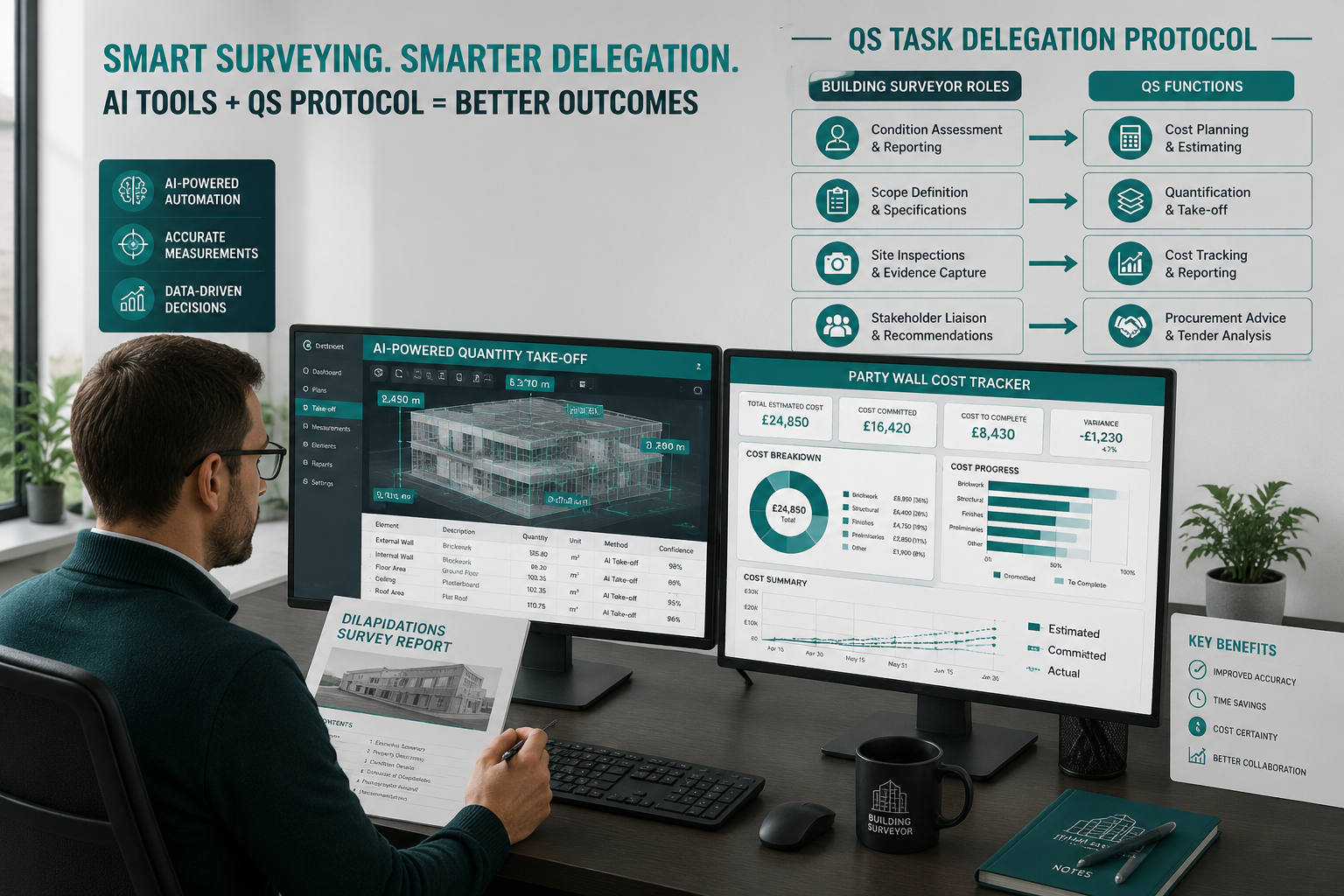
Firms with more than two surveyors should consider a formal delegation protocol:
- Senior building surveyor: Leads on condition assessment, schedule preparation, party wall award drafting, and client negotiation.
- Graduate or junior surveyor: Manages photographic records, schedule of condition documentation, and basic pricing using approved rate guides.
- External QS (on-call basis): Engaged for Tier 2 and Tier 3 cost validation only, reducing cost and availability dependency.
This structure allows a two-person team to handle roughly 40% more dilapidations and party wall instructions than a traditional model where every cost question is escalated to a QS.
Protecting RICS Standards Under Pressure
The QS shortage must not become a reason to compromise RICS professional standards. Firms should:
- Review PI cover to confirm it extends to cost advisory services provided within the building surveyor role.
- Maintain clear scope letters that define cost services as indicative, not certified cost plans.
- Refer complex matters — if a cost question genuinely exceeds competency, refer to a QS rather than attempt to answer it.
- Document all cost methodology — if a cost figure is later challenged, a clear audit trail of how it was derived is the primary defence.
RICS data confirms that firms are already turning work away due to inability to fulfil demand [6]. A structured approach to scope management is better than either turning away work or accepting instructions beyond competency.
Conclusion: Actionable Next Steps for Building Surveyor Firms in 2026
The QS shortage impact on building surveyor workloads is not a temporary inconvenience. With 349,000 net new workers needed in UK construction in 2026 [4], international competition for RICS-qualified talent intensifying [1], and specialist sectors pulling experienced QSs away from traditional roles, the pressure on building surveyors will continue to grow.
The firms that adapt successfully will be those that:
- Implement a tiered dilapidations protocol — handling routine cost assessments in-house and reserving QS collaboration for complex, high-value instructions.
- Strengthen party wall award drafting — incorporating explicit cost allocation clauses that reduce post-works disputes.
- Invest in digital take-off and pricing tools — reducing the time and QS input required for indicative cost schedules.
- Cross-skill strategically — focusing CPD on BCIS pricing, basic elemental cost analysis, and NEC4 awareness.
- Maintain rigorous scope management — protecting RICS standards and PI cover by clearly defining what cost services are and are not being provided.
- Build on-call QS relationships now — before the shortage deepens further, establish preferred supplier arrangements with QS consultants for Tier 2 and Tier 3 instructions.
The QS shortage is a structural challenge. The building surveyor response must be equally structural — not reactive, not ad hoc, but built into firm protocols, team structures, and CPD plans for 2026 and beyond.
References
[1] The Quantity Surveyor Shortage A Technical Outlook For 2026 – https://www.onboard-jobs.co.uk/resources/industry-news/the-quantity-surveyor-shortage-a-technical-outlook-for-2026
[2] Watch – https://www.youtube.com/watch?v=U8oCnx7DKqo
[3] Quantity Surveyor Shortage Crisis 2026 How Building Surveyors Can Adapt Service Delivery And Protect Project Margins – https://nottinghillsurveyors.com/blog/quantity-surveyor-shortage-crisis-2026-how-building-surveyors-can-adapt-service-delivery-and-protect-project-margins
[4] The Construction Labor Shortage In 2026 What Every Employer Needs To Know – https://thebluecollarrecruiter.com/the-construction-labor-shortage-in-2026-what-every-employer-needs-to-know/
[6] Recruitment Competition Skills Shortage – https://ww3.rics.org/uk/en/journals/construction-journal/recruitment-competition-skills-shortage.html