}
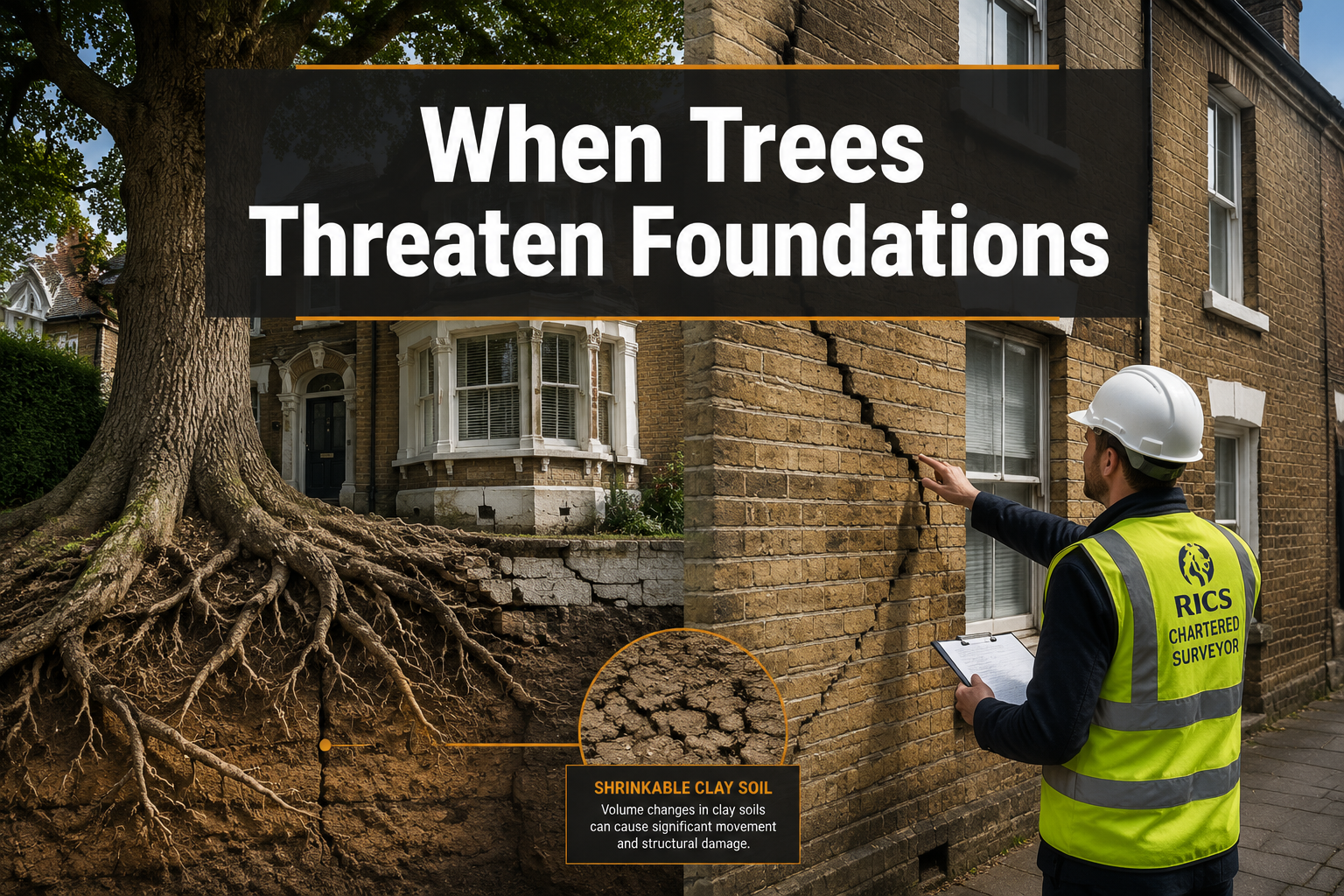
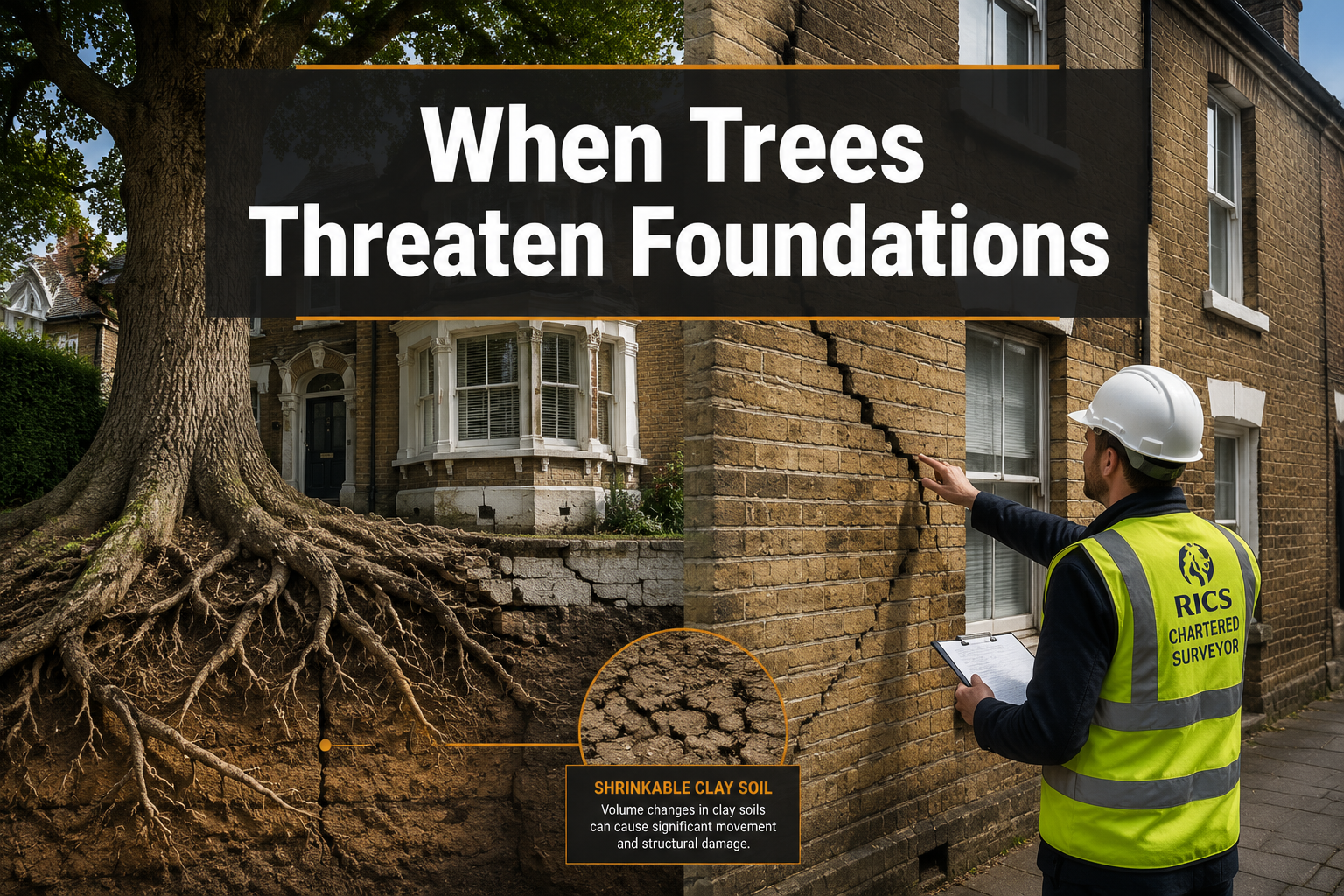
A Guardian investigation published in 2026 found that millions of homes across London, Essex and Kent are now at elevated risk of sinking, as climate change intensifies the drying cycles that cause shrinkable clay soils to contract beneath foundations [3]. Tree-related subsidence sits at the centre of this growing crisis, yet it remains one of the most misunderstood defects in residential surveying practice. This guide on When Trees Threaten Foundations: A Surveyor's Guide to Identifying, Reporting and Valuing Subsidence Risk in UK Homes sets out a structured, evidence-based approach for surveyors: how to identify genuine risk, how to report findings with appropriate nuance, and how to reflect that risk accurately in valuations.
Key Takeaways
- Tree-related subsidence is primarily a risk on shrinkable clay soils, not all ground types; soil classification is the first diagnostic step.
- High water-demand species such as willow, poplar and certain oaks within roughly 30 metres of a lightly-founded building represent the primary technical red flag.
- Most trees near buildings do not cause damage; the risk is specific to a combination of soil type, species, proximity and foundation depth.
- NHBC Chapter 4.2 guidance drives foundation depth requirements near trees on clay, often increasing the standard from approximately 1 metre to 2.5-3 metres.
- Surveyors must balance accurate risk reporting with measured language that avoids triggering unnecessary tree removal or mortgage collapse.
The Science Behind Tree-Related Subsidence on UK Clay Soils
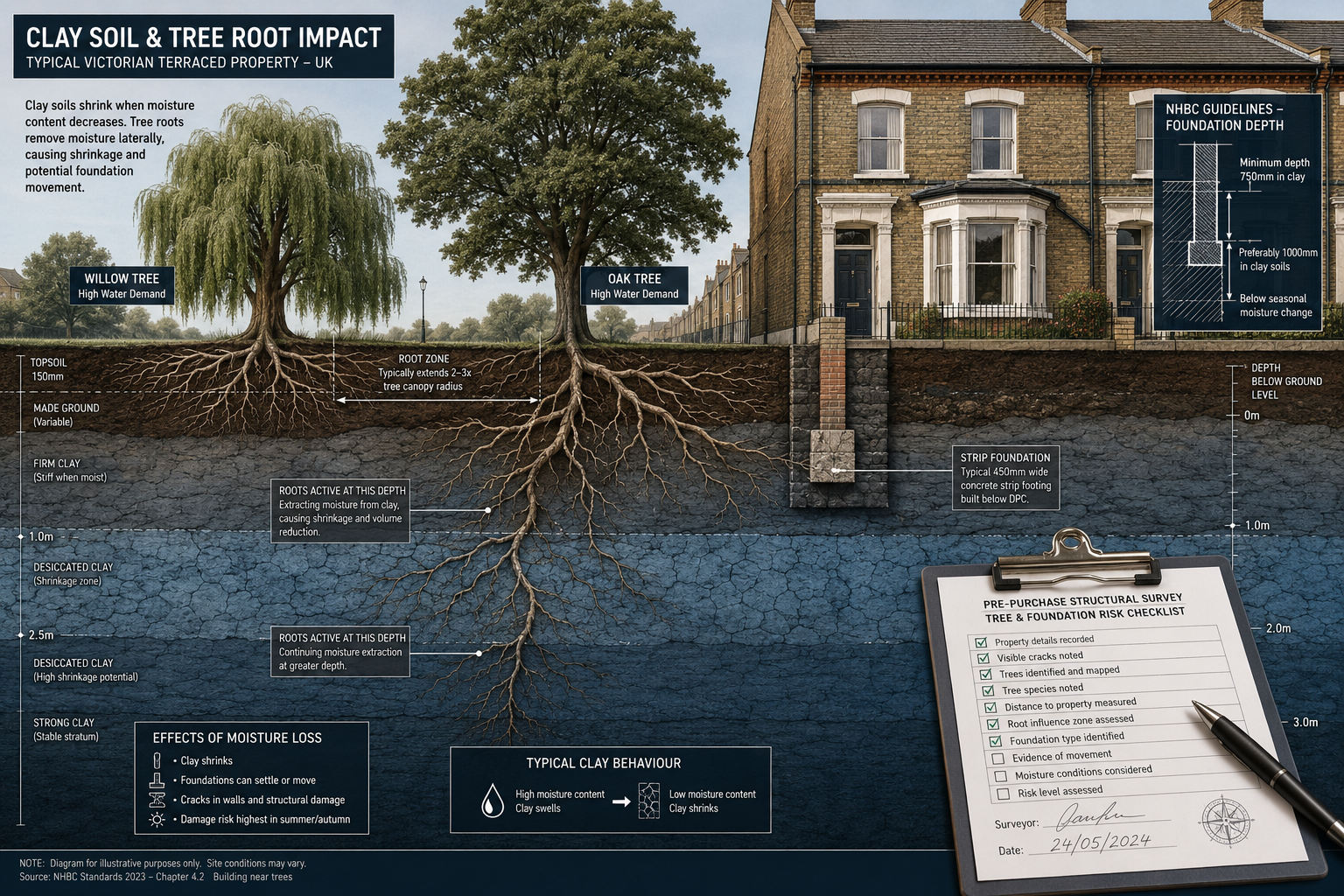
Understanding when trees threaten foundations begins with the soil, not the tree. Shrink-swell clay soils cover substantial parts of southern England, including much of Greater London, Essex, Kent and parts of the Midlands. These soils shrink as they dry out and swell when rewetted. During prolonged dry summers, the volume change can be dramatic enough to cause differential settlement beneath shallow foundations.
Trees accelerate this process through root water uptake. A mature oak can extract hundreds of litres of water from the soil each day during the growing season [1]. When that extraction occurs within the zone of influence of a building's foundations, the resulting soil shrinkage can cause uneven settlement, producing the characteristic cracking patterns that surveyors are trained to identify.
The UK Government's official guidance on property subsidence due to trees confirms that the majority of tree-related subsidence cases occur on clay soils, and sets out a structured assessment framework covering soil type, tree species, tree size and proximity, building age, foundation type and crack pattern analysis [2]. Surveyors who skip any of these steps risk both under-reporting and over-reporting risk.
The Role of Climate Change in Amplifying Risk
The risk is not static. Hotter, drier summers are extending the duration and intensity of soil desiccation events. The BBC has reported on how changing rainfall patterns are making subsidence episodes more frequent and more severe in clay-soil areas [5]. For surveyors working in 2026, this means that historical data on tree influence zones may understate current risk, and that properties which have performed adequately for decades may now be entering a period of heightened vulnerability.
High-Risk Species and Influence Zones
Not all trees carry equal risk. The Royal Horticultural Society and specialist arboricultural sources consistently identify the following species as high water-demand and therefore highest risk near buildings on clay [7]:
| Species | Typical Mature Height | Indicative Influence Radius |
|---|---|---|
| Willow (Salix spp.) | 15-25 m | Up to 40 m |
| Poplar (Populus spp.) | 20-30 m | Up to 40 m |
| Oak (Quercus spp.) | 15-25 m | Up to 30 m |
| Elm (Ulmus spp.) | 15-20 m | Up to 25 m |
| Ash (Fraxinus spp.) | 15-20 m | Up to 20 m |
Current practical guidance, including that applied in extension and new-build contexts, uses a 30-metre influence radius as a working benchmark for high-demand species on shrinkable clay [4]. Some sources note that certain species can cause damage from as far as 20 metres away even at moderate maturity [4]. Surveyors should treat these figures as indicative starting points rather than hard boundaries, always cross-referencing with observed crack patterns and soil data.
"The risk is specific to certain combinations of soil, species, distance and foundation design. This nuance must appear in survey reports."
How Surveyors Should Inspect and Report Tree-Related Subsidence Risk
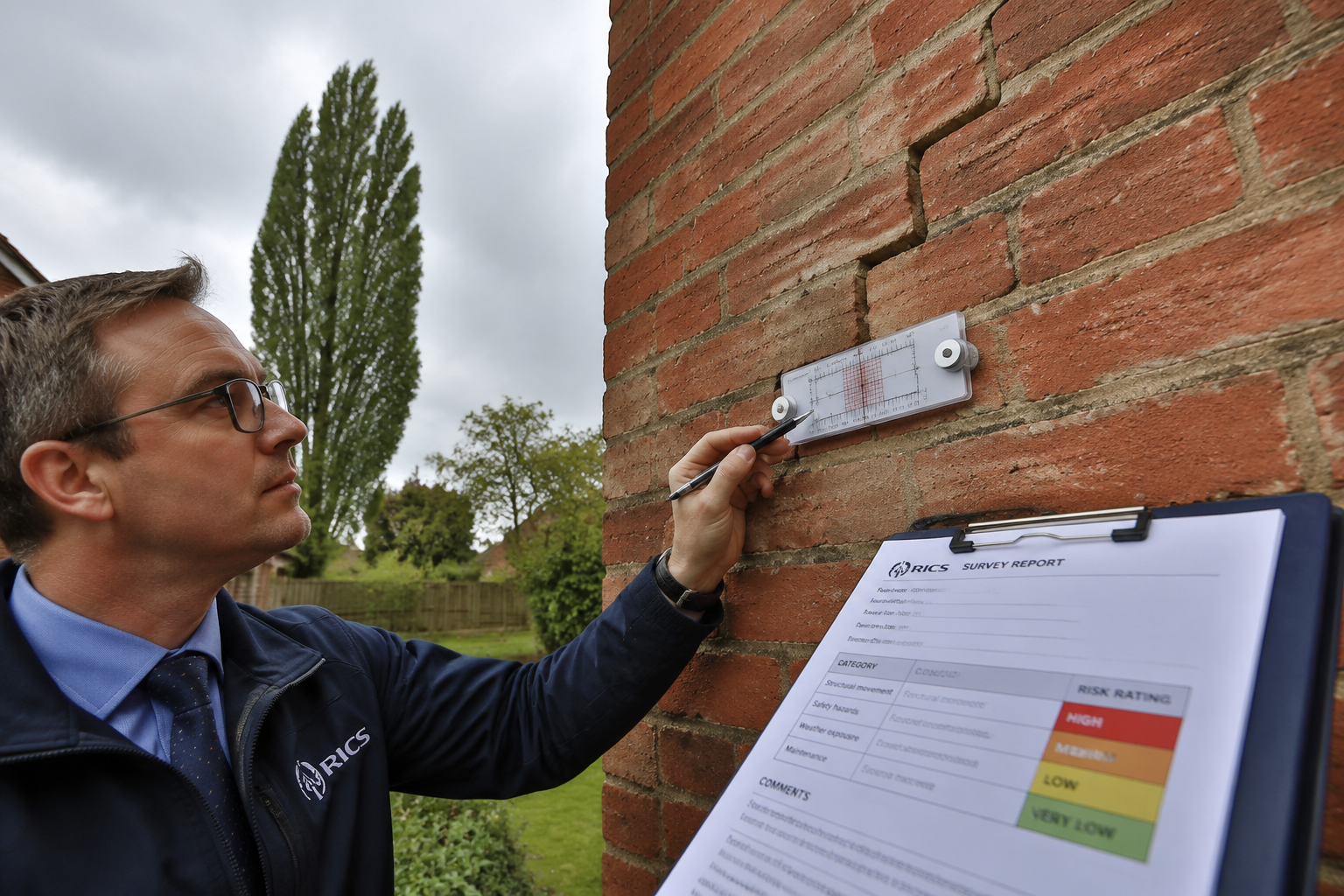
The inspection process for When Trees Threaten Foundations: A Surveyor's Guide to Identifying, Reporting and Valuing Subsidence Risk in UK Homes follows a logical sequence. Cutting corners at any stage undermines the reliability of the final report.
Step 1: Establish Soil Type
Before any tree assessment is meaningful, the surveyor must establish whether the site sits on shrinkable clay. Sources include:
- British Geological Survey (BGS) digital mapping
- Local authority planning records
- Visual inspection of exposed soil at drainage or inspection chamber openings
- Existing drainage or structural reports
A drainage survey can be invaluable here, since it may reveal both soil conditions and whether tree roots have already penetrated drainage runs, a common secondary indicator of root proximity.
Step 2: Identify Trees, Species and Proximity
The surveyor should record every tree within the relevant influence zone, noting:
- Species (or best estimate, with arboricultural referral recommended if uncertain)
- Estimated height and crown spread
- Distance from the nearest point of the building's foundations
- Whether the tree is protected by a Tree Preservation Order (TPO) or sits within a Conservation Area
The Tree Council's 2024 research highlights the social, cultural and environmental value of urban trees, reinforcing why blanket removal recommendations are rarely appropriate and may face planning resistance [9]. Surveyors who recommend felling without adequate justification expose themselves to professional criticism and may trigger unnecessary disputes.
Step 3: Assess Foundation Type and Depth
Older properties, particularly those built before 1950, are most vulnerable. Victorian and Edwardian houses typically have strip foundations at depths of 0.5-1 metre, well within the zone of soil moisture change on clay. NHBC Chapter 4.2 guidance, which remains the principal technical benchmark, requires foundation depths of 2.5-3 metres near high-demand species on highly plastic clay soils. The gap between what exists and what is now considered adequate is often significant.
For properties where foundation depth is uncertain, a solid floor slab survey or specialist structural investigation may be required to establish ground conditions before a definitive opinion can be given.
Step 4: Analyse Crack Patterns
Subsidence cracking has distinctive characteristics that differentiate it from thermal movement, settlement or other defect types:
- Diagonal cracking following mortar joints in a stair-step pattern, typically wider at the top
- Tapered cracks wider at one end, indicating differential movement
- Cracks at window and door corners, where stress concentrates
- Seasonal variation: cracks that open in summer and partially close in winter are a strong indicator of active clay shrinkage
Cracks should be measured, photographed and categorised using the BRE Digest 251 classification (Categories 0-5). Category 3 and above warrants urgent further investigation. A specialist defect survey or specific defect report is often the most appropriate vehicle for communicating findings at this level of complexity.
Step 5: Recommend Proportionate Further Investigations
Where risk is confirmed or strongly suspected, the surveyor should recommend a structured programme of further investigations rather than jumping to remediation. The stepped best-practice approach includes:
- Professional diagnosis by a structural engineer and arboriculturist
- Crack monitoring over at least one seasonal cycle
- Drainage inspection and repair (leaking drains can both exacerbate and mask subsidence)
- Arboricultural measures such as crown reduction or root barrier installation
- Underpinning or felling only where other measures are insufficient
This approach reflects the insurance and construction sector's growing recognition that premature tree removal is often unnecessary and can itself cause problems, including heave as soils rewet [6].
Reporting Language and Professional Duty
Survey reports must walk a careful line. Language that is too alarming can collapse a sale unnecessarily; language that is too cautious can expose the surveyor to negligence claims if damage worsens. Best practice in 2026 requires:
- Clear identification of the specific risk factors present
- Explicit statement that most trees near buildings do not cause damage
- Conditional recommendations tied to confirmed risk factors
- A clear recommendation for further specialist investigation where evidence warrants it
Surveyors considering which survey product is appropriate for a given property can refer to guidance on choosing the right property survey to ensure the scope of inspection matches the level of risk identified.
Valuing Subsidence Risk: How Tree Proximity Affects Property Value
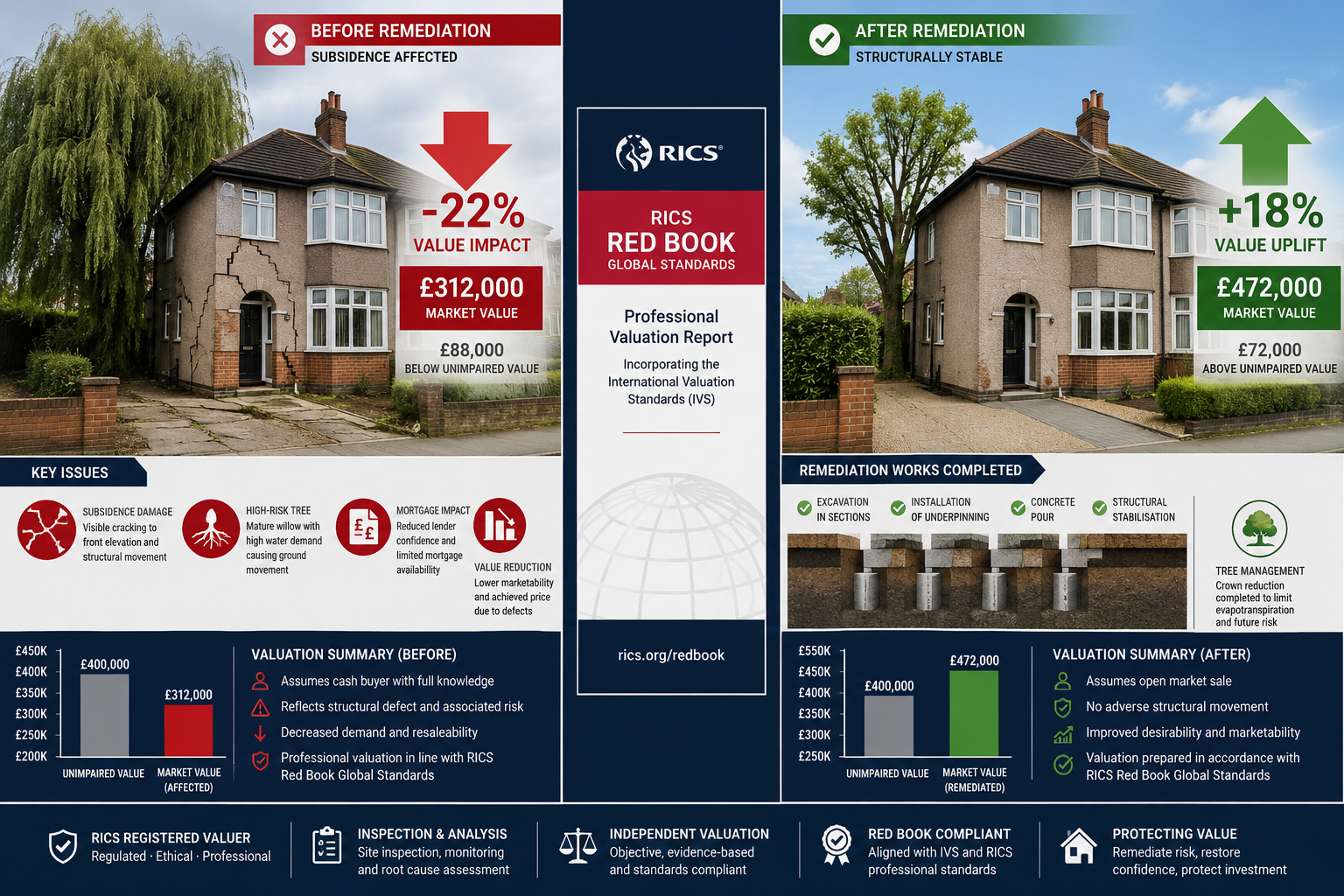
When Trees Threaten Foundations: A Surveyor's Guide to Identifying, Reporting and Valuing Subsidence Risk in UK Homes cannot be complete without addressing the valuation dimension. Confirmed or suspected tree-related subsidence has material implications for market value, mortgage lending and insurance.
Quantifying the Discount
There is no fixed formula for the subsidence discount, but surveyors and valuers consistently apply reductions based on the following factors:
- Stage of damage: Active, unmonitored subsidence warrants a larger discount than historic, stable movement
- Remediation cost: The cost of underpinning, drainage repair and arboricultural work must be reflected
- Insurability: Properties with a subsidence history may face higher premiums or exclusions, reducing buyer pool and therefore value
- Lender appetite: Some lenders will not advance on properties with active subsidence, effectively limiting the market to cash buyers
A property with confirmed active subsidence on clay, with a mature willow within 15 metres and no remediation history, might attract a discount of 20-40% relative to an equivalent undamaged property. Historic, monitored and stable subsidence with documented remediation may attract a much smaller adjustment of 5-15%, reflecting residual stigma rather than active risk.
Surveyors providing formal valuations in this context should ensure they are operating within the RICS Red Book framework. A Red Book valuation provides the evidential standard required by lenders, courts and insurers when subsidence risk is a material factor.
Party Wall and Excavation Considerations
Tree-related subsidence frequently intersects with party wall matters, particularly when remediation involves underpinning or deep excavation near a shared boundary. Under the Party Wall etc. Act 1996, excavation within 3 metres of a neighbouring structure to a depth below the neighbour's foundations triggers notice requirements. Surveyors advising on remediation programmes should be aware of the notice requirements for excavation near a neighbour to ensure clients are not inadvertently in breach.
Similarly, where a tree causing subsidence is on a neighbouring property, the legal and surveying position becomes more complex. The party wall three-metre rule and associated notice procedures may be relevant to any remediation strategy.
Insurance Reinstatement Considerations
Where subsidence has caused structural damage, the building's insurance reinstatement value may need to be reviewed. Standard reinstatement figures do not always account for the additional cost of deep foundations, specialist drainage and arboricultural management that subsidence remediation typically involves. An insurance reinstatement valuation carried out by a qualified surveyor ensures that the sum insured reflects the true cost of rebuilding to current standards, including any enhanced foundation specification required by the proximity of retained trees.
Surveys for Subsidence: Specialist Investigation
Where a standard Level 2 or Level 3 building survey raises concerns but cannot provide a definitive opinion, a dedicated survey for subsidence provides the depth of investigation needed. This typically involves trial pit excavation to establish foundation depth, soil sampling for plasticity index testing, and a coordinated report from both a structural engineer and an arboriculturist.
The cost of specialist investigation is modest relative to the financial consequences of purchasing a property with undiagnosed active subsidence. Surveyors should frame this recommendation clearly in their reports, with reference to the potential cost differential.
Conclusion
Tree-related subsidence is not a niche problem. With climate change intensifying soil desiccation cycles across southern England, the combination of mature trees, shrinkable clay and shallow Victorian foundations is producing an increasing volume of claims and disputes [3][5]. Surveyors who approach this risk with a structured, evidence-based methodology, covering soil type, species, proximity, foundation depth and crack pattern analysis, will produce reports that are both professionally defensible and genuinely useful to clients.
The key discipline is proportionality. Most trees near buildings do not cause damage [6]. Reports that conflate proximity with causation, or that recommend felling without adequate justification, do a disservice to clients, to the profession and to the urban tree canopy that provides measurable environmental and social value [9].
Actionable next steps for surveyors:
- Incorporate BGS soil mapping into every pre-inspection desktop review for properties in clay-soil areas
- Use the NHBC Chapter 4.2 species and distance tables as a starting framework, updated for current climate projections
- Recommend specialist subsidence surveys where Level 2 or Level 3 inspections identify confirmed risk factors
- Ensure valuation reports reflect both the remediation cost and the residual stigma discount using RICS Red Book methodology
- Advise clients on party wall notice obligations before any deep excavation or underpinning programme begins
For buyers, sellers and lenders navigating a property where trees and foundations are in close proximity, early engagement with a local chartered surveyor who understands the specific geology and tree stock of the area is the single most effective risk management step available.
References
[1] Warning Issued Anyone Oak Tree – https://www.express.co.uk/life-style/garden/2214500/warning-issued-anyone-oak-tree
[2] Property Subsidence Due To Trees – https://www.gov.uk/government/publications/property-subsidence-due-to-trees
[3] Millions Homes London Essex And Kent Sinking Climate Crisis Subsidence – https://www.theguardian.com/environment/2026/jun/11/millions-homes-london-essex-and-kent-sinking-climate-crisis-subsidence
[4] Trees That Can Damage Your Homes Foundation From 20 Metres Away – https://thenaturenetwork.co.uk/trees-that-can-damage-your-homes-foundation-from-20-metres-away/
[5] Clygjzp7mjeo – https://www.bbc.co.uk/news/articles/clygjzp7mjeo
[6] Trees Near Buildings Understanding The Risks And Managing Them Safely – https://harrisonclarke.co.uk/trees-near-buildings-understanding-the-risks-and-managing-them-safely/
[7] Near Buildings – https://www.rhs.org.uk/plants/types/trees/near-buildings
[9] Protecting Trees Of High Social Cultural And Environmental Value Final Report October 2024 V3.0 April 2025 – https://treecouncil.org.uk/wp-content/uploads/2025/04/Protecting-Trees-of-High-Social-Cultural-and-Environmental-Value_Final-Report_October-2024_v3.0-APRIL-2025.pdf