
}
Nearly one in three homebuyers who commission only a basic condition report later discover significant defects that a more detailed survey would have flagged — defects that cost an average of thousands of pounds to remedy. When the property in question shares a wall with a neighbour who is actively building, extending, or converting, the stakes rise considerably. Understanding the difference between survey levels, and knowing which RICS standard applies in 2026, is not a minor administrative detail. It is a financial safeguard.
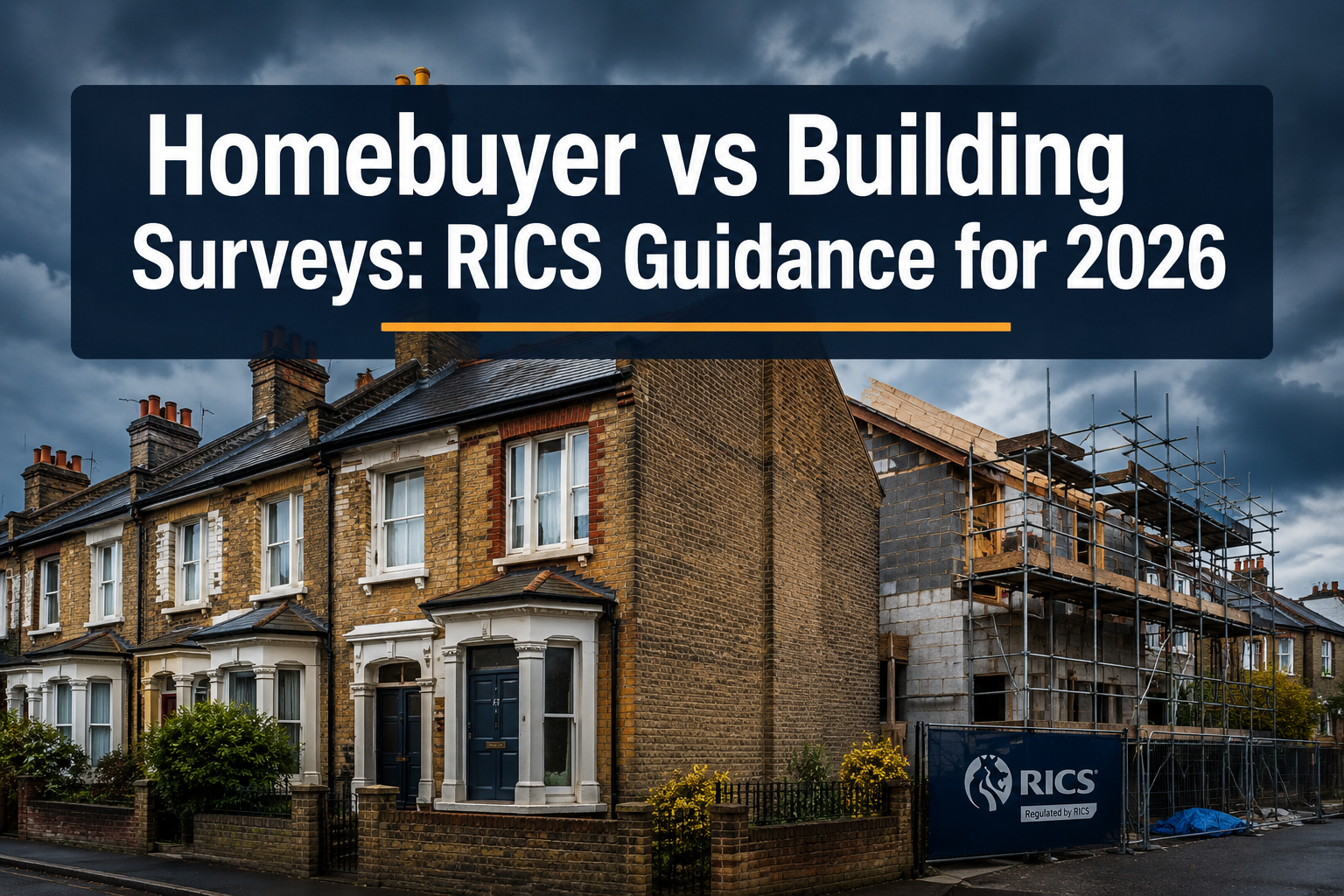
This article breaks down the key distinctions in Homebuyer vs Building Surveys: RICS Guidance for 2026 Properties with Party Wall Risks, explains how updated RICS standards affect the advice buyers receive, and clarifies when party wall considerations should drive the choice of survey level.
Key Takeaways
- The RICS Home Survey Standard 2nd Edition, published in May 2026, introduces clearer frameworks for properties with elevated risk profiles, including those affected by adjacent construction.
- A Level 2 HomeBuyer Report suits conventional properties in reasonable condition; a Level 3 Building Survey is recommended for older, altered, or non-standard properties.
- Party wall risks — including improperly served notices and disputed awards — significantly increase the complexity of any purchase and should influence the survey level chosen.
- The RICS 8th Edition Party Wall Guidance, currently in consultation, introduces updated procedural frameworks that buyers and their surveyors must understand in 2026.
- Approximately 70% of loft conversion disputes in urban terraced properties arise from failure to serve the correct Party Wall Act notice — a risk that a thorough survey can help identify early.
Understanding the Three RICS Survey Levels in 2026
The RICS Home Survey Standard 2nd Edition, published in May 2026, was developed with input from over 1,400 homeowners and 325 RICS members. It updates the 2019 standard and introduces more explicit guidance for what it terms "additional risk" dwellings — a category that now formally encompasses retrofit buildings, historic structures, and properties affected by neighbouring construction activity [1].
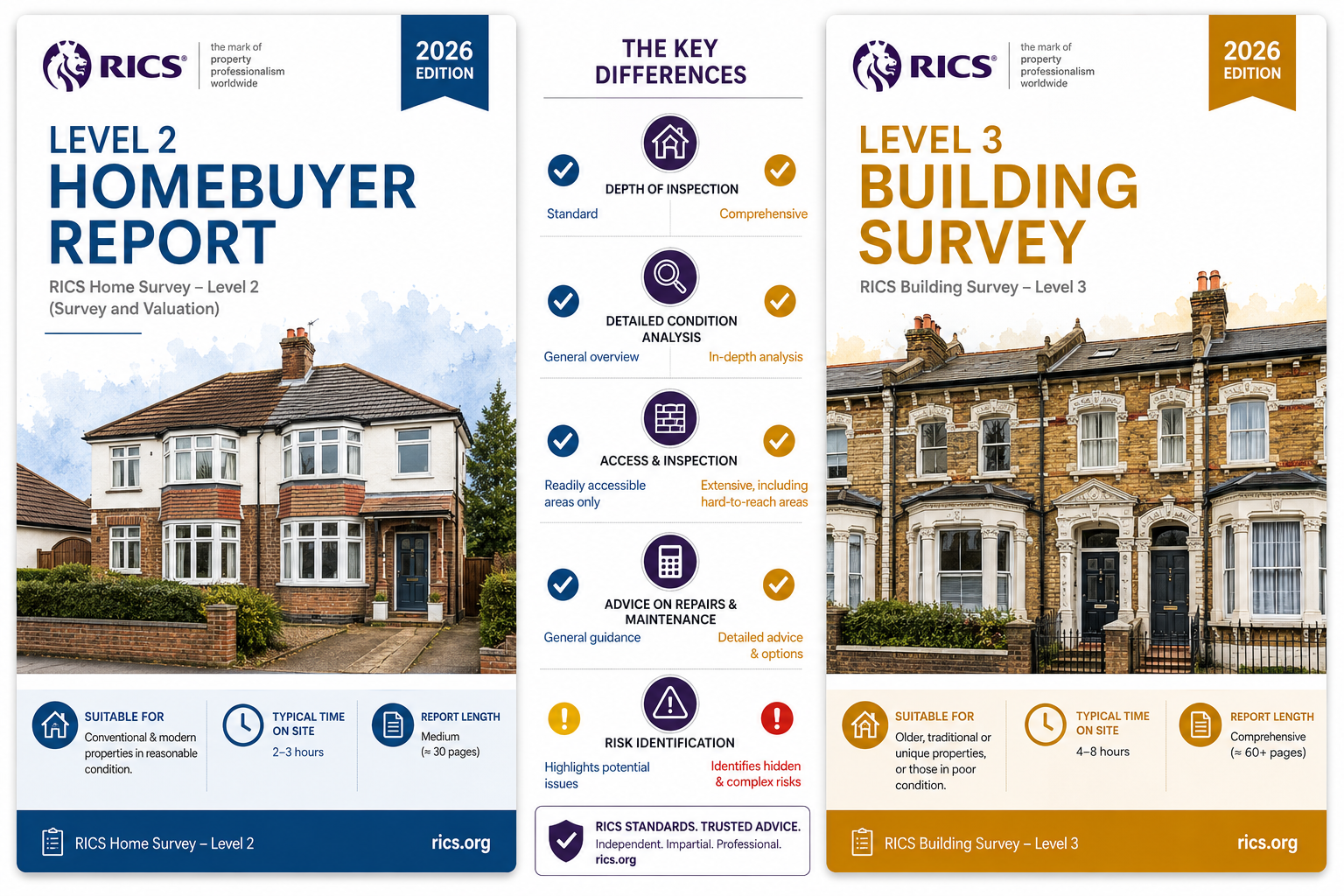
The three survey levels remain the foundation of the framework [2]:
| Survey Level | Name | Best Suited For |
|---|---|---|
| Level 1 | Condition Report | New builds or recently refurbished properties in good condition |
| Level 2 | HomeBuyer Report | Conventional properties in reasonable condition, no major alterations |
| Level 3 | Building Survey | Older, altered, non-standard, or high-risk properties |
Level 1: Condition Report
The Level 1 report provides a basic snapshot of a property's condition using a traffic-light rating system. It does not include advice on repairs, cost estimates, or detailed structural analysis. For most buyers considering a property with party wall exposure, this level is insufficient.
Level 2: HomeBuyer Report
The Level 2 HomeBuyer Report is the most commonly commissioned survey in England and Wales. It covers visible and accessible parts of the property, flags urgent defects, and includes a market valuation if requested. It is appropriate for properties built after roughly 1900 that have not been significantly altered and are in reasonable condition.
However, the Level 2 report has clear limitations. It does not include intrusive investigations, and it does not routinely assess the condition of shared walls in detail. For buyers purchasing a terraced or semi-detached property next to a neighbour who has recently completed — or is planning — a loft conversion, extension, or basement excavation, this level may leave critical risks unexamined.
You can explore the full scope of RICS home survey options to understand which level fits your property type.
Level 3: Building Survey
The Level 3 Building Survey is the most comprehensive residential survey available. It covers all accessible areas, includes advice on defects, repair options, and maintenance, and provides detailed commentary on structural elements — including party walls, foundations, and roof structures. For properties with known or suspected party wall risks, this is the survey level that RICS guidance strongly supports [2].
"A Level 3 Building Survey is not just for old houses. It is for any property where the buyer needs a full picture — and that includes properties where neighbouring works have altered the shared structure."
For a detailed comparison of these options, the difference between Level 2 and Level 3 surveys is worth reviewing before instructing a surveyor.
Party Wall Risks and the 2026 RICS Guidance Update
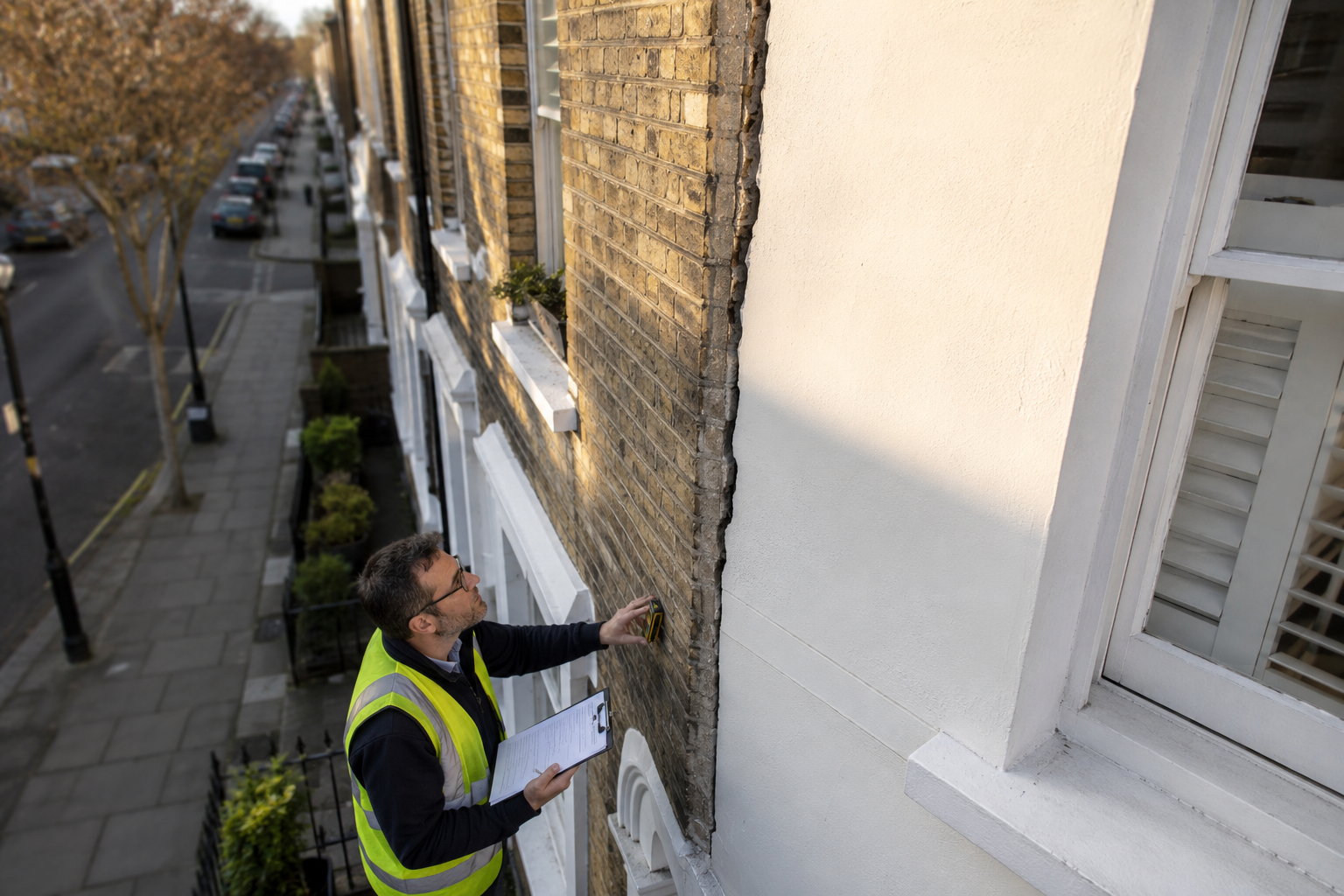
Party wall matters sit at the intersection of property law, structural engineering, and neighbourly relations. The Party Wall etc. Act 1996 governs works to shared walls, boundary walls, and excavations near neighbouring buildings in England and Wales. Despite being nearly three decades old, the Act is frequently misapplied — and the consequences for buyers who do not identify this risk before exchange can be severe.
The RICS 8th Edition Party Wall Guidance
In April 2026, RICS launched an eight-week consultation on the draft 8th edition of its guidance document "Party Wall Legislation and Procedure." This update addresses persistent professional failures, including:
- Improperly served party wall notices
- Awards challenged on jurisdictional grounds
- Disputed fee practices among appointed surveyors
- Inconsistent documentation standards [3]
The 8th edition introduces updated documentation templates, revised conduct guidelines, and a clearer procedural framework for surveyors acting under the Act [4]. Crucially, it reinforces that a party wall surveyor's appointment is personal and statutory — meaning the surveyor acts independently of client instruction once appointed, and any award produced outside proper jurisdiction is vulnerable to legal challenge [3].
For buyers, this matters in a practical sense: if the seller's neighbour carried out works without serving proper notice, or if a party wall award was produced by a surveyor acting without jurisdiction, the structural integrity of the shared wall may be uncertain — and the legal position unresolved.
Why Buyers Face Elevated Risk in 2026
The combination of increased urban densification, the ongoing popularity of loft conversions, and the growing number of basement excavations in city areas means that party wall exposure is more common than ever. Research cited in connection with the 8th edition consultation indicates that approximately 70% of loft conversion disputes in urban terraced properties arise from failure to serve the correct Party Wall Act notice [5].
When a buyer is purchasing a property where:
- The neighbour has recently completed a loft conversion
- An adjacent property is mid-way through a basement dig
- The shared wall shows signs of cracking or movement
- No party wall agreement documentation can be produced
…the case for commissioning a Level 3 Building Survey becomes compelling. A Level 2 report will not provide the depth of structural analysis needed to assess whether party wall works have caused damage, or whether latent defects exist that could become the buyer's liability after completion.
Understanding the full scope of party wall obligations before purchase is essential for any buyer in this position.
Loft Conversions: A Specific Warning
Loft conversions are among the most common triggers for party wall disputes in terraced and semi-detached properties. Works that involve cutting into a shared wall, raising a party wall, or installing steel beams that bear on a shared structure all require formal notice under the Act [5].
If a seller cannot produce a party wall award or a signed agreement from the time the loft was converted, buyers should treat this as a red flag. The party wall guidance for loft conversions explains what documentation should exist and what questions to ask before proceeding.
Excavation Near Neighbouring Buildings
Basement conversions and deep excavations within three to six metres of a neighbouring structure trigger separate notice requirements under the Act. If the property being purchased is adjacent to a property where such works occurred — or are planned — a surveyor needs to assess whether the foundations have been affected. This is another scenario where a Level 3 survey, potentially supplemented by a drainage survey or structural investigation, is warranted.
Choosing the Right Survey: Practical Guidance for 2026 Buyers Facing Party Wall Risks
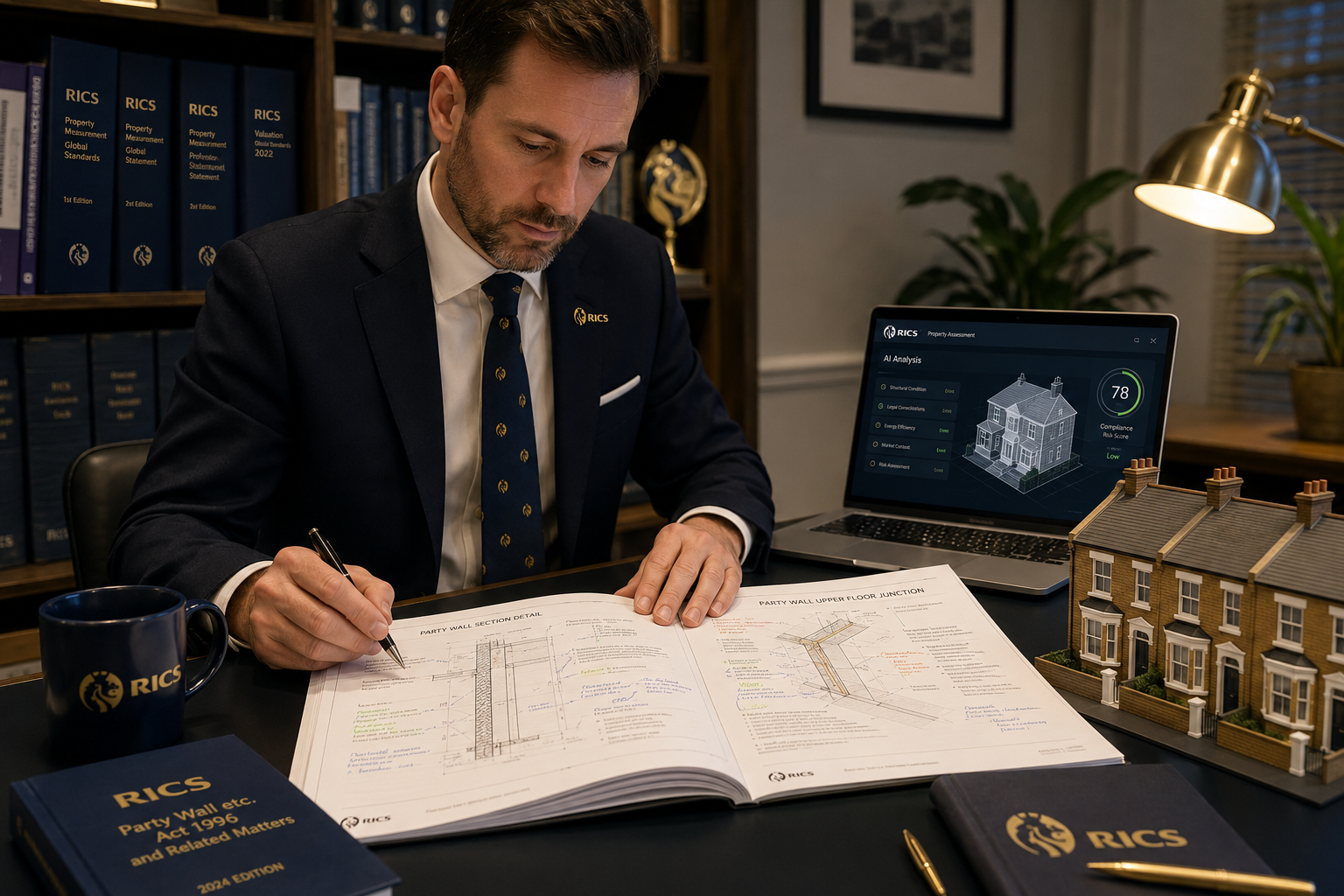
The question of Homebuyer vs Building Surveys: RICS Guidance for 2026 Properties with Party Wall Risks ultimately comes down to a risk-weighted decision. The following framework helps buyers make that call.
Step 1: Assess the Property Profile
Ask these questions before instructing a surveyor:
- Is the property terraced, semi-detached, or part of a converted building?
- Was it built before 1950?
- Has it been extended, altered, or converted at any point?
- Is there visible cracking on external walls, particularly near the party wall line?
- Is the neighbouring property currently undergoing works?
- Can the seller produce party wall documentation for any previous works?
If the answer to two or more of these questions is "yes" or "unknown," a Level 3 Building Survey is the appropriate choice. The RICS Level 3 Building Survey provides the depth of investigation these scenarios demand.
Step 2: Understand What the Survey Will and Will Not Cover
Even a Level 3 Building Survey has limitations. It is a visual, non-intrusive inspection. It will not open up walls, excavate foundations, or test hidden services. Where a surveyor identifies specific concerns — such as suspected movement in a party wall, or signs of damp near a shared chimney breast — they will recommend further specialist investigation.
This is where additional services become relevant. The 2026 RICS Home Survey Standard explicitly provides guidance on supplementary investigations, including technology-assisted inspections using AI-supported analysis and drone surveys for hard-to-access areas such as rooflines and chimney stacks [1]. For properties where roof-level party wall conditions are a concern, a roof survey may be instructed alongside the main survey.
Step 3: Verify Party Wall Compliance Before Exchange
A survey identifies physical condition. It does not resolve legal compliance issues. Buyers should, in parallel with commissioning their survey, ask the seller's solicitor to produce:
- Copies of any party wall notices served or received
- Signed party wall agreements or awards
- Structural engineer sign-off for any loft conversion, extension, or basement works
If this documentation is absent, buyers should understand what happens when no party wall agreement exists and what remedies are available.
Step 4: Factor Survey Findings into Valuation and Negotiation
A Level 3 Building Survey that identifies party wall defects — whether caused by neighbouring works or by the property's own construction history — provides a basis for price negotiation. Repair costs identified in the report can be used to renegotiate the purchase price or to require the seller to remedy defects before completion.
Buyers who commission only a Level 2 report and later discover party wall damage after moving in have limited recourse. The survey report will typically note that the inspection was visual and non-intrusive, and that further investigation was recommended. Acting on those recommendations before exchange is the buyer's responsibility.
Technological Advances in 2026 Surveys
The 2026 RICS Home Survey Standard's incorporation of technology-assisted inspection methods is a meaningful development for properties with party wall risks. AI-supported analysis can help surveyors identify crack patterns and movement indicators that might be missed in a standard visual inspection. Drone surveys provide access to chimney stacks, parapet walls, and roof junctions that are otherwise inaccessible [1].
These tools do not replace professional judgment, but they do extend the range of evidence available to the surveyor — and by extension, to the buyer.
When to Instruct a Party Wall Surveyor Separately
A building survey and a party wall survey serve different purposes. A building survey assesses the condition of the property being purchased. A party wall surveyor is appointed to administer the statutory process under the Party Wall etc. Act 1996 — either to serve notice on behalf of a building owner, or to act as an agreed or appointed surveyor in a dispute.
Buyers do not typically instruct a party wall surveyor as part of the purchase process. However, if the buyer intends to carry out works after purchase that will affect a shared wall, they will need to serve notice and potentially appoint a party wall surveyor. Understanding the costs associated with party wall matters early in the process avoids surprises later.
If the property being purchased is already subject to an active party wall dispute — for example, if the seller is in the middle of a dispute with a neighbour over ongoing works — buyers should treat this as a material risk and seek specialist advice before proceeding.
Conclusion
The choice between a HomeBuyer Report and a Building Survey is not simply a question of cost versus thoroughness. In 2026, with updated RICS standards explicitly addressing elevated-risk properties and a new party wall guidance framework under consultation, buyers have both better tools and clearer professional obligations to navigate.
For buyers facing party wall risks, the actionable steps are:
- Commission a Level 3 Building Survey for any terraced, semi-detached, or altered property where party wall exposure is possible.
- Request all party wall documentation from the seller's solicitor before exchange.
- Ask the surveyor to comment specifically on the condition of shared walls, party wall junctions, and any evidence of movement or previous works.
- Where the survey flags concerns, instruct specialist investigations — structural engineering, drainage, or drone surveys — before committing to purchase.
- Use the survey findings as a basis for informed price negotiation, not just as a post-purchase record.
Working with local chartered surveyors who understand the specific building stock and planning history of the area adds further value — particularly in urban areas where party wall activity is frequent and documentation is often incomplete.
The 2026 RICS guidance framework gives buyers and their surveyors the tools to make well-informed decisions. The responsibility is to use them.
References
[1] Home Survey Standards – https://www.rics.org/profession-standards/rics-standards-and-guidance/sector-standards/building-surveying-standards/home-surveys/home-survey-standards?utm_source=openai
[2] Home Surveys – https://www.rics.org/profession-standards/rics-standards-and-guidance/sector-standards/building-surveying-standards/home-surveys?utm_source=openai
[3] Rics Launches Consultation On Updated Party Wall Practice Guidance – https://www.rics.org/news-insights/rics-launches-consultation-on-updated-party-wall-practice-guidance?utm_source=openai
[4] Rics 8th Edition Party Wall Guidance 2026 Implementation Challenges And Surveyor Compliance Strategies – https://wimbledonsurveyors.com/rics-8th-edition-party-wall-guidance-2026-implementation-challenges-and-surveyor-compliance-strategies/?utm_source=openai
[5] Party Wall Surveys For Loft Conversions In 2026 Rics 8th Edition Protocols For Structural Notifiability And Neighbour Protections – https://nottinghillsurveyors.com/blog/party-wall-surveys-for-loft-conversions-in-2026-rics-8th-edition-protocols-for-structural-notifiability-and-neighbour-protections?utm_source=openai
[6] Rics Consumer Guide Party Walls – https://www.ricsfirms.com/residential/legal-issues/party-walls/rics-consumer-guide-party-walls/?utm_source=openai