
The Building Safety Levy exemption threshold has doubled to 50 homes under 2026's National Planning Policy Framework (NPPF) changes, fundamentally altering the economics of small and medium-sized development projects across the UK[1]. This single policy shift transforms how RICS-accredited surveyors must approach valuation surveys for properties with development potential, particularly when navigating the complex interplay between permitted development rights (PDR), site constraints, and emerging planning reforms.
Valuation Surveys for Properties with Development Potential: RICS Appraisals Maximising Uplift in 2026 Planning Reforms represent a critical intersection of technical surveying expertise, regulatory knowledge, and financial analysis. As market conditions show signs of recovery—with new buyer enquiries improving for three consecutive months through January 2026[3]—property owners and developers need sophisticated appraisal methodologies that accurately capture uplift potential while accounting for physical constraints like party walls, structural defects, and site-specific limitations.
Key Takeaways
- Residual valuation methods form the foundation for assessing development potential, calculating uplift by subtracting total development costs from projected Gross Development Value (GDV)
- 2026 planning reforms including Building Safety Levy exemptions and relaxed Biodiversity Net Gain requirements significantly improve feasibility for small-scale developments
- Site constraints such as party walls, structural defects, and access limitations require specialist assessment to avoid overvaluing development potential
- Regional disparities create vastly different uplift scenarios, with Manchester recording 8.2% year-on-year value growth compared to stagnant southern markets[2]
- RICS standards now incorporate ESG factors, building safety considerations, and geospatial technology for more accurate development appraisals[6]
Understanding Residual Valuation Methods for Development Potential
The Residual Valuation Framework
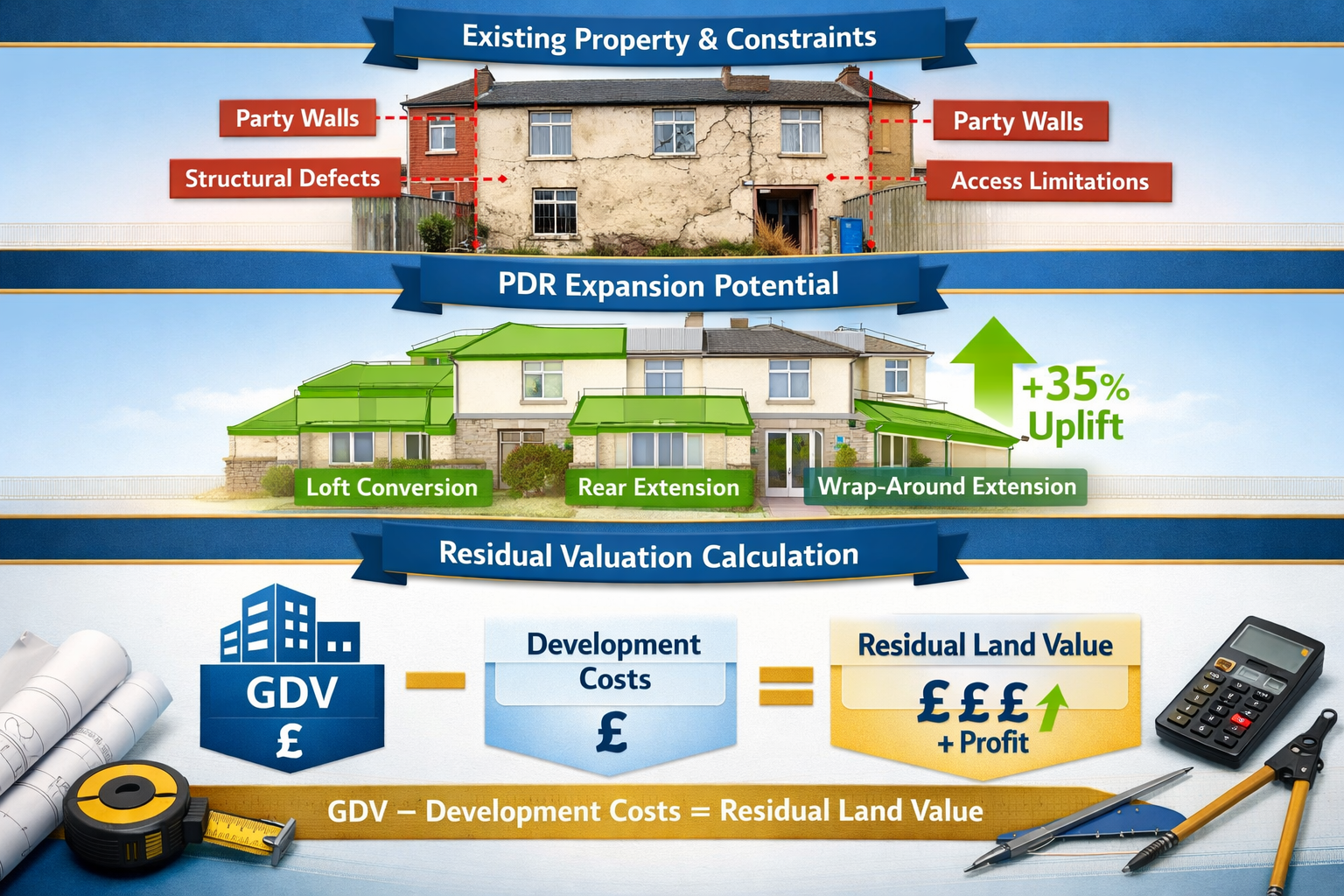
Residual valuation remains the cornerstone methodology for assessing properties with development potential. This approach works backwards from the Gross Development Value (GDV)—the estimated market value of the completed development—by subtracting all development costs, professional fees, finance charges, and developer's profit to arrive at the residual land value.
The basic formula follows this structure:
Residual Land Value = GDV – (Construction Costs + Professional Fees + Finance Costs + Marketing Costs + Developer's Profit + Contingency)
For properties with PDR expansion potential, RICS-accredited surveyors must carefully calibrate each component. Construction costs for loft conversions typically range from £1,200-£2,000 per square meter, while rear extensions cost £1,500-£2,500 per square meter depending on specification and regional variations.
Calculating Uplift in Constrained Markets
The 2026 planning reforms create new opportunities for maximising uplift, particularly in constrained urban markets where land availability is limited. The "default yes" policy for applications near railway stations[1] significantly enhances development potential for strategically located properties, potentially adding 15-25% to residual valuations in these zones.
When conducting valuation surveys for development potential, surveyors must assess:
- Existing use value (baseline property worth)
- Hope value (premium for development potential)
- Marriage value (additional value from combining development rights with land ownership)
- Constraint deductions (reductions for physical or legal limitations)
Professional commercial property surveyors increasingly utilize geospatial technology to model development scenarios, integrating planning policy layers, environmental constraints, and market comparables into three-dimensional valuation models[1].
Sensitivity Analysis and Risk Assessment
Given the volatility in construction costs and planning timelines, robust sensitivity analysis is essential. RICS guidance recommends testing residual valuations against multiple scenarios:
| Variable | Optimistic Scenario | Base Case | Pessimistic Scenario |
|---|---|---|---|
| GDV variance | +10% | Baseline | -15% |
| Construction cost | -5% | Baseline | +20% |
| Timeline | 12 months | 15 months | 24 months |
| Planning success | 95% | 80% | 60% |
This approach helps property owners and developers understand the range of potential outcomes rather than relying on single-point estimates that may prove unrealistic.
Navigating Site Constraints: Party Walls, Defects, and Physical Limitations
Party Wall Considerations in Development Valuations
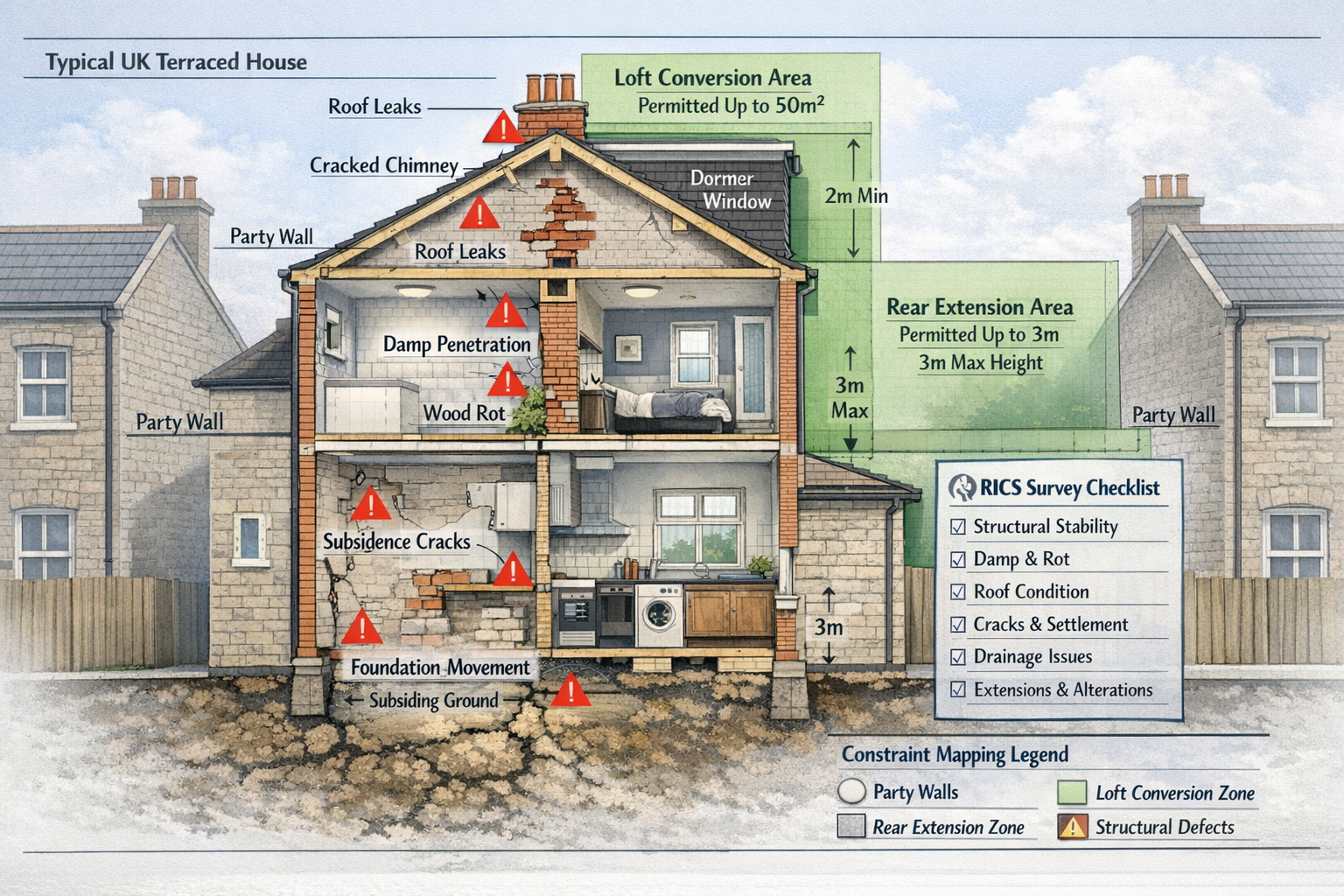
Party walls present both opportunities and constraints for properties with development potential. Under the Party Wall Act 1996, any work affecting shared walls requires formal notices and potentially agreements with adjoining owners, adding time, cost, and uncertainty to development projects.
When assessing uplift potential for terraced or semi-detached properties, RICS surveyors must factor in:
- Party wall surveyor fees (typically £700-£1,500 per neighbour)
- Potential neighbour objections (can delay projects 3-6 months)
- Structural reinforcement requirements for load-bearing walls
- Access limitations if neighbour consent is required
The 2026 reforms do not alter Party Wall Act requirements, meaning these constraints remain a significant consideration in development feasibility studies. Properties with complex party wall situations may see their development uplift reduced by 10-20% compared to detached properties with equivalent PDR potential.
Structural Defects and Their Impact on Development Viability
Existing structural defects can dramatically affect development potential valuations. A property with subsidence issues, for example, may require £15,000-£50,000 in remedial works before development can commence, directly reducing the residual land value.
Critical defects that impact development appraisals include:
- Subsidence and settlement 🏚️ (requires underpinning before extension work)
- Damp penetration 💧 (must be resolved to meet Building Regulations)
- Roof structural issues (affects loft conversion feasibility)
- Inadequate foundations (may require upgrading for additional loads)
- Electrical and plumbing obsolescence (increases refurbishment costs)
A comprehensive RICS home survey or Level 2 homebuyer survey should precede any development potential valuation to identify these constraints accurately. For properties with known issues, a specific defect report provides detailed analysis of remediation costs.
Access and Site-Specific Constraints
Physical access limitations can render otherwise viable development projects uneconomical. Narrow side passages, restricted street access, or conservation area restrictions may prevent machinery access, increasing construction costs by 30-50% due to manual handling requirements.
The 2026 planning reforms' relaxation of Biodiversity Net Gain (BNG) requirements for small sites[1] removes one constraint that previously affected many residential development projects, potentially improving viability by £5,000-£15,000 per project through reduced ecological assessment and mitigation costs.
Maximising Uplift Under 2026 Planning Reforms

Leveraging Building Safety Levy Exemptions
The expansion of Building Safety Levy exemptions to developments of up to 50 homes represents a significant cost saving for small and medium-sized developers[1]. Previously, the threshold stood at just 10 homes, meaning many modest development projects faced additional levy costs that eroded viability.
For a typical 25-unit residential conversion or new-build project, this exemption saves approximately £125,000-£250,000 (assuming £5,000-£10,000 per unit levy), directly increasing the residual land value and making marginal sites economically viable.
RICS valuers conducting development appraisals in 2026 must incorporate this policy change into their financial models, particularly when assessing:
- Larger residential properties suitable for conversion to multiple units
- Commercial-to-residential conversions under PDR
- Brownfield sites with capacity for small-scale housing developments
- Estate redevelopment opportunities in suburban locations
Permitted Development Rights Optimization
The current PDR framework allows significant extensions without full planning permission, including:
- Single-storey rear extensions up to 6 meters (terraced/semi-detached) or 8 meters (detached)
- Loft conversions with specified height and volume allowances
- Commercial-to-residential conversions (Class MA for offices, Class M for retail)
Strategic PDR optimization requires understanding the cumulative impact of multiple permitted works. A property might gain 40-60 square meters through combined rear extension and loft conversion, potentially adding £80,000-£180,000 to GDV in high-value markets (assuming £2,000-£3,000 per square meter).
However, the "default yes" policy near railway stations[1] suggests that properties in these locations may benefit from pursuing full planning applications for more ambitious schemes rather than limiting themselves to PDR, as approval likelihood has increased substantially.
Regional Variations in Development Potential
The widening north-south divide creates dramatically different uplift scenarios across UK regions. Manchester's 8.2% year-on-year growth[2] compared to flat or declining values in parts of southern England means identical development projects yield vastly different returns.
A commercial building survey in Manchester might reveal development potential worth pursuing at lower GDV thresholds than equivalent projects in oversupplied southern markets. Regional factors affecting development viability include:
- Local construction cost variations (up to 25% difference between regions)
- Planning authority efficiency (approval timelines vary 6-18 months)
- Market absorption rates (affects holding costs and finance charges)
- Comparable evidence density (more data improves valuation accuracy)
Technology-Enhanced Development Appraisals
The integration of geospatial technology and data analytics transforms how RICS surveyors assess development potential in 2026[1]. Modern Red Book valuations for development properties now incorporate:
- 3D site modeling from drone survey data
- Planning policy overlay mapping showing constraints and opportunities
- Automated comparable analysis using AI-enhanced databases
- Climate risk assessment for ESG compliance[6]
- Infrastructure proximity analysis (distance to stations, schools, amenities)
These technological advances enable more accurate uplift calculations by reducing uncertainty in key variables. A surveyor can now model multiple development scenarios within hours rather than days, testing sensitivity to different design approaches, material specifications, and planning outcomes.
ESG and Building Safety Integration
The April 2026 updates to RICS Home Survey Standards address government reforms on leasehold and commonhold issues[4], reflecting the profession's adaptation to evolving regulatory requirements. For development valuations, this means incorporating:
- Future-proofed building safety standards (anticipating regulatory changes)
- Energy efficiency requirements (EPC ratings affect marketability and value)
- Sustainable construction methods (may increase costs but enhance GDV)
- Supply chain resilience (material availability affects timeline and cost)
Properties with development potential must be assessed not just on current compliance but on their ability to meet emerging standards that will apply when development completes. This forward-looking approach prevents overvaluation of schemes that may face regulatory obstacles during construction.
Practical Implementation for Property Owners and Developers
When to Commission a Development Potential Valuation
Property owners should consider professional development appraisals when:
- Purchasing a property with obvious extension or conversion potential
- Refinancing to unlock equity for development works
- Planning estate succession where development uplift affects inheritance tax
- Considering sale vs. develop decisions for investment properties
- Negotiating lease extensions where development potential affects marriage value
A capital gains tax valuation incorporating development potential can significantly reduce tax liability by establishing a higher baseline value, particularly relevant for properties acquired before recent planning reforms enhanced their potential.
Selecting the Right RICS Surveyor
Not all surveyors possess equivalent expertise in development valuations. When selecting a professional for Valuation Surveys for Properties with Development Potential: RICS Appraisals Maximising Uplift in 2026 Planning Reforms, prioritize those with:
- RICS accreditation in valuation (MRICS or FRICS designation)
- Local market knowledge (regional variations are substantial)
- Planning expertise (understanding of PDR and local authority policies)
- Construction cost experience (accurate build cost estimation is critical)
- Technology capabilities (modern tools improve accuracy)
The price of valuation services varies based on complexity, but development potential appraisals typically cost £800-£2,500 depending on property size, location, and the sophistication of analysis required.
Integrating Valuations with Development Strategy
A development potential valuation should inform but not dictate strategy. The optimal approach considers:
- Phased development (spreading risk and capital requirements)
- Market timing (improving conditions through 2026 favor delayed projects[3])
- Alternative use scenarios (commercial vs. residential outcomes)
- Exit strategy flexibility (sell with planning vs. develop and sell)
For properties with complex constraints like significant structural defects or challenging party wall situations, the valuation might reveal that modest improvements (addressing defects without major development) yield better risk-adjusted returns than ambitious extension projects.
Monitoring Policy Changes and Market Conditions
The 2026 planning reforms represent a snapshot in an evolving regulatory landscape. Property owners with development potential should:
- Subscribe to RICS updates on valuation standards and planning policy
- Monitor local authority planning decisions (approval rates indicate policy interpretation)
- Track construction cost indices (volatility affects project viability)
- Review market comparables quarterly (GDV assumptions require regular updating)
The improving trajectory of buyer demand—with enquiries recovering from -29% in November to -15% by January 2026[3]—suggests strengthening market conditions that may enhance development project viability over the coming months.
Conclusion
Valuation Surveys for Properties with Development Potential: RICS Appraisals Maximising Uplift in 2026 Planning Reforms demand sophisticated integration of residual valuation methodology, site constraint analysis, and regulatory knowledge. The Building Safety Levy exemption expansion, relaxed Biodiversity Net Gain requirements, and "default yes" policy near railway stations create tangible opportunities for property owners to unlock substantial value through strategic development.
However, maximizing uplift requires realistic assessment of site-specific constraints. Party walls, structural defects, and access limitations can quickly erode theoretical development potential if not properly evaluated. RICS-accredited surveyors equipped with modern geospatial technology and comprehensive market knowledge provide the expert analysis necessary to distinguish genuinely viable opportunities from overoptimistic projections.
Actionable Next Steps
For property owners seeking to capitalize on development potential:
- Commission a comprehensive structural survey to identify defects requiring remediation before development
- Engage a RICS-accredited valuer with specific development appraisal experience in your region
- Request sensitivity analysis showing uplift potential across multiple scenarios
- Obtain preliminary planning advice from local authorities to validate assumptions
- Consider phased approaches that allow market testing before committing full capital
For developers evaluating acquisition opportunities:
- Prioritize properties near railway stations to leverage favorable planning policies
- Focus on schemes under 50 homes to maximize Building Safety Levy exemption benefits
- Factor regional variations into investment criteria—northern markets show stronger growth trajectories
- Integrate ESG considerations early to future-proof developments against emerging regulations
- Utilize technology-enhanced due diligence to accelerate decision-making and improve accuracy
The convergence of planning reform, market recovery, and technological advancement creates a uniquely favorable environment for development-focused property investment in 2026. Success requires rigorous professional appraisal that balances optimism about regulatory changes with realism about site constraints and market conditions.
References
[1] Mapping The Future The Top 3 Factors Affecting The Built Environment In 2026 – https://www.landmark.co.uk/news-insights/blog/mapping-the-future-the-top-3-factors-affecting-the-built-environment-in-2026/
[2] Navigating Widening North South Valuation Divides In 2026 Rics Techniques For Accurate Property Appraisals – https://nottinghillsurveyors.com/blog/navigating-widening-north-south-valuation-divides-in-2026-rics-techniques-for-accurate-property-appraisals
[3] Valuation Strategies Amid January 2026 Rics Residential Survey Spotting Early Market Recovery Signals – https://nottinghillsurveyors.com/blog/valuation-strategies-amid-january-2026-rics-residential-survey-spotting-early-market-recovery-signals
[4] Home Survey Standard 2nd Edition April 2026 Update – https://www.rics.org/news-insights/home-survey-standard-2nd-edition-april-2026-update
[6] Real Estate Valuation Extreme Conditions – https://ww3.rics.org/uk/en/journals/property-journal/real-estate-valuation-extreme-conditions.html