Recent data reveals that right of light disputes have increased by 47% in dense UK urban areas since 2024, driven by intensive development pressure and new regulatory frameworks. For surveyors preparing expert witness reports in 2026, navigating the intersection of CPR Part 35 standards and the recently implemented Rights of Light Protocol has become essential to successful litigation outcomes and development viability assessments.
Expert Witness Reports for Right of Light Disputes: CPR Part 35 Standards Post-2026 Daylight Reforms represent a critical evolution in property litigation. The June 2024 implementation of the RICS Rights of Light Protocol, combined with longstanding CPR Part 35 requirements, has fundamentally changed how surveyors gather photometric evidence, prepare court-compliant reports, and assess valuation impacts in daylight disputes.
Key Takeaways
- Expert witnesses must prioritize their overriding duty to the court under CPR 35.3, which supersedes obligations to instructing parties and requires mandatory compliance statements in all reports[1]
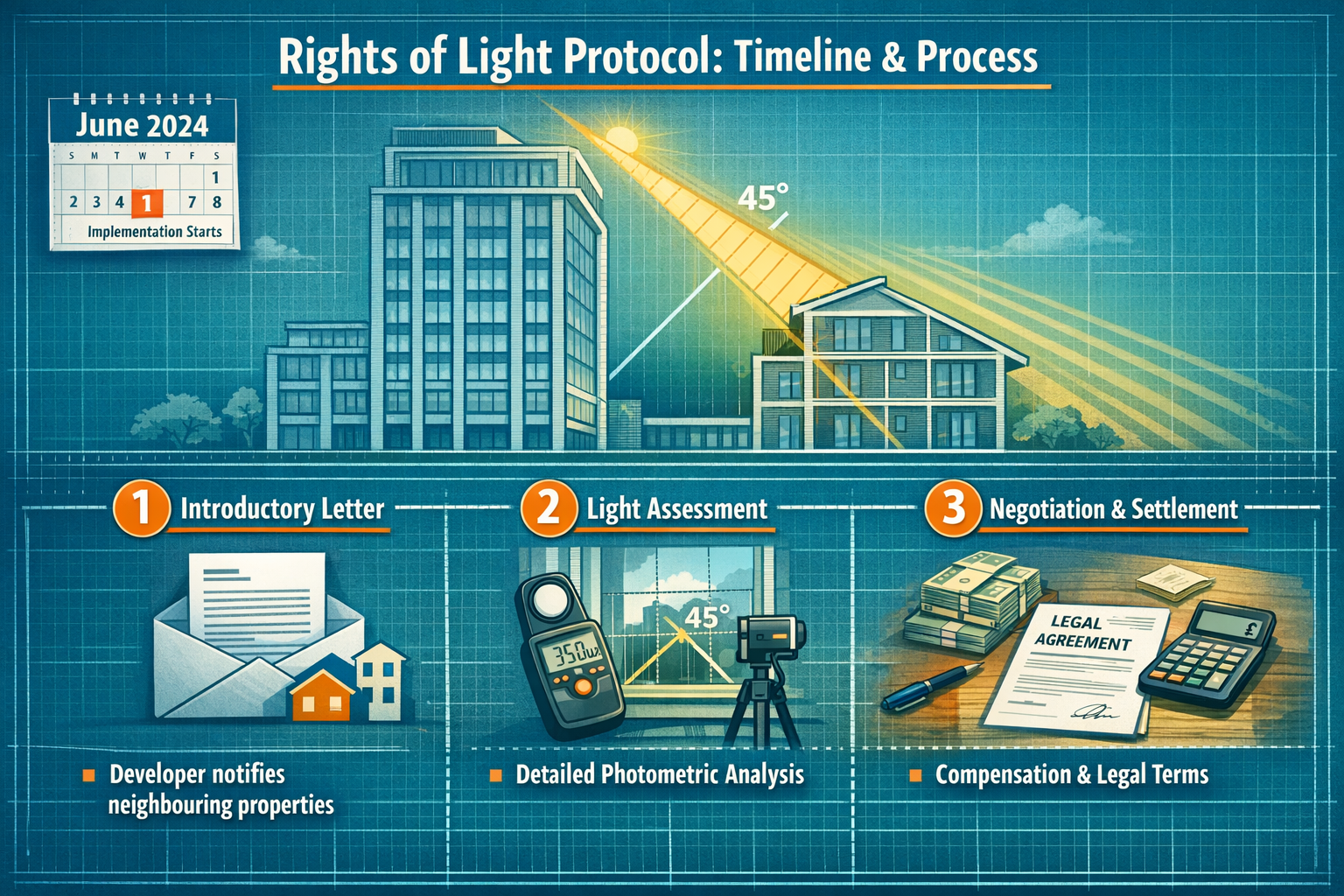
- The Rights of Light Protocol (effective June 1, 2024) establishes best practice guidelines requiring developers to issue introductory letters and conduct thorough assessments before commencing work[3]
- Photometric evidence must measure legal daylight thresholds using standardized methodologies, with expert reports documenting both technical measurements and valuation impacts[2]
- Court permission is now mandatory for submitting expert evidence, with parties required to provide cost estimates when requesting permission under CPR 35.2(1)[4]
- Development viability in dense cities increasingly depends on early rights of light due diligence and strategic planning to minimize infringement risks[3]
Understanding CPR Part 35 Standards for Expert Witness Reports
The Expert's Overriding Duty to the Court 📋
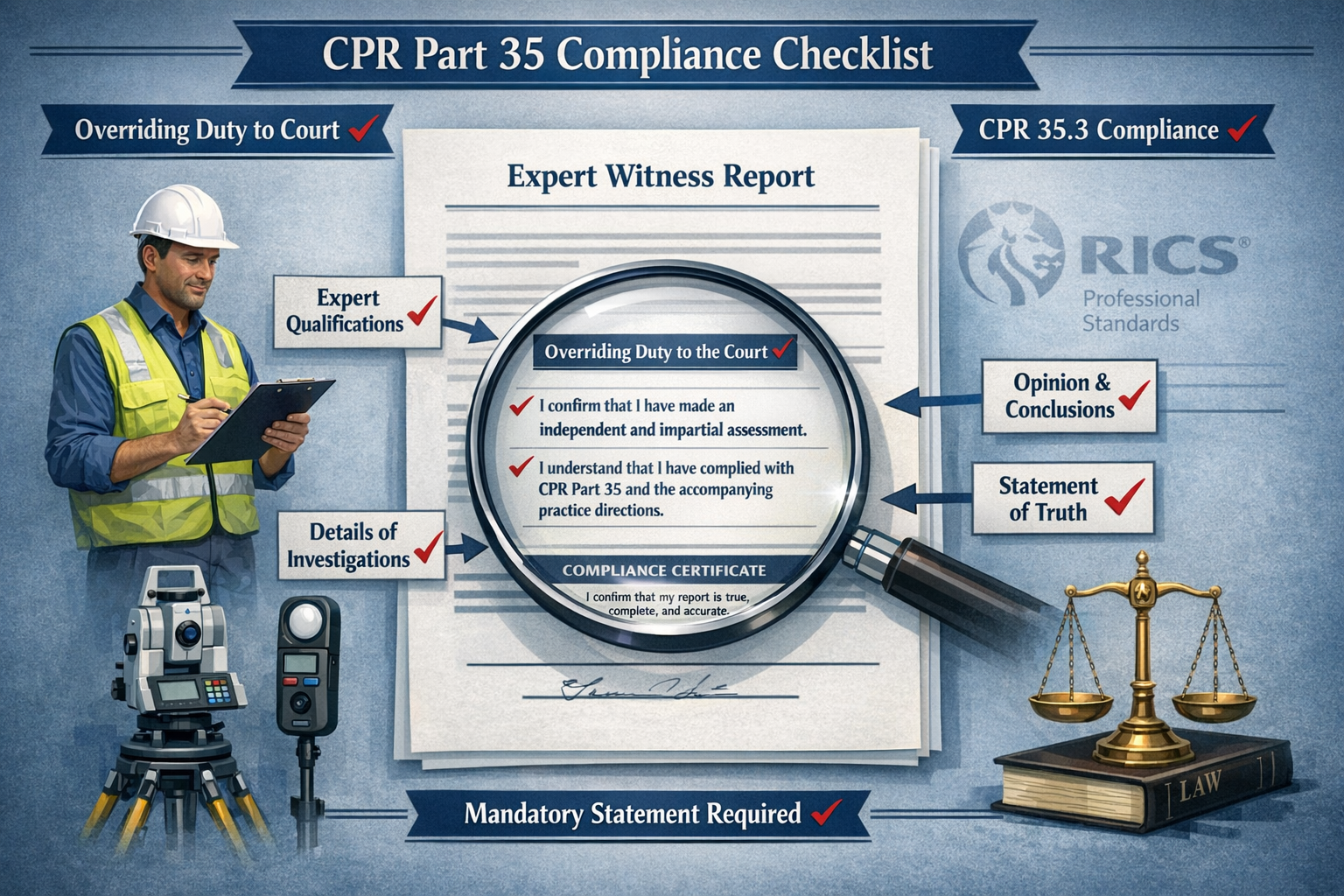
Under CPR 35.3, an expert witness's primary obligation is to assist the court on matters within their expertise. This duty fundamentally supersedes any obligation to the party instructing or paying them[1]. For surveyors preparing Expert Witness Reports for Right of Light Disputes: CPR Part 35 Standards Post-2026 Daylight Reforms, this means maintaining absolute independence regardless of which party—developer or affected neighbor—has retained their services.
The practical implications are significant:
- Objectivity is non-negotiable: Expert opinions must reflect genuine professional judgment, not advocacy for the instructing party
- Adverse findings must be disclosed: If photometric evidence contradicts the instructing party's position, the expert must report this truthfully
- Independence from commercial pressure: Even when future work depends on client satisfaction, the court's needs come first
Mandatory Compliance Statements
CPR 35.10(2) requires every expert report to include a specific statement confirming the expert understands and has complied with their duty under CPR 35.3[1]. This isn't merely a formality—failure to include this statement can result in the report being excluded from evidence.
The statement must appear at the end of the report and typically reads:
"I confirm that I understand my duty to the Court and have complied with that duty. I am aware of the requirements of CPR Part 35, its Practice Direction and the Guidance for the Instruction of Experts in Civil Claims 2014."
For those seeking expert witness services, ensuring your surveyor includes this compliance statement is essential for court admissibility.
Court Permission and Cost Transparency
Since the implementation of current CPR standards, no party may call an expert or submit an expert's report without the court's permission under CPR 35.2(1)[4]. This gatekeeping function serves to:
✅ Prevent unnecessary expert evidence
✅ Control litigation costs
✅ Ensure expert testimony is genuinely required to resolve the dispute
✅ Promote proportionality in proceedings
When requesting permission, parties must provide detailed cost estimates for the expert's work. This transparency requirement has fundamentally changed how surveyors price their services and how parties budget for right of light litigation.
The 2024 Rights of Light Protocol: New Standards for Expert Assessments
Implementation and Scope of the RoL Protocol
On June 1, 2024, the RICS incorporated the Rights of Light Protocol into its official guidance, establishing clear procedural standards for addressing daylight disputes[3]. While not legally mandatory, the Protocol represents best practice that courts increasingly expect parties to follow.
The Protocol specifically addresses the growing problem of protracted and expensive right of light disputes in dense urban environments. For surveyors preparing Expert Witness Reports for Right of Light Disputes: CPR Part 35 Standards Post-2026 Daylight Reforms, understanding the Protocol's requirements is essential because:
- Courts may criticize parties who fail to follow Protocol procedures
- Insurance policies may have conditions affecting Protocol compliance
- Early compliance can significantly reduce litigation costs
- Developer due diligence now routinely incorporates Protocol steps
The Introductory Letter Requirement
The Protocol mandates that developers issue an "Introductory Letter" to adjoining property owners before commencing development that risks infringing rights of light[3]. This letter must include:
- Summary of proposed development with sufficient detail for neighbors to understand potential impacts
- Request for access to undertake daylight assessments
- Timeline information for the development and assessment process
- Contact details for further communication
This requirement fundamentally changes the surveyor's role. Expert witnesses must now often be involved before disputes arise, conducting preliminary assessments that inform both the Introductory Letter and subsequent negotiations.
Insurance Policy Considerations ⚠️
A critical tension exists between the Protocol's communication requirements and traditional rights of light insurance policies. Historically, these policies have included conditions prohibiting developers from communicating with adjoining landowners about rights of light issues[3]. Breaching these conditions can invalidate coverage.
Surveyors must therefore advise clients to:
- Review insurance policy terms before issuing Introductory Letters
- Negotiate policy modifications if necessary
- Consider whether insurance or Protocol compliance better serves project objectives
- Document all decisions regarding communication strategies
This intersection of insurance requirements and best practice protocols represents a significant challenge for development viability in 2026, particularly in dense UK cities where rights of light risks are highest.
Growing Due Diligence Trends
There is an increasing trend of developers conducting more thorough due diligence on neighboring properties and planning design modifications to reduce or eliminate rights of light infringements[3]. This proactive approach reflects:
- Recognition that litigation costs often exceed early design adjustments
- Court expectations that parties attempt reasonable accommodation
- Protocol encouragement of early engagement and negotiation
- Insurance market pressure for risk mitigation
For surveyors, this means expert assessments are increasingly commissioned at the pre-planning stage rather than after disputes arise. Understanding how to integrate party wall considerations with rights of light assessments has become essential for comprehensive property development advice.
Gathering Photometric Evidence: Technical Standards for Expert Reports
Measuring Legal Daylight Thresholds
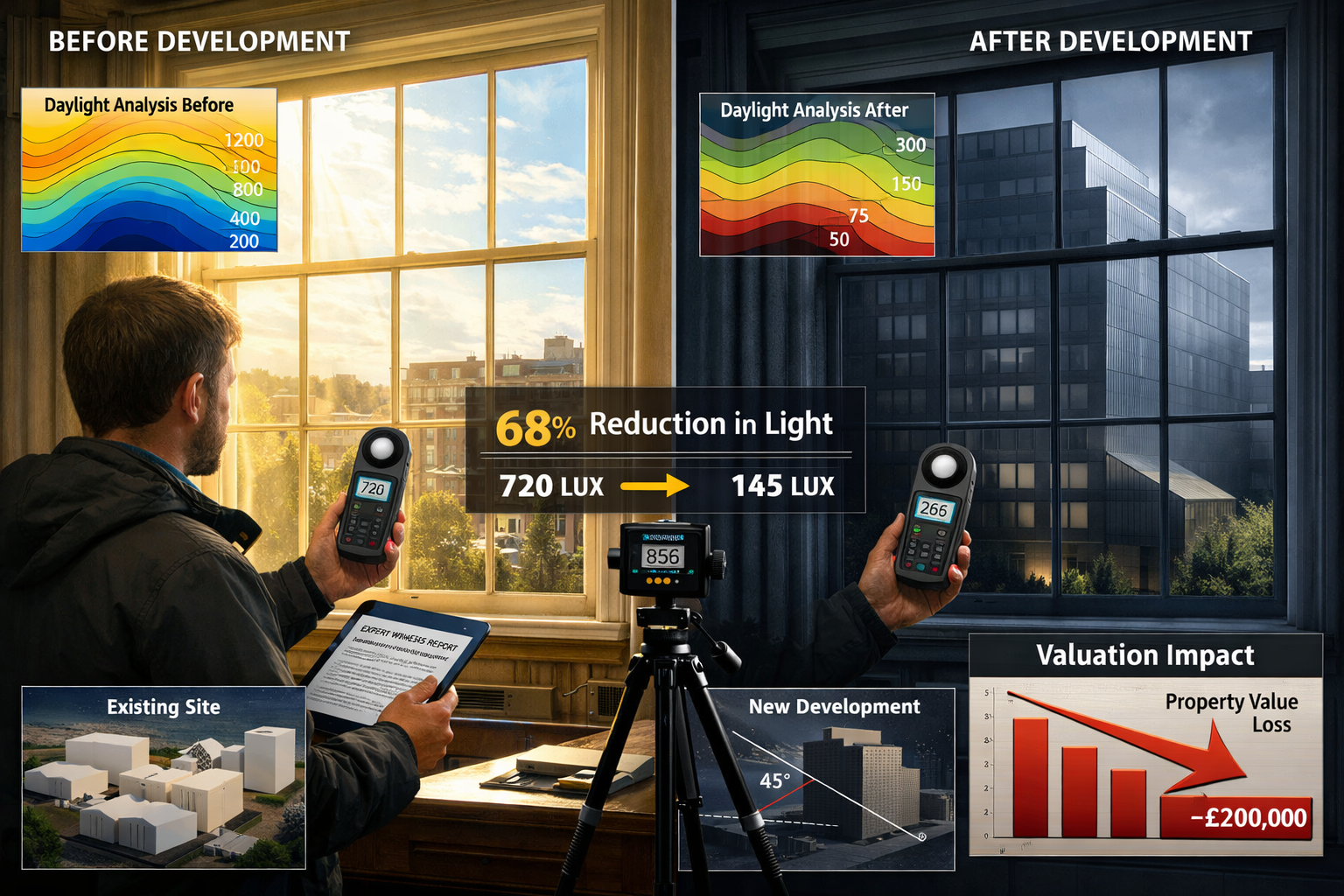
In right of light disputes, expert reports must measure whether affected rooms will fall below legal thresholds for daylight[2]. The standard methodology involves:
The 45-Degree Rule: Traditional common law test examining whether light can reach a window at an angle of 45 degrees or more from the horizontal and vertical planes.
Waldram Diagrams: Technical drawings showing the amount of visible sky from a particular point within a room, measuring the "grumble point" where daylight reduction becomes actionable.
Lux Level Measurements: Quantitative assessments of illumination levels, typically measuring whether rooms maintain at least 1-2% of available sky light (the traditional threshold for adequate natural lighting).
BRE Guidelines: Building Research Establishment standards providing detailed methodologies for assessing daylight and sunlight impacts on existing buildings.
Surveyors preparing Expert Witness Reports for Right of Light Disputes: CPR Part 35 Standards Post-2026 Daylight Reforms must use these established methodologies consistently and document their approach comprehensively.
Documentation Requirements Under CPR 35.5
CPR 35.5 specifies that expert evidence must generally be given in a written report format[6]. For right of light disputes, this report must include:
| Report Component | Description | CPR Requirement |
|---|---|---|
| Expert's Qualifications | Detailed CV demonstrating expertise in photometric assessment and property valuation | CPR 35.10(1) |
| Instructions Received | Summary of questions posed and scope of assessment | CPR 35.10(3) |
| Facts and Assumptions | Clear statement of factual basis and any assumptions made | CPR 35.10(3) |
| Methodology | Detailed explanation of measurement techniques and standards applied | CPR 35.10(2) |
| Findings | Photometric measurements, calculations, and technical analysis | CPR 35.10(2) |
| Opinion | Professional conclusions regarding infringement and impacts | CPR 35.10(2) |
| Material Considered | List of all documents, plans, and data reviewed | CPR 35.10(3) |
| Range of Opinion | Acknowledgment of alternative views if applicable | CPR 35.10(2) |
| Summary of Conclusions | Concise statement of key findings | CPR 35.10(2) |
| Statement of Truth | Compliance declaration under CPR 35.10(2) | Mandatory[1] |
The report must also identify any matters that fall outside the expert's expertise and any questions they are unable to answer definitively[1].
Photometric Equipment and Site Assessment
Modern expert assessments require sophisticated equipment:
- Digital Lux Meters: Calibrated instruments measuring illumination levels in different areas of affected rooms
- 3D Modeling Software: Programs creating accurate representations of existing and proposed buildings for shadow analysis
- Drone Photography: Aerial imagery documenting site conditions and neighboring properties (see drone surveys for more information)
- Specialist Cameras: Equipment capturing wide-angle views demonstrating visible sky from window positions
Site visits must be conducted at appropriate times to capture representative daylight conditions, typically requiring multiple visits at different times of day and year to document seasonal variations.
Addressing Written Questions Under CPR 35.6
After an expert report is served, opposing parties may submit written questions about the expert's opinion under CPR 35.6[6]. These questions must be:
- Submitted within 28 days of service of the expert report
- For purposes of clarification only
- Proportionate to the issues in dispute
Surveyors must respond to these questions within a reasonable timeframe, and responses form part of the expert evidence. This process often reveals weaknesses in initial assessments, making thorough initial reporting essential.
Valuation Impacts and Compensation Assessment
Quantifying Diminution in Value
A critical component of Expert Witness Reports for Right of Light Disputes: CPR Part 35 Standards Post-2026 Daylight Reforms is assessing the financial impact of daylight loss on affected properties. This requires:
Before-and-After Valuation: Comparing property value with adequate daylight versus value with reduced daylight post-development.
Market Evidence: Analyzing comparable sales data showing how daylight quality affects property values in the specific location.
Rental Impact Analysis: For investment properties, assessing how reduced daylight affects achievable rents and tenant demand.
Stigma and Marketability: Evaluating whether daylight loss creates perception issues affecting saleability beyond measurable illumination changes.
Valuation expertise is essential here, and many surveyors work alongside registered RICS valuers to ensure robust financial assessments.
Compensation Frameworks in 2026
Courts typically award compensation based on:
- Diminution in capital value (most common approach)
- Loss of amenity (where financial loss is difficult to quantify)
- Negotiated settlements (increasingly encouraged under the RoL Protocol)
The trend in 2026 is toward early negotiated settlements rather than protracted litigation, with the Rights of Light Protocol explicitly encouraging this approach[3]. Expert reports must therefore present findings in ways that facilitate negotiation while maintaining objectivity.
Development Viability Considerations 🏗️
For developers, expert assessments increasingly focus on project viability questions:
- What design modifications would eliminate or minimize infringement?
- What compensation costs should be budgeted for unavoidable impacts?
- How do rights of light risks affect project financing and insurance?
- What is the optimal strategy: design changes, compensation, or litigation?
In dense UK cities like London, where development sites are constrained and neighboring properties numerous, these viability assessments can determine whether projects proceed at all. Surveyors must therefore understand not just technical measurement standards but also commercial realities of urban development.
This commercial awareness must be balanced with the expert's overriding duty to the court—opinions on viability must reflect genuine professional judgment, not advocacy for development approval.
Practical Guidance for Surveyors in 2026
Pre-Instruction Considerations
Before accepting instructions for right of light expert witness work, surveyors should:
✅ Verify independence: Ensure no conflicts of interest exist with either party
✅ Confirm expertise: Only accept instructions within areas of genuine competence
✅ Clarify scope: Obtain clear written instructions defining assessment parameters
✅ Discuss costs: Provide transparent fee estimates for court permission applications
✅ Review insurance: Confirm professional indemnity coverage for expert witness work
Integrating Protocol Compliance with CPR Standards
The challenge for surveyors in 2026 is seamlessly integrating Rights of Light Protocol best practices with CPR Part 35 mandatory requirements. This means:
- Conducting preliminary assessments to inform Introductory Letters while maintaining independence for potential later litigation
- Documenting Protocol compliance steps in expert reports
- Advising clients on Protocol procedures without compromising expert objectivity
- Balancing early engagement with maintaining impartiality
For projects involving excavation work near neighbors, understanding how rights of light intersect with party wall procedures is essential for comprehensive risk management.
Common Pitfalls to Avoid ⚠️
Advocacy Creep: The most common error is gradually shifting from objective expert to advocate for the instructing party. Regular self-assessment of independence is essential.
Insufficient Documentation: Failing to comprehensively document methodology, assumptions, and limitations undermines report credibility and CPR compliance.
Ignoring Alternative Views: CPR requires acknowledgment of reasonable alternative opinions. Dismissing opposing expert views without proper analysis weakens reports.
Inadequate Site Assessment: Relying on desktop analysis without sufficient site visits produces reports vulnerable to challenge on factual accuracy.
Missing Compliance Statements: Omitting mandatory CPR 35.10(2) statements can result in report exclusion regardless of technical quality.
Continuing Professional Development
Given the rapid evolution of standards, surveyors must maintain current knowledge through:
- Regular review of CPR updates and case law developments
- RICS guidance updates and technical standards
- Training on photometric measurement technologies
- Understanding of property valuation methodologies
- Awareness of insurance market developments affecting rights of light
Professional bodies increasingly expect documented CPD specifically addressing expert witness competencies, making specialized training essential for maintaining credibility.
The Future of Right of Light Litigation
Emerging Trends in Dense Urban Areas
As UK cities continue densifying, several trends are reshaping right of light disputes:
Increased Pre-Development Assessment: More developers commission comprehensive rights of light surveys before purchasing sites or submitting planning applications.
Technology Integration: Advanced 3D modeling and AI-powered shadow analysis tools are improving assessment accuracy and efficiency.
Insurance Market Evolution: Rights of light insurance products are adapting to accommodate Protocol communication requirements.
Judicial Expectations: Courts increasingly expect parties to demonstrate Protocol compliance and good faith negotiation attempts before litigation.
Legislative and Regulatory Outlook
While no major legislative changes are currently anticipated for 2026, several developments warrant monitoring:
- Potential updates to planning policy regarding daylight standards for new developments
- Evolving case law interpreting Protocol compliance expectations
- Possible RICS guidance revisions based on early Protocol implementation experience
- Insurance industry responses to Protocol-insurance policy tensions
Surveyors preparing Expert Witness Reports for Right of Light Disputes: CPR Part 35 Standards Post-2026 Daylight Reforms must stay informed of these developments to maintain best practice standards.
Commercial Implications for Development
The combined effect of CPR standards and the Rights of Light Protocol is fundamentally changing development economics in dense urban areas:
- Earlier cost certainty: Comprehensive pre-development assessments reduce unexpected compensation liabilities
- Design optimization: Early rights of light analysis informs architectural decisions before planning submission
- Risk pricing: Lenders and investors increasingly demand detailed rights of light risk assessments
- Project timelines: Protocol compliance and negotiation processes must be factored into development schedules
For commercial property professionals seeking comprehensive assessment services, understanding how rights of light intersects with other survey requirements like commercial building surveys provides integrated risk management.
Conclusion
Expert Witness Reports for Right of Light Disputes: CPR Part 35 Standards Post-2026 Daylight Reforms represent a sophisticated intersection of legal compliance, technical expertise, and commercial awareness. The June 2024 implementation of the Rights of Light Protocol has added a new layer of best practice expectations while CPR Part 35 continues to mandate rigorous standards for expert independence and report quality.
For surveyors operating in this space, success requires:
🔑 Unwavering commitment to the overriding duty to the court
🔑 Technical competence in photometric measurement and valuation assessment
🔑 Commercial awareness of development viability and insurance considerations
🔑 Procedural knowledge of Protocol requirements and CPR compliance
🔑 Professional skepticism maintaining objectivity despite client pressures
Actionable Next Steps
For Surveyors:
- Review and update expert witness report templates to ensure full CPR 35.10 compliance
- Invest in continuing professional development on Rights of Light Protocol requirements
- Upgrade photometric measurement equipment and software to current standards
- Establish quality assurance processes for independence verification
- Develop relationships with valuation specialists for integrated assessments
For Developers:
- Commission rights of light assessments at the earliest feasible project stage
- Review insurance policies for Protocol communication restrictions before issuing Introductory Letters
- Budget appropriately for expert witness costs including court permission requirements
- Consider design modifications to minimize infringement risks before planning submission
- Engage with expert witness services that demonstrate comprehensive understanding of both CPR and Protocol standards
For Property Owners:
- Respond promptly to Introductory Letters from developers
- Commission independent expert assessments when significant daylight impacts are proposed
- Understand that survey evidence alone does not provide legal protection—litigation may be necessary[2]
- Consider negotiated settlements as encouraged by the Rights of Light Protocol
- Ensure instructed experts demonstrate clear CPR Part 35 compliance in their reports
The landscape of right of light disputes in 2026 demands higher standards of technical competence, procedural compliance, and professional independence than ever before. Surveyors who master these requirements will provide invaluable services to courts, clients, and the broader property development industry, facilitating fair outcomes while supporting sustainable urban densification.
References
[1] fenwickelliott – https://www.fenwickelliott.com/research-insight/newsletters/insight/39
[2] Right To Light Surveys Litigation Compensation – https://daylightprotect.com/insights/right-to-light-surveys-litigation-compensation
[3] Illuminating Development Shedding Light On The New Rights Of Light Protocol – https://www.hsfkramer.com/notes/realestatedevelopment/2024-04/illuminating-development-shedding-light-on-the-new-rights-of-light-protocol
[4] Part35 – https://www.justice.gov.uk/courts/procedure-rules/civil/rules/part35
[6] Where A Party Instructs An Expert To Prepare A Part 35 Compliant Report Before A Claim Has Been Issued – https://www.lexisnexis.co.uk/legal/guidance/where-a-party-instructs-an-expert-to-prepare-a-part-35-compliant-report-before-a-claim-has-been-issued