

Fewer than 40% of shared ownership buyers commission an independent building survey before purchasing their initial share — yet they remain liable for 100% of service charges and major repair costs from day one [7]. That gap between perceived protection and actual financial exposure sits at the heart of why valuation and surveying for shared ownership and staircasing: getting market value, repairs and lease risks right demands specialist knowledge that goes well beyond a standard residential instruction.
Shared ownership is structurally different from outright purchase. A buyer holds a leasehold interest in a fraction of the property's value, pays rent on the unsold share, and faces a complex web of obligations under both the lease and housing association policy. Surveyors and valuers instructed on these properties must understand how each of those layers interacts — from the initial purchase survey through every staircasing event to the point of full ownership or resale.
Key Takeaways
- Every staircasing transaction requires a fresh RICS-compliant market valuation, typically valid for only three months, and the methodology must remain consistent across all transaction types.
- Shared ownership leaseholders bear 100% of service charges and major works costs regardless of their equity share, making building condition a disproportionate financial risk for low-equity owners.
- Surveyors must disregard owner-funded improvements and maintenance failures when preparing staircasing valuations, following government guidance on fair apportionment.
- Lease length is a critical risk factor: statutory lease extension rights for flat owners only arise after staircasing to 100% ownership, leaving short-lease properties in a vulnerable position.
- Interim staircasing transactions are not publicly registered at the Land Registry, so accurate record-keeping by housing providers and solicitors is essential to avoid future title complications.

How Shared Ownership Changes the Surveyor's Role
Standard residential surveys focus on condition, value, and saleability for a buyer who will own the property outright. In shared ownership, the surveyor's audience is more complex. The buyer, the housing association as landlord, and any mortgage lender all have distinct interests — and the surveyor's report must serve all three without creating conflicts.
Understanding the Equity Split and Rent Apportionment
When a buyer acquires, say, a 40% share of a property valued at £300,000, they pay £120,000 for their share and rent on the remaining £180,000. The rent is calculated as a percentage of the unsold equity — typically 2.75% to 3% per annum under current Homes England guidance. For a property valuation to be meaningful, it must reflect the full open market value of the property as if sold with vacant possession, not just the buyer's share. Any undervaluation benefits the buyer at staircasing but disadvantages the housing association; overvaluation does the reverse.
RICS valuers are expected to apply a consistent methodology whether the instruction relates to an initial purchase, a staircasing event, a lease extension, or a resale [2]. This consistency protects all parties and ensures that the rent-to-premium split remains proportionate over time.
Defects That Disproportionately Affect Low-Equity Owners
Here is where the surveyor's report carries unusual weight. A shared ownership leaseholder is typically responsible for 100% of service charges and major works costs, regardless of the share they own [7]. A buyer holding a 25% share of a flat with a failing roof, deteriorating cladding, or drainage problems will face the same repair bill as a 100% owner.
This creates a disproportionate risk that surveyors must communicate clearly. A defect that might be described as "monitor and maintain" in a standard homebuyer report becomes a material financial risk in shared ownership. Surveyors should:
- Quantify estimated repair costs rather than leaving them as narrative observations.
- Flag Section 20 consultation risks where major works appear imminent and the landlord has not yet issued a notice.
- Identify any existing service charge disputes or major works programmes already underway.
- Note the proportion of repair cost relative to the buyer's equity stake, so the client understands the real-world impact.
A RICS Home Survey or Level 3 Building Survey is almost always more appropriate for shared ownership properties than a basic valuation alone, precisely because the condition findings carry such outsized financial consequences.
Staircasing Valuations: Methodology, Disputes and Record-Keeping
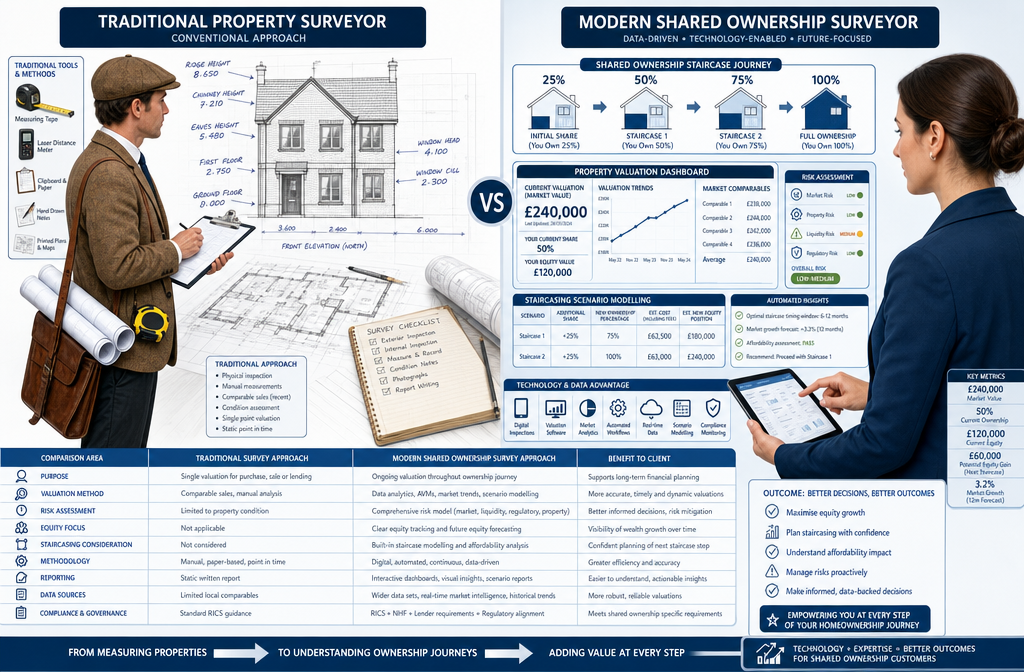
Staircasing allows a shared owner to buy additional shares in their property, incrementally increasing their equity until they reach 100% ownership [1]. Each staircasing event requires a new RICS-registered valuation to establish the current open market value. That figure then determines the price of the additional share being purchased.
Valuation Methodology for Staircasing
The valuation must reflect the open market value of the whole property at the date of inspection, using comparable sales evidence in the usual way. Crucially, government guidance requires that valuers disregard any improvements made by the shared owner as well as any failure to maintain the property in good repair [3]. This rule exists to prevent owners being penalised twice — once by having funded improvements themselves, and again by paying a higher price to staircase because of those improvements.
In practice, this means the valuer must:
- Establish what the property would be worth in its current condition.
- Identify any improvements the leaseholder has made (typically evidenced by a schedule provided by the owner).
- Adjust the valuation to remove the value attributable to those improvements.
- Similarly, disregard any deterioration caused by the leaseholder's failure to maintain, so the housing association cannot benefit from the owner's neglect.
This is not always straightforward. Where improvements are structural — an extension, a loft conversion, or a new kitchen — the valuer must form a view on what the property would have been worth without them. Comparable evidence for unimproved properties of the same type is essential.
Valuation Validity and Timing
Staircasing valuations are typically valid for three months [1]. If the transaction does not complete within that window, a fresh valuation is required. In a rising market, delays can be costly; in a falling market, the buyer may benefit from waiting. Surveyors should advise clients clearly on the validity period and the implications of market movement.
Under the Affordable Homes Programme 2021–2026, shared owners can purchase additional shares in increments as small as 1% annually for the first 15 years of ownership, with reduced transaction costs [8]. This "gradual staircasing" model increases the frequency of valuation instructions and makes the consistency of methodology even more important.
Disputing a Staircasing Valuation
Many shared ownership leases contain a provision making the RICS valuer's decision final and binding [3]. This limits the buyer's ability to challenge a valuation they consider too high. Where dispute provisions do exist, they typically allow for a second valuation by a jointly instructed surveyor, with the average of the two figures used.
Surveyors instructed on disputed valuations should:
- Review the lease carefully to identify the exact dispute mechanism.
- Obtain the original valuation report and supporting comparables.
- Conduct an independent inspection and prepare a fully evidenced counter-report.
- Be prepared to act as an expert witness if the dispute proceeds to a tribunal or court.
Record-Keeping: An Underappreciated Risk
Interim staircasing transactions — those that take a shared owner from, say, 25% to 50% without reaching 100% — are not registered at the Land Registry as separate title events [5]. The Land Registry records only the initial purchase and the final staircasing to 100%. All intermediate steps are recorded only in the housing association's internal systems and the solicitor's files.
This creates a real risk of records being lost, particularly where housing associations merge, are taken over, or change management systems. Surveyors and solicitors advising shared owners should always request a full staircasing history from the housing provider before proceeding with any transaction, and should flag any gaps or inconsistencies they find [5].
Lease Risks, Section 20 Obligations and the Path to Full Ownership
The lease is the foundation of every shared ownership arrangement, and its terms create risks that neither the buyer nor their surveyor can afford to overlook. Valuation and surveying for shared ownership and staircasing: getting market value, repairs and Lease risks right ultimately depends on understanding how the lease interacts with the physical condition of the property and the financial obligations it creates.
Lease Length and Extension Rights
Shared ownership leases are typically granted for 99 or 125 years. For flat owners, the statutory right to extend the lease under the Leasehold Reform, Housing and Urban Development Act 1993 only arises after the leaseholder has staircased to 100% ownership [4]. Until that point, the leaseholder has no statutory protection against a shortening lease.
This is a significant risk. A lease with fewer than 80 years remaining becomes harder to mortgage and less valuable. Once it falls below 80 years, the "marriage value" element of a lease extension valuation increases the cost substantially. Shared owners who cannot afford to staircase to 100% may find themselves trapped in a depreciating asset.
Surveyors should always note the unexpired lease term in their reports and advise clients to seek legal advice if the term is approaching or below 85 years. Some housing associations will agree to a voluntary lease extension before full ownership, but this is at their discretion [4]. The cost of a lease extension can vary significantly depending on lease length, ground rent, and property value, making early action advisable.
Section 20 Consultations and Major Works
Section 20 of the Landlord and Tenant Act 1985 requires landlords to consult leaseholders before carrying out qualifying works costing more than £250 per leaseholder, or entering into qualifying long-term agreements. For shared ownership leaseholders, this consultation is particularly important because they bear the full cost of major works regardless of their equity share.
A surveyor inspecting a shared ownership property should look for:
| Risk Factor | What to Check |
|---|---|
| Cladding and external walls | Any remediation works pending or in progress |
| Roof condition | Age, material, visible deterioration, recent repairs |
| Communal areas | Condition of lifts, corridors, entrance areas |
| Drainage and services | Evidence of historic blockages or failures |
| Structural movement | Cracks, settlement, subsidence indicators |
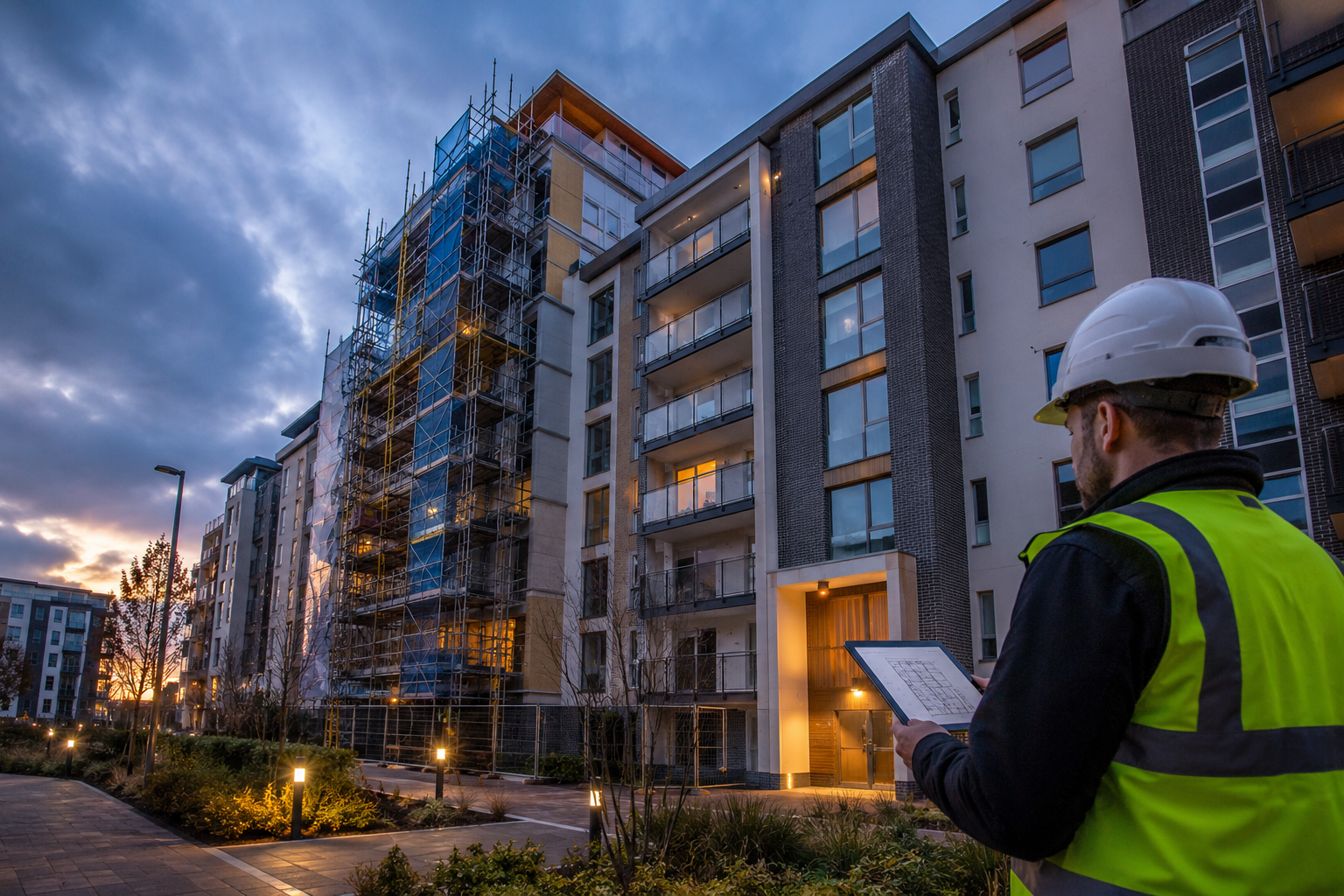
Where major works appear likely, the surveyor should recommend that the buyer obtain a copy of the most recent service charge accounts, any Section 20 notices already issued, and the housing association's planned maintenance programme. A stock condition survey of the wider building can provide valuable context on the landlord's maintenance obligations and forward planning.
Resale Restrictions and Right of First Refusal
Until a shared owner reaches 100% ownership, the housing association typically retains a right of first refusal on any resale [7]. This means the property must be offered back to the housing association at the RICS-determined market value before it can be sold on the open market. This can delay the sale process by several weeks and limits the seller's ability to negotiate price.
Surveyors advising clients who are considering selling should make clear that the resale value is determined by the same RICS valuation methodology as a staircasing event, and that the housing association's nominee buyer will pay the full market value for the whole property before the seller receives their proportionate share.
Costs of Staircasing: A Practical Summary
Understanding the full cost of staircasing helps clients plan effectively. Typical costs in 2026 include:
- RICS valuation fee: approximately £400–£600 per staircasing event [6]
- Legal fees: approximately £800–£1,500 per transaction [6]
- Mortgage arrangement fees: variable, depending on lender and product
- Stamp Duty Land Tax: may be payable depending on the share purchased and previous elections
Each staircasing event incurs these costs independently, which is why the gradual 1% annual staircasing model introduced under the Affordable Homes Programme 2021–2026 includes provisions for reduced fees during the first 15 years [8]. For buyers considering multiple small staircasing steps, the cumulative cost of repeated valuations and legal work should be weighed against the financial benefit of each incremental purchase.
For guidance on valuation pricing and what to expect from a professional instruction, speaking with a chartered surveyor before committing to a staircasing timetable is a sensible first step.
Communicating Risk to Shared Ownership Clients
The final, and often overlooked, dimension of valuation and surveying for shared ownership and staircasing: getting market value, repairs and lease risks right is communication. Shared ownership buyers are frequently first-time buyers with limited experience of leasehold obligations. A technically accurate survey report that fails to explain the financial consequences of its findings in plain terms is not fit for purpose.
Surveyors should structure their reports to:
- Separate condition findings from financial risk implications, making clear which defects carry cost consequences under the service charge regime.
- Explain the lease term risk in accessible language, including the impact on mortgage availability and resale value.
- Describe the Section 20 process and what it means for the buyer's future financial obligations.
- Advise on the staircasing valuation process so clients understand that future share purchases will be priced at market value, not at the original purchase price.
- Recommend specialist legal advice on the lease before exchange, particularly where unusual provisions exist around subletting, alterations, or resale.
A schedule of condition prepared at the point of purchase can also protect the buyer by recording the property's state at the start of the lease, which may be relevant if the landlord later claims dilapidations or disputes the scope of tenant repair obligations.
Conclusion
Shared ownership is a valuable route to homeownership, but it places buyers in a structurally different position from outright owners. The financial risks — particularly around major works, service charges, lease length, and staircasing costs — are real and can be severe for those holding small equity shares.
Actionable next steps for buyers and their advisers in 2026:
- Always commission a Level 2 or Level 3 building survey before purchasing any shared ownership property, not just a valuation.
- Request a full staircasing history and service charge accounts from the housing association before exchange.
- Check the unexpired lease term and seek legal advice immediately if it is below 85 years.
- Ensure any RICS valuation for staircasing correctly disregards owner-funded improvements and maintenance failures.
- Obtain written confirmation of any Section 20 notices already issued or major works programmes planned.
- Factor in the full cost of each staircasing event — valuation, legal, and mortgage fees — when planning an equity-building strategy.
- Instruct a RICS-registered chartered surveyor with demonstrable experience in shared ownership and leasehold property.
Getting these details right at every stage is not just good practice — it is the difference between shared ownership working as intended and becoming an expensive trap.
References
[1] Staircasing Shared Ownership – https://landgah.com/shared-ownership/help-advice/staircasing-shared-ownership/?utm_source=openai
[2] Shared Ownership Valuation Buying Selling – https://www.sharedownershipresources.org/so-explained/valuations/shared-ownership-valuation-buying-selling/?utm_source=openai
[3] 1 Shared Ownership – https://www.gov.uk/guidance/capital-funding-guide/1-shared-ownership?utm_source=openai
[4] How Shared Ownership Leases Are Different – https://www.lease-advice.org/leasehold/basics/shared-ownership/how-shared-ownership-leases-are-different/?utm_source=openai
[5] Be Aware Shared Ownership Staircasing Records – https://www.trowers.com/insights/2023/february/be-aware-shared-ownership-staircasing-records?utm_source=openai
[6] How Does Staircasing Work With Shared Ownership Uk 2026 – https://mortgagenotes.co.uk/questions/how-does-staircasing-work-with-shared-ownership-uk-2026.html?utm_source=openai
[7] Shared Ownership Staircasing – https://www.propertypassport.uk/guides/shared-ownership-staircasing?utm_source=openai
[8] Buying More Shares Staircasing – https://www.gov.uk/shared-ownership-scheme/buying-more-shares-staircasing./?utm_source=openai