
Pet-friendly rental listings in England have dropped 39% since the start of 2026 — falling from 8.2% to just 5.9% of total listings — yet the new law makes blanket pet bans legally indefensible [4]. That contradiction sits at the heart of every landlord's dilemma right now.
The Renters' Rights Act 2026 Pet Rules: Valuation Impacts and Building Survey Checks for Landlord Risk Mitigation framework represents one of the most significant shifts in private rented sector regulation in a generation. From 1 May 2026, landlords face mandatory obligations around pet consent, tightened eviction grounds, and a prohibition on pet-specific fees — all of which carry direct consequences for property valuations and the adequacy of existing building surveys.
This article breaks down what the legislation actually requires, how it affects asset values, and what survey checks landlords must commission to protect their investment.
Key Takeaways 📋
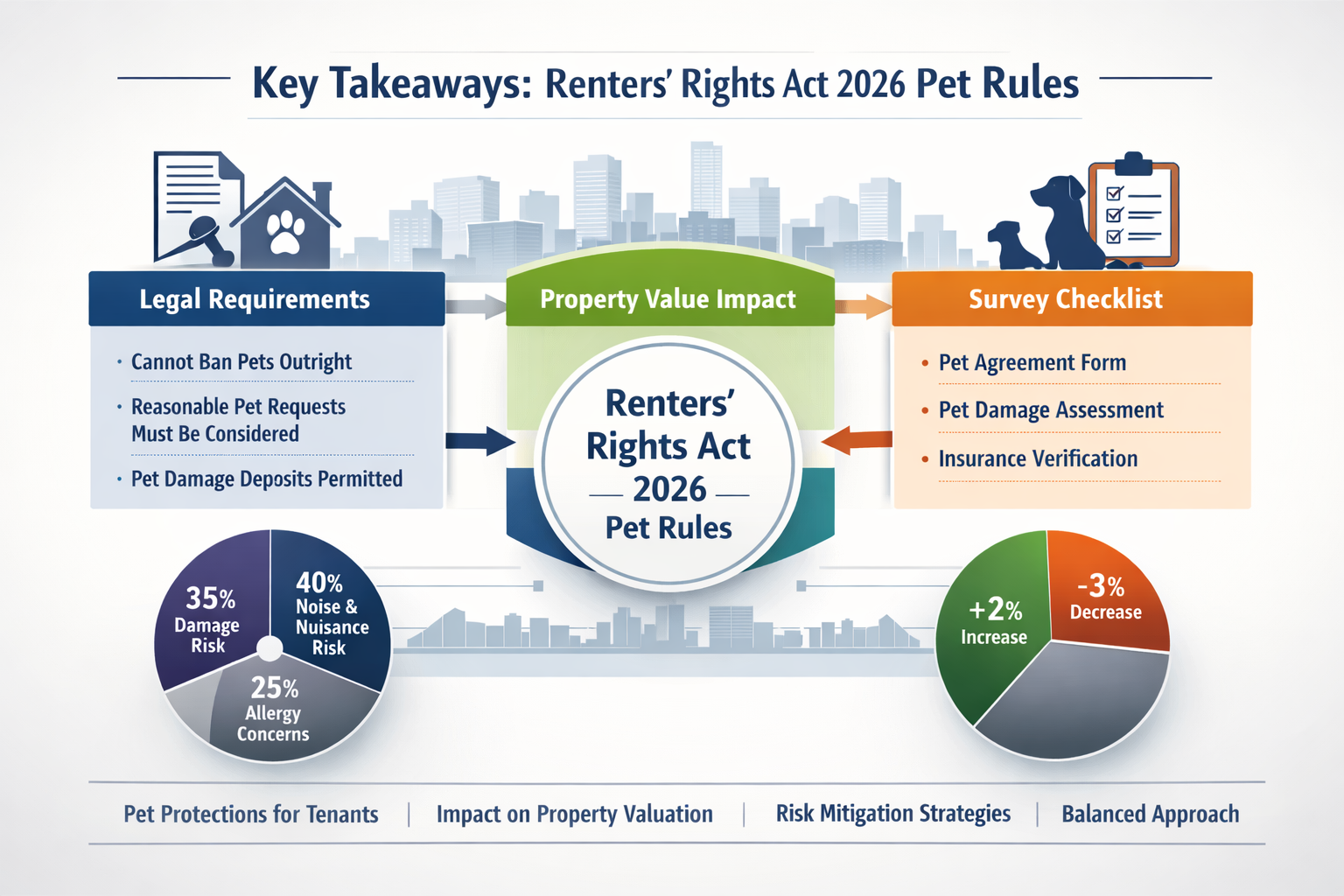
- Blanket "no pets" clauses are no longer legally sufficient — refusals must be individualized and evidence-based from 1 May 2026.
- Pet damage cannot be covered by extra deposits or fees; only the standard tenancy deposit remains available.
- Property valuations may be negatively adjusted where pet-related wear is unrecorded or where head lease restrictions create legal uncertainty.
- A pre-tenancy building survey creates the baseline evidence needed to defend deposit deductions and ombudsman disputes.
- Section 21 abolition means landlords must rely on Section 8 grounds, making documented evidence of pet damage more critical than ever.
What the Renters' Rights Act 2026 Actually Requires on Pets
The 1 May 2026 Implementation Date
Phase 1 of the Renters' Rights Act came into force on 1 May 2026, bringing with it a suite of pet-related obligations that apply to all assured tenancies in England [1]. The headline change is simple: tenants now have a statutory right to request permission to keep a pet, and landlords must take that request seriously.
The 28-Day Response Rule
When a tenant submits a formal written pet request, the landlord must respond within 28 days [1]. If additional information is needed before a decision can be made, a 7-day window applies for requesting that information — whichever deadline falls later governs [1]. Missing these deadlines does not just create awkwardness; it creates legal exposure.
💬 "Missing the 28-day response window or providing vague reasons for refusal leaves landlords vulnerable to ombudsman complaints and potential financial penalties."
Reasonable Grounds for Refusal
Landlords can still refuse pet requests — but only where they can demonstrate reasonable justification [1]. Accepted grounds include:
- The property size or layout is genuinely unsuitable for the type of animal requested
- A head lease restriction prohibits pets (common in leasehold flats)
- Credible evidence of excessive wear, nuisance, or allergy risks to other residents
Generic "no pets" clauses written into tenancy agreements are no longer sufficient [4]. Every refusal must be individualized, written, and defensible.
What Landlords Cannot Do
| Prohibited Action | Penalty Risk |
|---|---|
| Charge a separate pet deposit | Breach of deposit rules |
| Add a pet surcharge to rent | Up to £7,000 fine [2] |
| Issue a blanket ban without reasoning | Ombudsman complaint / legal challenge |
| Use Section 21 to evict for unauthorized pets | No longer available from May 2026 [2] |
The abolition of Section 21 "no-fault" evictions is particularly significant. Landlords who previously relied on Section 21 as a backstop for managing problematic tenancies — including those involving unauthorized pets — must now build their case through Section 8 grounds, which require documented evidence of breach or damage [2].
How Pet Rules Under the Renters' Rights Act 2026 Affect Property Valuations
The Valuation Challenge in 2026
The connection between the Renters' Rights Act 2026 Pet Rules: Valuation Impacts and Building Survey Checks for Landlord Risk Mitigation and property values is not immediately obvious — but it is real. A RICS-qualified valuer assessing a buy-to-let property must now factor in several new variables.
Understanding the methods of valuation used by chartered surveyors helps landlords appreciate why pet-related legislative risk can translate directly into adjusted asset values.
Three Valuation Pressure Points
1. Head Lease Restrictions and Leasehold Risk
Many flats are held on leases that prohibit pets. Under the old regime, a landlord could simply enforce that restriction. Under the new rules, the interaction between the tenant's statutory right to request a pet and the head lease prohibition creates legal uncertainty that valuers must account for. A property where the landlord cannot practically comply with the Act — because the freeholder prohibits pets — may face questions about its suitability as a rental asset.
For landlords considering freehold valuation or lease extension valuation, the interaction between pet rights and lease terms is now a material consideration.
2. Unrecorded Pet Damage and Yield Compression
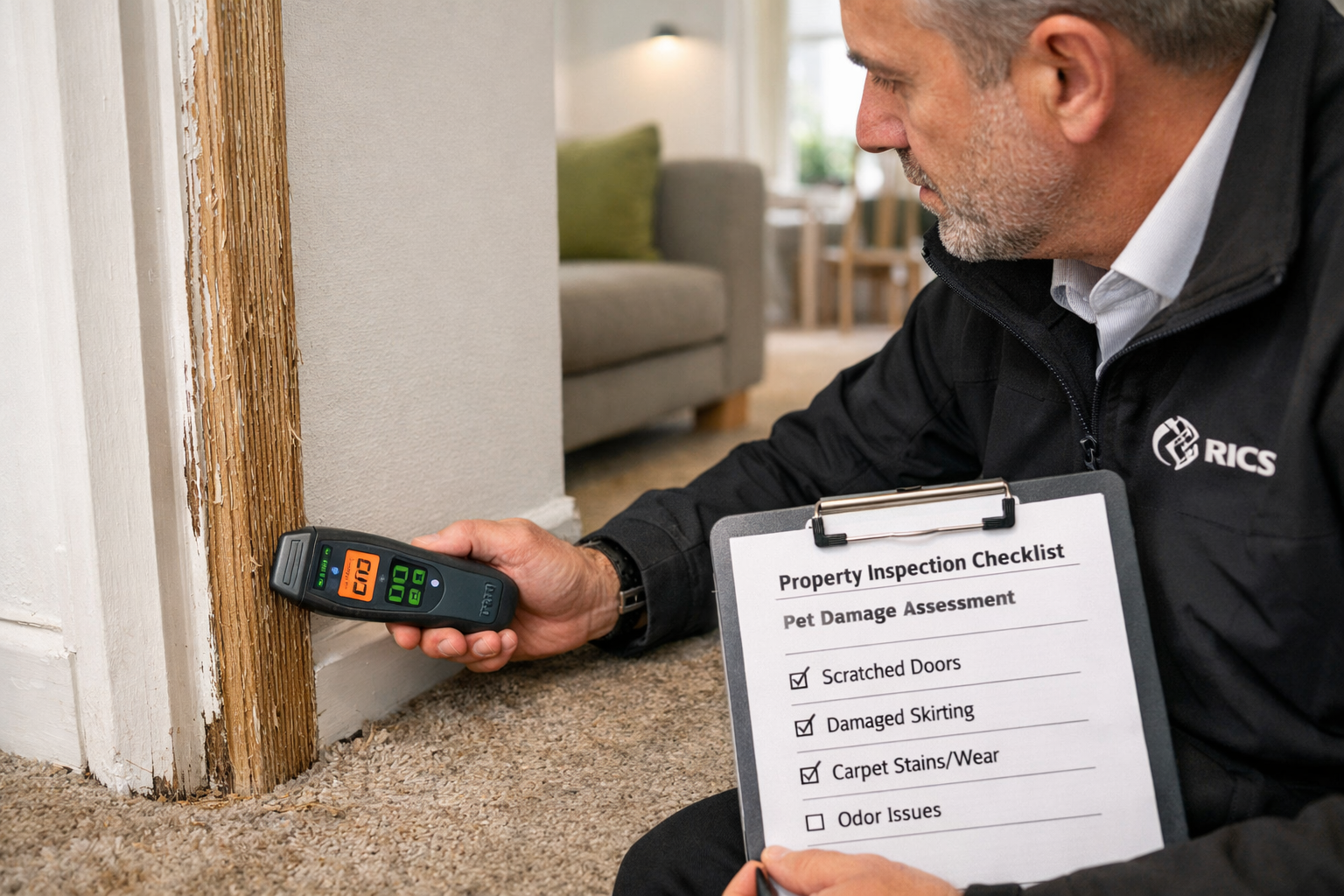
If a property has hosted pets over multiple tenancies without a proper schedule of condition being maintained, accumulated damage — scratched floors, stained carpets, marked walls, damaged door frames — may not be recoverable from deposits. This reduces net yield and, by extension, the investment value of the asset.
3. Reduced Marketability of Restrictive Properties
With pet-friendly listings already scarce (just 5,839 out of 98,964 total listings as of early 2026) [4], properties that can credibly accommodate pets may command stronger demand and lower void periods. Conversely, properties where pet accommodation is structurally impossible may face a narrower tenant pool.
What Valuers Look For
A RICS valuer conducting a buy-to-let assessment post-May 2026 will typically examine:
- Evidence of prior pet damage and whether it has been remediated
- Lease terms and freeholder consent provisions
- The landlord's documented compliance with the 28-day response protocol
- Any outstanding ombudsman complaints or tribunal proceedings
Building Survey Checks: The RICS-Aligned Checklist for Landlord Risk Mitigation

Why Standard Surveys Are No Longer Enough
A basic homebuyer-level report may not capture the granular condition data needed to defend deposit deductions or ombudsman complaints in a post-Section 21 world. The Renters' Rights Act 2026 Pet Rules: Valuation Impacts and Building Survey Checks for Landlord Risk Mitigation demands a more rigorous approach.
A RICS Level 3 Building Survey provides the most comprehensive baseline, covering structural elements, finishes, and fabric condition in detail. For older or more complex properties, a specialist defect survey may be appropriate where specific vulnerabilities — such as timber floors susceptible to pet urine damage — require targeted assessment.
Pre-Tenancy Survey Checklist 🐾
The following checks should be completed before a pet-owning tenant takes occupation:
Flooring and Finishes
- Photograph and record condition of all floor coverings (type, age, wear level)
- Note any existing scratches, stains, or lifting on hard floors
- Record carpet condition room by room with close-up photography
Doors, Skirtings, and Joinery
- Inspect all door bases and frames for existing scratch marks
- Record skirting board condition, noting any gaps or damage
- Check internal glazing for existing chips or cracks
Walls and Plasterwork
- Document wall condition at low level (most vulnerable to pet contact)
- Note any existing staining, scuffing, or impact damage
Damp and Timber
- Conduct moisture readings at floor level in all rooms — pet urine can penetrate subfloors
- Check under-floor void where accessible
- Inspect timber skirtings for existing moisture ingress
For properties with known damp history, a dedicated damp survey should be commissioned before and after any pet tenancy.
Garden and External Areas
- Photograph lawn condition, fencing integrity, and gate latches
- Record condition of any decking, paving, or outbuildings
Roof and Structure
- Confirm no existing structural movement that could be misattributed to pet activity
- For flat roofs or accessible roof areas, consider a roof survey to establish baseline condition
The Schedule of Condition: Your Legal Shield
A formal schedule of dilapidations — prepared by a chartered surveyor before the tenancy begins — creates a legally defensible baseline. Without it, any dispute about pet damage at the end of a tenancy becomes a "he said, she said" argument that landlords frequently lose at the Property Redress Scheme or the Housing Ombudsman.
💬 "A schedule of condition is not an optional extra in 2026 — it is the primary evidence base for any deposit deduction claim involving pet damage."
Ombudsman Dispute Preparation
From May 2026, all private landlords in England must belong to a government-approved redress scheme. Pet-related complaints are expected to spike as tenants test the new rights. Landlords should prepare by:
- Maintaining a paper trail — every pet request, response, and refusal must be documented with dates
- Commissioning mid-tenancy inspection reports — particularly for longer tenancies with pets
- Retaining survey evidence — pre- and post-tenancy survey reports from a RICS-accredited surveyor
- Seeking expert witness support where disputes escalate to tribunal — a RICS expert witness surveyor can provide independent professional opinion on the extent and cause of damage
Comparing Survey Levels for Pet-Risk Properties
| Survey Type | Best For | Pet-Risk Coverage |
|---|---|---|
| RICS Level 2 (Homebuyer) | Newer, standard properties | Basic — limited defect detail |
| RICS Level 3 Building Survey | Older, complex, or high-value properties | Comprehensive — recommended |
| Specialist Defect Survey | Targeted issues (damp, timber, structure) | Highly specific — ideal for post-tenancy disputes |
| Schedule of Condition | Pre-tenancy baseline | Essential — legal evidence standard |
Landlords managing portfolios across multiple locations can access local chartered surveyors to ensure consistent survey standards across all properties.
Practical Steps for Landlords in 2026
At the Application Stage
The Act preserves landlords' right to assess pet suitability before a tenancy begins [1]. Use this window to:
- Request details of the pet (species, breed, size, age)
- Review whether the property layout is genuinely suitable
- Check head lease terms with the freeholder in writing
- Commission a pre-tenancy building survey to establish baseline condition
During the Tenancy
- Conduct periodic inspections (with proper notice) and document findings
- Respond to any new pet requests within the 28-day statutory window
- Keep records of all written communications about pets
At the End of the Tenancy
- Commission a post-tenancy inspection by a RICS surveyor
- Compare findings directly against the pre-tenancy schedule of condition
- Raise any deposit deduction claims through the deposit protection scheme with photographic and survey evidence
Conclusion: Act Now, Document Everything
The Renters' Rights Act 2026 Pet Rules: Valuation Impacts and Building Survey Checks for Landlord Risk Mitigation is not a framework that rewards passive compliance. Landlords who wait for a dispute to arise before gathering evidence will find themselves at a significant disadvantage — both at the ombudsman and in any subsequent tribunal proceedings.
Actionable next steps:
- ✅ Audit your tenancy agreements — remove blanket "no pets" clauses and replace with a compliant pet request process
- ✅ Commission a RICS Level 3 Building Survey on all rental properties before the next tenancy begins
- ✅ Prepare a schedule of condition for every property, updated at each tenancy change
- ✅ Review head lease terms and obtain written freeholder consent positions on pets
- ✅ Register with an approved redress scheme if not already done
- ✅ Consult a RICS-accredited valuer to understand how the new rules affect your portfolio's investment value
The landlords who treat survey evidence as a strategic asset — not an administrative cost — will be best positioned to navigate the new regulatory landscape while protecting the long-term value of their properties.
References
[1] Renting To Pet Owners What Changes In 2026 Under The Renters Rights Act – https://www.parkersproperties.co.uk/guides/landlord/renting-to-pet-owners-what-changes-in-2026-under-the-renters-rights-act/
[2] Renting With Pets – https://blog.goodlord.co/renting-with-pets
[3] Watch – https://www.youtube.com/watch?v=rVat8TD4IBE
[4] Pet Friendly Rentals Drop Renters Rights Act – https://propertyportfolioinvestor.co.uk/news/pet-friendly-rentals-drop-renters-rights-act/
[5] Pets Families And Fairness The Renters Rights Act – https://www.johndwood.co.uk/journal/pets-families-and-fairness-the-renters-rights-act
[6] How The Renters Right Act Impacts You – https://www.guildofstudents.com/news/article/website/How-the-Renters-Right-Act-Impacts-You/