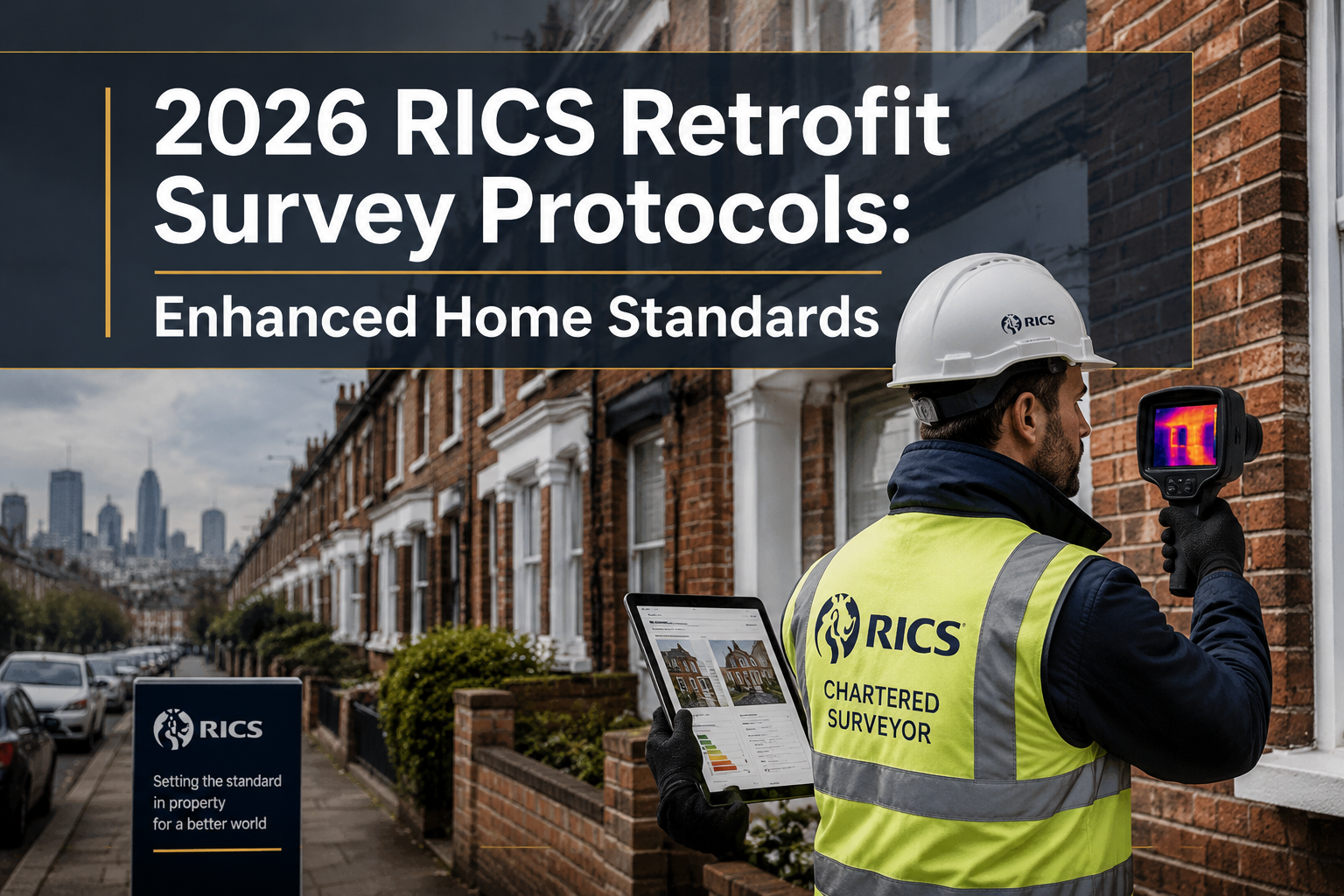

Nearly 40% of all UK homes were built between 1960 and 1985 — a generation of housing now entering its most expensive maintenance phase, just as the property market stalls. With RICS reporting a net buyer enquiry balance of -39% in its March 2026 Residential Survey, buyers have more negotiating power than at any point in recent memory [4]. Yet many are walking into purchases of mid-century homes without understanding the hidden defects that could cost tens of thousands of pounds to fix.
Level 3 Surveys for 1960s-1980s Housing Defects: 2026 RICS Updates Amid Slow House Price Growth sit at the intersection of two urgent realities: a slowing market that rewards informed buyers, and an ageing housing stock riddled with era-specific pathologies that only a comprehensive survey can expose.
Key Takeaways 📋
- 1960s-1980s homes carry unique, costly defects — including concrete cancer, asbestos-containing materials, and flat roof failures — that a Level 2 survey will not fully investigate.
- A Level 3 Building Survey is the gold standard for this era of property, producing detailed 20-30+ page reports covering structure, damp, drainage, and more [2].
- The 2026 RICS Home Survey Standard (2nd edition) is under active consultation, with updates expected to sharpen defect reporting protocols for older housing stock [4].
- Slow house price growth in 2026 creates leverage: survey findings can now support meaningful price renegotiations or seller-funded remediation.
- Northern resilience markets — Leeds, Manchester, Sheffield — offer relative value, but buyers still need a robust pre-purchase checklist tailored to mid-century stock.
Why 1960s-1980s Housing Stock Demands a Level 3 Survey
The Era's Construction Legacy
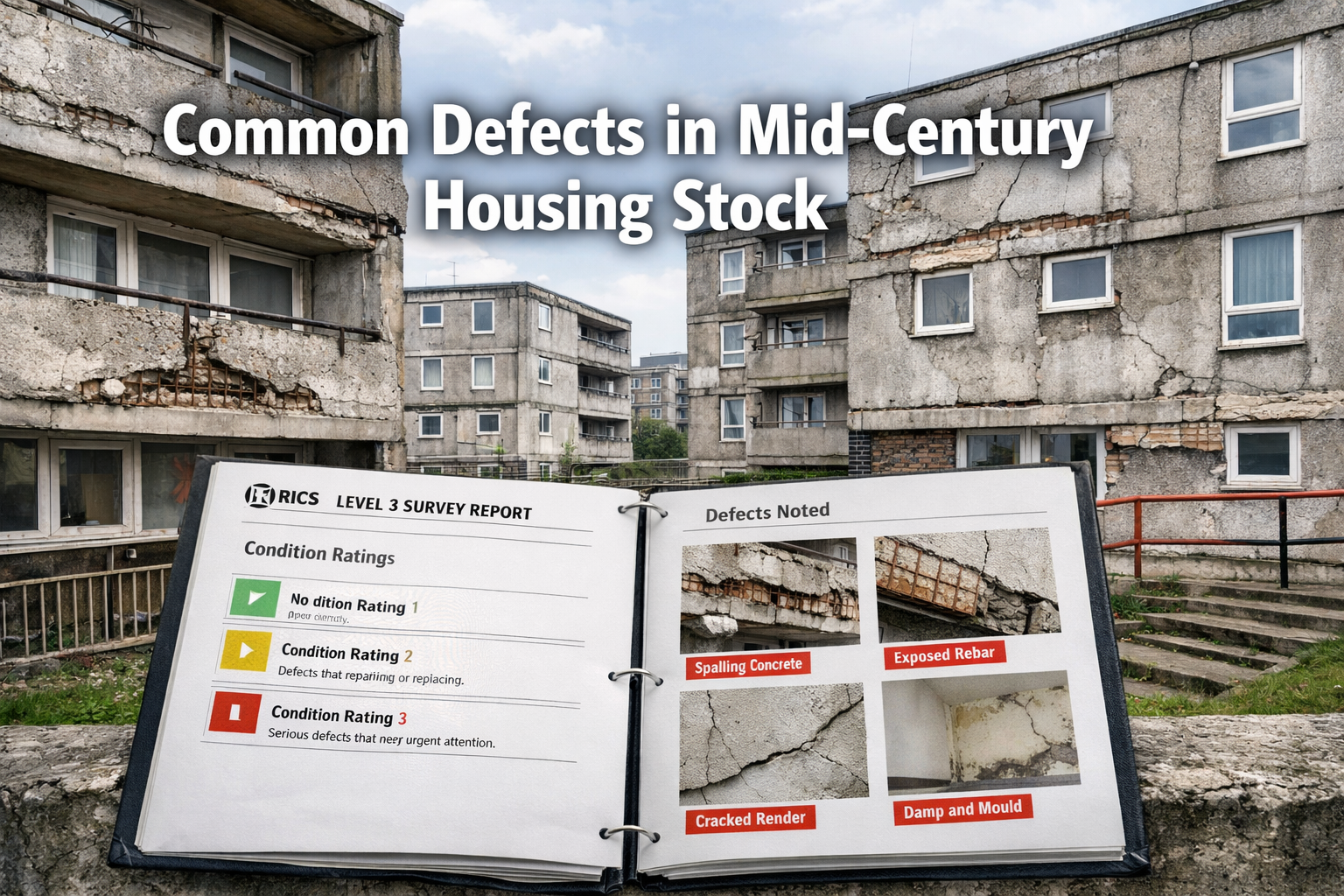
Post-war optimism drove a building boom across the UK from the late 1950s through the 1980s. Speed and cost were prioritised over longevity. The result is a generation of homes constructed with materials and methods that are now well past their design life — and in many cases, actively hazardous.
💬 "Properties from this era are among the most complex to assess. The combination of non-traditional construction, legacy materials, and decades of ad-hoc repairs creates a layered risk profile that demands the most thorough level of investigation available." — Notting Hill Surveyors [3]
A RICS Level 3 Building Survey is the only residential survey format that provides the depth of investigation this housing stock requires. Unlike a Level 2 Homebuyer Report, which is designed for properties in reasonable condition, a Level 3 survey delivers a forensic assessment of every accessible element of the building [1].
Common Defects Found in Mid-Century Homes
The following defects are disproportionately common in properties built between 1960 and 1985:
| Defect | Era Prevalence | Potential Cost |
|---|---|---|
| Concrete cancer (carbonation/rebar corrosion) | High in system-built & concrete panel homes | £5,000–£50,000+ |
| Asbestos-containing materials (ACMs) | Very high (pre-1985 builds) | £1,000–£20,000+ |
| Flat roof failure | High (bitumen/felt roofs) | £3,000–£15,000 |
| Aluminium wiring | Moderate (1960s-70s) | £3,000–£8,000 |
| Single-skin or cavity wall issues | High | £2,000–£10,000 |
| Poorly installed cavity wall insulation | High (1970s-80s retrofits) | £1,500–£6,000 |
| Subsidence/heave | Moderate–High | £10,000–£50,000+ |
| Failed drainage systems | High | £2,000–£15,000 |
Sources: [2][3]
Concrete Cancer: The Silent Structural Threat 🏗️
Concrete cancer — technically known as alkali-silica reaction (ASR) or reinforcement corrosion — is particularly prevalent in large-panel system (LPS) builds and concrete-framed properties from the 1960s and 1970s. As concrete carbonates over decades, the protective alkaline environment around steel reinforcement bars breaks down. The rebar corrodes, expands, and causes the concrete to crack and spall.
A Level 3 survey will document visible cracking patterns, spalling, and staining that indicate this process is underway. For suspected concrete cancer, surveyors will recommend specialist structural investigation — a step that a Level 2 report would not typically trigger [3].
For properties where structural concerns are significant, a residential structural engineering assessment may be recommended alongside the building survey.
Asbestos: Still Present, Still Dangerous ⚠️
Asbestos use in UK construction was not fully banned until 1999, meaning any property built or significantly renovated before that date may contain asbestos-containing materials. However, the 1960s-1980s era represents peak risk, with ACMs commonly found in:
- Artex ceilings (textured coatings)
- Roof tiles and soffits
- Floor tiles and adhesives
- Pipe lagging and boiler insulation
- Garage and outbuilding roofing (corrugated sheets)
A Level 3 survey will flag suspected ACMs and recommend specialist asbestos surveys to confirm presence and condition. This is not a minor concern: disturbed asbestos during renovation work is a serious health hazard and a significant legal liability for property owners.
2026 RICS Updates: What Buyers Need to Know
The Home Survey Standard 2nd Edition
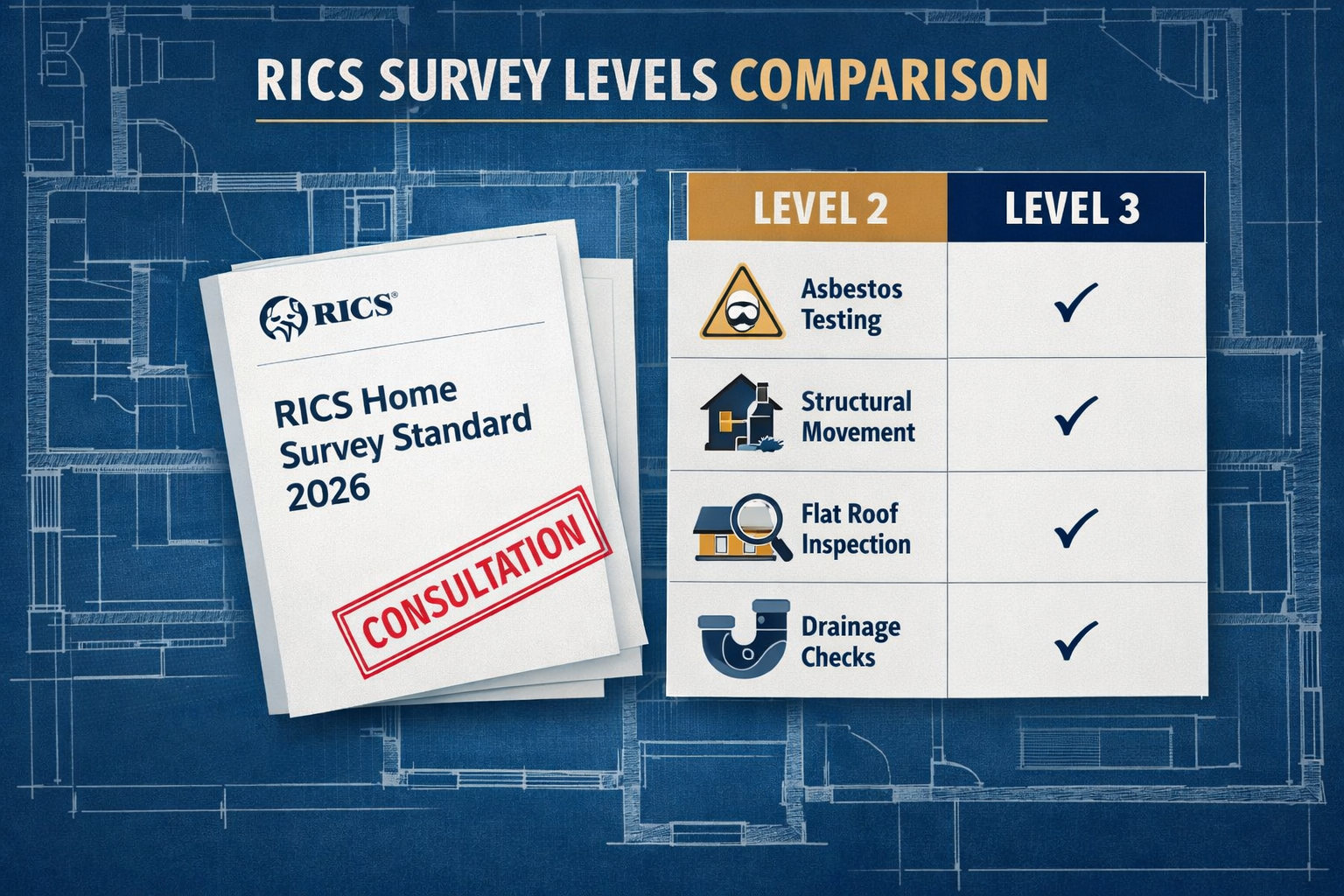
RICS is currently working through consultation responses for the Home Survey Standard 2nd edition, with the April 2026 update confirming that the process is ongoing [4]. While the specific updates relating to 1960s-1980s defect protocols have not been publicly disclosed at this stage, the direction of travel is clear: greater standardisation, clearer condition ratings, and more explicit guidance for surveyors dealing with non-traditional construction.
The current RICS Home Survey Standard already requires Level 3 surveyors to:
- ✅ Inspect and report on all accessible parts of the property
- ✅ Identify defects and their cause where possible
- ✅ Provide an opinion on the urgency of repairs
- ✅ Advise on further specialist investigations needed
- ✅ Comment on legal and planning matters that may affect the property [1]
The 2nd edition is expected to sharpen these requirements further, particularly around the documentation of non-traditional construction types — a category that includes many 1960s-1980s system-built homes.
Market Conditions in 2026: Why Surveys Matter More Than Ever
The RICS March 2026 Residential Survey data paints a clear picture: buyer enquiries have fallen sharply, with a net balance of -39%, as rising borrowing costs and geopolitical uncertainty weigh on confidence [4]. In practical terms, this means:
- Sellers are more willing to negotiate on price or agree to remediation works
- Survey findings carry more weight in renegotiation conversations
- Buyers who skip surveys are taking on greater risk in a market where prices are not rising to bail out poor decisions
💬 "In a rising market, buyers sometimes gamble on surveys. In a flat or falling market, that gamble becomes far more dangerous. A defect that costs £20,000 to fix cannot be recovered through price appreciation if prices are standing still."
Understanding how to choose the right property survey is therefore more important in 2026 than it has been for years. For any 1960s-1980s property, the answer is almost always a Level 3 Building Survey.
Valuation Adjustments in a Slow Market
Level 3 Surveys for 1960s-1980s Housing Defects: 2026 RICS Updates Amid Slow House Price Growth are not just about identifying problems — they are about quantifying them in a market context.
When a survey reveals significant defects, buyers have three options:
- Renegotiate the purchase price to reflect the cost of remediation
- Request the seller carries out repairs before exchange
- Walk away from the transaction
In the current slow market, option 1 is increasingly viable. A Level 3 report provides the documented evidence needed to support a price reduction request. For example:
- Cavity wall insulation failure (£4,000 to remedy) → supports a £4,000–£6,000 price reduction request
- Suspected asbestos requiring specialist removal (£8,000 estimate) → supports a £8,000–£12,000 price reduction request
For a formal valuation that accounts for identified defects, a professional property valuation can provide the independent evidence needed to support renegotiation.
Buyer Checklist: Level 3 Surveys for 1960s-1980s Properties in Northern Resilience Markets
Why Northern Markets Warrant Special Attention
Cities like Leeds, Manchester, Sheffield, and Newcastle have shown relative resilience in the 2025-2026 slowdown, driven by strong rental demand, ongoing regeneration investment, and lower average prices compared to the South East. However, these markets also contain large concentrations of 1960s-1980s housing stock — including significant numbers of system-built council properties that were subsequently sold under Right to Buy.
Buyers in these markets face a specific challenge: properties that appear affordable on the surface may carry substantial remediation costs that erode that affordability advantage.
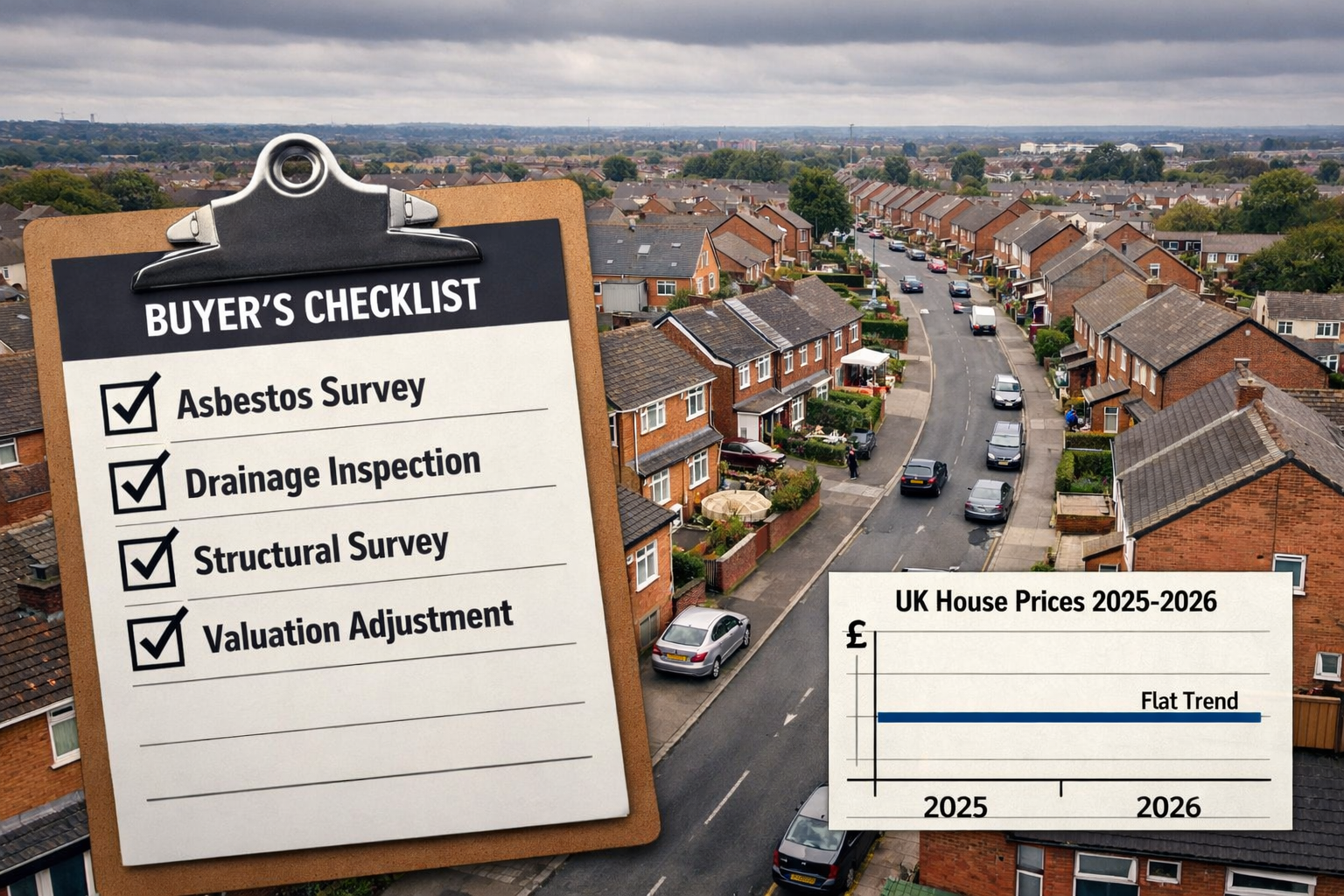
Pre-Purchase Checklist for 1960s-1980s Homes 📝
Use this checklist when considering a property from this era:
🔍 Before Instructing a Survey
- Confirm the construction type (brick, concrete panel, timber frame, steel frame)
- Check planning history for extensions, conversions, and structural alterations
- Review EPC rating — poor ratings often indicate insulation or heating system issues
- Ask the seller directly about known defects or previous insurance claims
🏗️ During the Survey Process
- Instruct a RICS Level 3 Building Survey — not a Level 2 Homebuyer Report
- Request that the surveyor specifically comments on asbestos risk
- Ask for commentary on the roof structure, flat roof areas, and drainage
- Ensure the survey includes the loft space, basement (if applicable), and outbuildings
- Consider a drainage survey as an add-on — drainage failures are common in this era
📋 After Receiving the Survey Report
- Obtain specialist quotes for any Category 3 (urgent) defects before exchange
- Instruct an asbestos survey if ACMs are flagged
- Use the report to support price renegotiation with documented cost estimates
- Consider a structural survey if concrete cancer or subsidence is suspected
- Review the survey findings against the asking price and local comparables
What a Level 3 Report Actually Contains
A comprehensive Level 3 Building Survey report typically runs to 20-30+ pages and covers [2]:
- Structural movement: subsidence, heave, settlement, cracking patterns
- Roof structures: internal and external, coverings, gutters, flashings
- Walls, floors, and ceilings: construction type, condition, defects
- Damp, timber, and decay: penetrating damp, rising damp, rot, woodworm
- Services: plumbing, electrics, heating (visual inspection only)
- Drainage: visible inspection, with specialist survey recommended where concerns exist
- Loft and basement: where accessible
- Legal and planning matters: building regulations compliance, planning history
The RICS official description of the Level 3 survey confirms that the report must provide "a description of the condition of each element, an assessment of the relative importance of the defects and problems found, and advice about the repairs and any further specialist investigations required" [1].
Buyers who want to understand the time commitment involved should also review how long a homebuyers survey takes, as a Level 3 inspection of a large or complex property can take a full day on site.
Comparing Survey Levels: Making the Right Choice
For any property built between 1960 and 1985, the choice between survey levels should be straightforward:
| Survey Level | Suitable For | 1960s-1980s Homes? |
|---|---|---|
| Level 1 (Condition Report) | New builds, conventional properties in good condition | ❌ Not recommended |
| Level 2 (Homebuyer Report) | Conventional properties in reasonable condition | ⚠️ Rarely appropriate |
| Level 3 (Building Survey) | Older, non-standard, or complex properties | ✅ Strongly recommended |
Those unsure about which level is appropriate can explore a comparison of different types of property survey to make a fully informed decision before instructing a surveyor.
Conclusion: Act on Information, Not Assumptions
Level 3 Surveys for 1960s-1980s Housing Defects: 2026 RICS Updates Amid Slow House Price Growth represent a convergence of opportunity and risk that every buyer of mid-century property needs to understand. The market is slow, prices are under pressure, and the housing stock is ageing — but buyers who invest in thorough due diligence are best positioned to negotiate effectively and avoid costly surprises.
Actionable Next Steps
- Confirm the build date and construction type of any 1960s-1980s property before proceeding.
- Always instruct a Level 3 Building Survey — not a Level 2 report — for this era of housing.
- Add specialist surveys (asbestos, drainage, structural) where the Level 3 report flags concerns.
- Use survey findings to renegotiate — the slow 2026 market supports this approach.
- Monitor RICS updates to the Home Survey Standard 2nd edition as consultation concludes.
- In Northern resilience markets, apply the buyer checklist above rigorously — apparent affordability can be eroded quickly by unidentified defects.
A Level 3 survey is not a cost — it is an investment in certainty. In a market where prices are not rising fast enough to absorb expensive mistakes, certainty is the most valuable thing a buyer can purchase.
References
[1] Description Of The RICS Home Survey Level 3 – https://www.rics.org/content/dam/ricsglobal/documents/standards/description_of_the_rics_home_survey_level_3.pdf
[2] What Does A Level 3 Survey Include 2025 – https://surveymatch.co.uk/what-does-a-level-3-survey-include-2025/
[3] Building Survey Defects In 1960s-1980s Housing Stock: Identifying Hidden Issues Before Purchase – https://nottinghillsurveyors.com/blog/building-survey-defects-in-1960s-1980s-housing-stock-identifying-hidden-issues-before-purchase
[4] Home Survey Standard 2nd Edition April 2026 Update – https://www.rics.org/news-insights/home-survey-standard-2nd-edition-april-2026-update
[6] RICS Level 3 Survey – https://www.heritage-survey.org/rics-level-3-survey-1
[7] Decoding The Level 3 RICS Home Survey: A Buyer's Perspective – https://surveyingpeople.com/decoding-the-level-3-rics-home-survey-a-buyers-perspective/